oil Seat Mii 2012 Owner's Guide
[x] Cancel search | Manufacturer: SEAT, Model Year: 2012, Model line: Mii, Model: Seat Mii 2012Pages: 308, PDF Size: 4.13 MB
Page 200 of 308

198Vehicle care and maintenance
For the sake of the environment
The remains of vehicle care products should not be disposed of with ordina-
ry household waste. Observe information provided by the manufacturer.
Washing the vehicle
The longer substances such as insects, bird droppings, resinous tree sap,
road dirt, industrial deposits, tar, soot or road salt and other aggressive ma-
terials remain on the vehicle, the more damage they do to the paintwork.
High temperatures (for instance due to strong sunlight) further intensify the
corrosive effect. The vehicle undercarriage should also be thoroughly wash-
ed at regular intervals.
Automatic car washes
Always observe the instructions provided at the automatic car wash. The
standard precautionary measures prior to entering the car wash should be
taken to avoid damage to the vehicle (close all windows, fold in exterior mir-
rors). If the vehicle is fitted with additional components (spoiler, roof-rack,
aerial...), check with the car wash supervisor whether these can enter the
car wash ⇒
.
The vehicle paintwork is so durable that the vehicle can normally be washed
without problems in an automatic car washing tunnel. However, wear and
damage to the paintwork will depend on the type of car wash used. SEAT
recommends the use of car washes without brushes.
To remove traces of wax on windows and to prevent wiper blades from
scratching, please observe the following ⇒ page 200, Cleaning windows
and exterior mirrors.
Washing the vehicle by hand
When washing the vehicle by hand, use plenty of water to soften the dirt
first, and rinse off as well as possible. Then clean the vehicle with a soft
sponge, glove or brush using only slight
pressure. Start at the roof and work downwards. Special vehicle shampoo
should only be used for very persistent dirt.
Rinse the sponge or glove thoroughly and often.
Wheels, sills and similar should be cleaned last. Use a second sponge for
this.
WARNING
Sharp components on the vehicle may cause injury.
● Protect arms and hands from sharp edges when cleaning the vehicle
undercarriage or the interior of the wheel hubs.
WARNING
After the vehicle has been washed, the braking effect will be reduced
(and the braking distance increased) due to moisture (and ice in winter)
on the brakes.
● “Dry the brakes and remove ice” by braking carefully. Ensure that you
are not endangering other road-users or breaking traffic regulations in
the process.
CAUTION
● The temperature of the water must not exceed +60 °C (+140 °F).
● To avoid damage to the paintwork, do not wash the vehicle in full sun.
● Do not use rough sponges or similar which could damage the surface to
clean away the traces of insects.
● Never wipe the headlights with a dry cloth or sponge, always moisten
first. It is best to use soapy water.
● Washing the vehicle in low temperatures: When washing the vehicle
with a hose, do not direct water into the lock cylinders or the gaps around
the doors, rear lid, or sunroof. Locks and seals could freeze!
Page 202 of 308

200Vehicle care and maintenance
Cleaning windows and exterior mirrors
Cleaning windows and exterior mirrors
Spray windows and exterior windows with a standard window cleaner con-
taining alcohol.
Dry the windows with a clean chamois leather or a lint-free cloth. The cha-
mois leathers used on painted surfaces are not suitable for cleaning win-
dows because they are soiled with wax deposits which could smear the win-
dows.
Use window cleaner or a silicone remover to clean rubber, oil, grease and
silicone deposits off ⇒
.
Removing wax deposits
Automatic car washes and certain vehicle care products may leave wax de-
posits on the windows. These deposits can only be removed with a special
product or cleaning cloths. If wax deposits are left on the windscreen and
the rear window, the blades can scratch the glass. SEAT recommends you
wipe the wax deposits off the windscreen and the rear window with a soft
cloth each time after you have washed the vehicle.
A window cleaning detergent which helps to dissolve the wax may be added
to the windscreen washer fluid to prevent the wiper blades from scratching
the windscreen. Please ensure the you add the cleaning product in the cor-
rect proportions. Products for removing grease do not eliminate the wax de-
posits ⇒
.
Special cleaning products or window cloths are available at any Technical
Service. To remove wax deposits, SEAT recommends the following products: ●
For the hottest time of the year: the window cleaner for summer
use G 052 184 A1. Proportion 1:100 (1 part detergent, 100 parts water) in
the windscreen washer bottle.
● All year round: the window cleaner G 052 164 A2; proportion 1:2 in
windscreen washer bottle (1 part concentrate, 2 parts water) in winter, up to
-18 °C (-0.4 °F), or 1:4, during the rest of the year.
● Window cloths G 052 522 A1 for all windows and exterior mirrors.
Removing snow
Use a small brush to remove snow from the windows and exterior mirrors.
Removing ice
If possible, use a de-icing spray to remove ice. If you use an ice scraper,
push it in one direction only without swinging it. If you pull the scraper
backwards, the dirt may scratch the window.
WARNING
Dirty or misted windows reduce visibility in all directions and increase
the risk of accident and serious injury.
● Do not drive unless you have good visibility through all windows!
● Remove ice and snow from the windows and demist inside and out.
CAUTION
● Never mix our cleaning products with other products not recommended
by SEAT in the windscreen washer bottle. This could lead to flocculation and
may block the windscreen washer jets.
● Do not use hot or warm water to remove ice or snow from the windows
and exterior mirrors. The glass could crack!
● The heating element for the rear window is located on the inner side of
the window. Do not stick adhesive labels over the heating elements and
never clean the inside of the rear window with corrosive or acid products or
other similar chemical cleaning products.
Page 206 of 308

204Vehicle care and maintenance
WARNING
Additional underseal or anti-corrosion products could catch fire due to
the high temperatures reached by the exhaust gas system and other en-
gine components.
● Do not apply additional underseal or anti-corrosion products to the
exhaust pipes, catalytic converters, heat shields or other parts of the ve-
hicle which reach high temperatures.
Cleaning the engine compartment
The engine compartment of any motor vehicle is a potentially hazardous
area ⇒ page 180. The engine compartment should only be cleaned by qualified personnel. If
it is not correctly cleaned, the anti-corrosion coating and consequently elec-
trical components may be damaged. Moreover, water may filter directly into
the vehicle interior through the water chamber ⇒
.
If the engine compartment is very dirty, always take the vehicle to a Special-
ised workshop for professional cleaning. SEAT recommends visiting a Tech-
nical Service.
Water box
The water box is in the engine compartment, between the windscreen and
the engine, and beneath a perforated cover. Air is taken in through the wa-
ter box from outside to the vehicle interior via the heating and air condition-
ing system.
Leaves and other loose objects should be regularly cleaned away from the
water box either by hand or with a vacuum.
WARNING
When working on the engine or in the engine compartment, there is a
risk of injury, burns, accident or fire.
● Before starting work, please ensure you are familiar with the required
procedure and the safety precautions ⇒ page 180.
● SEAT recommends you have this work performed by a specialised
workshop.
CAUTION
If water is manually poured into the water box (for example, using a high
pressure cleaning appliance), this could cause significant damage to the ve-
hicle.
For the sake of the environment
Only wash the engine compartment in areas allocated for this purpose, to
prevent dirty water which may be contaminated by oil, grease or fuel, from
entering the drains. In some districts, the engine compartment may not be
washed outside the wash bays provided for this purpose.
Page 207 of 308

205
Vehicle care and maintenance
Caring for and cleaning the vehicle interior
Introduction
The dye from many items of modern clothing (e.g. dark jeans) is not always
solid enough. Seat upholstery (material and leather), especially when light-
coloured, may visibly discolour if the dye comes out of clothing (even when
used correctly). This is not an upholstery defect but indicates that the dye in
the item of clothing is not solid enough.
Additional information and warnings:
● Caring for and cleaning the vehicle exterior ⇒ page 197
● Accessories, parts replacement, repairs and modifications ⇒ page 222
WARNING
Vehicle care products may be toxic and hazardous. If vehicle care prod-
ucts are not suitable or are used inappropriately, this could result in acci-
dent, serious injury, burns or intoxication.
● Vehicle care products must always be stored in the original container
which should be kept closed.
● Observe information provided by the manufacturer.
● To prevent confusion, never store vehicle care products in empty food
cans, bottles or other containers.
● Keep all care products out of reach of children.
● Harmful vapours may be produced when using vehicle care products.
Therefore, care products should only be used in well-ventilated spaces or
in the open air.
● Never use fuel, turpentine, engine oil, acetone or any other volatile
liquid to wash, clean or care for the vehicle. These are toxic and highly
flammable.
WARNING
Inappropriate care and cleaning of vehicle components may effect the ve-
hicle safety equipment, increasing the risk of severe injury.
● Vehicle components should only be cleaned and maintained in ac-
cordance with the manufacturer's instructions.
● Only use approved or recommended care products.
CAUTION
● Cleaning products which contain solvents will damage the material.
● To avoid damage, stubborn stains should be removed by a specialised
workshop.
Note
Suitable vehicle care products are available from your Technical Service.
Vehicle diagramPrior to a journey...While drivingCare, cleaning and mainte-
nanceIf and whenTechnical Data
Page 209 of 308
207
Vehicle care and maintenance
Type of stainCleaning the vehicleWater-based stains ,
e.g. coffee or fruit
juice.– Use a sponge and wipe with a solution of water
and wool wash.
– Dry with a dry, absorbent cloth.
Persistent stains ,
e.g. chocolate or
make-up.– Apply a washing paste a)
directly to the stain and
allow it to work.
– Apply clean water using a sponge or damp cloth to
remove the cleaning product deposits.
– Dry with a dry absorbent cloth.
Grease-based
stains, e.g. oil or lip-
stick.– Apply neutral soap or cleaning paste a)
and allow it
to work.
– Remove dissolved grease or colour particles with
an absorbent cloth.
– Then apply clean water. Take care not to soak the
upholstery.
a) Bile soap can be used as a cleaning paste.
CAUTION
Brushes should only be used to clean the mats and floor mat! Other surfa-
ces may be damaged if a brush is used.
CAUTION
Do not use steam cleaning equipment, as the dirt becomes more encrusted
in the material when steam is applied.
CAUTION
Never use brushes for cleaning damp material as they could damage the
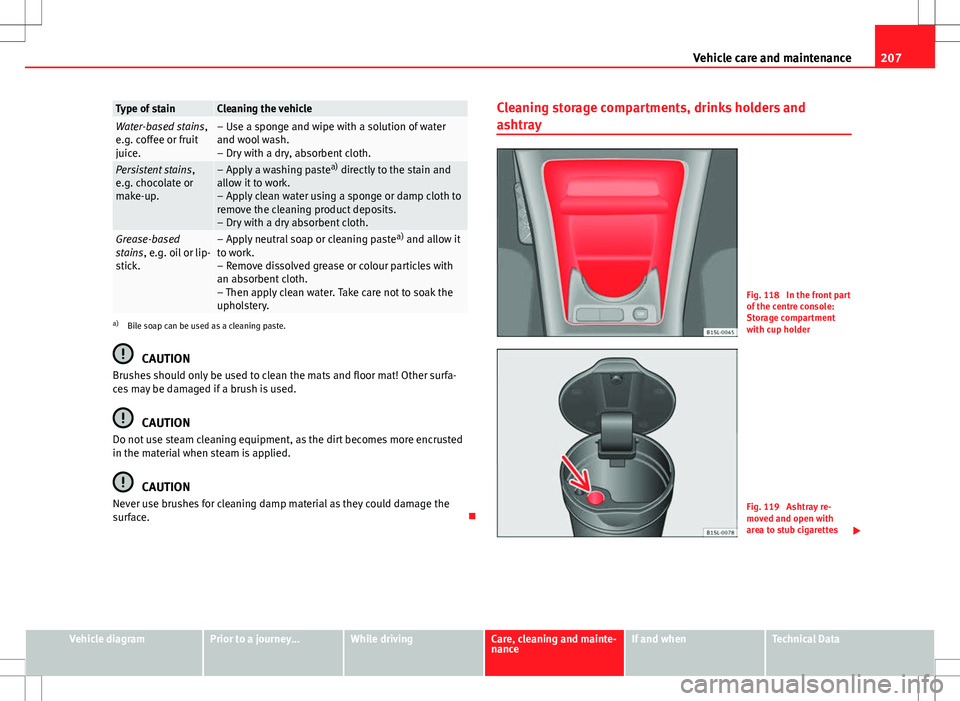
surface. Cleaning storage compartments, drinks holders and
ashtray
Fig. 118 In the front part
of the centre console:
Storage compartment
with cup holder
Fig. 119 Ashtray re-
moved and open with
area to stub cigarettes
Vehicle diagramPrior to a journey...While drivingCare, cleaning and mainte-
nanceIf and whenTechnical Data
Page 213 of 308

211
Vehicle care and maintenance
About your tyres and wheels
Fig. 120 Diagram for
changing wheels
The tyres of a vehicle are the components which are subjected to most
stress and are the most underestimated. Tyres are very important, as the
support offered by their narrow surface is the only point of contact between
the vehicle and the road.
The service life of tyres is dependent on tyre pressure, driving style, the care
they receive and the correct fitting.
The tyres and wheel rims are an essential part of the vehicle's design. The
tyres and rims approved by SEAT are specially matched to the characteris-
tics of the vehicle and our critical to good road holding and safe handling.
Avoiding damage to tyres and wheels
● If you have to drive over a kerb or similar obstacle, drive very slowly and
as near as possible at a right angle to the kerb.
● Inspect the tyres regularly for damage (punctures, cuts, cracks, dents).
● Remove any foreign bodies found on the outside of the tread provided
they have not passed through the wall of the tyre
⇒ page 216.
● The instructions for tyre control systems should always be observed. ●
Replace damaged or worn tyres as soon as possible ⇒ page 216.
● Regularly check tyres for non-visible damage ⇒ page 216.
● Never exceed the maximum permitted speed or loads specified for the
type of tyre fitted on your vehicle ⇒ page 218.
● Do not allow tyres (including the spare wheel) to come into contact with
aggressive substances, grease, oil, fuel or brake fluid ⇒
.
● Lost valve caps should be replaced immediately.
Tyres with directional tread pattern
Tyres with directional tread pattern have been designed to operate best
when rotating in only one direction. An arrow on the tyre sidewall indicates
the direction of rotation on tyres with directional tread ⇒ page 218. Always
observe the direction of rotation indicated when mounting the wheel. This
guarantees optimum grip and helps to avoid aquaplaning, excessive noise
and wear.
If the tyre is mounted in the opposite direction of rotation, drive with ex-
treme caution, as the tyre is no longer being used correctly. This is of partic-
ular importance when the road surface is wet. Change the tyre as soon as
possible or remount it with the correct direction of rotation.
Interchanging tyres
To ensure that the wear is equal on all tyres the wheels should be changed
round from time to time according to the system ⇒ Fig. 120. All the tyres will
then last for about the same time.
SEAT recommends you take the vehicle to a Specialised workshop to have
the tyres changed.
Tyres that are over 6 years old
Tyres are subject to an ageing process as a result of physical and chemical
processes. This may affect their performance. Tyres which are stored for
long periods of time without being used, harden and become more fragile
than tyres which are in constant use.
SEAT recommends that tyres over six years old are replaced with new tyres.
This also applies to tyres (including the spare wheel) which appear to be in
Vehicle diagramPrior to a journey...While drivingCare, cleaning and mainte-
nanceIf and whenTechnical Data
Page 214 of 308

212Vehicle care and maintenance
perfect condition on the outside and which have a tread depth within the
values stipulated by the Law ⇒
.
The date of manufacture, part of the tyre identification number (TIN), indi-
cates the age of the tyre ( ) ⇒ page 218.
Storing tyres
Mark tyres when you remove them to indicate the direction of rotation (left,
right, forwards, backwards). This ensures you will be able to mount them
correctly when you replace them. When removed, the wheels and/or tyres
should be stored in a cool, dry and preferably dark location. Do not place
tyres mounted on the wheel in a vertical position.
Protect tyres not mounted on wheels from dirt by storing them in suitable
bags and standing them on the ground on their tread.
WARNING
Aggressive fluids or substances could result in visible or invisible dam-
age with the consequent risks.
● Always ensure that tyres do not come into contact with chemical
products, oil, grease, fuel, brake fluid or other aggressive substances.
WARNING
Old tyres, even if they have never been used, may lose air or burst unex-
pectedly while driving, resulting in serious accident or damage.
● If tyres are over six years old, they should only be used in an emer-
gency and with extreme caution.
For the sake of the environment
Old tyres must be disposed of by qualified personnel according to the laws
in the country concerned. Wheel rims
The design of wheel bolts is matched to the rims. If different rims are fitted,
the correct wheel bolts with the right length and correctly shaped bolt
heads must be used. This ensures that wheels are fitted securely and that
the brake system functions correctly
⇒ page 250.
For technical reasons, it is not generally possible to use the wheels from
other vehicles. In some cases, this may also be true for the same model of
wheel.
The tyres and rims approved by SEAT are specially matched to the character-
istics of the vehicle and are critical to good road holding and safe handling.
Wheel bolts
Wheel bolts must be tightened to the correct torque ⇒ page 250.
Beadlock wheel rims
Beadlock wheel rims have various components. These are joined together
by special bolts using a special procedure. This ensures good performance,
a better seal, improved safety and wheel run out. Therefore, worn rims
should always be replaced and must only be repaired in a Specialised work-
shop. SEAT recommends visiting a Technical Service ⇒
.
Wheel trims with bolted trims
Wheel trims may be fitted with interchangeable trim parts which are attach-
ed to the rim using self-locking bolts. Worn trims should only be replaced at
a Specialised workshop. SEAT recommends visiting a Technical Service
⇒
.
Page 224 of 308

222Vehicle care and maintenance
Accessories, replacements, repairs and
modifications
Introduction
Additional information and warnings:
● Seat belts ⇒ page 57
● Airbag system ⇒ page 67
● Roof carrier ⇒ page 104
● Ashtray and cigarette lighter ⇒ page 115
● Power socket ⇒ page 117
● Braking, stopping and parking ⇒ page 134
● Parking distance warning system ⇒ page 149
● Cruise control system (CCS) ⇒ page 152
● Working in the engine compartment ⇒ page 180
● Engine oil ⇒ page 185
● Engine coolant ⇒ page 189
● Vehicle battery ⇒ page 193
● Caring for and cleaning the vehicle exterior ⇒ page 197
● Care and cleaning of the vehicle interior ⇒ page 205
● Notes for the user ⇒ page 233
● ⇒ Booklet Radio system
● Instruction Manual for the Portable Navigation System (supplied by
SEAT) in the equipment.
WARNING
The use of unsuitable spare parts and accessories, or incorrectly per-
formed modifications or repairs may result in damage to the vehicle, acci-
dents and serious injury.
● SEAT strongly recommends you to only use SEAT approved accesso-
ries and SEAT ®
original spare parts. These parts and accessories have
been specially tested by SEAT for suitability, reliability and safety.
● Have any repairs or modifications carried out at a Specialised work-
shop. Specialised workshops have the necessary tools, diagnostics
equipment, repair information and qualified personnel.
● Only mount parts with the same specifications as the parts fitted at
factory.
● Never mount, fasten or fit objects such as drink holders or telephone
cradles over the covers of the airbag modules or within their deployment
zones.
● Only use wheels and tyre combinations which have been approved by
SEAT for your vehicle type.
Page 225 of 308

223
Vehicle care and maintenance
Running-in
Please observe the instructions for running-in new components.
Running-in the engine
The engine needs to be run in over the first 1500 km (1000 miles). During
its first few hours of running, the internal friction in the engine is greater
than later on when all the moving parts have bedded down.
How the vehicle is driven for the first 1500 km (1000 miles) influences the
future engine performance. Throughout the life of the vehicle, it should be
driven at a moderate speed, especially when the engine is cold, as this will
reduce engine wear and increase its useful life. Never drive at extremely low
engine speeds. Change down to a lower gear when the engine no longer
runs “smoothly”. Up to 1000 kilometres the following instructions apply:
● Do not use full throttle.
● Do not force the engine above two thirds of its maximum speed.
Between 1000 and 1500 kilometres (600 to 1000 miles), gradually in-
crease power until reaching the maximum speed and high engine speeds.
Running in new tyres and brake pads
● Replacement of new tyres and wheel trims ⇒ page 210
● Notes on the brakes ⇒ page 134
For the sake of the environment
If the engine is run in gently, the life of the engine will be increased and the
engine oil consumption reduced.
Accessories and spare parts
SEAT recommends you consult an Official Service before purchasing acces-
sories and spare parts or consumables. For example, when fitting accesso- ries at a later date, or when replacing a component. A SEAT Official Service
will advise you as to the legal requirements and manufacturer's recommen-
dations regarding accessories, spare parts and other components.
SEAT recommend you use only approved
SEAT accessories and genuine
SEAT spare parts ®
. These parts and accessories have been specially tested
by SEAT for suitability, reliability and safety. In addition the SEAT Technical
Service will guarantee that the assembly is carried out professionally.
Although we continually monitor the market, SEAT cannot guarantee that
products not approved by SEAT are reliable, safe and suitable for the vehi-
cle. Therefore, SEAT cannot accept liability, even in those cases authorised
by an officially recognised technical inspection office or other official body.
Any retro-fitted equipment which has a direct effect on vehicle control must
be approved by SEAT for use in your vehicle and bear the e mark (the Euro-
pean Union's authorisation symbol). This includes cruise control systems or
electronically controlled suspension.
If any additional electrical components are fitted which do not serve to con-
trol the vehicle itself, these must bear the mark (European Union manu-
facturer conformity declaration). This includes refrigerator boxes, laptops or
ventilator fans.
WARNING
Unprofessional repairs or modifications to the vehicle may affect the per-
formance of the airbags, resulting in operating faults or fatal accident.
● Never mount, fasten or fit objects such as drink holders or telephone
cradles over or next to the covers of the airbag modules or within their
deployment zones.
● Objects placed over the airbag covers, or within their deployment
zones, could lead to serious injury or loss of life if the airbags are trig-
gered.
Vehicle diagramPrior to a journey...While drivingCare, cleaning and mainte-
nanceIf and whenTechnical Data
Page 226 of 308

224Vehicle care and maintenance
Fluids and consumables
All vehicle fluids and consumables , such as notched belts, tyres, coolant
fluids, engine oils, spark plugs and batteries are continually being devel-
oped. Therefore all fluids and consumables should be changed at a Special-
ised workshop. Technical Services are permanently informed of any modifi-
cations.
WARNING
The incorrect use or handling of fluids or consumables may result in acci-
dent, serious injury, burns or intoxication.
● Therefore, fluids must always be stored closed in their original con-
tainer.
● Never store fluids in empty food containers or bottles as other people
may accidentally drink the fluid.
● Keep all fluids and consumables out of reach of children.
● Read and observe the information and warnings given on the fluid
containers.
● Only work in the open air or in well-ventilated zones, when using
products which give off harmful vapours.
● Never use fuel, turpentine, engine oil, acetone or any other volatile
liquid in the maintenance of the vehicle. These are toxic and highly flam-
mable. They could lead to fire or explosions!
CAUTION
● Only use appropriate fluids. Never mix the fluids. Using the wrong fluids
could cause serious malfunctions and engine damage!
● Accessories and other components mounted in front of the air inlet re-
duce the cooling effect of the coolant. If the engine is running under great
strain in high outside temperatures, it could overheat.
For the sake of the environment
Leaking fluids could pollute the environment. Collect any spilt fluids in suit-
able containers and dispose of in accordance with legislation and with re-
spect for the environment.
Repairs and technical changes
When performing repairs and technical modifications, SEAT's directives
must be observed! ⇒
Unauthorised modifications to the electronic components or software in the
vehicle may cause malfunctions. Due to the way the electronic components
are linked together in networks, other indirect systems may be affected by
the faults. This may significantly affect the vehicle's performance, increase
component wear and could mean that the vehicle registration documents
are no longer valid.
Your SEAT Official Service cannot be held liable for any damage caused by
technical modifications or repairs performed incorrectly.
The SEAT Official Service does not accept liability for damage resulting from
technical modifications or repairs performed incorrectly; neither is the SEAT
warranty valid in these cases.
SEAT recommends you have any technical modifications or repairs per-
formed at a SEAT Official Service and that you use genuine SEAT spare
parts ®
.
Vehicles with special accessories and equipment
The manufacturers of additional equipment guarantee that the equipment
complies with applicable laws and regulations with respect to the environ-
ment, in particular Directives 2000/53/CE and 2003/11/CE. The first direc-
tive governs the disposal of end-of-life vehicles while the second refers to
the restrictions on the marketing and use of certain dangerous substances
and preparations.