warning light Seat Mii 2012 Repair Manual
[x] Cancel search | Manufacturer: SEAT, Model Year: 2012, Model line: Mii, Model: Seat Mii 2012Pages: 308, PDF Size: 4.13 MB
Page 197 of 308
195
In the engine compartment
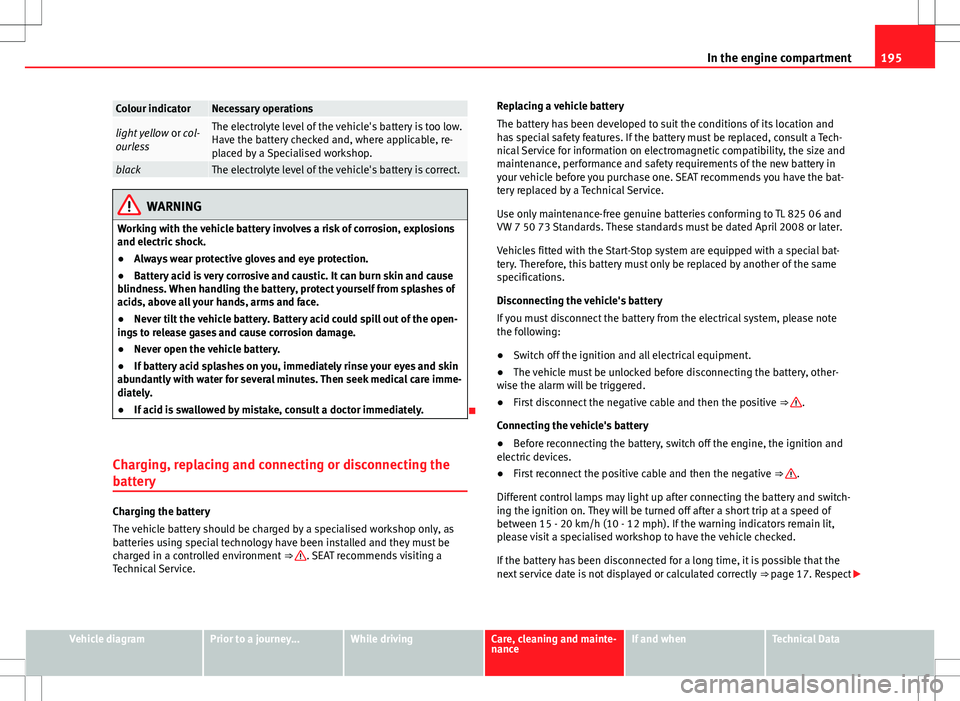
Colour indicatorNecessary operations
light yellow or col-
ourlessThe electrolyte level of the vehicle's battery is too low.
Have the battery checked and, where applicable, re-
placed by a Specialised workshop.
blackThe electrolyte level of the vehicle's battery is correct.
WARNING
Working with the vehicle battery involves a risk of corrosion, explosions
and electric shock.
● Always wear protective gloves and eye protection.
● Battery acid is very corrosive and caustic. It can burn skin and cause
blindness. When handling the battery, protect yourself from splashes of
acids, above all your hands, arms and face.
● Never tilt the vehicle battery. Battery acid could spill out of the open-
ings to release gases and cause corrosion damage.
● Never open the vehicle battery.
● If battery acid splashes on you, immediately rinse your eyes and skin
abundantly with water for several minutes. Then seek medical care imme-
diately.
● If acid is swallowed by mistake, consult a doctor immediately.
Charging, replacing and connecting or disconnecting the
battery
Charging the battery
The vehicle battery should be charged by a specialised workshop only, as
batteries using special technology have been installed and they must be
charged in a controlled environment ⇒
. SEAT recommends visiting a
Technical Service. Replacing a vehicle battery
The battery has been developed to suit the conditions of its location and
has special safety features. If the battery must be replaced, consult a Tech-
nical Service for information on electromagnetic compatibility, the size and
maintenance, performance and safety requirements of the new battery in
your vehicle before you purchase one. SEAT recommends you have the bat-
tery replaced by a Technical Service.
Use only maintenance-free genuine batteries conforming to TL 825 06 and
VW 7 50 73 Standards. These standards must be dated April 2008 or later.
Vehicles fitted with the Start-Stop system are equipped with a special bat-
tery. Therefore, this battery must only be replaced by another of the same
specifications.
Disconnecting the vehicle's battery
If you must disconnect the battery from the electrical system, please note
the following:
●
Switch off the ignition and all electrical equipment.
● The vehicle must be unlocked before disconnecting the battery, other-
wise the alarm will be triggered.
● First disconnect the negative cable and then the positive ⇒
.
Connecting the vehicle's battery
● Before reconnecting the battery, switch off the engine, the ignition and
electric devices.
● First reconnect the positive cable and then the negative ⇒
.
Different control lamps may light up after connecting the battery and switch-
ing the ignition on. They will be turned off after a short trip at a speed of
between 15 - 20 km/h (10 - 12 mph). If the warning indicators remain lit,
please visit a specialised workshop to have the vehicle checked.
If the battery has been disconnected for a long time, it is possible that the
next service date is not displayed or calculated correctly ⇒ page 17. Respect
Vehicle diagramPrior to a journey...While drivingCare, cleaning and mainte-
nanceIf and whenTechnical Data
Page 198 of 308

196In the engine compartment
the maximum service intervals permitted ⇒ Booklet Maintenance
Programme.
Automatic consumer disconnection
The intelligent vehicle electrical system automatically implements a range
of measures to prevent the battery from discharging when high demands
are made on it:
● the idling speed is increased so that the alternator provides more elec-
tricity.
● where necessary, the power of the most powerful consumers is reduced
or even completely disconnected.
● On starting the engine, the power supply from the 12-volt socket and
the cigarette lighter may be interrupted for a short time.
The on-board management program cannot always prevent the battery from
running flat. For example, if the ignition is left on for a long period with the
engine off or if the side lights or parking lights are left on while the vehicle
is stationary.
Why the battery runs flat:
● When stationary for a long time without starting the engine, particularly
if the ignition is switched on.
● Use of electrical consumers with the engine switched off.
WARNING
Incorrectly securing the battery or using the wrong battery can cause
short-circuits, fire and serious injuries.
● Always use only maintenance free batteries, protected to prevent a
leak, and whose properties, specifications and size correspond to the
standard battery.
WARNING
A highly explosive mixture of gases is released when the battery is under
charge.
● The batteries should be charged in a well-ventilated room only.
● Never charge a frozen or recently thawed battery. A flat battery can al-
so freeze at temperatures close to 0 °C (+32 °F).
● Always replace a battery which has frozen.
● Battery cables not correctly connected may cause a short circuit. Re-
connect first the positive cable and then the negative cable.
CAUTION
● Never disconnect the battery if the ignition is switched on or if the en-
gine is running. This could damage the electrical system or electronic com-
ponents.
● Never plug accessories supply current, such as solar panels or a battery
charger, to the 12-volt socket or the cigarette lighter. This could damage the
vehicle's electrical system.
For the sake of the environment
Dispose of the battery in an environment-friendly manner. Batteries contain
toxic substances such as sulphuric acid and lead.
For the sake of the environment
Battery acid can contaminate the environment. Collect any spilt service flu-
ids and allow a dispose of them correctly.
Page 200 of 308

198Vehicle care and maintenance
For the sake of the environment
The remains of vehicle care products should not be disposed of with ordina-
ry household waste. Observe information provided by the manufacturer.
Washing the vehicle
The longer substances such as insects, bird droppings, resinous tree sap,
road dirt, industrial deposits, tar, soot or road salt and other aggressive ma-
terials remain on the vehicle, the more damage they do to the paintwork.
High temperatures (for instance due to strong sunlight) further intensify the
corrosive effect. The vehicle undercarriage should also be thoroughly wash-
ed at regular intervals.
Automatic car washes
Always observe the instructions provided at the automatic car wash. The
standard precautionary measures prior to entering the car wash should be
taken to avoid damage to the vehicle (close all windows, fold in exterior mir-
rors). If the vehicle is fitted with additional components (spoiler, roof-rack,
aerial...), check with the car wash supervisor whether these can enter the
car wash ⇒
.
The vehicle paintwork is so durable that the vehicle can normally be washed
without problems in an automatic car washing tunnel. However, wear and
damage to the paintwork will depend on the type of car wash used. SEAT
recommends the use of car washes without brushes.
To remove traces of wax on windows and to prevent wiper blades from
scratching, please observe the following ⇒ page 200, Cleaning windows
and exterior mirrors.
Washing the vehicle by hand
When washing the vehicle by hand, use plenty of water to soften the dirt
first, and rinse off as well as possible. Then clean the vehicle with a soft
sponge, glove or brush using only slight
pressure. Start at the roof and work downwards. Special vehicle shampoo
should only be used for very persistent dirt.
Rinse the sponge or glove thoroughly and often.
Wheels, sills and similar should be cleaned last. Use a second sponge for
this.
WARNING
Sharp components on the vehicle may cause injury.
● Protect arms and hands from sharp edges when cleaning the vehicle
undercarriage or the interior of the wheel hubs.
WARNING
After the vehicle has been washed, the braking effect will be reduced
(and the braking distance increased) due to moisture (and ice in winter)
on the brakes.
● “Dry the brakes and remove ice” by braking carefully. Ensure that you
are not endangering other road-users or breaking traffic regulations in
the process.
CAUTION
● The temperature of the water must not exceed +60 °C (+140 °F).
● To avoid damage to the paintwork, do not wash the vehicle in full sun.
● Do not use rough sponges or similar which could damage the surface to
clean away the traces of insects.
● Never wipe the headlights with a dry cloth or sponge, always moisten
first. It is best to use soapy water.
● Washing the vehicle in low temperatures: When washing the vehicle
with a hose, do not direct water into the lock cylinders or the gaps around
the doors, rear lid, or sunroof. Locks and seals could freeze!
Page 204 of 308

202Vehicle care and maintenance
● Insert a new blade of the same length and type in the windscreen wiper
arm in the opposite direction to the arrow B
and hook into place. This fea-
ture is operational when the blade is in position (arrow A).
● Return the windscreen wiper arm to the windscreen. Do not let it simply
drop down!
WARNING
Worn or dirty wiper blades reduce visibility and increase the risk of acci-
dent and serious injury.
● Always replace damaged or worn blades or blades which do not clean
the windscreen correctly.
CAUTION
● Damaged or dirty windscreen wipers could scratch the glass.
● If products containing solvents, rough sponges or sharp objects are
used to clean the blades, the graphite layer will be damaged.
● Never use fuel, nail varnish remover, paint thinner or similar products to
clean the windows.
Note
If wax deposits, other cleaning products from the automatic car wash, or
other care products, are left on the windscreen and the rear window, the
blades can scratch the glass. Remove wax deposits with a special product
or cleaning cloths.
Caring for and polishing the vehicle paintwork
Waxing
Regular waxing protects the paintwork. It is time to apply a good coat of wax
when water no longer forms droplets and rolls off the clean paintwork. Even if a
wax solution is used regularly in the automatic car wash, SEAT rec-
ommends protecting the paint with a hard wax coating at least twice a year.
Polishing
Polishing is only necessary if the paint has lost its shine, and the gloss can-
not be brought back by applying wax.
If the polish does not contain wax, a wax product should be applied after
polishing.
CAUTION
● To prevent damage, vehicle polish or hard wax should not be used on
components painted in matt paint, plastic components and the glass head-
lamp and tail light covers.
● Do not polish your vehicle in a sandy or dusty environment.
Care and cleaning of chrome and aluminium wheel rims
● Use a clean, damp, lint-free, smooth cloth to clean anodized surfaces.
● If there is a lot of dirt, use a special cleaning product which does not
contain solvents.
● Then, polish the chrome and aluminium wheel trims with a smooth dry
cloth.
CAUTION
In order to prevent damage to the aluminium and chrome wheel trims:
● Do not clean or polish them in direct sunlight.
● Do not clean or polish them in sandy or dusty environments.
● Do not use abrasive cleaning agents such as home cream cleaners.
● Do not use insect sponges, scouring pads, or similar products to clean
insect deposits.
Page 207 of 308

205
Vehicle care and maintenance
Caring for and cleaning the vehicle interior
Introduction
The dye from many items of modern clothing (e.g. dark jeans) is not always
solid enough. Seat upholstery (material and leather), especially when light-
coloured, may visibly discolour if the dye comes out of clothing (even when
used correctly). This is not an upholstery defect but indicates that the dye in
the item of clothing is not solid enough.
Additional information and warnings:
● Caring for and cleaning the vehicle exterior ⇒ page 197
● Accessories, parts replacement, repairs and modifications ⇒ page 222
WARNING
Vehicle care products may be toxic and hazardous. If vehicle care prod-
ucts are not suitable or are used inappropriately, this could result in acci-
dent, serious injury, burns or intoxication.
● Vehicle care products must always be stored in the original container
which should be kept closed.
● Observe information provided by the manufacturer.
● To prevent confusion, never store vehicle care products in empty food
cans, bottles or other containers.
● Keep all care products out of reach of children.
● Harmful vapours may be produced when using vehicle care products.
Therefore, care products should only be used in well-ventilated spaces or
in the open air.
● Never use fuel, turpentine, engine oil, acetone or any other volatile
liquid to wash, clean or care for the vehicle. These are toxic and highly
flammable.
WARNING
Inappropriate care and cleaning of vehicle components may effect the ve-
hicle safety equipment, increasing the risk of severe injury.
● Vehicle components should only be cleaned and maintained in ac-
cordance with the manufacturer's instructions.
● Only use approved or recommended care products.
CAUTION
● Cleaning products which contain solvents will damage the material.
● To avoid damage, stubborn stains should be removed by a specialised
workshop.
Note
Suitable vehicle care products are available from your Technical Service.
Vehicle diagramPrior to a journey...While drivingCare, cleaning and mainte-
nanceIf and whenTechnical Data
Page 208 of 308

206Vehicle care and maintenance
Treating your upholstery
Check list
For information on how to treat and care for the vehicle upholstery, please
bear the following in mind ⇒
:
¥ Before entering the vehicle, fasten all Velcro fastenings which could
come into contact with upholstery and coverings. If the Velcro fasten-
ings on upholstery and material covers are not securely fastened,
this could damage them.
¥ To prevent damage, do not allow the upholstery or covers to come
into contact with sharp or decorative objects. Decorative objects
such as zips, rivets and rhinestones on clothing and belts.
¥ Dust and grit in the pores and seams should be removed regularly to
prevent them scratching and damaging the surface.
¥ Always check that the dyes used in clothing are fast to prevent them
from staining the upholstery. This is particularly true for clear-col-
oured upholstery.
CAUTION
Failure to observe the instructions in the check list for caring for your up-
holstery could result in damage or discolouration of the upholstery and cov-
ers.
● Always follow the check list and perform the necessary operations.
Note
SEAT recommends you take the vehicle to a Specialised workshop to treat
any stains on the upholstery caused by the discolouration of clothing. Padding and fabric trim cleaning
Normal cleaning
●
Before applying cleaning products, please read the instructions for han-
dling and the warnings shown on the container.
● The upholstery, textile covers, and carpet should be regularly vacuumed
(with vacuum brush).
● We recommend that you use a soft sponge or lint-free, micro-fibre cloth
for normal cleaning ⇒
.
General superficial dirt on upholstery and textile covers can be cleaned with
a normal foam cleaning product.
If the upholstery and the material trims are very dirty, we recommend you
have them cleaned by a specialist cleaning form.
Cleaning stains
It may be necessary to clean the whole surface and not only the stain itself.
Especially if the surface has been dirtied through normal use. Otherwise,
the stained area may become lighter than the rest of the surface after treat-
ment.
Page 224 of 308

222Vehicle care and maintenance
Accessories, replacements, repairs and
modifications
Introduction
Additional information and warnings:
● Seat belts ⇒ page 57
● Airbag system ⇒ page 67
● Roof carrier ⇒ page 104
● Ashtray and cigarette lighter ⇒ page 115
● Power socket ⇒ page 117
● Braking, stopping and parking ⇒ page 134
● Parking distance warning system ⇒ page 149
● Cruise control system (CCS) ⇒ page 152
● Working in the engine compartment ⇒ page 180
● Engine oil ⇒ page 185
● Engine coolant ⇒ page 189
● Vehicle battery ⇒ page 193
● Caring for and cleaning the vehicle exterior ⇒ page 197
● Care and cleaning of the vehicle interior ⇒ page 205
● Notes for the user ⇒ page 233
● ⇒ Booklet Radio system
● Instruction Manual for the Portable Navigation System (supplied by
SEAT) in the equipment.
WARNING
The use of unsuitable spare parts and accessories, or incorrectly per-
formed modifications or repairs may result in damage to the vehicle, acci-
dents and serious injury.
● SEAT strongly recommends you to only use SEAT approved accesso-
ries and SEAT ®
original spare parts. These parts and accessories have
been specially tested by SEAT for suitability, reliability and safety.
● Have any repairs or modifications carried out at a Specialised work-
shop. Specialised workshops have the necessary tools, diagnostics
equipment, repair information and qualified personnel.
● Only mount parts with the same specifications as the parts fitted at
factory.
● Never mount, fasten or fit objects such as drink holders or telephone
cradles over the covers of the airbag modules or within their deployment
zones.
● Only use wheels and tyre combinations which have been approved by
SEAT for your vehicle type.
Page 228 of 308

226Vehicle care and maintenance
Retro-fitting of two-way radios
An exterior aerial is required for the use of two-way radios in the vehicle.
The retro-fitting of electrical or electronic appliances in the vehicle is sub-
ject to their approval for use in your vehicle. Under certain circumstances,
this could mean that your vehicle registration documents are no longer val-
id.
SEAT has approved your vehicle for use with two-way radios providing the
following conditions are observed:
●The exterior aerial must be mounted professionally.
● The maximum transmitting power is 10 watts.
An only external aerial is needed to give the equipment its optimal reach.
Check first with a Specialised workshop if you wish to use a two-way radio
with a transmitting power of over 10 watts. The Specialised workshops are
familiar with the technical options for installation. SEAT recommends visit-
ing a Technical Service.
All legal requirements, together with the instructions for the use of two-way
radios must be observed.
WARNING
If the two-way radio is not securely fastened in position, it could be sent
flying around the vehicle in the event of sharp braking, sudden manoeu-
vres or accident, causing injury.
● While driving, two-way radios must be securely fastened in position,
outside the airbags deployment zones, or safely stowed away.
WARNING
When using a two-way radio without a connection to an exterior aerial,
the maximum permitted levels of electromagnetic radiation may be ex-
ceeded. This is also the case if the aerial has not been correctly installed.
● You should only use a two-way radio inside the vehicle if it has first
been correctly connected to an exterior aerial.
Information stored by the control units
Your vehicle is fitted at the factory with a series of electronic control units
responsible for the engine and gearbox management. In addition, the con-
trol units supervise the performance of the exhaust gas system and the air-
bag systems.
Therefore, while the vehicle is being driven, these electronic control units
are continuously analysing the vehicle data. In the event of faults or devia-
tions from the theoretical values, only this data is stored. Normally, the
warning lamps on the instrument panel light up in the event of faults.
This data can only be read and analysed using special equipment.
The storing of the data allows specialised workshops to detect and repair
faults. Stored data may include:
● Data relating to the engine or the gearbox
● Speed
● Direction of travel
● Braking force
● Detection of seat belt
The vehicle control units never record conversations held by passengers in
the vehicle.
Page 232 of 308

230Vehicle care and maintenance
Removing and fitting the navigator holder
● Press the holder release button ⇒ Fig. 126 (arrow).
● Remove the holder from the dash panel in an upwards direction.
● If necessary, close the opening with the corresponding cover.
In order to fit the holder, place it on the opening from above and press in a
downwards direction until it engages with a click. ⇒
.
WARNING
Any distraction may lead to an accident, with the risk of injury. Operating
the navigator could distract you from the traffic.
● Always stay alert and drive responsibly.
● Select volume settings that allow you to easily hear signals from out-
side the vehicle at all times (e.g. emergency service sirens).
● Setting the volume too high may cause damage to your hearing. This
also applies if the device is set to high volumes for a short period.
WARNING
Journey instructions and traffic signals shown on the navigation system
may differ to the current traffic situation.
● Traffic signals and driving regulations take precedence over journey
instructions and indications from the navigation system.
● Adjust your speed and driving style to visibility, road, traffic and
weather conditions.
WARNING
If the navigator is not securely fastened in position, it could be sent fly-
ing around the vehicle in the event of sharp braking, sudden manoeuvres
or accident, causing injury.
● Fit the navigator housing safely on the corresponding opening on the
dash panel.
● Always place the navigator securely in its holder or store it safely in
the vehicle.
CAUTION
An unsuitable gradient and angle of vision setting can damage the naviga-
tor.
● When adjusting the navigation device, move it with care and not beyond
its limits.
CAUTION
Excessively high or low outside temperatures can affect the Portable Navi-
gation System operation or damage the device.
● Always take the Portable Navigation System with you when you leave the
vehicle to protect it from excessively high or low temperatures and intense
sunlight.
CAUTION
Humidity can damage the Portable Navigation System connections on the
dash panel.
● Do not clean the holder for the navigation device with moist products.
Use a dry cloth.
Note
SEAT recommends taking the Portable Navigation System with you when
you leave the vehicle to prevent it from being stolen.
Page 238 of 308

236Vehicle care and maintenance
Engine management and exhaust gas
purification system
Introduction
Additional information and warnings:
● Changing gear ⇒ page 124
● Refuelling ⇒ page 171
● Fuel ⇒ page 177
● Engine oil ⇒ page 185
● Vehicle battery ⇒ page 193
● Information stored in the control units ⇒ page 222
● Tow-starting and towing away ⇒ page 276
WARNING
The components of the exhaust system reach very high temperatures.
This could cause a fire.
● Always park your vehicle so that no part of the exhaust system can
come in contact with flammable materials (such as dried grass).
● Never apply additional underseal or anti-corrosion coatings to the ex-
haust pipes, catalytic converter or the heat shields on the exhaust sys-
tem.
Control lamps
lights
upPossible causeSolution
Fault in engine management
(Electronic Power Control).Take the vehicle to a Specialised
workshop as soon as possible
and have the engine checked.
Fault in catalytic converter.
You should reduce speed accord-
ingly. Drive carefully until you
reach the next Specialised work-
shop. Have the engine checked
there.
flashesPossible causeSolution
Combustion fault which could
damage the catalytic convert-
er.You should reduce speed accord-
ingly. Drive carefully until you
reach the next Specialised work-
shop. Have the engine checked
there.
Several warning and control lamps light up for a few seconds when the igni-
tion is switched on while a test of the function is being carried out. They will
switch off after a few seconds.
CAUTION
Always pay attention to any lit lamps and to the corresponding descriptions
and instructions to avoid damage to the vehicle.
Note
While the control lamps or maintain lit up, the engine will present
faults, a higher consumption of fuel and a loss of engine power.