brake fluid Seat Mii 2012 Owner's manual
[x] Cancel search | Manufacturer: SEAT, Model Year: 2012, Model line: Mii, Model: Seat Mii 2012Pages: 308, PDF Size: 4.13 MB
Page 17 of 308

15
Instrument panel
Instrument panel Control and warning lamps
The control and warning lamps are indicators of warnings, ⇒ , faults ⇒ or certain functions. Some control and warning lamps come on when the ig-
nition is switched on, and go out when the engine starts running, or while
driving.
When certain control and warning lamps are lit, an audible warning is also
heard.
SymbolMeaning ⇒ See
Handbrake applied.
⇒ page 134
Do not continue driving!
The brake fluid level is too low or there is a
fault in the brake system.
lights up: Do not continue driving!
The liquid coolant level is too low,
the engine liquid coolant temperature is too
high or
there is a fault in the liquid coolant system.
⇒ page 189
flashes: Engine coolant system faulty.⇒ page 189
Do not continue driving!
Engine oil pressure too low.⇒ page 185
lights up or flashes: Do not continue driv-
ing!
Fault in the steering.⇒ page 147
On the instrument panel: Driver or passen-
ger has not fastened seat belt.
⇒ page 57
Instrument panel display: A passenger in
the rear seats has fastened their seatbelt.
SymbolMeaning ⇒ See
A passenger in the rear seats has not fas-
tened their seat belt.⇒ page 57
Faulty generator.⇒ page 193Vehicles with the Start-Stop system: it is
necessary to start the engine manually.⇒ page 160
flashes in addition to the rest of the seg-
ments of the fuel gauge: Fuel tank almost
empty.⇒ page 171
flashes quickly: The City Safety Assist sys-
tem* function brakes automatically or has
braked automatically. Or:
flashes slowly: City Safety Assist function is
not currently available.
⇒ page 155
The City Safety Assist* function has been
connected manually. It switches off after 5
seconds.
flashes: The City Safety Assist* function has
been manually disconnected.
after the ignition is switched on: Indication
for the approach of the end of the period for
an inspection to be carried out.⇒ page 17
lights up: ESC* faulty or disconnected by
the system. ALTERNATIVELY:
flashes: ESC* or ASR regulating.
⇒ page 134
lights up: Traction Control faulty or switched
off by the system. ALTERNATIVELY:
flashes: Traction Control regulator operat-
ing.
ABS faulty or does not work.
Vehicle diagramPrior to a journey...While drivingCare, cleaning and mainte-
nanceIf and whenTechnical Data
Page 23 of 308

21
Instrument panel
WARNING
Although the outside temperature is above freezing, some roads and
bridges may be frozen.
● At an outside temperature of above +4 °C (+39 °F), even when the
“ice crystal” is not visible, there may still be ice on the road.
● Never rely totally on the outside temperature indicator!
CAUTION
Failure to heed the warning lamps when they appear may result in faults in
the vehicle.
Note
Different versions of the instrument panel are available and therefore the
versions and instructions on the display may vary.
Note
When several warnings are active at the same time, the symbols are shown
successively for a few seconds. The symbols will stay on until the fault is
rectified.
Service interval display
The inspection display appears on the instrument panel display ⇒ Fig. 9
or ⇒ Fig. 10 2.
SEAT makes a difference between services with engine oil change (Mainte-
nance Service) and services without engine oil change (Inspection Service).
The service interval display only gives information for service dates which
involve an engine oil change. The dates of the remaining services (for exam-
ple, the next Inspection Service or change of brake fluid) are listed on the
label attached to the door strut, or even in the Maintenance Programme. The set service intervals have been specified with
the service dependent on
time/distance travelled.
Inspection reminder
If the inspection period is due to expire shortly, Inspection reminder ap-
pears when starting the ignition abbreviated to and a warning in km. The
number of kilometres shown is the maximum number that may be driven
until the next service.
Service due
After the service date, an audible warning is given when the ignition is
switched on and the abbreviation displayed on the screen flashes for a
few seconds.
Note
The service message disappears after a few seconds, when the engine is
started or when OK
is pressed on the windscreen wiper lever.
Note
In vehicles in which the battery has been disconnected for a long period of
time, it is not possible to calculate the date of the next service. Therefore
the service interval display may not be correct. In this case, please check
the maximum permitted service intervals ⇒ Booklet Maintenance Pro-
gramme.
Vehicle diagramPrior to a journey...While drivingCare, cleaning and mainte-
nanceIf and whenTechnical Data
Page 137 of 308
135
Starting, changing gears, parking
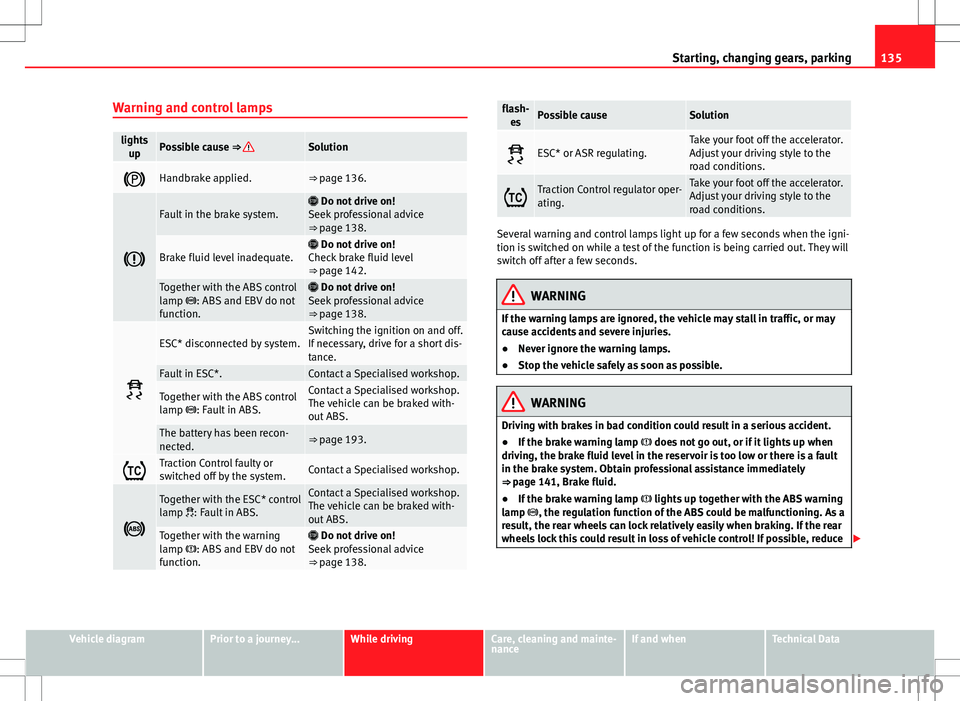
Warning and control lamps
lights upPossible cause ⇒ Solution
Handbrake applied.⇒ page 136.
Fault in the brake system. Do not drive on!
Seek professional advice
⇒ page 138.
Brake fluid level inadequate. Do not drive on!
Check brake fluid level
⇒ page 142.
Together with the ABS control
lamp : ABS and EBV do not
function. Do not drive on!
Seek professional advice
⇒ page 138.
ESC* disconnected by system.Switching the ignition on and off.
If necessary, drive for a short dis-
tance.
Fault in ESC*.Contact a Specialised workshop.
Together with the ABS control
lamp : Fault in ABS.Contact a Specialised workshop.
The vehicle can be braked with-
out ABS.
The battery has been recon-
nected.⇒ page 193.
Traction Control faulty or
switched off by the system.Contact a Specialised workshop.
Together with the ESC* control
lamp : Fault in ABS.Contact a Specialised workshop.
The vehicle can be braked with-
out ABS.
Together with the warning
lamp : ABS and EBV do not
function. Do not drive on!
Seek professional advice
⇒ page 138.
flash- esPossible causeSolution
ESC* or ASR regulating.Take your foot off the accelerator.
Adjust your driving style to the
road conditions.
Traction Control regulator oper-
ating.Take your foot off the accelerator.
Adjust your driving style to the
road conditions.
Several warning and control lamps light up for a few seconds when the igni-
tion is switched on while a test of the function is being carried out. They will
switch off after a few seconds.
WARNING
If the warning lamps are ignored, the vehicle may stall in traffic, or may
cause accidents and severe injuries.
● Never ignore the warning lamps.
● Stop the vehicle safely as soon as possible.
WARNING
Driving with brakes in bad condition could result in a serious accident.
● If the brake warning lamp does not go out, or if it lights up when
driving, the brake fluid level in the reservoir is too low or there is a fault
in the brake system. Obtain professional assistance immediately
⇒ page 141, Brake fluid.
● If the brake warning lamp lights up together with the ABS warning
lamp , the regulation function of the ABS could be malfunctioning. As a
result, the rear wheels can lock relatively easily when braking. If the rear
wheels lock this could result in loss of vehicle control! If possible, reduce
Vehicle diagramPrior to a journey...While drivingCare, cleaning and mainte-
nanceIf and whenTechnical Data
Page 143 of 308

141
Starting, changing gears, parking
WARNING (Continued)
● Even though braking assist systems are extremely effective and help
control the vehicle in difficult situations, remember that the vehicle sta-
bility depends on tyre grip.
● When accelerating on a slippery surface, for example on ice and
snow, press the accelerator carefully. The wheels can still slip even with
braking assist systems resulting in loss of vehicle control.
WARNING
The effectiveness of the ESC* can be considerably reduced if other com-
ponents and systems affecting driving dynamics are not maintained or
are not functioning correctly. This includes, among others, brakes, tyres
and other systems already mentioned.
● Remember that changing and fitting other components to the vehicle
can affect operation of the ABS, BAS, ASR TC, EDL and ESC*.
● Changes to the vehicle suspension or using unapproved wheel/tyre
combinations can affect operation of the ABS, BAS, ASR, TC, EDL and
ESC* and their effectiveness.
● Likewise, the effectiveness of ESC* depends on the use of suitable
tyres ⇒ page 210.
Note
To ensure that the ESC*, ASR and TC work properly, all four wheels must be
fitted with identical tyres. Any differences in the rolling radius of the tyres
can cause the system to reduce engine power when this is not desired.
Note
If a malfunction should occur in the ABS, the ESC*, ASR, TC and EDL will al-
so be affected.
Note
Noises may be heard while any of the above systems are operating.
Brake fluid
Fig. 91 In the engine
compartment: brake fluid
reservoir, lid
In the course of time, the brake fluid absorbs water from the ambient air. If
there is too much water contained in the brake fluid, the brake system could
be damaged. In addition, the boiling point of the brake fluid is significantly
lowered. When the brake fluid contains too much water and the brakes are
subject to considerable forces, bubbles of water vapour can form in the sys-
tem. These bubbles of water vapour can significantly reduce braking power,
notably increasing braking distance, and could even result in the total fail-
ure of the brake system. Ensuring that the brake system is always function-
ing correctly is essential for your own safety and the safety of other road
users ⇒
.
Brake fluid specifications
SEAT have developed a special brake fluid optimised for the brake systems
of their vehicles. To ensure the optimum working of the brake system, SEAT
Vehicle diagramPrior to a journey...While drivingCare, cleaning and mainte-
nanceIf and whenTechnical Data
Page 144 of 308

142Starting, changing gears, parking
recommends the use of brake fluid in accordance with the VW 501 14
standard. If this brake fluid is not available or another brake fluid is used for
different reasons, use a brake fluid that complies with the United States
standard FMVSS 116 DOT 4 or the German standard DIN ISO 4925 CLASS 4
⇒
.
Brake fluids conforming to the standard VW 501 14, fulfil the American re-
quirements of the FMVSS 116 DOT 4 standard and the German
DIN ISO 4925 CLASS 4 standard. However, fluids that comply with the Amer-
ican FMVSS 116 DOT 4 standard or the German DIN ISO 4925 CLASS 4
standard do not necessarily comply with the VW 501 14 standard. Always
check the information on the brake fluid container and ensure that you are
using suitable brake fluid.
A suitable brake fluid can be obtained from SEAT dealerships.
Brake fluid level
The level of the brake fluid should always be between the MIN and MAX
marks, or above the MIN mark ⇒
.
It is not always possible to check the level of the brake fluid, as in some
models the engine components make it difficult to see the brake fluid reser-
voir. If you cannot read the exact brake fluid level, consult a specialist.
The brake fluid level drops slightly when the vehicle is being used due to
wear of the brake pads and the automatic readjustment of the brake.
Changing the brake fluid
The brake fluid should be changed in accordance with the instructions giv-
en in the Maintenance Programme. Have the brake fluid changed by a Spe-
cialised workshop. SEAT recommends visiting a Technical Service. This
means that only brake fluid complying with the required specifications will
be used.
WARNING
If the brake fluid level is low or unsuitable/old brake fluid is used, the
brake system may fail or braking power will be reduced.
● Check the brake system and the brake fluid level regularly!
● The brake fluid should be changed regularly in accordance with the
instructions given in the Maintenance Programme.
● When the brake fluid is used and brakes are subjected to extreme
braking forces, bubbles of vapour form in the brake system. These bub-
bles of water vapour can significantly reduce braking power, notably in-
creasing braking distance, and could even result in the total failure of the
brake system.
● Always ensure that you use suitable brake fluid. Only used brake fluid
that conforms to the VW 501 14 standard, FMVSS 116 DOT 4 standard or
even the DIN ISO 4925 CLASS 4 standard. Other types of brake fluid
could affect brake operation and reduce braking power. Do not use a
brake fluid if the container does not specify compliance with the
VW 501 14, FMVSS 116 DOT 4 or DIN ISO 4925 CLASS 4 standards.
● The replacement brake fluid must be new.
WARNING
Brake fluid is poisonous.
● To reduce the risk of poisoning, do not keep brake fluid in drinks bot-
tles/containers or similar. Other people could drink from these recipients
even if the contents are clearly marked.
● Always keep brake fluid in the original container; keep it correctly
sealed and out of reach of children.
CAUTION
Brake fluid could damage the paintwork. Wipe off any brake fluid from the
paintwork immediately.
Page 145 of 308

143
Starting, changing gears, parking
For the sake of the environment
Brake fluid is an environmental pollutant. Collect any spilt service fluids and
allow a professional to dispose of them.
Vehicle diagramPrior to a journey...While drivingCare, cleaning and mainte-
nanceIf and whenTechnical Data
Page 178 of 308

176At the filling station
Note
● The filling nozzles of natural gas pumps can differ in the way they are
operated. If you are unacquainted with the pump, it is advisable that a
member of staff of the service station performs the refuelling operation.
● Noises heard when refuelling are normal and do not indicate the pres-
ence of a fault in the system.
● The vehicle natural gas system is prepared both for refuelling with a
small compressor (slow refuel) and a large compressor (fast refuel) in natu-
ral gas service stations.
Refuelling precautions
Checklist
Never work on the engine or in the engine compartment if you are not famil-
iar with the operations to be carried out, the applicable safety standards
and if you do not have the instruments, liquids and tools necessary
⇒ page 180, Working in the engine compartment! In such a case, have any
work carried out by a Specialised workshop. Check the following regularly,
preferably when you refuel:
¥ Windscreen washer fluid level
⇒ page 91
¥ Engine oil level
⇒ page 185
¥ Engine coolant level
⇒ page 189
¥ Brake fluid level
⇒ page 134
¥ Tyre pressure ⇒ page 210
¥ Vehicle lighting required to guarantee road safety:
– Turn signals
– Side lights, dipped beam and main beam headlights
– Rear lights
– Brake lights
– Rear fog light ⇒ page 84
Information on bulb replacement ⇒ page 264.
Page 182 of 308

180In the engine compartment
Care, cleaning and maintenance
In the engine compartment
Working in the engine compartmentIntroduction
Before working in the engine compartment, make sure that the vehicle is
parked on horizontal and firm ground.
The engine compartment of the vehicle is a hazardous area. Never work on
the engine or in the engine compartment if you are not familiar with the op-
erations to be carried out, the applicable safety standards and especially if
you do not have the instruments, liquids and tools necessary ⇒
! In such
a case, have any work carried out by a Specialised workshop. Negligent
work can cause serious injury.
Additional information and warnings:
● Exterior detail ⇒ page 6
● Windscreen wash system ⇒ page 91
● Start and stop the engine ⇒ page 119
● Brake fluid ⇒ page 134
● Checks when filling up ⇒ page 171
● Engine oil ⇒ page 185
● Engine coolant ⇒ page 189
● Vehicle battery ⇒ page 193
● Accessories, parts replacement, repairs and modifications ⇒ page 222
WARNING
If the vehicle moves unexpectedly, this could cause serious injury.
● Never work underneath the vehicle if it is not secured against moving.
If you must work underneath the vehicle with the wheels in contact with
the ground then it should be parked on flat ground, the wheels should be
prevented from moving and the key must be removed from the ignition.
● If you have to work underneath the vehicle, you must use suitable
stands additionally to support the vehicle, there is a risk of accident!.
The jack is not intended for this kind of work and its failure could lead to
severe injuries.
● Disconnect the Start-Stop system.
WARNING
The engine compartment is a dangerous area capable of causing serious
injury.
● For all type of work, always take the utmost precautions, work care-
fully and note the general safety standards in force. Never take personal
risks.
● Never work on the engine or in the engine compartment if you are not
familiar with the necessary operations. If you are not sure about proce-
dures then visit a Specialised workshop to carry out the necessary work.
Incorrect work can cause serious injuries.
Page 184 of 308
182In the engine compartment
WARNING
Refill liquids and certain materials can catch fire easily in the engine
compartment, causing a fire and serious injury!
● Never smoke.
● Never work close to places exposed to flames or sparks.
● Never pour service fluids over the engine. These fluid may ignite hot
engine parts and cause injuries.
● If it is necessary to work on the fuel system or the electrical system,
please follow the instructions below:
–Always disconnect the vehicle battery.
– Never work close to heaters, heat sources or places exposed to
flames or sparks.
● Always keep a recently serviced and perfectly working fire extin-
guisher close by.
CAUTION
When refilling or changing service liquids, ensure that you put the liquids
into the right tank. Making a mistake when refilling could cause serious
malfunctions and damage the engine!
For the sake of the environment
Service fluids leaks are harmful to the environment. For this reason you
should make regular checks on the ground underneath your vehicle. Take
the vehicle to a Specialised workshop to be checked if you see stains, oil or
other fluids on the ground. Collect any spilt service fluids and allow a pro-
fessional to dispose of them. Preparing the vehicle for work in the engine compartment
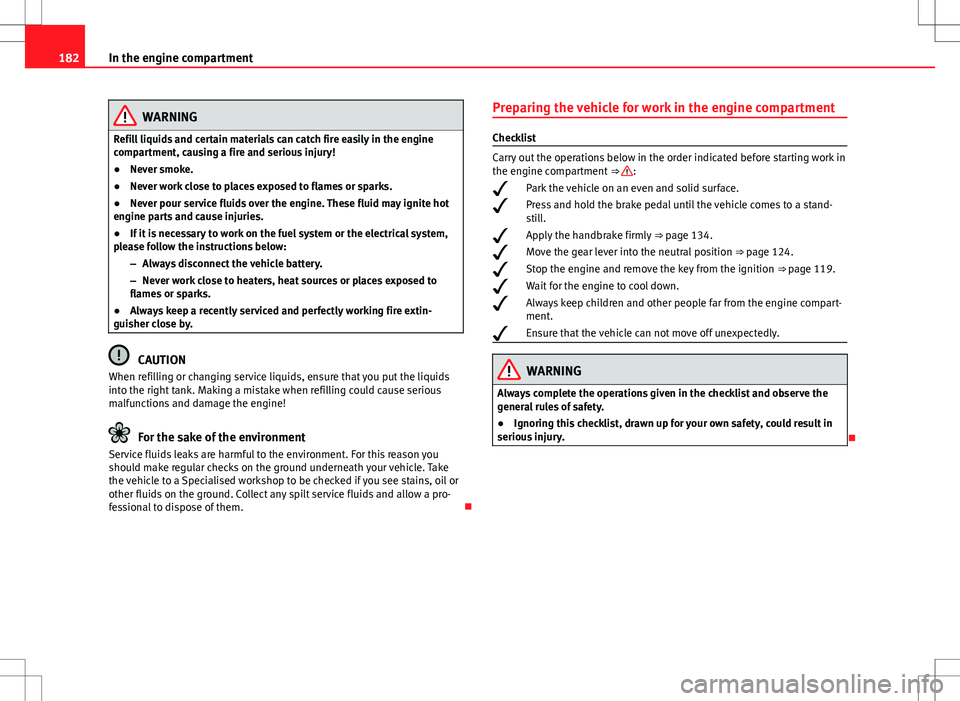
Checklist
Carry out the operations below in the order indicated before starting work in
the engine compartment
⇒
:
¥ Park the vehicle on an even and solid surface.
¥ Press and hold the brake pedal until the vehicle comes to a stand-
still.
¥ Apply the handbrake firmly
⇒ page 134.
¥ Move the gear lever into the neutral position
⇒ page 124.
¥ Stop the engine and remove the key from the ignition
⇒ page 119.
¥ Wait for the engine to cool down.
¥ Always keep children and other people far from the engine compart-
ment.
¥ Ensure that the vehicle can not move off unexpectedly.
WARNING
Always complete the operations given in the checklist and observe the
general rules of safety.
● Ignoring this checklist, drawn up for your own safety, could result in
serious injury.
Page 194 of 308

192In the engine compartment
WARNING
Hot vapours and coolant can cause serious burns.
● Never open the coolant expansion tank if steam or coolant is coming
from the engine compartment. Wait until you cannot see or hear any
steam or coolant escaping.
● Always wait until the engine has completely cooled before very care-
fully opening the expansion tank cap. Contact with hot elements of the
engine can cause skin burns.
● Once the engine has cooled, follow the instructions below before
opening the bonnet:
–Engage the handbrake and place the gear selector lever in P or the
gear stick in neutral.
– Remove the key from the ignition.
– Keep children away from the engine compartment and never leave
them unsupervised.
● When the engine is warm or hot, the cooling system is pressurised.
Do not unscrew the cap on the coolant expansion tank when the engine
is hot. Otherwise, coolant may spray out under pressure causing burns
and serious injury.
–Carefully and slowly unscrew the cap anticlockwise, gently press-
ing down on it.
– Always protect your face, hands and arms from hot coolant and
steam using a large, thick cloth.
● When refilling liquids, avoid spilling them on parts of the engine and
the exhaust system. Spilled liquids could cause a fire. Under specific cir-
cumstances, the ethylene glycol can catch fire.CAUTION
● Top up with distilled water only. Any other type of water may lead to con-
siderable rusting in the engine due to its chemical components. This could
consequently damage the engine. If you have not used distilled water but
another type of water to top up the coolant, a Specialised workshop must
immediately replace all of the fluid in the engine cooling system.
● Only top up coolant to the top level of the marked area ⇒ Fig. 113. Oth-
erwise the excess coolant will be forced out of the cooling system when the
engine is hot, causing damage.
● If a lot of liquid coolant has been lost, wait for the engine to cool down
completely before adding coolant. Extensive coolant loss is an indication of
leaks in the engine cooling system. Have the engine cooling system inspec-
ted immediately by a Specialised workshop. Otherwise engine damage may
occur.
● When refilling or changing service liquids, ensure that you put the liq-
uids into the right tank. Making a mistake when refilling could cause seri-
ous malfunctions and damage the engine!