child lock Seat Mii 2012 Owner's manual
[x] Cancel search | Manufacturer: SEAT, Model Year: 2012, Model line: Mii, Model: Seat Mii 2012Pages: 308, PDF Size: 4.13 MB
Page 5 of 308
Table of Contents
Manual structure . . . . . . . . . . . . . . . . . . . . 5
Vehicle diagram . . . . . . . . . . . . . . . . . . . . . . 6
Exterior views . . . . . . . . . . . . . . . . . . . . . . . . . . . . . 6
Side view . . . . . . . . . . . . . . . . . . . . . . . . . . . . . . . . 6
Front view . . . . . . . . . . . . . . . . . . . . . . . . . . . . . . . 7
Rear view . . . . . . . . . . . . . . . . . . . . . . . . . . . . . . . . 8
Vehicle interior . . . . . . . . . . . . . . . . . . . . . . . . . . . . 9
Driver door overview . . . . . . . . . . . . . . . . . . . . . . . 9
Overview of the driver side . . . . . . . . . . . . . . . . . . 10
Overview of centre console . . . . . . . . . . . . . . . . . 12
Detail of the passenger seat . . . . . . . . . . . . . . . . 14
Symbols on the roof . . . . . . . . . . . . . . . . . . . . . . . 14
Instrument panel . . . . . . . . . . . . . . . . . . . . . . . . . . 15
Control and warning lamps . . . . . . . . . . . . . . . . . 15
Instruments . . . . . . . . . . . . . . . . . . . . . . . . . . . . . . 17
SEAT information system . . . . . . . . . . . . . . . . . . . 22
Prior to a journey... . . . . . . . . . . . . . . . . . . 25
Before starting the engine . . . . . . . . . . . . . . . . . 25
Tips for driving . . . . . . . . . . . . . . . . . . . . . . . . . . . 25
Unlocking and locking . . . . . . . . . . . . . . . . . . . . . 28
Vehicle key set . . . . . . . . . . . . . . . . . . . . . . . . . . . 28
Central locking* and locking system . . . . . . . . . . 33
Doors . . . . . . . . . . . . . . . . . . . . . . . . . . . . . . . . . . . 38
Rear lid . . . . . . . . . . . . . . . . . . . . . . . . . . . . . . . . . . 40
Windows . . . . . . . . . . . . . . . . . . . . . . . . . . . . . . . . 43
Opening and closing the sliding/tilting electric
panoramic sunroof . . . . . . . . . . . . . . . . . . . . . . . . 44 Ensuring you are correctly and safely seated
48
Adjusting the seat position . . . . . . . . . . . . . . . . . 48
Seat functions . . . . . . . . . . . . . . . . . . . . . . . . . . . . 55
Seat belts . . . . . . . . . . . . . . . . . . . . . . . . . . . . . . . 57
Airbag system . . . . . . . . . . . . . . . . . . . . . . . . . . . . 67
Child seats (accessories) . . . . . . . . . . . . . . . . . . . 76
Lights and visibility . . . . . . . . . . . . . . . . . . . . . . . . 84
Lights . . . . . . . . . . . . . . . . . . . . . . . . . . . . . . . . . . . 84
Sun blind . . . . . . . . . . . . . . . . . . . . . . . . . . . . . . . . 89
Window wash/wipe system . . . . . . . . . . . . . . . . . 91
Rear vision mirror . . . . . . . . . . . . . . . . . . . . . . . . . 95
Transporting . . . . . . . . . . . . . . . . . . . . . . . . . . . . . . 97
Driving tips . . . . . . . . . . . . . . . . . . . . . . . . . . . . . . 97
Loading luggage compartment . . . . . . . . . . . . . . 100
Roof carrier system . . . . . . . . . . . . . . . . . . . . . . . . 104
Trailer coupling . . . . . . . . . . . . . . . . . . . . . . . . . . . 107
Practical equipment . . . . . . . . . . . . . . . . . . . . . . . 108
Storage compartments . . . . . . . . . . . . . . . . . . . . . 108
Drink holders . . . . . . . . . . . . . . . . . . . . . . . . . . . . . 113
Ashtray and Lighter . . . . . . . . . . . . . . . . . . . . . . . . 115
Electrical power socket* . . . . . . . . . . . . . . . . . . . . 117
While driving . . . . . . . . . . . . . . . . . . . . . . . . . 119
Starting, changing gears, parking . . . . . . . . . . 119
Stopping and starting the engine . . . . . . . . . . . . 119
Changing gear . . . . . . . . . . . . . . . . . . . . . . . . . . . . 124
Braking, stopping and parking . . . . . . . . . . . . . . 134
Ecological driving . . . . . . . . . . . . . . . . . . . . . . . . . 144
Steering . . . . . . . . . . . . . . . . . . . . . . . . . . . . . . . . . 147
Driver assistance systems . . . . . . . . . . . . . . . . . . 149
Parking distance warning system* . . . . . . . . . . . 149
Cruise control* (Cruise control system - CCS) . . . 152 Safety Assist* (City Safety Assist function) . . . . . 155
Hill hold . . . . . . . . . . . . . . . . . . . . . . . . . . . . . . . . . 160
Hill-start aid* . . . . . . . . . . . . . . . . . . . . . . . . . . . . . 162
Air control . . . . . . . . . . . . . . . . . . . . . . . . . . . . . . . . . 164
Heating, Ventilation and Air conditioning system . .164
At the filling station . . . . . . . . . . . . . . . . . . . . . . . . 171
Refuelling . . . . . . . . . . . . . . . . . . . . . . . . . . . . . . . 171
Fuel . . . . . . . . . . . . . . . . . . . . . . . . . . . . . . . . . . . . 177
Care, cleaning and maintenance . 180
In the engine compartment . . . . . . . . . . . . . . . . 180
Working in the engine compartment . . . . . . . . . . 180
Engine oil . . . . . . . . . . . . . . . . . . . . . . . . . . . . . . . . 185
Engine coolant . . . . . . . . . . . . . . . . . . . . . . . . . . . 189
Vehicle battery . . . . . . . . . . . . . . . . . . . . . . . . . . . 193
Vehicle care and maintenance . . . . . . . . . . . . . . 197
Care and cleaning the vehicle exterior . . . . . . . . 197
Caring for and cleaning the vehicle interior . . . . 205
Wheels and tyres . . . . . . . . . . . . . . . . . . . . . . . . . . 210
Accessories, replacements, repairs and
modifications . . . . . . . . . . . . . . . . . . . . . . . . . . . . 222
Notes for the user . . . . . . . . . . . . . . . . . . . . . . . . . 233
Engine management and exhaust gas
purification system . . . . . . . . . . . . . . . . . . . . . . . . 236
If and when . . . . . . . . . . . . . . . . . . . . . . . . . . . 238
Practical information . . . . . . . . . . . . . . . . . . . . . . 238
Frequently asked questions . . . . . . . . . . . . . . . . . 238
In case of emergency . . . . . . . . . . . . . . . . . . . . . . 240
Emergency locking and unlocking . . . . . . . . . . . . 243
Vehicle tool kit* . . . . . . . . . . . . . . . . . . . . . . . . . . . 246
3
Table of Contents
Page 30 of 308

28Unlocking and locking
Unlocking and locking
Vehicle key set
Introduction
Additional information and warnings:
● Adjustments to the SEAT information system ⇒ page 22
● Central locking and locking system ⇒ page 33
● Start and stop the engine ⇒ page 119
● Notes for the user ⇒ page 233
● Emergency locking and unlocking ⇒ page 243
WARNING
Swallowing batteries with a diameter of 20 mm or other types of lithium
battery may quickly result in serious injuries of even death.
● Always keep the vehicle keys and the key tab with the batteries,
spare batteries, flat batteries and other types of batteries larger than
20 mm out of the reach of children.
● Immediately seek medical assistance if you suspect the swallowing of
a battery.
WARNING
Careless or incorrect use of vehicle keys may result in severe injury and
accident.
● Always take all the keys with you whenever you leave the vehicle.
Children and unauthorised individuals could lock the doors or the rear
lid, start the engine or turn the ignition on activating electrical systems,
for example: the electric windows.
● Never leave children or disabled people alone in the vehicle. They
could be trapped in the vehicle in an emergency and will not be able to
get themselves to safety. For example, depending on the time of the
year, temperatures inside a locked and closed vehicle can be extremely
high or extremely low resulting in serious injuries and illness or even
death, particularly for young children.
● Never remove the key from the ignition if the vehicle is in motion. The
steering may lock and it will not be possible to turn the steering wheel.
Page 35 of 308

33
Unlocking and locking
Central locking* and locking system Introduction
Central locking functions correctly when all the doors and the rear lid are
correctly shut. If the driver door is open, the vehicle cannot be locked with
the key.
The battery of a vehicle left unlocked during a long period (for instance, in a
private garage) may run down and fail to start the motor.
Additional information and warnings:
● Exterior detail ⇒ page 6
● Vehicle key set ⇒ page 28
● Doors ⇒ page 38
● Rear lid ⇒ page 40
● Electric windows ⇒ page 43
● Emergency locking and unlocking ⇒ page 243
WARNING
The incorrect use of the central locking system may cause serious inju-
ries.
● The central locking system will lock all doors. A vehicle locked from
the inside can prevent any non-authorised individual from opening the
doors and accessing the vehicle. Nevertheless, in case of emergency or
accident, locked doors will complicate access to the passenger compart-
ment to help the passengers.
● Never leave children or disabled people alone in the vehicle. The cen-
tral locking button can be used to lock all the doors from within. There-
fore, passengers will be locked inside the vehicle. Individuals locked in
the vehicle can be exposed to very high or very low temperatures.
WARNING (Continued)
● Depending on the time of the year, temperatures inside a locked and
closed vehicle can be extremely high or extremely low resulting in seri-
ous injuries and illness or even death, particularly for young children.
● Never leave individuals locked in a closed and locked vehicle. In case
of emergency, they may not be able to exit the vehicle by themselves or
get help.
Description of the central locking system
The central locking system allows all doors and the rear lid to be locked and
unlocked centrally.
● From outside, using the vehicle key.
● From inside, by pushing the central locking button ⇒ page 36.
The central locking system can be activated or deactivated at a specialised
workshop.
In case of a vehicle key fault or central locking system fault, all doors can be
locked or unlocked manually.
Locking the vehicle after the airbags have been deployed
If the airbags are deployed due to an accident, the vehicle will be automati-
cally and completely unlocked. Depending on the amount of damage, the
vehicle can be locked following an accident in the following ways:
Vehicle diagramPrior to a journey...While drivingCare, cleaning and mainte-
nanceIf and whenTechnical Data
Page 40 of 308
38Unlocking and locking
Doors
Introduction
Additional information and warnings:
● Vehicle key set ⇒ page 28
● Central locking and locking system ⇒ page 33
● Emergency locking and unlocking ⇒ page 243
WARNING
If a door is not correctly closed, it could open unexpectedly when driving
and cause serious injuries.
● Always stop immediately and close the door.
● When closing, ensure that the door has closed correctly. A closed
door should be flush with the corresponding parts of the bodywork.
● Open and close doors only when nobody is in the way of the door.
WARNING
A door held open by its retainer could be blown closed by the wind or
close if the vehicle is on a hill causing injury.
● When opening and closing doors, always use the door handle.
Note
On the display of the SEAT Portable System (supplied by SEAT), ⇒ page 222
can be seen if at least one vehicle door has been left open or is not correctly
closed. Childproof lock
The childproof lock prevents the rear doors from being
opened from the inside. This system prevents minors from
opening a door accidentally while the vehicle is running.
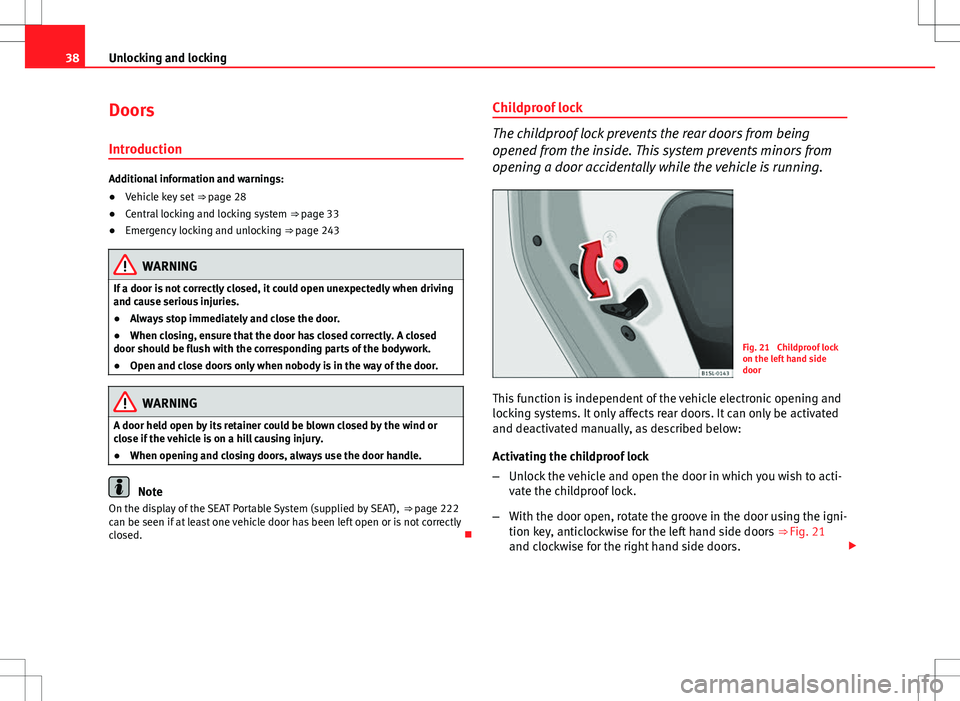
Fig. 21 Childproof lock
on the left hand side
door
This function is independent of the vehicle electronic opening and
locking systems. It only affects rear doors. It can only be activated
and deactivated manually, as described below:
Activating the childproof lock
– Unlock the vehicle and open the door in which you wish to acti-
vate the childproof lock.
– With the door open, rotate the groove in the door using the igni-
tion key, anticlockwise for the left hand side doors ⇒ Fig. 21
and clockwise for the right hand side doors.
Page 41 of 308
39
Unlocking and locking
Deactivating the childproof lock
– Unlock the vehicle and open the door whose childproof lock you
want to deactivate.
– With the door open, rotate the groove in the door using the igni-
tion key, anticlockwise for the right hand side doors and clock-
wise for the left hand side doors ⇒ Fig. 21.
Once the childproof lock is activated, the door can only be opened from the
outside. The childproof lock can be activated and deactivated by inserting
the key in the groove when the door is open, as described above.
Vehicle diagramPrior to a journey...While drivingCare, cleaning and mainte-
nanceIf and whenTechnical Data
Page 42 of 308
40Unlocking and locking
Rear lid
Introduction
Additional information and warnings:
● Exterior detail ⇒ page 6
● Central locking ⇒ page 33
● Transporting ⇒ page 97
● Emergency locking and unlocking ⇒ page 243
WARNING
Careless and unsuitable locking, opening and closing of the rear lid can
cause accidents and serious injury.
● Open and close the rear lid only when nobody is in the way.
● Do not close the rear lid by pushing it down with your hand on the
rear window. The rear window could break and cause injury.
● Ensure the rear lid is closed and locked correctly after closing, other-
wise, it may open unexpectedly while driving. A closed rear lid should be
flush with the corresponding parts of the bodywork.
● Always keep the rear lid closed while driving to avoid toxic gases en-
tering the interior.
● Do not open the rear lid when there is a load installed, for example a
carrier system. Likewise, the rear lid cannot be opened when a load is at-
tached to it, for example bicycles. An open rear lid could close itself if
there is an additional weight on it. If necessary, press down on the rear
lid and remove the load.
● Close and lock both the rear lid and all the other doors when you are
not using the vehicle. Ensure that nobody remains inside the vehicle.
WARNING (Continued)
● Never allow children to play inside or around the vehicle without su-
pervision, especially if the rear lid is open. Children could enter the lug-
gage compartment, close the rear lid and become trapped. Depending on
the time of the year, temperatures inside a locked and closed vehicle can
be extremely high or extremely low resulting in serious injuries and ill-
ness or even death, particularly for young children.
● Never leave children or disabled people alone in the vehicle. If the ve-
hicle key or the central locking button is used, they may be locked in the
vehicle.
CAUTION
Before opening the rear lid, ensure that there is sufficient free space to
open and close it, for example if you are in a garage.
Note
On the display of the Portable Navigation System (supplied by SEAT)
⇒ page 222 can be seen if the rear lid has been left open or is not correctly
shut.
Page 44 of 308

42Unlocking and locking
Closing the rear lid
● Grab the handgrip inside the rear lid ⇒ Fig. 23 (arrow).
● Push the rear lid downwards until it locks into place in the lock.
● Ensure that it is correctly closed by pulling on it firmly.
Locking the rear lid with central locking*
If the vehicle is unlocked and no doors or the rear lid are opened during
about. 30 seconds, it will automatically lock again. This function prevents
the vehicle from remaining unlocked if the unlocking button is pressed by
mistake.
Locking is only possible when the rear lid is correctly and fully closed.
● The rear lid is also locked by a central locking.
● If the vehicle rear lid is locked or unlocked using the
button, when it
is closed once more it will lock automatically.
● A closed but not locked rear lid will lock automatically at a speed above
about 9 km/h (6 mph).
Locking the rear lid with the vehicle mechanical key
Locking is only possible when the rear lid is correctly and fully closed.
● Insert the vehicle key into the lock cylinder of the driver door and turn
the key in a clockwise direction ⇒ page 33.
WARNING
Unsuitable or careless closing and locking of the rear lid could cause se-
rious injuries.
● Never leave the vehicle unattended, and never allow children to play
inside or around the vehicle without supervision, especially if the rear lid
is open. Children could enter the luggage compartment, close the rear lid
and become trapped. A locked vehicle can be subjected to extremely high
and low temperatures, depending on the time of year, thus causing seri-
ous injuries/illness and even death.
Note
Before closing the rear lid, make sure that the key has not been left inside
the boot.
Page 45 of 308
43
Unlocking and locking
Windows Introduction
Additional information and warnings:
● SEAT information system ⇒ page 22
● Central locking and locking system ⇒ page 33
WARNING
Careless use of the electric windows can cause serious injury.
● Only operate the electric windows when nobody is in the way.
● Never leave children or disabled people alone in the vehicle if the
doors are to be locked. The windows cannot be opened in case of an
emergency.
● Always take all the keys with you whenever you leave the vehicle. Af-
ter turning off the ignition, the windows can be opened and closed for a
short time using the buttons on the door as long as the driver door or
passenger side door is not open.
CAUTION
When the windows are open, rain can enter into the vehicle, dampening the
interior equipment and causing damage to the vehicle. Opening and closing the electric windows
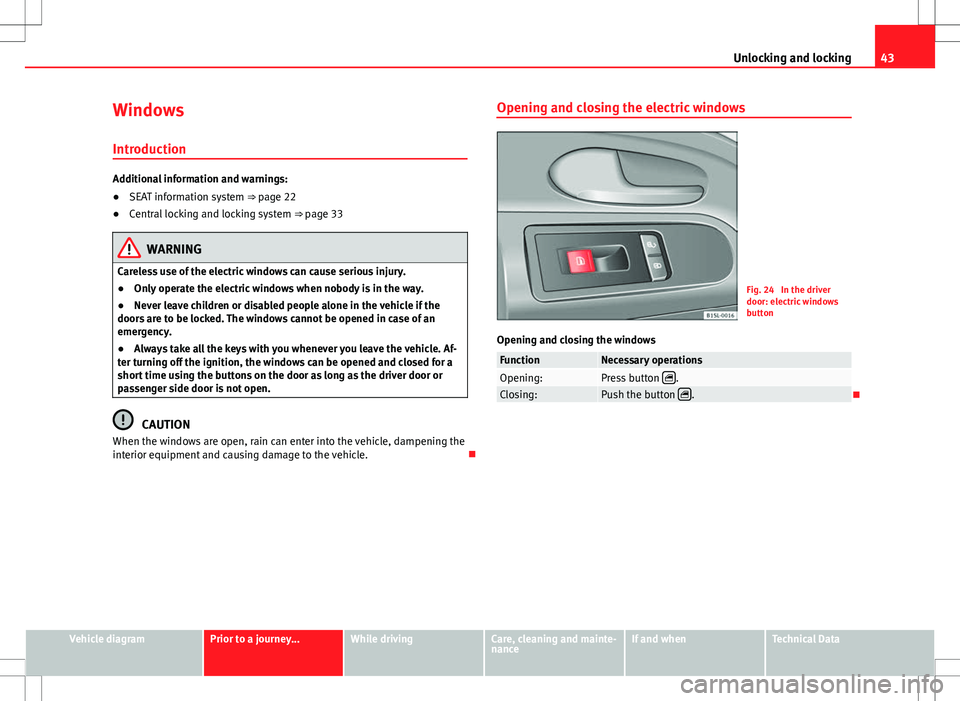
Fig. 24 In the driver
door: electric windows
button
Opening and closing the windows
FunctionNecessary operationsOpening:Press button .Closing:Push the button .
Vehicle diagramPrior to a journey...While drivingCare, cleaning and mainte-
nanceIf and whenTechnical Data
Page 51 of 308

49
Ensuring you are correctly and safely seated
WARNING (Continued)
● Keep your back straight and resting completely against the backrest
and the front seats correctly adjusted. Never place any part of your body
in the area of the airbag or very close to it.
● If passengers on the rear seats are not sitting in an upright position,
the risk of severe injury due to incorrect positioning of the belt web in-
creases.
WARNING
Incorrect seat adjustment may lead to accidents and severe injuries.
● Only adjust the seats when the vehicle is stationary, as the seats
could move unexpectedly while the vehicle is in motion and you could
lose control of the vehicle. Furthermore, an incorrect position is adopted
when adjusting the seat.
● Only adjust the height, backrest and forwards or backwards position
of the seat when there is nobody in the seat adjustment area.
● There must be no objects blocking the front seat adjustment area.
Danger of injuries due to an incorrect sitting position
If the seat belts are worn incorrectly or not at all, the risk of severe or fatal
injuries increases. Seat belts can provide optimal protection only if the belt
web is properly worn. The seat belt cannot offer its full protection if the belt
web is not positioned correctly. This could result in severe and even fatal in-
juries. The risk of severe or fatal injuries is especially increased when a de-
ploying airbag strikes an occupant who has assumed an incorrect sitting
position. The driver is responsible for all passengers in the vehicle, particu-
larly children.
The following list shows just some examples of incorrect sitting positions
which can be dangerous to all occupants. When the vehicle is in motion:
●
Never stand in the vehicle.
● Never stand on the seats.
● Never kneel on the seats.
● Never tilt your backrest too far to the rear.
● Never lean against the dash panel.
● Never lie on the rear seats.
● Never sit on the front edge of a seat.
● Never sit sideways.
● Never lean out of a window.
● Never put your feet out of a window.
● Never put your feet on the dash panel.
● Never put your feet on the surface of a seat or backrest.
● Never travel in a footwell.
● Never travel on a seat without wearing the seat belt.
● Never carry any person in the luggage compartment.
WARNING
Every incorrect sitting position increases the risk of severe or fatal inju-
ries in the event of accidents or sudden braking or manoeuvres.
● All vehicle occupants must assume the proper sitting position and be
properly belted in while travelling.
● Occupants in incorrect sitting positions, not wearing their seat belt or
too close to the airbag run the risk of suffering severe or fatal injuries,
particularly if the airbag deploys and hits an occupant sitting in an incor-
rect position.
Vehicle diagramPrior to a journey...While drivingCare, cleaning and mainte-
nanceIf and whenTechnical Data
Page 75 of 308

73
Ensuring you are correctly and safely seated
When the front airbags are triggered they fill the zones marked in
red ⇒ Fig. 47 and ⇒ Fig. 48 (radius of action). Therefore, objects should
never be placed or mounted in these areas ⇒
. Factory-fitted accessories
are outside the range of the front airbag for the driver and the front passen-
ger, e.g. the baseplate for the mobile telephone support.
The airbag covers fold out of the steering wheel ⇒ Fig. 47 or dash panel
⇒ Fig. 48 when the driver and front passenger airbags are triggered. The air-
bag covers remain connected to the steering wheel or the dash panel.
WARNING
The airbag is deployed at high speed in fractions of a second.
● Always keep the deployment areas of the front airbags vacant.
● Never secure objects to the covers or in the deployment area of the
airbag modules, e.g. drink holders or phone supports.
● The deployment space between the front passengers and the airbags
must not in any case be occupied by other passenger, pets and objects.
● Never fix any object to the windscreen above the front airbag on the
front passenger side.
● Do not alter, cover or stick anything to the steering wheel hub or the
surface of the airbag module on the passenger side of the dash panel.
WARNING
Front airbags are deployed in front of the steering wheel ⇒ Fig. 47 and
the dash panel ⇒ Fig. 48.
● When driving, always hold the steering wheel on the outer edge of
the ring with both hands: 9 o'clock and 3 o'clock position.
WARNING (Continued)
● Adjust the driver seat so that there is a distance of at least
25 cm(10 inches) between the centre of your chest and the hub of the
steering wheel. If you physical constitution prevents you from meeting
these requirements, make sure you contact a Specialised workshop.
● Adjust the front passenger seat so there is as much distance as possi-
ble between the front passenger and the dash panel.
Deactivating and activating the front passenger airbag
using the key switch
Fig. 49 On front passen-
ger side: key switch for
disabling and enabling
the front passenger air-
bag
Disable the front passenger airbag when a rear-facing child seat is moun-
ted.
Deactivating the front passenger airbag
● Switch the ignition off.
● Open the door on the front passenger side.
● Unfold the key shaft ⇒ page 28.
Vehicle diagramPrior to a journey...While drivingCare, cleaning and mainte-
nanceIf and whenTechnical Data