wheel bolts Seat Mii 2012 Owner's manual
[x] Cancel search | Manufacturer: SEAT, Model Year: 2012, Model line: Mii, Model: Seat Mii 2012Pages: 308, PDF Size: 4.13 MB
Page 107 of 308

105
Transporting
Securing the base supports and roof carrier system
Fig. 70 Attachment
points for the basic sup-
port and the roof carrier
system
The mounts are the basis of a complete roof carrier system. Special fixtures
must then be added in order to safely transport luggage, bicycles, skis, surf
boards or boats on the roof. The suitable accessories can be acquired at
SEAT dealerships.
Securing the base supports and roof carrier system
The roof carrier system must always be installed exactly according to the in-
structions provided.
The front attachment opening can be found in the lower part of the sides of
the roof and are fixed with plastic bolts ⇒ Fig. 70 (left magnified image).
The openings can only be seen with the door open. The markings for attach-
ment in the lower part are found in the upper part of the rear side windows
⇒ Fig. 70 (right magnified image).
The base support should only be fitted to the points indicated in the dia-
gram.
WARNING
If the base supports and the roof carrier system are incorrectly fitted or
used in an unsuitable manner, the entire system could break free causing
accident and injury.
● Always take the manufacturer assembly instructions into account.
● Only use base supports and roof carrier systems that are not dam-
aged and are correctly fitted.
● The base support should only be fitted to the points indicated in the
diagram ⇒ Fig. 70.
● Secure the base supports and roof carrier system correctly.
● Check the screw fittings and attachments before driving and after a
short distance. During each long journey, check the attachments during
every break.
● Always fit the roof carrier system correctly for wheels, skis and surf-
boards, etc.
● Never change or repair the basic supports or roof carrier system.
Note
Read and take into account the instructions included with the roof carrier
system fitted and keep them in the vehicle.
Loading the roof carrier system
Loads can only be correctly secured when the roof carrier system is correctly
fitted ⇒ .
Maximum authorised roof load
The maximum authorised roof load is 50 kg. The roof load includes the
weight of the base support, the roof carrier system and the load being
transported ⇒
.
Vehicle diagramPrior to a journey...While drivingCare, cleaning and mainte-
nanceIf and whenTechnical Data
Page 214 of 308

212Vehicle care and maintenance
perfect condition on the outside and which have a tread depth within the
values stipulated by the Law ⇒
.
The date of manufacture, part of the tyre identification number (TIN), indi-
cates the age of the tyre ( ) ⇒ page 218.
Storing tyres
Mark tyres when you remove them to indicate the direction of rotation (left,
right, forwards, backwards). This ensures you will be able to mount them
correctly when you replace them. When removed, the wheels and/or tyres
should be stored in a cool, dry and preferably dark location. Do not place
tyres mounted on the wheel in a vertical position.
Protect tyres not mounted on wheels from dirt by storing them in suitable
bags and standing them on the ground on their tread.
WARNING
Aggressive fluids or substances could result in visible or invisible dam-
age with the consequent risks.
● Always ensure that tyres do not come into contact with chemical
products, oil, grease, fuel, brake fluid or other aggressive substances.
WARNING
Old tyres, even if they have never been used, may lose air or burst unex-
pectedly while driving, resulting in serious accident or damage.
● If tyres are over six years old, they should only be used in an emer-
gency and with extreme caution.
For the sake of the environment
Old tyres must be disposed of by qualified personnel according to the laws
in the country concerned. Wheel rims
The design of wheel bolts is matched to the rims. If different rims are fitted,
the correct wheel bolts with the right length and correctly shaped bolt
heads must be used. This ensures that wheels are fitted securely and that
the brake system functions correctly
⇒ page 250.
For technical reasons, it is not generally possible to use the wheels from
other vehicles. In some cases, this may also be true for the same model of
wheel.
The tyres and rims approved by SEAT are specially matched to the character-
istics of the vehicle and are critical to good road holding and safe handling.
Wheel bolts
Wheel bolts must be tightened to the correct torque ⇒ page 250.
Beadlock wheel rims
Beadlock wheel rims have various components. These are joined together
by special bolts using a special procedure. This ensures good performance,
a better seal, improved safety and wheel run out. Therefore, worn rims
should always be replaced and must only be repaired in a Specialised work-
shop. SEAT recommends visiting a Technical Service ⇒
.
Wheel trims with bolted trims
Wheel trims may be fitted with interchangeable trim parts which are attach-
ed to the rim using self-locking bolts. Worn trims should only be replaced at
a Specialised workshop. SEAT recommends visiting a Technical Service
⇒
.
Page 220 of 308

218Vehicle care and maintenance
● Do not drive faster than 80 km/h (50 mph).
● Avoid heavy acceleration, hard braking and fast cornering.
● Snow chains on the temporary spare wheel are not permitted
⇒ page 220.
● After mounting the spare wheel or the temporary spare wheel, check the
tyre pressure as soon as possible ⇒ page 214.
It is advisable to check the spare wheel or temporary spare wheel tyre pres-
sure when checking the rest of the vehicle wheels at least once a month.
The spare wheel should have the highest pressure allowed for the vehicle
⇒ page 214. The sticker situated on the temporary spare wheel shows the
tyre pressure.
WARNING
Incorrect handling of the spare wheel or the temporary spare wheel can
cause loss of vehicle control, producing collisions or other serious acci-
dents and injury.
● Never use the spare wheel or the temporary spare wheel if it is dam-
aged or worn to the wear indicator.
● In some vehicles the spare wheel is smaller than the original tyres.
This can be seen on a sticker showing the text “80 km/h” and “50 mph”.
This text indicates the maximum velocity permitted for this type of tyre.
● Never drive faster than 80 km/h (50 mph). Avoid powerful accelera-
tion, hard braking and taking corners at high speed.
● Never drive more than 200 km (120 miles) with a temporary spare
wheel fitted to the drive axle.
● Replace the temporary spare wheel for a normal wheel as soon as
possible. The compact temporary spare wheel is only intended for tempo-
rary use over short distances.
● The temporary spare wheel must always be secured with the factory
supplied wheel bolts.
WARNING (Continued)
● You should never use more than one temporary spare wheel.
● After mounting the temporary spare wheel, check the tyre pressure as
soon as possible ⇒ page 214.
● Snow chains on the temporary spare wheel are not permitted.
Note
Wherever possible, secure the spare wheel, temporary spare wheel or the
replaced wheel safely in the luggage compartment. In vehicles with anti-
puncture kit, it is not possible to secure the defective wheel.
Tyre code
Fig. 124 Universal code on tyres
Page 223 of 308

221
Vehicle care and maintenance
Remove wheel hub covers and trim rings before fitting snow chains ⇒
.
The wheel bolts should be covered with caps for safety reasons. These are
available from Technical Services.
Temporary spare wheel
For technical reasons, snow chains must not be used on the compact tem-
porary spare wheel ⇒ page 217.
If it is necessary to fit chains with the temporary spare wheel in use, install
the temporary spare wheel on the rear axle in the event of a fault in a front
wheel. Then, fit the rear wheel that is free, instead of the damaged front
wheel. In this situation, observe the rotating direction of the wheels. SEAT
recommends attaching the snow chains before fitting the wheel.
WARNING
The use of unsuitable or incorrectly fitted chains could lead to serious ac-
cidents and damage.
● Always the appropriate snow chains.
● Observe the fitting instructions provided by the snow chain manufac-
turer.
● Never exceed the maximum permitted speeds when driving with snow
chains.
CAUTION
● You must remove the snow chains to drive on roads which are free of
snow. Otherwise they will impair handling, damage the tyres and wear out
very quickly.
● Wheel trims may be damaged or scratched if the chains come into direct
contact with them. SEAT recommends the use of covered snow chains.
Note
Snow chains are available in different sizes according to the vehicle type.
Vehicle diagramPrior to a journey...While drivingCare, cleaning and mainte-
nanceIf and whenTechnical Data
Page 249 of 308
247
Practical information
Components
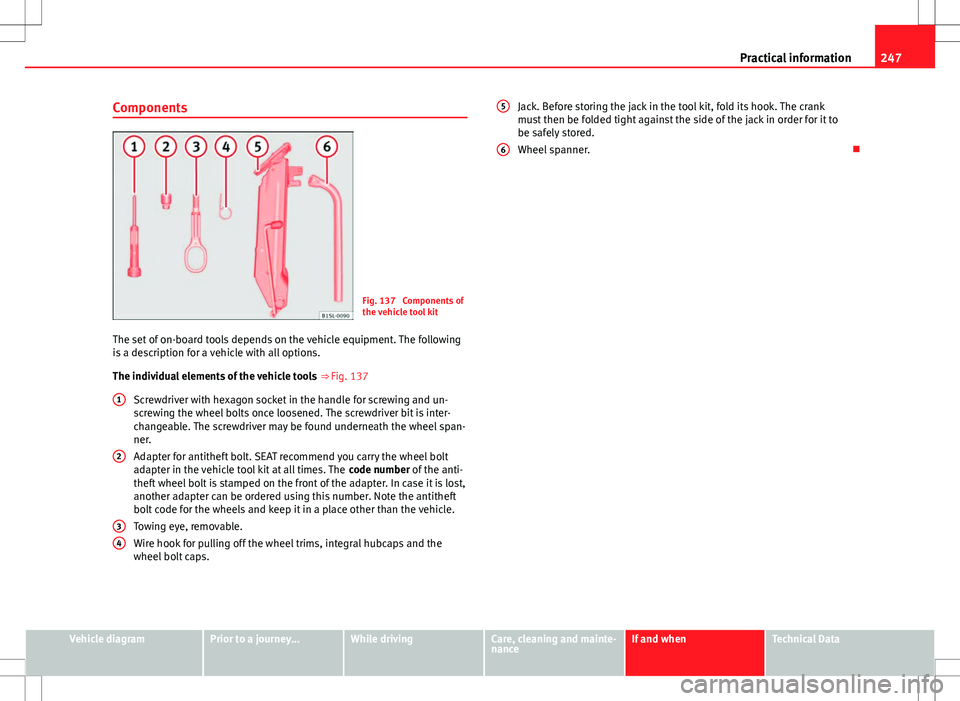
Fig. 137 Components of
the vehicle tool kit
The set of on-board tools depends on the vehicle equipment. The following
is a description for a vehicle with all options.
The individual elements of the vehicle tools ⇒ Fig. 137
Screwdriver with hexagon socket in the handle for screwing and un-
screwing the wheel bolts once loosened. The screwdriver bit is inter-
changeable. The screwdriver may be found underneath the wheel span-
ner.
Adapter for antitheft bolt. SEAT recommend you carry the wheel bolt
adapter in the vehicle tool kit at all times. The code number of the anti-
theft wheel bolt is stamped on the front of the adapter. In case it is lost,
another adapter can be ordered using this number. Note the antitheft
bolt code for the wheels and keep it in a place other than the vehicle.
Towing eye, removable.
Wire hook for pulling off the wheel trims, integral hubcaps and the
wheel bolt caps.
1
2
34
Jack. Before storing the jack in the tool kit, fold its hook. The crank
must then be folded tight against the side of the jack in order for it to
be safely stored.
Wheel spanner.
5
6
Vehicle diagramPrior to a journey...While drivingCare, cleaning and mainte-
nanceIf and whenTechnical Data
Page 250 of 308
248Practical information
Wheel trims
Introduction
Additional information and warnings:
● Caring for and cleaning the vehicle exterior ⇒ page 197
● Vehicle tools ⇒ page 246
● Change wheel ⇒ page 250
● Tire Mobility Set ⇒ page 256
WARNING
If the wheel trims are not appropriate or not fitted correctly, they could
cause major accidents or damage.
● Incorrectly mounted wheel trims may come off while driving and en-
danger other road users.
● Damaged trims must never be mounted on the wheels.
● Always ensure that the brake ventilation and cooling is not cut off or
blocked. This is also valid if hubcaps are fitted later. If there is not
enough air, you may require significantly longer braking distances.
CAUTION
Remove and remount wheel trims taking care to avoid damage to the vehi-
cle. Hubcaps
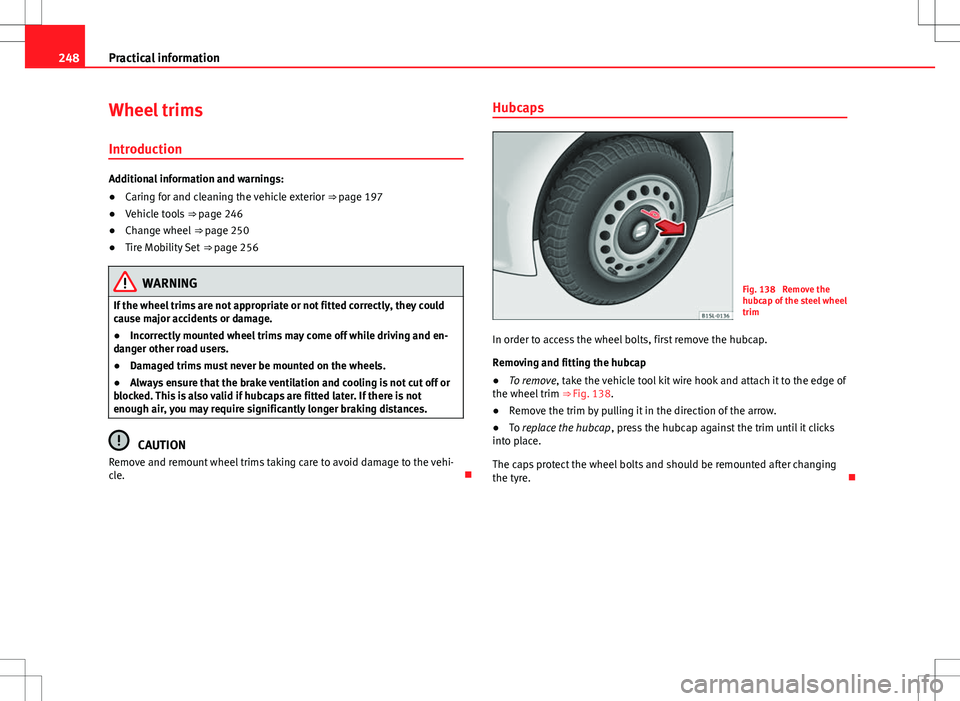
Fig. 138 Remove the
hubcap of the steel wheel
trim
In order to access the wheel bolts, first remove the hubcap.
Removing and fitting the hubcap
● To remove, take the vehicle tool kit wire hook and attach it to the edge of
the wheel trim ⇒ Fig. 138.
● Remove the trim by pulling it in the direction of the arrow.
● To replace the hubcap , press the hubcap against the trim until it clicks
into place.
The caps protect the wheel bolts and should be remounted after changing
the tyre.
Page 251 of 308

249
Practical information
Full hubcaps
Fig. 139 Removing the
full hubcap
Removing the full hubcap
● Take the wheel brace and the wire hook from the vehicle tool kit
⇒ page 246.
● Hook the wire through one of the grooves on the hubcap.
● Insert the wheel brace onto the wire hook
⇒ Fig. 139 and pull the hub
cap in the direction shown by the arrow.
Fitting hubcaps
Press the hubcap against the wheel so that the space for the valve fits over
the tyre valve. Make sure that the hubcap is correctly fitted all the way
around the wheel. If you are using an anti-theft wheel lock, screw it in the
opposite position to the valve. Wheel bolt capsFig. 140 Removing the
wheel bolt caps
● Take the wire hook from the vehicle tool kit ⇒ page 246.
● Insert the wire hook in the cap through the opening ⇒ Fig. 140 and pull
outwards in the direction of the arrow.
The caps protect the wheel bolts and should be remounted after changing
the tyre.
The anti-theft wheel locking bolt has a special cap. This cap only fits on an-
ti-theft locking bolts and is not for use with standard wheel bolts.
Vehicle diagramPrior to a journey...While drivingCare, cleaning and mainte-
nanceIf and whenTechnical Data
Page 252 of 308

250Practical information
Changing a wheel
Introduction
Some vehicle versions and models do not have a factory-fitted jack or box
spanner. In this case, we recommend consulting a Specialised workshop to
change the wheel.
You should only change the wheels yourself if the vehicle is parked in a safe
place, you are familiar with the procedure and you have all the necessary
tools! Otherwise, you should seek professional assistance.
Additional information and warnings:
● Exterior detail ⇒ page 6
● Vehicle key set ⇒ page 28
● Wheels and tyres ⇒ page 210
● In case of emergency ⇒ page 240
● Vehicle tools ⇒ page 246
● Wheel trims ⇒ page 248
WARNING
Changing a wheel can be dangerous, especially on the hard shoulder.
Please observe the following rules to minimise the risk of injury:
● Stop the vehicle safely as soon as possible. Park your vehicle as safe
distance from surrounding traffic to change a wheel.
● When changing a wheel, keep all passengers and particularly chil-
dren a safe distance away from the work area.
● Turn on the hazard warning lights to warn other road users.
● Ensure the ground on which you park is flat and solid. If necessary,
support the jack on a wide solid base.
WARNING (Continued)
● If you are changing a wheel yourself, you should be familiar with the
required procedure. Otherwise, you should seek professional assistance.
● Only use suitable tools that are not damaged when changing a wheel.
● Always stop the engine, apply the handbrake lever firmly and place
the selector lever in position P, or engage a gear for a manual gearbox to
reduce the risk of the vehicle moving accidentally.
● Have the tightening torque of the wheel bolts checked as soon as
possible with a reliable torque wrench.
Page 253 of 308

251
Practical information
Preparations for changing a wheel
Check list
Before changing a wheel, complete the following operations in the order
given ⇒
:
1. In the event of a flat tyre, park the vehicle a safe distance from traffic and on suitable ground.
2. Apply the handbrake firmly ⇒ page 134.
3. Automatic gearbox: move the selector lever to position P
⇒ page 124.
4. Stop the engine and remove the key from the ignition ⇒ page 119.
5. Manual gearbox: Select a gear ⇒ page 124.
6. Have all vehicle occupants get out of the vehicle and wait in a safe place (for example, behind the safety barrier).
7. Chock the wheel opposite the wheel being changed with a stone or similar object.
8. If the luggage compartment is full: take the baggage out of the vehi- cle.
9. Remove the spare wheel or the temporary spare wheel and the vehi- cle tool kit from the luggage compartment.
10. Remove the wheel trims ⇒ page 248.
WARNING
Failure to follow the checklist prepared for your own safety could lead to
accidents and severe injuries.
● Always complete the operations given in the checklist and observe
the general rules of safety.
Wheel bolts
Fig. 141 Changing the
wheel: Slacken the wheel
bolts
Fig. 142 Changing the
wheel: Tyre valve
1 and
position of anti-theft
wheel locking bolt 2
Only use the tool supplied with the vehicle to loosen the wheel bolts.
Loosen the wheel bolts only about one turn before raising the vehicle with
the jack.
Vehicle diagramPrior to a journey...While drivingCare, cleaning and mainte-
nanceIf and whenTechnical Data
Page 254 of 308

252Practical information
If the wheel bolt is very tight, you may be able to loosen it by pushing down
on the end of the wheel brace carefully with your foot. Hold on to the vehicle
for support and take care not to slip.
Loosening wheel bolts
● Fit the wheel brace as far as it will go over the wheel bolt ⇒ Fig. 141.
● Hold the wheel brace at the end and rotate the bolt approximately one
turn anticlockwise ⇒
.
Loosening anti-theft wheel bolts
For wheels with full hubcap, the anti-theft wheel lock must be threaded into
position ⇒ Fig. 142 2
before mounting the hubcap. Otherwise it will not be
possible to mount the full hubcap.
● Take the adapter for anti-theft wheel bolts out of the vehicle tool kit.
● Insert the adapter onto the wheel bolt ⇒ Fig. 142. Push it on as far as it
will go.
● Fit the wheel brace onto the adapter as far as possible.
● Hold the wheel brace at the end and rotate the bolt approximately one
turn anticlockwise ⇒
.
Important information about wheel bolts
The wheel rims and bolts have been designed to be fitted to factory op-
tions. If different rims are fitted, the correct wheel bolts with the right length
and correctly shaped bolt heads must be used. This ensures that wheels are
fitted securely and that the brake system functions correctly.
In some circumstances, wheel bolts from the same model vehicle should
not be used.
Wheel bolt tightening torque
The prescribed tightening torque for wheel bolts for steel and alloy wheels
is 110 Nm. Have the tightening torque of the wheel bolts checked as soon
as possible with a reliable torque wrench. If wheel bolts are rusty and it is difficult to tighten them, the threads should
be replaced and cleaned before checking the tightening torque.
Never grease or lubricate wheel bolts or the wheel hub threads. Although
they have been tightened to the prescribed torque, they could come loose
while driving.
WARNING
If the wheel bolts are not fitted correctly they could be released while
driving leading to loss of vehicle control and serious damage.
● Only use wheel bolts which correspond to the wheel rims in question.
● Never use different wheel bolts.
● The bolts and threads should be clean, free of oil and grease and easy
to thread.
● To loosen and tighten the wheel bolts, always use the wheel brace
supplied with the vehicle.
● Loosen the wheel bolts only about one turn before raising the vehicle
with the jack.
● Never grease or lubricate wheel bolts or the wheel hub threads. Al-
though they have been tightened to the prescribed torque, they could
come loose while driving.
● Never loosen the bolted joints of wheel trims with bolted ring trims.
● If the wheel bolts are not tightened to the correct torque, they may
come loose while driving, and the bolts and rims may come out. If the
tightening torque is too high, the wheel bolts and threads can be dam-
aged.