door lock Seat Mii 2013 User Guide
[x] Cancel search | Manufacturer: SEAT, Model Year: 2013, Model line: Mii, Model: Seat Mii 2013Pages: 306, PDF Size: 4.3 MB
Page 41 of 306
39
Opening and closing
Rear lid
Introduction
Additional information and warnings:
● Exterior detail ⇒ page 6
● Central locking ⇒ page 32
● Transporting ⇒ page 95
● Emergency locking and unlocking ⇒ page 244
WARNING
Careless and unsuitable locking, opening and closing of the rear lid can
cause accidents and serious injury.
● Open and close the rear lid only when nobody is in the way.
● Do not close the rear lid by pushing it down with your hand on the
rear window. The rear window could break and cause injury.
● Ensure the rear lid is locked after closing, otherwise, it may open un-
expectedly while driving. A closed rear lid should be flush with the corre-
sponding parts of the bodywork.
● Always keep the rear lid closed while driving to avoid toxic gases en-
tering the vehicle interior.
● Do not open the rear lid when there is a load installed, for example a
carrier system. Likewise, the rear lid cannot be opened when a load is at-
tached to it, for example bicycles. An open rear lid could close itself if
there is an additional weight on it. If necessary, press down on the rear
lid and remove the load.
● Close and lock both the rear lid and all the other doors when you are
not using the vehicle. Ensure that nobody remains inside the vehicle.
WARNING (Continued)
● Never allow children to play inside or around the vehicle without su-
pervision, especially if the rear lid is open. Children could enter the lug-
gage compartment, close the rear lid and become trapped. Depending on
the time of the year, temperatures inside a locked and closed vehicle can
be extremely high or extremely low resulting in serious injuries and ill-
ness or even death, particularly for young children.
● Never leave children or disabled people alone in the vehicle. If the ve-
hicle key or the central locking button is used, they may be locked in the
vehicle.
CAUTION
Before opening the rear lid, ensure that there is sufficient free space to
open and close it, for example if you are in a garage.
Note
On the display of the Portable Navigation System (supplied by SEAT)
⇒ page 222 can be seen if the rear lid has been left open or is not correctly
shut.
Vehicle diagramPrior to a journey...While drivingCare, cleaning and mainte-
nanceIf and whenTechnical specifications
Page 42 of 306
40Opening and closing
Opening the rear lid
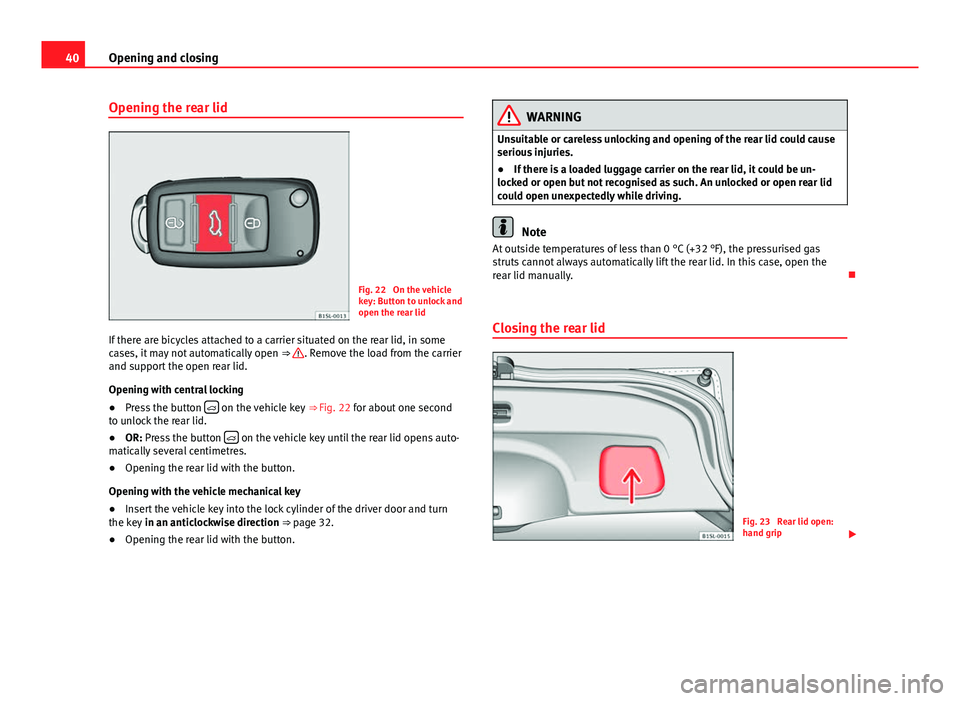
Fig. 22 On the vehicle
key: Button to unlock and
open the rear lid
If there are bicycles attached to a carrier situated on the rear lid, in some
cases, it may not automatically open ⇒
. Remove the load from the carrier
and support the open rear lid.
Opening with central locking
● Press the button
on the vehicle key
⇒ Fig. 22 for about one second
to unlock the rear lid.
● OR: Press the button
on the vehicle key until the rear lid opens auto-
matically several centimetres.
● Opening the rear lid with the button.
Opening with the vehicle mechanical key
● Insert the vehicle key into the lock cylinder of the driver door and turn
the key in an anticlockwise direction
⇒ page 32.
● Opening the rear lid with the button.
WARNING
Unsuitable or careless unlocking and opening of the rear lid could cause
serious injuries.
● If there is a loaded luggage carrier on the rear lid, it could be un-
locked or open but not recognised as such. An unlocked or open rear lid
could open unexpectedly while driving.
Note
At outside temperatures of less than 0 °C (+32 °F), the pressurised gas
struts cannot always automatically lift the rear lid. In this case, open the
rear lid manually.
Closing the rear lid
Fig. 23 Rear lid open:
hand grip
Page 43 of 306
41
Opening and closing
Closing the rear lid
● Grab the handgrip inside the rear lid ⇒ Fig. 23 (arrow).
● Push the rear lid downwards until it locks into place in the lock.
● Ensure that it is correctly closed by pulling on it firmly.
Locking the rear lid with central locking*
If the vehicle is unlocked and no doors or the rear lid are opened during
about. 30 seconds, it will automatically lock again. This function prevents
the vehicle from remaining unlocked if the unlocking button is pressed by
mistake.
Locking is only possible when the rear lid is correctly and fully closed.
● The rear lid is also locked by a central locking.
● If the vehicle rear lid is locked or unlocked using the
button, when it
is closed once more it will lock automatically.
● A closed but not locked rear lid will lock automatically at a speed above
about 9 km/h (6 mph).
Locking the rear lid with the vehicle mechanical key
Locking is only possible when the rear lid is correctly and fully closed.
● Insert the vehicle key into the lock cylinder of the driver door and turn
the key in a clockwise direction ⇒ page 32.
WARNING
Unsuitable or careless closing and locking of the rear lid could cause se-
rious injuries.
● Never allow children to play inside or around the vehicle without su-
pervision, especially if the rear lid is open. Children could enter the lug-
gage compartment, close the rear lid and become trapped. A locked vehi-
cle can be subjected to extremely high and low temperatures, depending
on the time of year, thus causing serious injuries/illness and even death.
Note
Before closing the rear lid, make sure that the key has not been left inside
the luggage compartment.
Vehicle diagramPrior to a journey...While drivingCare, cleaning and mainte-
nanceIf and whenTechnical specifications
Page 44 of 306
42Opening and closing
Windows
Introduction
Additional information and warnings:
● SEAT information system ⇒ page 22
● Central locking and locking system ⇒ page 32
WARNING
Careless use of the electric windows can cause serious injury.
● Only operate the electric windows when nobody is in the way.
● Never leave children or disabled people alone in the vehicle if the
doors are to be locked. The windows cannot be opened in case of an
emergency.
● Always take all the keys with you whenever you leave the vehicle. Af-
ter turning off the ignition, the windows can be opened and closed for a
short time using the buttons on the door as long as the driver door or
passenger side door is not open.
CAUTION
When the windows are open, rain can enter into the vehicle, dampening the
interior equipment and causing damage to the vehicle. Opening and closing the electric windows
Fig. 24 In the driver
door: electric windows
button
Opening and closing the windows
effectNecessary operationsOpening:Press button .Closing:Pull the switch .
Page 45 of 306
43
Opening and closing
Side-opening rear windows
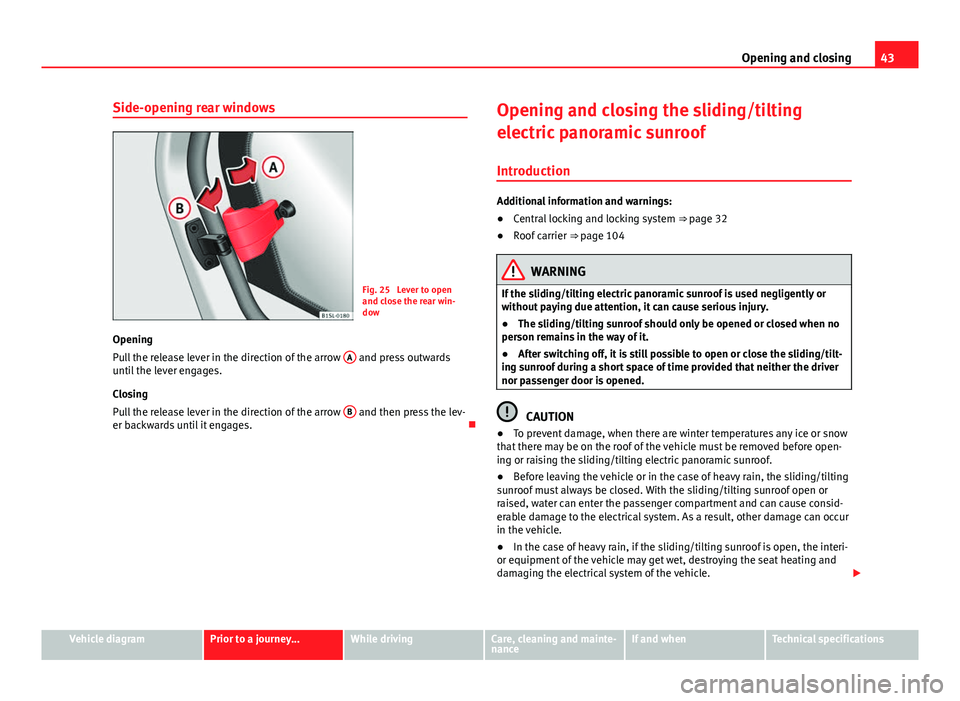
Fig. 25 Lever to open
and close the rear win-
dow
Opening
Pull the release lever in the direction of the arrow A
and press outwards
until the lever engages.
Closing
Pull the release lever in the direction of the arrow B
and then press the lev-
er backwards until it engages. Opening and closing the sliding/tilting
electric panoramic sunroof
Introduction
Additional information and warnings:
● Central locking and locking system ⇒ page 32
● Roof carrier ⇒ page 104
WARNING
If the sliding/tilting electric panoramic sunroof is used negligently or
without paying due attention, it can cause serious injury.
● The sliding/tilting sunroof should only be opened or closed when no
person remains in the way of it.
● After switching off, it is still possible to open or close the sliding/tilt-
ing sunroof during a short space of time provided that neither the driver
nor passenger door is opened.
CAUTION
● To prevent damage, when there are winter temperatures any ice or snow
that there may be on the roof of the vehicle must be removed before open-
ing or raising the sliding/tilting electric panoramic sunroof.
● Before leaving the vehicle or in the case of heavy rain, the sliding/tilting
sunroof must always be closed. With the sliding/tilting sunroof open or
raised, water can enter the passenger compartment and can cause consid-
erable damage to the electrical system. As a result, other damage can occur
in the vehicle.
● In the case of heavy rain, if the sliding/tilting sunroof is open, the interi-
or equipment of the vehicle may get wet, destroying the seat heating and
damaging the electrical system of the vehicle.
Vehicle diagramPrior to a journey...While drivingCare, cleaning and mainte-
nanceIf and whenTechnical specifications
Page 73 of 306
71
Ensuring you are correctly and safely seated
When the front airbags are triggered they fill the zones marked in
red ⇒ Fig. 47 and ⇒ Fig. 48 (radius of action). Therefore, objects should
never be placed or mounted in these areas ⇒
, Factory-fitted accessories
are outside the range of the front airbag for the driver and the front passen-
ger, e.g. the baseplate for the mobile phone support.
The airbag covers fold out of the steering wheel ⇒ Fig. 47 or dash panel
⇒ Fig. 48 when the driver and front passenger airbags are triggered. The air-
bag covers remain connected to the steering wheel or the dash panel.
WARNING
The airbag is deployed at high speed in fractions of a second.
● Always keep the deployment areas of the front airbags vacant.
● Never secure objects to the covers or in the deployment area of the
airbag modules, e.g. drink holders or phone supports.
● The deployment space between the front passengers and the airbags
must not in any case be occupied by other passenger, pets and objects.
● Never fix any object to the windscreen above the front airbag on the
front passenger side.
● Do not alter, cover or stick anything to the steering wheel hub or the
surface of the airbag module on the passenger side of the dash panel.
WARNING
Front airbags are deployed in front of the steering wheel ⇒ Fig. 47 and
the dash panel ⇒ Fig. 48.
● When driving, always hold the steering wheel on the outer edge of
the ring with both hands: 9 o'clock and 3 o'clock position.
WARNING (Continued)
● Adjust the driver seat so that there is a distance of at least 25 cm
(10 inches) between the centre of your chest and the hub of the steering
wheel. If you physical constitution prevents you from meeting these re-
quirements, make sure you contact a specialised workshop.
● Adjust the front passenger seat so there is as much distance as possi-
ble between the front passenger and the dash panel.
Deactivating and activating the front passenger front
airbag using the key switch
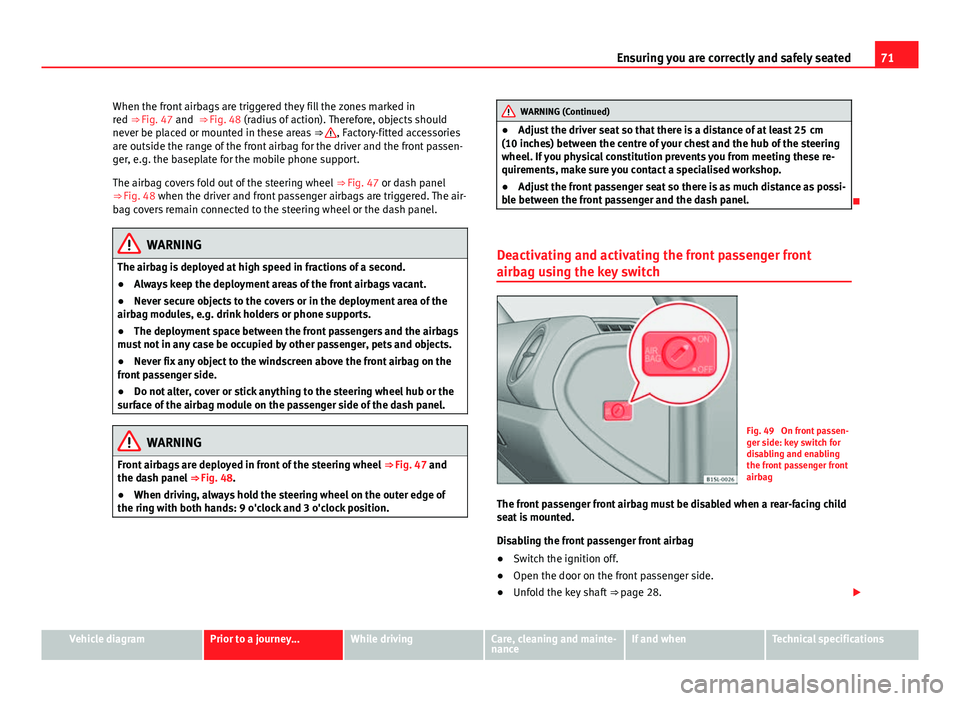
Fig. 49 On front passen-
ger side: key switch for
disabling and enabling
the front passenger front
airbag
The front passenger front airbag must be disabled when a rear-facing child
seat is mounted.
Disabling the front passenger front airbag
● Switch the ignition off.
● Open the door on the front passenger side.
● Unfold the key shaft ⇒ page 28.
Vehicle diagramPrior to a journey...While drivingCare, cleaning and mainte-
nanceIf and whenTechnical specifications
Page 88 of 306
86Lights and visibility
Headlight range control, lighting of instruments and
controls
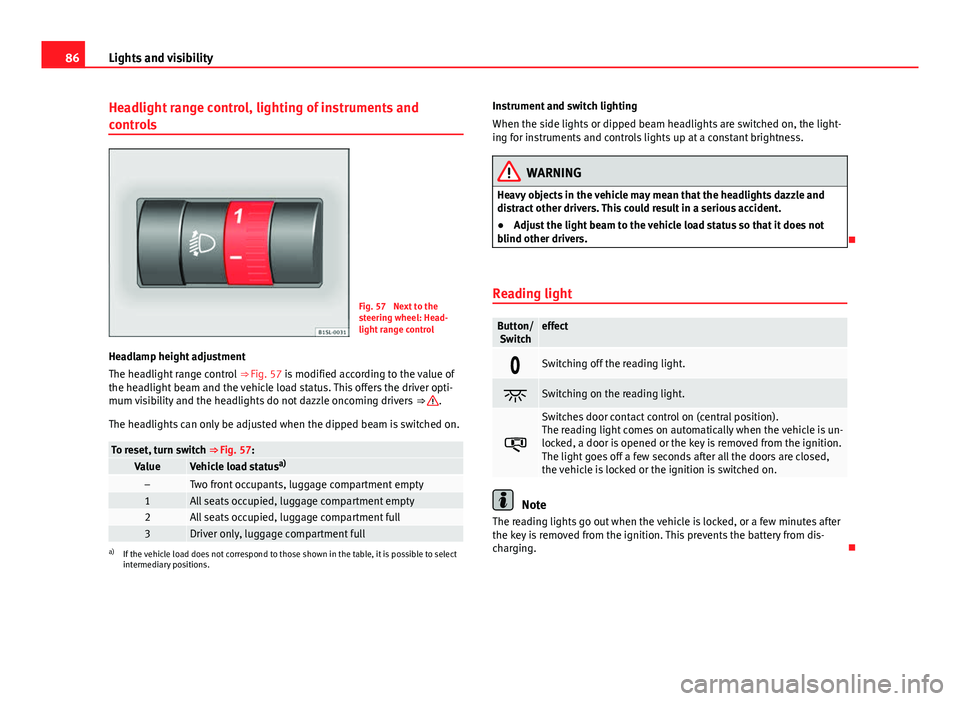
Fig. 57 Next to the
steering wheel: Head-
light range control
Headlamp height adjustment
The headlight range control ⇒ Fig. 57 is modified according to the value of
the headlight beam and the vehicle load status. This offers the driver opti-
mum visibility and the headlights do not dazzle oncoming drivers ⇒
.
The headlights can only be adjusted when the dipped beam is switched on.
To reset, turn switch ⇒ Fig. 57:ValueVehicle load status a)–Two front occupants, luggage compartment empty1All seats occupied, luggage compartment empty2All seats occupied, luggage compartment full3Driver only, luggage compartment fulla)
If the vehicle load does not correspond to those shown in the table, it is possible to select
intermediary positions. Instrument and switch lighting
When the side lights or dipped beam headlights are switched on, the light-
ing for instruments and controls lights up at a constant brightness.
WARNING
Heavy objects in the vehicle may mean that the headlights dazzle and
distract other drivers. This could result in a serious accident.
● Adjust the light beam to the vehicle load status so that it does not
blind other drivers.
Reading light
Button/ Switcheffect
Switching off the reading light.
Switching on the reading light.
Switches door contact control on (central position).
The reading light comes on automatically when the vehicle is un-
locked, a door is opened or the key is removed from the ignition.
The light goes off a few seconds after all the doors are closed,
the vehicle is locked or the ignition is switched on.
Note
The reading lights go out when the vehicle is locked, or a few minutes after
the key is removed from the ignition. This prevents the battery from dis-
charging.
Page 100 of 306
98Transporting
Loading luggage compartment
Introduction
Always transport heavy loads in the luggage compartment and place the
seat backs in a vertical position. Never overload the vehicle. Both the carry-
ing capacity as well as the distribution of the load in the vehicle have ef-
fects on the driving behaviour and braking ability ⇒
.
Additional information and warnings:
● Airbag system ⇒ page 65
● Light ⇒ page 82
● Transporting ⇒ page 95
● Wheels and tyres ⇒ page 210
WARNING
When the vehicle is not in use or being watched, always lock the doors
and the rear lid to reduce the risk of serious injury or death.
● Do not leave children unwatched, especially when the rear lid is open.
Children could climb into the luggage compartment, close the rear lid
from inside and be unable to escape themselves. This could lead to seri-
ous injury or death.
● Never allow children to play in or around the vehicle.
● Never transport people in the luggage compartment.
WARNING
Unsecured or incorrectly secured objects can cause serious injury in case
of a sudden manoeuvring or breaking or in case of an accident. This is es-
pecially true when objects are struck by a detonating airbag and fired
through the vehicle interior. To reduce the risks, please note the follow-
ing:
● Secure all objects in the vehicle. Always keep equipment and heavy
objects in the luggage compartment.
● Always secure objects with suitable rope or straps so that they can-
not enter the deployment areas around the frontal or side airbags in case
of sudden braking or an accident.
● While driving, always keep object compartments closed.
● Do not place hard, heavy or sharp objects inside the vehicle interior,
in open storage compartments, the rear shelf or on the dash panel.
● Remove hard, heavy and sharp objects from clothes and pockets in-
side the vehicle and store securely.
WARNING
The transport of heavy object changes vehicle handling and increases
braking distance. Heavy loads that have not been stored or secured cor-
rectly could cause loss of control and result in serious injury.
● The vehicle handling changes when transporting heavy objects due
to a change in the centre of gravity.
● Distribute the load as uniformly and as low down on the vehicle as
possible.
● Store heavy objects in the luggage compartment as far from the rear
axle as possible.
CAUTION
Hard objects on the rear shelf could chafe against the wires of the heating
element in the heated rear window and cause damage.
Page 177 of 306
175
At the filling station
Refuelling with natural gas
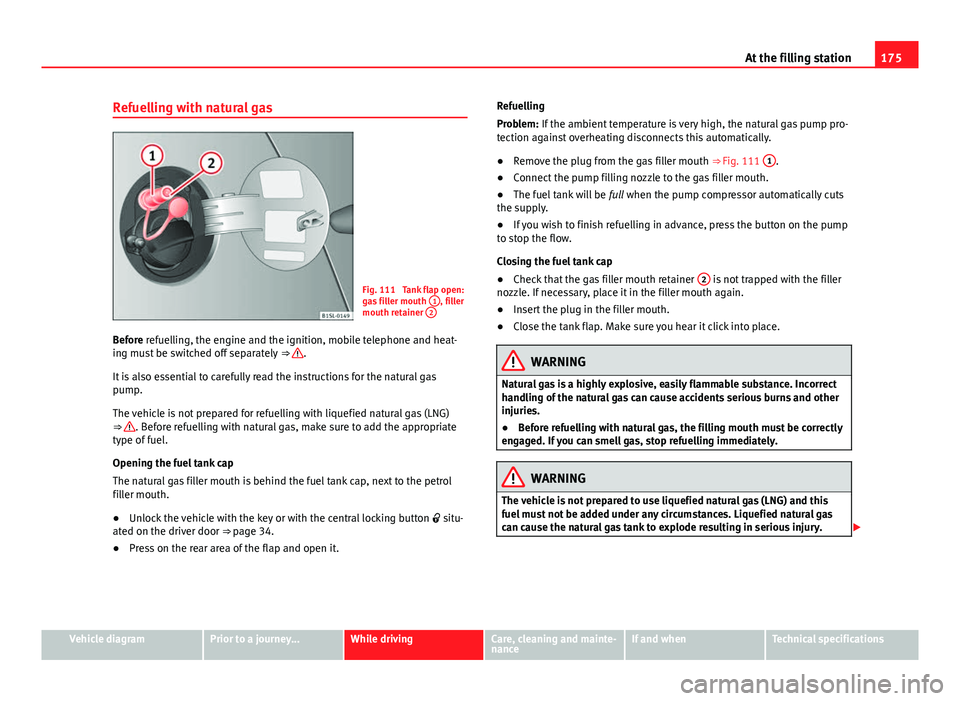
Fig. 111 Tank flap open:
gas filler mouth 1, filler
mouth retainer 2
Before refuelling, the engine and the ignition, mobile telephone and heat-
ing must be switched off separately
⇒ .
It is also essential to carefully read the instructions for the natural gas
pump.
The vehicle is not prepared for refuelling with liquefied natural gas (LNG)
⇒
. Before refuelling with natural gas, make sure to add the appropriate
type of fuel.
Opening the fuel tank cap
The natural gas filler mouth is behind the fuel tank cap, next to the petrol
filler mouth.
● Unlock the vehicle with the key or with the central locking button situ-
ated on the driver door ⇒ page 34.
● Press on the rear area of the flap and open it. Refuelling
Problem: If the ambient temperature is very high, the natural gas pump pro-
tection against overheating disconnects this automatically.
●
Remove the plug from the gas filler mouth ⇒ Fig. 111 1
.
● Connect the pump filling nozzle to the gas filler mouth.
● The fuel tank will be full when the pump compressor automatically cuts
the supply.
● If you wish to finish refuelling in advance, press the button on the pump
to stop the flow.
Closing the fuel tank cap
● Check that the gas filler mouth retainer 2
is not trapped with the filler
nozzle. If necessary, place it in the filler mouth again.
● Insert the plug in the filler mouth.
● Close the tank flap. Make sure you hear it click into place.
WARNING
Natural gas is a highly explosive, easily flammable substance. Incorrect
handling of the natural gas can cause accidents serious burns and other
injuries.
● Before refuelling with natural gas, the filling mouth must be correctly
engaged. If you can smell gas, stop refuelling immediately.
WARNING
The vehicle is not prepared to use liquefied natural gas (LNG) and this
fuel must not be added under any circumstances. Liquefied natural gas
can cause the natural gas tank to explode resulting in serious injury.
Vehicle diagramPrior to a journey...While drivingCare, cleaning and mainte-
nanceIf and whenTechnical specifications
Page 200 of 306
198Vehicle care and maintenance
For the sake of the environment
The remains of car care products should not be disposed of with ordinary
household waste. Observe information provided by the manufacturer.
Washing the vehicle
The longer substances such as insects, bird droppings, resinous tree sap,
road dirt, industrial deposits, tar, soot or road salt and other aggressive ma-
terials remain on the vehicle, the more damage they do to the paintwork.
High temperatures (for instance due to strong sunlight) further intensify the
corrosive effect. The vehicle undercarriage should also be thoroughly wash-
ed at regular intervals.
Automatic car washes
Always observe the instructions provided at the automatic car wash. The
standard precautionary measures prior to entering the car wash should be
taken to avoid damage to the vehicle (close all windows, fold in exterior mir-
rors). If the vehicle is fitted with additional components (spoiler, roof-rack,
aerial...), check with the car wash supervisor whether these can enter the
car wash ⇒
.
The vehicle paintwork is so durable that the vehicle can normally be washed
without problems in an automatic car wash tunnel. However, wear and dam-
age to the paintwork will depend on the type of car wash used. SEAT recom-
mends the use of car washed without brushes.
To remove traces of wax on windows and to prevent wiper blades from
scratching, please observe the following ⇒ page 200, Cleaning windows
and exterior mirrors.
Washing the car by hand
When washing the car by hand, use plenty of water to soften the dirt first,
and rinse off as well as possible. Then clean the vehicle with a soft
sponge, glove or brush using only slight
pressure. Start at the roof and work downwards. Special car shampoo
should only be used for very persistent dirt.
Rinse the sponge or glove thoroughly and often.
Wheels, sills and similar should be cleaned last. Use a second sponge for
this.
WARNING
Sharp components on the vehicle may cause injury.
● Protect arms and hands from sharp edges when cleaning the vehicle
undercarriage or the interior of the wheel hubs.
WARNING
After the vehicle has been washed, the braking effect will be reduced
(and the braking distance increased) due to moisture (and ice in winter)
on the brakes.
● Dry the brakes and remove ice by braking carefully. Ensure that you
are not endangering other road-users or breaking traffic regulations in
the process.
CAUTION
● The temperature of the water must not exceed +60 °C (+140 °F).
● To avoid damage to the paintwork, do not wash the vehicle in full sun.
● Do not use rough sponges or similar which could damage the surface to
clean away the traces of insects.
● Never wipe the headlights with a dry cloth or sponge, always moisten
first. It is best to use soapy water.
● Washing the vehicle in low temperatures: When washing the vehicle
with a hose, do not direct water into the lock cylinders or the gaps around
the doors, rear lid, or sunroof. Locks and seals could freeze!