steering Seat Mii 2013 User Guide
[x] Cancel search | Manufacturer: SEAT, Model Year: 2013, Model line: Mii, Model: Seat Mii 2013Pages: 306, PDF Size: 4.3 MB
Page 61 of 306
59
Ensuring you are correctly and safely seated
At speeds of 30 km/h (18 mph) to 50 km/h (30 mph), the forces acting on
bodies in a collision can easily exceed one tonne (1000 kg or
2.205 pounds). At greater speed these forces are even higher.
This example applies not only to head-on collisions, but to all accidents and
collisions.
Dangers of not using the seat belt
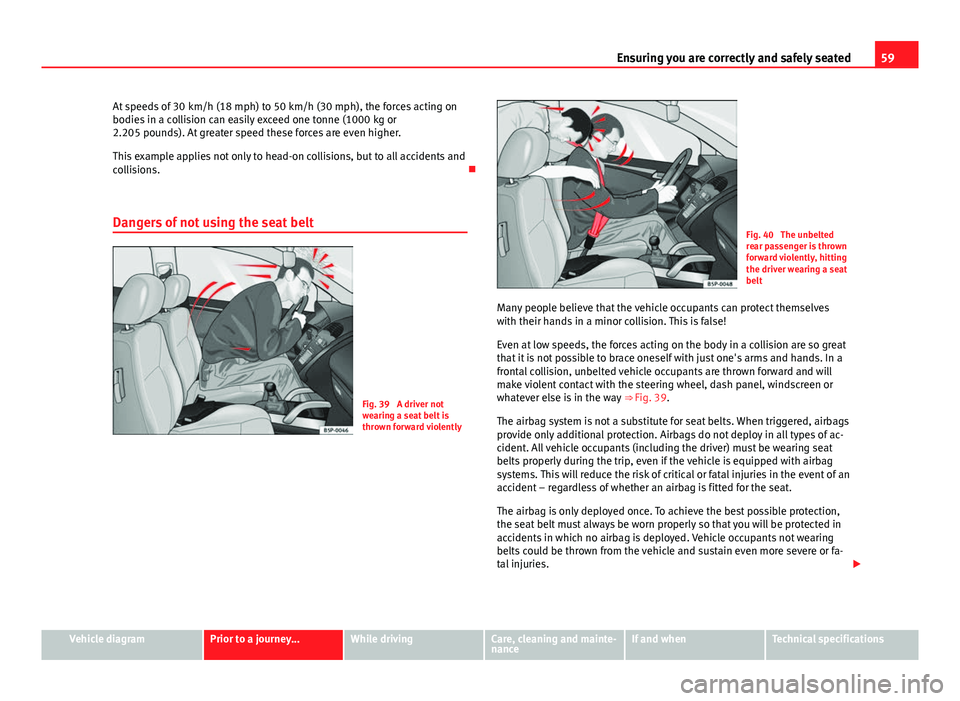
Fig. 39 A driver not
wearing a seat belt is
thrown forward violently
Fig. 40 The unbelted
rear passenger is thrown
forward violently, hitting
the driver wearing a seat
belt
Many people believe that the vehicle occupants can protect themselves
with their hands in a minor collision. This is false!
Even at low speeds, the forces acting on the body in a collision are so great
that it is not possible to brace oneself with just one's arms and hands. In a
frontal collision, unbelted vehicle occupants are thrown forward and will
make violent contact with the steering wheel, dash panel, windscreen or
whatever else is in the way ⇒ Fig. 39.
The airbag system is not a substitute for seat belts. When triggered, airbags
provide only additional protection. Airbags do not deploy in all types of ac-
cident. All vehicle occupants (including the driver) must be wearing seat
belts properly during the trip, even if the vehicle is equipped with airbag
systems. This will reduce the risk of critical or fatal injuries in the event of an
accident – regardless of whether an airbag is fitted for the seat.
The airbag is only deployed once. To achieve the best possible protection,
the seat belt must always be worn properly so that you will be protected in
accidents in which no airbag is deployed. Vehicle occupants not wearing
belts could be thrown from the vehicle and sustain even more severe or fa-
tal injuries.
Vehicle diagramPrior to a journey...While drivingCare, cleaning and mainte-
nanceIf and whenTechnical specifications
Page 67 of 306
65
Ensuring you are correctly and safely seated
Airbag system Introduction
Front airbags have been installed for both driver and passenger. The front
airbags can also protect the chest and head of driver and passenger if the
seats, seat belts head restraints and, for the driver, the steering wheel are
correctly adjusted and used. Airbags are considered as additional safety
equipment. An airbag cannot replace the seat belt, which must be worn at
all times, even in front seats where front airbags have been installed.
Additional information and warnings:
● Driving tips ⇒ page 25
● Correct sitting position ⇒ page 47
● Seat belts ⇒ page 56
● Child seats (accessories) ⇒ page 74
● Care and cleaning of the vehicle interior ⇒ page 205
● Accessories, parts replacement, repairs and modifications ⇒ page 222
● Notes for the user ⇒ page 233
WARNING
Never exclusively trust the airbag system as a means of protection.
● Even when triggered, airbag protection is only auxiliary.
● The airbags provide the best protection when the seat belts are prop-
erly fastened, thus reducing the risk of sustaining injuries ⇒ page 56,
Seat belts.
● Before each trip, every occupant must sit properly, correctly fasten
the seat belt belonging to his or her seat and keeping it fastened
throughout the trip. This rule is valid for all vehicle occupants.
WARNING
Occupants sitting in the front of the vehicle must never carry any objects
in the deployment space between them and the airbags, as this increa-
ses the risk of sustaining injuries if the airbag is triggered. This modifies
the airbag deployment space or the objects may fly uncontrollably and
hit your body.
● Never carry objects in your hand or on your lap while the vehicle is in
motion.
● Never transport objects on the front passenger seat. In the event of
sudden braking and manoeuvres, the objects may end up in the airbag
deployment space and fly uncontrollably around the interior if the airbag
is activated.
● Occupants of the front and rear seats must never carry any other peo-
ple, pets or objects in the deployment space between them and the air-
bags. Make sure children and other passengers also respect this recom-
mendation.
WARNING
The airbag system provides protection for one accident only. If they have
been deployed, they must be replaced.
● Ensure deployed airbags and the system components involved are im-
mediately replaced with new, SEAT-approved components for the vehicle.
● Have any repairs or modifications carried out at a specialised work-
shop. Specialised workshops have the necessary tools, diagnostics
equipment, repair information and qualified personnel.
● Never fit recycled or reused airbag components in your vehicle.
● Never modify the airbag system components.
Vehicle diagramPrior to a journey...While drivingCare, cleaning and mainte-
nanceIf and whenTechnical specifications
Page 71 of 306
69
Ensuring you are correctly and safely seated
● Optimised seat belts for all seats.
● Seat belt tension devices for driver and passenger.
● Seat belt force limiters for driver and passenger.
● Seat belt warning lamp
● Front airbags for driver and passenger.
● Side airbags for driver and passenger.
● Airbag control lamp .
● Control units and sensors.
● Head restraints optimised for rear-end collision.
● Adjustable steering column.
● If necessary, anchor points for child seats for the rear seats.
● Where applicable, mountings for the child seat upper retaining strap. Situations when the front and side airbags do not deploy:
●
If the ignition is switched off during the collision.
● In frontal collisions when the deceleration measured by the control unit
is too low.
● In minor side collisions.
● In rear collisions.
● In the event of the vehicle overturning.
● When the impact speed is lower than the reference value set in the con-
trol unit.
Vehicle diagramPrior to a journey...While drivingCare, cleaning and mainte-
nanceIf and whenTechnical specifications
Page 72 of 306
70Ensuring you are correctly and safely seated
Front airbags
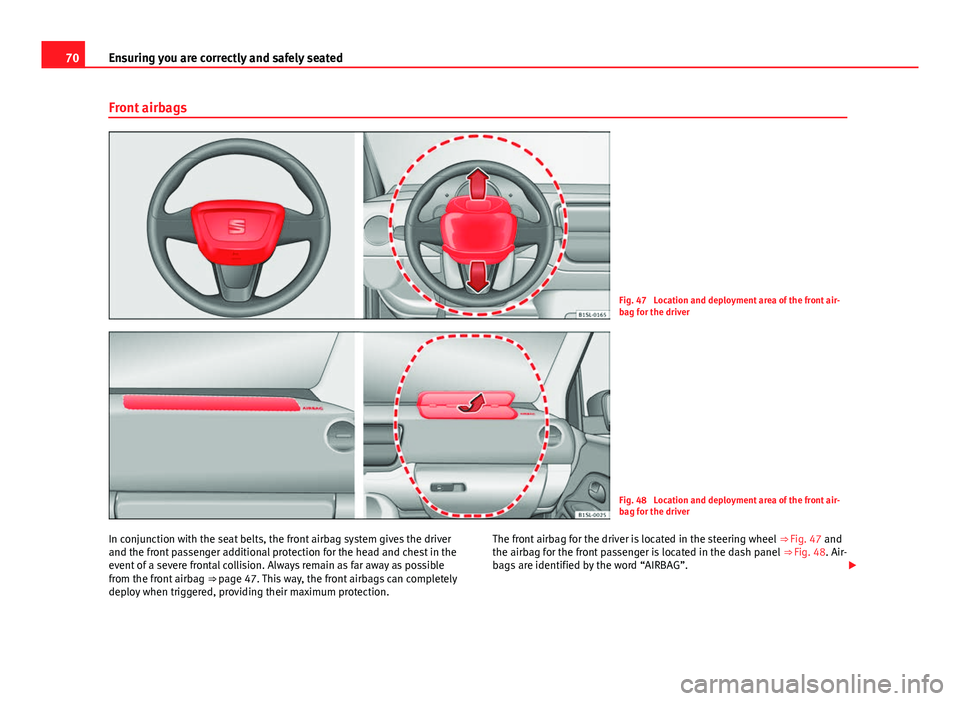
Fig. 47 Location and deployment area of the front air-
bag for the driver
Fig. 48 Location and deployment area of the front air-
bag for the driver
In conjunction with the seat belts, the front airbag system gives the driver
and the front passenger additional protection for the head and chest in the
event of a severe frontal collision. Always remain as far away as possible
from the front airbag ⇒ page 47. This way, the front airbags can completely
deploy when triggered, providing their maximum protection. The front airbag for the driver is located in the steering wheel
⇒ Fig. 47 and
the airbag for the front passenger is located in the dash panel ⇒ Fig. 48. Air-
bags are identified by the word “AIRBAG”.
Page 73 of 306
71
Ensuring you are correctly and safely seated
When the front airbags are triggered they fill the zones marked in
red ⇒ Fig. 47 and ⇒ Fig. 48 (radius of action). Therefore, objects should
never be placed or mounted in these areas ⇒
, Factory-fitted accessories
are outside the range of the front airbag for the driver and the front passen-
ger, e.g. the baseplate for the mobile phone support.
The airbag covers fold out of the steering wheel ⇒ Fig. 47 or dash panel
⇒ Fig. 48 when the driver and front passenger airbags are triggered. The air-
bag covers remain connected to the steering wheel or the dash panel.
WARNING
The airbag is deployed at high speed in fractions of a second.
● Always keep the deployment areas of the front airbags vacant.
● Never secure objects to the covers or in the deployment area of the
airbag modules, e.g. drink holders or phone supports.
● The deployment space between the front passengers and the airbags
must not in any case be occupied by other passenger, pets and objects.
● Never fix any object to the windscreen above the front airbag on the
front passenger side.
● Do not alter, cover or stick anything to the steering wheel hub or the
surface of the airbag module on the passenger side of the dash panel.
WARNING
Front airbags are deployed in front of the steering wheel ⇒ Fig. 47 and
the dash panel ⇒ Fig. 48.
● When driving, always hold the steering wheel on the outer edge of
the ring with both hands: 9 o'clock and 3 o'clock position.
WARNING (Continued)
● Adjust the driver seat so that there is a distance of at least 25 cm
(10 inches) between the centre of your chest and the hub of the steering
wheel. If you physical constitution prevents you from meeting these re-
quirements, make sure you contact a specialised workshop.
● Adjust the front passenger seat so there is as much distance as possi-
ble between the front passenger and the dash panel.
Deactivating and activating the front passenger front
airbag using the key switch
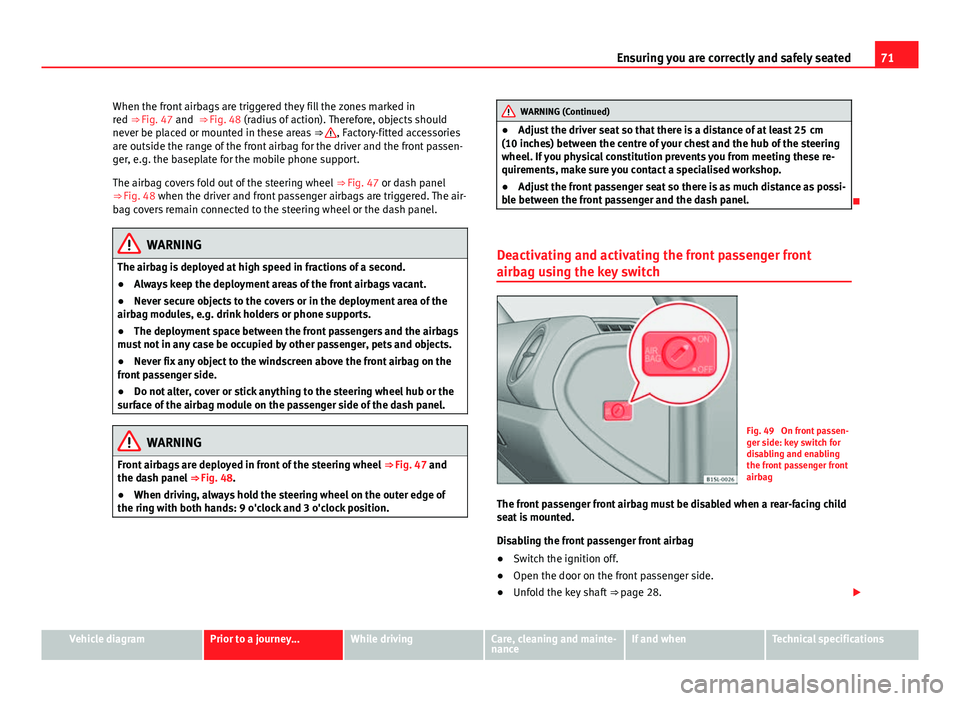
Fig. 49 On front passen-
ger side: key switch for
disabling and enabling
the front passenger front
airbag
The front passenger front airbag must be disabled when a rear-facing child
seat is mounted.
Disabling the front passenger front airbag
● Switch the ignition off.
● Open the door on the front passenger side.
● Unfold the key shaft ⇒ page 28.
Vehicle diagramPrior to a journey...While drivingCare, cleaning and mainte-
nanceIf and whenTechnical specifications
Page 86 of 306
84Lights and visibility
Turning on and off lights
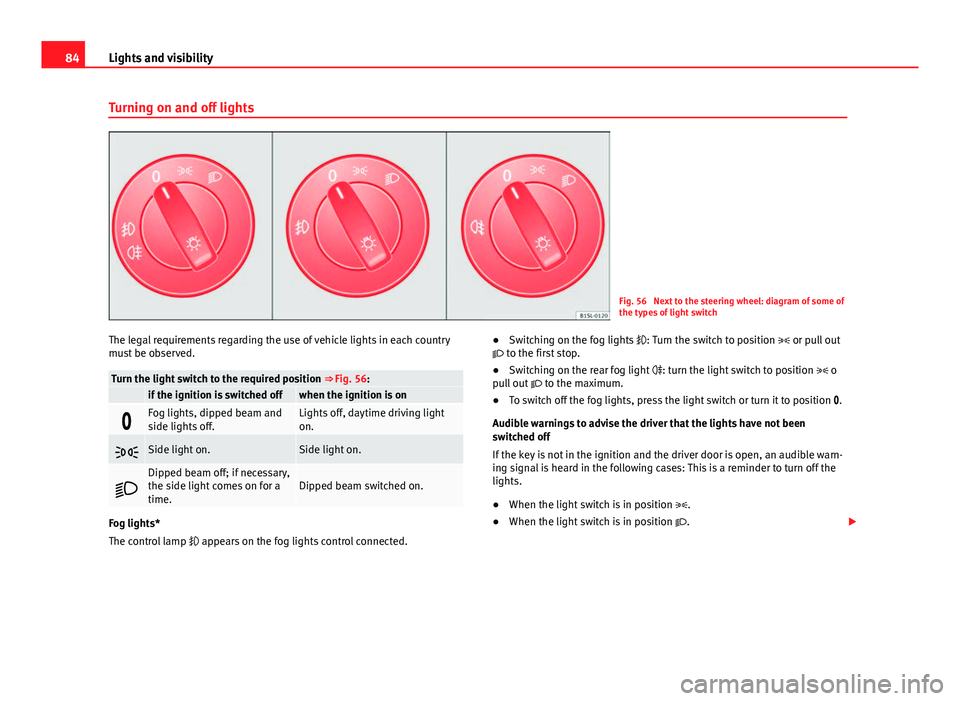
Fig. 56 Next to the steering wheel: diagram of some of
the types of light switch
The legal requirements regarding the use of vehicle lights in each country
must be observed.
Turn the light switch to the required position ⇒ Fig. 56: if the ignition is switched offwhen the ignition is on
Fog lights, dipped beam and
side lights off.Lights off, daytime driving light
on.
Side light on.Side light on.
Dipped beam off; if necessary,
the side light comes on for a
time.Dipped beam switched on.
Fog lights*
The control lamp appears on the fog lights control connected. ●
Switching on the fog lights : Turn the switch to position or pull out
to the first stop.
● Switching on the rear fog light : turn the light switch to position o
pull out to the maximum.
● To switch off the fog lights, press the light switch or turn it to position .
Audible warnings to advise the driver that the lights have not been
switched off
If the key is not in the ignition and the driver door is open, an audible warn-
ing signal is heard in the following cases: This is a reminder to turn off the
lights.
● When the light switch is in position .
● When the light switch is in position .
Page 88 of 306
86Lights and visibility
Headlight range control, lighting of instruments and
controls
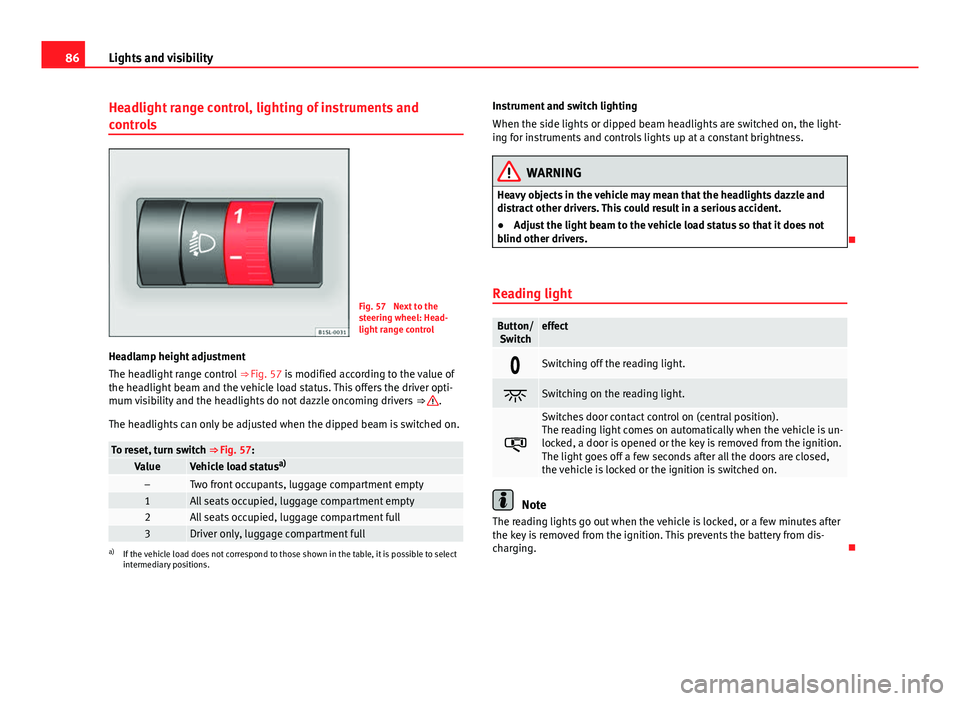
Fig. 57 Next to the
steering wheel: Head-
light range control
Headlamp height adjustment
The headlight range control ⇒ Fig. 57 is modified according to the value of
the headlight beam and the vehicle load status. This offers the driver opti-
mum visibility and the headlights do not dazzle oncoming drivers ⇒
.
The headlights can only be adjusted when the dipped beam is switched on.
To reset, turn switch ⇒ Fig. 57:ValueVehicle load status a)–Two front occupants, luggage compartment empty1All seats occupied, luggage compartment empty2All seats occupied, luggage compartment full3Driver only, luggage compartment fulla)
If the vehicle load does not correspond to those shown in the table, it is possible to select
intermediary positions. Instrument and switch lighting
When the side lights or dipped beam headlights are switched on, the light-
ing for instruments and controls lights up at a constant brightness.
WARNING
Heavy objects in the vehicle may mean that the headlights dazzle and
distract other drivers. This could result in a serious accident.
● Adjust the light beam to the vehicle load status so that it does not
blind other drivers.
Reading light
Button/ Switcheffect
Switching off the reading light.
Switching on the reading light.
Switches door contact control on (central position).
The reading light comes on automatically when the vehicle is un-
locked, a door is opened or the key is removed from the ignition.
The light goes off a few seconds after all the doors are closed,
the vehicle is locked or the ignition is switched on.
Note
The reading lights go out when the vehicle is locked, or a few minutes after
the key is removed from the ignition. This prevents the battery from dis-
charging.
Page 121 of 306
119
Starting, changing gears, parking
While driving
Starting, changing gears, parking
Stopping and starting the engine Introduction
Immobiliser display
When an invalid key is used or in the event of a system fault, is dis-
played on the instrument panel. The engine cannot be started.
Pushing or towing
For technical reasons, the vehicle must not be push- or tow-started. Jump
starting is preferable.
Additional information and warnings:
● Vehicle key set ⇒ page 28
● Changing gear ⇒ page 124
● Braking, stopping and parking ⇒ page 134
● Steering ⇒ page 147
● Refuelling ⇒ page 171
● Fuel ⇒ page 177
● Emergency locking and unlocking ⇒ page 244
● Jump starting ⇒ page 275
● Tow starting and towing away ⇒ page 278
WARNING
Switching off the engine while driving makes stopping the vehicle diffi-
cult. As a consequence you may lose control of the vehicle and there is a
risk of serious accident.
● The assisted braking and steering systems, the airbag system, seat
belts and certain safety equipment are only active while the engine is
running.
● The engine should only be switched off when the vehicle is at a
standstill.
WARNING
While the engine is running or starting it could help reduce the risk of se-
rious injury.
● Never start or leave the engine running in poorly ventilated or closed
spaces. Exhaust gas contains carbon monoxide, a toxic, colourless and
odourless gas. Carbon monoxide can cause people to lose conscious-
ness. It can also cause death.
● Never leave the vehicle unattended if the engine is running. The vehi-
cle could move off suddenly or something unexpected could happen re-
sulting in damage and serious injury.
● Never use start boosters. Cold start sprays could explode or increase
the engine speed unexpectedly.
Vehicle diagramPrior to a journey...While drivingCare, cleaning and mainte-
nanceIf and whenTechnical specifications
Page 122 of 306
120Starting, changing gears, parking
WARNING
The components of the exhaust system reach very high temperatures.
This could cause a fire and considerable damage.
● Always park your vehicle so that no part of the exhaust system can
come in contact with flammable materials (such as wood, leaves, spilled
fuel, dried grass, etc).
● Never apply additional underseal or anti-corrosion coatings to the ex-
haust pipes, catalytic converter or the heat shields on the exhaust sys-
tem.
Ignition lock
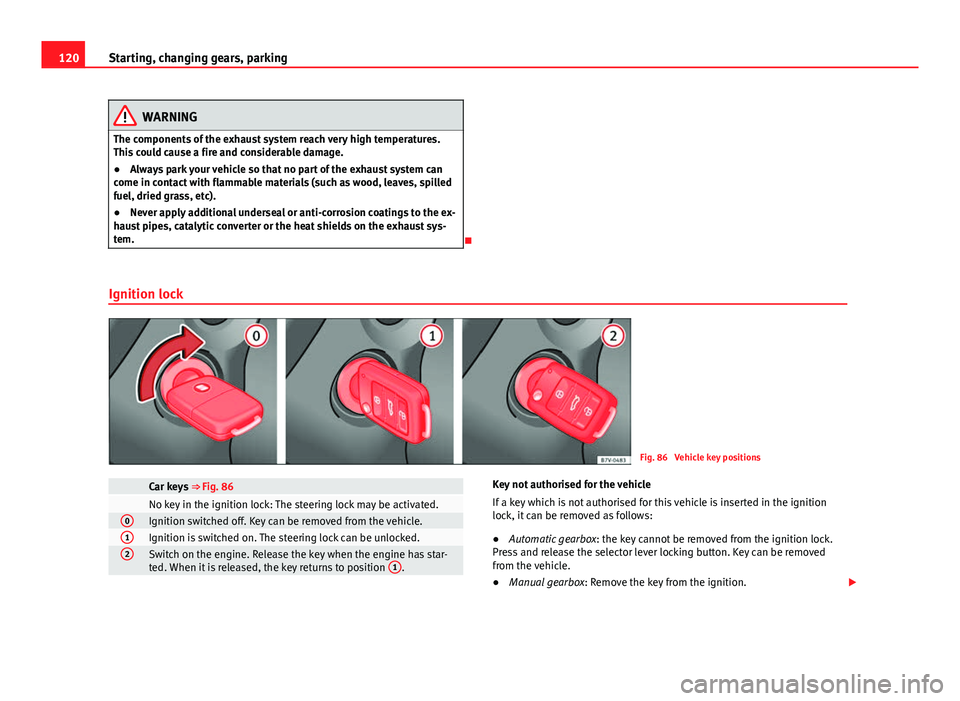
Fig. 86 Vehicle key positions
Car keys ⇒ Fig. 86 No key in the ignition lock: The steering lock may be activated.0Ignition switched off. Key can be removed from the vehicle.1Ignition is switched on. The steering lock can be unlocked.2Switch on the engine. Release the key when the engine has star-
ted. When it is released, the key returns to position 1.
Key not authorised for the vehicle
If a key which is not authorised for this vehicle is inserted in the ignition
lock, it can be removed as follows:
●
Automatic gearbox : the key cannot be removed from the ignition lock.
Press and release the selector lever locking button. Key can be removed
from the vehicle.
● Manual gearbox: Remove the key from the ignition.
Page 123 of 306

121
Starting, changing gears, parking
WARNING
Unsuitable or careless use of the vehicle key could result in serious in-
jury.
● Always take all the keys with you whenever you leave the vehicle. The
engine could accidentally be started and electrical equipment such as
the windows could accidentally be operated resulting in serious injury.
● Never leave children or disabled people alone in the car. They could
be trapped in the car in an emergency and will not be able to get them-
selves to safety. For example, depending on the time of the year, temper-
atures inside a locked and closed vehicle can be extremely high or ex-
tremely low resulting in serious injuries and illness or even death, partic-
ularly for young children.
● Never remove the key from the ignition if the vehicle is in motion. The
steering may lock and it will not be possible to turn the steering wheel.
Note
● If the key is left in the ignition lock with the engine off for long periods,
the vehicle battery will run flat.
● In vehicles with automatic gearbox the ignition key can only be with-
drawn with the selector lever in position P. In this case, press and release
the selector lever locking button.
Starting the engine
Complete operations only in the sequence given.
1.Press the brake pedal and keep pressed until step 5 has been completed.
1 a.In vehicles with a manual gearbox: Press the clutch pedal all
the way and keep pressed until the engine starts.
Complete operations only in the sequence given.
2.Put the gearbox lever in neutral or the selector lever in posi- tion P or N.
3.Turn the key in the ignition lock to position ⇒ Fig. 86 2; do
not press the accelerator.
4.When the engine has started, release the key in the ignition lock.
5.If the engine does not start, stop the process and try again af-ter one minute.
6.Release the handbrake when you want to begin driving⇒ page 134.
WARNING
Never leave the vehicle unattended if the engine is running. The vehicle
could move off suddenly, especially if it is in gear, resulting in an acci-
dent and serious injury.
WARNING
Cold start sprays could explode or cause a sudden increase in the engine
speed.
● Never use start boosters.
CAUTION
● An attempt to start the engine while driving or starting the engine imme-
diately after turning it off can cause damage to the engine or starter motor.
● When the engine is cold, avoid high revs and heavy acceleration and do
not make the engine work hard.
● Do not push or tow start the engine. Unburnt fuel could damage the cat-
alytic converter.
Vehicle diagramPrior to a journey...While drivingCare, cleaning and mainte-
nanceIf and whenTechnical specifications