weight Seat Mii 2013 User Guide
[x] Cancel search | Manufacturer: SEAT, Model Year: 2013, Model line: Mii, Model: Seat Mii 2013Pages: 306, PDF Size: 4.3 MB
Page 82 of 306
80Ensuring you are correctly and safely seated
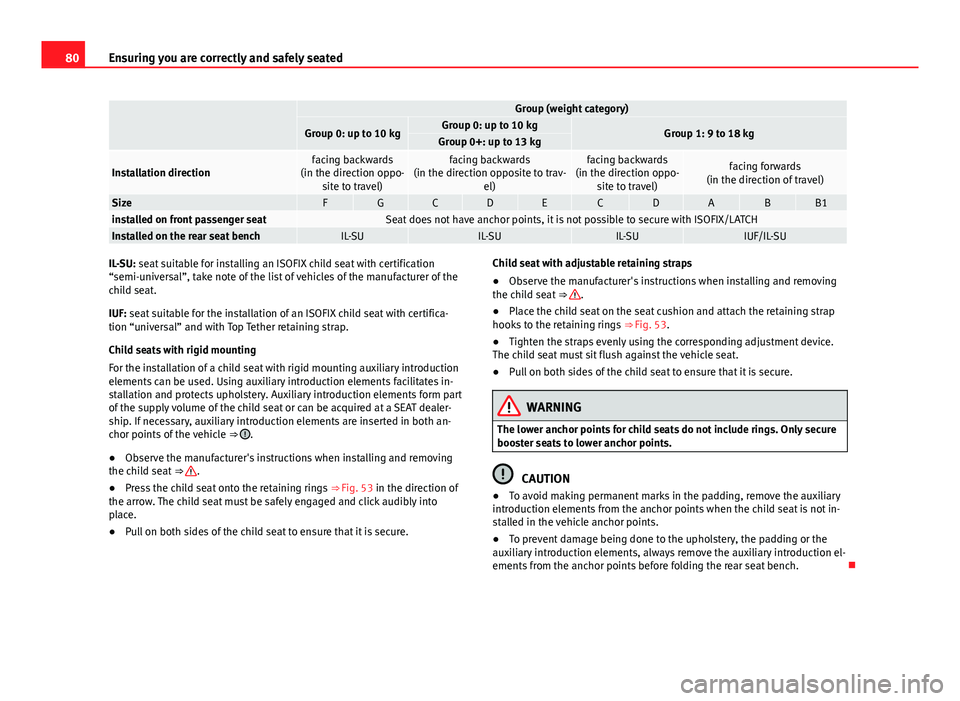
Group (weight category)
Group 0: up to 10 kgGroup 0: up to 10 kgGroup 1: 9 to 18 kgGroup 0+: up to 13 kg
Installation directionfacing backwards
(in the direction oppo- site to travel)facing backwards
(in the direction opposite to trav- el)facing backwards
(in the direction oppo- site to travel)facing forwards
(in the direction of travel)
SizeFGCDECDABB1installed on front passenger seatSeat does not have anchor points, it is not possible to secure with ISOFIX/LATCHInstalled on the rear seat benchIL-SUIL-SUIL-SUIUF/IL-SU
IL-SU: seat suitable for installing an ISOFIX child seat with certification
“semi-universal”, take note of the list of vehicles of the manufacturer of the
child seat.
IUF: seat suitable for the installation of an ISOFIX child seat with certifica-
tion “universal” and with Top Tether retaining strap.
Child seats with rigid mounting
For the installation of a child seat with rigid mounting auxiliary introduction
elements can be used. Using auxiliary introduction elements facilitates in-
stallation and protects upholstery. Auxiliary introduction elements form part
of the supply volume of the child seat or can be acquired at a SEAT dealer-
ship. If necessary, auxiliary introduction elements are inserted in both an-
chor points of the vehicle ⇒
.
● Observe the manufacturer's instructions when installing and removing
the child seat ⇒
.
● Press the child seat onto the retaining rings ⇒ Fig. 53 in the direction of
the arrow. The child seat must be safely engaged and click audibly into
place.
● Pull on both sides of the child seat to ensure that it is secure. Child seat with adjustable retaining straps
●
Observe the manufacturer's instructions when installing and removing
the child seat ⇒
.
● Place the child seat on the seat cushion and attach the retaining strap
hooks to the retaining rings ⇒ Fig. 53.
● Tighten the straps evenly using the corresponding adjustment device.
The child seat must sit flush against the vehicle seat.
● Pull on both sides of the child seat to ensure that it is secure.
WARNING
The lower anchor points for child seats do not include rings. Only secure
booster seats to lower anchor points.
CAUTION
● To avoid making permanent marks in the padding, remove the auxiliary
introduction elements from the anchor points when the child seat is not in-
stalled in the vehicle anchor points.
● To prevent damage being done to the upholstery, the padding or the
auxiliary introduction elements, always remove the auxiliary introduction el-
ements from the anchor points before folding the rear seat bench.
Page 97 of 306
95
Transporting
Transporting
Driving tips Introduction
Always transport heavy loads in the luggage compartment and place the
seat backs in a vertical position. Never overload the vehicle. Both the carry-
ing capacity as well as the distribution of the load in the vehicle have ef-
fects on the driving behaviour and braking ability ⇒
.
Additional information and warnings:
● Rear lid ⇒ page 39
● To lower the front passenger seat back ⇒ page 54
● Light ⇒ page 82
● Luggage compartment ⇒ page 98
● Roof carrier ⇒ page 104
● Wheels and tyres ⇒ page 210
WARNING
Unsecured or incorrectly secured objects can cause serious injury in case
of a sudden manoeuvring or breaking or in case of an accident. This is es-
pecially true when objects are struck by a detonating airbag and fired
through the vehicle interior. To reduce the risks, please note the follow-
ing:
● Secure all objects in the vehicle. Always keep equipment and heavy
objects in the luggage compartment.
WARNING (Continued)
● Always secure objects with suitable rope or slings so that they cannot
enter the deployment areas around the frontal or side airbags in case of
sudden braking or an accident.
● Always ensure that objects inside the vehicle cannot move into the
deployment area of the bags while driving.
● While driving, always keep object compartments closed.
● Remove all objects from the front passenger seat when this is fol-
lowed down. When the seat backrest is folded down, it presses on small
and light objects and these are detected by the weight sensor on the
seat; this sends false information to the airbag control unit.
● While the backrest of the front passenger seat is folded, the frontal
airbag must remain disconnected and the PASSENGER AIRBAG OFF
light on.
● Objects secured in the vehicle should never be placed in such a way
as to make passengers sit in an incorrect position.
● If secured objects occupy a seat then this should not be occupied or
used by anybody.
WARNING
The driving behaviour and braking ability change when transporting
heavy and large objects.
● Adjust your speed and driving style to visibility, road, traffic and
weather conditions.
● Accelerate gently and carefully.
● Avoid sudden braking and manoeuvres.
● Brake early.
Vehicle diagramPrior to a journey...While drivingCare, cleaning and mainte-
nanceIf and whenTechnical specifications
Page 107 of 306
105
Transporting
Securing the base supports and roof carrier system
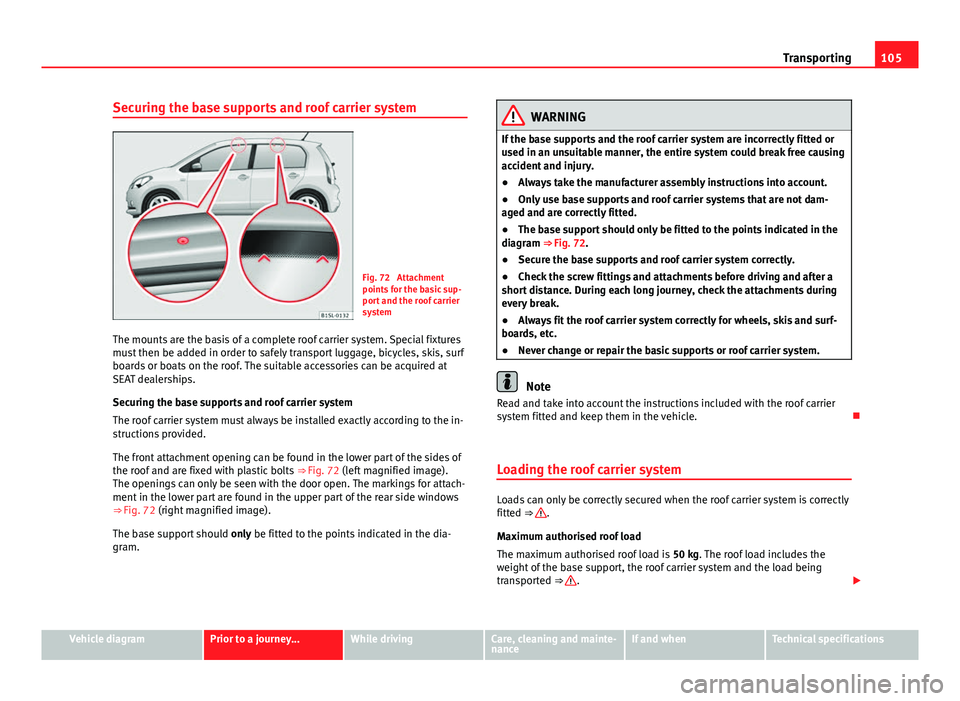
Fig. 72 Attachment
points for the basic sup-
port and the roof carrier
system
The mounts are the basis of a complete roof carrier system. Special fixtures
must then be added in order to safely transport luggage, bicycles, skis, surf
boards or boats on the roof. The suitable accessories can be acquired at
SEAT dealerships.
Securing the base supports and roof carrier system
The roof carrier system must always be installed exactly according to the in-
structions provided.
The front attachment opening can be found in the lower part of the sides of
the roof and are fixed with plastic bolts ⇒ Fig. 72 (left magnified image).
The openings can only be seen with the door open. The markings for attach-
ment in the lower part are found in the upper part of the rear side windows
⇒ Fig. 72 (right magnified image).
The base support should only be fitted to the points indicated in the dia-
gram.
WARNING
If the base supports and the roof carrier system are incorrectly fitted or
used in an unsuitable manner, the entire system could break free causing
accident and injury.
● Always take the manufacturer assembly instructions into account.
● Only use base supports and roof carrier systems that are not dam-
aged and are correctly fitted.
● The base support should only be fitted to the points indicated in the
diagram ⇒ Fig. 72.
● Secure the base supports and roof carrier system correctly.
● Check the screw fittings and attachments before driving and after a
short distance. During each long journey, check the attachments during
every break.
● Always fit the roof carrier system correctly for wheels, skis and surf-
boards, etc.
● Never change or repair the basic supports or roof carrier system.
Note
Read and take into account the instructions included with the roof carrier
system fitted and keep them in the vehicle.
Loading the roof carrier system
Loads can only be correctly secured when the roof carrier system is correctly
fitted ⇒ .
Maximum authorised roof load
The maximum authorised roof load is 50 kg. The roof load includes the
weight of the base support, the roof carrier system and the load being
transported ⇒
.
Vehicle diagramPrior to a journey...While drivingCare, cleaning and mainte-
nanceIf and whenTechnical specifications
Page 108 of 306
106Transporting
Always check the weight of the base support, the roof carrier system and
the weight of the load to be transported and, if necessary, weigh them. Nev-
er exceed the maximum authorised roof load.
If you are using a roof carrier with a lower weight rating, you cannot trans-
port the maximum roof load. Do not exceed the maximum weight limit for
the roof carrier given in the fitting instructions.
Distributing a load
Uniformly distribute loads and secure them correctly ⇒
.
Check attachments
After fitting the base supports and the roof carrier system, always check the
attachments after a short trip or at regular intervals.
WARNING
Exceeding the maximum authorised roof load can result in accidents
and/or vehicle damage.
● Always respect the maximum authorised weight for the roof, the max-
imum authorised weight on the axles and the total maximum authorised
weight of the vehicle.
● Never exceed the capacity of the roof carrier system even if this is
less than the maximum authorised roof load.
● Secure heavy objects towards the front and distribute the load even-
ly.
WARNING
Loose and incorrectly secured loads can fall from the roof carrier system
causing accidents and injury.
● Always use suitable ropes and straps in good condition.
● Always secure loads correctly.
Page 113 of 306
111
Practical equipment
CAUTION
● The hook can hold a maximum weight of 1.5 kg.
● When the hook is folded forward it folds up automatically when the stor-
age compartment opens.
● We recommend that any small luggage items be removed from the hook
before opening the storage compartment.
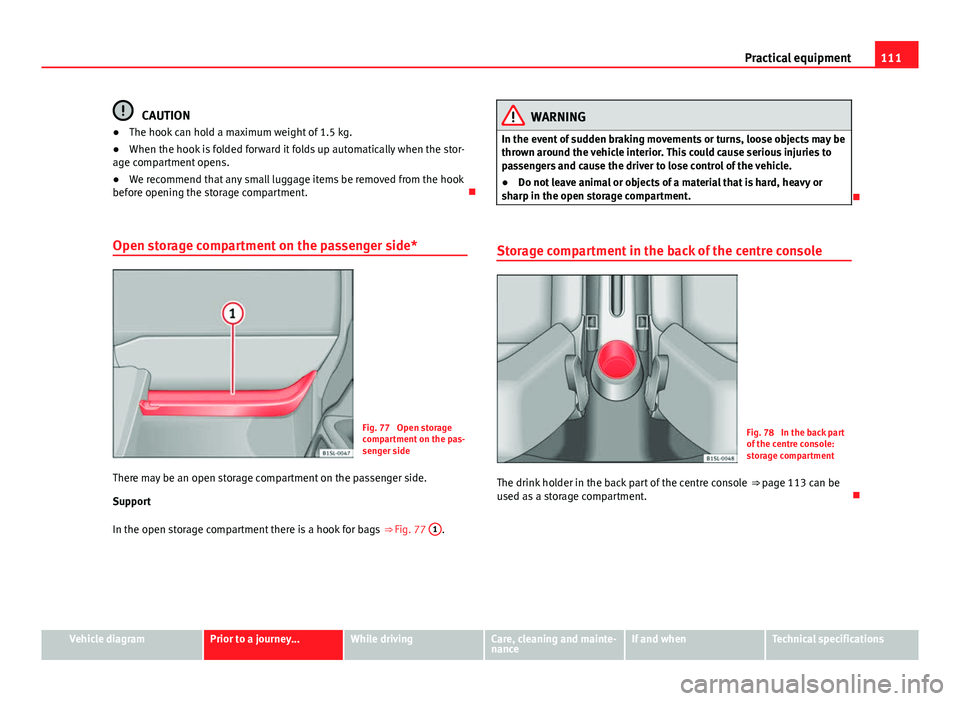
Open storage compartment on the passenger side*
Fig. 77 Open storage
compartment on the pas-
senger side
There may be an open storage compartment on the passenger side.
Support
In the open storage compartment there is a hook for bags ⇒ Fig. 77 1
.
WARNING
In the event of sudden braking movements or turns, loose objects may be
thrown around the vehicle interior. This could cause serious injuries to
passengers and cause the driver to lose control of the vehicle.
● Do not leave animal or objects of a material that is hard, heavy or
sharp in the open storage compartment.
Storage compartment in the back of the centre console
Fig. 78 In the back part
of the centre console:
storage compartment
The drink holder in the back part of the centre console ⇒ page 113 can be
used as a storage compartment.
Vehicle diagramPrior to a journey...While drivingCare, cleaning and mainte-
nanceIf and whenTechnical specifications
Page 148 of 306
146Starting, changing gears, parking
Unnecessary short journeys should be avoided. Try to combine trips.
The vehicle uses more fuel in winter than in summer, even when other con-
ditions are the same.
“Warming” the engine is not only forbidden in some countries, but in prac-
tice it is technically superfluous as it is a waste of fuel.
Adjusting type pressures.
Having the correct pressure in your tyres helps to reduce rolling resistance
and, as a result reduces fuel consumption. Increasing the tyre pressure
slightly (+ 0.2 bar / + 3 psi / + 200 kPa) can help to save fuel.
When you buy new tyres, make sure they are optimised for minimum rolling
resistance.
Use low friction engine oil
The use of low viscosity totally synthetic oils, known as low friction engine
oil, help to reduce fuel consumption. Low friction engine oils reduce the re-
sistance caused by friction in the engine, they flow around the engine more
quickly and efficiently, particularly in cold starts. The effect is particularly
noticeable in vehicles frequently used for short journeys.
Always check the engine oil level and observe service intervals (engine oil
change intervals).
When purchasing engine oil, always observe legal requirements and ensure
that the oil is approved by SEAT.
Avoid carrying unnecessary loads
The lighter the vehicle, the more economical and ecological the driving
style. For example, an additional weight of 100 kg will increase fuel con-
sumption up to 0.3 l/100 km.
Remove any unnecessary objects or loads from the vehicle. Remove optional equipment and unnecessary accessories
The more aerodynamic the vehicle, the lower the fuel consumption. Option-
al equipment and accessories (such as roof racks or bike carriers) reduce
the aerodynamic benefits of the vehicle.
Therefore, we recommend you remove all optional and unnecessary equip-
ment and racks, especially if you intend to drive at high speeds.
Page 154 of 306
152Driver assistance systems
Cruise control* (Cruise control system - CCS)
Introduction
The cruise control system (CCS) is able to individually maintain the set
speed when driving forwards from approx. 20 km/h (15 mph).
The CCS only slows down by reducing the accelerator but not by braking
⇒
.
Additional information and warnings:
● Changing gear ⇒ page 124
● Accessories, parts replacement, repairs and modifications ⇒ page 222
WARNING
Use of the cruise control could cause accidents and severe injuries if it is
not possible to drive at a constant speed maintaining the safety distance.
● Do not use the cruise control in heavy traffic, if the distance from the
vehicle in front is insufficient, on steep roads, with several bends or in
slippery circumstances (snow, ice, rain or loose gravel), or on flooded
roads.
● Never use the CCS when driving off-road or on unpaved roads.
● Always adapt your speed and the distance to the vehicles ahead in
line with visibility, weather conditions, the condition of the road and the
traffic situation.
● To avoid unexpected operation of the cruise control system, turn it off
every time you finish using it.
● It is dangerous to use a set speed which is too high for the prevailing
road, traffic or weather conditions.
● When travelling down hills, the CCS cannot maintain a constant
speed. The vehicle tends to accelerate under its own weight. Select a
lower gear or use the foot brake to slow the vehicle.
Control lamp
lights upPossible cause
This cruise control system maintains the set speed of
the vehicle.
Several warning and control lamps should light up for a few seconds when
the ignition is switched on, signalling that the function is being verified.
They will switch off after a few seconds.
WARNING
If the warning lamps are ignored, the vehicle may stall in traffic, or may
cause accidents and severe injuries.
● Never ignore the warning lamps.
CAUTION
Failure to heed the warning lamps when they appear may result in faults in
the vehicle.
Page 233 of 306
231
Vehicle care and maintenance
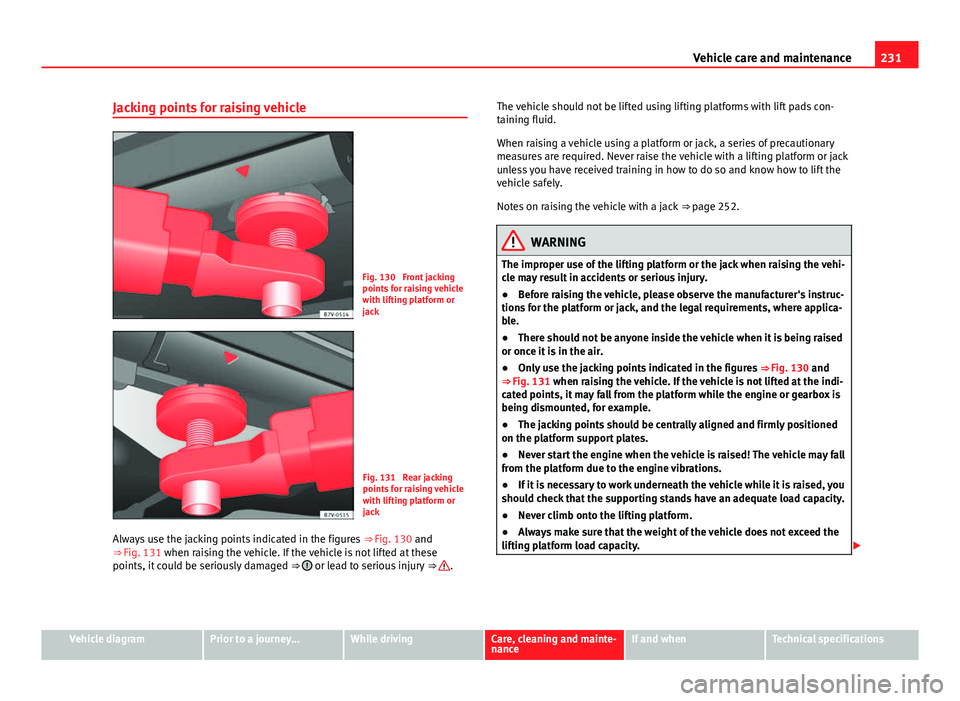
Jacking points for raising vehicle
Fig. 130 Front jacking
points for raising vehicle
with lifting platform or
jack
Fig. 131 Rear jacking
points for raising vehicle
with lifting platform or
jack
Always use the jacking points indicated in the figures ⇒ Fig. 130 and
⇒ Fig. 131 when raising the vehicle. If the vehicle is not lifted at these
points, it could be seriously damaged ⇒
or lead to serious injury ⇒ .The vehicle should not be lifted using lifting platforms with lift pads con-
taining fluid.
When raising a vehicle using a platform or jack, a series of precautionary
measures are required. Never raise the vehicle with a lifting platform or jack
unless you have received training in how to do so and know how to lift the
vehicle safely.
Notes on raising the vehicle with a jack
⇒ page 252.
WARNING
The improper use of the lifting platform or the jack when raising the vehi-
cle may result in accidents or serious injury.
● Before raising the vehicle, please observe the manufacturer's instruc-
tions for the platform or jack, and the legal requirements, where applica-
ble.
● There should not be anyone inside the vehicle when it is being raised
or once it is in the air.
● Only use the jacking points indicated in the figures ⇒ Fig. 130 and
⇒ Fig. 131 when raising the vehicle. If the vehicle is not lifted at the indi-
cated points, it may fall from the platform while the engine or gearbox is
being dismounted, for example.
● The jacking points should be centrally aligned and firmly positioned
on the platform support plates.
● Never start the engine when the vehicle is raised! The vehicle may fall
from the platform due to the engine vibrations.
● If it is necessary to work underneath the vehicle while it is raised, you
should check that the supporting stands have an adequate load capacity.
● Never climb onto the lifting platform.
● Always make sure that the weight of the vehicle does not exceed the
lifting platform load capacity.
Vehicle diagramPrior to a journey...While drivingCare, cleaning and mainte-
nanceIf and whenTechnical specifications
Page 284 of 306
282Description of specifications
Technical specifications
Description of specifications
Technical specifications
Introduction
The information in the vehicle documentation always takes
precedence over the information in this Instruction Manual.
All technical specifications provided in this documentation are valid for the
standard model in Spain. The vehicle data card included in the Mainte-
nance Programme or the vehicle registration documentation shows which
engine is installed in the vehicle.
The figures may be different depending whether additional equipment is fit-
ted, for different models, for special vehicles and for other countries.
Additional information and warnings:
● Transporting ⇒ page 95
● Ecological driving ⇒ page 144
● Fuel ⇒ page 177
● Engine oil ⇒ page 185
● Engine coolant ⇒ page 189
● Wheels and tyres ⇒ page 210
● Notes for the user ⇒ page 233
WARNING
Failure to observe requirements for weight, loads, dimensions and maxi-
mum speed may lead to severe accident.
Page 285 of 306
283
Description of specifications
Vehicle identification data
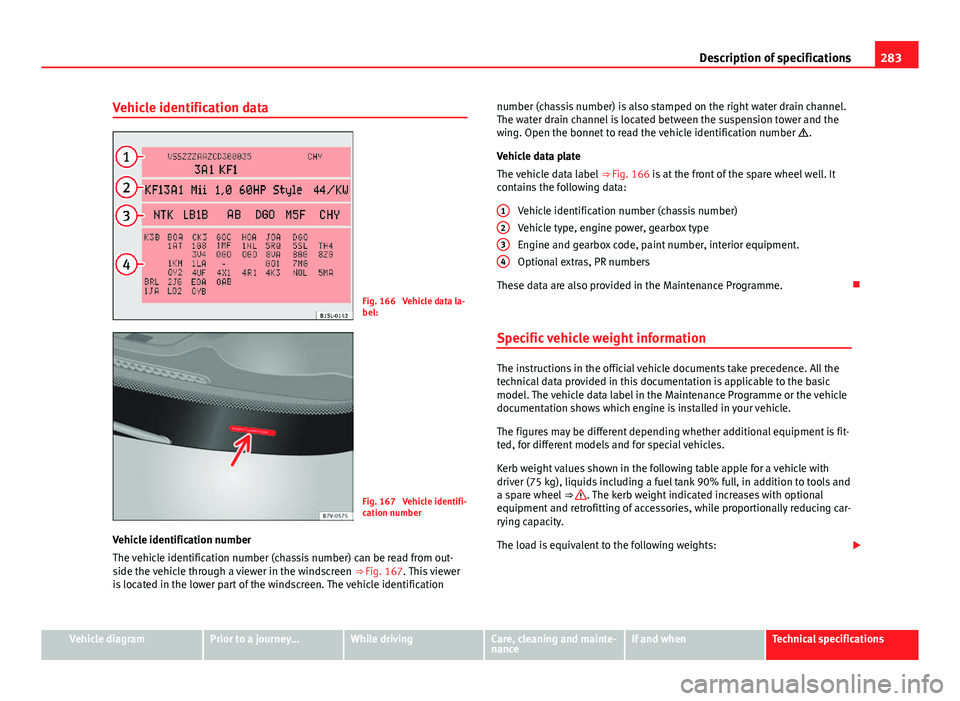
Fig. 166 Vehicle data la-
bel:
Fig. 167 Vehicle identifi-
cation number
Vehicle identification number
The vehicle identification number (chassis number) can be read from out-
side the vehicle through a viewer in the windscreen ⇒ Fig. 167. This viewer
is located in the lower part of the windscreen. The vehicle identification number (chassis number) is also stamped on the right water drain channel.
The water drain channel is located between the suspension tower and the
wing. Open the bonnet to read the vehicle identification number
.
Vehicle data plate
The vehicle data label ⇒ Fig. 166 is at the front of the spare wheel well. It
contains the following data:
Vehicle identification number (chassis number)
Vehicle type, engine power, gearbox type
Engine and gearbox code, paint number, interior equipment.
Optional extras, PR numbers
These data are also provided in the Maintenance Programme.
Specific vehicle weight information
The instructions in the official vehicle documents take precedence. All the
technical data provided in this documentation is applicable to the basic
model. The vehicle data label in the Maintenance Programme or the vehicle
documentation shows which engine is installed in your vehicle.
The figures may be different depending whether additional equipment is fit-
ted, for different models and for special vehicles.
Kerb weight values shown in the following table apple for a vehicle with
driver (75 kg), liquids including a fuel tank 90% full, in addition to tools and
a spare wheel ⇒
. The kerb weight indicated increases with optional
equipment and retrofitting of accessories, while proportionally reducing car-
rying capacity.
The load is equivalent to the following weights:
1
234
Vehicle diagramPrior to a journey...While drivingCare, cleaning and mainte-
nanceIf and whenTechnical specifications