gearbox Seat Mii 2013 Owner's Guide
[x] Cancel search | Manufacturer: SEAT, Model Year: 2013, Model line: Mii, Model: Seat Mii 2013Pages: 306, PDF Size: 4.3 MB
Page 165 of 306
163
Driver assistance systems
The system maintains brake pressure for approximately two seconds after
the driver takes his foot off the brake pedal to prevent the vehicle from
lurching backwards when it is started. During these two seconds, the driver
has enough time to release the clutch pedal and accelerate without vehicle
moving and without having to use the handbrake, making start-up easier,
more comfortable and safer.
These are the basic operation conditions:
● being on a ramp or hill/slope,
● closed doors,
● vehicle completely stationary,
● engine running and foot on the brake,
● besides having a gear engaged or being in neutral for manual gear
change and with the selector lever at positions S, D or R in vehicles with au-
tomatic gearbox.
This system is also active in reversing uphill.
WARNING
● If you do not start the vehicle immediately after taking your foot off
the brake pedal, the vehicle may start to roll back under certain condi-
tions. Depress the brake pedal or use the hand brake immediately.
● If the engine stalls, depress the brake pedal or use the hand brake
immediately.
● When following a line of traffic uphill, if you want to prevent the vehi-
cle from rolling back accidentally when starting off, hold the brake pedal
down for a few seconds before starting off.
Note
The Official Service or a specialist workshop can tell you if your vehicle is
equipped with this system.
Vehicle diagramPrior to a journey...While drivingCare, cleaning and mainte-
nanceIf and whenTechnical specifications
Page 228 of 306
226Vehicle care and maintenance
Retro-fitting of two-way radios
An exterior aerial is required for the use of two-way radios in the vehicle.
The retro-fitting of electrical or electronic appliances in the vehicle is sub-
ject to their approval for use in your vehicle. Under certain circumstances,
this could mean that your vehicle registration documents are no longer val-
id.
SEAT has approved your vehicle for use with two-way radios providing the
following conditions are observed:
●The exterior aerial must be mounted professionally.
● The maximum transmitting power is 10 watts.
The optimal reach of the equipment is only achieved with an external aerial.
Check first with a specialised workshop if you wish to use a two-way radio
with a transmitting power of over 10 watts. The specialised workshops are
familiar with the technical options for installation. SEAT recommends visit-
ing a Technical Service.
All legal requirements, together with the instructions for the use of two-way
radios must be observed.
WARNING
If the two-way radio is not securely fastened in position, it could be sent
flying around the vehicle in the event of sharp braking, sudden manoeu-
vres or accident, causing injury.
● While driving, two-way radios must be securely fastened in position,
outside the airbags deployment zones, or safely stowed away.
WARNING
When using a two-way radio without a connection to an exterior aerial,
the maximum permitted levels of electromagnetic radiation may be ex-
ceeded. This is also the case if the aerial has not been correctly installed.
● You should only use a two-way radio inside the vehicle if it has first
been correctly connected to an exterior aerial.
Information stored by the control units
Your vehicle is fitted at the factory with a series of electronic control units
responsible for the engine and gearbox management. In addition, the con-
trol units supervise the performance of the exhaust gas system and the air-
bag systems.
Therefore, while the vehicle is being driven, these electronic control units
are continuously analysing the vehicle data. In the event of faults or devia-
tions from the theoretical values, only this data is stored. Normally, the
warning lamps on the instrument panel light up in the event of faults.
This data can only be read and analysed using special equipment.
The storing of the data allows specialised workshops to detect and repair
faults. Stored data may include:
● Data relating to the engine or the gearbox
● Speed
● Direction of travel
● Braking force
● Detection of seat belt
The vehicle control units never record conversations held by passengers in
the vehicle.
Page 233 of 306
231
Vehicle care and maintenance
Jacking points for raising vehicle
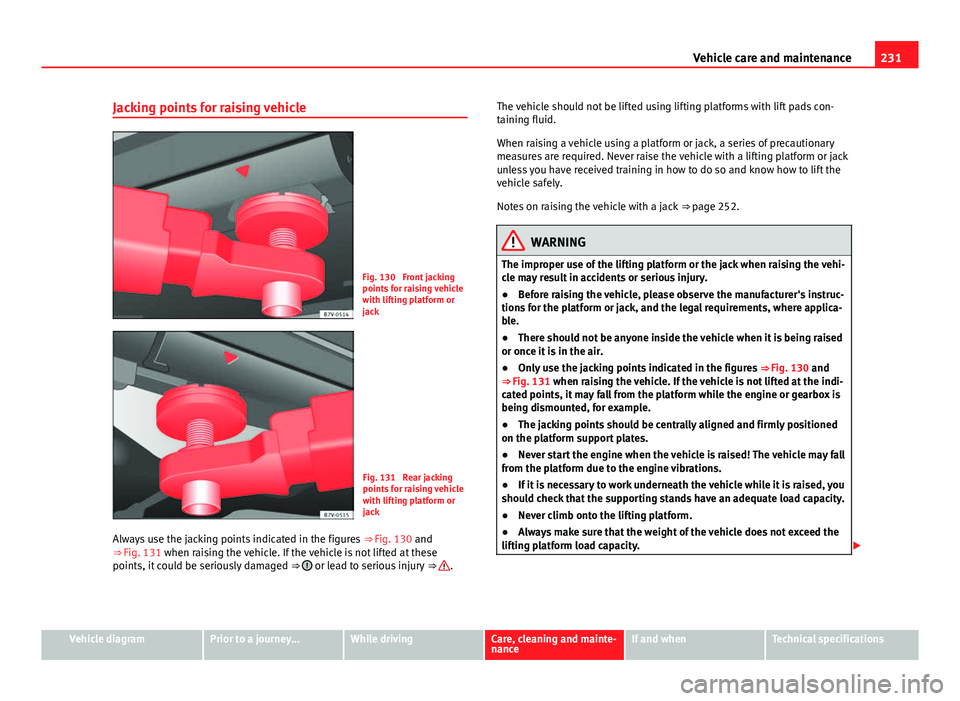
Fig. 130 Front jacking
points for raising vehicle
with lifting platform or
jack
Fig. 131 Rear jacking
points for raising vehicle
with lifting platform or
jack
Always use the jacking points indicated in the figures ⇒ Fig. 130 and
⇒ Fig. 131 when raising the vehicle. If the vehicle is not lifted at these
points, it could be seriously damaged ⇒
or lead to serious injury ⇒ .The vehicle should not be lifted using lifting platforms with lift pads con-
taining fluid.
When raising a vehicle using a platform or jack, a series of precautionary
measures are required. Never raise the vehicle with a lifting platform or jack
unless you have received training in how to do so and know how to lift the
vehicle safely.
Notes on raising the vehicle with a jack
⇒ page 252.
WARNING
The improper use of the lifting platform or the jack when raising the vehi-
cle may result in accidents or serious injury.
● Before raising the vehicle, please observe the manufacturer's instruc-
tions for the platform or jack, and the legal requirements, where applica-
ble.
● There should not be anyone inside the vehicle when it is being raised
or once it is in the air.
● Only use the jacking points indicated in the figures ⇒ Fig. 130 and
⇒ Fig. 131 when raising the vehicle. If the vehicle is not lifted at the indi-
cated points, it may fall from the platform while the engine or gearbox is
being dismounted, for example.
● The jacking points should be centrally aligned and firmly positioned
on the platform support plates.
● Never start the engine when the vehicle is raised! The vehicle may fall
from the platform due to the engine vibrations.
● If it is necessary to work underneath the vehicle while it is raised, you
should check that the supporting stands have an adequate load capacity.
● Never climb onto the lifting platform.
● Always make sure that the weight of the vehicle does not exceed the
lifting platform load capacity.
Vehicle diagramPrior to a journey...While drivingCare, cleaning and mainte-
nanceIf and whenTechnical specifications
Page 234 of 306
232Vehicle care and maintenance
CAUTION
● Never raise the vehicle at the engine oil sump, the gearbox or the rear or
front axles.
● Always use an intermediate rubber support to prevent damage to the
vehicle underbody. Check that the arms of the lifting platform are able to
move with obstruction.
● The arms should not come into contact with the side running boards or
other parts of the vehicle.
Page 237 of 306
235
Vehicle care and maintenance
Conformity certification
The respective manufacturer hereby declares that the products indicated as
follows fulfil the basic requirements and the following dispositions and im-
portant legislations on the date of manufacture of the vehicle, among oth-
ers FCC Part 15.19, FCC Part 15.21 and RSS-Gen Issue 1:
Radio frequency equipment
● Electronic gearbox lock.
● Vehicle key
Electrical equipment
● 12 volt power socket
Environmental friendliness
Environmental protection is a top priority in the design, choice of materials
and manufacture of your new SEAT.
Constructive measures to encourage recycling
● Joints and connections designed for easy dismantling
● Modular construction to facilitate dismantling
● Increased use of single-grade materials.
● Plastic parts and elastomers are marked in accordance with ISO 1043,
ISO 11469 and ISO 1629.
Choice of materials
● Use of recycled materials.
● Use of compatible plastics in the same part if its components are not
easily separated.
● Use of recycled materials and/or materials originating from renewable
sources. ●
Reduction of volatile components, including odour, in plastic materials.
● Use of CFC-free coolants.
Ban on heavy metals, with the exceptions dictated by law (Annex II of ELV
Directive 2000/53/EC): cadmium, lead, mercury, hexavalent chromium.
Manufacturing methods
● Reduction of the quantity of thinner in the protective wax for cavities.
● Use of plastic film as protection during vehicle transport.
● Use of solvent-free adhesives.
● Use of CFC-free coolants in cooling systems.
● Recycling and energy recovery from residues (RDF).
● Improvement in the quality of waste water.
● Use of systems for the recovery of residual heat (thermal recovery, en-
thalpy wheels, etc.).
● The use of water-soluble paints
Collection and scrapping of end-of-life vehicles
Collection of end-of-life vehicles
SEAT is already prepared for the moment when you wish to scrap your vehi-
cle and offers you an environmentally-friendly solution. An extensive net-
work of used car reception centres already exists in much of Europe. After
the vehicle has been delivered, you will receive a certificate of destruction
describing the environmentally friendly scrapping of the vehicle in accord-
ance with applicable legislation.
We will collect the used vehicle free of charge, provided it complies with all
national legislation.
Please see your Technical Service for further information about the collec-
tion and scrapping of end-of-life vehicles.
Vehicle diagramPrior to a journey...While drivingCare, cleaning and mainte-
nanceIf and whenTechnical specifications
Page 243 of 306
241
Practical information
In case of emergency
Introduction
Additional information and warnings:
● Braking, stopping and parking ⇒ page 134
● Emergency locking and unlocking ⇒ page 244
● Vehicle tools ⇒ page 247
● Change wheel ⇒ page 252
WARNING
A faulty vehicle in traffic represents a risk of accident for the driver and
for other road users.
● Stop the vehicle safely as soon as possible. Park the vehicle a safe
distance from surrounding traffic to lock all the doors in case of an emer-
gency. Turn on the hazard warning lights to warn other road users.
● Never leave children or disabled people alone in the vehicle if the
doors are to be locked. In case of an emergency, passengers will be trap-
ped inside the vehicle. Individuals locked in the vehicle can be exposed
to very high or very low temperatures.
Protecting yourself and securing the vehicle
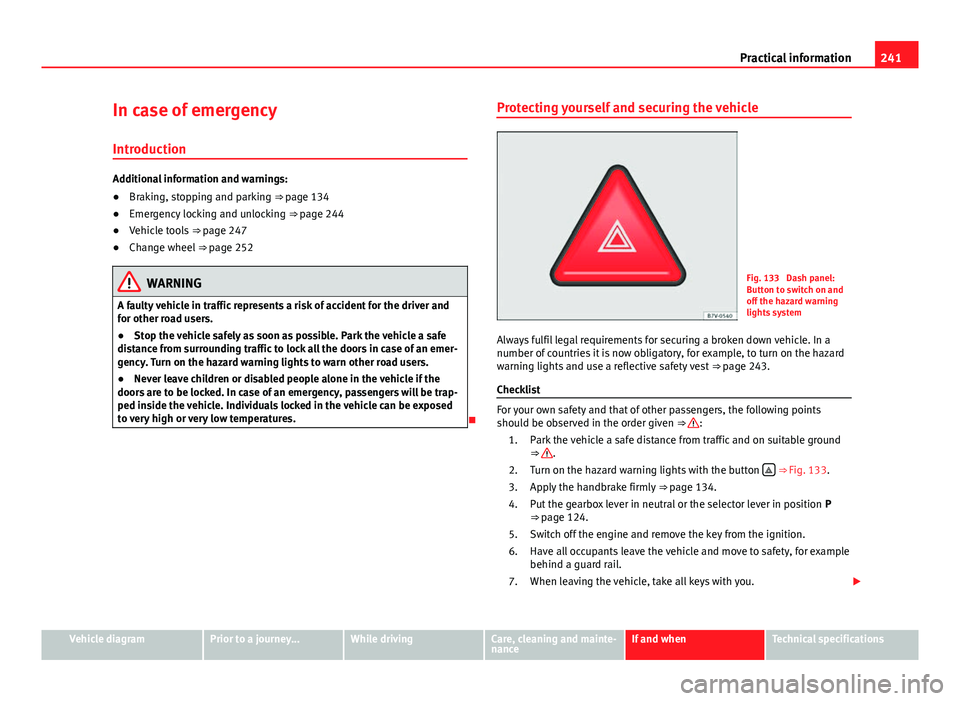
Fig. 133 Dash panel:
Button to switch on and
off the hazard warning
lights system
Always fulfil legal requirements for securing a broken down vehicle. In a
number of countries it is now obligatory, for example, to turn on the hazard
warning lights and use a reflective safety vest ⇒ page 243.
Checklist
For your own safety and that of other passengers, the following points
should be observed in the order given ⇒
:
1. Park the vehicle a safe distance from traffic and on suitable ground ⇒
.
2. Turn on the hazard warning lights with the button ⇒
Fig. 133.
3. Apply the handbrake firmly ⇒ page 134.
4. Put the gearbox lever in neutral or the selector lever in position P ⇒ page 124.
5. Switch off the engine and remove the key from the ignition.
6. Have all occupants leave the vehicle and move to safety, for example behind a guard rail.
7. When leaving the vehicle, take all keys with you.
Vehicle diagramPrior to a journey...While drivingCare, cleaning and mainte-
nanceIf and whenTechnical specifications
Page 254 of 306

252Practical information
Changing a wheel
Introduction
Some vehicle versions and models do not have a factory-fitted jack or box
spanner. In this case, we recommend consulting a Specialised workshop to
change the wheel.
You should only change the wheels yourself if the vehicle is parked in a safe
place, you are familiar with the procedure and you have all the necessary
tools! Otherwise, you should seek professional assistance.
Additional information and warnings:
● Exterior detail ⇒ page 6
● Vehicle key set ⇒ page 28
● Wheels and tyres ⇒ page 210
● In case of emergency ⇒ page 241
● Vehicle tools ⇒ page 247
● Wheel trims ⇒ page 250
WARNING
Changing a wheel can be dangerous, especially on the hard shoulder.
Please observe the following rules to minimise the risk of injury:
● Stop the vehicle safely as soon as possible. Park your vehicle as safe
distance from surrounding traffic to change a wheel.
● When changing a wheel, keep all passengers and particularly chil-
dren a safe distance away from the work area.
● Turn on the hazard warning lights to warn other road users.
● Ensure the ground on which you park is flat and solid. If necessary,
support the jack on a wide solid base.
WARNING (Continued)
● If you are changing a wheel yourself, you should be familiar with the
required procedure. Otherwise, you should seek professional assistance.
● Only use suitable tools that are not damaged when changing a wheel.
● Always stop the engine, apply the handbrake lever firmly and place
the selector lever in position P, or engage a gear for a manual gearbox to
reduce the risk of the vehicle moving accidentally.
● Have the tightening torque of the wheel bolts checked as soon as
possible with a reliable torque wrench.
Page 255 of 306

253
Practical information
Preparations for changing a wheel
Check list
Before changing a wheel, complete the following operations in the order
given ⇒
:
1. In the event of a flat tyre, park the vehicle a safe distance from traffic and on suitable ground.
2. Apply the handbrake firmly ⇒ page 134.
3. Automatic gearbox: move the selector lever to position P
⇒ page 124.
4. Stop the engine and remove the key from the ignition ⇒ page 119.
5. Manual gearbox: Select a gear ⇒ page 124.
6. Have all vehicle occupants get out of the vehicle and wait in a safe place (for example, behind the safety barrier).
7. Chock the wheel opposite the wheel being changed with a stone or similar object.
8. If the luggage compartment is full: take the baggage out of the vehi- cle.
9. Remove the spare wheel or the temporary spare wheel and the vehi- cle tool kit from the luggage compartment.
10. Remove the wheel trims ⇒ page 250.
WARNING
Failure to follow the checklist prepared for your own safety could lead to
accidents and severe injuries.
● Always complete the operations given in the checklist and observe
the general rules of safety.
Wheel bolts
Fig. 144 Changing a
wheel: Slacken the wheel
bolts.
Fig. 145 Changing a
wheel: Tyre valve
1 and
position of anti-theft
wheel locking bolt 2
Only use the tool supplied with the vehicle to loosen the wheel bolts.
Loosen the wheel bolts only about one turn before raising the vehicle with
the jack.
Vehicle diagramPrior to a journey...While drivingCare, cleaning and mainte-
nanceIf and whenTechnical specifications
Page 258 of 306
256Practical information
Check list
For your own safety and that of other passengers, the following points
should be observed in the order given ⇒
:
1. Select a suitable flat and firm surface for raising the vehicle.
2. Switch off the engine, engage a gear (manual gearbox) or place the selector lever in position P ⇒ page 124 and engage the handbrake
⇒ page 134.
3. Block the wheel diagonally opposite the wheel being changed with collapsible wheel chocks or other suitable objects.
4. Loosen the wheel bolts on the wheel to be changed ⇒ page 253.
5. Look below the vehicle for the jacking point ⇒ Fig. 146 closest to the
tyre which has to be changed.
6. Raise the jack with the handle until it can be inserted below the jack- ing point.
7. Ensure that the foot of the jack is firmly on the ground and that it is placed, at a vertical angle, immediately below the lifting point on the
vehicle ⇒ Fig. 147.
8. Straighten the jack and continue raising it using the handle until the claw holds the vertical reinforcement beneath the vehicle ⇒ Fig. 147.
9. Raise the vehicle until the wheel is clear of the ground.
WARNING
If the vehicle is not correctly raised, it could fall off the jack causing seri-
ous injury. Please observe the following rules to minimise the risk of in-
jury:
● You should only use a jack approved by SEAT for your vehicle. Other
jacks, even those approved for other SEAT models, might slip out of
place.
WARNING (Continued)
● The ground should be firm and flat. If the ground is sloped or soft
then the vehicle could slip and fall off the jack. If necessary, support the
jack on a wide solid base.
● If the ground is slippery (for example, on tiles), place a non-slip sur-
face (for example a floor mat) beneath the jack to avoid slipping.
● Only fit the jack at the prescribed jacking points. The claw of the jack
should grip the reinforcement nerve on the underbody ⇒ Fig. 147.
● You should never have any limbs beneath a raised vehicle which is
only supported by a jack.
● If you have to work underneath the vehicle, you must use suitable
stands additionally to support the vehicle, there is a risk of accident!.
● Never raise the vehicle if it is tilting to one side or the engine is run-
ning.
● Never start the engine when the vehicle is raised. The vehicle may
come loose from the jack due to the engine vibrations.
WARNING
Failure to follow the checklist prepared for your own safety could lead to
accidents and severe injuries.
● Always complete the operations given in the checklist and observe
the general rules of safety.
Page 260 of 306

258Practical information
Anti-puncture kit*
Introduction
The Tyre Mobility Set* will reliably seal punctures caused by the penetration
of a foreign body of up to about 4 mm in diameter. Do not remove foreign
objects, e.g. screws or nails, from the tyre.
After inserting the sealant residue in the tyre, you must again check the tyre
pressure about 10 minutes after starting the engine.
You should only use the tire mobility set if the vehicle is parked in a safe
place, you are familiar with the procedure and you have the necessary tire
mobility set! Otherwise, you should seek professional assistance.
The tyre sealant must not be used in the following cases:
● If the wheel rim has been damaged.
● In outside temperatures below -20 °C (-4 °F).
● In the event of cuts or perforations in the tyre greater than 4 mm.
● If you have been driving with very low pressure or a completely flat tyre.
● If the sealant bottle has passes its use by date.
Additional information and warnings:
● Vehicle key set ⇒ page 28
● Braking, stopping and parking ⇒ page 134
● Wheels and tyres ⇒ page 210
● In case of emergency ⇒ page 241
● Wheel trims ⇒ page 250
WARNING
Using the tire mobility set can be dangerous, especially when filling the
tyre at the roadside. Please observe the following rules to minimise the
risk of injury:
● Stop the vehicle safely as soon as possible. Park your vehicle as safe
distance from surrounding traffic to fill the tyre.
● Ensure the ground on which you park is flat and solid.
● All passengers and particularly children must keep a safe distance
from the work area.
● Turn on the hazard warning lights to warn other road users.
● Use the tire mobility set only if you are familiar with the necessary
procedure. Otherwise, you should seek professional assistance.
● The tire mobility set is intended for temporary, emergency use only.
Use only until you can reach the nearest specialised workshop.
● Replace the repaired tyre with the tire mobility set as soon as possi-
ble.
● The sealant is a health hazard and must be cleaned immediately if it
comes into contact with the skin.
● Always keep the tire mobility set out of the reach of small children.
● Never use the approved jack, even if it has been approved for your ve-
hicle.
● Always stop the engine, apply the handbrake lever firmly and engage
gear if using a manual gearbox, in order to reduce the risk of vehicle in-
voluntary movement.
WARNING
A tyre filled with sealant does not have the same performance properties
as a conventional tyre.
● Never drive faster than 80 km/h (50 mph).