roof Seat Mii 2013 Owner's Guide
[x] Cancel search | Manufacturer: SEAT, Model Year: 2013, Model line: Mii, Model: Seat Mii 2013Pages: 306, PDF Size: 4.3 MB
Page 200 of 306
198Vehicle care and maintenance
For the sake of the environment
The remains of car care products should not be disposed of with ordinary
household waste. Observe information provided by the manufacturer.
Washing the vehicle
The longer substances such as insects, bird droppings, resinous tree sap,
road dirt, industrial deposits, tar, soot or road salt and other aggressive ma-
terials remain on the vehicle, the more damage they do to the paintwork.
High temperatures (for instance due to strong sunlight) further intensify the
corrosive effect. The vehicle undercarriage should also be thoroughly wash-
ed at regular intervals.
Automatic car washes
Always observe the instructions provided at the automatic car wash. The
standard precautionary measures prior to entering the car wash should be
taken to avoid damage to the vehicle (close all windows, fold in exterior mir-
rors). If the vehicle is fitted with additional components (spoiler, roof-rack,
aerial...), check with the car wash supervisor whether these can enter the
car wash ⇒
.
The vehicle paintwork is so durable that the vehicle can normally be washed
without problems in an automatic car wash tunnel. However, wear and dam-
age to the paintwork will depend on the type of car wash used. SEAT recom-
mends the use of car washed without brushes.
To remove traces of wax on windows and to prevent wiper blades from
scratching, please observe the following ⇒ page 200, Cleaning windows
and exterior mirrors.
Washing the car by hand
When washing the car by hand, use plenty of water to soften the dirt first,
and rinse off as well as possible. Then clean the vehicle with a soft
sponge, glove or brush using only slight
pressure. Start at the roof and work downwards. Special car shampoo
should only be used for very persistent dirt.
Rinse the sponge or glove thoroughly and often.
Wheels, sills and similar should be cleaned last. Use a second sponge for
this.
WARNING
Sharp components on the vehicle may cause injury.
● Protect arms and hands from sharp edges when cleaning the vehicle
undercarriage or the interior of the wheel hubs.
WARNING
After the vehicle has been washed, the braking effect will be reduced
(and the braking distance increased) due to moisture (and ice in winter)
on the brakes.
● Dry the brakes and remove ice by braking carefully. Ensure that you
are not endangering other road-users or breaking traffic regulations in
the process.
CAUTION
● The temperature of the water must not exceed +60 °C (+140 °F).
● To avoid damage to the paintwork, do not wash the vehicle in full sun.
● Do not use rough sponges or similar which could damage the surface to
clean away the traces of insects.
● Never wipe the headlights with a dry cloth or sponge, always moisten
first. It is best to use soapy water.
● Washing the vehicle in low temperatures: When washing the vehicle
with a hose, do not direct water into the lock cylinders or the gaps around
the doors, rear lid, or sunroof. Locks and seals could freeze!
Page 201 of 306
199
Vehicle care and maintenance
CAUTION
To prevent damage to the vehicle, please observe the following before en-
tering an automatic car wash :
● Compare the distance between the vehicle wheels and the distance be-
tween the guide-rails of the car wash to prevent damage to the wheels and
tyres!
● Switch off the rain sensor before taking the vehicle to an automatic car
wash.
● Compare the height and width of your vehicle with the available height
and width when entering and driving through the car wash.
● Fold in exterior mirrors Electrically retractable exterior mirrors must not
be folded in or out by hand. Always use the electrical power control.
● To avoid damaging the bonnet paintwork, rest the windscreen wipers on
the windscreen after drying the wiper blades. Do not let them fall!
● Lock the rear lid to prevent it from opening unexpectedly while inside
the car wash.
Washing the vehicle with high pressure cleaning apparatus
When cleaning the vehicle with a high-pressure cleaner, always follow the
operating instructions for the equipment. Pay special attention to the re-
quired pressure of the jet and the distance between the jet and the vehicle
⇒
.
Keep a suitable distance from soft materials, such as rubber hoses or insu-
lating material, and from the parking distance warning system sensors. The
sensors of the parking distance warning system are situated on the rear
bumper ⇒
.
Do not use a nozzle that sprays the water out in a direct stream or one that
has a rotating jet for forcing off dirt ⇒
.
WARNING
The incorrect use of high pressure cleaning equipment could result in
permanent damage, visible or invisible, to the tyres or other materials.
This could result in a serious accident.
● Ensure there is a suitable distance between the nozzle and the tyres.
● Never wash tyres with a concentrated jet or so-called “dirt blasters”.
Even at large spraying distances and short cleaning times, you may dam-
age the tyres.
WARNING
After the vehicle has been washed, the braking effect will be reduced
(and the braking distance increased) due to moisture (and ice in winter)
on the brakes.
● Dry the brakes and remove ice by braking carefully. Ensure that you
are not endangering other road-users or breaking traffic regulations in
the process.
CAUTION
● The temperature of the water must not be above +60 °C (+140 °F).
● To avoid damage to the paintwork, do not wash the vehicle in full sun.
● To ensure that the system functions well, the sensors located on the
bumper must be kept clean and free from ice. When cleaning with pressure
hoses and steam cleaners, the sensors should be sprayed only briefly. A
distance of 10 cm between the sensors and the steam / hose nozzle must
be observed.
● Do not use a high pressure cleaner to remove ice or snow from windows
● Washing the vehicle in low temperatures: When washing the vehicle
with a hose, do not direct water into the lock cylinders or the gaps around
the doors, rear lid, or sunroof. Locks and seals could freeze!
Vehicle diagramPrior to a journey...While drivingCare, cleaning and mainte-
nanceIf and whenTechnical specifications
Page 224 of 306
222Vehicle care and maintenance
Accessories, replacements, repairs and
modifications
Introduction
Additional information and warnings:
● Seat belts ⇒ page 56
● Airbag system ⇒ page 65
● Roof carrier ⇒ page 104
● Ashtray and cigarette lighter ⇒ page 115
● Power socket ⇒ page 117
● Braking, stopping and parking ⇒ page 134
● Parking sensor system ⇒ page 149
● Cruise control system (CCS) ⇒ page 152
● Working in the engine compartment ⇒ page 180
● Engine oil ⇒ page 185
● Engine coolant ⇒ page 189
● Vehicle battery ⇒ page 193
● Caring for and cleaning the vehicle exterior ⇒ page 197
● Care and cleaning of the vehicle interior ⇒ page 205
● Notes for the user ⇒ page 233
● ⇒ Booklet Radio
● Instruction Manual for the Portable Navigation System (supplied by
SEAT) in the equipment.
WARNING
The use of spare parts and accessories, or incorrectly performed modifi-
cations or repairs may result in damage to the vehicle, accidents and se-
rious injury.
● SEAT strongly recommends you to only use SEAT approved accesso-
ries and SEAT ®
original spare parts. These parts and accessories have
been specially tested by SEAT for suitability, reliability and safety.
● Have any repairs or modifications carried out at a specialised work-
shop. Specialised workshops have the necessary tools, diagnostics
equipment, repair information and qualified personnel.
● Only mount parts with the same specifications as the parts fitted at
factory.
● Never mount, fasten or fit objects such as drink holders or telephone
cradles over the covers of the airbag modules or within their deployment
zones.
● Only use wheels and tyre combinations which have been approved by
SEAT for your vehicle type.
Page 227 of 306
225
Vehicle care and maintenance
The vehicle owner should keep the documentation for the additional equip-
ment safely and hand it over to the scrap yard at the end of the vehicle's
service life. This ensures that any additional equipment mounted in end-of-
life vehicles is correctly disposed of with respect for the environment.
WARNING
Repairs or modifications which are not performed correctly may result in
damage or errors in the vehicle operation, affecting the effectiveness of
the driver assist systems. This could result in serious accident.
● All repairs and modifications to the vehicle should only be performed
by a specialised workshop.
Repair and faults in the airbag system
When performing repairs and technical modifications, SEAT's directives
must be observed! ⇒
Modifications and repairs to the front bumper, doors, front seats, and re-
pairs to the roof or chassis should only be carried out in a specialised work-
shop. These components may contain parts or sensors belonging to the air-
bag system.
If work is carried out on the airbag system or parts have to be removed and
fitted on the system when performing other repair work, parts of the airbag
system may be damaged. The consequence may be that, in the event of an
accident, the airbag inflates incorrectly or does not inflate at all.
So that the effectiveness of the airbag is not reduced and that removed
parts do not cause any injuries or environmental pollution, regulations must
be observed. These requirements are known to specialised workshops.
Modifications to the vehicle suspension may affect the operation of the air-
bag system in the event of collision. For example, if wheel and tyre combi-
nations not approved by SEAT are used, or if the vehicle height is lowered, the suspension is stiffened or the suspension springs, telescopic arms,
dampers, etc., are modified, the results received by the airbag sensors and
sent to the control unit may not be accurate. For example, some modifica-
tions to the suspension could increase the force measured by the sensors
and result in the triggering of the airbag systems in collisions. Under normal
conditions, the measured values would be lower and the airbag would not
have been triggered. Other modifications may reduce the forces measured
by the sensors and therefore the airbags are not triggered in situations
when they should have triggered.
WARNING
Repairs or modifications which are not performed correctly may result in
damage or errors in the vehicle operation, affecting the effectiveness of
the airbag systems. This could result in serious or fatal accident.
● All repairs and modifications to the vehicle should only be performed
by a specialised workshop.
● Airbag modules must never be repaired: if damaged, they must be re-
placed.
● Never fit recycled or reused airbag components in your vehicle.
WARNING
Modifications to the vehicle suspension, including the use of unauthor-
ised wheel and tyre combinations, may affect the performance of the air-
bags and increase the risk of serious or fatal injury in the event of acci-
dent.
● Never fit suspension components which are not identical to the origi-
nal parts mounted in the vehicle.
● Never use wheel and tyre combinations not approved by SEAT.
Vehicle diagramPrior to a journey...While drivingCare, cleaning and mainte-
nanceIf and whenTechnical specifications
Page 236 of 306
234Vehicle care and maintenance
Warning of high voltage label
There is a label close to the bonnet lock which warns of high voltage in the
vehicle electrical installation.
Warning relating to the City Safety Assist system laser sensor
There are some warning and information signs on the City Safety Assist sys-
tem laser sensor ⇒ Fig. 132.
Using your vehicle in other countries and continents
The vehicle is manufactured at the factory for use in a particular country in
accordance with the national legislation in force at the time of manufacture.
If the vehicle is sold in another country or used in another country for an ex-
tended period of time, the applicable legislation of that country should be
observed.
It may be necessary to fit or remove certain pieces of equipment or to deac-
tivate certain functions. Service work may also be affected. This is particu-
larly true if the vehicle is used in a different climate for an extended period
of time.
As there are different types of frequency bands around the world, you may
find that the radio system or the Portable Navigation System (supplied by
SEAT) supplied at the factory does not work in another country.
CAUTION
● SEAT does not accept liability for any damage to the vehicle due to the
use of a lower quality fuel, an inadequate service or the non-availability of
genuine spare parts.
● SEAT does not accept liability if the vehicle does not comply in part or in
full with the legal requirements of other countries or continents. Radio reception and the aerial
For factory-fitted radio equipment, the aerial for radio reception is fitted to
the roof of the vehicle.
Note
If electrical equipment such as mobile telephones, is used near a roof aer-
ial, you may observe interference in the reception of AM stations.
Notes on SEAT repairs
Information about authorised SEAT services and authorised SEAT repairs
can be requested by payment at the following addresses:
Clients in Europe, Asia, Australia, Africa, Central America and South
America
Contact a Technical Service or specialised workshop, or request the corre-
sponding documentation at www.erwin.volkswagen.de.
WARNING
Repairs or modifications which are not performed correctly may result in
damage or errors in the vehicle operation, affecting the effectiveness of
the driver assist and airbag systems. This could result in serious acci-
dent.
● Have any repairs or modifications carried out at a specialised work-
shop.
Page 286 of 306
284Description of specifications
● Passengers.
● Total equipment.
● Roof load, included in the carrier.
WARNING
Exceeding the maximum authorised weight and the load on the axles
could cause damage to the vehicle, accidents and serious injuries.
● The real load on the axles should never exceed the maximum permit-
ted.
● The load and its distribution in the vehicle have effects on the vehicle
handling and the braking ability. Always drive at a suitable speed.
CAUTION
Distribute the load as uniformly and as low down on the vehicle as possible.
When transporting heavy objects in the luggage compartment, these
should be placed as far forward as possible or over the rear axle to have as
little influence on handling as possible.
Information on fuel consumption
The consumption and emission values indicated do not refer to one specific
vehicle. They are only to be used to compare the values of the different ve-
hicle versions. The fuel consumption and CO 2 emissions of a vehicle not on-
ly depend on the effective use of fuel. They also depend on your driving
style and other non-technical factors.
Calculation of fuel consumption
Fuel consumption and emission values are determined according to the cur-
rent version of the 715/2007/EC or 80/1268/EEC regulation and are valid
for the vehicle kerb weight. The specifications do not refer to an individualvehicle. To measure the fuel consumption, two measuring cycles are carried
out on a rolling road test bed. The test criteria are as follows:
Urban cycleMeasurement of the urban cycle starts with an engine cold
start. City driving is then simulated at between 0 and 50 km/
h (0 and 31 mph).
Road cycle
In the road cycle simulation, the car undergoes frequent ac-
celeration and braking in all gears, as in normal everyday
driving. The road speed ranges from 0 to 120 km/h (0 and
75 mph).
CombinedThe average combined consumption is calculated with a
weighting of around 37 % for the urban cycle and 63 % for
the road cycle.
CO
2 emis-
sions of the
combinationThe exhaust gases are collected during both driving cycles
to calculate carbon dioxide emissions (urban and road). The
gas composition is then analysed to evaluate the CO 2 con-
tent and other emissions.
Note
The kerb weight may vary according to the vehicle equipment. This could
raise consumption and the CO 2 emissions slightly.
Note
In practice, consumption values could be different to the values calculated
based on the 715/2007/EC or 80/1268/EEC regulations.
Page 287 of 306
285
Description of specifications
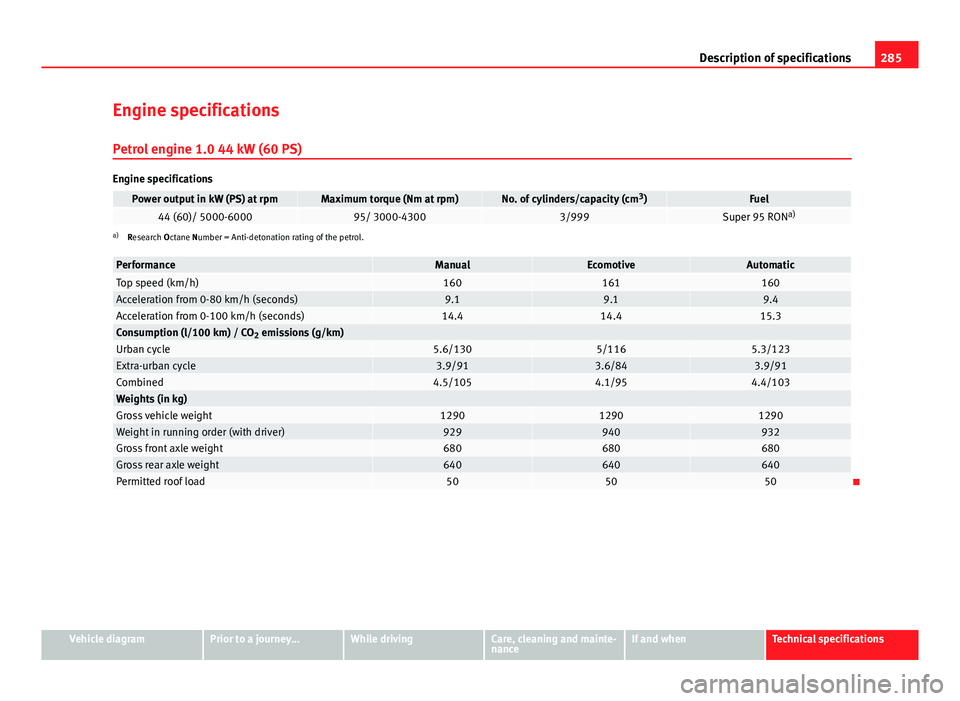
Engine specifications
Petrol engine 1.0 44 kW (60 PS)
Engine specifications
Power output in kW (PS) at rpmMaximum torque (Nm at rpm)No. of cylinders/capacity (cm 3
)Fuel44 (60)/ 5000-600095/ 3000-43003/999Super 95 RON a)a)
Research Octane Number = Anti-detonation rating of the petrol.
PerformanceManualEcomotiveAutomaticTop speed (km/h)160161160Acceleration from 0-80 km/h (seconds)9.19.19.4Acceleration from 0-100 km/h (seconds)14.414.415.3Consumption (l/100 km) / CO 2 emissions (g/km)Urban cycle5.6/1305/1165.3/123Extra-urban cycle3.9/913.6/843.9/91Combined4.5/1054.1/954.4/103Weights (in kg)Gross vehicle weight129012901290Weight in running order (with driver)929940932Gross front axle weight680680680Gross rear axle weight640640640Permitted roof load505050
Vehicle diagramPrior to a journey...While drivingCare, cleaning and mainte-
nanceIf and whenTechnical specifications
Page 288 of 306
286Description of specifications
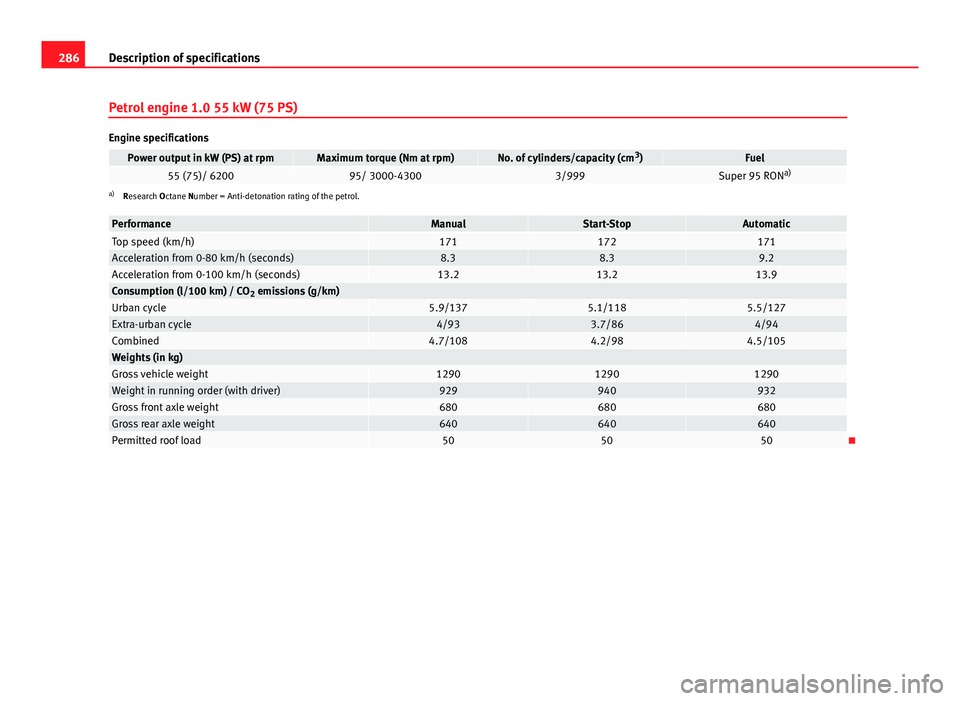
Petrol engine 1.0 55 kW (75 PS)
Engine specifications
Power output in kW (PS) at rpmMaximum torque (Nm at rpm)No. of cylinders/capacity (cm 3
)Fuel55 (75)/ 620095/ 3000-43003/999Super 95 RON a)a)
Research Octane Number = Anti-detonation rating of the petrol.
PerformanceManualStart-StopAutomaticTop speed (km/h)171172171Acceleration from 0-80 km/h (seconds)8.38.39.2Acceleration from 0-100 km/h (seconds)13.213.213.9Consumption (l/100 km) / CO 2 emissions (g/km)Urban cycle5.9/1375.1/1185.5/127Extra-urban cycle4/933.7/864/94Combined4.7/1084.2/984.5/105Weights (in kg)Gross vehicle weight129012901290Weight in running order (with driver)929940932Gross front axle weight680680680Gross rear axle weight640640640Permitted roof load505050
Page 289 of 306
287
Description of specifications
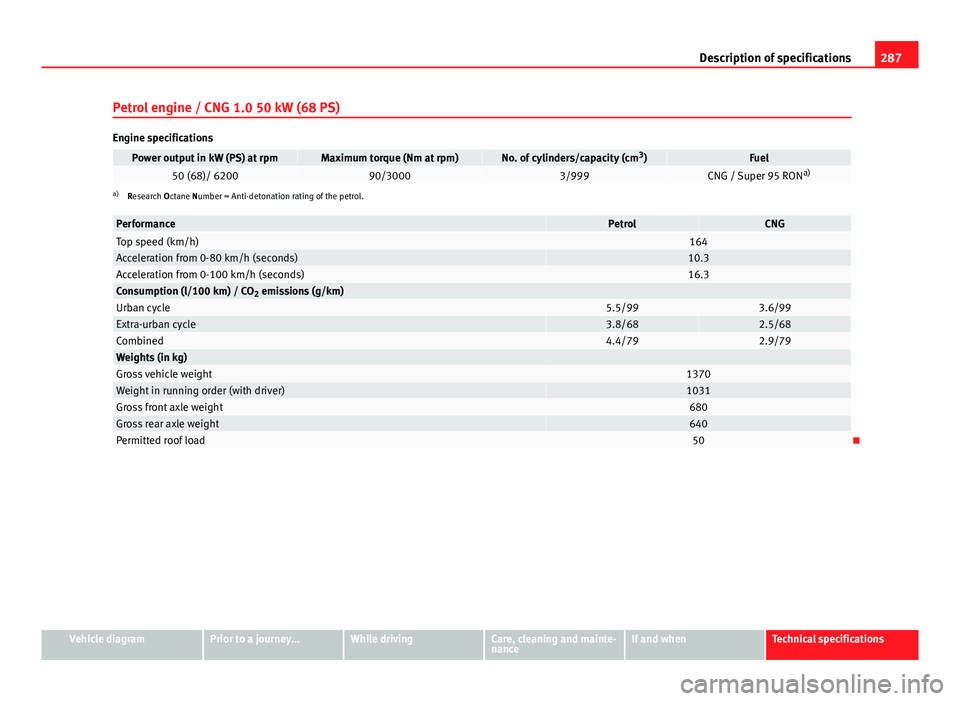
Petrol engine / CNG 1.0 50 kW (68 PS)
Engine specifications
Power output in kW (PS) at rpmMaximum torque (Nm at rpm)No. of cylinders/capacity (cm 3
)Fuel50 (68)/ 620090/30003/999CNG / Super 95 RON a)a)
Research Octane Number = Anti-detonation rating of the petrol.
PerformancePetrolCNGTop speed (km/h)164Acceleration from 0-80 km/h (seconds)10.3Acceleration from 0-100 km/h (seconds)16.3Consumption (l/100 km) / CO 2 emissions (g/km)Urban cycle5.5/993.6/99Extra-urban cycle3.8/682.5/68Combined4.4/792.9/79Weights (in kg)Gross vehicle weight1370Weight in running order (with driver)1031Gross front axle weight680Gross rear axle weight640Permitted roof load50
Vehicle diagramPrior to a journey...While drivingCare, cleaning and mainte-
nanceIf and whenTechnical specifications
Page 293 of 306
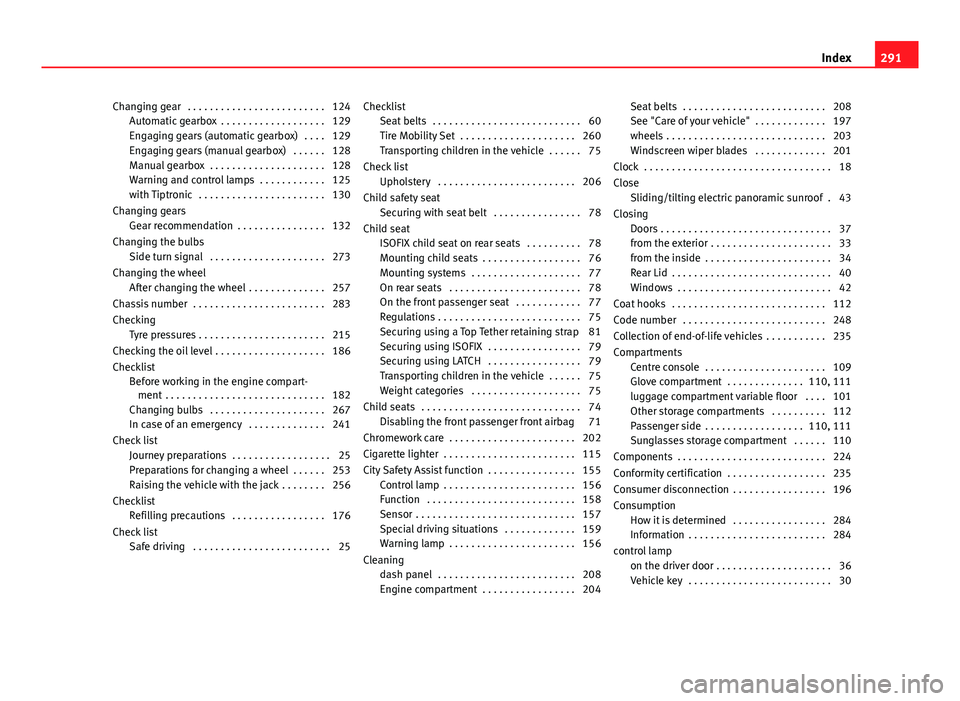
Changing gear . . . . . . . . . . . . . . . . . . . . . . . . . 124Automatic gearbox . . . . . . . . . . . . . . . . . . . 129
Engaging gears (automatic gearbox) . . . . 129
Engaging gears (manual gearbox) . . . . . . 128
Manual gearbox . . . . . . . . . . . . . . . . . . . . . 128
Warning and control lamps . . . . . . . . . . . . 125
with Tiptronic . . . . . . . . . . . . . . . . . . . . . . . 130
Changing gears Gear recommendation . . . . . . . . . . . . . . . . 132
Changing the bulbs Side turn signal . . . . . . . . . . . . . . . . . . . . . 273
Changing the wheel After changing the wheel . . . . . . . . . . . . . . 257
Chassis number . . . . . . . . . . . . . . . . . . . . . . . . 283
Checking Tyre pressures . . . . . . . . . . . . . . . . . . . . . . . 215
Checking the oil level . . . . . . . . . . . . . . . . . . . . 186
Checklist Before working in the engine compart-ment . . . . . . . . . . . . . . . . . . . . . . . . . . . . . 182
Changing bulbs . . . . . . . . . . . . . . . . . . . . . 267
In case of an emergency . . . . . . . . . . . . . . 241
Check list Journey preparations . . . . . . . . . . . . . . . . . . 25
Preparations for changing a wheel . . . . . . 253
Raising the vehicle with the jack . . . . . . . . 256
Checklist Refilling precautions . . . . . . . . . . . . . . . . . 176
Check list Safe driving . . . . . . . . . . . . . . . . . . . . . . . . . 25 Checklist
Seat belts . . . . . . . . . . . . . . . . . . . . . . . . . . . 60
Tire Mobility Set . . . . . . . . . . . . . . . . . . . . . 260
Transporting children in the vehicle . . . . . . 75
Check list Upholstery . . . . . . . . . . . . . . . . . . . . . . . . . 206
Child safety seat Securing with seat belt . . . . . . . . . . . . . . . . 78
Child seat ISOFIX child seat on rear seats . . . . . . . . . . 78
Mounting child seats . . . . . . . . . . . . . . . . . . 76
Mounting systems . . . . . . . . . . . . . . . . . . . . 77
On rear seats . . . . . . . . . . . . . . . . . . . . . . . . 78
On the front passenger seat . . . . . . . . . . . . 77
Regulations . . . . . . . . . . . . . . . . . . . . . . . . . . 75
Securing using a Top Tether retaining strap 81
Securing using ISOFIX . . . . . . . . . . . . . . . . . 79
Securing using LATCH . . . . . . . . . . . . . . . . . 79
Transporting children in the vehicle . . . . . . 75
Weight categories . . . . . . . . . . . . . . . . . . . . 75
Child seats . . . . . . . . . . . . . . . . . . . . . . . . . . . . . 74 Disabling the front passenger front airbag 71
Chromework care . . . . . . . . . . . . . . . . . . . . . . . 202
Cigarette lighter . . . . . . . . . . . . . . . . . . . . . . . . 115
City Safety Assist function . . . . . . . . . . . . . . . . 155 Control lamp . . . . . . . . . . . . . . . . . . . . . . . . 156
Function . . . . . . . . . . . . . . . . . . . . . . . . . . . 158
Sensor . . . . . . . . . . . . . . . . . . . . . . . . . . . . . 157
Special driving situations . . . . . . . . . . . . . 159
Warning lamp . . . . . . . . . . . . . . . . . . . . . . . 156
Cleaning dash panel . . . . . . . . . . . . . . . . . . . . . . . . . 208
Engine compartment . . . . . . . . . . . . . . . . . 204 Seat belts . . . . . . . . . . . . . . . . . . . . . . . . . . 208
See "Care of your vehicle" . . . . . . . . . . . . . 197
wheels . . . . . . . . . . . . . . . . . . . . . . . . . . . . . 203
Windscreen wiper blades . . . . . . . . . . . . . 201
Clock . . . . . . . . . . . . . . . . . . . . . . . . . . . . . . . . . . 18
Close Sliding/tilting electric panoramic sunroof . 43
Closing Doors . . . . . . . . . . . . . . . . . . . . . . . . . . . . . . . 37
from the exterior . . . . . . . . . . . . . . . . . . . . . . 33
from the inside . . . . . . . . . . . . . . . . . . . . . . . 34
Rear Lid . . . . . . . . . . . . . . . . . . . . . . . . . . . . . 40
Windows . . . . . . . . . . . . . . . . . . . . . . . . . . . . 42
Coat hooks . . . . . . . . . . . . . . . . . . . . . . . . . . . . 112
Code number . . . . . . . . . . . . . . . . . . . . . . . . . . 248
Collection of end-of-life vehicles . . . . . . . . . . . 235
Compartments Centre console . . . . . . . . . . . . . . . . . . . . . . 109
Glove compartment . . . . . . . . . . . . . . 110, 111
luggage compartment variable floor . . . . 101
Other storage compartments . . . . . . . . . . 112
Passenger side . . . . . . . . . . . . . . . . . . 110, 111
Sunglasses storage compartment . . . . . . 110
Components . . . . . . . . . . . . . . . . . . . . . . . . . . . 224
Conformity certification . . . . . . . . . . . . . . . . . . 235
Consumer disconnection . . . . . . . . . . . . . . . . . 196
Consumption How it is determined . . . . . . . . . . . . . . . . . 284
Information . . . . . . . . . . . . . . . . . . . . . . . . . 284
control lamp on the driver door . . . . . . . . . . . . . . . . . . . . . 36
Vehicle key . . . . . . . . . . . . . . . . . . . . . . . . . . 30
291
Index