service Seat Mii 2013 Service Manual
[x] Cancel search | Manufacturer: SEAT, Model Year: 2013, Model line: Mii, Model: Seat Mii 2013Pages: 306, PDF Size: 4.3 MB
Page 203 of 306
201
Vehicle care and maintenance
Cleaning and changing windscreen wiper blades
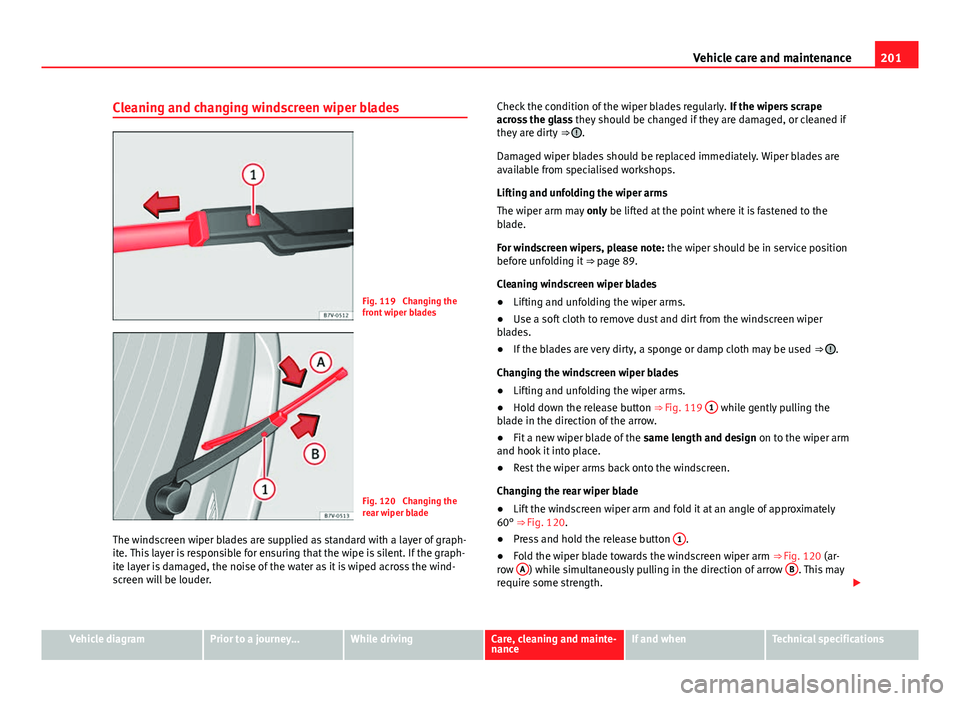
Fig. 119 Changing the
front wiper blades
Fig. 120 Changing the
rear wiper blade
The windscreen wiper blades are supplied as standard with a layer of graph-
ite. This layer is responsible for ensuring that the wipe is silent. If the graph-
ite layer is damaged, the noise of the water as it is wiped across the wind-
screen will be louder. Check the condition of the wiper blades regularly.
If the wipers scrape
across the glass they should be changed if they are damaged, or cleaned if
they are dirty ⇒
.
Damaged wiper blades should be replaced immediately. Wiper blades are
available from specialised workshops.
Lifting and unfolding the wiper arms
The wiper arm may only be lifted at the point where it is fastened to the
blade.
For windscreen wipers, please note: the wiper should be in service position
before unfolding it ⇒ page 89.
Cleaning windscreen wiper blades
● Lifting and unfolding the wiper arms.
● Use a soft cloth to remove dust and dirt from the windscreen wiper
blades.
● If the blades are very dirty, a sponge or damp cloth may be used ⇒
.
Changing the windscreen wiper blades
● Lifting and unfolding the wiper arms.
● Hold down the release button ⇒ Fig. 119 1
while gently pulling the
blade in the direction of the arrow.
● Fit a new wiper blade of the same length and design on to the wiper arm
and hook it into place.
● Rest the wiper arms back onto the windscreen.
Changing the rear wiper blade
● Lift the windscreen wiper arm and fold it at an angle of approximately
60° ⇒ Fig. 120.
● Press and hold the release button 1
.
● Fold the wiper blade towards the windscreen wiper arm ⇒ Fig. 120 (ar-
row A
) while simultaneously pulling in the direction of arrow B. This may
require some strength.
Vehicle diagramPrior to a journey...While drivingCare, cleaning and mainte-
nanceIf and whenTechnical specifications
Page 206 of 306
204Vehicle care and maintenance
WARNING
Additional underseal or anti-corrosion products could catch fire due to
the high temperatures reached by the exhaust gas system and other en-
gine components.
● Do not apply additional underseal or anti-corrosion products to the
exhaust pipes, catalytic converters, heat shields or other parts of the ve-
hicle which reach high temperatures.
Cleaning the engine compartment
The engine compartment of any motor vehicle is a potentially hazardous
area ⇒ page 180. The engine compartment should only be cleaned by qualified personnel. If
it is not correctly cleaned, the anti-corrosion coating and consequently elec-
trical components may be damaged. Moreover, water may filter directly into
the vehicle interior through the water chamber ⇒
.
If the engine compartment is very dirty, always take the vehicle to a special-
ised workshop for professional cleaning. SEAT recommends visiting a Tech-
nical Service.
Water box
The water box is in the engine compartment, between the windscreen and
the engine, and beneath a perforated cover. Air is taken in through the wa-
ter box from outside to the vehicle interior via the heating and air condition-
er.
Leaves and other loose objects should be regularly cleaned away from the
water box either by hand or with a vacuum.
WARNING
When working on the engine or in the engine compartment, there is a
risk of injury, burns, accident or fire.
● Before starting work, please ensure you are familiar with the required
procedure and the safety precautions ⇒ page 180.
● SEAT recommends you have this work performed by a specialised
workshop.
CAUTION
If water is manually poured into the water box (for example, using a high
pressure cleaning appliance), this could cause significant damage to the ve-
hicle.
For the sake of the environment
Only wash the engine compartment in areas allocated for this purpose, to
prevent dirty water which may be contaminated by oil, grease or fuel, from
entering the drains. In some districts, the engine compartment may not be
washed outside the wash bays provided for this purpose.
Page 207 of 306
205
Vehicle care and maintenance
Caring for and cleaning the vehicle interior
Introduction
The dye from many items of modern clothing (e.g. dark jeans) is not always
solid enough. Seat upholstery (material and leather), especially when light-
coloured, may visibly discolour if the dye comes out of clothing (even when
used correctly). This is not an upholstery defect but indicates that the dye in
the item of clothing is not solid enough.
Additional information and warnings:
● Caring for and cleaning the vehicle exterior ⇒ page 197
● Accessories, parts replacement, repairs and modifications ⇒ page 222
WARNING
Car-care products may be toxic and hazardous. If car care products are
not suitable or are used inappropriately, this could result in accident, se-
rious injury, burns or intoxication.
● Car care products must always be stored in the original container
which should be kept closed.
● Observe information provided by the manufacturer.
● To prevent confusion, never store car care products in empty food
cans, bottles or other containers.
● Keep all care products out of reach of children.
● Harmful vapours may be produced when using car care products.
Therefore, care products should only be used in well-ventilated spaces or
in the open air.
● Never use fuel, turpentine, engine oil, acetone or any other volatile
liquid to wash, clean or care for the vehicle. These are toxic and highly
flammable.
WARNING
Inappropriate care and cleaning of vehicle components may effect the ve-
hicle safety equipment, increasing the risk of severe injury.
● Vehicle components should only be cleaned and maintained in ac-
cordance with the manufacturer's instructions.
● Only use approved or recommended care products.
CAUTION
● Cleaning products which contain solvents will damage the material.
● To avoid damage, stubborn stains should be removed by a specialised
workshop.
Note
Suitable vehicle care products are available from your Technical Service.
Vehicle diagramPrior to a journey...While drivingCare, cleaning and mainte-
nanceIf and whenTechnical specifications
Page 212 of 306
210Vehicle care and maintenance
Wheels and tyres
Introduction
SEAT recommend that all work on tyres and wheels is carried out by a speci-
alised workshop. They have the necessary special tools and replacement
parts, trained personnel and facilities for disposing of the old tyres. SEAT
recommends visiting a Technical Service.
Additional information and warnings:
● Transporting ⇒ page 95
● Braking, stopping and parking ⇒ page 134
● Caring for and cleaning the vehicle exterior ⇒ page 197
● Notes for the user ⇒ page 233
● Vehicle tool kit ⇒ page 247
● Wheel trims ⇒ page 250
● Change wheel ⇒ page 252
● Tire Mobility Set ⇒ page 258
WARNING
The vehicle cannot be totally controlled or braked if the tyres (new or
used) are worn or damaged.
● Incorrect use of wheels and tyres could make driving more dangerous
and result in serious accidents and damage.
● All four wheels must be fitted with radial tyres of the same type, size
(rolling circumference) and the same tread pattern.
● New tyres do not give maximum grip and will not have reached their
maximum braking capacity to start with, and therefore need running in.
To prevent accidents and major damage, extreme caution should be tak-
en for the first 600 km (400 miles).
WARNING (Continued)
● Check tyre pressures regularly and ensure they are maintained at the
pressures indicated. If the tyre pressure is too low, the tyres could over-
heat, resulting in tread detachment or even burst tyres.
● Never drive on damaged (punctured, cut, cracked or dented) or worn
tyres. Driving on damaged or worn tyres could result in burst tyres, seri-
ous accidents or damage. Worn or damaged tyres must be replaced im-
mediately.
● Never exceed the maximum permitted speed or loads specified for the
type of tyre fitted on your vehicle.
● The effectiveness of driver and brake assist systems also depends on
the grip of the tyres.
● If you notice unusual vibration or if the vehicle pulls to one side when
driving, stop the car immediately and check the tyres and wheels for
damage.
● To minimise the risk of losing control of the vehicle or causing a seri-
ous accident, never undo the bolted joints of beadlock wheels.
● Never mount used tyres or wheels if you are not sure of their previous
history. They may be damaged, although the damage is not immediately
visible.
● Old tyres, even if they have never been used, may lose air or burst un-
expectedly while driving, especially at high speeds, resulting in serious
accident and injury. If tyres are over six years old, they should only be
used in an emergency and with extreme caution.
Note
For technical reasons, it is not generally possible to use the wheels from
other vehicles. In some cases, this may also be true for the same model of
wheel. Please refer to the vehicle documentation or ask at a Technical Serv-
ice.
Page 213 of 306
211
Vehicle care and maintenance
About your tyres and wheels
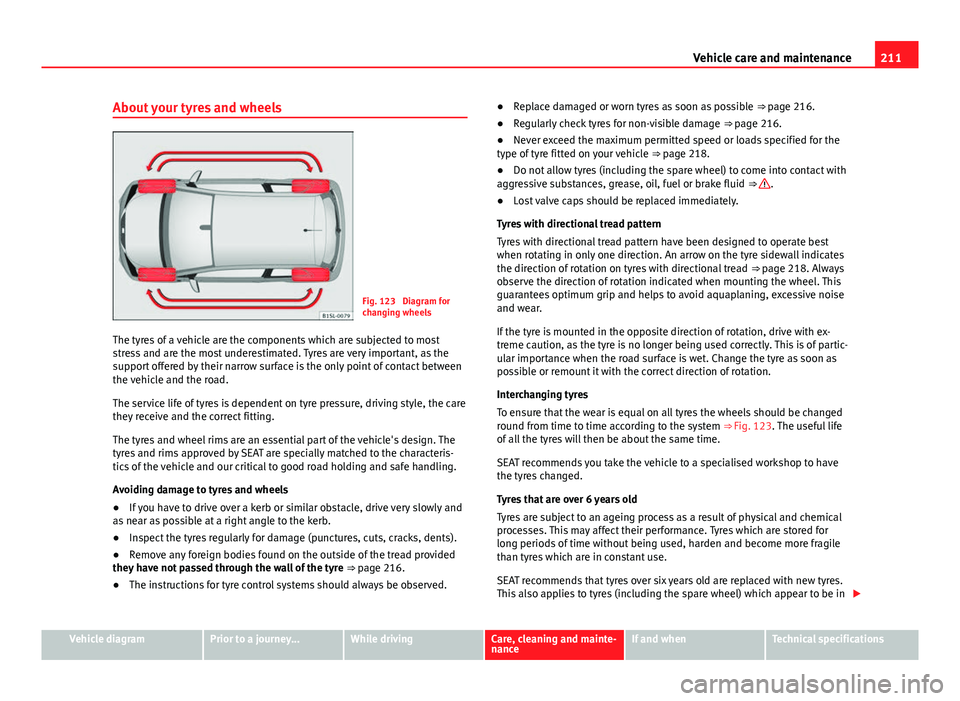
Fig. 123 Diagram for
changing wheels
The tyres of a vehicle are the components which are subjected to most
stress and are the most underestimated. Tyres are very important, as the
support offered by their narrow surface is the only point of contact between
the vehicle and the road.
The service life of tyres is dependent on tyre pressure, driving style, the care
they receive and the correct fitting.
The tyres and wheel rims are an essential part of the vehicle's design. The
tyres and rims approved by SEAT are specially matched to the characteris-
tics of the vehicle and our critical to good road holding and safe handling.
Avoiding damage to tyres and wheels
● If you have to drive over a kerb or similar obstacle, drive very slowly and
as near as possible at a right angle to the kerb.
● Inspect the tyres regularly for damage (punctures, cuts, cracks, dents).
● Remove any foreign bodies found on the outside of the tread provided
they have not passed through the wall of the tyre
⇒ page 216.
● The instructions for tyre control systems should always be observed. ●
Replace damaged or worn tyres as soon as possible ⇒ page 216.
● Regularly check tyres for non-visible damage ⇒ page 216.
● Never exceed the maximum permitted speed or loads specified for the
type of tyre fitted on your vehicle ⇒ page 218.
● Do not allow tyres (including the spare wheel) to come into contact with
aggressive substances, grease, oil, fuel or brake fluid ⇒
.
● Lost valve caps should be replaced immediately.
Tyres with directional tread pattern
Tyres with directional tread pattern have been designed to operate best
when rotating in only one direction. An arrow on the tyre sidewall indicates
the direction of rotation on tyres with directional tread ⇒ page 218. Always
observe the direction of rotation indicated when mounting the wheel. This
guarantees optimum grip and helps to avoid aquaplaning, excessive noise
and wear.
If the tyre is mounted in the opposite direction of rotation, drive with ex-
treme caution, as the tyre is no longer being used correctly. This is of partic-
ular importance when the road surface is wet. Change the tyre as soon as
possible or remount it with the correct direction of rotation.
Interchanging tyres
To ensure that the wear is equal on all tyres the wheels should be changed
round from time to time according to the system ⇒ Fig. 123. The useful life
of all the tyres will then be about the same time.
SEAT recommends you take the vehicle to a specialised workshop to have
the tyres changed.
Tyres that are over 6 years old
Tyres are subject to an ageing process as a result of physical and chemical
processes. This may affect their performance. Tyres which are stored for
long periods of time without being used, harden and become more fragile
than tyres which are in constant use.
SEAT recommends that tyres over six years old are replaced with new tyres.
This also applies to tyres (including the spare wheel) which appear to be in
Vehicle diagramPrior to a journey...While drivingCare, cleaning and mainte-
nanceIf and whenTechnical specifications
Page 214 of 306
212Vehicle care and maintenance
perfect condition on the outside and which have a tread depth within the
values stipulated by the Law ⇒
.
The date of manufacture, part of the tyre identification number (TIN), indi-
cates the age of the tyre ( ) ⇒ page 218.
Storing tyres
Mark tyres when you remove them to indicate the direction of rotation (left,
right, forwards, backwards). This ensures you will be able to mount them
correctly when you replace them. When removed, the wheels and/or tyres
should be stored in a cool, dry and preferably dark location. Do not place
tyres mounted on the wheel in a vertical position.
Protect tyres not mounted on wheels from dirt by storing them in suitable
bags and standing them on the ground on their tread.
WARNING
Aggressive fluids or substances could result in visible or invisible dam-
age with the consequent risks.
● Always ensure that tyres do not come into contact with chemical
products, oil, grease, fuel, brake fluid or other aggressive substances.
WARNING
Old tyres, even if they have never been used, may lose air or burst unex-
pectedly while driving, resulting in serious accident or damage.
● If tyres are over six years old, they should only be used in an emer-
gency and with extreme caution.
For the sake of the environment
Old tyres must be disposed of by qualified personnel according to the laws
in the country concerned. Wheel rims
The design of wheel bolts is matched to the rims. If different rims are fitted,
the correct wheel bolts with the right length and correctly shaped bolt
heads must be used. This ensures that wheels are fitted securely and that
the brake system functions correctly
⇒ page 252.
For technical reasons, it is not generally possible to use the wheels from
other vehicles. In some cases, this may also be true for the same model of
wheel.
The tyres and rims approved by SEAT are specially matched to the character-
istics of the vehicle and are critical to good road holding and safe handling.
Wheel bolts
Wheel bolts must be tightened to the correct torque ⇒ page 252.
Beadlock wheel rims
Beadlock wheel rims have various components. These are joined together
by special bolts using a special procedure. This ensures good performance,
a better seal, improved safety and wheel run out. Therefore, worn rims
should always be replaced and must only be repaired in a specialised work-
shop. SEAT recommends visiting a Technical Service ⇒
.
Wheel rims with bolted trims
Wheel rims may be fitted with interchangeable trim parts which are attach-
ed to the rim using self-locking bolts. Worn trims should only be replaced at
a specialised workshop. SEAT recommends visiting a Technical Service
⇒
.
Page 217 of 306
215
Vehicle care and maintenance
Checking tyre pressures
Check tyre pressures only when the vehicle has not been driven for more
than a few kilometres at low speeds in the past three hours.
● The tyre pressures should be checked regularly, and only when the tyres
are cold. Always check all tyres, including the spare wheel. Tyre pressures
should be checked more often in colder regions, and only when the vehicle
has not been driven recently. Always use a correctly-operating tyre gauge.
● Adjust tyre pressures to the loads carried in the vehicle.
● After adjusting the tyre pressure, check that the caps are properly
screwed.
The spare wheel or temporary spare wheel must be at the maximum pres-
sure specified.
WARNING
If tyre pressures are too high or too low, the tyre may deflate or burst
suddenly while driving. This could result in a serious accident.
● If the tyre pressure is too low, the tyres could overheat, resulting in
tread detachment or even burst tyres.
● When driving at high speeds and/or fully loaded, the tyre could sud-
denly overheat, burst or be subject to tread detachment, with the resul-
tant loss of control of the vehicle.
● Tyre pressures which are too high or too low reduce the service life of
the tyre, affecting the vehicle's performance.
● Tyre pressures should be checked regularly, at least once a month
and before long journeys.
● Adjust the pressures of all the tyres to the vehicle load.
● Never deflate excess pressure from hot tyres.
CAUTION
● Take care not to tilt the manometer when placing it on the valve. Other-
wise, the valve may be damaged.
● To avoid damage to the valves, always replace valve caps correctly.
Check that the caps are identical to the standard caps and have been cor-
rectly tightened.
For the sake of the environment
Under-inflated tyres will increase the fuel consumption.
Tread depth and wear indicators
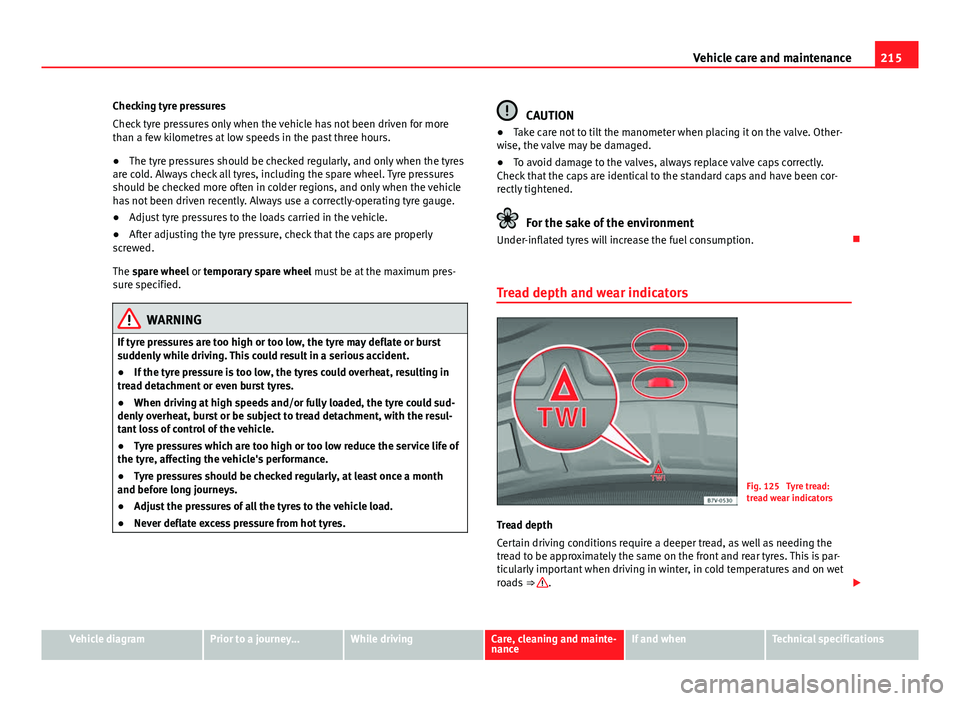
Fig. 125 Tyre tread:
tread wear indicators
Tread depth
Certain driving conditions require a deeper tread, as well as needing the
tread to be approximately the same on the front and rear tyres. This is par-
ticularly important when driving in winter, in cold temperatures and on wet
roads ⇒
.
Vehicle diagramPrior to a journey...While drivingCare, cleaning and mainte-
nanceIf and whenTechnical specifications
Page 221 of 306
219
Vehicle care and maintenance
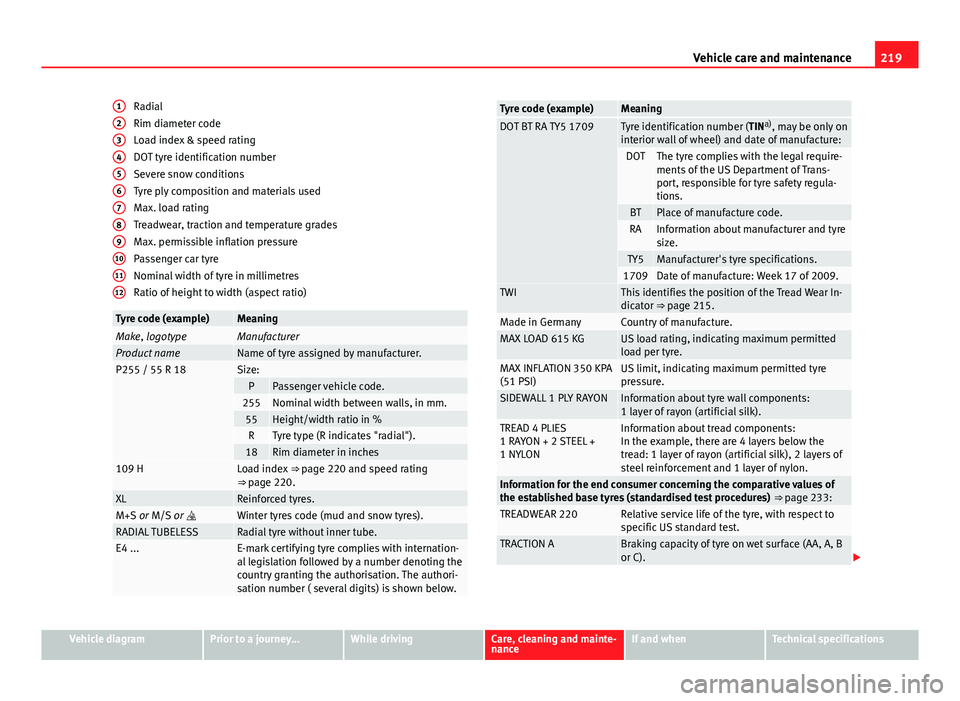
Radial
Rim diameter code
Load index & speed rating
DOT tyre identification number
Severe snow conditions
Tyre ply composition and materials used
Max. load rating
Treadwear, traction and temperature grades
Max. permissible inflation pressure
Passenger car tyre
Nominal width of tyre in millimetres
Ratio of height to width (aspect ratio)
Tyre code (example)MeaningMake, logotypeManufacturerProduct nameName of tyre assigned by manufacturer.P255 / 55 R 18Size:PPassenger vehicle code.255Nominal width between walls, in mm.55Height/width ratio in %RTyre type (R indicates "radial").18Rim diameter in inches109 HLoad index ⇒ page 220 and speed rating
⇒ page 220.
XLReinforced tyres.M+S or M/S or Winter tyres code (mud and snow tyres).RADIAL TUBELESSRadial tyre without inner tube.E4 ...E-mark certifying tyre complies with internation-
al legislation followed by a number denoting the
country granting the authorisation. The authori-
sation number ( several digits) is shown below.
123456789101112
Tyre code (example)MeaningDOT BT RA TY5 1709Tyre identification number (TIN a)
, may be only on
interior wall of wheel) and date of manufacture:
DOTThe tyre complies with the legal require-
ments of the US Department of Trans-
port, responsible for tyre safety regula-
tions.
BTPlace of manufacture code.RAInformation about manufacturer and tyre
size.
TY5Manufacturer's tyre specifications.1709Date of manufacture: Week 17 of 2009.TWIThis identifies the position of the Tread Wear In-
dicator ⇒ page 215.
Made in GermanyCountry of manufacture.MAX LOAD 615 KGUS load rating, indicating maximum permitted
load per tyre.
MAX INFLATION 350 KPA
(51 PSI)US limit, indicating maximum permitted tyre
pressure.
SIDEWALL 1 PLY RAYONInformation about tyre wall components:
1 layer of rayon (artificial silk).
TREAD 4 PLIES
1 RAYON + 2 STEEL +
1 NYLONInformation about tread components:
In the example, there are 4 layers below the
tread: 1 layer of rayon (artificial silk), 2 layers of
steel reinforcement and 1 layer of nylon.
Information for the end consumer concerning the comparative values of
the established base tyres (standardised test procedures) ⇒ page 233:
TREADWEAR 220Relative service life of the tyre, with respect to
specific US standard test.
TRACTION ABraking capacity of tyre on wet surface (AA, A, B
or C).
Vehicle diagramPrior to a journey...While drivingCare, cleaning and mainte-
nanceIf and whenTechnical specifications
Page 222 of 306
220Vehicle care and maintenance
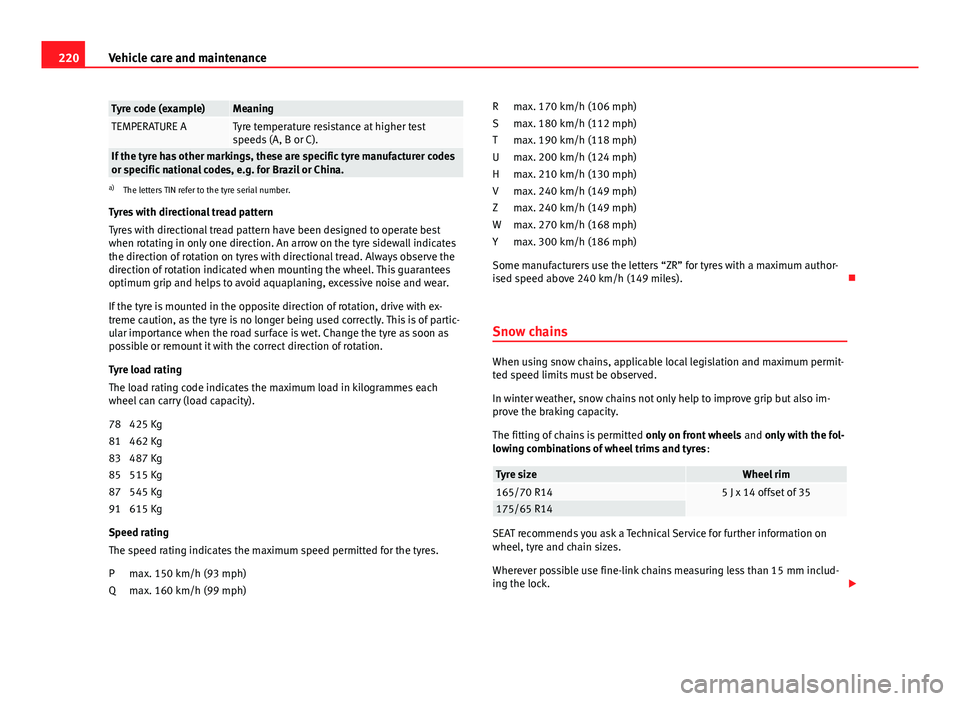
Tyre code (example)MeaningTEMPERATURE ATyre temperature resistance at higher test
speeds (A, B or C).
If the tyre has other markings, these are specific tyre manufacturer codes
or specific national codes, e.g. for Brazil or China.
a)
The letters TIN refer to the tyre serial number.
Tyres with directional tread pattern
Tyres with directional tread pattern have been designed to operate best
when rotating in only one direction. An arrow on the tyre sidewall indicates
the direction of rotation on tyres with directional tread. Always observe the
direction of rotation indicated when mounting the wheel. This guarantees
optimum grip and helps to avoid aquaplaning, excessive noise and wear.
If the tyre is mounted in the opposite direction of rotation, drive with ex-
treme caution, as the tyre is no longer being used correctly. This is of partic-
ular importance when the road surface is wet. Change the tyre as soon as
possible or remount it with the correct direction of rotation.
Tyre load rating
The load rating code indicates the maximum load in kilogrammes each
wheel can carry (load capacity).
425 Kg
462 Kg
487 Kg
515 Kg
545 Kg
615 Kg
Speed rating
The speed rating indicates the maximum speed permitted for the tyres.
max. 150 km/h (93 mph)
max. 160 km/h (99 mph)
78
81
83
85
87
91
P
Q max. 170 km/h (106 mph)
max. 180 km/h (112 mph)
max. 190 km/h (118 mph)
max. 200 km/h (124 mph)
max. 210 km/h (130 mph)
max. 240 km/h (149 mph)
max. 240 km/h (149 mph)
max. 270 km/h (168 mph)
max. 300 km/h (186 mph)
Some manufacturers use the letters “ZR” for tyres with a maximum author-
ised speed above 240 km/h (149 miles).
Snow chains
When using snow chains, applicable local legislation and maximum permit-
ted speed limits must be observed.
In winter weather, snow chains not only help to improve grip but also im-
prove the braking capacity.
The fitting of chains is permitted only on front wheels and only with the fol-
lowing combinations of wheel trims and tyres :
Tyre sizeWheel rim165/70 R145 J x 14 offset of 35175/65 R14
SEAT recommends you ask a Technical Service for further information on
wheel, tyre and chain sizes.
Wherever possible use fine-link chains measuring less than 15 mm includ-
ing the lock.
R
S
T
U
H
V
Z
W
Y
Page 223 of 306
221
Vehicle care and maintenance
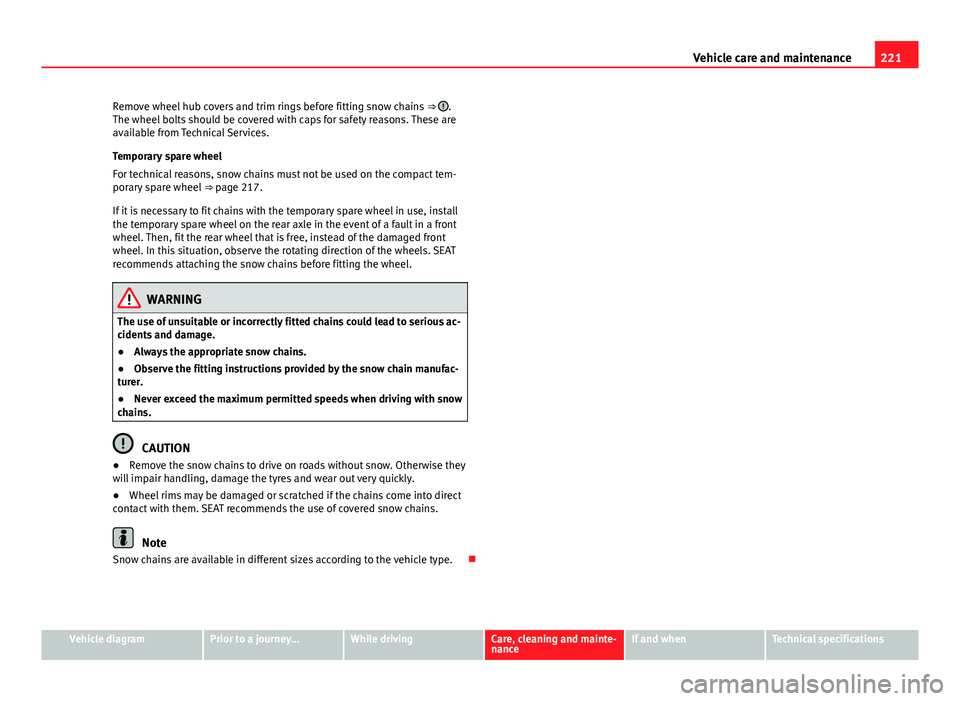
Remove wheel hub covers and trim rings before fitting snow chains ⇒
.
The wheel bolts should be covered with caps for safety reasons. These are
available from Technical Services.
Temporary spare wheel
For technical reasons, snow chains must not be used on the compact tem-
porary spare wheel ⇒ page 217.
If it is necessary to fit chains with the temporary spare wheel in use, install
the temporary spare wheel on the rear axle in the event of a fault in a front
wheel. Then, fit the rear wheel that is free, instead of the damaged front
wheel. In this situation, observe the rotating direction of the wheels. SEAT
recommends attaching the snow chains before fitting the wheel.
WARNING
The use of unsuitable or incorrectly fitted chains could lead to serious ac-
cidents and damage.
● Always the appropriate snow chains.
● Observe the fitting instructions provided by the snow chain manufac-
turer.
● Never exceed the maximum permitted speeds when driving with snow
chains.
CAUTION
● Remove the snow chains to drive on roads without snow. Otherwise they
will impair handling, damage the tyres and wear out very quickly.
● Wheel rims may be damaged or scratched if the chains come into direct
contact with them. SEAT recommends the use of covered snow chains.
Note
Snow chains are available in different sizes according to the vehicle type.
Vehicle diagramPrior to a journey...While drivingCare, cleaning and mainte-
nanceIf and whenTechnical specifications