ESP Seat Mii 2013 Repair Manual
[x] Cancel search | Manufacturer: SEAT, Model Year: 2013, Model line: Mii, Model: Seat Mii 2013Pages: 306, PDF Size: 4.3 MB
Page 208 of 306
206Vehicle care and maintenance
Treating your upholstery
Check list
For information on how to treat and care for the vehicle upholstery, please
bear the following in mind ⇒
:
Before entering the vehicle, fasten all Velcro fastenings which could
come into contact with upholstery and coverings. If the Velcro fasten-
ings on upholstery and material covers are not securely fastened,
this could damage them.
To prevent damage, do not allow the upholstery or covers to come
into contact with sharp or decorative objects. Decorative objects
such as zips, rivets and rhinestones on clothing and belts.
Dust and grit in the pores and seams should be removed regularly to
prevent them scratching and damaging the surface.
Always check that the dyes used in clothing are fast to prevent them
from staining the upholstery. This is particularly true for clear-col-
oured upholstery.
CAUTION
Failure to observe the instructions in the check list for caring for your up-
holstery could result in damage or discolouration of the upholstery and cov-
ers.
● Always follow the check list and perform the necessary operations.
Note
SEAT recommends you take the vehicle to a Specialised workshop to treat
any stains on the upholstery caused by the discolouration of clothing. Padding and fabric trim cleaning
Normal cleaning
●
Before applying cleaning products, please read the instructions for han-
dling and the warnings shown on the container.
● The upholstery, textile covers, and carpet should be regularly vacuumed
(with vacuum brush).
● We recommend that you use a soft sponge or lint-free, micro-fibre cloth
for normal cleaning ⇒
.
General superficial dirt on upholstery and textile covers can be cleaned with
a normal foam cleaning product.
If the upholstery and the material trims are very dirty, we recommend you
have them cleaned by a specialist cleaning form.
Cleaning stains
It may be necessary to clean the whole surface and not only the stain itself.
Especially if the surface has been dirtied through normal use. Otherwise,
the stained area may become lighter than the rest of the surface after treat-
ment.
Page 212 of 306
210Vehicle care and maintenance
Wheels and tyres
Introduction
SEAT recommend that all work on tyres and wheels is carried out by a speci-
alised workshop. They have the necessary special tools and replacement
parts, trained personnel and facilities for disposing of the old tyres. SEAT
recommends visiting a Technical Service.
Additional information and warnings:
● Transporting ⇒ page 95
● Braking, stopping and parking ⇒ page 134
● Caring for and cleaning the vehicle exterior ⇒ page 197
● Notes for the user ⇒ page 233
● Vehicle tool kit ⇒ page 247
● Wheel trims ⇒ page 250
● Change wheel ⇒ page 252
● Tire Mobility Set ⇒ page 258
WARNING
The vehicle cannot be totally controlled or braked if the tyres (new or
used) are worn or damaged.
● Incorrect use of wheels and tyres could make driving more dangerous
and result in serious accidents and damage.
● All four wheels must be fitted with radial tyres of the same type, size
(rolling circumference) and the same tread pattern.
● New tyres do not give maximum grip and will not have reached their
maximum braking capacity to start with, and therefore need running in.
To prevent accidents and major damage, extreme caution should be tak-
en for the first 600 km (400 miles).
WARNING (Continued)
● Check tyre pressures regularly and ensure they are maintained at the
pressures indicated. If the tyre pressure is too low, the tyres could over-
heat, resulting in tread detachment or even burst tyres.
● Never drive on damaged (punctured, cut, cracked or dented) or worn
tyres. Driving on damaged or worn tyres could result in burst tyres, seri-
ous accidents or damage. Worn or damaged tyres must be replaced im-
mediately.
● Never exceed the maximum permitted speed or loads specified for the
type of tyre fitted on your vehicle.
● The effectiveness of driver and brake assist systems also depends on
the grip of the tyres.
● If you notice unusual vibration or if the vehicle pulls to one side when
driving, stop the car immediately and check the tyres and wheels for
damage.
● To minimise the risk of losing control of the vehicle or causing a seri-
ous accident, never undo the bolted joints of beadlock wheels.
● Never mount used tyres or wheels if you are not sure of their previous
history. They may be damaged, although the damage is not immediately
visible.
● Old tyres, even if they have never been used, may lose air or burst un-
expectedly while driving, especially at high speeds, resulting in serious
accident and injury. If tyres are over six years old, they should only be
used in an emergency and with extreme caution.
Note
For technical reasons, it is not generally possible to use the wheels from
other vehicles. In some cases, this may also be true for the same model of
wheel. Please refer to the vehicle documentation or ask at a Technical Serv-
ice.
Page 215 of 306
213
Vehicle care and maintenance
WARNING
The use of worn or damaged wheel rims could make driving more danger-
ous and result in serious accidents and damage.
● Only wheel rims which have been approved for use with your vehicle
should be used.
● Inspect wheel rims regularly for damage and replace as required.
WARNING
If the bolted joints of wheel rims with bolted ring trims are not correctly
tightened or loosened, this could result in serious accident.
● Never loosen the bolted joints of wheel rims with bolted ring trims.
● Any work relating to wheel rims with bolted rims should be carried
out at specialised workshop. SEAT recommends visiting a Technical Serv-
ice.
Replacement of new tyres and wheel rims
New tyres
● When tyres are new, drive with extreme caution for the first 600 km
(400 miles), as all tyres need to be run-in. Tyres which have not been run-in
do not have such good grip ⇒
or braking capacity ⇒ .
● All four wheels must be fitted with radial tyres of the same type, size
(rolling circumference) and the same tread pattern.
● The tread depth of new tyres may vary, according to the type and make
of tyre and the tread pattern. Replacing tyres
●
Where possible, always replace both wheels on an axle (both wheels on
the front axle or both wheels on the rear axle) ⇒
.
● Only replace used tyres with those authorised by SEAT for the corre-
sponding type vehicle. Pay special attention to size, diameter, and maxi-
mum load and speed capacity.
● Never use tyres which are larger than SEAT approved tyres. If the tyres
are too big, they may knock or rub against the chassis or other components,
resulting in damage.
WARNING
New tyres do not give maximum grip and will not have reached their max-
imum braking capacity to start with, and therefore need running in.
● To prevent accidents and major damage, extreme caution should be
taken for the first 600 km (400 miles).
WARNING
There should be adequate space between the tyres and the vehicle in ac-
cordance with the vehicle design. If this is not the case, the tyres may
rub against parts of the running gear, chassis or brake lines, leading to
faults in the brake system or to tread detachment, and the risk of burst
tyres.
● The true tyre dimension should not be greater than the dimensions of
tyres manufactured and approved by SEAT and should not rub against
parts of the vehicle.
Note
Although tyres may be shown as being the same size, the true dimensions
of different types of tyre may vary with respect to the nominal size, or tread
patterns may be different.
Vehicle diagramPrior to a journey...While drivingCare, cleaning and mainte-
nanceIf and whenTechnical specifications
Page 216 of 306
214Vehicle care and maintenance
Note
If you use tyres that are approved by SEAT, you can be sure that the true tyre
dimensions will be correct for your vehicle. For other tyre models, the tyre
vendor should provide the manufacturer's certificate with the tyre, indicat-
ing that this type of tyre is suitable for your vehicle. This certificate should
always be carried with the vehicle.
Tyre pressures
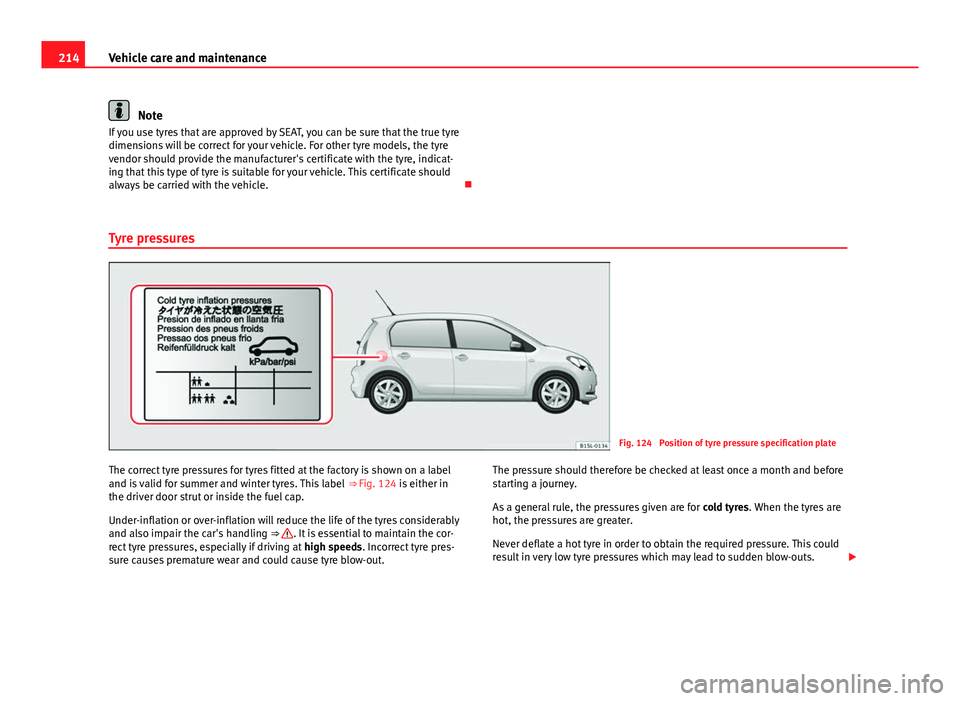
Fig. 124 Position of tyre pressure specification plate
The correct tyre pressures for tyres fitted at the factory is shown on a label
and is valid for summer and winter tyres. This label ⇒ Fig. 124 is either in
the driver door strut or inside the fuel cap.
Under-inflation or over-inflation will reduce the life of the tyres considerably
and also impair the car's handling ⇒
. It is essential to maintain the cor-
rect tyre pressures, especially if driving at high speeds. Incorrect tyre pres-
sure causes premature wear and could cause tyre blow-out. The pressure should therefore be checked at least once a month and before
starting a journey.
As a general rule, the pressures given are for
cold tyres. When the tyres are
hot, the pressures are greater.
Never deflate a hot tyre in order to obtain the required pressure. This could
result in very low tyre pressures which may lead to sudden blow-outs.
Page 218 of 306
216Vehicle care and maintenance
The minimum tread depth required by law in the majority of cases is
1.6 mm, measured in the tread grooves next to the tread wear indicators.
Observe legal requirements in each country.
The performance of winter tyres is much reduced when the tread has worn
to 4 mm (5/32 inch).
The tread depth of new tyres may vary, according to the type and make of
tyre and the tread pattern.
Wear indicators on the tyre
The original tyres on your vehicle have 1.6 mm high ⇒ Fig. 125 tread wear
indicators running across the tread. A number of these indicators are equal-
ly spaced around the tyre tread. Certain marks on the tyre walls (for exam-
ple, the letters “TWI” or other symbols) indicate the position of the wear in-
dicators.
Tread wear indicators indicate if a tyre is worn. Tyres must always be re-
placed before the tyre tread has worn to the level of the indicator.
WARNING
Driving with worn tyres is dangerous, and may lead to loss of control of
the vehicle with serious consequences.
● Tyres must be replaced before the wear indicators are at the same lev-
el as the tread pattern.
● Worn tyres have significantly reduced grip, especially on wet surfa-
ces, increasing the risk of “aquaplaning”.
● Worn tyres make control of the vehicle more difficult in normal or dif-
ficult driving conditions, increasing the braking distance and the risk of
skidding.
Damaged tyres
Damage to wheels and tyres is often not immediately visible. If you notice
unusual
vibration or the car pulling to one side, this may indicate that one
of the tyres is damaged ⇒
.
● Slow down immediately if you think you have a damaged wheel.
● Check the wheels and tyres for damage.
● If tyres are worn, stop driving and seek qualified assistance.
● If there is no visible exterior damage, drive slowly and carefully to the
nearest specialised workshop and have the vehicle checked.
Foreign bodies in the tyre
● Do not remove foreign bodies if they have penetrated through the tyre
wall!
● You should obtain professional assistance immediately.
Wear of tyres
The wear of tyres depends on a number of factors, for example:
● Driving style.
● Unbalanced wheels.
● Running gear settings.
Driving style : driving round bends fast or sudden acceleration or braking
speed up the wear of tyres. When the driving style is normal, if the tyres
wear too quickly, have the running gear settings checked at a specialised
workshop.
Wheel run-out: The wheels on new vehicles are balanced. However, certain
circumstances may lead to imbalance (run-out), which is detected as vibra-
tions in the steering wheel. Run-out leads to wear of the steering and sus-
pension. In the event of run out, the wheels should be balanced again.
When a new wheel is fitted, it should be balanced again.
Page 221 of 306
219
Vehicle care and maintenance
Radial
Rim diameter code
Load index & speed rating
DOT tyre identification number
Severe snow conditions
Tyre ply composition and materials used
Max. load rating
Treadwear, traction and temperature grades
Max. permissible inflation pressure
Passenger car tyre
Nominal width of tyre in millimetres
Ratio of height to width (aspect ratio)
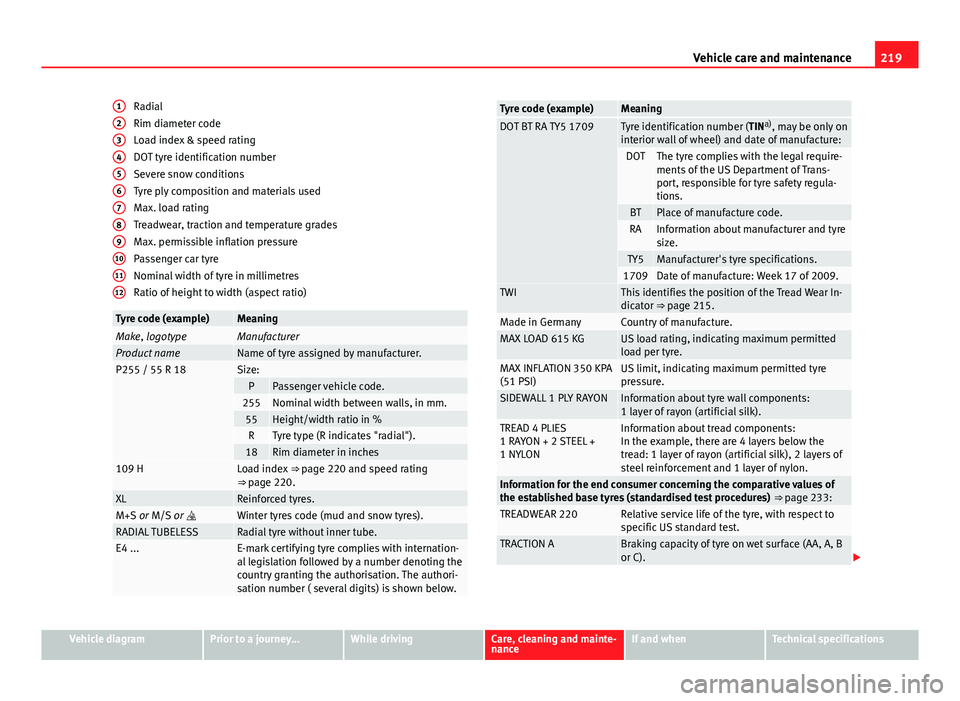
Tyre code (example)MeaningMake, logotypeManufacturerProduct nameName of tyre assigned by manufacturer.P255 / 55 R 18Size:PPassenger vehicle code.255Nominal width between walls, in mm.55Height/width ratio in %RTyre type (R indicates "radial").18Rim diameter in inches109 HLoad index ⇒ page 220 and speed rating
⇒ page 220.
XLReinforced tyres.M+S or M/S or Winter tyres code (mud and snow tyres).RADIAL TUBELESSRadial tyre without inner tube.E4 ...E-mark certifying tyre complies with internation-
al legislation followed by a number denoting the
country granting the authorisation. The authori-
sation number ( several digits) is shown below.
123456789101112
Tyre code (example)MeaningDOT BT RA TY5 1709Tyre identification number (TIN a)
, may be only on
interior wall of wheel) and date of manufacture:
DOTThe tyre complies with the legal require-
ments of the US Department of Trans-
port, responsible for tyre safety regula-
tions.
BTPlace of manufacture code.RAInformation about manufacturer and tyre
size.
TY5Manufacturer's tyre specifications.1709Date of manufacture: Week 17 of 2009.TWIThis identifies the position of the Tread Wear In-
dicator ⇒ page 215.
Made in GermanyCountry of manufacture.MAX LOAD 615 KGUS load rating, indicating maximum permitted
load per tyre.
MAX INFLATION 350 KPA
(51 PSI)US limit, indicating maximum permitted tyre
pressure.
SIDEWALL 1 PLY RAYONInformation about tyre wall components:
1 layer of rayon (artificial silk).
TREAD 4 PLIES
1 RAYON + 2 STEEL +
1 NYLONInformation about tread components:
In the example, there are 4 layers below the
tread: 1 layer of rayon (artificial silk), 2 layers of
steel reinforcement and 1 layer of nylon.
Information for the end consumer concerning the comparative values of
the established base tyres (standardised test procedures) ⇒ page 233:
TREADWEAR 220Relative service life of the tyre, with respect to
specific US standard test.
TRACTION ABraking capacity of tyre on wet surface (AA, A, B
or C).
Vehicle diagramPrior to a journey...While drivingCare, cleaning and mainte-
nanceIf and whenTechnical specifications
Page 225 of 306
223
Vehicle care and maintenance
Running-in
Please observe the instructions for running-in new components.
Running-in the engine
The engine needs to be run in over the first 1500 km (1000 miles). During
its first few hours of running, the internal friction in the engine is greater
than later on when all the moving parts have bedded down.
How the vehicle is driven for the first 1500 km (1000 miles) influences the
future engine performance. Throughout the life of the vehicle, it should be
driven at a moderate speed, especially when the engine is cold, as this will
reduce engine wear and increase its useful life. Never drive at extremely low
engine speeds. Change down to a lower gear when the engine no longer
runs “smoothly”. Up to 1000 kilometres the following instructions apply:
● Do not use full throttle.
● Do not force the engine above two thirds of its maximum speed.
Between 1000 and 1500 kilometres (600 to 1000 miles), gradually in-
crease power until reaching the maximum speed and high engine speeds.
Running in new tyres and brake pads
● Replacement of new tyres and wheel rims ⇒ page 210
● Notes on the brakes ⇒ page 134
For the sake of the environment
If the engine is run in gently, the life of the engine will be increased and the
engine oil consumption reduced.
Accessories and spare parts
SEAT recommends you consult an Official Service before purchasing acces-
sories and spare parts or consumables. For example, when fitting accesso- ries at a later date, or when replacing a component. A SEAT Official Service
will advise you as to the legal requirements and manufacturer's recommen-
dations regarding accessories, spare parts and other components.
SEAT recommend you use only approved
SEAT accessories and genuine
SEAT spare parts ®
. These parts and accessories have been specially tested
by SEAT for suitability, reliability and safety. In addition the SEAT Technical
Service will guarantee that the assembly is carried out professionally.
Although we continually monitor the market, SEAT cannot guarantee that
products not approved by SEAT are reliable, safe and suitable for the vehi-
cle. Therefore, SEAT cannot accept liability, even in those cases authorised
by an officially recognised technical inspection office or other official body.
Any retro-fitted equipment which has a direct effect on vehicle control must
be approved by SEAT for use in your vehicle and bear the e mark (the Euro-
pean Union's authorisation symbol). This includes cruise control systems or
electronically controlled suspension.
If any additional electrical components are fitted which do not serve to con-
trol the vehicle itself, these must bear the mark (European Union manu-
facturer conformity declaration). This includes refrigerator boxes, laptops or
ventilator fans.
WARNING
Unprofessional repairs or modifications to the vehicle may affect the per-
formance of the airbags, resulting in operating faults or fatal accident.
● Never mount, fasten or fit objects such as drink holders or telephone
cradles over or next to the covers of the airbag modules or within their
deployment zones.
● Objects placed over the airbag covers, or within their deployment
zones, could lead to serious injury or loss of life if the airbags are trig-
gered.
Vehicle diagramPrior to a journey...While drivingCare, cleaning and mainte-
nanceIf and whenTechnical specifications
Page 226 of 306
224Vehicle care and maintenance
Fluids and consumables
All vehicle fluids and consumables , such as notched belts, tyres, coolant
fluids, engine oils, spark plugs and batteries are continually being devel-
oped. Therefore all fluids and consumables should be changed at a special-
ised workshop. Technical Services are permanently informed of any modifi-
cations.
WARNING
The incorrect use or handling of fluids or consumables may result in acci-
dent, serious injury, burns or intoxication.
● Therefore, fluids must always be stored closed in their original con-
tainer.
● Never store fluids in empty food containers or bottles as other people
may accidentally drink the fluid.
● Keep all fluids and consumables out of reach of children.
● Read and observe the information and warnings given on the fluid
containers.
● Only work in the open air or in well-ventilated zones, when using
products which give off harmful vapours.
● Never use fuel, turpentine, engine oil, acetone or any other volatile
liquid in the maintenance of the vehicle. These are toxic and highly flam-
mable. They could lead to fire or explosions!
CAUTION
● Only use appropriate fluids. Never mix the fluids. Using the wrong fluids
could cause serious malfunctions and engine damage!
● Accessories and other components mounted in front of the air inlet re-
duce the cooling effect of the coolant. If the engine is running under great
strain in high outside temperatures, it could overheat.
For the sake of the environment
Leaking fluids could pollute the environment. Collect any spilt fluids in suit-
able containers and dispose of in accordance with legislation and with re-
spect for the environment.
Repairs and technical changes
When performing repairs and technical modifications, SEAT's directives
must be observed! ⇒
Unauthorised modifications to the electronic components or software in the
vehicle may cause malfunctions. Due to the way the electronic components
are linked together in networks, other indirect systems may be affected by
the faults. This may significantly affect the vehicle's performance, increase
component wear and could mean that the vehicle registration documents
are no longer valid.
Your SEAT Official Service cannot be held liable for any damage caused by
technical modifications or repairs performed incorrectly.
The SEAT Official Service does not accept liability for damage resulting from
technical modifications or repairs performed incorrectly; neither is the SEAT
warranty valid in these cases.
SEAT recommends you have any technical modifications or repairs per-
formed at a SEAT Official Service and that you use genuine SEAT spare
parts ®
.
Vehicles with special accessories and equipment
The manufacturers of additional equipment guarantee that the equipment
complies with applicable laws and regulations with respect to the environ-
ment, in particular Directives 2000/53/CE and 2003/11/CE. The first direc-
tive governs the disposal of end-of-life vehicles while the second refers to
the restrictions on the marketing and use of certain dangerous substances
and preparations.
Page 227 of 306
225
Vehicle care and maintenance
The vehicle owner should keep the documentation for the additional equip-
ment safely and hand it over to the scrap yard at the end of the vehicle's
service life. This ensures that any additional equipment mounted in end-of-
life vehicles is correctly disposed of with respect for the environment.
WARNING
Repairs or modifications which are not performed correctly may result in
damage or errors in the vehicle operation, affecting the effectiveness of
the driver assist systems. This could result in serious accident.
● All repairs and modifications to the vehicle should only be performed
by a specialised workshop.
Repair and faults in the airbag system
When performing repairs and technical modifications, SEAT's directives
must be observed! ⇒
Modifications and repairs to the front bumper, doors, front seats, and re-
pairs to the roof or chassis should only be carried out in a specialised work-
shop. These components may contain parts or sensors belonging to the air-
bag system.
If work is carried out on the airbag system or parts have to be removed and
fitted on the system when performing other repair work, parts of the airbag
system may be damaged. The consequence may be that, in the event of an
accident, the airbag inflates incorrectly or does not inflate at all.
So that the effectiveness of the airbag is not reduced and that removed
parts do not cause any injuries or environmental pollution, regulations must
be observed. These requirements are known to specialised workshops.
Modifications to the vehicle suspension may affect the operation of the air-
bag system in the event of collision. For example, if wheel and tyre combi-
nations not approved by SEAT are used, or if the vehicle height is lowered, the suspension is stiffened or the suspension springs, telescopic arms,
dampers, etc., are modified, the results received by the airbag sensors and
sent to the control unit may not be accurate. For example, some modifica-
tions to the suspension could increase the force measured by the sensors
and result in the triggering of the airbag systems in collisions. Under normal
conditions, the measured values would be lower and the airbag would not
have been triggered. Other modifications may reduce the forces measured
by the sensors and therefore the airbags are not triggered in situations
when they should have triggered.
WARNING
Repairs or modifications which are not performed correctly may result in
damage or errors in the vehicle operation, affecting the effectiveness of
the airbag systems. This could result in serious or fatal accident.
● All repairs and modifications to the vehicle should only be performed
by a specialised workshop.
● Airbag modules must never be repaired: if damaged, they must be re-
placed.
● Never fit recycled or reused airbag components in your vehicle.
WARNING
Modifications to the vehicle suspension, including the use of unauthor-
ised wheel and tyre combinations, may affect the performance of the air-
bags and increase the risk of serious or fatal injury in the event of acci-
dent.
● Never fit suspension components which are not identical to the origi-
nal parts mounted in the vehicle.
● Never use wheel and tyre combinations not approved by SEAT.
Vehicle diagramPrior to a journey...While drivingCare, cleaning and mainte-
nanceIf and whenTechnical specifications
Page 228 of 306
226Vehicle care and maintenance
Retro-fitting of two-way radios
An exterior aerial is required for the use of two-way radios in the vehicle.
The retro-fitting of electrical or electronic appliances in the vehicle is sub-
ject to their approval for use in your vehicle. Under certain circumstances,
this could mean that your vehicle registration documents are no longer val-
id.
SEAT has approved your vehicle for use with two-way radios providing the
following conditions are observed:
●The exterior aerial must be mounted professionally.
● The maximum transmitting power is 10 watts.
The optimal reach of the equipment is only achieved with an external aerial.
Check first with a specialised workshop if you wish to use a two-way radio
with a transmitting power of over 10 watts. The specialised workshops are
familiar with the technical options for installation. SEAT recommends visit-
ing a Technical Service.
All legal requirements, together with the instructions for the use of two-way
radios must be observed.
WARNING
If the two-way radio is not securely fastened in position, it could be sent
flying around the vehicle in the event of sharp braking, sudden manoeu-
vres or accident, causing injury.
● While driving, two-way radios must be securely fastened in position,
outside the airbags deployment zones, or safely stowed away.
WARNING
When using a two-way radio without a connection to an exterior aerial,
the maximum permitted levels of electromagnetic radiation may be ex-
ceeded. This is also the case if the aerial has not been correctly installed.
● You should only use a two-way radio inside the vehicle if it has first
been correctly connected to an exterior aerial.
Information stored by the control units
Your vehicle is fitted at the factory with a series of electronic control units
responsible for the engine and gearbox management. In addition, the con-
trol units supervise the performance of the exhaust gas system and the air-
bag systems.
Therefore, while the vehicle is being driven, these electronic control units
are continuously analysing the vehicle data. In the event of faults or devia-
tions from the theoretical values, only this data is stored. Normally, the
warning lamps on the instrument panel light up in the event of faults.
This data can only be read and analysed using special equipment.
The storing of the data allows specialised workshops to detect and repair
faults. Stored data may include:
● Data relating to the engine or the gearbox
● Speed
● Direction of travel
● Braking force
● Detection of seat belt
The vehicle control units never record conversations held by passengers in
the vehicle.