lock Seat Mii 2013 Repair Manual
[x] Cancel search | Manufacturer: SEAT, Model Year: 2013, Model line: Mii, Model: Seat Mii 2013Pages: 306, PDF Size: 4.3 MB
Page 214 of 306
212Vehicle care and maintenance
perfect condition on the outside and which have a tread depth within the
values stipulated by the Law ⇒
.
The date of manufacture, part of the tyre identification number (TIN), indi-
cates the age of the tyre ( ) ⇒ page 218.
Storing tyres
Mark tyres when you remove them to indicate the direction of rotation (left,
right, forwards, backwards). This ensures you will be able to mount them
correctly when you replace them. When removed, the wheels and/or tyres
should be stored in a cool, dry and preferably dark location. Do not place
tyres mounted on the wheel in a vertical position.
Protect tyres not mounted on wheels from dirt by storing them in suitable
bags and standing them on the ground on their tread.
WARNING
Aggressive fluids or substances could result in visible or invisible dam-
age with the consequent risks.
● Always ensure that tyres do not come into contact with chemical
products, oil, grease, fuel, brake fluid or other aggressive substances.
WARNING
Old tyres, even if they have never been used, may lose air or burst unex-
pectedly while driving, resulting in serious accident or damage.
● If tyres are over six years old, they should only be used in an emer-
gency and with extreme caution.
For the sake of the environment
Old tyres must be disposed of by qualified personnel according to the laws
in the country concerned. Wheel rims
The design of wheel bolts is matched to the rims. If different rims are fitted,
the correct wheel bolts with the right length and correctly shaped bolt
heads must be used. This ensures that wheels are fitted securely and that
the brake system functions correctly
⇒ page 252.
For technical reasons, it is not generally possible to use the wheels from
other vehicles. In some cases, this may also be true for the same model of
wheel.
The tyres and rims approved by SEAT are specially matched to the character-
istics of the vehicle and are critical to good road holding and safe handling.
Wheel bolts
Wheel bolts must be tightened to the correct torque ⇒ page 252.
Beadlock wheel rims
Beadlock wheel rims have various components. These are joined together
by special bolts using a special procedure. This ensures good performance,
a better seal, improved safety and wheel run out. Therefore, worn rims
should always be replaced and must only be repaired in a specialised work-
shop. SEAT recommends visiting a Technical Service ⇒
.
Wheel rims with bolted trims
Wheel rims may be fitted with interchangeable trim parts which are attach-
ed to the rim using self-locking bolts. Worn trims should only be replaced at
a specialised workshop. SEAT recommends visiting a Technical Service
⇒
.
Page 219 of 306
217
Vehicle care and maintenance
Running gear settings : an incorrectly positioned running gear increases the
wear of tyres and affects your safety while driving. If tyres wear too quickly,
have the wheel alignment checked at a specialised workshop.
WARNING
If you notice unusual vibration or the car pulls to one side while driving,
this may indicate that one of the tyres is damaged.
● Reduce speed immediately and stop, while observing the highway
code.
● Check the wheels and tyres for damage.
● Never carry on driving on worn tyres or wheels. Request qualified as-
sistance immediately.
● If there is no visible exterior damage, drive slowly and carefully to the
nearest specialised workshop and have the vehicle checked.
Spare wheel or temporary spare wheel*
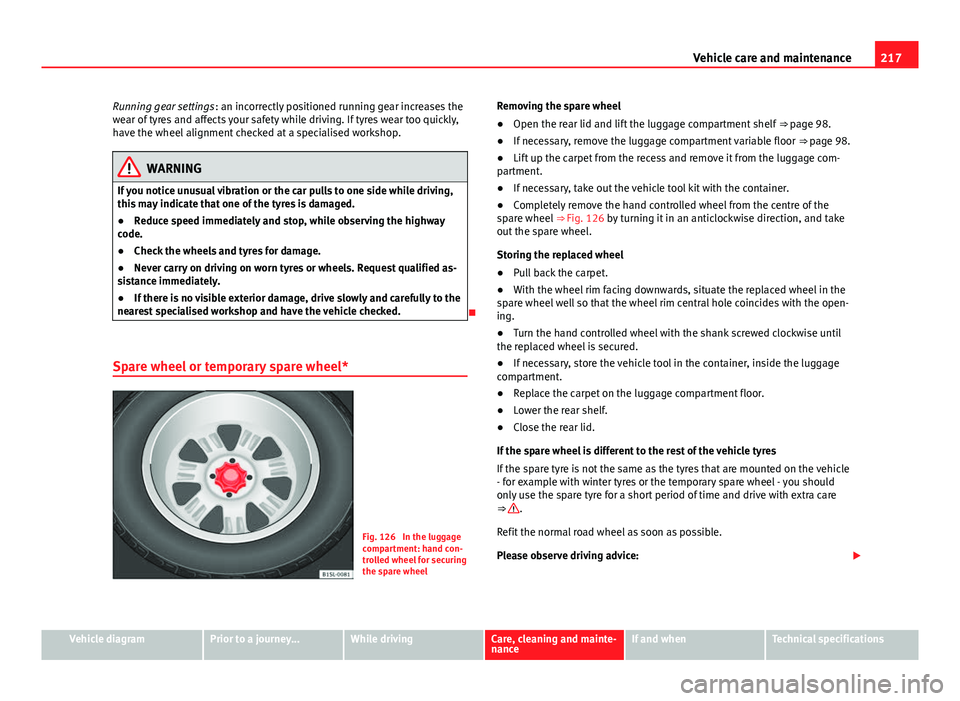
Fig. 126 In the luggage
compartment: hand con-
trolled wheel for securing
the spare wheel Removing the spare wheel
●
Open the rear lid and lift the luggage compartment shelf ⇒ page 98.
● If necessary, remove the luggage compartment variable floor ⇒ page 98.
● Lift up the carpet from the recess and remove it from the luggage com-
partment.
● If necessary, take out the vehicle tool kit with the container.
● Completely remove the hand controlled wheel from the centre of the
spare wheel ⇒ Fig. 126 by turning it in an anticlockwise direction, and take
out the spare wheel.
Storing the replaced wheel
● Pull back the carpet.
● With the wheel rim facing downwards, situate the replaced wheel in the
spare wheel well so that the wheel rim central hole coincides with the open-
ing.
● Turn the hand controlled wheel with the shank screwed clockwise until
the replaced wheel is secured.
● If necessary, store the vehicle tool in the container, inside the luggage
compartment.
● Replace the carpet on the luggage compartment floor.
● Lower the rear shelf.
● Close the rear lid.
If the spare wheel is different to the rest of the vehicle tyres
If the spare tyre is not the same as the tyres that are mounted on the vehicle
- for example with winter tyres or the temporary spare wheel - you should
only use the spare tyre for a short period of time and drive with extra care
⇒
.
Refit the normal road wheel as soon as possible.
Please observe driving advice:
Vehicle diagramPrior to a journey...While drivingCare, cleaning and mainte-
nanceIf and whenTechnical specifications
Page 222 of 306
220Vehicle care and maintenance
Tyre code (example)MeaningTEMPERATURE ATyre temperature resistance at higher test
speeds (A, B or C).
If the tyre has other markings, these are specific tyre manufacturer codes
or specific national codes, e.g. for Brazil or China.
a)
The letters TIN refer to the tyre serial number.
Tyres with directional tread pattern
Tyres with directional tread pattern have been designed to operate best
when rotating in only one direction. An arrow on the tyre sidewall indicates
the direction of rotation on tyres with directional tread. Always observe the
direction of rotation indicated when mounting the wheel. This guarantees
optimum grip and helps to avoid aquaplaning, excessive noise and wear.
If the tyre is mounted in the opposite direction of rotation, drive with ex-
treme caution, as the tyre is no longer being used correctly. This is of partic-
ular importance when the road surface is wet. Change the tyre as soon as
possible or remount it with the correct direction of rotation.
Tyre load rating
The load rating code indicates the maximum load in kilogrammes each
wheel can carry (load capacity).
425 Kg
462 Kg
487 Kg
515 Kg
545 Kg
615 Kg
Speed rating
The speed rating indicates the maximum speed permitted for the tyres.
max. 150 km/h (93 mph)
max. 160 km/h (99 mph)
78
81
83
85
87
91
P
Q max. 170 km/h (106 mph)
max. 180 km/h (112 mph)
max. 190 km/h (118 mph)
max. 200 km/h (124 mph)
max. 210 km/h (130 mph)
max. 240 km/h (149 mph)
max. 240 km/h (149 mph)
max. 270 km/h (168 mph)
max. 300 km/h (186 mph)
Some manufacturers use the letters “ZR” for tyres with a maximum author-
ised speed above 240 km/h (149 miles).
Snow chains
When using snow chains, applicable local legislation and maximum permit-
ted speed limits must be observed.
In winter weather, snow chains not only help to improve grip but also im-
prove the braking capacity.
The fitting of chains is permitted only on front wheels and only with the fol-
lowing combinations of wheel trims and tyres :
Tyre sizeWheel rim165/70 R145 J x 14 offset of 35175/65 R14
SEAT recommends you ask a Technical Service for further information on
wheel, tyre and chain sizes.
Wherever possible use fine-link chains measuring less than 15 mm includ-
ing the lock.
R
S
T
U
H
V
Z
W
Y
Page 236 of 306
234Vehicle care and maintenance
Warning of high voltage label
There is a label close to the bonnet lock which warns of high voltage in the
vehicle electrical installation.
Warning relating to the City Safety Assist system laser sensor
There are some warning and information signs on the City Safety Assist sys-
tem laser sensor ⇒ Fig. 132.
Using your vehicle in other countries and continents
The vehicle is manufactured at the factory for use in a particular country in
accordance with the national legislation in force at the time of manufacture.
If the vehicle is sold in another country or used in another country for an ex-
tended period of time, the applicable legislation of that country should be
observed.
It may be necessary to fit or remove certain pieces of equipment or to deac-
tivate certain functions. Service work may also be affected. This is particu-
larly true if the vehicle is used in a different climate for an extended period
of time.
As there are different types of frequency bands around the world, you may
find that the radio system or the Portable Navigation System (supplied by
SEAT) supplied at the factory does not work in another country.
CAUTION
● SEAT does not accept liability for any damage to the vehicle due to the
use of a lower quality fuel, an inadequate service or the non-availability of
genuine spare parts.
● SEAT does not accept liability if the vehicle does not comply in part or in
full with the legal requirements of other countries or continents. Radio reception and the aerial
For factory-fitted radio equipment, the aerial for radio reception is fitted to
the roof of the vehicle.
Note
If electrical equipment such as mobile telephones, is used near a roof aer-
ial, you may observe interference in the reception of AM stations.
Notes on SEAT repairs
Information about authorised SEAT services and authorised SEAT repairs
can be requested by payment at the following addresses:
Clients in Europe, Asia, Australia, Africa, Central America and South
America
Contact a Technical Service or specialised workshop, or request the corre-
sponding documentation at www.erwin.volkswagen.de.
WARNING
Repairs or modifications which are not performed correctly may result in
damage or errors in the vehicle operation, affecting the effectiveness of
the driver assist and airbag systems. This could result in serious acci-
dent.
● Have any repairs or modifications carried out at a specialised work-
shop.
Page 237 of 306
235
Vehicle care and maintenance
Conformity certification
The respective manufacturer hereby declares that the products indicated as
follows fulfil the basic requirements and the following dispositions and im-
portant legislations on the date of manufacture of the vehicle, among oth-
ers FCC Part 15.19, FCC Part 15.21 and RSS-Gen Issue 1:
Radio frequency equipment
● Electronic gearbox lock.
● Vehicle key
Electrical equipment
● 12 volt power socket
Environmental friendliness
Environmental protection is a top priority in the design, choice of materials
and manufacture of your new SEAT.
Constructive measures to encourage recycling
● Joints and connections designed for easy dismantling
● Modular construction to facilitate dismantling
● Increased use of single-grade materials.
● Plastic parts and elastomers are marked in accordance with ISO 1043,
ISO 11469 and ISO 1629.
Choice of materials
● Use of recycled materials.
● Use of compatible plastics in the same part if its components are not
easily separated.
● Use of recycled materials and/or materials originating from renewable
sources. ●
Reduction of volatile components, including odour, in plastic materials.
● Use of CFC-free coolants.
Ban on heavy metals, with the exceptions dictated by law (Annex II of ELV
Directive 2000/53/EC): cadmium, lead, mercury, hexavalent chromium.
Manufacturing methods
● Reduction of the quantity of thinner in the protective wax for cavities.
● Use of plastic film as protection during vehicle transport.
● Use of solvent-free adhesives.
● Use of CFC-free coolants in cooling systems.
● Recycling and energy recovery from residues (RDF).
● Improvement in the quality of waste water.
● Use of systems for the recovery of residual heat (thermal recovery, en-
thalpy wheels, etc.).
● The use of water-soluble paints
Collection and scrapping of end-of-life vehicles
Collection of end-of-life vehicles
SEAT is already prepared for the moment when you wish to scrap your vehi-
cle and offers you an environmentally-friendly solution. An extensive net-
work of used car reception centres already exists in much of Europe. After
the vehicle has been delivered, you will receive a certificate of destruction
describing the environmentally friendly scrapping of the vehicle in accord-
ance with applicable legislation.
We will collect the used vehicle free of charge, provided it complies with all
national legislation.
Please see your Technical Service for further information about the collec-
tion and scrapping of end-of-life vehicles.
Vehicle diagramPrior to a journey...While drivingCare, cleaning and mainte-
nanceIf and whenTechnical specifications
Page 241 of 306
239
Practical information
If and when
Practical information
Frequently asked questions
If you suspect that the vehicle has a fault or is damaged when using it, be-
fore consulting a SEAT dealership or a specialised workshop, carefully read
the following instructions. Similarly, the terms in the alphabetical index
“Things to note” or “Checklist” may be of help.
ProblemPossible causes,
among othersPossible solution
The engine does
not start.
The vehicle battery is
flat.– Carry out the jump start
⇒ page 275.
– Charge the battery
⇒ page 193.
You are using an incor-
rect vehicle key.Use the correct key
⇒ page 28.
The fuel tank level is
insufficient.Refuel ⇒ page 171.
The vehicle cannot
be locked or un-
locked with the
key.
– Vehicle key battery is
flat.
– Too far away from
the vehicle.
– Buttons pressed out-
side the radius of
reach.– Change the battery
⇒ page 28.
– Move closer to the vehicle.
– Synchronize the vehicle
key ⇒ page 28.
– Manually lock or unlock
the vehicle ⇒ page 244.
Unusual noises.
Engine cold, City Safe-
ty Assist system, steer-
ing column electronic
lock.See entry “Noises” in the de-
tailed alphabetical index.
ProblemPossible causes,
among othersPossible solution
Handling is
strange.
Assistance systems ac-
tive.See entry “Assistance sys-
tems” in the detailed alpha-
betical index.
You are using an incor-
rect tyre pressure.Check the tyre pressure
⇒ page 210.
Damage to the wheel
trims or tyres.
Inspect wheel trims and
tyres regularly for damage
⇒ page 210 and replace
them if necessary
⇒ page 252.
Vehicle has no
jack, spare wheel
or tire mobility set
present.Equipment subject to
the vehicle.
No direct solution, depends
on the equipment. In this
case, you should contact a
SEAT Dealership
⇒ page 247.
Surface not correct-
ly illuminated.
– Headlights covered
for driving on the left-
hand side or right-
hand side.
– Headlight adjust-
ment too high.
– Faulty bulbs.
– Dipped headlights
switched off.– Cover the headlights for
driving on the left-hand side
or right-hand side
⇒ page 82.
– Adjust the headlight range
⇒ page 82.
– Change the bulbs
⇒ page 266.
– Switch on the dipped
headlights ⇒ page 82.
Vehicle diagramPrior to a journey...While drivingCare, cleaning and mainte-
nanceIf and whenTechnical specifications
Page 243 of 306
241
Practical information
In case of emergency
Introduction
Additional information and warnings:
● Braking, stopping and parking ⇒ page 134
● Emergency locking and unlocking ⇒ page 244
● Vehicle tools ⇒ page 247
● Change wheel ⇒ page 252
WARNING
A faulty vehicle in traffic represents a risk of accident for the driver and
for other road users.
● Stop the vehicle safely as soon as possible. Park the vehicle a safe
distance from surrounding traffic to lock all the doors in case of an emer-
gency. Turn on the hazard warning lights to warn other road users.
● Never leave children or disabled people alone in the vehicle if the
doors are to be locked. In case of an emergency, passengers will be trap-
ped inside the vehicle. Individuals locked in the vehicle can be exposed
to very high or very low temperatures.
Protecting yourself and securing the vehicle
Fig. 133 Dash panel:
Button to switch on and
off the hazard warning
lights system
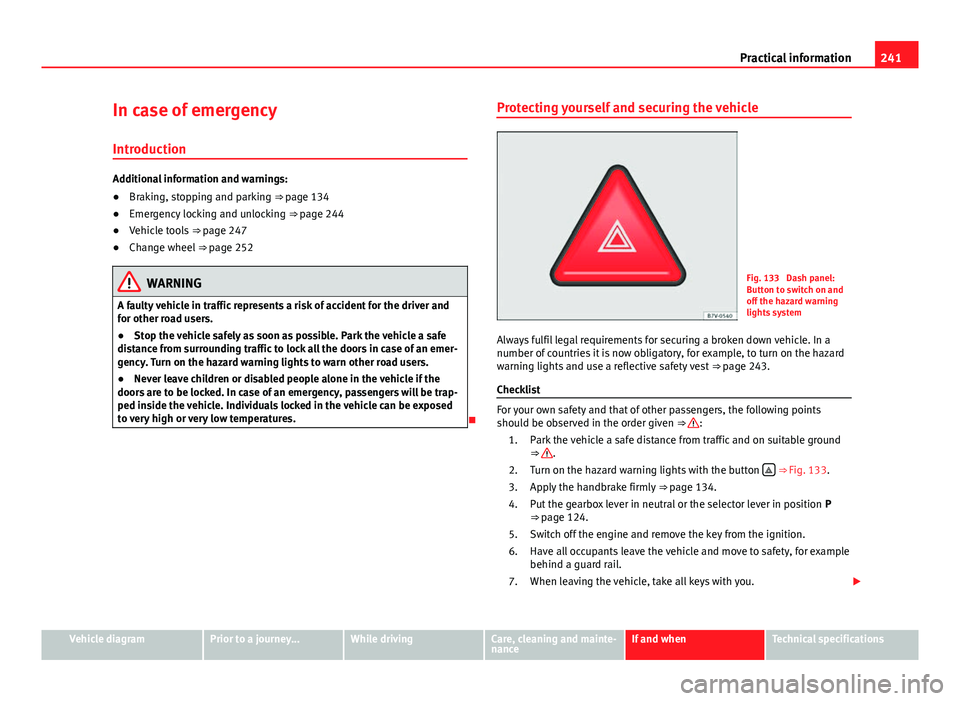
Always fulfil legal requirements for securing a broken down vehicle. In a
number of countries it is now obligatory, for example, to turn on the hazard
warning lights and use a reflective safety vest ⇒ page 243.
Checklist
For your own safety and that of other passengers, the following points
should be observed in the order given ⇒
:
1. Park the vehicle a safe distance from traffic and on suitable ground ⇒
.
2. Turn on the hazard warning lights with the button ⇒
Fig. 133.
3. Apply the handbrake firmly ⇒ page 134.
4. Put the gearbox lever in neutral or the selector lever in position P ⇒ page 124.
5. Switch off the engine and remove the key from the ignition.
6. Have all occupants leave the vehicle and move to safety, for example behind a guard rail.
7. When leaving the vehicle, take all keys with you.
Vehicle diagramPrior to a journey...While drivingCare, cleaning and mainte-
nanceIf and whenTechnical specifications
Page 246 of 306
244Practical information
Emergency locking and unlocking
Introduction
The doors and rear lid can be locked manually and partially opened, for ex-
ample if the key or the central locking is damaged.
Additional information and warnings:
● Vehicle key set ⇒ page 28
● Central locking and locking system ⇒ page 32
● Doors ⇒ page 37
● Rear lid ⇒ page 39
● In case of emergency ⇒ page 241
WARNING
Opening and closing doors carelessly can cause serious injury.
● If the vehicle is locked from outside, the doors and windows cannot
be opened from the inside.
● Never leave children or disabled people alone in the car. They could
be trapped in the car in an emergency and will not be able to get them-
selves to safety.
● Depending on the time of the year, temperatures inside a locked and
closed vehicle can be extremely high or extremely low resulting in seri-
ous injuries and illness or even death, particularly for young children.
WARNING
Getting in the way of the doors and the rear lid is dangerous and can lead
to serious injury.
● Open and close the doors and the rear lid only when there is nobody
in the way.
CAUTION
When opening and closing in an emergency, carefully disassemble compo-
nents and then reassemble them carefully to avoid damage to the vehicle.
Manually locking and unlocking the driver door
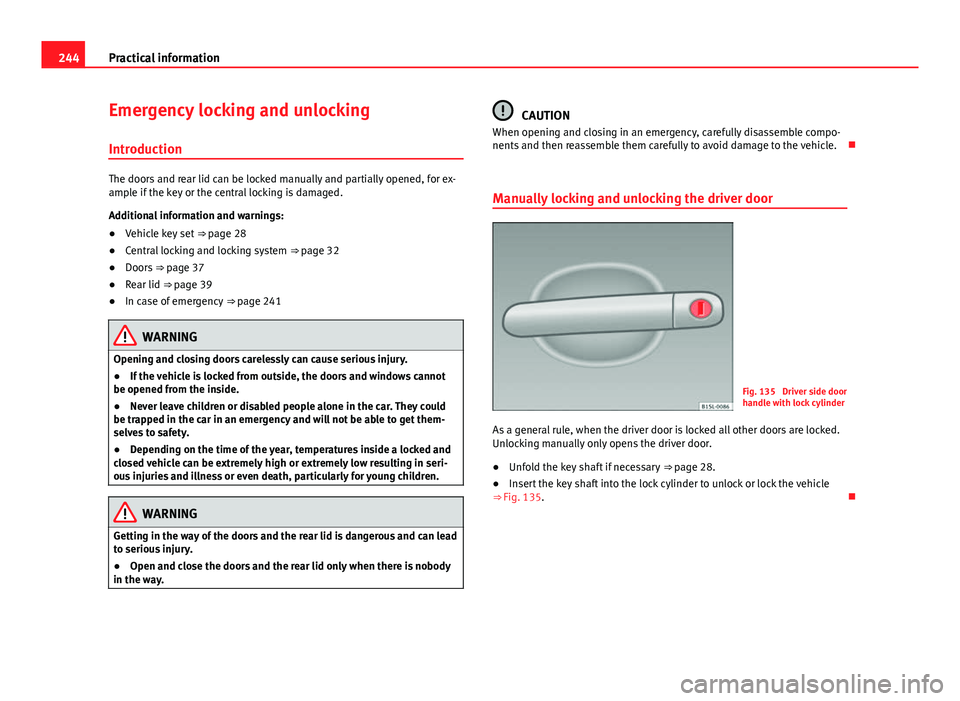
Fig. 135 Driver side door
handle with lock cylinder
As a general rule, when the driver door is locked all other doors are locked.
Unlocking manually only opens the driver door.
● Unfold the key shaft if necessary
⇒ page 28.
● Insert the key shaft into the lock cylinder to unlock or lock the vehicle
⇒ Fig. 135.
Page 247 of 306
245
Practical information
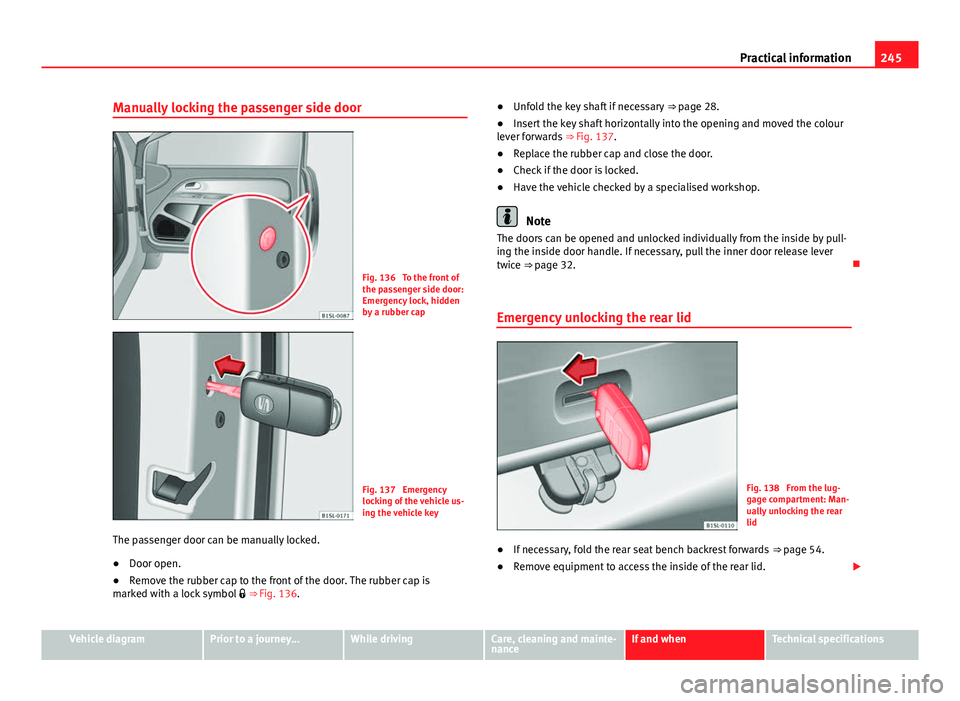
Manually locking the passenger side door
Fig. 136 To the front of
the passenger side door:
Emergency lock, hidden
by a rubber cap
Fig. 137 Emergency
locking of the vehicle us-
ing the vehicle key
The passenger door can be manually locked.
● Door open.
● Remove the rubber cap to the front of the door. The rubber cap is
marked with a lock symbol ⇒ Fig. 136. ●
Unfold the key shaft if necessary ⇒ page 28.
● Insert the key shaft horizontally into the opening and moved the colour
lever forwards ⇒ Fig. 137.
● Replace the rubber cap and close the door.
● Check if the door is locked.
● Have the vehicle checked by a specialised workshop.
Note
The doors can be opened and unlocked individually from the inside by pull-
ing the inside door handle. If necessary, pull the inner door release lever
twice ⇒ page 32.
Emergency unlocking the rear lid
Fig. 138 From the lug-
gage compartment: Man-
ually unlocking the rear
lid
● If necessary, fold the rear seat bench backrest forwards ⇒ page 54.
● Remove equipment to access the inside of the rear lid.
Vehicle diagramPrior to a journey...While drivingCare, cleaning and mainte-
nanceIf and whenTechnical specifications
Page 248 of 306

246Practical information
● Unfold the key shaft ⇒ page 28.
● Insert the key shaft into the rear lid opening ⇒ Fig. 138 and press the
release lever in the direction of the arrow to unlock the rear lid.