change wheel Seat Mii 2014 User Guide
[x] Cancel search | Manufacturer: SEAT, Model Year: 2014, Model line: Mii, Model: Seat Mii 2014Pages: 219, PDF Size: 4.19 MB
Page 171 of 219

Wheels and tyresTyre code (example)Meaning
TREADWEAR 220Relative service life of the tyre, with respect to specific US standard test.
TRACTION ABraking capacity of tyre on wet surface (AA, A, B or C).
TEMPERATURE ATyre temperature resistance at higher test speeds (A, B or C).
If the tyre has other markings, these are specific tyre manufacturer codes or specific national codes, e.g. for Brazil or China.
a)
The letters TIN refer to the tyre serial number.
Tyres with directional tread pattern
Tyres with directional tread pattern have
been designed to operate best when rotating
in only one direction. An arrow on the tyre
sidewall indicates the direction of rotation on
tyres with directional tread. Always observe
the direction of rotation indicated when
mounting the wheel. This guarantees opti-
mum grip and helps to avoid aquaplaning,
grip, noise and wear.
If the tyre is mounted in the opposite direc-
tion of rotation, drive with extreme caution,
as the tyre is no longer being used correctly.
This is of particular importance when the
road surface is wet. Change the tyre as soon
as possible or remount it with the correct di-
rection of rotation.
Tyre load rating
The load rating code indicates the maximum
load in kilogrammes each wheel can carry
(load capacity). 425 kg
462 kg
487 kg
515 kg
545 kg
615 kg
Speed rating
The speed rating indicates the maximum
speed permitted for the tyres. max. 150 km/h (93 mph)
max. 160 km/h (99 mph)
max. 170 km/h (106 mph)
max. 180 km/h (112 mph)
max. 190 km/h (118 mph)
max. 200 km/h (124 mph)
max. 210 km/h (130 mph)
max. 240 km/h (149 mph)
max. 240 km/h (149 mph)
78
81
83
85
87
91
P
Q
R
S
T
U
H
V
Z max. 270 km/h (168 mph)
max. 300 km/h (186 mph)
Some manufacturers use the letters “ZR” for
tyres with a maximum authorised speed
above 240 km/h.
Snow chains When using snow chains, applicable local
legislation and maximum permitted speed
limits must be observed.
In winter weather, snow chains not only help
to improve grip but also improve the braking
capacity.
The fitting of chains is permitted
only on
front wheels and with the following combi-
nation
s of wheel trims and tyres :
»
W
Y
169
Technical specifications
Advice
Operation
Safety
Page 175 of 219
Emergencies
● Raise the carpet at the recess (arrow)
››› Fig. 122 . Note
After use, return the jack to its initial position
using the handle in order to securely store it
in the vehicle. Accessing the vehicle tool kit and tyre
mobility system in vehicles fitted with
the SEAT SOUND 7 speaker system
(with subwoofer)*
●
Open the boot hatch and lift the shelf.
● If necessary, remove the boot variable floor
››› page 76 .
● Lif t
up the carpet from the recess and re-
move it from the luggage compartment.
● Disconnect the subwoofer’s speaker cable.
● Completely remove the hand-controlled
wheel from the centre of the subwoofer
speaker by turning it anti-clockwise.
● Take out the subwoofer, which is on top of
the tools and tyre mobility system.
● When finished, place the tools and system
back in the same way and place as before to
ensure the speaker sits properly in its hous-
ing. ●
Place the subwoofer in the direction of the
arrow and with the word “FRONT” facing for-
ward.
● Reconnect the speaker cable and firmly ro-
tate the securing wheel clockwise so that the
subwoofer is firmly in place.
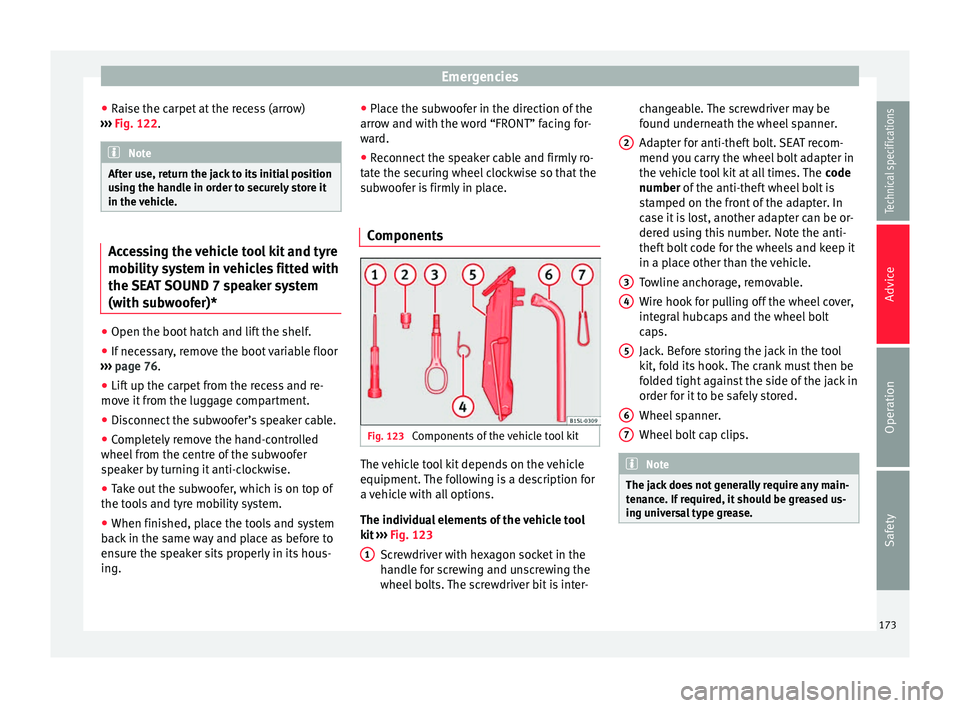
Components Fig. 123
Components of the vehicle tool kit The vehicle tool kit depends on the vehicle
equipment. The following is a description for
a vehicle with all options.
The individual elements of the vehicle tool
kit
›
›› Fig. 123
Sc
rewdriver with hexagon socket in the
handle for screwing and unscrewing the
wheel bolts. The screwdriver bit is inter-
1 changeable. The screwdriver may be
found underneath the wheel spanner.
Adapter for anti-theft bolt. SEAT recom-
mend you carry the wheel bolt adapter in
the vehicle tool kit at all times. The
code
number of the anti-theft wheel bolt is
s t
amped on the front of the adapter. In
case it is lost, another adapter can be or-
dered using this number. Note the anti-
theft bolt code for the wheels and keep it
in a place other than the vehicle.
Towline anchorage, removable.
Wire hook for pulling off the wheel cover,
integral hubcaps and the wheel bolt
caps.
Jack. Before storing the jack in the tool
kit, fold its hook. The crank must then be
folded tight against the side of the jack in
order for it to be safely stored.
Wheel spanner.
Wheel bolt cap clips. Note
The jack does not generally require any main-
tenance. If required, it should be greased us-
ing universal type grease. 2
3
4
5
6
7
173
Technical specifications
Advice
Operation
Safety
Page 176 of 219

Advice
Changing a wheel Introduction Some vehicle versions and models do not
have a factory-fitted jack or box spanner. In
this case, we recommend consulting a Speci-
alised workshop to change the wheel.
You should only change the wheels yourself if
the vehicle is parked in a safe place, you are
familiar with the procedure and safety stand-
ards and you have all the necessary tools!
Otherwise, you should seek professional as-
sistance.
WARNING
Changing a wheel can be dangerous, espe-
cially on the hard shoulder. Please observe
the following rules to minimise the risk of in-
jury:
● Stop the vehicle safely as soon as possible.
Park at a safe distance from surrounding traf-
fic to change a wheel.
● When changing a wheel, keep all passen-
gers, and particularly children, a safe dis-
tance away from the work area.
● Turn on the hazard warning lights to warn
other road users.
● Ensure the ground on which you park is flat
and solid. If necessary, support the jack on a
wide solid base. ●
If you are changing a wheel yourself, you
should be familiar with the required proce-
dure. Otherwise, you should seek professio-
nal assistance.
● Only use suitable tools that are not dam-
aged when changing a wheel.
● Always stop the engine, apply the hand-
brake lever firmly and place the selector lever
in position P, or engage a gear for a manual
gearbox to reduce the risk of the vehicle mov-
ing accidentally.
● Have the tightening torque of the wheel
bolts checked as soon as possible with a reli-
able torque wrench. WARNING
If the wheel trims are not appropriate or not
fitted correctly, they could cause major acci-
dents or damage.
● Incorrectly mounted wheel trims may come
off while driving and endanger other road
users.
● Damaged trims must never be mounted on
the wheels.
● Always ensure that the brake ventilation
and cooling is not cut off or blocked. This is
also valid if hubcaps are fitted later. If there
is not enough air, you may require signifi-
cantly longer braking distances. CAUTION
Remove and remount wheel trims taking care
to avoid damage to the vehicle. Hubcaps
Fig. 124
Remove the hubcap of the steel
wheel trim In order to access the wheel bolts, first re-
move the hubcap.
Removing and fitting the hubcap
● To remove , take the vehicle tool kit wire
hook and att
ach it to the edge of the wheel
trim ››› Fig. 124
.
● Remove the trim by pulling it in the direc-
tion of the arrow.
● To replace the hubcap , press the hubcap
against the trim until it clicks into place.
174
Page 179 of 219

Emergencies
Raising the vehicle with the jack Fig. 129
Jack position points Fig. 130
Jack mounted on the left rear part of
the vehicle The jack may be applied only at the jacking
points shown (marks on chassis)
››› Fig. 129 .
A lw
ays the relevant jacking point for the
wheel to be changed ››› .
Raise the vehicle using only the designated
jacking points. WARNING
If the vehicle is not correctly raised, it could
fall off the jack causing serious injury. Please
observe the following rules to minimise the
risk of injury:
● You should only use a jack approved by
SEAT for your vehicle. Other jacks, even those
approved for other SEAT models, might slip
out of place.
● The ground should be firm and flat. If the
ground is sloped or soft then the vehicle
could slip and fall off the jack. If necessary,
support the jack on a wide solid base.
● If the ground is slippery, such as tiles,
place a non-slip surface (a floor mat, for in-
stance) beneath the jack to avoid slipping.
● Only fit the jack at the prescribed jacking
points. The claw of the jack should grip the
reinforcement nerve on the underbody
››› Fig. 130.
● You shou
ld never place a body limb such as
an arm or leg under a raised vehicle that is
solely supported by the jack.
● If you have to work underneath the vehicle,
you must use suitable stands additionally to
support the vehicle, there is a risk of acci-
dent!.
● Never raise the vehicle if it is tilting to one
side or the engine is running.
● Never start the engine when the vehicle is
raised. The vehicle may come loose from the
jack due to the engine vibrations. 177
Technical specifications
Advice
Operation
Safety
Page 180 of 219

Advice
Changing a wheel Fig. 131
Changing a wheel: loosen wheel
bolts with the socket at the end of the wheel
brace Removing the wheel
● Loosen the wheel bolts ››› page 175 .
● Jacking up the vehicle ››› page 177.
● Using the hexagonal socket in the wheel
brace ››› Fig. 131 , unscrew the slackened
wheel bo
lts and place them on a clean sur-
face.
● Take off the wheel.
How to use the spare wheel or temporary
spare wheel
Check the direction of rotation of the tyre
››› page 167, Tyre code.
● Plac
e the spare wheel or temporary spare
wheel into position. ●
Replace the wheel bolts and tighten slight-
ly using the hexagonal socket on the end of the wheel br
ace.
● To tighten the anti-theft locking wheel bolts
use the corresponding adaptor.
● Lower the car with the jack.
● Tighten all of the wheel bolts clockwise
››› . Tighten the bolts in diagonal pairs (not
in a circle).
● Put the caps, trim or full hubcap back on
››› page 174 . WARNING
If the wheel bolts are not treated suitably or
not tightened to the correct torque then this
could lead to loss of vehicle control and to a
serious accident.
● All the wheel bolts and hub threads should
be clean and free of oil and grease. The wheel
bolts should be easily tightened to the cor-
rect torque.
● The hexagonal socket in the wheel brace
should be used for turning wheel bolts only.
Do not use it to loosen or tighten the wheel
bolts. After changing the wheel
●
Clean the vehicle tools, if necessary and
put them away in the luggage compartment
foam holder ›››
page 172 . ●
St or
e the spare wheel, the temporary spare
wheel or the changed wheel securely in the
luggage compartment.
● Have the tightening torque of the wheel
bolts checked as soon as possible with a tor-
que wrench ››› page 176
.
● Have the flat tyre replaced as quickly as
possible.
Tyre repair
TMS (Tyre Mobility System)* The Anti-puncture kit* (Tyre Mobility System)
will reliably seal punctures caused by the
penetration of a foreign body of up to about
4 mm
in diameter.
Do not remove foreign ob-
j
ects, e.g. screws or nails, from the tyre.
After inserting the sealant residue in the tyre,
you must again check the tyre pressure about
10 minutes after starting the engine.
You should only use the tire mobility set if
the vehicle is parked in a safe place, you are
familiar with the procedure and you have the
necessary tire mobility set! Otherwise, you
should seek professional assistance.
The tyre sealant must not be used in the
following cases: ● If the wheel rim has been damaged.
178
Page 185 of 219

Emergencies
Connect the battery clamps so they have
good metal-to-metal contact with the battery
terminals.
If the engine fails to start, switch off the start-
er after about 10 seconds and try again after
about 1 minute. WARNING
● Please note the safety warnings referring to
working in the engine compartment
››› page 143.
● The b att
ery providing assistance must have
the same voltage as the flat battery (12V) and
approximately the same capacity (see imprint
on battery). Failure to comply could result in
an explosion.
● Never use jump leads when one of the bat-
teries is frozen. Danger of explosion! Even af-
ter the battery has thawed, battery acid could
leak and cause chemical burns. If a battery
freezes, it should be replaced.
● Keep sparks, flames and lighted cigarettes
away from batteries, danger of explosion.
Failure to comply could result in an explo-
sion.
● Observe the instructions provided by the
manufacturer of the jump leads.
● Do not connect the negative cable from the
other vehicle directly to the negative terminal
of the flat battery. The gas emitted from the
battery could be ignited by sparks. Danger of
explosion. ●
Do not attach the negative cable from the
other vehicle to parts of the fuel system or to
the brake line.
● The non-insulated parts of the battery
clamps must not be allowed to touch. The
jump lead attached to the positive battery
terminal must not touch metal parts of the ve-
hicle, this can cause a short circuit.
● Position the leads in such a way that they
cannot come into contact with any moving
parts in the engine compartment.
● Do not lean on the batteries. This could re-
sult in chemical burns. Note
The vehicles must not touch each other, oth-
erwise electricity could flow as soon as the
positive terminals are connected. Towing and tow starting
Introduction When towing or tow starting, respect the le-
gal requirements.
For technical reasons, it is not possible to
tow a vehicle if the battery is flat. WARNING
A vehicle with a flat battery should never be
towed.
● Never remove the key from the ignition
lock. Otherwise, the steering wheel lock
could suddenly lock. The vehicle would not
be controlled and a serious accident could
ensue. WARNING
When towing the vehicle, the handling and
braking efficiency change considerably.
Please observe the following instructions to
minimise the risk of serious accidents and in-
jury:
● As the driver of the vehicle being towed:
– The brake must be depressed must hard-
er as the brake servo does not operate.
Always remain aware to avoid collision
with the towing vehicle.
– More strength is required at the steering
wheel as the power steering does not op-
erate when the engine is switched off.
● As the driver of the towing vehicle:
– Accelerate gently and carefully.
– Avoid sudden braking and manoeuvres.
– Brake well in advance than usual and
brake gently.
» 183
Technical specifications
Advice
Operation
Safety
Page 187 of 219
Emergencies
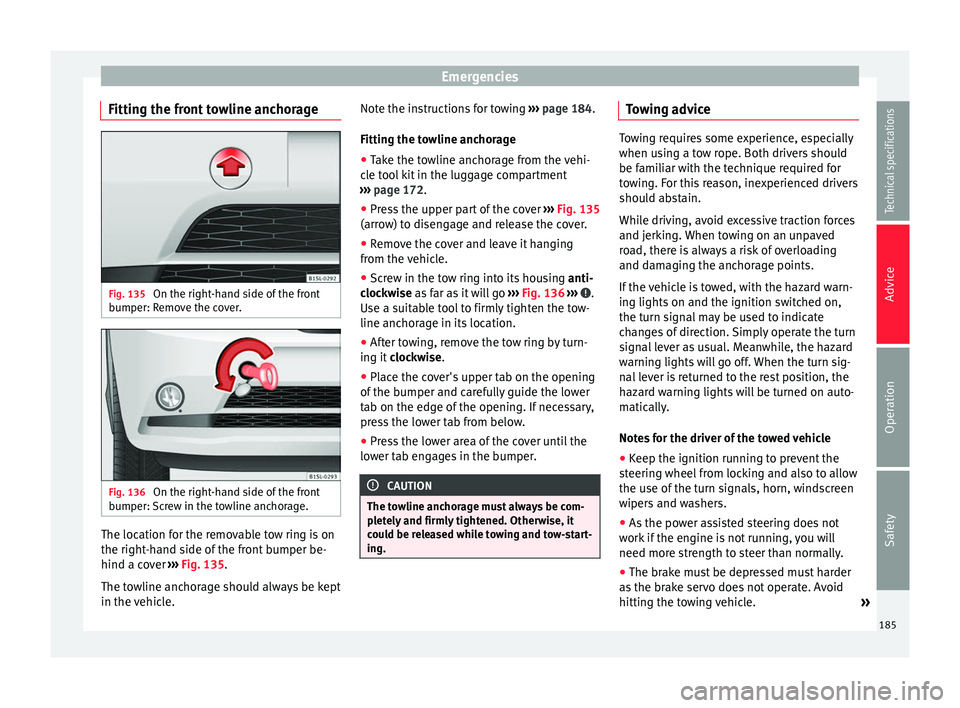
Fitting the front towline anchorage Fig. 135
On the right-hand side of the front
bumper: Remove the cover. Fig. 136
On the right-hand side of the front
bumper: Screw in the towline anchorage. The location for the removable tow ring is on
the right-hand side of the front bumper be-
hind a cover
››› Fig. 135 .
The t o
wline anchorage should always be kept
in the vehicle. Note the instructions for towing
››› page 184.
Fitting the towline anchorage
● Take the towline anchorage from the vehi-
cle tool kit in the luggage compartment
››› page 172.
● Pre
ss the upper part of the cover ››› Fig. 135
(arrow) to disengage and release the cover.
● Remove the cover and leave it hanging
from the vehicle.
● Screw in the tow ring into its housing anti-
clockwise as far as it will go ››
› Fig. 136 ››› .
Use a suitable tool to firmly tighten the tow-
line anchorage in its location.
● After towing, remove the tow ring by turn-
ing it clockwise .
● Plac
e the cover's upper tab on the opening
of the bumper and carefully guide the lower
tab on the edge of the opening. If necessary,
press the lower tab from below.
● Press the lower area of the cover until the
lower tab engages in the bumper. CAUTION
The towline anchorage must always be com-
pletely and firmly tightened. Otherwise, it
could be released while towing and tow-start-
ing. Towing advice
Towing requires some experience, especially
when using a tow rope. Both drivers should
be familiar with the technique required for
towing. For this reason, inexperienced drivers
should abstain.
While driving, avoid excessive traction forces
and jerking. When towing on an unpaved
road, there is always a risk of overloading
and damaging the anchorage points.
If the vehicle is towed, with the hazard warn-
ing lights on and the ignition switched on,
the turn signal may be used to indicate
changes of direction. Simply operate the turn
signal lever as usual. Meanwhile, the hazard
warning lights will go off. When the turn sig-
nal lever is returned to the rest position, the
hazard warning lights will be turned on auto-
matically.
Notes for the driver of the towed vehicle
●
Keep the ignition running to prevent the
steering wheel from locking and also to allow
the use of the turn signals, horn, windscreen
wipers and washers.
● As the power assisted steering does not
work if the engine is not running, you will
need more strength to steer than normally.
● The brake must be depressed must harder
as the brake servo does not operate. Avoid
hitting the towing vehicle. »
185
Technical specifications
Advice
Operation
Safety
Page 201 of 219

Technical featuresUrban
cycleMeasurement of the urban cycle starts with
an engine cold start. City driving is then si-
mulated at between 0 and 50 km/h (0 and
31 mph).
Road
cycle
In the road cycle simulation, the car under-
goes frequent acceleration and braking in all
gears, as in normal everyday driving. The
road speed ranges from 0 to 120 km/h (0
and 75 mph).
Com-
binedThe average combined consumption is calcu-
lated with a weighting of around 37 % for the
urban cycle and 63 % for the road cycle.
CO
2
emis-
sions of
the
combi-
nationThe exhaust gases are collected during both
driving cycles to calculate carbon dioxide
emissions (urban and road). The gas compo-
sition is analysed below to evaluate the CO 2
content and other emissions. Note
● The kerb weight may vary according to the
vehicle equipment. This could raise consump-
tion and the CO 2 emissions slightly.
● In practice, consumption values could be
different to the values calculated based on
the 715/2007/EC or 80/1268/EEC regula-
tions. Wheels
Tyre pressure, snow chains, wheel
bolts Tyre pressures
The sticker with the tyre pressure values can
be found on the inside of the fuel tank flap.
The tyre pressure values given there are for
cold tyres. The slightly raised pressures of
w
arm ty
res must not be reduced. ››› Snow chains
Snow chains may be fitted only to the
front
wheels .
C on
sult the section “wheels” of this manual.
Wheel bolts
After the wheels have been changed, the
tightening torque
of the wheel bolts should
be checked as soon as possible with a torque
wrench ››› . The tightening torque for steel
and alloy wheels is 140 Nm. WARNING
● Check the tyre pressure at least once per
month. Checking the tyre pressure is very im-
portant. If the tyre pressure is too high or too
low, there is an increased danger of accidents
- particularly at high speeds. ●
If the tightening torque of the wheel bolts
is too low, they could loosen while the vehi-
cle is in motion. Risk of accident! If the tight-
ening torque is too high, the wheel bolts and
threads can be damaged. Note
We recommend that you ask your Technical
Service for information about appropriate
wheel, tyre and snow chain size. 199
Technical specifications
Advice
Operation
Safety
Page 207 of 219

Index
Index
A
Abroad Extended stay abroad with your vehicle . . . . . 135
Sale of vehicle . . . . . . . . . . . . . . . . . . . . . . . . . 135
ABS See "Brake assist systems" . . . . . . . . . . . . . . . 104
Accessories . . . . . . . . . . . . . . . . . . . . . . . . . . . . . . 118
Additional equipment . . . . . . . . . . . . . . . . . . . . . 119
Adjust Headlight range . . . . . . . . . . . . . . . . . . . . . . . . . 58
Adjustment Correct sitting position . . . . . . . . . . . . . . . . . . . . . 6
Front seat . . . . . . . . . . . . . . . . . . . . . . . . . . . . . . 63
rear head restraints . . . . . . . . . . . . . . . . . . . . . . . 9
Steering wheel . . . . . . . . . . . . . . . . . . . . . . . . . . . 7
Aerial . . . . . . . . . . . . . . . . . . . . . . . . . . . . . . . . . . . 135
Airbags description . . . . . . . . . . . . . . . . . . . . . . . . . . . . . 19
Airbag system . . . . . . . . . . . . . . . . . . . . . . . . . . 17, 21 activation . . . . . . . . . . . . . . . . . . . . . . . . . . . . . . 20
Cleaning dash panel . . . . . . . . . . . . . . . . . . . . 133
Control lamp . . . . . . . . . . . . . . . . . . . . . . . . . . . . 23
Deactivating the front passenger front airbag . 24
Deactivating using the key switch . . . . . . . . . . . 24
Differences between front passenger front air-bag systems . . . . . . . . . . . . . . . . . . . . . . . . . . 22
Faults . . . . . . . . . . . . . . . . . . . . . . . . . . . . . . . . . 120
Front airbags . . . . . . . . . . . . . . . . . . . . . . . . . . . . 21
functioning . . . . . . . . . . . . . . . . . . . . . . . . . . . . . 20
Locking the vehicle after airbag deployment . . 46
Repairs . . . . . . . . . . . . . . . . . . . . . . . . . . . . . . . 120
Side airbags . . . . . . . . . . . . . . . . . . . . . . . . . . . . 22
Use of child seats . . . . . . . . . . . . . . . . . . . . . . . . 24
Vehicle care . . . . . . . . . . . . . . . . . . . . . . . . . . . . 133 Air conditioner
Air recirculation . . . . . . . . . . . . . . . . . . . . . . . . . 84
Air vents . . . . . . . . . . . . . . . . . . . . . . . . . . . . . . . 83
Faults . . . . . . . . . . . . . . . . . . . . . . . . . . . . . . . . . . 83
set . . . . . . . . . . . . . . . . . . . . . . . . . . . . . . . . . . . . 82
Things to note . . . . . . . . . . . . . . . . . . . . . . . . . . . 83
User instructions . . . . . . . . . . . . . . . . . . . . . . . . 82
Air conditioning system . . . . . . . . . . . . . . . . . . . . . 80 Controls . . . . . . . . . . . . . . . . . . . . . . . . . . . . . . . . 81
Air recirculation . . . . . . . . . . . . . . . . . . . . . . . . . . . 84 How it works . . . . . . . . . . . . . . . . . . . . . . . . . . . . 84
switch off . . . . . . . . . . . . . . . . . . . . . . . . . . . . . . . 84
temporarily switch off . . . . . . . . . . . . . . . . . . . . . 84
Air vents . . . . . . . . . . . . . . . . . . . . . . . . . . . . . . . . . 83
Alternator . . . . . . . . . . . . . . . . . . . . . . . . . . . . . . . 155
Aluminium care . . . . . . . . . . . . . . . . . . . . . . . . . . 129
Anodized surfaces . . . . . . . . . . . . . . . . . . . . . . . . 129
Anti-lock brake system (ABS) . . . . . . . . . . . . . . . 104
Anti-theft bolts . . . . . . . . . . . . . . . . . . . . . . . . . . . 173
Anti-theft locking bolts . . . . . . . . . . . . . . . . . . . . 174
Anti-theft wheel locking bolts . . . . . . . . . . . . . . . 175
Antifreeze . . . . . . . . . . . . . . . . . . . . . . . . . . . . . . . 150
Ashtray . . . . . . . . . . . . . . . . . . . . . . . . . . . . . . . . . . 71
Aspects to take into account before starting the vehicle . . . . . . . . . . . . . . . . . . . . . . . . . . . . . . . . . . 5
ASR see Brake assist systems . . . . . . . . . . . . . . . . . 104
Assistance systems Brake assist system (BAS) . . . . . . . . . . . . . . . . 104
Cruise control system (CCS) . . . . . . . . . . . . . . . 107
Electronic differential lock system (EDL) . . . . . 104
Electronic stability control (ESC) . . . . . . . . . . . 103
Optical parking system (OPS) . . . . . . . . . . . . . 107
Parking aid . . . . . . . . . . . . . . . . . . . . . . . . . . . . 106
Parking distance warning system . . . . . . . . . . 106
Safety Assist (City Safety Assist function) . . . . 110
Start-Stop . . . . . . . . . . . . . . . . . . . . . . . . . . . . . 115 Traction control system (ASR) . . . . . . . . . . . . . 104
Traction Control (TC) . . . . . . . . . . . . . . . . . . . . . 104
Assist systems Anti-lock brake system (ABS) . . . . . . . . . . . . . . 104
Audible warnings Control and warning lamps . . . . . . . . . . . . . . . . 39
Lights . . . . . . . . . . . . . . . . . . . . . . . . . . . . . . . . . 56
Seat belt not fastened . . . . . . . . . . . . . . . . . . . . 12
Speed . . . . . . . . . . . . . . . . . . . . . . . . . . . . . . . . . 42
Automatic belt retainer . . . . . . . . . . . . . . . . . . . . . 16
Automatic car wash . . . . . . . . . . . . . . . . . . . . . . . 126
Automatic device disconnection . . . . . . . . . . . . . 157
automatic gearbox . . . . . . . . . . . . . . . . . . . . . . . . . 93
Automatic gearbox . . . . . . . . . . . . . . . . . . . . . . . . . 95 driving . . . . . . . . . . . . . . . . . . . . . . . . . . . . . . . . . 96
Ignition key removal lock . . . . . . . . . . . . . . . . . . 87
Kickdown . . . . . . . . . . . . . . . . . . . . . . . . . . . . . . . 96
malfunction . . . . . . . . . . . . . . . . . . . . . . . . . . . . . 97
starting on a slope . . . . . . . . . . . . . . . . . . . . . . . 97
stopping on a slope . . . . . . . . . . . . . . . . . . . . . . 97
Axle loads . . . . . . . . . . . . . . . . . . . . . . . . . . . . . . . 198
B BAS see Brake assist systems . . . . . . . . . . . . . . . . . 104
Battery Change in the vehicle key . . . . . . . . . . . . . . . . . 44
Discharging . . . . . . . . . . . . . . . . . . . . . . . . . . . . 172
drains . . . . . . . . . . . . . . . . . . . . . . . . . . . . . . . . . 45
See Vehicle battery . . . . . . . . . . . . . . . . . . . . . . 154
Battery acid . . . . . . . . . . . . . . . . . . . . . . . . . . . . . . 156
Before starting the vehicle . . . . . . . . . . . . . . . . . . . 5
Belt tensioner . . . . . . . . . . . . . . . . . . . . . . . . . . . . . 16 Disposal . . . . . . . . . . . . . . . . . . . . . . . . . . . . . . . 17
Service and disposal . . . . . . . . . . . . . . . . . . . . . 17
Belt tension limiter . . . . . . . . . . . . . . . . . . . . . . . . . 16
Bench . . . . . . . . . . . . . . . . . . . . . . . . . . . . . . . . . . . 74
205