cooling Seat Mii 2014 User Guide
[x] Cancel search | Manufacturer: SEAT, Model Year: 2014, Model line: Mii, Model: Seat Mii 2014Pages: 219, PDF Size: 4.19 MB
Page 152 of 219
Advice
Engine coolant Introduction WARNING
Engine coolant is toxic!
● Only keep engine coolant in its original
container, tightly shut and in a safe place.
● Never store engine coolant in empty food
containers or bottles as other people may ac-
cidentally drink it.
● Always keep engine coolant out of reach of
children.
● Ensure that the proportion of engine cool-
ant additive corresponds to the lowest out-
side temperature to which the vehicle will be
exposed.
● If the outside temperature is extremely low,
the engine coolant could freeze causing the
vehicle to stop. As this would also cause the
heating to stop working, vehicle occupants
without warm clothing could freeze. For the sake of the environment
Coolants and additives can contaminate the
environment. Collect any spilt fluids in suita-
ble containers and dispose of them in accord-
ance with legislation and with the utmost re-
spect for the environment. Coolant warning lamp
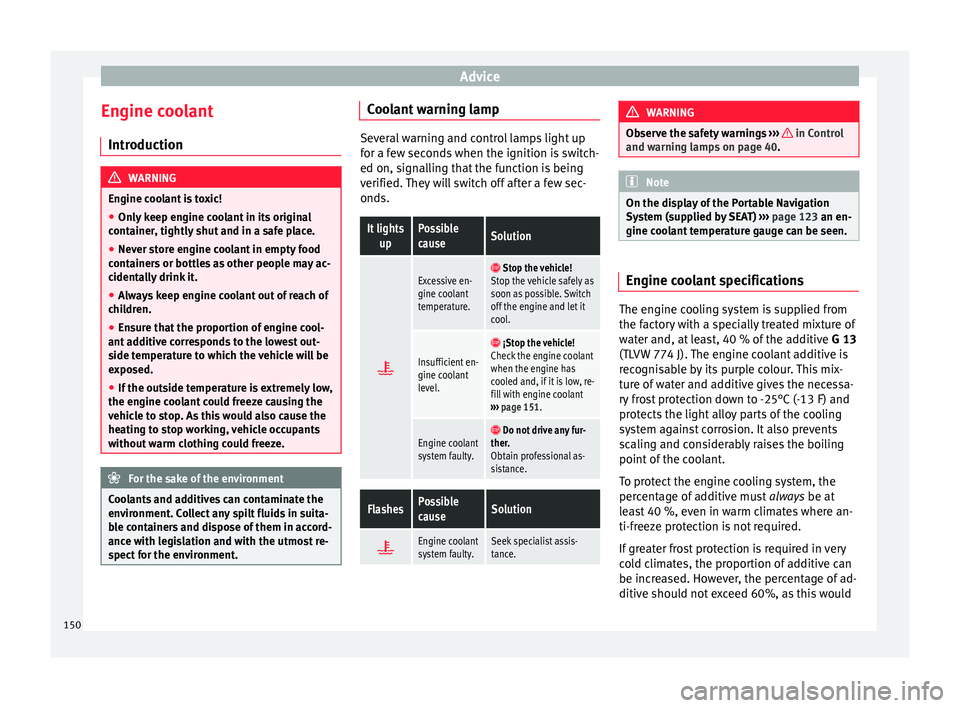
Several warning and control lamps light up
for a few seconds when the ignition is switch-
ed on, signalling that the function is being
verified. They will switch off after a few sec-
onds.It lights
upPossible
causeSolution
Excessive en-
gine coolant
temperature. Stop the vehicle!
Stop the vehicle safely as
soon as possible. Switch
off the engine and let it
cool.
Insufficient en-
gine coolant
level.
¡Stop the vehicle!
Check the engine coolant
when the engine has
cooled and, if it is low, re-
fill with engine coolant
››› page 151.
Engine coolant
system faulty. Do not drive any fur-
ther.
Obtain professional as-
sistance.
FlashesPossible
causeSolution
Engine coolant
system faulty.Seek specialist assis-
tance. WARNING
Observe the safety warnings ››› in Control
and warning lamps on page 40. Note
On the display of the Portable Navigation
System (supplied by SEAT) ››› page 123 an en-
gine coolant temperature gauge can be seen. Engine coolant specifications
The engine cooling system is supplied from
the factory with a specially treated mixture of
water and, at least, 40 % of the additive
G 13
(TLVW 774 J). The engine coolant additive is
recognisable by its purple colour. This mix-
ture of water and additive gives the necessa-
ry frost protection down to -25°C (-13 F) and
protects the light alloy parts of the cooling
system against corrosion. It also prevents
scaling and considerably raises the boiling
point of the coolant.
To protect the engine cooling system, the
percentage of additive must always be at
l e
ast 40 %, even in warm climates where an-
ti-freeze protection is not required.
If greater frost protection is required in very
cold climates, the proportion of additive can
be increased. However, the percentage of ad-
ditive should not exceed 60%, as this would
150
Page 153 of 219
Checking and refilling levels
reduce the frost protection and, in turn, de-
crease the cooling capacity.
When the coolant is topped up, use a mixture
of distilled water and, at least, 40 % of the G
13 or G 12 p lu
s-plus (TL-VW 774 G) additive
(both are purple) to obtain an optimum anti-
corrosion protection ››› . The mixture of G
13 with G 12 plus (TL-VW 774 F), G 12 (red) or
G 11 (green-blue) engine coolants will signifi-
cantly reduce the anticorrosion protection
and should, therefore be avoided ››› .
WARNING
If there is not enough anti-freeze in the cool-
ant system, the engine may fail leading to se-
rious damage.
● Please make sure that the percentage of
additive is correct with respect to the lowest
expected ambient temperature in the zone in
which the vehicle is to be used.
● When the outside temperature is very low,
the coolant could freeze and the vehicle
would be immobilised. In this case, the heat-
ing would not work either and inadequately
dressed passengers could die of cold. CAUTION
The original additives should never be mixed
with coolants which are not approved by
SEAT. Otherwise, you run the risk of causing
severe damage to the engine and the engine
cooling system. ●
If the fluid in the expansion tank is not pur-
ple but is, for example, brown, this indicates
that the G 13 additive has been mixed with
an inadequate coolant. The coolant must be
changed as soon as possible if this is the
case! This could result in serious faults and
engine damage. For the sake of the environment
Coolants and additives can contaminate the
environment. If any fluids are spilled, they
should be collected and correctly disposed
of, with respect to the environment. Checking the engine coolant level and
refilling
Fig. 109
In the engine compartment: Marking
on coolant expansion tank Fig. 110
In the engine compartment: Coolant
expansion tank cap If the coolant level is low, the coolant warn-
ing indicator will light.
Preparations
● Park the vehicle on even, flat and firm
ground.
● Allow the engine to cool ››› .
● Open the bonnet ››› page 143.
● The coolant expansion tank is easily recog-
nisable because of the symbol on the cap
››› Fig. 110 .
Chec k
ing the engine coolant level
● When the engine is cold, check the coolant
level using the side marking on the expan-
sion tank ››› Fig. 109.
● If the l
evel is below the “MIN” mark, top up
with coolant. When the engine is hot it may
be slightly above the marked area. »
151
Technical specifications
Advice
Operation
Safety
Page 154 of 219
Advice
Topping up the engine coolant level
● Always protect your face, hands and arms
from hot coolant and steam using a large,
thick cloth over the coolant expansion tank
cap.
● Remove the cap very carefully ››› .
● Only refill using new engine coolant ac-
c or
ding to SEAT specifications ( ››› page 150)
››› .
● The engine coolant level should be be-
tween the marks on the coolant expansion
tank ››› Fig. 109 .
Do not exceed the top level
of
the marked area ››› .
● Screw on the cap tightly.
● If, in the event of an emergency, you have
no coolant that is compliant to the required
specifications ( ››› page 150), do not use an-
other type of additive. Instead, top up with
distilled water only
›
›› . Then re-establish
the correct proportion of the mixture with the
correct additive as soon as possible
››› page 150 . WARNING
Hot vapours and coolant can cause serious
burns.
● Never open the coolant expansion tank if
steam or coolant is coming from the engine
compartment. Wait until you cannot see or
hear any steam or coolant escaping. ●
Always wait until the engine has complete-
ly cooled before very carefully opening the
expansion tank cap. Contact with hot ele-
ments of the engine can cause skin burns.
● When the engine is warm or hot, the cool-
ing system is pressurised. Do not unscrew
the cap on the expansion tank when the en-
gine is hot. Otherwise, coolant may spray out
under pressure causing burns and serious in-
jury.
– Carefully and slowly unscrew the cap an-
ti-clockwise, gently pressing down on it.
– Always protect your face, hands and arms
from hot coolant and steam using a large,
thick cloth.
● When refilling liquids, avoid spilling them
on parts of the engine and the exhaust sys-
tem. Spilled liquids could cause a fire. Under
specific circumstances, the ethylene glycol
can catch fire. CAUTION
● Top up with distilled water only. Any other
type of water may lead to considerable rust-
ing in the engine due to its chemical compo-
nents. This could consequently damage the
engine. If you have not used distilled water
but another type of water to top up the cool-
ant, a specialised workshop must immediate-
ly replace all of the fluid in the engine cooling
system.
● Only top up coolant to the top level of the
marked area ››› Fig. 109. Otherwise the ex- cess coolant will be forced out of the cooling
system when the engine is hot, causing dam-
age.
● If a lot of liquid coolant has been lost, wait
for the engine to cool down completely before
adding coolant. Extensive coolant loss is an
indication of leaks in the engine cooling sys-
tem. Have the engine cooling system inspec-
ted immediately by a specialised workshop.
Otherwise engine damage may occur.
● When refilling or changing service liquids,
ensure that you put the liquids into the right
tank. Making a mistake when refilling could
cause serious malfunctions and damage the
engine! Brake fluid
Checking the brake fluid level Fig. 111
In the engine compartment: brake
fluid reservoir, lid 152
Page 176 of 219

Advice
Changing a wheel Introduction Some vehicle versions and models do not
have a factory-fitted jack or box spanner. In
this case, we recommend consulting a Speci-
alised workshop to change the wheel.
You should only change the wheels yourself if
the vehicle is parked in a safe place, you are
familiar with the procedure and safety stand-
ards and you have all the necessary tools!
Otherwise, you should seek professional as-
sistance.
WARNING
Changing a wheel can be dangerous, espe-
cially on the hard shoulder. Please observe
the following rules to minimise the risk of in-
jury:
● Stop the vehicle safely as soon as possible.
Park at a safe distance from surrounding traf-
fic to change a wheel.
● When changing a wheel, keep all passen-
gers, and particularly children, a safe dis-
tance away from the work area.
● Turn on the hazard warning lights to warn
other road users.
● Ensure the ground on which you park is flat
and solid. If necessary, support the jack on a
wide solid base. ●
If you are changing a wheel yourself, you
should be familiar with the required proce-
dure. Otherwise, you should seek professio-
nal assistance.
● Only use suitable tools that are not dam-
aged when changing a wheel.
● Always stop the engine, apply the hand-
brake lever firmly and place the selector lever
in position P, or engage a gear for a manual
gearbox to reduce the risk of the vehicle mov-
ing accidentally.
● Have the tightening torque of the wheel
bolts checked as soon as possible with a reli-
able torque wrench. WARNING
If the wheel trims are not appropriate or not
fitted correctly, they could cause major acci-
dents or damage.
● Incorrectly mounted wheel trims may come
off while driving and endanger other road
users.
● Damaged trims must never be mounted on
the wheels.
● Always ensure that the brake ventilation
and cooling is not cut off or blocked. This is
also valid if hubcaps are fitted later. If there
is not enough air, you may require signifi-
cantly longer braking distances. CAUTION
Remove and remount wheel trims taking care
to avoid damage to the vehicle. Hubcaps
Fig. 124
Remove the hubcap of the steel
wheel trim In order to access the wheel bolts, first re-
move the hubcap.
Removing and fitting the hubcap
● To remove , take the vehicle tool kit wire
hook and att
ach it to the edge of the wheel
trim ››› Fig. 124
.
● Remove the trim by pulling it in the direc-
tion of the arrow.
● To replace the hubcap , press the hubcap
against the trim until it clicks into place.
174