handbrake Seat Mii 2014 User Guide
[x] Cancel search | Manufacturer: SEAT, Model Year: 2014, Model line: Mii, Model: Seat Mii 2014Pages: 219, PDF Size: 4.19 MB
Page 116 of 219

Operation
The City Safety Assist function is limited by
the laws of physics and by the nature of the
system itself. For this reason, this may pro-
duce reactions from the City Safety Assist
system in certain circumstances that are late
or unexpected by the driver. For this reason,
always pay due attention and if necessary, in-
tervene.
For example, the following driving situations
require special attention:
Driving through a bend
When entering or leaving a “long” bend, the
vehicle may decelerate when the radar sen-
sor detects a vehicle travelling in the adjoin-
ing lane ››› Fig. 91
A. To interrupt deceleration
you can accelerate, turn the steering wheel or
press the clutch.
Narrow vehicles in front
The radar sensor will only detect narrow vehi-
cles in front if they are in the sensor detec-
tion zone ››› Fig. 91 B. This applies especially
to n
arrow vehicles such as motorbikes.
Other vehicles changing lanes
Vehicles moving into your lane in close prox-
imity can cause unexpected braking from the
City Safety Assist system ›››
Fig. 92. To inter-
rupt dec
eleration you can accelerate, turn the
steering wheel or press the clutch. Malfunction in the radar sensor
If the radar sensor operation is impaired, for
example due to heavy rain, mist, snow or dirt,
the City Safety Assist system function is tem-
porarily switched off. On the instrument pan-
el display the control lamp
flashes.
When the fau
lt in the radar sensor has been
rectified, the City Safety Assist system func-
tion automatically becomes available. The
control lamp
switches off.
The following conditions could prevent the
City Safety Assist system from functioning:
● Tight bends.
● Accelerator pressed all the way down to the
floor.
● If the City Safety Assist system is switched
off or there is a fault ››› page 111.
● If the radar sensor is dirty, covered or over-
heated ››› page 112.
● In the event
of snow, heavy rain or dense
fog.
● If there are vehicles in front.
● Vehicles changing lanes.
● Vehicles moving in the opposite direction
in the same lane.
● Very dirty vehicles with a low degree of re-
flection.
● Presence of thick dust. Hill driving assistant*
Operation This function is only included in vehicles with
ESC.
The hill driving assistant helps the driver to
move off and upward on a hill when the vehi-
cle is stationary.
The system maintains brake pressure for ap-
proximately two seconds after the driver
takes his foot off the brake pedal to prevent
the vehicle from lurching backward when it is
started. During these 2 seconds, the driver
has enough time to release the clutch pedal
and accelerate without the vehicle moving
and without having to use the handbrake,
making start-up easier, more comfortable
and safer.
These are the basic operation conditions:
● being on a ramp or hill/slope,
● doors closed,
● vehicle completely stationary,
● engine running and foot on the brake,
● besides having a gear engaged or being in
neutral for manual gear change and with the
selector lever at positions S
, D
or R in vehi-
cles with an automatic gearbox.
This system is also active when reversing up-
hill.
114
Page 146 of 219
Advice
●
Never work under the vehicle if it has not
been immobilized. If you must work under-
neath the vehicle with the wheels in contact
with the ground then it should be parked on
flat ground, the wheels should be prevented
from moving and the key should be removed
from the ignition.
● If you have to work underneath the vehicle,
you must use suitable stands additionally to
support the vehicle, there is a risk of acci-
dent!. The jack is not intended for this kind of
work and its failure could lead to severe inju-
ries.
● Disconnect the Start-Stop system. WARNING
The engine compartment is a dangerous area
capable of causing serious injury.
● For all type of work, always take the utmost
precautions, work carefully and note the gen-
eral safety standards in force. Never take per-
sonal risks.
● Never work on the engine or in the engine
compartment if you are not familiar with the
necessary operations. If you are not sure
about procedures then visit a specialised
workshop to carry out the necessary work.
Working incorrectly can cause serious inju-
ries.
● Never open the bonnet if you see steam or
coolant escaping from the engine compart-
ment. This may cause serious burns. Always
wait until you cannot see or hear the sound of steam or coolant coming from the engine
compartment.
●
Always allow the engine to cool down be-
fore opening the bonnet.
● Contact with hot elements of the engine
and the exhaust system can cause burns.
● Once the engine has cooled, follow the in-
structions below before opening the bonnet:
– Engage the handbrake and place the gear
selector lever in N or the gear stick in
neutral.
– Remove the key from the ignition.
– Keep children away from the engine com-
partment and never leave them unsuper-
vised.
● When the engine is warm or hot, the cool-
ing system is pressurised. Do not unscrew
the cap on the expansion tank when the en-
gine is hot. Otherwise, coolant may spray out
under pressure causing burns and serious in-
jury.
– After cooling, carefully and slowly un-
screw the cap anticlockwise, gently
pressing down on it.
– Always protect your face, hands and arms
from hot coolant and steam using a large,
thick cloth.
● When refilling liquids, avoid spilling them
on parts of the engine and the exhaust sys-
tem. Spilled liquids could cause a fire. WARNING
The high voltages of the electrical system can
give electric shocks as well as causing burns
and serious injury and possibly even death!
● Never cause short circuits in the electrical
system. The battery could explode.
● To minimise the risk of electric shock and
serious consequences while the engine is
running or starting the engine, note the fol-
lowing:
– Never touch the electrical wiring of the
ignition system. WARNING
In the engine compartment, there are rotat-
ing parts that could cause serious injury.
● Never place your hands directly on or near
the radiator fan. Touching the rotor blades
could seriously harm you. The ventilator
works according to the engine temperature
and could start suddenly even when the igni-
tion is turned off and the key is removed.
● If any work has to be performed when the
engine is started or with the engine running,
there is an additional, potentially fatal, safety
risk from rotating parts, such as the drive
belts, alternator, radiator fan, etc., as well as
from the high-voltage ignition system. Al-
ways work with the utmost caution.
– Always make sure that no parts of your
body, jewellery, ties, loose clothing and
long hair can be trapped by the rotating 144
Page 147 of 219
Checking and refilling levels
parts of the engine. Before any work, re-
move ties and jewellery (necklaces, etc),
tie long hair back and tie all items of
loose clothing to your body to make sure
that they cannot be trapped by engine
components.
– Take extreme caution when operating the
accelerator and remain attentive. The ve-
hicle could move, even if the handbrake
is applied.
● Always make sure you have not left any ob-
jects, such as cleaning cloths and tools, in
the engine compartment. If any object is left
in the engine compartment, this could cause
malfunctions, engine faults and even a fire. WARNING
Refill liquids and certain materials can catch
fire easily in the engine compartment, caus-
ing a fire and serious injury!
● Never smoke.
● Never work close to places exposed to
flames or sparks.
● Never pour service fluids over the engine.
These fluid may ignite hot engine parts and
cause injuries.
● If it is necessary to work on the fuel system
or the electrical system, please follow the in-
structions below:
–Always disconnect the vehicle battery.
– Never work close to heaters, heat sources
or places exposed to flames or sparks. ●
Always keep a recently serviced and per-
fectly working fire extinguisher close by.
● Never cover the engine with additional in-
sulating materials such as a blanket. Risk of
fire! CAUTION
When refilling or changing service liquids,
ensure that you put the liquids into the right
tank. Making a mistake when refilling could
cause serious malfunctions and damage the
engine! For the sake of the environment
Service fluids leaks are harmful to the envi-
ronment. For this reason you should make
regular checks on the ground underneath
your vehicle. Take the vehicle to a specialised
workshop to be checked if you see stains, oil
or other fluids on the ground. Collect any
spilt service fluids and allow a professional to
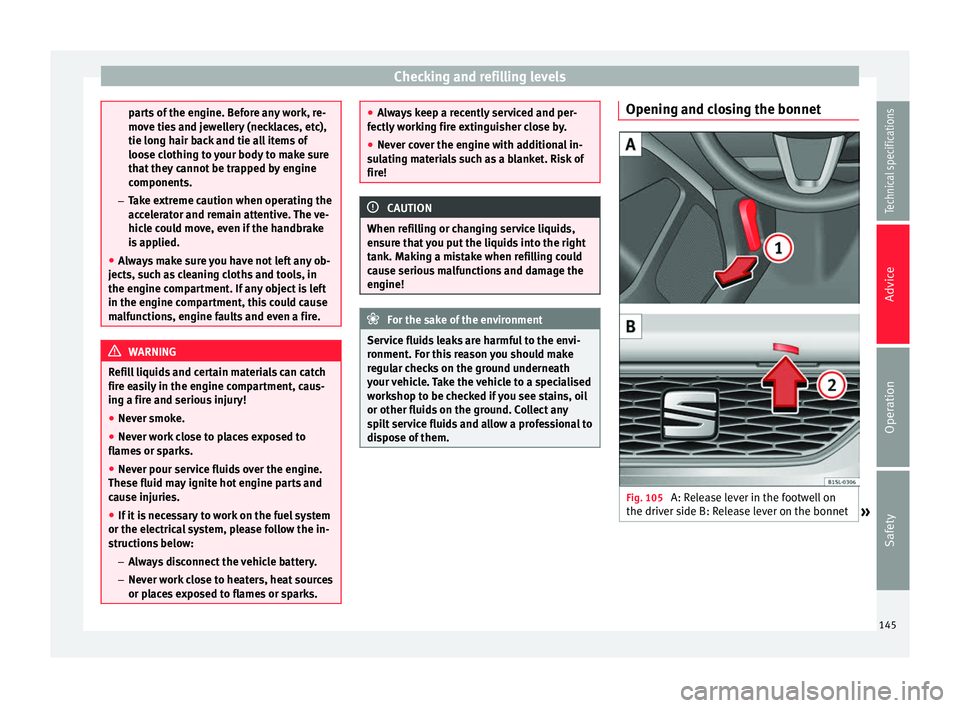
dispose of them. Opening and closing the bonnet
Fig. 105
A: Release lever in the footwell on
the driver side B: Release lever on the bonnet » 145Technical specifications
Advice
Operation
Safety
Page 173 of 219

Emergencies
Fire extinguisher
A fire extinguisher can be stored in a holder
in the passenger seat footwell.
The fire extinguisher must conform to legal
requirements, be ready for use and be
checked regularly. Check the certification
seal on the extinguisher. WARNING
Loose objects in the vehicle interior can be vi-
olently thrown in case of a sudden manoeu-
vre or braking and especially in accidents
causing serious injury.
● Secure or store fire extinguishers, first aid
kit, reflective vests and warning triangle se-
curely in the vehicle. Protecting yourself and securing the
vehicle
Fig. 121
Dash panel: Button for switching the
hazard lights warning system on and off. Always fulfil legal requirements for securing a
broken down vehicle. In a number of coun-
tries it is now obligatory, for example, to turn
on the hazard warning lights and use a re-
flective safety vest
››› page 170.
For your own safety and that of other passen-
gers, the following points should be ob-
served in the order given:
Park the vehicle a safe distance from
traffic and on suitable ground ››› .
Turn on the hazard warning lights with
the button
››› Fig. 121.
Apply the handbrake firmly ››› page 89.
Put the gearbox lever in neutral or the
selector lever in position N ››› page 93.
1.
2.
3.
4. Switch off the engine and remove the
key from the ignition.
Have all occupants leave the vehicle and
move to safety, for example behind a
guard rail.
When leaving the vehicle, take all keys
with you.
Place an emergency warning triangle to
indicate the position of your vehicle to
other road users.
Allow the engine to cool and check if a
specialist is required.
When being towed with the hazard warning
lights on, a change in direction or traffic lane
can be indicated as usual using the turn sig-
nal lever. The hazard lights will be interrup-
ted temporarily.
Examples of when to use the hazard warning
lights:
● If the vehicles ahead suddenly slow down
or reach the end of a traffic jam, to warn the
vehicles behind.
● In case of an emergency.
● If the vehicle breaks down.
● When tow-starting or towing.
Always comply with the applicable laws re-
garding the use of hazard warning lights.
If the hazard warning lights are not working,
you must use an alternative method of »
5.
6.
7.
8.
9.
171Technical specifications
Advice
Operation
Safety
Page 208 of 219
Index
Bonnet Closing . . . . . . . . . . . . . . . . . . . . . . . . . . . . . . . 145
Opening . . . . . . . . . . . . . . . . . . . . . . . . . . . . . . 145
Boot variable floor extend below . . . . . . . . . . . . . . . . . . . . . . . . . . . 76
extend forwards . . . . . . . . . . . . . . . . . . . . . . . . . 76
Brake Brake servo . . . . . . . . . . . . . . . . . . . . . . . . . . . . . 92
Brake assist systems . . . . . . . . . . . . . . . . . . . . . . 103
Brake assist system (BAS) . . . . . . . . . . . . . . . . . . 104
Brake fluid . . . . . . . . . . . . . . . . . . . . . . . . . . . . . . 152 Specification . . . . . . . . . . . . . . . . . . . . . . . . . . . 153
Brakes . . . . . . . . . . . . . . . . . . . . . . . . . . . . . . . . . . . 89 Brake assist systems . . . . . . . . . . . . . . . . . . . . 103
Brake fluid . . . . . . . . . . . . . . . . . . . . . . . . . . . . . 152
Brake fluid level . . . . . . . . . . . . . . . . . . . . . . . . 153
Brake pads . . . . . . . . . . . . . . . . . . . . . . . . . . . . . 91
Changing the brake fluid . . . . . . . . . . . . . . . . . 153
Control lamp . . . . . . . . . . . . . . . . . . . . . . . . . . . . 89
Emergency brake indicator in case of suddenbraking . . . . . . . . . . . . . . . . . . . . . . . . . . . . . 172
Handbrake . . . . . . . . . . . . . . . . . . . . . . . . . . . . . 90
Running-in brake pads . . . . . . . . . . . . . . . . . . . . 91
Warning lamp . . . . . . . . . . . . . . . . . . . . . . . . . . . 89
Brake servo . . . . . . . . . . . . . . . . . . . . . . . . . . 92, 103
Brake system Malfunction . . . . . . . . . . . . . . . . . . . . . . . . . . . . . 92
Brake systems . . . . . . . . . . . . . . . . . . . . . . . . . . . 103
Breakdown Securing the vehicle . . . . . . . . . . . . . . . . . . . . . 171
Bulb fault See changing bulbs . . . . . . . . . . . . . . . . . . . . . 191
C Capacities Fuel tank . . . . . . . . . . . . . . . . . . . . . . . . . . . . . . 203 Care
See "Care of your vehicle" . . . . . . . . . . . . . . . . 125
Vehicle interior . . . . . . . . . . . . . . . . . . . . . . . . . 131
Care of your vehicle Exterior . . . . . . . . . . . . . . . . . . . . . . . . . . . . . . . 125
Caring for paintwork . . . . . . . . . . . . . . . . . . . . . . . 129
Carrier system . . . . . . . . . . . . . . . . . . . . . . . . . . . . . 77
Catalytic converter . . . . . . . . . . . . . . . . . . . . . . . . 102 Control lamp . . . . . . . . . . . . . . . . . . . . . . . . . . . 101
Malfunctions . . . . . . . . . . . . . . . . . . . . . . . . . . . 102
CCS . . . . . . . . . . . . . . . . . . . . . . . . . . . . . . . . . . . . 107
Central locking . . . . . . . . . . . . . . . . . . . . . . . . . . . . 45 Central locking button . . . . . . . . . . . . . . . . . . . . 48
locking and unlocking from the exterior . . . . . . 46
locking and unlocking from the inside . . . . . . . 48
Central locking system After airbag deployment . . . . . . . . . . . . . . . . . . 46
Description . . . . . . . . . . . . . . . . . . . . . . . . . . . . . 46
Opening doors individually . . . . . . . . . . . . . . . . 46
Changing Windscreen wiper blades . . . . . . . . . . . . . . . . . 188
Changing a wheel . . . . . . . . . . . . . . . . . . . . . . . . 174 Changing a wheel . . . . . . . . . . . . . . . . . . . . . . . 178
Raising the vehicle . . . . . . . . . . . . . . . . . . . . . . 177
Wheel bolts . . . . . . . . . . . . . . . . . . . . . . . . . . . . 175
Changing bulbs . . . . . . . . . . . . . . . . . . . . . . . . . . 191 Front bumper . . . . . . . . . . . . . . . . . . . . . . . . . . 193
in the headlights . . . . . . . . . . . . . . . . . . . . . . . 192
Number plate light . . . . . . . . . . . . . . . . . . . . . . 195
Rear lights . . . . . . . . . . . . . . . . . . . . . . . . . . . . . 194
Sea changing bulbs . . . . . . . . . . . . . . . . . . . . . 191
Changing gear . . . . . . . . . . . . . . . . . . . . . . . . . . . . 93 Automatic gearbox . . . . . . . . . . . . . . . . . . . . . . . 95
Engaging gears (automatic gearbox) . . . . . . . . 95
Engaging gears (manual gearbox) . . . . . . . . . . 94
Manual gearbox . . . . . . . . . . . . . . . . . . . . . . . . . 94 Warning and control lamps . . . . . . . . . . . . . . . . 93
with Tiptronic . . . . . . . . . . . . . . . . . . . . . . . . . . . 96
Changing gears Gear recommendation . . . . . . . . . . . . . . . . . . . . 98
Changing the bulbs Side turn signal . . . . . . . . . . . . . . . . . . . . . . . . 196
Changing the wheel After changing the wheel . . . . . . . . . . . . . . . . . 178
Chassis number . . . . . . . . . . . . . . . . . . . . . . . . . . 197
Checking Tyre pressures . . . . . . . . . . . . . . . . . . . . . . . . . . 162
Checking the oil level . . . . . . . . . . . . . . . . . . . . . . 148
Child safety . . . . . . . . . . . . . . . . . . . . . . . . . . . . . . . 25
Child safety seat Securing with seat belt . . . . . . . . . . . . . . . . . . . 30
Child seat . . . . . . . . . . . . . . . . . . . . . . . . . . . . . . . . 25 Fix with ISOFIX . . . . . . . . . . . . . . . . . . . . . . . . . . 31
ISOFIX child seat on rear seats . . . . . . . . . . . . . 29
Mounting child seats . . . . . . . . . . . . . . . . . . . . . 28
Mounting systems . . . . . . . . . . . . . . . . . . . . . . . 28
On rear seats . . . . . . . . . . . . . . . . . . . . . . . . . . . . 29
On the front passenger seat . . . . . . . . . . . . . . . 28
Regulations . . . . . . . . . . . . . . . . . . . . . . . . . . . . . 27
Securing using a Top Tether retaining strap . . . 32
Transporting children in the vehicle . . . . . . . . . 27
Weight categories . . . . . . . . . . . . . . . . . . . . . . . . 27
Child seats Disabling the front passenger front airbag . . . . 24
Chromework care . . . . . . . . . . . . . . . . . . . . . . . . . 129
Cigarette lighter . . . . . . . . . . . . . . . . . . . . . . . . . . . 72
City Safety Assist function . . . . . . . . . . . . . . . . . . 110 Control lamp . . . . . . . . . . . . . . . . . . . . . . . . . . . 111
Function . . . . . . . . . . . . . . . . . . . . . . . . . . . . . . 113
Sensor . . . . . . . . . . . . . . . . . . . . . . . . . . . . . . . . 112
Special driving situations . . . . . . . . . . . . . . . . 113
Warning lamp . . . . . . . . . . . . . . . . . . . . . . . . . . 111
206
Page 211 of 219
Index
Filling the tank . . . . . . . . . . . . . . . . . . . . . . . . . . . 139 At the filling station . . . . . . . . . . . . . . . . . . . . . 137
Fire extinguisher . . . . . . . . . . . . . . . . . . . . . . . . . . 171
First-aid kit Storage . . . . . . . . . . . . . . . . . . . . . . . . . . . . . . . 170
First aid kit . . . . . . . . . . . . . . . . . . . . . . . . . . . . . . 170 see First aid kit . . . . . . . . . . . . . . . . . . . . . . . . . 170
Floor mats . . . . . . . . . . . . . . . . . . . . . . . . . . . . . . . . 10
Fluids . . . . . . . . . . . . . . . . . . . . . . . . . . . . . . . . . . 118
Fog lights . . . . . . . . . . . . . . . . . . . . . . . . . . . . . . . . 56
Front airbags See "Airbag system" . . . . . . . . . . . . . . . . . . . . . . 21
Front passenger airbag See "Airbag system" . . . . . . . . . . . . . . . . . . . . . . 21
Front passenger front airbag Deactivating using the key switch . . . . . . . . . . . 24
Fuel . . . . . . . . . . . . . . . . . . . . . . . . . . . . . . . . . . . . 137 Information on consumption . . . . . . . . . . . . . . 198
Petrol . . . . . . . . . . . . . . . . . . . . . . . . . . . . . . . . . 137
Type of fuel . . . . . . . . . . . . . . . . . . . . . . . . . . . . 137
Fuel consumption Economical driving . . . . . . . . . . . . . . . . . . . . . . . 99
¿Why does it increase? . . . . . . . . . . . . . . . . . . . 102
Fuel gauge . . . . . . . . . . . . . . . . . . . . . . . . . . . . . . 140 Control lamp . . . . . . . . . . . . . . . . . . . . . . . . . . . 140
Fuel . . . . . . . . . . . . . . . . . . . . . . . . . . . . . . . . . . 140
Refuelling . . . . . . . . . . . . . . . . . . . . . . . . . . . . . 140
Fuel tank flap close . . . . . . . . . . . . . . . . . . . . . . . . . . . . . . . . . 142
open . . . . . . . . . . . . . . . . . . . . . . . . . . . . . . . . . 142
Petrol . . . . . . . . . . . . . . . . . . . . . . . . . . . . . . . . . 142
Fuses . . . . . . . . . . . . . . . . . . . . . . . . . . . . . . . . . . . 189 Fuse box . . . . . . . . . . . . . . . . . . . . . . . . . . . . . . 190
Identifying blown fuses . . . . . . . . . . . . . . . . . . 191
Identifying by colours . . . . . . . . . . . . . . . . . . . . 190
Preparation before replacing . . . . . . . . . . . . . . 191
Replacement . . . . . . . . . . . . . . . . . . . . . . . . . . . 191 G
Glove compartment
see Compartments . . . . . . . . . . . . . . . . . . . . 68, 69
H Handbrake . . . . . . . . . . . . . . . . . . . . . . . . . . . . . . . 90
Hazard warning lights . . . . . . . . . . . . . . . . . . . . . 171
Head-on collisions and the laws of physics . . . . . 14
Headlamp range adjustment . . . . . . . . . . . . . . . . . 35
Headlight range control . . . . . . . . . . . . . . . . . . . . . 58
Headlights Driving abroad . . . . . . . . . . . . . . . . . . . . . . . . . . 58
Headlight washers . . . . . . . . . . . . . . . . . . . . . . . 61
Heated rear window . . . . . . . . . . . . . . . . . . . . . . . . 82
Heated seats . . . . . . . . . . . . . . . . . . . . . . . . . . . . . . 64
Heating and ventilation system Controls . . . . . . . . . . . . . . . . . . . . . . . . . . . . . . . . 81
See also Air conditioning system . . . . . . . . . . . 80
High pressure cleaning apparatus . . . . . . . . . . . 127
Hill driving assistant . . . . . . . . . . . . . . . . . . . . . . 114
Hill hold Control lamp . . . . . . . . . . . . . . . . . . . . . . . . . . . 115
Start-Stop system . . . . . . . . . . . . . . . . . . . . . . . 115
Warning lamp . . . . . . . . . . . . . . . . . . . . . . . . . . 115
Horn . . . . . . . . . . . . . . . . . . . . . . . . . . . . . . . . . . . . 35
I Identification number . . . . . . . . . . . . . . . . . . . . . 197
Identification plate . . . . . . . . . . . . . . . . . . . . . . . . 197
Ignition See "Engine and ignition" . . . . . . . . . . . . . . . . . 86
Ignition key see vehicle key . . . . . . . . . . . . . . . . . . . . . . . 43, 44
Ignition lock . . . . . . . . . . . . . . . . . . . . . . . . . . . . . . 86 Key removal lock . . . . . . . . . . . . . . . . . . . . . . . . . 87
Unauthorised vehicle key . . . . . . . . . . . . . . . . . 86 Immobiliser . . . . . . . . . . . . . . . . . . . . . . . . . . . . . . . 88
Immobilizer
Operating fault . . . . . . . . . . . . . . . . . . . . . . . . . . 86
In case of a breakdown Securing the vehicle . . . . . . . . . . . . . . . . . . . . . 171
In case of an emergency Hazard warning lights . . . . . . . . . . . . . . . . . . . 171
In case of a breakdown . . . . . . . . . . . . . . . . . . 171
Protecting yourself and securing the vehicle . 171
In case of emergency . . . . . . . . . . . . . . . . . . . . . . 170
Information on consumption . . . . . . . . . . . . . . . . 198
InSP Indicator . . . . . . . . . . . . . . . . . . . . . . . . . . . . . 38
Instrument panel Display . . . . . . . . . . . . . . . . . . . . . . . . . . . . . . . . 37
Display control functions . . . . . . . . . . . . . . . . . . 41
Instruments . . . . . . . . . . . . . . . . . . . . . . . . . . . . . 36
Lighting . . . . . . . . . . . . . . . . . . . . . . . . . . . . . . . . 58
Screen . . . . . . . . . . . . . . . . . . . . . . . . . . . . . . . . . 36
Service interval display . . . . . . . . . . . . . . . . . . . 38
Symbols . . . . . . . . . . . . . . . . . . . . . . . . . . . . . . . 39
Warning lamp . . . . . . . . . . . . . . . . . . . . . . . . . . . 39
Warning lamps . . . . . . . . . . . . . . . . . . . . . . . . . . 39
Instruments . . . . . . . . . . . . . . . . . . . . . . . . . . . . . . 36
In the event of an emergency Fire extinguishers . . . . . . . . . . . . . . . . . . . . . . . 170
First aid kit . . . . . . . . . . . . . . . . . . . . . . . . . . . . 170
Warning triangle . . . . . . . . . . . . . . . . . . . . . . . . 170
ISOFIX . . . . . . . . . . . . . . . . . . . . . . . . . . . . . . . . . . . 31 see Child seat . . . . . . . . . . . . . . . . . . . . . . . . . . . 25
J Jack . . . . . . . . . . . . . . . . . . . . . . . . . . . . . . . . . . . . 174 Raising the vehicle . . . . . . . . . . . . . . . . . . . . . . 177
K key see vehicle key . . . . . . . . . . . . . . . . . . . . . . . . . . 44
209