heating Seat Mii 2014 User Guide
[x] Cancel search | Manufacturer: SEAT, Model Year: 2014, Model line: Mii, Model: Seat Mii 2014Pages: 219, PDF Size: 4.19 MB
Page 82 of 219

Operation
Air conditioning
Heating, ventilation and air
conditioning system Introduction Dust and pollen filter
The dust and pollen filter with its activated
charcoal cartridge serves as a barrier against
impurities in the interior ambient air.
For the air conditioner to work with maximum
efficiency, the dust and pollen filter must be
replaced at the intervals specified in the
Maintenance Programme.
If the filter loses efficiency prematurely due
to use in areas with very high levels of air
pollution, the filter must be changed more
frequently than stated in the Service Sched-
ule.
WARNING
Reduced visibility through the windows in-
creases the risk of serious accidents. ●
Ensure that all windows are free of ice and
snow and that they are not fogged up pre-
venting a clear view of everything outside.
● The maximum heat output required to de-
frost windows as quickly as possible is only
available when the engine has reached its
normal running temperature. Only drive when
you have good visibility.
● Always ensure that you use the heating
system, ventilation, air conditioner and the
heated rear window to maintain good visibili-
ty.
● Never leave the air recirculation on for a
long period of time. If the cooling system is
switched off and air recirculation mode
switched on, the windows can mist over very
quickly, considerably limiting visibility.
● Switch air recirculation mode off when it is
not required. WARNING
Stuffy or used air will increase fatigue and re-
duce driver concentration possibly resulting
in a serious accident.
● Never leave the fresh air fan turned off or
use the air recirculation for long periods of
time; the air in the vehicle interior will not be
refreshed. CAUTION
● Switch the air conditioner off if you think it
may be broken. This will avoid additional
damage. Have the air conditioner checked by
a specialised workshop.
● Repairs to the air conditioner require spe-
cialist knowledge and special tools. SEAT rec-
ommends taking your car in for technical
service. Note
● When the cooling system is turned off, air
coming from the outside will not be dried. To
avoid fogging up the windows, SEAT recom-
mends leaving the cooler (compressor) on. To
do this, press the A/C button. The button
lamp should light up.
● The maximum heat output required to de-
frost windows as quickly as possible is only
available when the engine has reached its
normal running temperature.
● Keep the air intake slots in front of the
windscreen free of snow, ice and leaves to en-
sure heating and cooling are not impaired,
and to prevent the windows from misting
over. 80
Page 83 of 219
Air conditioning
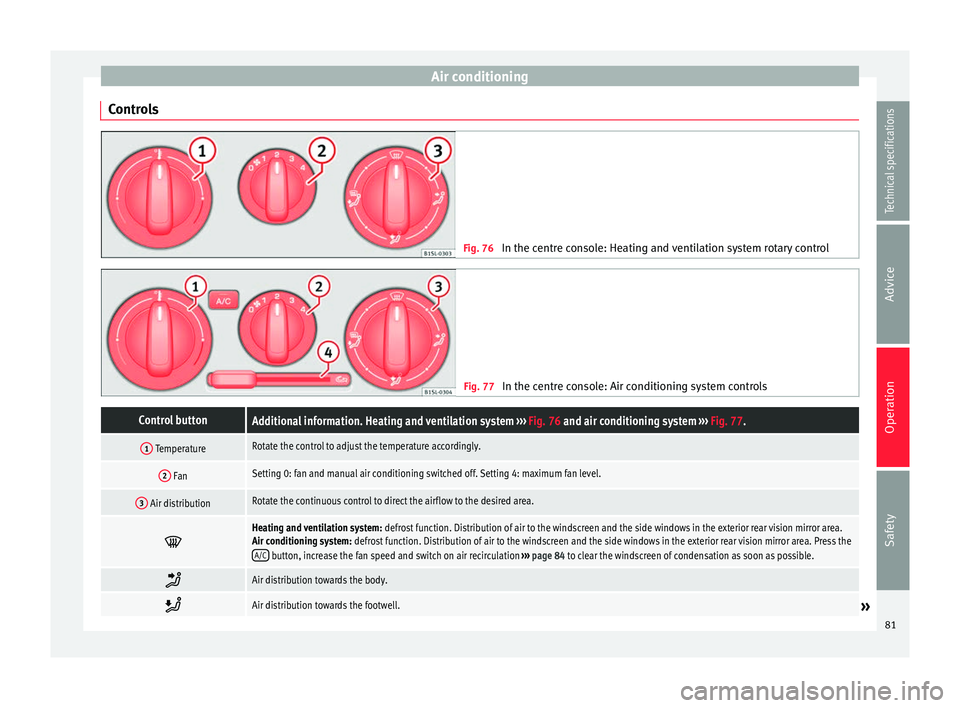
Controls Fig. 76
In the centre console: Heating and ventilation system rotary control Fig. 77
In the centre console: Air conditioning system controlsControl buttonAdditional information. Heating and ventilation system ››› Fig. 76 and air conditioning system ››› Fig. 77.
1 TemperatureRotate the control to adjust the temperature accordingly.
2 FanSetting 0: fan and manual air conditioning switched off. Setting 4: maximum fan level.
3 Air distributionRotate the continuous control to direct the airflow to the desired area.
Heating and ventilation system:
defrost function. Distribution of air to the windscreen and the side windows in the exterior rear vision mirror area.
Air conditioning system: defrost function. Distribution of air to the windscreen and the side windows in the exterior rear vision mirror area. Press the
A/C
button, increase the fan speed and switch on air recirculation ››› page 84 to clear the windscreen of condensation as soon as possible.
Air distribution towards the body.
Air distribution towards the footwell.»
81
Technical specifications
Advice
Operation
Safety
Page 84 of 219
OperationControl buttonAdditional information. Heating and ventilation system
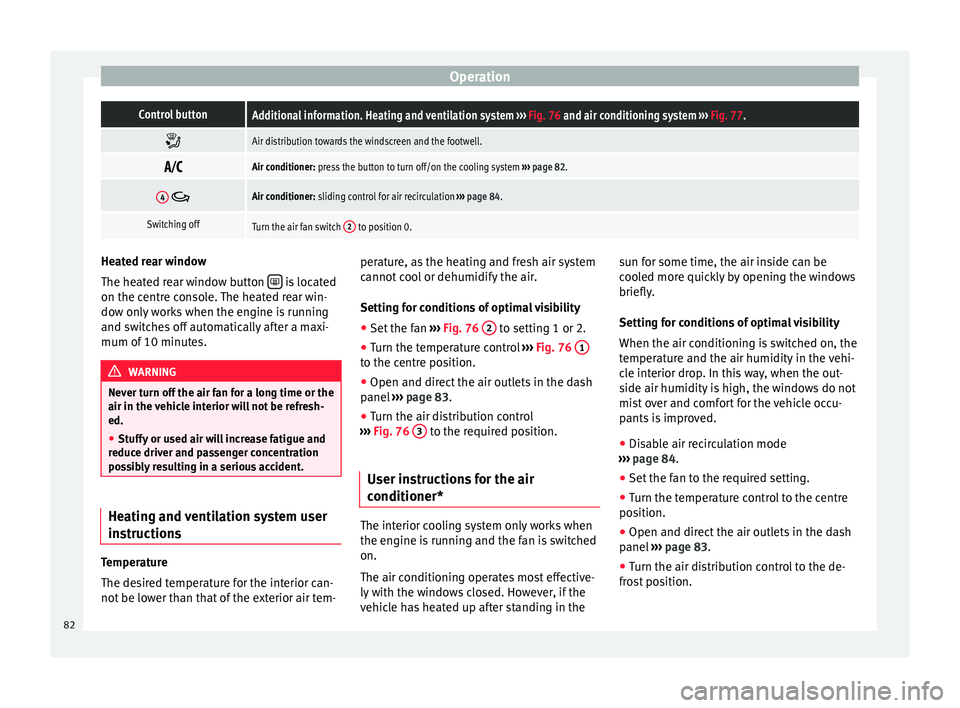
››› Fig. 76 and air conditioning system ››› Fig. 77.
Air distribution towards the windscreen and the footwell.
Air conditioner: press the button to turn off/on the cooling system
››› page 82.
4 Air conditioner: sliding control for air recirculation ››› page 84.
Switching offTurn the air fan switch 2 to position 0.Heated rear window
The heated rear window button
is located
on the centre console. The heated rear win-
dow only works when the engine is running
and switches off automatically after a maxi-
mum of 10 minutes. WARNING
Never turn off the air fan for a long time or the
air in the vehicle interior will not be refresh-
ed.
● Stuffy or used air will increase fatigue and
reduce driver and passenger concentration
possibly resulting in a serious accident. Heating and ventilation system user
instructions
Temperature
The desired temperature for the interior can-
not be lower than that of the exterior air tem- perature, as the heating and fresh air system
cannot cool or dehumidify the air.
Setting for conditions of optimal visibility
● Set the fan ››› Fig. 76 2 to setting 1 or 2.
● Turn the temperature control ››› Fig. 76 1 to the centre position.
●
Open and direct the air outlets in the dash
panel ››› page 83.
● Turn the air di
stribution control
››› Fig. 76 3 to the required position.
User instructions for the air
conditioner* The interior cooling system only works when
the engine is running and the fan is switched
on.
The air conditioning operates most effective-
ly with the windows closed. However, if the
vehicle has heated up after standing in thesun for some time, the air inside can be
cooled more quickly by opening the windows
briefly.
Setting for conditions of optimal visibility
When the air conditioning is switched on, the
temperature and the air humidity in the vehi-
cle interior drop. In this way, when the out-
side air humidity is high, the windows do not
mist over and comfort for the vehicle occu-
pants is improved.
● Disable air recirculation mode
››› page 84.
● Set the f
an to the required setting.
● Turn the temperature control to the centre
position.
● Open and direct the air outlets in the dash
panel ››› page 83.
● Turn the air di
stribution control to the de-
frost position.
82
Page 85 of 219
Air conditioning
● Press the A/C button to switch it on. The in-
dicator on the button will light up.
The cooling system does not switch on
If the air conditioning system cannot be
switched on, this may be caused by the fol-
lowing:
● The engine is not running.
● The fan is switched off.
● The air conditioner fuse has blown. ●
The outside temperature is lower than ap-
proximately +2 °C (+36 °F).
● The air conditioner compressor has been
temporarily switched off because the engine
coolant temperature is too high.
● Another fault in the vehicle. Have the air
conditioner checked by a specialised work-
shop.
Things to note
If the humidity and temperature outside the
vehicle are high, condensation
can drip off the ev aporator in the cooling system and
form a pool underneath the vehicle. This is
normal and does not indicate a leak! Note
After starting it, any residual humidity in the
air conditioner could mist over the wind-
screen. Switch on the defrost function as
soon as possible to clear the windscreen of
condensation. Air vents
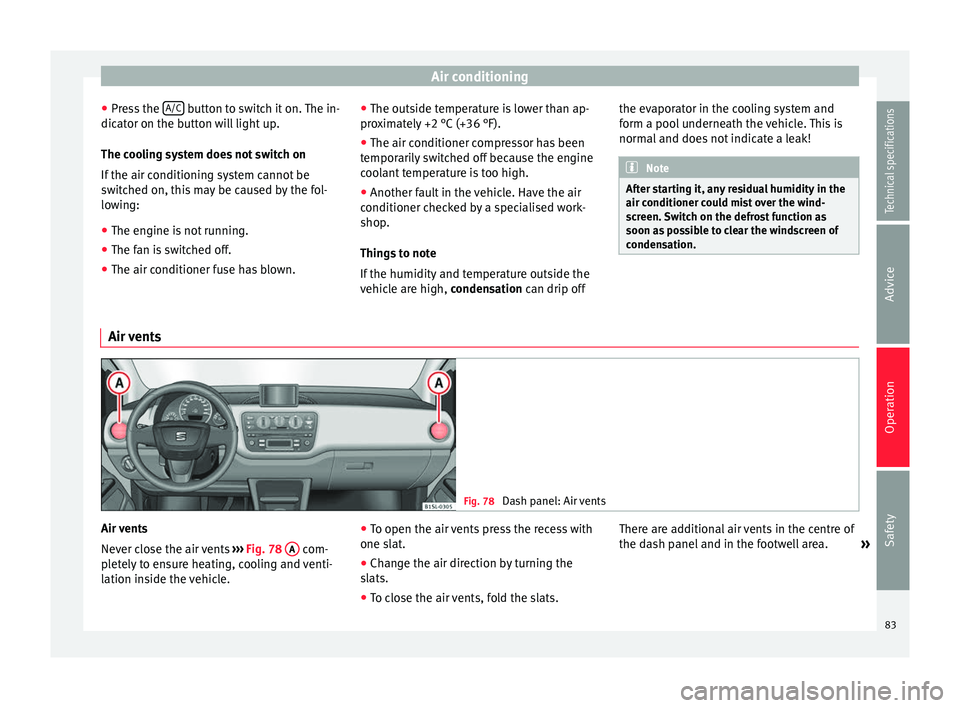
Fig. 78
Dash panel: Air vents Air vents
Never close the air vents
››› Fig. 78 A com-
pletely to ensure heating, cooling and venti-
lation inside the vehicle. ●
To open the air vents press the recess with
one slat.
● Change the air direction by turning the
slats.
● To close the air vents, fold the slats. There are additional air vents in the centre of
the dash panel and in the footwell area.
»
83
Technical specifications
Advice
Operation
Safety
Page 99 of 219

Driving
Driving down hills
The steeper the gradient, the lower the gear
you will need to select. The lowest gears in-
crease the engine braking work. Never go
down hills with the selector lever in neutral
N .
● You shou
ld reduce speed accordingly.
● Place the lever in the position D to the left
on the Tiptronic shift gate M
››› page 96.
● Gently pull the selector lever back – to
change down a gear.
Starting when going up a slope
The steeper the gradient, the lower the gear
you will need.
When stopping on a slope with a gear range
engaged, the vehicle must be prevented from
rolling backwards by always pressing the
brake pedal or pulling the handbrake lever
up. When starting, release the brake pedal or
the handbrake ››› .
Kick-down
The kickdown system provides maximum ac-
celeration when the gear selector lever is in
the position D
, or in the Tiptronic position M
.
When the accelerator pedal is pressed right
down, the automatic gearbox will shift down
to a lower gear, depending on road speed
and engine speed. This takes advantage of the maximum acceleration of the vehicle
››› .
When the accelerator is pressed to the floor,
the automatic gearbox shifts to the next gear
only after the engine reaches the specified
maximum engine speed. WARNING
Rapid acceleration can cause loss of traction
and skidding, especially on slippery ground.
This could cause loss of control of the vehicle
resulting in an accident and serious injury.
● Always adapt your driving style to suit the
flow of traffic.
● Only use the kick-down function or rapid
acceleration if visibility, weather, road and
traffic conditions so permit.
● Never put other road users in danger by ac-
celerating or with your driving style. CAUTION
If you stop on a hill with a gear range engag-
ed, do not try to prevent the vehicle from roll-
ing back by pressing on the accelerator. Oth-
erwise, the automatic gearbox may overheat
causing damage. Automatic gearbox malfunction
Back-up programme
When automatic gearbox warning and control
lamps light up on the instrument panel, there
may be a system malfunction
››› page 93. In
the event of some faults the automatic gear-
box functions using a backup programme.
When the programme is activated, it is possi-
ble to drive the vehicle, however, at low
speeds and within a selected range of gears.
With the manual gearbox, in some cases it is
not possible to drive with all the gears .
In all cases the automatic gearbox must be
checked at a specialised workshop.
Automatic gearbox overheating
The automatic gearbox can overheat with a
prolonged start up, or when stopping and
starting continuously. This overheating is dis-
played with a warning lamp in the instru-
ment panel. Additionally, an audible warning
can be heard. Stop and let the gearbox cool
››› .
The vehicle moves forward or back despite
having selected a gear range
When the vehicle does not move in the re-
quired direction, the system may not have
the gear range correctly engaged. Press the
brake pedal and engage the gear range
again. If the vehicle still does not move in the »
97
Technical specifications
Advice
Operation
Safety
Page 102 of 219

Operation
(25 mph) in fourth gear and at 50 km/h
(31 mph) in fifth gear.
In addition, “skipping” gears when shifting
up helps to save fuel, weather and traffic
conditions permitting.
Do not wait until the last moment before
changing gear. Only use first gear when you
move off and change to second gear quickly.
Avoid the kick-down function in vehicles with
automatic gearbox.
Vehicles with a gear display help to achieve
an economical driving style as the display in-
dicates the best moment to change gear.
Let the vehicle roll
If you take your foot off the accelerator, the
fuel supply is stopped and consumption is
reduced.
Allow the vehicle to roll without accelerating,
for example when approaching a red traffic
light. However, if the vehicle is rolling too
slowly or the distance is too long, the clutch
pedal should be pressed to declutch. The en-
gine will then operate at idle speed.
If the vehicle is going to be at a standstill for
a period of time, switch off the engine; for ex-
ample, while waiting at a level crossing.
Think ahead and “flow” with the traffic
Frequent acceleration and braking considera-
bly increase fuel consumption. If you think ahead as you drive and keep a safe distance
from the vehicle in front, it is possible to slow
down by simply lifting your foot off the accel-
erator. This eliminates the need for constant
braking and acceleration.
Calm and steady driving
Constancy is more important than speed: The
more you drive at a constant speed, the lower
the fuel consumption.
When driving on the motorway, it is more effi-
cient to drive at a constant and more moder-
ate speed than to be continuously accelerat-
ing and braking. As a general rule, you will
reach your destination just as quickly when
you drive at a constant speed.
The cruise control function helps you to ach-
ieve a constant style of driving.
Moderate use of additional devices
It is important to travel in comfort, but con-
venience systems should be used ecological-
ly.
Some equipment, when connected, increase
fuel consumption considerably, for example:
●
Air conditioning cooling system: If the air
conditioning system is required to cool to
significantly lower temperatures than the true
outside temperature, it will require a large
amount of energy from the engine. Therefore,
we recommend that the selected temperature for the vehicle is not too different to the out-
side temperature. It is a good idea to air the
vehicle before starting your journey and to
drive a short distance with the windows
open. Then you can close the windows and
switch on the air conditioning. Keep windows
closed when travelling at high speeds. Driv-
ing with the windows open increases fuel
consumption.
●
Switch off the seat heating when the seats
have warmed up.
● Switch off the heated rear window when it
is not moist or covered in ice.
Avoid short journeys
Fuel consumption is much higher when the
engine is cold, immediately after it has been
started. It takes a few kilometres of driving
for the engine to warm up and to normalise
consumption.
The engine and catalytic converter need to
reach their proper working temperature in or-
der t o minimi
se fuel consumption and emis-
sions. The ambient temperature has a deci-
sive influence.
Fig. 84
shows the difference in consumption
for the same journey at +20 °C (+68 °F) and
at -10 °C (+14 °F).
Therefore, unnecessary short journeys
should be avoided. Try to combine trips.
100
Page 104 of 219
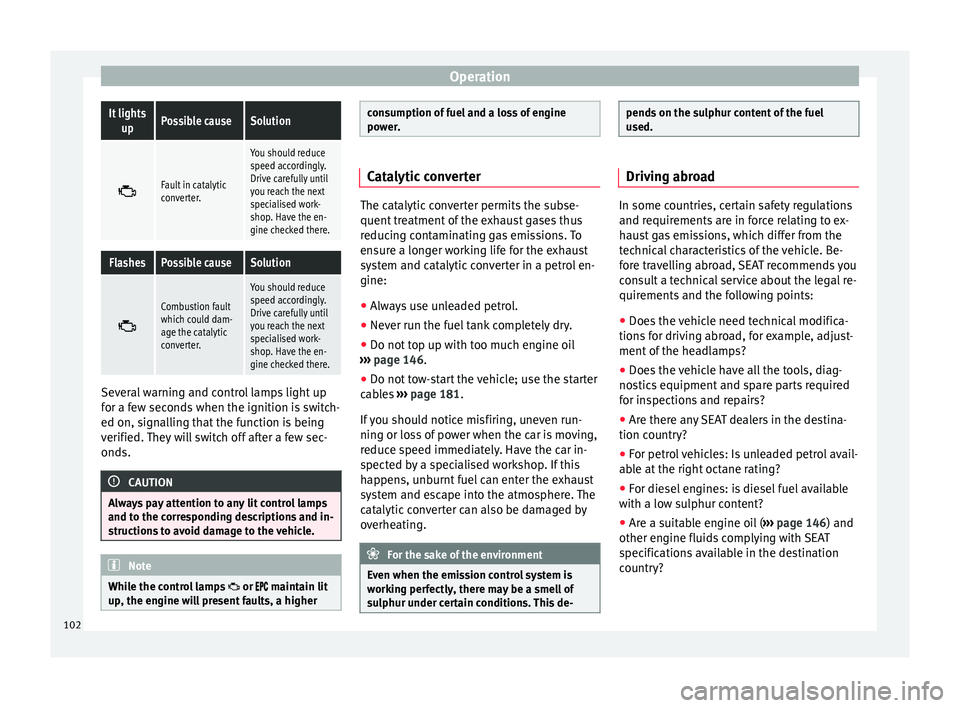
OperationIt lights
upPossible causeSolution
Fault in catalytic
converter.
You should reduce
speed accordingly.
Drive carefully until
you reach the next
specialised work-
shop. Have the en-
gine checked there.
FlashesPossible causeSolution
Combustion fault
which could dam-
age the catalytic
converter.
You should reduce
speed accordingly.
Drive carefully until
you reach the next
specialised work-
shop. Have the en-
gine checked there.
Several warning and control lamps light up
for a few seconds when the ignition is switch-
ed on, signalling that the function is being
verified. They will switch off after a few sec-
onds.
CAUTION
Always pay attention to any lit control lamps
and to the corresponding descriptions and in-
structions to avoid damage to the vehicle. Note
While the control lamps or
maintain lit
up, the engine will present faults, a higher consumption of fuel and a loss of engine
power.
Catalytic converter
The catalytic converter permits the subse-
quent treatment of the exhaust gases thus
reducing contaminating gas emissions. To
ensure a longer working life for the exhaust
system and catalytic converter in a petrol en-
gine:
● Always use unleaded petrol.
● Never run the fuel tank completely dry.
● Do not top up with too much engine oil
››› page 146 .
● Do not t
ow-start the vehicle; use the starter
cables ››› page 181.
If
you should notice misfiring, uneven run-
ning or loss of power when the car is moving,
reduce speed immediately. Have the car in-
spected by a specialised workshop. If this
happens, unburnt fuel can enter the exhaust
system and escape into the atmosphere. The
catalytic converter can also be damaged by
overheating. For the sake of the environment
Even when the emission control system is
working perfectly, there may be a smell of
sulphur under certain conditions. This de- pends on the sulphur content of the fuel
used.
Driving abroad
In some countries, certain safety regulations
and requirements are in force relating to ex-
haust gas emissions, which differ from the
technical characteristics of the vehicle. Be-
fore travelling abroad, SEAT recommends you
consult a technical service about the legal re-
quirements and the following points:
●
Does the vehicle need technical modifica-
tions for driving abroad, for example, adjust-
ment of the headlamps?
● Does the vehicle have all the tools, diag-
nostics equipment and spare parts required
for inspections and repairs?
● Are there any SEAT dealers in the destina-
tion country?
● For petrol vehicles: Is unleaded petrol avail-
able at the right octane rating?
● For diesel engines: is diesel fuel available
with a low sulphur content?
● Are a suitable engine oil ( ››› page 146) and
other engine fluids complying with SEAT
specifications available in the destination
country?
102
Page 106 of 219

Operation
the driver control the vehicle due to the loss
of adherence with the road surface prevent-
ing braking and steering. If the vehicle is
driven through series of bends at high
speed, the ESC* will not always be as effec-
tive: the vehicle reaction to aggressive driv-
ing is not the same as at reduced speeds.
Adjust your speed and driving style to suit
visibility, and weather, road and traffic condi-
tions. ESC* cannot push the limits of the laws
of physics; improve the transmission availa-
ble or maintain the vehicle on the road if a
lack of driver attention creates an inevitable
situation. Otherwise, ESC* assists in main-
taining vehicle control in extreme situations
and uses the movements of the steering
made by the driver to maintain the vehicle
moving in the desired direction. If the vehicle
is driven at such a speed that it will leave the
road before ESC* can intervene then the sys-
tem cannot provide assistance.
The ABS, BAS, ASR and EDL systems are in-
corporated into the ESC*. The ESC* is always
on 1)
.
Anti-lock brake system (ABS)
ABS can prevent the wheels from locking dur-
ing braking until just before the vehicle stops
thus helping the driver to steer the vehicle
and maintain control. This means that, even during full braking, the risk of skidding is re-
duced:
● Press and hold the brake pedal fully. Do not
remove your foot from the brake pedal or re-
duce braking force!
● Do not “pump” the brake pedal, or reduce
braking force!
● Maintain vehicle direction when braking
fully.
● When the brake pedal is released or when
the brake force is reduced, ABS is turned off.
ABS control can be observed by vibration of
the brake pedal and noise. You should never
e xpect
the ABS to reduce the braking dis-
tance under
any circumstances. This distance
will increase when driving on gravel, recent
snow or on icy or slippery ground.
Brake assist system (BAS)
The brake assist system may reduce the re-
quired braking distance. The brake assist
system boosts the braking force if you press
the brake pedal quickly in an emergency. As
a result, the braking pressure increases rap-
idly, the braking force is multiplied and the
braking distance is reduced. This enables the
ABS to be activated more quickly and effec-
tively. ¡Do not lift your foot off the brake pedal!
When the br
ake pedal is released or when
the brake force is reduced, braking assist au-
tomatically turns off the brake servo.
Traction control system (ASR) or Traction
Control (TC)
In the event of wheelspin, the traction control
system ASR or TC reduces the engine torque
to match the amount of grip available. The
ASR or TC makes some situations easier, for
example, when starting, accelerating or go-
ing uphill, even in unfavourable road condi-
tions.
Electronic differential lock system (EDL)
EDL is available when driving in straight lines
under normal conditions. When the EDL de-
tects wheelspin, it brakes the spinning wheel
and directs the power to the other one. To
prevent the disc brake of the braked wheel
from overheating, the EDL cuts out automati-
cally if subjected to excessive loads. The EDL
will switch on again automatically when the
brake has cooled down. WARNING
Driving at high speed on icy, slippery or wet
ground can result in loss of vehicle control 1)
Depending on the version.
104
Page 131 of 219

Care and maintenance
● For the hottest time of the year: the window
cleaner for summer use G 052 184 A1. Pro-
portion 1:100 (1 part detergent, 100 parts
water) in the windscreen washer reservoir.
● All year round: the window clean-
er G 052 164 A2; proportion 1:2 in wind-
screen washer bottle (1 part concentrate, 2
parts water) in winter, up to -18 ℃ (-0.4 °F),
or 1:4, during the rest of the year.
● Window cloths G 052 522 A1 for all win-
dows and exterior mirrors.
Removing snow
Use a small brush to remove snow from the
windows and exterior mirrors.
Removing ice
If possible, use a de-icing spray to remove
ice. If you use an ice scraper, push it in one
direction only without swinging it. If you pull
the s c
raper backwards, the dirt may scratch
the window. WARNING
Dirty or misted windows reduce visibility in
all directions and increase the risk of acci-
dent and serious injury.
● Do not drive unless you have good visibility
through all windows!
● Remove ice and snow from the windows
and demist inside and out. CAUTION
● Never mix our cleaning products with other
products not recommended by SEAT in the
windscreen washer reservoir. This could lead
to flocculation and may block the windscreen
washer jets.
● Do not use hot or warm water to remove ice
or snow from the windows and exterior mir-
rors. The glass could crack!
● The heating element for the rear window is
located on the inner side of the window. Do
not stick adhesive labels over the heating el-
ements and never clean the inside of the rear
window with corrosive or acid products or
other similar chemical cleaning products. Caring for and polishing the vehicle
paintwork
Waxing
Regular waxing protects the paintwork. It is
time to apply a good coat of
wax when water
no lon g
er forms droplets and rolls off the
clean paintwork.
Even if a wax solution is used regularly in the
automatic car wash, SEAT recommends pro-
tecting the paint with a hard wax coating at
least twice a year. Polishing
Polishing is only necessary if the paint has
lost its shine, and the gloss cannot be
brought back by applying wax.
If the polish does not contain wax, a wax
product should be applied after polishing.
CAUTION
● To prevent damage, car polish or hard wax
should not be used on components painted in
matt paint, plastic components and the glass
headlamp and tail light covers.
● Do not polish your vehicle in a sandy or
dusty environment. Care and cleaning of chrome and
aluminium wheel rims
●
Use a clean, damp, lint-free, smooth cloth
to clean anodized surfaces.
● If there is a lot of dirt, use a special clean-
ing product which does not contain solvents.
● Then, polish the chrome and aluminium
wheel trims with a smooth dry cloth. CAUTION
In order to prevent damage to the aluminium
and chrome wheel trims:
● Do not clean or polish them in direct sun-
light. » 129
Technical specifications
Advice
Operation
Safety
Page 133 of 219
Care and maintenance
Cleaning the engine compartment The engine compartment of any motor vehi-
cle is a potentially hazardous area
››› page 143.
The en gine c
ompartment should only be
cleaned by qualified personnel. If it is not
correctly cleaned, the anti-corrosion coating
and consequently electrical components may
be damaged. Moreover, water may filter di-
rectly into the vehicle interior through the wa-
ter chamber ››› .
If the engine compartment is very dirty, al-
ways take the vehicle to a specialised work-
shop for professional cleaning. SEAT recom-
mends taking your car in for technical serv-
ice.
Water box
The water box is in the engine compartment,
between the windscreen and the engine, and
beneath a perforated cover. Air is taken in
through the water box from outside to the ve-
hicle interior via the heating and air condi-
tioner.
Leaves and other loose objects should be
regularly cleaned away from the water box ei-
ther by hand or with a vacuum. WARNING
When working on the engine or in the engine
compartment, there is a risk of injury, burns,
accident or fire.
● Before starting work, please ensure you are
familiar with the required procedure and the
safety precautions ››› page 143.
● SEAT recommends getting a specialised
workshop to do these jobs. CAUTION
If water is manually poured into the water box
(e.g. using a high pressure cleaning appli-
ance), this could cause significant damage to
the vehicle. For the sake of the environment
Only wash the engine compartment in areas
allocated for this purpose, to prevent dirty
water which may be contaminated by oil,
grease or fuel, from entering the drains. In
some places, even washing this compartment
outside planned areas for this purpose is
banned. Caring for and cleaning the
vehicle interior
Introduction The dye from many items of modern clothing
(e.g. dark jeans) is not always colour-fast.
Seat upholstery (material and leather), espe-
cially when light-coloured, may visibly discol-
our if the dye comes out of clothing (even
when used correctly). This is not an uphols-
tery defect but indicates that the dye in the
item of clothing is not sufficiently colour-fast.
WARNING
Car-care products may be toxic and hazard-
ous. If car care products are not suitable or
are used inappropriately, this could result in
accident, serious injury, burns or intoxica-
tion.
● Car care products must always be stored in
the original container which should be kept
closed.
● Observe information provided by the manu-
facturer.
● To prevent confusion, never store car care
products in empty food cans, bottles or other
containers.
● Keep all care products out of reach of chil-
dren. » 131
Technical specifications
Advice
Operation
Safety