open bonnet Seat Mii 2014 User Guide
[x] Cancel search | Manufacturer: SEAT, Model Year: 2014, Model line: Mii, Model: Seat Mii 2014Pages: 219, PDF Size: 4.19 MB
Page 150 of 219
Advice
Checking the engine oil level and
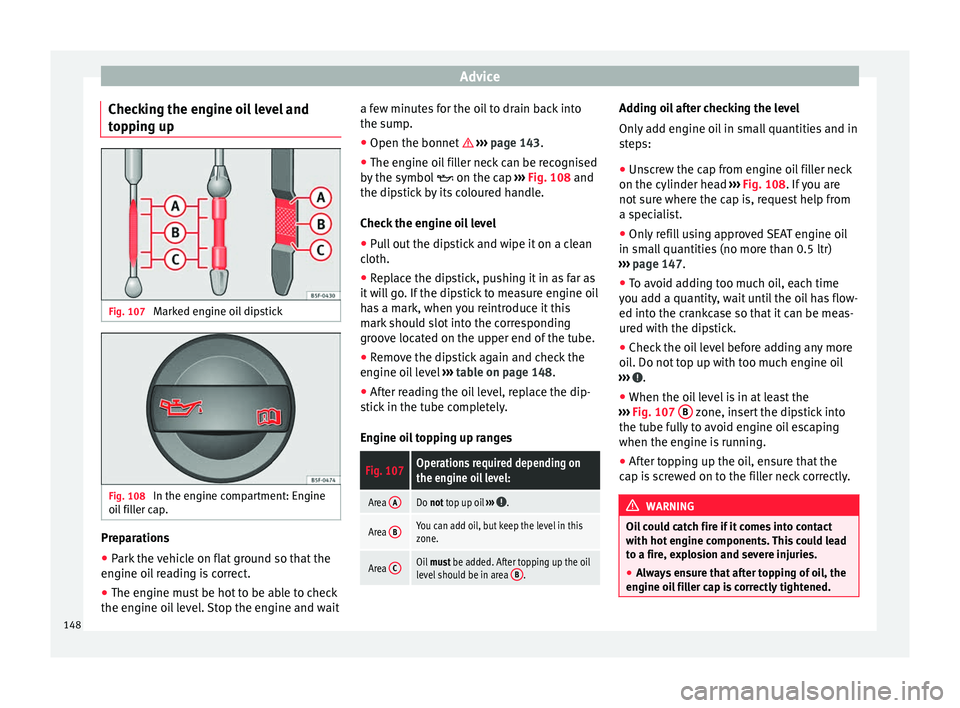
topping up Fig. 107
Marked engine oil dipstick Fig. 108
In the engine compartment: Engine
oil filler cap. Preparations
● Park the vehicle on flat ground so that the
engine oil reading is correct.
● The engine must be hot to be able to check
the engine oil level. Stop the engine and wait a few minutes for the oil to drain back into
the sump.
●
Open the bonnet ››› page 143.
● The engine oil filler neck can be recognised
by the symbol on the cap
›
›› Fig. 108 and
the dipstick by its coloured handle.
Check the engine oil level
● Pull out the dipstick and wipe it on a clean
cloth.
● Replace the dipstick, pushing it in as far as
it will go. If the dipstick to measure engine oil
has a mark, when you reintroduce it this
mark should slot into the corresponding
groove located on the upper end of the tube.
● Remove the dipstick again and check the
engine oil level ››› table on page 148.
● After reading the oil level, replace the dip-
stick in the tube completely.
Engine oil topping up ranges
Fig. 107Operations required depending on
the engine oil level:
Area ADo not top up oil
››› .
Area BYou can add oil, but keep the level in this
zone.
Area COil
must be added. After topping up the oil
level should be in area B. Adding oil after checking the level
Only add engine oil in small quantities and in
steps:
●
Unscrew the cap from engine oil filler neck
on the cylinder head ››› Fig. 108 . If you are
not s
ure where the cap is, request help from
a specialist.
● Only refill using approved SEAT engine oil
in small quantities (no more than 0.5 ltr)
››› page 147.
● To av
oid adding too much oil, each time
you add a quantity, wait until the oil has flow-
ed into the crankcase so that it can be meas-
ured with the dipstick.
● Check the oil level before adding any more
oil. Do not top up with too much engine oil
››› .
● When the oil level is in at least the
››› Fig. 107 B zone, insert the dipstick into
the tube fully to avoid engine oil escaping
when the engine is running.
● After topping up the oil, ensure that the
cap is screwed on to the filler neck correctly. WARNING
Oil could catch fire if it comes into contact
with hot engine components. This could lead
to a fire, explosion and severe injuries.
● Always ensure that after topping of oil, the
engine oil filler cap is correctly tightened. 148
Page 153 of 219
Checking and refilling levels
reduce the frost protection and, in turn, de-
crease the cooling capacity.
When the coolant is topped up, use a mixture
of distilled water and, at least, 40 % of the G
13 or G 12 p lu
s-plus (TL-VW 774 G) additive
(both are purple) to obtain an optimum anti-
corrosion protection ››› . The mixture of G
13 with G 12 plus (TL-VW 774 F), G 12 (red) or
G 11 (green-blue) engine coolants will signifi-
cantly reduce the anticorrosion protection
and should, therefore be avoided ››› .
WARNING
If there is not enough anti-freeze in the cool-
ant system, the engine may fail leading to se-
rious damage.
● Please make sure that the percentage of
additive is correct with respect to the lowest
expected ambient temperature in the zone in
which the vehicle is to be used.
● When the outside temperature is very low,
the coolant could freeze and the vehicle
would be immobilised. In this case, the heat-
ing would not work either and inadequately
dressed passengers could die of cold. CAUTION
The original additives should never be mixed
with coolants which are not approved by
SEAT. Otherwise, you run the risk of causing
severe damage to the engine and the engine
cooling system. ●
If the fluid in the expansion tank is not pur-
ple but is, for example, brown, this indicates
that the G 13 additive has been mixed with
an inadequate coolant. The coolant must be
changed as soon as possible if this is the
case! This could result in serious faults and
engine damage. For the sake of the environment
Coolants and additives can contaminate the
environment. If any fluids are spilled, they
should be collected and correctly disposed
of, with respect to the environment. Checking the engine coolant level and
refilling
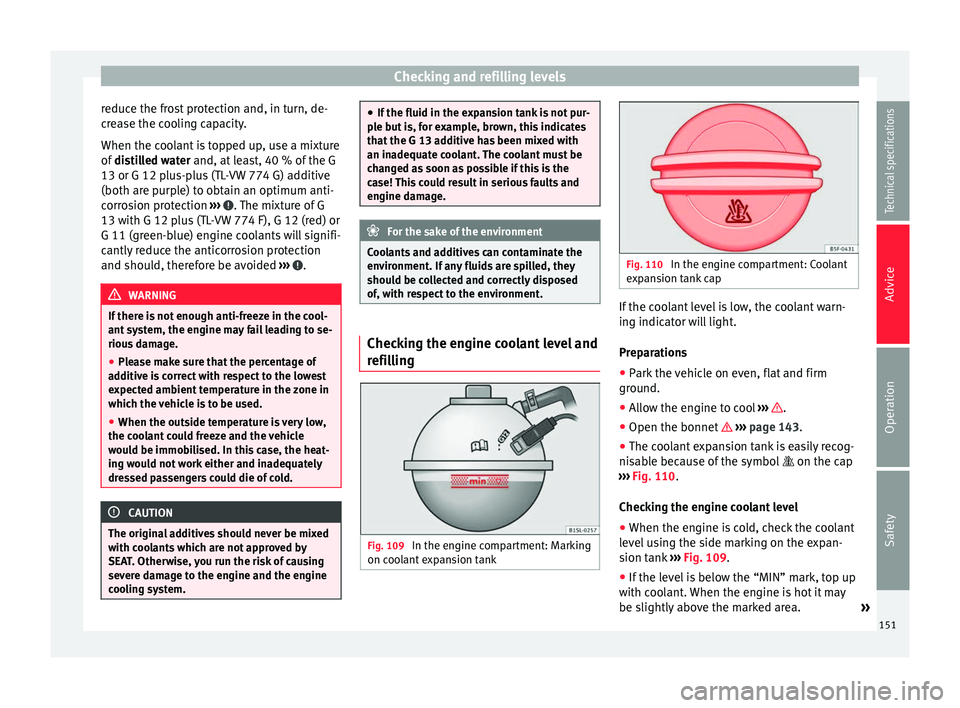
Fig. 109
In the engine compartment: Marking
on coolant expansion tank Fig. 110
In the engine compartment: Coolant
expansion tank cap If the coolant level is low, the coolant warn-
ing indicator will light.
Preparations
● Park the vehicle on even, flat and firm
ground.
● Allow the engine to cool ››› .
● Open the bonnet ››› page 143.
● The coolant expansion tank is easily recog-
nisable because of the symbol on the cap
››› Fig. 110 .
Chec k
ing the engine coolant level
● When the engine is cold, check the coolant
level using the side marking on the expan-
sion tank ››› Fig. 109.
● If the l
evel is below the “MIN” mark, top up
with coolant. When the engine is hot it may
be slightly above the marked area. »
151
Technical specifications
Advice
Operation
Safety
Page 156 of 219
Advice
●
To reduce the risk of poisoning, do not keep
brake fluid in drinks bottles/containers or
similar. Other people could drink from these
recipients even if the contents are clearly
marked.
● Always keep brake fluid in the original con-
tainer; keep it correctly sealed and out of
reach of children. CAUTION
Brake fluid damages the vehicle paintwork.
Wipe off any brake fluid from the paintwork
immediately. For the sake of the environment
Brake fluid is an environmental pollutant.
Collect any spilt service fluids and allow a
professional to dispose of them. Checking and topping up the
windscreen washer reservoir with
water
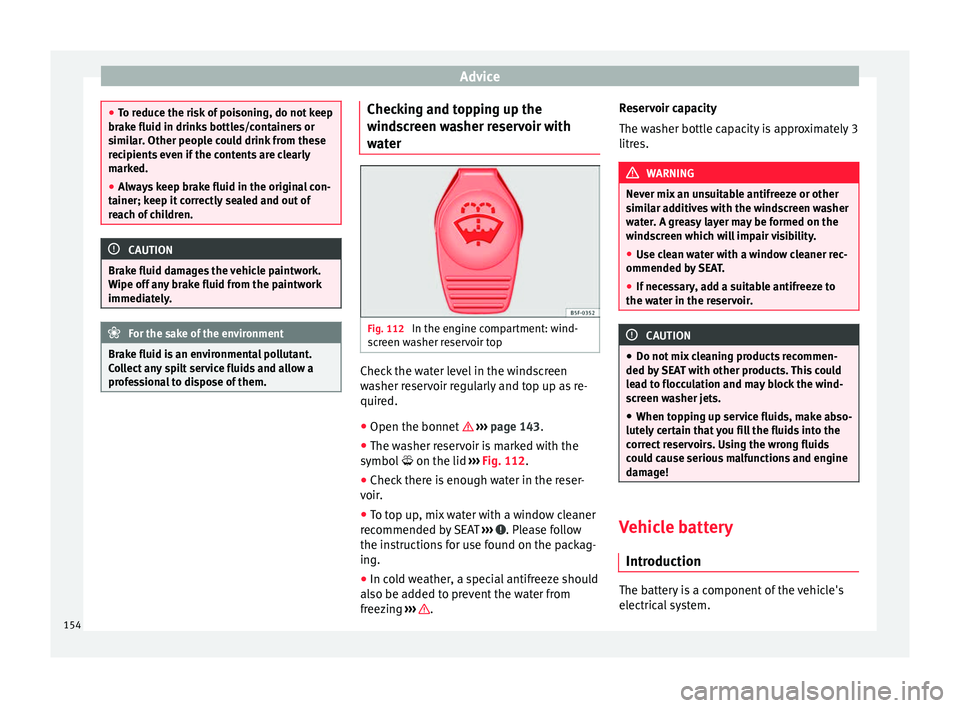
Fig. 112
In the engine compartment: wind-
screen washer reservoir top Check the water level in the windscreen
washer reservoir regularly and top up as re-
quired.
● Open the bonnet ››› page 143.
● The washer reservoir is marked with the
symbol on the lid ››› Fig. 112 .
● Chec k
there is enough water in the reser-
voir.
● To top up, mix water with a window cleaner
recommended by SEAT ››› . Please follow
the instructions for use found on the packag-
ing.
● In cold weather, a special antifreeze should
also be added to prevent the water from
freezing ››› .Reservoir capacity
The washer bottle capacity is approximately 3
litres.
WARNING
Never mix an unsuitable antifreeze or other
similar additives with the windscreen washer
water. A greasy layer may be formed on the
windscreen which will impair visibility.
● Use clean water with a window cleaner rec-
ommended by SEAT.
● If necessary, add a suitable antifreeze to
the water in the reservoir. CAUTION
● Do not mix cleaning products recommen-
ded by SEAT with other products. This could
lead to flocculation and may block the wind-
screen washer jets.
● When topping up service fluids, make abso-
lutely certain that you fill the fluids into the
correct reservoirs. Using the wrong fluids
could cause serious malfunctions and engine
damage! Vehicle battery
Introduction The battery is a component of the vehicle's
electrical system.
154
Page 158 of 219

Advice
WARNING
Observe the safety warnings ››› in Control
and warning lamps on page 40. Checking the electrolyte level of the
vehicle battery
Fig. 113
In the engine compartment: Remove
the cover from the vehicle's battery. The battery's electrolyte level should be
checked regularly in high-mileage vehicles,
in hot countries and in older batteries. Other
batteries do not require maintenance.
Vehicles fitted with the Start-Stop system are
equipped with special batteries. For technical
reasons, the electrolyte level cannot be
checked in these batteries. Preparations
● Prepare the vehicle for work in the engine
compartment ››› page 143
● Open the bonnet ››› page 143.
● Press on the tabs ››› Fig. 113 (arrows) in the
dir ection of
the arrows and lift the battery
cover up.
Checking the battery electrolyte level
● Make sure there is sufficient lighting to
clearly recognise the colours. Never use
flames or shiny objects as a light source.
● Depending on the level of acid, the Magic
eye on the top of the battery will change col-
our.
Colour in-
dicatorNecessary operations
Light yellow
or colourlessThe electrolyte level of the vehicle's bat-
tery is too low. Have the battery checked
and, where applicable, replaced by a
specialised workshop.
BlackThe electrolyte level of the vehicle's bat-
tery is correct. WARNING
Working with the vehicle battery involves a
risk of corrosion, explosions and electric
shock. ●
Never tilt the vehicle battery. Battery acid
could spill out of the openings for the release
of gases and cause corrosion damage.
● Never open the vehicle battery.
● If battery acid splashes on you, immediate-
ly rinse your eyes and skin abundantly with
water for several minutes. Then seek medical
care immediately.
● If acid is swallowed by mistake, consult a
doctor immediately. Charging, replacing and connecting or
disconnecting the battery
Charging the battery
The vehicle battery should be charged by a
specialised workshop only, as batteries us-
ing special technology have been installed
and they must be charged in a controlled en-
vironment
››› . SEAT recommends taking
your car in for technical service.
Replacing a vehicle battery
The battery has been developed to suit the
conditions of its location and has special
safety features. If the battery must be re-
placed, consult a technical service for infor-
mation on electromagnetic compatibility, the
size and maintenance, performance and
safety requirements of the new battery in
your vehicle before you purchase one. SEAT
156
Page 192 of 219
Advice
Note
Several components may run on a single
fuse. Vehicle fuses
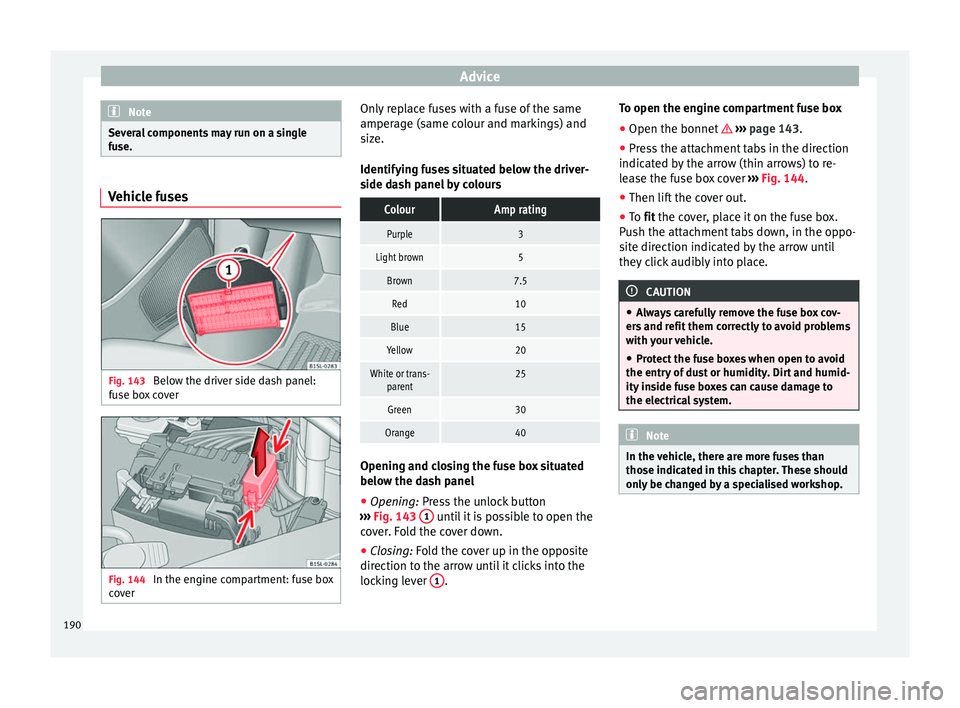
Fig. 143
Below the driver side dash panel:
fuse box cover Fig. 144
In the engine compartment: fuse box
cover Only replace fuses with a fuse of the same
amperage (same colour and markings) and
size.
Identifying fuses situated below the driver-
side dash panel by coloursColourAmp rating
Purple3
Light brown5
Brown7.5
Red10
Blue15
Yellow20
White or trans-
parent25
Green30
Orange40 Opening and closing the fuse box situated
below the dash panel
●
Opening: Press the unlock button
› ›
› Fig. 143 1 until it is possible to open the
cover. Fold the cover down.
● Closing: Fold the cover up in the opposite
dir ection t
o the arrow until it clicks into the
locking lever 1 .To open the engine compartment fuse box
●
Open the bonnet ››› page 143.
● Press the attachment tabs in the direction
indicated by the arrow (thin arrows) to re-
lease the fuse box cover ››› Fig. 144 .
● Then lif t
the cover out.
● To fit the cover, place it on the fuse box.
P
ush the attachment tabs down, in the oppo-
site direction indicated by the arrow until
they click audibly into place. CAUTION
● Always carefully remove the fuse box cov-
ers and refit them correctly to avoid problems
with your vehicle.
● Protect the fuse boxes when open to avoid
the entry of dust or humidity. Dirt and humid-
ity inside fuse boxes can cause damage to
the electrical system. Note
In the vehicle, there are more fuses than
those indicated in this chapter. These should
only be changed by a specialised workshop. 190
Page 194 of 219
Advice
CAUTION
● After changing a bulb, if the rubber covers
are not replaced correctly on the headlamp
framework, the electrical installation may be damaged, especially if water is allowed to en-
ter.
● Remove the ignition key before working on
the electric system. Otherwise, a short circuit could occur. ●
Switch off the lights and the parking light
before changing a bulb.
● Take good care to avoid damaging any com-
ponents. Replacing the bulbs in the headlights
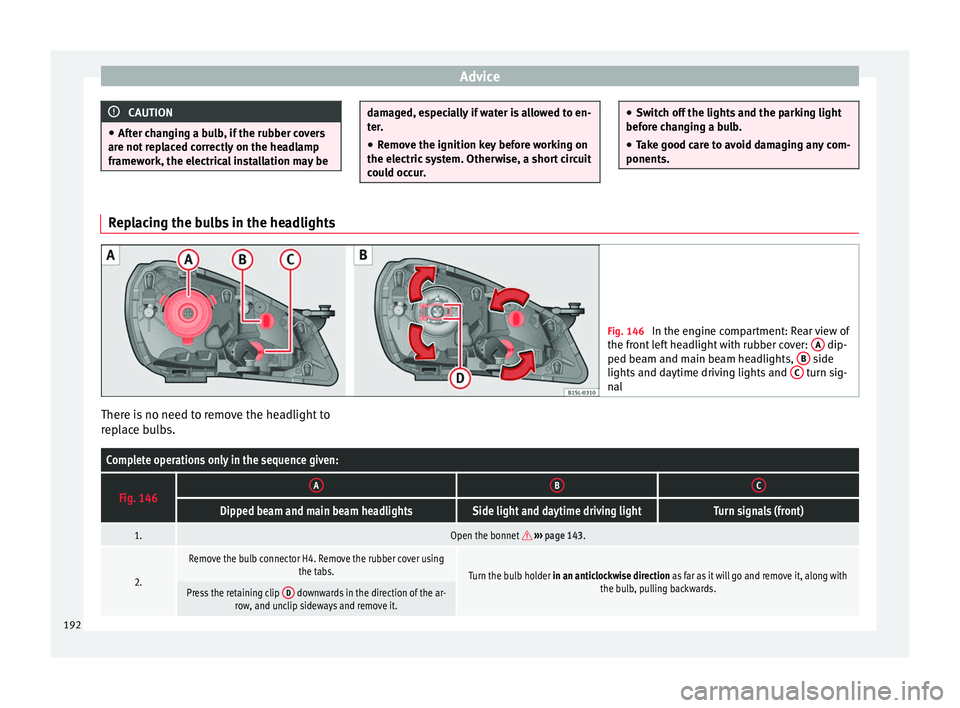
Fig. 146
In the engine compartment: Rear view of
the front left headlight with rubber cover: A dip-
ped beam and main beam headlights, B side
lights and daytime driving lights and C turn sig-
nal There is no need to remove the headlight to
replace bulbs.Complete operations only in the sequence given:
Fig. 146ABC
Dipped beam and main beam headlightsSide light and daytime driving lightTurn signals (front)
1.Open the bonnet
››› page 143.
2.
Remove the bulb connector H4. Remove the rubber cover using
the tabs.Turn the bulb holder in an anticlockwise direction as far as it will go and remove it, along with the bulb, pulling backwards.Press the retaining clip D downwards in the direction of the ar-
row, and unclip sideways and remove it. 192
Page 208 of 219
Index
Bonnet Closing . . . . . . . . . . . . . . . . . . . . . . . . . . . . . . . 145
Opening . . . . . . . . . . . . . . . . . . . . . . . . . . . . . . 145
Boot variable floor extend below . . . . . . . . . . . . . . . . . . . . . . . . . . . 76
extend forwards . . . . . . . . . . . . . . . . . . . . . . . . . 76
Brake Brake servo . . . . . . . . . . . . . . . . . . . . . . . . . . . . . 92
Brake assist systems . . . . . . . . . . . . . . . . . . . . . . 103
Brake assist system (BAS) . . . . . . . . . . . . . . . . . . 104
Brake fluid . . . . . . . . . . . . . . . . . . . . . . . . . . . . . . 152 Specification . . . . . . . . . . . . . . . . . . . . . . . . . . . 153
Brakes . . . . . . . . . . . . . . . . . . . . . . . . . . . . . . . . . . . 89 Brake assist systems . . . . . . . . . . . . . . . . . . . . 103
Brake fluid . . . . . . . . . . . . . . . . . . . . . . . . . . . . . 152
Brake fluid level . . . . . . . . . . . . . . . . . . . . . . . . 153
Brake pads . . . . . . . . . . . . . . . . . . . . . . . . . . . . . 91
Changing the brake fluid . . . . . . . . . . . . . . . . . 153
Control lamp . . . . . . . . . . . . . . . . . . . . . . . . . . . . 89
Emergency brake indicator in case of suddenbraking . . . . . . . . . . . . . . . . . . . . . . . . . . . . . 172
Handbrake . . . . . . . . . . . . . . . . . . . . . . . . . . . . . 90
Running-in brake pads . . . . . . . . . . . . . . . . . . . . 91
Warning lamp . . . . . . . . . . . . . . . . . . . . . . . . . . . 89
Brake servo . . . . . . . . . . . . . . . . . . . . . . . . . . 92, 103
Brake system Malfunction . . . . . . . . . . . . . . . . . . . . . . . . . . . . . 92
Brake systems . . . . . . . . . . . . . . . . . . . . . . . . . . . 103
Breakdown Securing the vehicle . . . . . . . . . . . . . . . . . . . . . 171
Bulb fault See changing bulbs . . . . . . . . . . . . . . . . . . . . . 191
C Capacities Fuel tank . . . . . . . . . . . . . . . . . . . . . . . . . . . . . . 203 Care
See "Care of your vehicle" . . . . . . . . . . . . . . . . 125
Vehicle interior . . . . . . . . . . . . . . . . . . . . . . . . . 131
Care of your vehicle Exterior . . . . . . . . . . . . . . . . . . . . . . . . . . . . . . . 125
Caring for paintwork . . . . . . . . . . . . . . . . . . . . . . . 129
Carrier system . . . . . . . . . . . . . . . . . . . . . . . . . . . . . 77
Catalytic converter . . . . . . . . . . . . . . . . . . . . . . . . 102 Control lamp . . . . . . . . . . . . . . . . . . . . . . . . . . . 101
Malfunctions . . . . . . . . . . . . . . . . . . . . . . . . . . . 102
CCS . . . . . . . . . . . . . . . . . . . . . . . . . . . . . . . . . . . . 107
Central locking . . . . . . . . . . . . . . . . . . . . . . . . . . . . 45 Central locking button . . . . . . . . . . . . . . . . . . . . 48
locking and unlocking from the exterior . . . . . . 46
locking and unlocking from the inside . . . . . . . 48
Central locking system After airbag deployment . . . . . . . . . . . . . . . . . . 46
Description . . . . . . . . . . . . . . . . . . . . . . . . . . . . . 46
Opening doors individually . . . . . . . . . . . . . . . . 46
Changing Windscreen wiper blades . . . . . . . . . . . . . . . . . 188
Changing a wheel . . . . . . . . . . . . . . . . . . . . . . . . 174 Changing a wheel . . . . . . . . . . . . . . . . . . . . . . . 178
Raising the vehicle . . . . . . . . . . . . . . . . . . . . . . 177
Wheel bolts . . . . . . . . . . . . . . . . . . . . . . . . . . . . 175
Changing bulbs . . . . . . . . . . . . . . . . . . . . . . . . . . 191 Front bumper . . . . . . . . . . . . . . . . . . . . . . . . . . 193
in the headlights . . . . . . . . . . . . . . . . . . . . . . . 192
Number plate light . . . . . . . . . . . . . . . . . . . . . . 195
Rear lights . . . . . . . . . . . . . . . . . . . . . . . . . . . . . 194
Sea changing bulbs . . . . . . . . . . . . . . . . . . . . . 191
Changing gear . . . . . . . . . . . . . . . . . . . . . . . . . . . . 93 Automatic gearbox . . . . . . . . . . . . . . . . . . . . . . . 95
Engaging gears (automatic gearbox) . . . . . . . . 95
Engaging gears (manual gearbox) . . . . . . . . . . 94
Manual gearbox . . . . . . . . . . . . . . . . . . . . . . . . . 94 Warning and control lamps . . . . . . . . . . . . . . . . 93
with Tiptronic . . . . . . . . . . . . . . . . . . . . . . . . . . . 96
Changing gears Gear recommendation . . . . . . . . . . . . . . . . . . . . 98
Changing the bulbs Side turn signal . . . . . . . . . . . . . . . . . . . . . . . . 196
Changing the wheel After changing the wheel . . . . . . . . . . . . . . . . . 178
Chassis number . . . . . . . . . . . . . . . . . . . . . . . . . . 197
Checking Tyre pressures . . . . . . . . . . . . . . . . . . . . . . . . . . 162
Checking the oil level . . . . . . . . . . . . . . . . . . . . . . 148
Child safety . . . . . . . . . . . . . . . . . . . . . . . . . . . . . . . 25
Child safety seat Securing with seat belt . . . . . . . . . . . . . . . . . . . 30
Child seat . . . . . . . . . . . . . . . . . . . . . . . . . . . . . . . . 25 Fix with ISOFIX . . . . . . . . . . . . . . . . . . . . . . . . . . 31
ISOFIX child seat on rear seats . . . . . . . . . . . . . 29
Mounting child seats . . . . . . . . . . . . . . . . . . . . . 28
Mounting systems . . . . . . . . . . . . . . . . . . . . . . . 28
On rear seats . . . . . . . . . . . . . . . . . . . . . . . . . . . . 29
On the front passenger seat . . . . . . . . . . . . . . . 28
Regulations . . . . . . . . . . . . . . . . . . . . . . . . . . . . . 27
Securing using a Top Tether retaining strap . . . 32
Transporting children in the vehicle . . . . . . . . . 27
Weight categories . . . . . . . . . . . . . . . . . . . . . . . . 27
Child seats Disabling the front passenger front airbag . . . . 24
Chromework care . . . . . . . . . . . . . . . . . . . . . . . . . 129
Cigarette lighter . . . . . . . . . . . . . . . . . . . . . . . . . . . 72
City Safety Assist function . . . . . . . . . . . . . . . . . . 110 Control lamp . . . . . . . . . . . . . . . . . . . . . . . . . . . 111
Function . . . . . . . . . . . . . . . . . . . . . . . . . . . . . . 113
Sensor . . . . . . . . . . . . . . . . . . . . . . . . . . . . . . . . 112
Special driving situations . . . . . . . . . . . . . . . . 113
Warning lamp . . . . . . . . . . . . . . . . . . . . . . . . . . 111
206