ECU Seat Mii 2014 Owner's Guide
[x] Cancel search | Manufacturer: SEAT, Model Year: 2014, Model line: Mii, Model: Seat Mii 2014Pages: 219, PDF Size: 4.19 MB
Page 126 of 219

Advice
● Select the required chapter and press the
corresponding button.
Removing and fitting the navigator
● Securely support the navigator.
● Press the release button 1 until the device
is released from its holder.
● Take the navigator out and store it safely.
To fit the navigator, place it in the upper sup-
port and push the lower part inside the hold-
er until it engages with a click ››› .
Removing and fitting the navigator holder
● Press the holder release button ››› Fig. 95
(arrow).
● Remove the holder from the dash panel in
an upwards direction.
● If necessary, close the opening with the
corresponding cover.
In order to fit the holder, place it on the open-
ing from above and press in a downwards di-
rection until it engages with a click. ››› .
WARNING
Any distraction may lead to an accident, with
the risk of injury. Operating the navigator
could distract you from the traffic.
● Always stay alert and drive responsibly. ●
Select volume settings that allow you to
easily hear signals from outside the vehicle
at all times (e.g. emergency service sirens).
● Setting the volume too high may cause
damage to your hearing. This also applies if
the device is set to high volumes for a short
period. WARNING
Journey instructions and traffic signals
shown on the navigation system may differ to
the current traffic situation.
● Traffic signals and driving regulations take
precedence over journey instructions and in-
dications from the navigation system.
● Adjust your speed and driving style to visi-
bility, road, traffic and weather conditions. WARNING
If the navigator is not securely fastened in
position, it could be sent flying around the
vehicle in the event of sharp braking, sudden
manoeuvres or accident, causing injury.
● Fit the navigator housing safely on the cor-
responding opening on the dash panel.
● Always place the navigator securely in its
holder or store it in the vehicle. CAUTION
An unsuitable gradient and angle of vision
setting can damage the navigator. ●
When adjusting the navigation device,
move it with care and not beyond its limits. CAUTION
Excessively high or low outside temperatures
can affect the Portable Navigation System op-
eration or damage the device.
● Always take the Portable Navigation Sys-
tem with you when you leave the vehicle to
protect it from excessively high or low tem-
peratures and intense sunlight. CAUTION
Humidity can damage the Portable Naviga-
tion System connections on the dash panel.
● Do not clean the holder for the navigation
device with moist products. Use a dry cloth. Note
SEAT recommends taking the Portable Navi-
gation System with you when you leave the
vehicle to prevent it from being stolen. 124
Page 148 of 219

Advice
Fig. 106
C: Bonnet securing rod in the bon-
net. D: Bonnet supported by the bonnet se-
curing rod Opening the bonnet
● Before opening the bonnet, make sure that
the windscreen wiper arms are in place
against the windscreen ››› .
● Pull the release lever 1 in the direction of
the arrow ›››
Fig. 105
A. The bonnet is re- leased from the lock carrier by a spring mech-
anism
››› .
● Lift the bonnet up slightly while pressing
the release lever 2
B
in the direction of the
arr
ow to completely open the bonnet.
● Take out the bonnet support rod from its
clip in the direction of the arrow 3
C
and
p
lace it in the corresponding open position
4
D
(arrow).
C
losing the bonnet
● Slightly lift the bonnet ››› .
● Take out the bonnet support rod from the
opening catch 4
D
and insert it into its clip
3
C
in the opening catch.
● L
et the bonnet fall from a height of 30 cm
into its clip; Do not
apply pressure!
If the bonnet is not correctly closed, open it
once again and close it correctly.
The bonnet is correctly closed when it is flush
with the corresponding parts on the body-
work. WARNING
If the bonnet is not correctly closed, it could
suddenly open while driving leaving the driv-
er without visibility. This could result in a se-
rious accident.
● After closing the bonnet, always check that
it is properly secured by the locking mecha-
nism in the lock carrier piece. The bonnet must be flush with the surrounding body pan-
els.
●
While driving, if you notice that the bonnet
is not correctly closed then stop immediately
and close it correctly.
● Only open and close the bonnet when there
is nobody within its range. CAUTION
● To avoid damage to the bonnet and to the
windscreen wiper arms, only open it when
the windscreen wipers are in place against
the windscreen.
● Before driving, always lower the wiper
arms. Engine oil
Introduction WARNING
Incorrectly handling engine oil can cause in-
jury and serious burns.
● Always protect your eyes when handling
engine oil.
● Oil is toxic and must be kept out of the
reach of children.
● Engine oil should only be kept in its origi-
nal packaging; the same goes for used oil un-
til it is disposed of. 146
Page 159 of 219

Checking and refilling levels
recommends you have the battery replaced
by a technical service.
Use only maintenance-free genuine batteries
conforming to TL 825 06 and VW 7 50 73
Standards. These standards must be dated
April 2008 or later.
Vehicles fitted with the Start-Stop system are
equipped with a special battery. Therefore,
this battery must only be replaced by another
with the same specifications.
Disconnecting the vehicle's battery
If you must disconnect the battery from the
electrical system, please note the following:
● Switch off the ignition and all electrical
equipment.
● The vehicle must be unlocked before dis-
connecting the battery, otherwise the alarm
will be triggered.
● First disconnect the negative cable and
then the positive ››› .
Connecting the vehicle's battery
● Before reconnecting the battery, switch off
the engine and all electrical devices.
● First reconnect the positive cable and then
the negative ››› .
Different control lamps may light up after
connecting the battery and switching the ig-
nition on. They will be turned off after a short trip at a speed of between 15-20 km/h
(10-12 mph). If the warning indicators remain
lit, please visit a specialised workshop to
have the vehicle checked.
If the battery has been disconnected for a
long time, it is possible that the next service
date is not displayed or calculated correctly
››› page 36 . Respect the maximum service in-
t er
vals permitted ››› Booklet Maintenance
Programme.
Autom
atic device disconnection
The intelligent vehicle electrical system auto-
matically implements a range of measures to
prevent the battery from discharging when
high demands are made on it:
● The idling speed is increased so that the al-
ternator provides more electricity.
● Where necessary, the power to the most
powerful devices is reduced or even com-
pletely disconnected.
● On starting the engine, the power supply
from the 12-volt power sockets and the ciga-
rette lighter may be interrupted for a short
time.
The on-board management program cannot
always prevent the battery from running flat.
For example, if the ignition is left on for a
long period with the engine off or if the side
lights or parking lights are left on while the
vehicle is stationary. Why the battery runs flat:
●
When stationary for a long time without
starting the engine, particularly if the ignition
is switched on.
● Use of electrical devices with the engine
switched off. WARNING
Incorrectly securing the battery or using the
wrong battery can cause short-circuits, fire
and serious injuries.
● Always use only maintenance-free batter-
ies, protected to prevent a leak, and whose
properties, specifications and size corre-
spond to the standard battery. WARNING
A highly explosive mixture of gases is re-
leased when the battery is under charge.
● The batteries should be charged in a well-
ventilated room only.
● Never charge a frozen or recently thawed
battery. A flat battery can also freeze at tem-
peratures close to 0 °C (+32 °F).
● Always replace a battery which has frozen.
● Battery cables not correctly connected may
cause a short circuit. Reconnect first the posi-
tive cable and then the negative cable. » 157
Technical specifications
Advice
Operation
Safety
Page 162 of 219
Advice
Tyres that are over 6 years old
Tyres are subject to an ageing process as a
result of physical and chemical processes.
This may affect their performance. Tyres
which are stored for long periods of time
without being used, harden and become
more fragile than tyres which are in constant
use.
SEAT recommends that tyres over six years
old are replaced with new tyres. This also ap-
plies to tyres (including the spare wheel)
which appear to be in perfect condition on
the outside and which have a tread depth
within the values stipulated by the Law ››› .
The date of manufacture, part of the tyre
identification number (TIN), indicates the age
of the tyre ( ) ››› page 167 .
St orin
g tyres
Mark tyres when you remove them to indicate
the direction of rotation (left, right, forwards,
backwards). This ensures you will be able to
mount them correctly when you replace
them. When removed, the wheels and/or
tyres should be stored in a cool, dry and pref-
erably dark location. Do not place tyres
mount
ed on the wheel in a vertical position.
Protect tyres not mounted on wheels from
dirt by storing them in suitable bags and
standing them on the ground on their tread. WARNING
Aggressive fluids or substances could result
in visible or invisible damage with the conse-
quent risks.
● Always ensure that tyres do not come into
contact with chemical products, oil, grease,
fuel, brake fluid or other aggressive substan-
ces. WARNING
Old tyres, even if they have never been used,
may lose air or burst unexpectedly while driv-
ing, resulting in serious accident or damage.
● If tyres are over six years old, they should
only be used in an emergency and with ex-
treme caution. For the sake of the environment
Old tyres must be disposed of by qualified
personnel according to the laws in the coun-
try concerned. Wheel rims
The design of wheel bolts is matched to the
rims. If different rims are fitted, the correct
wheel bolts with the right length and correct-
ly shaped bolt heads must be used. This en-
sures that wheels are fitted securely and that
the brake system functions correctly
››› page 174 . F
or t
echnical reasons, it is not generally pos-
sible to use the wheels from other vehicles.
In some cases, this may also be true for the
same model of wheel.
The tyres and rims approved by SEAT are spe-
cially matched to the characteristics of the
vehicle and are critical to good road holding
and safe handling.
Note for Italy:
A SEAT Service Centre should
be consulted whether different sized wheels
or tyres to those originally fitted by SEAT may
be fitted, as well as the combinations al-
lowed between the front axle (axle 1) and
back axle (axle 2).
Wheel bolts
Wheel bolts must be tightened to the correct
torque ››› page 174
.
Beadlock wheel rims
Beadlock wheel rims have various compo-
nents. These are joined together by special
bolts using a special procedure. This ensures
good performance, a better seal, improved
safety and wheel run out. Therefore, worn
rims should always be replaced and must on-
ly be repaired in a specialised workshop.
SEAT recommends visiting a technical service
››› .
160
Page 167 of 219
Wheels and tyres
The tyre pressure control lamp lights up
If the ty
re pressure of a wheel is much lower
than the value set by the driver, then the tyre
pressure control lamp ››› will light up.
WARNING
● When the tyre pressure control lamp lights
up, reduce speed immediately and avoid any
sudden turning or braking manoeuvre. Stop
when possible, and check the tyre pressure
and status.
● The driver is responsible for maintaining
correct tyre pressures. For this reason, tyre
pressure must be regularly checked.
● Under certain circumstances (e.g. when
driving in a sporty manner, in winter condi-
tions or on a dirt track) the tyre control lamp
may light up belatedly or may function incor-
rectly. Note
If the battery is disconnected, the yellow
warning lamp lights up after turning the
ignition on.
This should turn off after a brief
journey. Spare wheel or temporary spare
wheel*
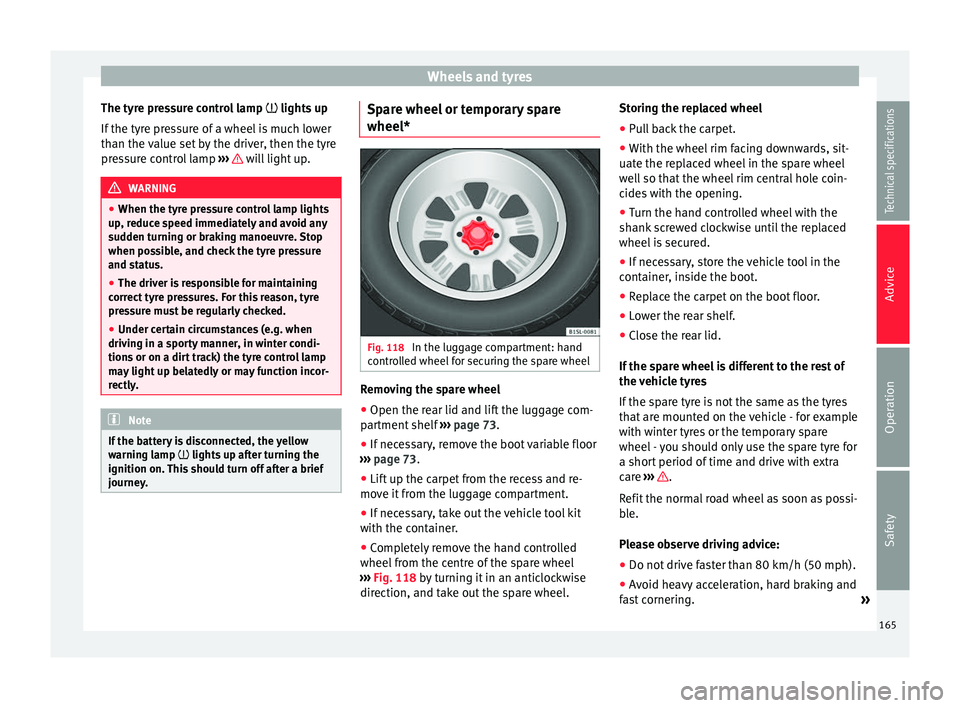
Fig. 118
In the luggage compartment: hand
controlled wheel for securing the spare wheel Removing the spare wheel
● Open the rear lid and lift the luggage com-
partment shelf ››› page 73 .
● If nec
essary, remove the boot variable floor
››› page 73.
● Lift
up the carpet from the recess and re-
move it from the luggage compartment.
● If necessary, take out the vehicle tool kit
with the container.
● Completely remove the hand controlled
wheel from the centre of the spare wheel
››› Fig. 118 by turning it in an anticlockwise
direction, and t
ake out the spare wheel. Storing the replaced wheel
● Pull back the carpet.
● With the wheel rim facing downwards, sit-
uate the replaced wheel in the spare wheel
well so that the wheel rim central hole coin-
cides with the opening.
● Turn the hand controlled wheel with the
shank screwed clockwise until the replaced
wheel is secured.
● If necessary, store the vehicle tool in the
container, inside the boot.
● Replace the carpet on the boot floor.
● Lower the rear shelf.
● Close the rear lid.
If the spare wheel is different to the rest of
the vehicle tyres
If the spare tyre is not the same as the tyres
that are mounted on the vehicle - for example
with winter tyres or the temporary spare
wheel - you should only use the spare tyre for
a short period of time and drive with extra
care ››› .
Refit the normal road wheel as soon as possi-
ble.
Please observe driving advice:
● Do not drive faster than 80 km/h (50 mph).
● Avoid heavy acceleration, hard braking and
fast cornering. »
165
Technical specifications
Advice
Operation
Safety
Page 168 of 219

Advice
● Snow chains on the temporary spare wheel
are not permitted ››› page 169 .
● Af t
er mounting the spare wheel or the tem-
porary spare wheel, check the tyre pressure
as soon as possible ››› page 162.
It is advisable to check the spare wheel or
temporary spare wheel tyre pressure when
checking the rest of the vehicle wheels at
least once a month. The spare wheel should
have the highest pressure allowed for the ve-
hicle ››› page 162. The sticker situated on the
temporary spare wheel shows the tyre pres-
sure. WARNING
Incorrect handling of the spare wheel or the
temporary spare wheel can cause loss of ve- hicle control, producing collisions or other
serious accidents and injury.
●
Never use the spare wheel or the temporary
spare wheel if it is damaged or worn to the
wear indicator.
● In some vehicles the spare wheel is smaller
than the original tyres. This can be seen on a
sticker showing the text “80 km/h” and
“50 mph”. This text indicates the maximum
velocity permitted for this type of tyre.
● Never drive faster than 80 km/h (50 mph).
Avoid powerful acceleration, hard braking
and taking corners at high speed.
● Never drive more than 200 km with a tem-
porary spare wheel fitted to the drive axle.
● Replace the temporary spare wheel for a
normal wheel as soon as possible. The com-
pact temporary spare wheel is only intended
for temporary use over short distances. ●
The temporary spare wheel must always be
secured with the factory supplied wheel
bolts.
● You should never use more than one tem-
porary spare wheel.
● After mounting the temporary spare wheel,
check the tyre pressure as soon as possible
››› page 162.
● Sno w c
hains on the temporary spare wheel
are not permitted. Note
Wherever possible, secure the spare wheel,
temporary spare wheel or the replaced wheel
safely in the luggage compartment. In vehi-
cles with anti-puncture kit, it is not possible
to secure the defective wheel. 166
Page 173 of 219

Emergencies
Fire extinguisher
A fire extinguisher can be stored in a holder
in the passenger seat footwell.
The fire extinguisher must conform to legal
requirements, be ready for use and be
checked regularly. Check the certification
seal on the extinguisher. WARNING
Loose objects in the vehicle interior can be vi-
olently thrown in case of a sudden manoeu-
vre or braking and especially in accidents
causing serious injury.
● Secure or store fire extinguishers, first aid
kit, reflective vests and warning triangle se-
curely in the vehicle. Protecting yourself and securing the
vehicle
Fig. 121
Dash panel: Button for switching the
hazard lights warning system on and off. Always fulfil legal requirements for securing a
broken down vehicle. In a number of coun-
tries it is now obligatory, for example, to turn
on the hazard warning lights and use a re-
flective safety vest
››› page 170.
For your own safety and that of other passen-
gers, the following points should be ob-
served in the order given:
Park the vehicle a safe distance from
traffic and on suitable ground ››› .
Turn on the hazard warning lights with
the button
››› Fig. 121.
Apply the handbrake firmly ››› page 89.
Put the gearbox lever in neutral or the
selector lever in position N ››› page 93.
1.
2.
3.
4. Switch off the engine and remove the
key from the ignition.
Have all occupants leave the vehicle and
move to safety, for example behind a
guard rail.
When leaving the vehicle, take all keys
with you.
Place an emergency warning triangle to
indicate the position of your vehicle to
other road users.
Allow the engine to cool and check if a
specialist is required.
When being towed with the hazard warning
lights on, a change in direction or traffic lane
can be indicated as usual using the turn sig-
nal lever. The hazard lights will be interrup-
ted temporarily.
Examples of when to use the hazard warning
lights:
● If the vehicles ahead suddenly slow down
or reach the end of a traffic jam, to warn the
vehicles behind.
● In case of an emergency.
● If the vehicle breaks down.
● When tow-starting or towing.
Always comply with the applicable laws re-
garding the use of hazard warning lights.
If the hazard warning lights are not working,
you must use an alternative method of »
5.
6.
7.
8.
9.
171Technical specifications
Advice
Operation
Safety
Page 174 of 219
Advice
drawing attention to your vehicle. This meth-
od must comply with traffic legislation. WARNING
A faulty vehicle in traffic represents a risk of
accident for the driver and for other road
users.
● Stop the vehicle safely as soon as possible.
Park the vehicle a safe distance from sur-
rounding traffic to lock all the doors in case of
an emergency. Turn on the hazard warning
lights to warn other road users.
● Never leave children or disabled people
alone in the vehicle if the doors are to be
locked. In case of an emergency, passengers
will be trapped inside the vehicle. Individuals
locked in the vehicle can be exposed to very
high or very low temperatures. WARNING
The components of the exhaust system reach
very high temperatures. This could cause a
fire and considerable damage.
● Always park your vehicle so that no part of
the exhaust system can come in contact with
flammable materials (such as dried grass or
fuel). Note
● The vehicle battery will discharge and run
down if the hazard warning lights remain on
for too long (even with the ignition turned
off). ●
For some vehicles, the brake lights will
blink when braking suddenly at speeds of ap-
proximately 80 km/h (50 mph) to alert vehi-
cles to the rear. If braking continues, the haz-
ard warning lights system will automatically
be turned on at a speed of less than approxi-
mately 10 km/h (6 mph). The brake lights re-
main lit. Upon accelerating, the hazard warn-
ing lights will be automatically turned off. Vehicle tool kit*
Introduction When securing the vehicle in case of a break-
down, please note the legal requirements for
each country.
Vehicle tool kit
For vehicles with a factory-fitted spare wheel
or temporary spare wheel, in addition to win-
ter wheels, the luggage compartment may
contain additional vehicle tools
››› page 172. WARNING
When the vehicle tool kit, tire mobility set
and spare wheel are loose in the interior they
can be violently thrown in case of a sudden
manoeuvre or braking and especially in acci-
dents, causing serious injury.
● Ensure that the vehicle tool kit, the tire mo-
bility set and the spare wheel or temporary spare wheel are safely secured in the luggage
compartment.
WARNING
Unsuitable or damaged vehicle tools can
cause injury or accidents.
● Never work with inappropriate or damaged
tools. Location
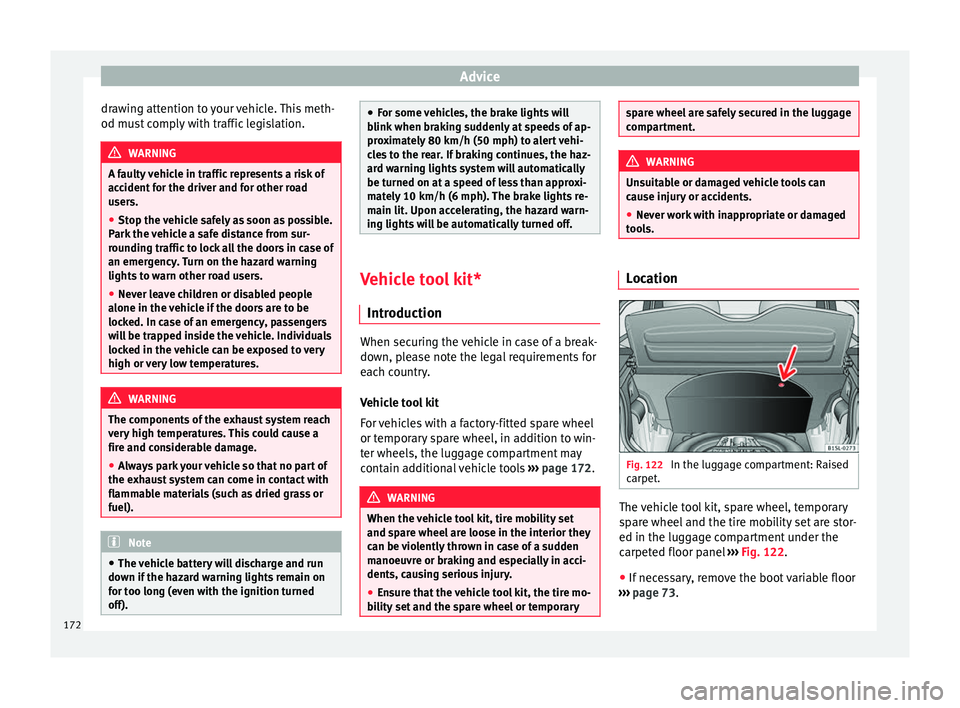
Fig. 122
In the luggage compartment: Raised
carpet. The vehicle tool kit, spare wheel, temporary
spare wheel and the tire mobility set are stor-
ed in the luggage compartment under the
carpeted floor panel
›››
Fig. 122 .
● If nec
essary, remove the boot variable floor
››› page 73.
172
Page 175 of 219
Emergencies
● Raise the carpet at the recess (arrow)
››› Fig. 122 . Note
After use, return the jack to its initial position
using the handle in order to securely store it
in the vehicle. Accessing the vehicle tool kit and tyre
mobility system in vehicles fitted with
the SEAT SOUND 7 speaker system
(with subwoofer)*
●
Open the boot hatch and lift the shelf.
● If necessary, remove the boot variable floor
››› page 76 .
● Lif t
up the carpet from the recess and re-
move it from the luggage compartment.
● Disconnect the subwoofer’s speaker cable.
● Completely remove the hand-controlled
wheel from the centre of the subwoofer
speaker by turning it anti-clockwise.
● Take out the subwoofer, which is on top of
the tools and tyre mobility system.
● When finished, place the tools and system
back in the same way and place as before to
ensure the speaker sits properly in its hous-
ing. ●
Place the subwoofer in the direction of the
arrow and with the word “FRONT” facing for-
ward.
● Reconnect the speaker cable and firmly ro-
tate the securing wheel clockwise so that the
subwoofer is firmly in place.
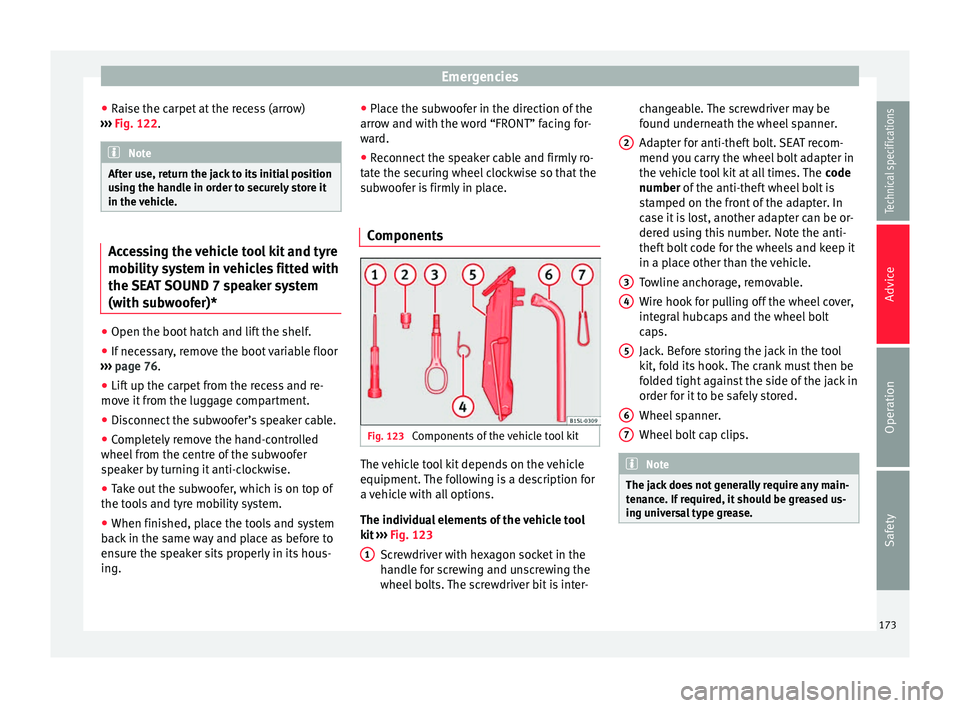
Components Fig. 123
Components of the vehicle tool kit The vehicle tool kit depends on the vehicle
equipment. The following is a description for
a vehicle with all options.
The individual elements of the vehicle tool
kit
›
›› Fig. 123
Sc
rewdriver with hexagon socket in the
handle for screwing and unscrewing the
wheel bolts. The screwdriver bit is inter-
1 changeable. The screwdriver may be
found underneath the wheel spanner.
Adapter for anti-theft bolt. SEAT recom-
mend you carry the wheel bolt adapter in
the vehicle tool kit at all times. The
code
number of the anti-theft wheel bolt is
s t
amped on the front of the adapter. In
case it is lost, another adapter can be or-
dered using this number. Note the anti-
theft bolt code for the wheels and keep it
in a place other than the vehicle.
Towline anchorage, removable.
Wire hook for pulling off the wheel cover,
integral hubcaps and the wheel bolt
caps.
Jack. Before storing the jack in the tool
kit, fold its hook. The crank must then be
folded tight against the side of the jack in
order for it to be safely stored.
Wheel spanner.
Wheel bolt cap clips. Note
The jack does not generally require any main-
tenance. If required, it should be greased us-
ing universal type grease. 2
3
4
5
6
7
173
Technical specifications
Advice
Operation
Safety
Page 178 of 219
Advice
If the wheel bolt is very tight, you may be
able to loosen it by pushing down on the end
of the wheel brace carefully with your foot.
Hold on to the vehicle for support and take
care not to slip.
Loosening wheel bolts
● Fit the wheel brace as far as it will go over
the wheel bolt ››› Fig. 127 .
● Ho l
d the wheel brace at the end and rotate
the bolt approximately one turn anticlockwise
››
› .
Loosening anti-theft wheel bolts
For wheels with full hubcap, the anti-theft
wheel lock must be threaded into position
››› Fig. 128 2 before mounting the hubcap.
Otherwise it will not be possible to mount the
entire hubcap.
● Take the adapter for anti-theft wheel bolts
out of the vehicle tool kit.
● Insert the adapter onto the wheel bolt
››› Fig. 128 . Push it on as far as it will go.
● Fit the wheel
brace onto the adapter as far
as possible.
● Hold the wheel brace at the end and rotate
the bolt approximately one turn anticlockwise
››
› . Important information about wheel bolts
The wheel rims and bolts have been de-
signed to be fitted to factory options. If differ-
ent rims are fitted, the correct wheel bolts
with the right length and correctly shaped
bolt heads must be used. This ensures that
wheels are fitted securely and that the brake
system functions correctly.
In some circumstances, wheel bolts from the
same model vehicle should not be used.
Wheel bolt tightening torque
The prescribed tightening torque for wheel
bolts for steel and alloy wheels is
110 Nm
.
Hav e the tight
ening torque of the wheel bolts
checked as soon as possible with a reliable
torque wrench.
If wheel bolts are rusty and it is difficult to
tighten them, the threads should be replaced
and cleaned before checking the tightening
tor
que.
Never grease or lubricate wheel bolts or the
wheel hub threads. Although they have been
tightened to the prescribed torque, they
could come loose while driving. WARNING
If the wheel bolts are not fitted correctly they
could be released while driving leading to
loss of vehicle control and serious damage. ●
Only use wheel bolts which correspond to
the wheel rims in question.
● Never use different wheel bolts.
● The bolts and threads should be clean, free
of oil and grease and easy to thread.
● To loosen and tighten the wheel bolts, al-
ways use the wheel brace supplied with the
vehicle.
● Loosen the wheel bolts only about one turn
before raising the vehicle with the jack.
● Never grease or lubricate wheel bolts or the
wheel hub threads. Although they have been
tightened to the prescribed torque, they
could come loose while driving.
● Never loosen the bolted joints of wheel
rims with bolted ring trims.
● If the wheel bolts are not tightened to the
correct torque, they may come loose while
driving, and the bolts and rims may come
out. If the tightening torque is too high, the
wheel bolts and threads can be damaged. 176