ESP Seat Mii 2014 Workshop Manual
[x] Cancel search | Manufacturer: SEAT, Model Year: 2014, Model line: Mii, Model: Seat Mii 2014Pages: 219, PDF Size: 4.19 MB
Page 137 of 219

Care and maintenance
Labels and plates Fig. 100
Warnings relating to handling the
City Safety Assist system radar sensor func-
tion Some parts in the engine compartment come
from the factory with certificates of safety, la-
bels or plates containing important informa-
tion regarding the operation of the vehicle,
for example, on the petrol cap, on the pas-
senger's sun visor, on the driver door strut, or
on the floor of the boot.
● Never remove these certificates of safety,
labels or plates, and ensure they are kept in
good condition and are legible.
● If a vehicle part, bearing a certificate of
safety, label or plate, is replaced, the special-
ised workshop should attach the information
back in the same place. Certificate of safety
A certificate of safety on the door strut states
that all the safety standards and regulations
established by the national traffic authorities
responsible for road safety were met at the
time of manufacture. It may also give the
month and year of manufacture, together
with the chassis number.
Warning of high voltage label
There is a label close to the bonnet lock
which warns of high voltage in the vehicle's
electrical system.
Warning relating to the City Safety Assist
system laser sensor
There are some warning and information
signs on the City Safety Assist system laser
sensor
››› Fig. 100 .
U s
ing your vehicle in other countries
and continents The vehicle is manufactured at the factory for
use in a particular country in accordance with
the national legislation in force at the time of
manufacture.
If the vehicle is sold in another country or
used in another country for an extended peri-
od of time, the applicable legislation of that
country should be observed.It may be necessary to fit or remove certain
pieces of equipment or to deactivate certain
functions. Service work may also be affected.
This is particularly true if the vehicle is used
in a different climate for an extended period
of time.
As there are different types of frequency
bands around the world, you may find that
the radio system or the Portable Navigation
System (supplied by SEAT) supplied at the
factory does not work in another country.
CAUTION
● SEAT does not accept liability for any dam-
age to the vehicle due to the use of a lower
quality fuel, an inadequate service or the
non-availability of genuine spare parts.
● SEAT does not accept liability if the vehicle
does not comply in part or in full with the le-
gal requirements of other countries or conti-
nents. Radio reception and the aerial
For factory-fitted radio equipment, the aerial
for radio reception is fitted to the roof of the
vehicle.
Note
If electrical equipment such as mobile tele-
phones, is used near a roof aerial, you may » 135
Technical specifications
Advice
Operation
Safety
Page 138 of 219

Advice
observe interference in the reception of AM
stations.
Notes on SEAT repairs
Following payment, information about au-
thorised SEAT services and authorised SEAT
repairs in the following locations can be re-
quested:
Clients in Europe, Asia, Australia, Africa,
Central America and South America
Contact a technical service or specialised
workshop, or request the corresponding doc-
umentation at www.erwin.volkswagen.de.
WARNING
Repairs or modifications which are not per-
formed correctly may result in damage or er-
rors in the vehicle operation, affecting the ef-
fectiveness of the driver assist and airbag
systems. This could result in serious acci-
dent.
● Have any repairs or modifications carried
out at a specialised workshop. Conformity certification
The respective manufacturer hereby declares
that the products indicated below comply
with basic requirements and the following provisions and important legislation on the
date of manufacture of the vehicle, among
others FCC Part 15.19, FCC Part 15.21 and
RSS-Gen Issue 1:
Radio frequency equipment
● Electronic gearbox lock.
● Vehicle key
Electrical equipment
● 12 volt power socket
Collection and scrapping of end-of-life
vehicles Collection of end-of-life vehicles
SEAT is already prepared for the moment
when you wish to scrap your vehicle and of-
fers you an environmentally-friendly solution.
An extensive network of used car reception
centres already exists in much of Europe. Af-
ter the vehicle has been delivered, you will
receive a certificate of destruction describing
the environmentally friendly scrapping of the
vehicle in accordance with applicable legisla-
tion.
We will collect the used vehicle free of
charge, provided it complies with all national
legislation.Please see your technical service for further
information about the collection and scrap-
ping of end-of-life vehicles.
Scrapping
The relevant safety requirements must be ob-
served when the vehicle or components of
the airbag or belt tensioner systems are
scrapped. These requirements are known to
specialised workshops.
136
Page 143 of 219

Checking and refilling levelsFlashes for about 10
secondsState of the barsPossible cause ››› Solution
and the segments
remaining a)Reserve zone (four small segments)The fuel tank is almost empty.
The reserve tank is being used
››› page 203.Refuel as soon as possible ››› .
–The vehicle is running in natural gas operating mode.–
a)
This only applies to vehicles with the fuel gauge on the dash panel display.
Several warning and control lamps light up
for a few seconds when the ignition is switch-
ed on, signalling that the function is being
verified. They will switch off after a few sec-
onds.
In natural gas engines
The warning lamp lights up when both fuel
type
s (petrol and natural gas) have reached
reserve level.
The warning lamp lights up when the vehi-
cl
e is running in natural gas operating mode.
The warning lamp switches off when the
natural gas is exhausted. The engine
changes to operate with petrol.
Problem:
if the vehicle is left parked for a
long time just after refuelling, the gas level
indicator does not accurately indicate the
same level shown after refuelling when the
vehicle is started up again. This is not due to
a leak in the system, but to a drop in pres-
sure in the gas tank for technical reasons af- ter a cooling phase immediately after refuel-
ling. WARNING
Driving with insufficient fuel reserve could re-
sult in the vehicle breaking down in traffic
and a serious accident.
● If the fuel level is too low then the fuel sup-
ply to the engine can become irregular espe-
cially on slopes.
● If the engine “is choked” or stalls due to
lack of or irregularity of the fuel supply, the
power steering as well as all of the driver as-
sistance systems including braking assis-
tance will stop working.
● Always refuel when there is only one quar-
ter of the fuel tank left to avoid running out of
fuel. CAUTION
● Always pay attention to any lit control
lamps and to the corresponding descriptions and instructions to avoid damage to the vehi-
cle.
● Never run the fuel tank completely dry. An
irregular fuel supply may lead to ignition
faults and unburnt fuel could enter the ex-
haust system. This could damage the catalyt-
ic converter. Note
The arrow next to the fuel pump symbol on
the instrument panel ››› Fig. 101 indicates the
s ide of
the vehicle on which the tank flap is
located. 141
Technical specifications
Advice
Operation
Safety
Page 145 of 219

Checking and refilling levels
The vehicle is only prepared for refuelling
with Compressed Natural Gas (CNG) ››› . Re-
fuelling with another type of natural gas is
not allowed, e.g. Liquefied Nature Gas (LNG)
or hydromethane.
Opening the fuel tank cap
The natural gas filler mouth is behind the fuel
tank cap, next to the petrol filler mouth.
● Unlock the vehicle with the key or with the
central locking button situated on the driv-
er door ›
›
› page 48.
● Press on the rear area of the flap and open
it.
Refuelling
Problem:
If the ambient temperature is very
high, the natural gas pump protection
against overheating disconnects this auto-
matically.
● Remove the plug from the gas filler mouth
››› Fig. 104
1 .
● Connect the pump filling nozzle to the gas
filler mouth.
● The fuel tank will be full when the pump
c ompr
essor automatically cuts the supply.
● If you wish to finish refuelling in advance,
press the button on the pump to stop the
flow. Closing the fuel tank cap
●
Check that the gas filler mouth retainer 2 is not trapped with the filler nozzle. If neces-
sary, place it in the filler mouth again.
●
Insert the plug in the filler mouth.
● Close the tank flap. Make sure you hear it
click into place. WARNING
Natural gas is a highly explosive, easily flam-
mable substance. Incorrect handling of the
natural gas can cause accidents serious
burns and other injuries.
● Before refuelling with natural gas, the fill-
ing mouth must be correctly engaged. If you
can smell gas, stop refuelling immediately. WARNING
The vehicle is not prepared to use liquefied
natural gas (LNG) and this fuel must not be
added under any circumstances. Liquefied
natural gas can cause the natural gas tank to
explode, resulting in serious injury. Note
● The filling nozzles of natural gas pumps
can differ in the way they are operated. If you
are unacquainted with the pump, it is advisa-
ble that a member of staff of the service sta-
tion performs the refuelling operation. ●
Noises heard when refuelling are normal
and do not indicate the presence of a fault in
the system.
● The vehicle natural gas system is prepared
both for refuelling with a small compressor
(slow refuel) and a large compressor (fast re-
fuel) in natural gas service stations. Bonnet
Working in the engine compartment Before working in the engine compartment,
make sure that the vehicle is parked on hori-
zontal and firm ground.
The engine compartment of the vehicle is a
hazardous area. Never work on the engine or
in the engine compartment if you are not fa-
miliar with the operations to be carried out,
the applicable safety standards and especial-
ly if you do not have the necessary instru-
ments, liquids and tools
››› ! If required,
have any work carried out by a specialised
workshop. Negligent work can cause serious
injury. WARNING
If the vehicle moves unexpectedly, this could
cause serious injury. » 143
Technical specifications
Advice
Operation
Safety
Page 148 of 219

Advice
Fig. 106
C: Bonnet securing rod in the bon-
net. D: Bonnet supported by the bonnet se-
curing rod Opening the bonnet
● Before opening the bonnet, make sure that
the windscreen wiper arms are in place
against the windscreen ››› .
● Pull the release lever 1 in the direction of
the arrow ›››
Fig. 105
A. The bonnet is re- leased from the lock carrier by a spring mech-
anism
››› .
● Lift the bonnet up slightly while pressing
the release lever 2
B
in the direction of the
arr
ow to completely open the bonnet.
● Take out the bonnet support rod from its
clip in the direction of the arrow 3
C
and
p
lace it in the corresponding open position
4
D
(arrow).
C
losing the bonnet
● Slightly lift the bonnet ››› .
● Take out the bonnet support rod from the
opening catch 4
D
and insert it into its clip
3
C
in the opening catch.
● L
et the bonnet fall from a height of 30 cm
into its clip; Do not
apply pressure!
If the bonnet is not correctly closed, open it
once again and close it correctly.
The bonnet is correctly closed when it is flush
with the corresponding parts on the body-
work. WARNING
If the bonnet is not correctly closed, it could
suddenly open while driving leaving the driv-
er without visibility. This could result in a se-
rious accident.
● After closing the bonnet, always check that
it is properly secured by the locking mecha-
nism in the lock carrier piece. The bonnet must be flush with the surrounding body pan-
els.
●
While driving, if you notice that the bonnet
is not correctly closed then stop immediately
and close it correctly.
● Only open and close the bonnet when there
is nobody within its range. CAUTION
● To avoid damage to the bonnet and to the
windscreen wiper arms, only open it when
the windscreen wipers are in place against
the windscreen.
● Before driving, always lower the wiper
arms. Engine oil
Introduction WARNING
Incorrectly handling engine oil can cause in-
jury and serious burns.
● Always protect your eyes when handling
engine oil.
● Oil is toxic and must be kept out of the
reach of children.
● Engine oil should only be kept in its origi-
nal packaging; the same goes for used oil un-
til it is disposed of. 146
Page 149 of 219

Checking and refilling levels
●
Never store engine oil in empty food con-
tainers or bottles as other people may acci-
dentally drink it.
● Regular contact with engine oil can be bad
for the skin. If you come into contact with en-
gine oil, wash your skin with soap and water.
● With the engine running, the engine oil
gets extremely hot and can cause severe skin
burns. Always wait until the engine has fully
cooled. For the sake of the environment
Similar to the other service liquids, spilled
engine oil can be bad for the environment.
Collect these liquids in suitable containers
and dispose of them while respecting the en-
vironment. Warning and control lampsFlashesPossible
causeSolution
Engine oil
pressure too
low.
Stop the vehicle!
Switch off the engine. Check
the engine oil level, and if
necessary, refill with
››› page 148.
engine oil - If the warning in-
dicator flashes although the
oil level is correct, do not
continue driving or leave the
engine running. Otherwise,
the engine could be dam-
aged. Seek specialist assis-
tance. WARNING
Observe the safety warnings ››› in Control
and warning lamps on page 40. Engine oil specifications
Replacement engine oil must strictly comply
with the specifications.
The correct oil must be used to ensure the
correct operation and long service life of the
engine. The engine comes with a high-quality
multigrade oil that can generally be used all
year round.Only use an engine oil that complies to SEAT
standards whenever possible
››› . Only refill
engine oil using approved engine oil in ac-
cordance with the corresponding VW stand-
ard ( ››› table on page 147 ). All oils indicated
ar e synthetic multigrade oils .
Engine oils are being continuously further
developed. Technical services are constantly
updated with any modifications. SEAT there-
fore recommends that you have the engine
oil changed by a technical service.
Engines
Specifications of en- gine oil with a serv- ice dependent on
time/distance travel- led
44 kW - 55 kW Petrol en-ginesVW 504 00, VW 502 00
Natural gas engineVW 502 00 CAUTION
● Only use engine oils whose specifications
are expressly approved by SEAT. The use of
any other type of oil could cause engine dam-
age!
● No additives should be used with engine
oil. Any damage caused by the use of such
additives would not be covered by the factory
warranty. 147
Technical specifications
Advice
Operation
Safety
Page 150 of 219
Advice
Checking the engine oil level and
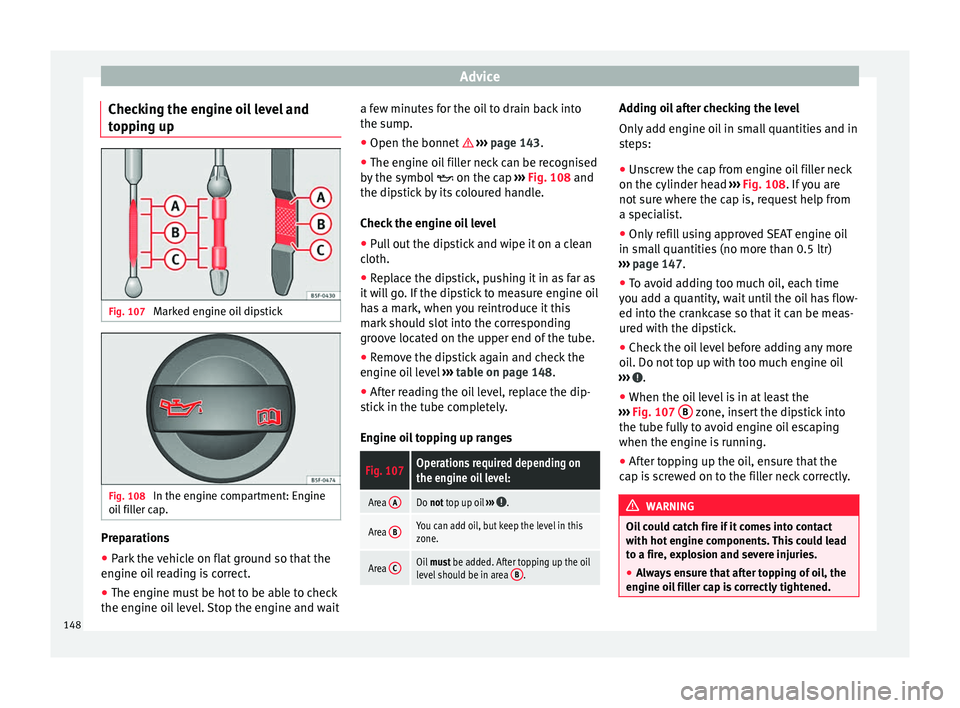
topping up Fig. 107
Marked engine oil dipstick Fig. 108
In the engine compartment: Engine
oil filler cap. Preparations
● Park the vehicle on flat ground so that the
engine oil reading is correct.
● The engine must be hot to be able to check
the engine oil level. Stop the engine and wait a few minutes for the oil to drain back into
the sump.
●
Open the bonnet ››› page 143.
● The engine oil filler neck can be recognised
by the symbol on the cap
›
›› Fig. 108 and
the dipstick by its coloured handle.
Check the engine oil level
● Pull out the dipstick and wipe it on a clean
cloth.
● Replace the dipstick, pushing it in as far as
it will go. If the dipstick to measure engine oil
has a mark, when you reintroduce it this
mark should slot into the corresponding
groove located on the upper end of the tube.
● Remove the dipstick again and check the
engine oil level ››› table on page 148.
● After reading the oil level, replace the dip-
stick in the tube completely.
Engine oil topping up ranges
Fig. 107Operations required depending on
the engine oil level:
Area ADo not top up oil
››› .
Area BYou can add oil, but keep the level in this
zone.
Area COil
must be added. After topping up the oil
level should be in area B. Adding oil after checking the level
Only add engine oil in small quantities and in
steps:
●
Unscrew the cap from engine oil filler neck
on the cylinder head ››› Fig. 108 . If you are
not s
ure where the cap is, request help from
a specialist.
● Only refill using approved SEAT engine oil
in small quantities (no more than 0.5 ltr)
››› page 147.
● To av
oid adding too much oil, each time
you add a quantity, wait until the oil has flow-
ed into the crankcase so that it can be meas-
ured with the dipstick.
● Check the oil level before adding any more
oil. Do not top up with too much engine oil
››› .
● When the oil level is in at least the
››› Fig. 107 B zone, insert the dipstick into
the tube fully to avoid engine oil escaping
when the engine is running.
● After topping up the oil, ensure that the
cap is screwed on to the filler neck correctly. WARNING
Oil could catch fire if it comes into contact
with hot engine components. This could lead
to a fire, explosion and severe injuries.
● Always ensure that after topping of oil, the
engine oil filler cap is correctly tightened. 148
Page 151 of 219

Checking and refilling levels
This will avoid engine oil spilling onto hot
engine parts when the engine is running.
CAUTION
● If the engine oil level is above the area Ado not start the engine. Seek specialist assis-
tance. Otherwise catalytic converter and en-
gine damage may occur.
● When refilling or changing service liquids,
ensure that you put the liquids into the right
tank. Making a mistake when refilling could
cause serious malfunctions and damage the
engine! For the sake of the environment
The oil level must never be above area A .
Otherwise oil can be drawn in through the
crankcase breather and escape into the at-
mosphere via the exhaust system. Engine oil consumption
The consumption of engine oil can be differ-
ent from one engine to another and can vary
during the useful life of the engine.
Depending on how you drive and the condi-
tions in which the vehicle is used, oil con-
sumption can be up to 1 ltr./2000 km. In the
case of new vehicles, the consumption can
exceed this figure over 5,000 kilometres. For
this reason the engine oil level must be checked at regular intervals, preferably when
filling the tank and before a journey.
When the engine is working hard, for in-
stance during sustained high-speed motor-
way cruising in summer or when climbing
mountain passes, the oil level should pref-
erably be kept within area
››› Fig. 107 A .
Changing the engine oil The engine oil must be changed regularly ac-
cording to the specifications of the Mainte-
nance Programme.
Due to the problems linked with disposing of
used oil and the need for suitable tools and
special knowledge, always visit a specialised
workshop to have the engine oil and filter
changed. SEAT recommends taking your car
in for technical service.
Detailed information on the service intervals
is shown in the Maintenance Programme.
Engine oil additives make new oil darker after
the engine has been running for a short peri-
od. This is normal and does not mean more
frequent oil changes are required.
WARNING
If, in exceptional circumstances, you must
change the engine oil yourself, please note
the following: ●
Wear eye protection.
● Always wait until the engine has complete-
ly cooled to avoid being burned.
● Always keep your arms horizontal when un-
screwing the oil drainage bolt so that it does
not run down your arms.
● Use a suitable container large enough to
collect all of the used oil in the engine.
● Never collect engine oil in empty food con-
tainers, cans, bottles or other containers as
not all people are able to identify engine oil.
● Oil is toxic and must be kept out of the
reach of children. For the sake of the environment
Before changing the engine oil, find a suita-
ble location or service for proper disposal. For the sake of the environment
Always dispose of engine oil with the utmost
respect for the environment. Never dispose of
used engine oil in places such as a garden,
woods, drains, roads, paths, rivers and drain-
age systems. 149Technical specifications
Advice
Operation
Safety
Page 152 of 219
Advice
Engine coolant Introduction WARNING
Engine coolant is toxic!
● Only keep engine coolant in its original
container, tightly shut and in a safe place.
● Never store engine coolant in empty food
containers or bottles as other people may ac-
cidentally drink it.
● Always keep engine coolant out of reach of
children.
● Ensure that the proportion of engine cool-
ant additive corresponds to the lowest out-
side temperature to which the vehicle will be
exposed.
● If the outside temperature is extremely low,
the engine coolant could freeze causing the
vehicle to stop. As this would also cause the
heating to stop working, vehicle occupants
without warm clothing could freeze. For the sake of the environment
Coolants and additives can contaminate the
environment. Collect any spilt fluids in suita-
ble containers and dispose of them in accord-
ance with legislation and with the utmost re-
spect for the environment. Coolant warning lamp
Several warning and control lamps light up
for a few seconds when the ignition is switch-
ed on, signalling that the function is being
verified. They will switch off after a few sec-
onds.It lights
upPossible
causeSolution
Excessive en-
gine coolant
temperature. Stop the vehicle!
Stop the vehicle safely as
soon as possible. Switch
off the engine and let it
cool.
Insufficient en-
gine coolant
level.
¡Stop the vehicle!
Check the engine coolant
when the engine has
cooled and, if it is low, re-
fill with engine coolant
››› page 151.
Engine coolant
system faulty. Do not drive any fur-
ther.
Obtain professional as-
sistance.
FlashesPossible
causeSolution
Engine coolant
system faulty.Seek specialist assis-
tance. WARNING
Observe the safety warnings ››› in Control
and warning lamps on page 40. Note
On the display of the Portable Navigation
System (supplied by SEAT) ››› page 123 an en-
gine coolant temperature gauge can be seen. Engine coolant specifications
The engine cooling system is supplied from
the factory with a specially treated mixture of
water and, at least, 40 % of the additive
G 13
(TLVW 774 J). The engine coolant additive is
recognisable by its purple colour. This mix-
ture of water and additive gives the necessa-
ry frost protection down to -25°C (-13 F) and
protects the light alloy parts of the cooling
system against corrosion. It also prevents
scaling and considerably raises the boiling
point of the coolant.
To protect the engine cooling system, the
percentage of additive must always be at
l e
ast 40 %, even in warm climates where an-
ti-freeze protection is not required.
If greater frost protection is required in very
cold climates, the proportion of additive can
be increased. However, the percentage of ad-
ditive should not exceed 60%, as this would
150
Page 153 of 219
Checking and refilling levels
reduce the frost protection and, in turn, de-
crease the cooling capacity.
When the coolant is topped up, use a mixture
of distilled water and, at least, 40 % of the G
13 or G 12 p lu
s-plus (TL-VW 774 G) additive
(both are purple) to obtain an optimum anti-
corrosion protection ››› . The mixture of G
13 with G 12 plus (TL-VW 774 F), G 12 (red) or
G 11 (green-blue) engine coolants will signifi-
cantly reduce the anticorrosion protection
and should, therefore be avoided ››› .
WARNING
If there is not enough anti-freeze in the cool-
ant system, the engine may fail leading to se-
rious damage.
● Please make sure that the percentage of
additive is correct with respect to the lowest
expected ambient temperature in the zone in
which the vehicle is to be used.
● When the outside temperature is very low,
the coolant could freeze and the vehicle
would be immobilised. In this case, the heat-
ing would not work either and inadequately
dressed passengers could die of cold. CAUTION
The original additives should never be mixed
with coolants which are not approved by
SEAT. Otherwise, you run the risk of causing
severe damage to the engine and the engine
cooling system. ●
If the fluid in the expansion tank is not pur-
ple but is, for example, brown, this indicates
that the G 13 additive has been mixed with
an inadequate coolant. The coolant must be
changed as soon as possible if this is the
case! This could result in serious faults and
engine damage. For the sake of the environment
Coolants and additives can contaminate the
environment. If any fluids are spilled, they
should be collected and correctly disposed
of, with respect to the environment. Checking the engine coolant level and
refilling
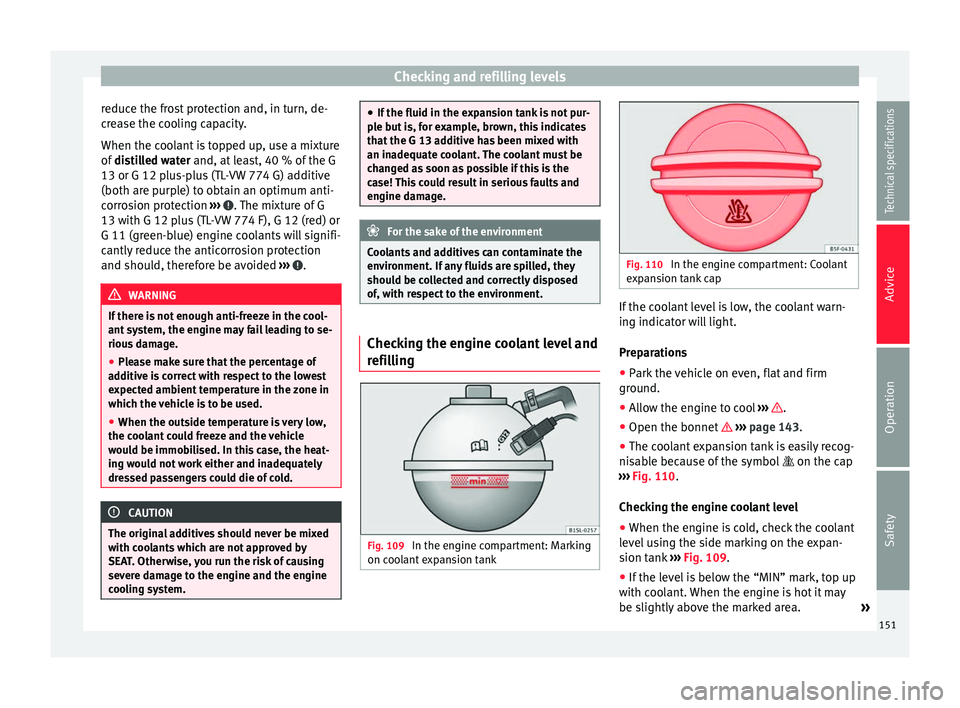
Fig. 109
In the engine compartment: Marking
on coolant expansion tank Fig. 110
In the engine compartment: Coolant
expansion tank cap If the coolant level is low, the coolant warn-
ing indicator will light.
Preparations
● Park the vehicle on even, flat and firm
ground.
● Allow the engine to cool ››› .
● Open the bonnet ››› page 143.
● The coolant expansion tank is easily recog-
nisable because of the symbol on the cap
››› Fig. 110 .
Chec k
ing the engine coolant level
● When the engine is cold, check the coolant
level using the side marking on the expan-
sion tank ››› Fig. 109.
● If the l
evel is below the “MIN” mark, top up
with coolant. When the engine is hot it may
be slightly above the marked area. »
151
Technical specifications
Advice
Operation
Safety