headlights Seat Mii 2014 Owner's manual
[x] Cancel search | Manufacturer: SEAT, Model Year: 2014, Model line: Mii, Model: Seat Mii 2014Pages: 219, PDF Size: 4.19 MB
Page 37 of 219

Cockpit
Operation
Cockpit Overview Legend for the Fig. 23
:
Int
erior door release lever . . . . . . . . .49
Turn switch for adjusting the exteri-
or mirrors . . . . . . . . . . . . . . . . . . . . . . . . 61
– Exterior mirror adjustment
– Heated exterior mirrors
Air outlets . . . . . . . . . . . . . . . . . . . . . . . . 80
Lever for . . . . . . . . . . . . . . . . . . . . . . . . . 55
– Turn signals and main beam
headlights
– Cruise control system (CCS) –
– – /+ – /- . . . . . . .107
Steering wheel with horn and
– Driver airbag . . . . . . . . . . . . . . . . . . . 21
Dash panel . . . . . . . . . . . . . . . . . . . . . . . 36, 39
Windscreen wiper/ windscreen
wash lever . . . . . . . . . . . . . . . . . . . . . . . 60
– Windscreen wipers
– Rear window wiper
1 2
3
4
5
6
7 –
Lever with buttons for controlling
the SEAT information system - ,
/
. . . . . . . . . . . . . . . . . . . . . . . . . 40
C ontr
ols for:
– Start-Stop system button . . .115
– Rear window heating button . .80
– Left seat heating controls . . . . . 64
Switches for: – Heating and ventilation system .80
– Air conditioner . . . . . . . . . . . . . . . . . . 80
SEAT Portable System (supplied by
SEAT) . . . . . . . . . . . . . . . . . . . . . . . . . . . . 123
Radio (factory fitted) ››› Booklet Ra-
dio
Controls for:
– Hazard warning lights switch . 170
– Passenger front airbag off warn-
ing lamp . .17
– Right seat heating controls
or rear window heating button
(alternative position) . . . . . . . . . . .64, 80
Storage compartment with drink
holder in the centre console . . . . . . .71
Handle of the storage compartment
or storage compartment open 1)
. . . 67
8 9
10
11
12
13
14 In the side of the dash panel: Key
switch for switching off the front
passenger airbag
1)
. . . . . . . . . . . . . . . 17
Position of passenger front airbag
on the dash panel . . . . . . . . . . . . . . . . 17
Ashtray* . . . . . . . . . . . . . . . . . . . . . . . . . 71
12 volt socket or cigarette lighter* .72, 72
Lever for:
– Manual gearbox . . . . . . . . . . . . . . . . 94
– Automatic gearbox . . . . . . . . . . . . .95
Handbrake . . . . . . . . . . . . . . . . . . . . . . . 89
Button for:
– City Safety Assist function . 110
Ignition lock . . . . . . . . . . . . . . . . . . . . . . 86
Pedals . . . . . . . . . . . . . . . . . . . . . . . . . . . 93
Storage compartment . . . . . . . . . . . . .67
Steering column adjustment lever .6
Open bonnet lever . . . . . . . . . . . . . . . . 143
Headlamp range adjustment . . . 55
Light switch . . . . . . . . . . . . . . . . . . . 55
Central lock button . . . . . . . . . .45
Button for operating the electric
windows of the driver door . . . . .52
15 16
17
18
19
20
21
22
23
24
25
26
27
28
29
30
1)
According to version
35
Technical specifications
Advice
Operation
Safety
Page 57 of 219
Lights and visibility
sunroof encounters resistance or an obstacle
when closing, it will immediately reopen.
● Check why the sliding/tilting sunroof has
not closed.
● Try to close it again.
● If it is still not possible to close it due to an
obstacle or resistance, it will remain in the
corresponding position. Close it without the
anti-trap function.
Closing the sliding/tilting electric panoramic
sunroof without the anti-trap function
● Within about 5 seconds of activating the
anti-trap function, pull knob ››› Fig. 42 5 un-
til the sliding/tilting sunroof is fully closed.
● As such, the sliding/tilting sunroof will
close without the anti-trap function!
● If the sunroof still cannot be closed, visit a
specialised workshop.
If the knob is released during the closing op-
eration, the sliding/tilting electric panoramic
sunroof opens automatically. WARNING
Closing the sliding/tilting electric panoramic
sunroof without the anti-trap function can re-
sult in serious injury.
● The sliding/tilting sunroof should always
be closed carefully. ●
No person should ever remain in the way of
the sliding/tilting sunroof, especially when
closing without the anti-trap function.
● The anti-trap function does not prevent fin-
gers or other parts of the body from becom-
ing trapped against the roof frame and inju-
ries occurring. Lights and visibility
Lights Introduction The legal requirements regarding the use of
vehicle lights in each country must be ob-
served.
The driver is personally responsible for the
correct use and adjustment of the lights in all
situations.
WARNING
If the headlights are set too high and the
main beam is not used correctly, there is a
risk of dazzling or distracting other road
users. This could result in a serious accident.
● Always make sure that the headlights are
correctly adjusted.
● Never use the main beam or flashed head-
lamps as this could dazzle other drivers. Control lampsIt lights
upPossible causeSolution
Rear fog light switched
on.›››
page 56» 55
Technical specifications
Advice
Operation
Safety
Page 59 of 219
Lights and visibility
Lights and visibility: functions Parking light remains on both sides
If when switching off the ignition, the light
control remains in the position
and the ve-
hic
le is closed from outside, both headlights,
in addition to the side lights and the rear
lights will light up.
Daytime driving light
The daytime driving light consists of individu-
al lights in the front headlamps.
When the daytime driving light is switched
on, only the individual lights come on ››› .
The daytime lights are switched on each time
the ignition is turned on if the light switch is
in position .
Switching the daytime driving light on and
off
To switch the daytime driving light on or off,
it is necessary to fit or remove the corre-
sponding fuse. Ask for professional assis-
tance for this. WARNING
If the road is not well-lit and the vehicle is
not clearly visible to other drivers, an acci-
dent may occur.
● Never use the daytime driving light if the
road is not well-lit as a result of the weather conditions and poor visibility. The daytime
driving lights are not bright enough to illumi-
nate the road ahead and to ensure that other
road users are able to see you.
●
The rear lights do not come on with the
daytime driving light. A vehicle which does
not have the rear lights on may not be visible
to other drivers in the darkness, if it is rain-
ing or in conditions of poor visibility. Note
The headlights, rear lights and turn signals
may mist up temporarily on the inside in cool
or damp weather. This is normal and in no
way effects the useful life of the vehicle light-
ing system. Turn signal and main beam lever
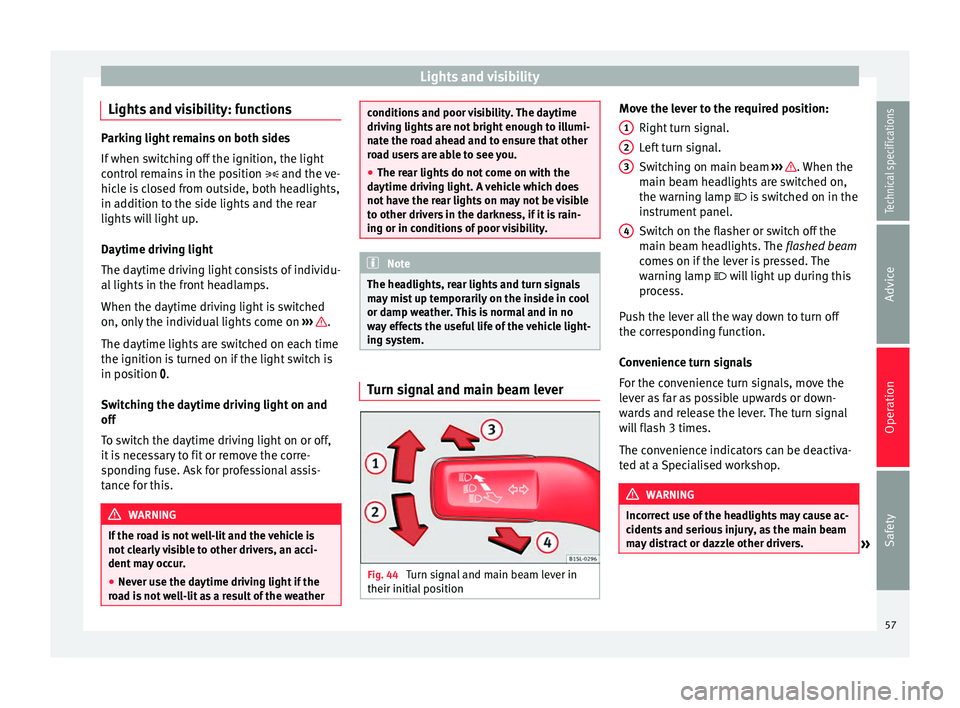
Fig. 44
Turn signal and main beam lever in
their initial position Move the lever to the required position:
Right turn signal.
Left turn signal.
Switching on main beam ››› . When the
main beam headlights are switched on,
the warning lamp is switched on in the
instrument panel.
Switch on the flasher or switch off the
main beam headlights. The flashed beam
comes on if the lever is pressed. The
warning lamp
will light up during this
pr
ocess.
Push the lever all the way down to turn off
the corresponding function.
Convenience turn signals
For the convenience turn signals, move the
lever as far as possible upwards or down-
wards and release the lever. The turn signal
will flash 3 times.
The convenience indicators can be deactiva-
ted at a Specialised workshop. WARNING
Incorrect use of the headlights may cause ac-
cidents and serious injury, as the main beam
may distract or dazzle other drivers. » 1
2
3
4
57
Technical specifications
Advice
Operation
Safety
Page 60 of 219

Operation
Note
● The turn signal only works when the igni-
tion is switched on. The hazard warning
lights also work when the ignition is switch-
ed off ››› page 170.
● If an
y of both turn signals fails, the warning
lamp will start flashing twice faster than nor-
mal.
● The main beam headlights can only be
sw
itched on if the dipped beam headlights
are already on. Adjusting the headlights
In those countries where vehicles drive on
the other side of the road to the home coun-
try, the asymmetric dipped beam may dazzle
drivers of oncoming vehicles.
For this reason, stickers may be needed to
cover the headlights when driving abroad.
For further information, please refer to a spe-
cialised workshop. SEAT recommends visiting
a technical service.
Note
The use of stickers to cover headlights is only
permitted over a short period. To modify the
direction of the headlamps more permanent-
ly, please take the vehicle to a specialised
workshop. SEAT recommends taking your car
in for technical service. Headlight range control, lighting of
instruments and controls
Fig. 45
Next to the steering wheel: Headlight
range control Headlamp height adjustment
The headlight range control
››› Fig. 45 is
modified ac c
ording to the value of the head-
light beam and the vehicle load status. This
offers the driver optimum visibility and the
headlights do not dazzle oncoming drivers
››› .
The headlights can only be adjusted when
the dipped beam is switched on.
To reset, turn switch ››› Fig. 45:
ValueVehicle load status a)
–Two front occupants, luggage compart-
ment empty
To reset, turn switch
››› Fig. 45:
ValueVehicle load status a)
1All seats occupied, luggage compartment
empty
2All seats occupied, luggage compartment
full
3Driver only, luggage compartment full
a)
If the vehicle load does not correspond to those shown in the
table, it is possible to select intermediary positions.
Instrument and switch lighting
When the side lights or dipped beam head-
lights are switched on, the lighting for instru-
ments and controls lights up at a constant
brightness. WARNING
Heavy objects in the vehicle may mean that
the headlights dazzle and distract other driv-
ers. This could result in a serious accident.
● Adjust the light beam to the vehicle load
status so that it does not blind other drivers. Reading light
But-
ton/SwitchFunction
Switching off the reading light.
58
Page 129 of 219

Care and maintenance
SEAT recommends the use of car washes
without brushes.
To remove traces of wax on windows and to
prevent wiper blades from scratching, please
observe the following ››› page 128, Cleaning
windows and exterior mirrors .
Washing the car by hand
When washing the car by hand, use plenty of
water to soften the dirt first, and rinse off as
well as possible.
Then clean the vehicle with a soft sponge,
glove or
brush using only slight pressure.
Start at the roof and work downwards. Spe-
cial car shampoo should only be used for
ver
y persistent dirt.
Rinse the sponge or glove thoroughly and of-
ten.
Wheels, sills and similar should be cleaned
last. Use a second sponge for this. WARNING
Sharp components on the vehicle may cause
injury.
● Protect arms and hands from sharp edges
when cleaning the vehicle undercarriage or
the interior of the wheel hubs. WARNING
After the vehicle has been washed, the brak-
ing effect will be reduced (and the braking
distance increased) due to moisture (and ice
in winter) on the brakes.
● “Dry the brakes and remove ice” by braking
carefully. Ensure that you are not endanger-
ing other road-users or breaking traffic regu-
lations in the process. CAUTION
● The temperature of the water must not ex-
ceed +60 °C (+140 °F).
● To avoid damage to the paintwork, do not
wash the vehicle in full sun.
● Do not use rough sponges or similar which
could damage the surface to clean away the
traces of insects.
● Never wipe the headlights with a dry cloth
or sponge, always moisten first. It is best to
use soapy water.
● Washing the vehicle in low temperatures:
When washing the vehicle with a hose, do
not direct water into the lock cylinders or the
gaps around the doors or roof. Locks and
seals could freeze! CAUTION
To prevent damage to the vehicle, please ob-
serve the following before entering an auto-
matic car wash: ●
Compare the distance between the vehicle
wheels and the distance between the guide-
rails of the car wash to prevent damage to the
wheels and tyres!
● Switch off the rain sensor before taking the
vehicle to an automatic car wash.
● Compare the height and width of your vehi-
cle with the available height and width when
entering and driving through the car wash.
● Fold in exterior mirrors Electrically retracta-
ble exterior mirrors must not be folded in or
out by hand. Always use the electrical power
control.
● To avoid damaging the bonnet paintwork,
rest the windscreen wipers on the windscreen
after drying the wiper blades. Do not let them
fall!
● Lock the rear lid to prevent it from opening
unexpectedly while inside the car wash. Washing the vehicle with high
pressure cleaning apparatus
When cleaning the vehicle with a high-pres-
sure cleaner, always follow the operating in-
structions for the equipment. Pay special at-
tention to the required pressure of the jet
and the
distance
between the jet and the ve-
hic
le ››› .
Keep a suitable distance from soft materials,
such as rubber hoses or insulating material, »
127
Technical specifications
Advice
Operation
Safety
Page 184 of 219

Advice
CAUTION
To avoid considerable damage to the vehicle
electrical system, note the following careful-
ly: ● If the jump leads are incorrectly connected,
this could result in a short circuit.
● The vehicles must not touch each other,
otherwise electricity could flow as soon as
the positive terminals are connected. How to jump start: description
Fig. 133
Diagram of connections for vehicles
without Start-Stop system. Fig. 134
Diagram of connections for vehicles
with Start-Stop system. Jump lead terminal connections
1. Switch off the ignition of both vehicles
››› .
2. Connect one end of the red jump lead to
the po s
itive + terminal of the vehicle
with the flat battery A
››› Fig. 133 .
3. C
onnect the other end of the red
jump
lead to the positive terminal + in the ve-
hicle providing assistance B .
4. For vehicles without Start-Stop system:
connect one end of the black jump lead to
the negative terminal – of the vehicle
providing the current B
››› Fig. 133 .
– For
vehicles with Start-Stop system: con-
nect one end of the black jump lead X to a
suitable ground terminal, to a solid piece of
metal in the engine block, or to the engine
block itself ››› Fig. 134 . 5.
C
onnect the other end of the
black jump
lead X to a solid metal component bolted
to the engine block or to the engine block
itself of the vehicle with the flat battery.
Do not connect it to a point near the bat-
tery A .
6. Position the leads in such a way that they cannot come into contact with any moving
parts in the engine compartment.
Starting
7. Start the engine of the vehicle with the boosting battery and let it run at idling
speed.
8. Start the engine of the vehicle with the flat battery and wait 2 or 3 minutes until the
engine is “running”.
Removing the jump leads
9. Before you remove the jump leads, switch off the dipped beam headlights (if they
are switched on).
10. Turn on the heater blower and heated rear
w indo
w in the vehicle with the flat battery.
This helps minimise voltage peaks which
are generated when the leads are discon-
nected.
11.When the engine is running, disconnect the leads in reverse order to the details
given above.
182
Page 194 of 219
Advice
CAUTION
● After changing a bulb, if the rubber covers
are not replaced correctly on the headlamp
framework, the electrical installation may be damaged, especially if water is allowed to en-
ter.
● Remove the ignition key before working on
the electric system. Otherwise, a short circuit could occur. ●
Switch off the lights and the parking light
before changing a bulb.
● Take good care to avoid damaging any com-
ponents. Replacing the bulbs in the headlights
Fig. 146
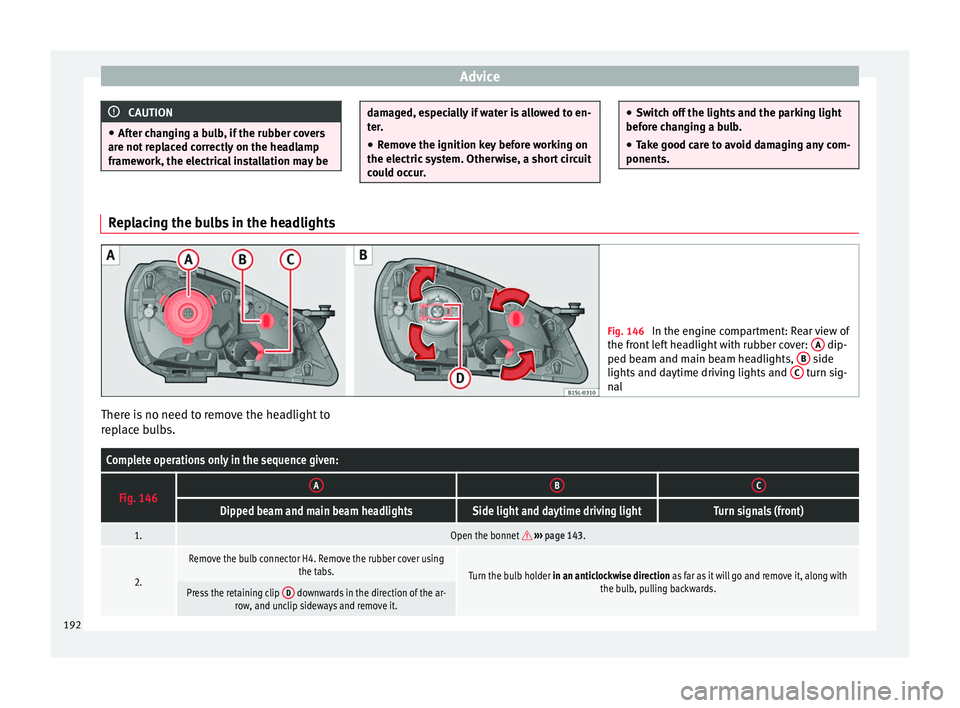
In the engine compartment: Rear view of
the front left headlight with rubber cover: A dip-
ped beam and main beam headlights, B side
lights and daytime driving lights and C turn sig-
nal There is no need to remove the headlight to
replace bulbs.Complete operations only in the sequence given:
Fig. 146ABC
Dipped beam and main beam headlightsSide light and daytime driving lightTurn signals (front)
1.Open the bonnet
››› page 143.
2.
Remove the bulb connector H4. Remove the rubber cover using
the tabs.Turn the bulb holder in an anticlockwise direction as far as it will go and remove it, along with the bulb, pulling backwards.Press the retaining clip D downwards in the direction of the ar-
row, and unclip sideways and remove it. 192
Page 195 of 219
Fuses and bulbsComplete operations only in the sequence given:
Fig. 146ABC
Dipped beam and main beam headlightsSide light and daytime driving lightTurn signals (front)
3.Remove the bulb from the holder. If necessary, press the lock on the bulb holder.
4.Replace the faulty bulb by a new identical bulb.
5.Insert the bulb, return it to its position and insert the retaining
clip DInsert the bulb holder in the headlight and
turn it clockwise as far as the stop.Insert the bulb holder in the headlight and
turn it clockwise as far as the stop.
6.Place the rubber cover and check that is in the correct position.
Insert the connector to the bulb H4. Note
The images show the left hand headlight
from behind. The structure of the right hand
side headlight is symmetric. To replace the front bumper bulbs
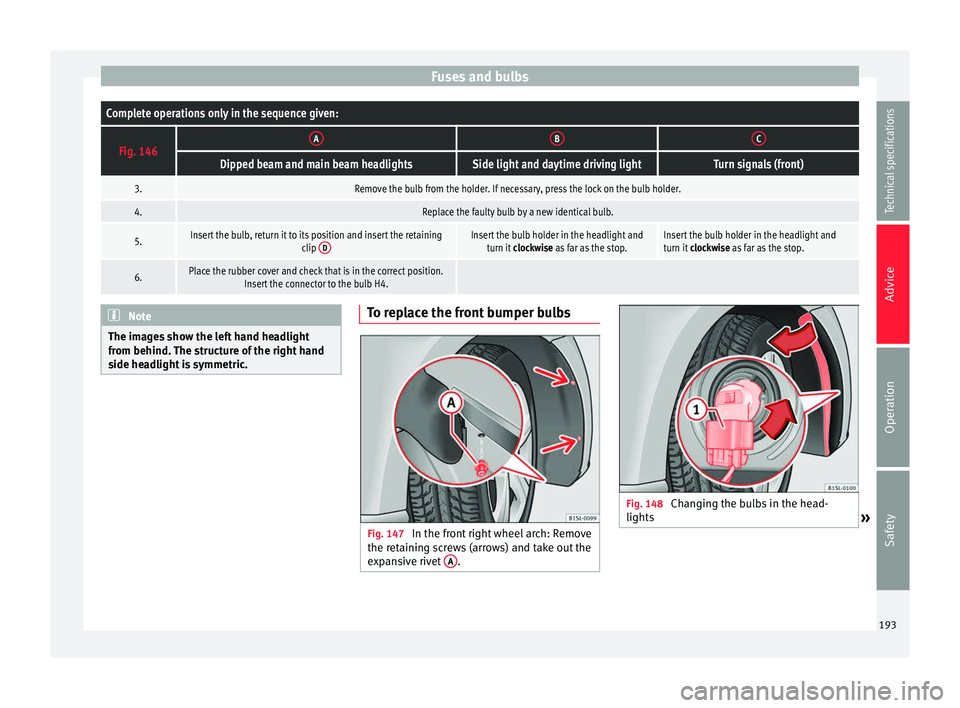
Fig. 147
In the front right wheel arch: Remove
the retaining screws (arrows) and take out the
expansive rivet A . Fig. 148
Changing the bulbs in the head-
lights » 193
Technical specifications
Advice
Operation
Safety
Page 208 of 219
Index
Bonnet Closing . . . . . . . . . . . . . . . . . . . . . . . . . . . . . . . 145
Opening . . . . . . . . . . . . . . . . . . . . . . . . . . . . . . 145
Boot variable floor extend below . . . . . . . . . . . . . . . . . . . . . . . . . . . 76
extend forwards . . . . . . . . . . . . . . . . . . . . . . . . . 76
Brake Brake servo . . . . . . . . . . . . . . . . . . . . . . . . . . . . . 92
Brake assist systems . . . . . . . . . . . . . . . . . . . . . . 103
Brake assist system (BAS) . . . . . . . . . . . . . . . . . . 104
Brake fluid . . . . . . . . . . . . . . . . . . . . . . . . . . . . . . 152 Specification . . . . . . . . . . . . . . . . . . . . . . . . . . . 153
Brakes . . . . . . . . . . . . . . . . . . . . . . . . . . . . . . . . . . . 89 Brake assist systems . . . . . . . . . . . . . . . . . . . . 103
Brake fluid . . . . . . . . . . . . . . . . . . . . . . . . . . . . . 152
Brake fluid level . . . . . . . . . . . . . . . . . . . . . . . . 153
Brake pads . . . . . . . . . . . . . . . . . . . . . . . . . . . . . 91
Changing the brake fluid . . . . . . . . . . . . . . . . . 153
Control lamp . . . . . . . . . . . . . . . . . . . . . . . . . . . . 89
Emergency brake indicator in case of suddenbraking . . . . . . . . . . . . . . . . . . . . . . . . . . . . . 172
Handbrake . . . . . . . . . . . . . . . . . . . . . . . . . . . . . 90
Running-in brake pads . . . . . . . . . . . . . . . . . . . . 91
Warning lamp . . . . . . . . . . . . . . . . . . . . . . . . . . . 89
Brake servo . . . . . . . . . . . . . . . . . . . . . . . . . . 92, 103
Brake system Malfunction . . . . . . . . . . . . . . . . . . . . . . . . . . . . . 92
Brake systems . . . . . . . . . . . . . . . . . . . . . . . . . . . 103
Breakdown Securing the vehicle . . . . . . . . . . . . . . . . . . . . . 171
Bulb fault See changing bulbs . . . . . . . . . . . . . . . . . . . . . 191
C Capacities Fuel tank . . . . . . . . . . . . . . . . . . . . . . . . . . . . . . 203 Care
See "Care of your vehicle" . . . . . . . . . . . . . . . . 125
Vehicle interior . . . . . . . . . . . . . . . . . . . . . . . . . 131
Care of your vehicle Exterior . . . . . . . . . . . . . . . . . . . . . . . . . . . . . . . 125
Caring for paintwork . . . . . . . . . . . . . . . . . . . . . . . 129
Carrier system . . . . . . . . . . . . . . . . . . . . . . . . . . . . . 77
Catalytic converter . . . . . . . . . . . . . . . . . . . . . . . . 102 Control lamp . . . . . . . . . . . . . . . . . . . . . . . . . . . 101
Malfunctions . . . . . . . . . . . . . . . . . . . . . . . . . . . 102
CCS . . . . . . . . . . . . . . . . . . . . . . . . . . . . . . . . . . . . 107
Central locking . . . . . . . . . . . . . . . . . . . . . . . . . . . . 45 Central locking button . . . . . . . . . . . . . . . . . . . . 48
locking and unlocking from the exterior . . . . . . 46
locking and unlocking from the inside . . . . . . . 48
Central locking system After airbag deployment . . . . . . . . . . . . . . . . . . 46
Description . . . . . . . . . . . . . . . . . . . . . . . . . . . . . 46
Opening doors individually . . . . . . . . . . . . . . . . 46
Changing Windscreen wiper blades . . . . . . . . . . . . . . . . . 188
Changing a wheel . . . . . . . . . . . . . . . . . . . . . . . . 174 Changing a wheel . . . . . . . . . . . . . . . . . . . . . . . 178
Raising the vehicle . . . . . . . . . . . . . . . . . . . . . . 177
Wheel bolts . . . . . . . . . . . . . . . . . . . . . . . . . . . . 175
Changing bulbs . . . . . . . . . . . . . . . . . . . . . . . . . . 191 Front bumper . . . . . . . . . . . . . . . . . . . . . . . . . . 193
in the headlights . . . . . . . . . . . . . . . . . . . . . . . 192
Number plate light . . . . . . . . . . . . . . . . . . . . . . 195
Rear lights . . . . . . . . . . . . . . . . . . . . . . . . . . . . . 194
Sea changing bulbs . . . . . . . . . . . . . . . . . . . . . 191
Changing gear . . . . . . . . . . . . . . . . . . . . . . . . . . . . 93 Automatic gearbox . . . . . . . . . . . . . . . . . . . . . . . 95
Engaging gears (automatic gearbox) . . . . . . . . 95
Engaging gears (manual gearbox) . . . . . . . . . . 94
Manual gearbox . . . . . . . . . . . . . . . . . . . . . . . . . 94 Warning and control lamps . . . . . . . . . . . . . . . . 93
with Tiptronic . . . . . . . . . . . . . . . . . . . . . . . . . . . 96
Changing gears Gear recommendation . . . . . . . . . . . . . . . . . . . . 98
Changing the bulbs Side turn signal . . . . . . . . . . . . . . . . . . . . . . . . 196
Changing the wheel After changing the wheel . . . . . . . . . . . . . . . . . 178
Chassis number . . . . . . . . . . . . . . . . . . . . . . . . . . 197
Checking Tyre pressures . . . . . . . . . . . . . . . . . . . . . . . . . . 162
Checking the oil level . . . . . . . . . . . . . . . . . . . . . . 148
Child safety . . . . . . . . . . . . . . . . . . . . . . . . . . . . . . . 25
Child safety seat Securing with seat belt . . . . . . . . . . . . . . . . . . . 30
Child seat . . . . . . . . . . . . . . . . . . . . . . . . . . . . . . . . 25 Fix with ISOFIX . . . . . . . . . . . . . . . . . . . . . . . . . . 31
ISOFIX child seat on rear seats . . . . . . . . . . . . . 29
Mounting child seats . . . . . . . . . . . . . . . . . . . . . 28
Mounting systems . . . . . . . . . . . . . . . . . . . . . . . 28
On rear seats . . . . . . . . . . . . . . . . . . . . . . . . . . . . 29
On the front passenger seat . . . . . . . . . . . . . . . 28
Regulations . . . . . . . . . . . . . . . . . . . . . . . . . . . . . 27
Securing using a Top Tether retaining strap . . . 32
Transporting children in the vehicle . . . . . . . . . 27
Weight categories . . . . . . . . . . . . . . . . . . . . . . . . 27
Child seats Disabling the front passenger front airbag . . . . 24
Chromework care . . . . . . . . . . . . . . . . . . . . . . . . . 129
Cigarette lighter . . . . . . . . . . . . . . . . . . . . . . . . . . . 72
City Safety Assist function . . . . . . . . . . . . . . . . . . 110 Control lamp . . . . . . . . . . . . . . . . . . . . . . . . . . . 111
Function . . . . . . . . . . . . . . . . . . . . . . . . . . . . . . 113
Sensor . . . . . . . . . . . . . . . . . . . . . . . . . . . . . . . . 112
Special driving situations . . . . . . . . . . . . . . . . 113
Warning lamp . . . . . . . . . . . . . . . . . . . . . . . . . . 111
206
Page 209 of 219
Index
Cleaning dash panel . . . . . . . . . . . . . . . . . . . . . . . . . . . . 133
Engine compartment . . . . . . . . . . . . . . . . . . . . 131
Seat belts . . . . . . . . . . . . . . . . . . . . . . . . . . . . . 134
See "Care of your vehicle" . . . . . . . . . . . . . . . . 125
wheels . . . . . . . . . . . . . . . . . . . . . . . . . . . . . . . . 130
Windscreen wiper blades . . . . . . . . . . . . . . . . . 188
Clock . . . . . . . . . . . . . . . . . . . . . . . . . . . . . . . . . . . . 36
Closing Doors . . . . . . . . . . . . . . . . . . . . . . . . . . . . . . . . . . 49
from the exterior . . . . . . . . . . . . . . . . . . . . . . . . . 46
from the inside . . . . . . . . . . . . . . . . . . . . . . . . . . 48
Rear lid . . . . . . . . . . . . . . . . . . . . . . . . . . . . . . . . 51
Sliding/tilting electric panoramic sunroof . . . . 53
windows . . . . . . . . . . . . . . . . . . . . . . . . . . . . . . . 52
Coat hooks . . . . . . . . . . . . . . . . . . . . . . . . . . . . . . . 70
Cockpit . . . . . . . . . . . . . . . . . . . . . . . . . . . . . . . . . . 35
Code number . . . . . . . . . . . . . . . . . . . . . . . . . . . . 173
Collection of end-of-life vehicles . . . . . . . . . . . . . 136
Compartments boot variable floor . . . . . . . . . . . . . . . . . . . . . . . 76
Centre console . . . . . . . . . . . . . . . . . . . . . . . . . . 68
Glove compartment . . . . . . . . . . . . . . . . . . . 68, 69
Other storage compartments . . . . . . . . . . . . . . . 70
Passenger side . . . . . . . . . . . . . . . . . . . . . . . 68, 69
Sunglasses storage compartment . . . . . . . . . . . 68
Components . . . . . . . . . . . . . . . . . . . . . . . . . . . . . 118
Conformity certification . . . . . . . . . . . . . . . . . . . . 136
Consumption How it is determined . . . . . . . . . . . . . . . . . . . . 198
Information . . . . . . . . . . . . . . . . . . . . . . . . . . . . 198
control lamp on the driver door . . . . . . . . . . . . . . . . . . . . . . . . 49
Vehicle key . . . . . . . . . . . . . . . . . . . . . . . . . . . . . 44
Control lamp Airbag system . . . . . . . . . . . . . . . . . . . . . . . . . . . 23
Brake pad wear warning . . . . . . . . . . . . . . . . . . 89 Brake system . . . . . . . . . . . . . . . . . . . . . . . . . . . 89
Catalytic converter . . . . . . . . . . . . . . . . . . . . . . 101
Checking the engine oil level . . . . . . . . . . . . . 147
City Safety Assist function . . . . . . . . . . . . . . . . 111
Cruise control system (CCS) . . . . . . . . . . . . . . . 108
Emission control system . . . . . . . . . . . . . . . . . 101
Engine coolant . . . . . . . . . . . . . . . . . . . . . . . . . 150
Engine management . . . . . . . . . . . . . . . . . . . . 101
Engine oil sensor . . . . . . . . . . . . . . . . . . . . . . . 147
ESC . . . . . . . . . . . . . . . . . . . . . . . . . . . . . . . . . . . 89
Fuel level . . . . . . . . . . . . . . . . . . . . . . . . . . . . . . 140
Hill hold . . . . . . . . . . . . . . . . . . . . . . . . . . . . . . . 115
Overview . . . . . . . . . . . . . . . . . . . . . . . . . . . . . . . 39
Steering column lock . . . . . . . . . . . . . . . . . . . . . 85
Control lamps Lights . . . . . . . . . . . . . . . . . . . . . . . . . . . . . . . . . 55
Controlling function Electric exterior mirrors . . . . . . . . . . . . . . . . . . . 63
Control units . . . . . . . . . . . . . . . . . . . . . . . . . . . . . 121 Reprogramming . . . . . . . . . . . . . . . . . . . . . . . . 121
Convenience functions Reprogramming . . . . . . . . . . . . . . . . . . . . . . . . 121
Coolant See engine coolant . . . . . . . . . . . . . . . . . . . . . . 150
Correct sitting position for vehicle occupants . . . . 6
Crossing a river Salt water . . . . . . . . . . . . . . . . . . . . . . . . . . . . . 103
Cruise control system . . . . . . . . . . . . . . . . . . . . . . 107
Cruise control system (CCS) Control lamp . . . . . . . . . . . . . . . . . . . . . . . . . . . 108
Operations . . . . . . . . . . . . . . . . . . . . . . . . . . . . 109
Curb weight . . . . . . . . . . . . . . . . . . . . . . . . . . . . . 198
D Damaged tyres . . . . . . . . . . . . . . . . . . . . . . . . . . . 163
Dangers in not using the seat belt . . . . . . . . . . . . 14 Dash panel . . . . . . . . . . . . . . . . . . . . . . . . . . . . . . . 35
Airbag system . . . . . . . . . . . . . . . . . . . . . . 21, 133
Data link connector (DLC) . . . . . . . . . . . . . . . . . . 122
Data registry . . . . . . . . . . . . . . . . . . . . . . . . . . . . . 121
Data storage during the journey . . . . . . . . . . . . . 121
Data stored by the control units . . . . . . . . . . . . . 121
Daytime driving light . . . . . . . . . . . . . . . . . . . . . . . 57
De-icing the door lock cylinder . . . . . . . . . . . . . . 130
De-icing the locks . . . . . . . . . . . . . . . . . . . . . . . . . 130
Deadlock "Safe" security system . . . . . . . . . . . . . . . . . . . . 48
Device disconnection . . . . . . . . . . . . . . . . . . . . . . 157
Diagnostics connection . . . . . . . . . . . . . . . . . . . . 122
Differential lock See "Brake assist systems" . . . . . . . . . . . . . . . 104
Digital clock . . . . . . . . . . . . . . . . . . . . . . . . . . . . . . 36
Dimensions . . . . . . . . . . . . . . . . . . . . . . . . . . . . . . 203
Dipped beam headlights . . . . . . . . . . . . . . . . . . . . 56
Dipstick . . . . . . . . . . . . . . . . . . . . . . . . . . . . . . . . . 148
Display . . . . . . . . . . . . . . . . . . . . . . . . . . . . . . . . . . 37 Instrument panel . . . . . . . . . . . . . . . . . . . . . . . . 37
Disposal Airbag system . . . . . . . . . . . . . . . . . . . . . . . . . . 136
Belt tensioner . . . . . . . . . . . . . . . . . . . . . . . . . . . 17
End-of-life vehicle . . . . . . . . . . . . . . . . . . . . . . . 136
Door release lever interior . . . . . . . . . . . . . . . . . . . . . . . . . . . . . . . . . 35
Doors . . . . . . . . . . . . . . . . . . . . . . . . . . . . . . . . . . . . 49 Childproof locks . . . . . . . . . . . . . . . . . . . . . . . . . 50
Emergency locking and unlocking . . . . . . . . . . 186
Drink holders . . . . . . . . . . . . . . . . . . . . . . . . . . . . . 70 Centre console . . . . . . . . . . . . . . . . . . . . . . . . . . 71
Drinks bottles see Drink holders . . . . . . . . . . . . . . . . . . . . . . . . 70
Driving Data storage . . . . . . . . . . . . . . . . . . . . . . . . . . . 121
Driving abroad . . . . . . . . . . . . . . . . . . . . . . . . . 102
207