instrument panel Seat Mii 2015 Owner's Guide
[x] Cancel search | Manufacturer: SEAT, Model Year: 2015, Model line: Mii, Model: Seat Mii 2015Pages: 232, PDF Size: 4.23 MB
Page 143 of 232

Driving
Automatic gearbox malfunction Back-up programme
When autom
atic
gearbox warning and indica-
tion lamps light up on the instrument panel,
there may be a system malfunction
››› page 137. In the event of some faults the
automatic gearbox functions using a backup
programme. When the programme is activa-
ted, it is possible to drive the vehicle, howev-
er, at low speeds and within a selected range
of gears.
With the manual gearbox, in some cases it is
not possible to drive with all the gears .
In all cases the automatic gearbox must be
checked at a specialised workshop.
Automatic gearbox overheating
The automatic gearbox can overheat with a
prolonged start up, or when stopping and
starting continuously. This overheating is dis-
played with a warning lamp in the instru-
ment panel. Additionally, an audible warning
can be heard. Stop and let the gearbox cool
››› .
The v
ehic
le moves forward or back despite
having selected a gear range
When the vehicle does not move in the re-
quired direction, the system may not have
the gear range correctly engaged. Press the
brake pedal and engage the gear range again. If the vehicle still does not move in the
required dir
ection, there is a system malfunc-
tion. Seek specialist assistance and have the
system checked. CAUTION
● When the ge arbo
x is displayed as overheat-
ing for the first time, the vehicle must be
parked safely or must be driven at a speed of
more than 20 km/h (12 mph).
● When the warning lamp lights up and the
audible w
arning is heard, the vehicle must be
parked safely and the engine switched off.
Let the gearbox cool down.
● To prevent damage to the gearbox, driving
must
only be continued when the warning
lamps are no longer lit up. While the gearbox
is overheated, starting up and driving, even
at a slow speed should be avoided. Recommended gear display
In some vehicles, the recommended gear for
r
educ
in
g fuel consumption is displayed on
the instrument panel:
DisplayMeaning
Optimum gear.
Recommendation to change up a gear.
Recommendation to change down a
gear. WARNING
The recommended gear display is intended as
a guideline only; it shou
ld never replace the
driver's attention to driving carefully.
● Responsibility for selecting the correct gear
for eac
h situation continues to lie with the
driver, for example when overtaking or climb-
ing a hill. For the sake of the environment
Selecting the most appropriate gear for the
sit uation w
ill help you to save fuel. Note
● The rec ommended g
ear display is switched
off when the clutch pedal is pressed.
● On the display of the Portable Navigation
Sys
tem (supplied by SEAT) ››› page 164 the
recommended gear can also be seen. Run-in and economical driving
R u
nnin
g in Please observe the instructions for running-in
new c
omponents.
R u
nning-in the engine
The engine needs to be run in over the first
1,500 km. During its first few hours of »
141
Technical data
Advice
Operation
Emergencies
Safety
Page 159 of 232
Driver assistance systems
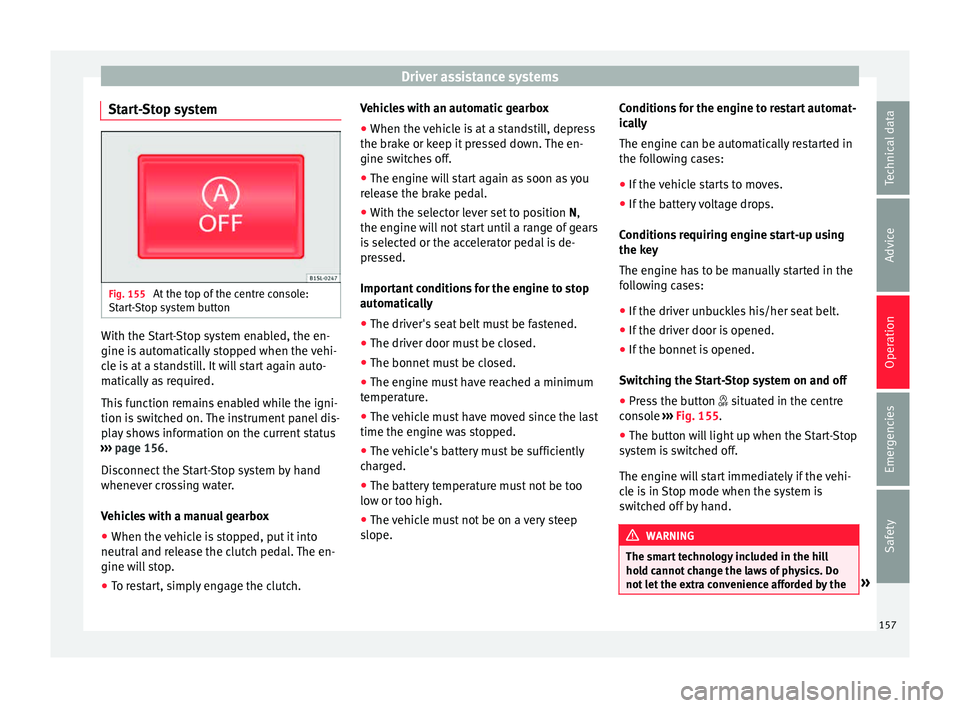
Start-Stop system Fig. 155
At the top of the centre console:
St ar
t
-Stop system button With the Start-Stop system enabled, the en-
gine i
s
aut
omatically stopped when the vehi-
cle is at a standstill. It will start again auto-
matically as required.
This function remains enabled while the igni-
tion is switched on. The instrument panel dis-
play shows information on the current status
››› page 156.
Disconnect the Start-Stop system by hand
whenever crossing water.
Vehicles with a manual gearbox
● When the vehicle is stopped, put it into
neutral and r
elease the clutch pedal. The en-
gine will stop.
● To restart, simply engage the clutch. Vehicles with an automatic gearbox
●
When the vehicle is at a standstill, depress
the brake or k
eep it pressed down. The en-
gine switches off.
● The engine will start again as soon as you
rele
ase the brake pedal.
● With the selector lever set to position N,
the engine wi
ll not start until a range of gears
is selected or the accelerator pedal is de-
pressed.
Important conditions for the engine to stop
automatically
● The driver's seat belt must be fastened.
● The driver door must be closed.
● The bonnet must be closed.
● The engine must have reached a minimum
temperat
ure.
● The vehicle must have moved since the last
time the engine wa
s stopped.
● The vehicle's battery must be sufficiently
char
ged.
● The battery temperature must not be too
low or too high.
● The
vehicle must not be on a very steep
slope. Condition
s for the engine to restart automat-
ical
ly
The engine can be automatically restarted in
the following cases:
● If the vehicle starts to moves.
● If the battery voltage drops.
Conditions
requiring engine start-up using
the key
The engine has to be manually started in the
following cases:
● If the driver unbuckles his/her seat belt.
● If the driver door is opened.
● If the bonnet is opened.
Switc
hing the Start-Stop system on and off
● Press the button situat
ed in the centre
console ››› Fig. 155.
● The button will light up when the Start-Stop
syst
em is switched off.
The engine will start immediately if the vehi-
cle is in Stop mode when the system is
switched off by hand. WARNING
The smart technology included in the hill
hol d c
annot change the laws of physics. Do
not let the extra convenience afforded by the » 157
Technical data
Advice
Operation
Emergencies
Safety
Page 164 of 232

Advice
The optimal reach of the equipment is only
ac hiev
ed w
ith an external aerial.
Check first with a specialised workshop that
understands the technical possibilities of in-
stallation if you wish to use a two-way radio
with a transmitting power of over 10 watts.
SEAT recommends taking your car in for tech-
nical service.
All legal requirements, together with the in-
structions for the use of two-way radios must
be observed. WARNING
If the two-way radio is not securely fastened
in pos ition, it
could be sent flying around the
vehicle in the event of sharp braking, sudden
manoeuvres or accident, causing injury.
● While driving, two-way radios must be se-
curely
fastened in position, outside the air-
bags deployment zones, or safely stowed
away. WARNING
When using a two-way radio without a con-
nection to an e xt
erior aerial, the maximum
permitted levels of electromagnetic radiation
may be exceeded. This is also the case if the
aerial has not been correctly installed.
● You should only use a two-way radio inside
the vehic
le if it has first been correctly con-
nected to an exterior aerial. Information stored by the control
u
nit
s Your vehicle is fitted at the factory with a ser-
ies
of
electronic control units responsible for
the engine and gearbox management. In ad-
dition, the control units supervise the per-
formance of the exhaust gas system and the
airbag systems.
Therefore, while the vehicle is being driven,
these electronic control units are continuous-
ly analysing the vehicle data. In the event of
faults or deviations from the theoretical val-
ues, only this data is stored. Normally, the
warning lamps on the instrument panel light
up in the event of faults.
This data can only be read and analysed us-
ing special equipment.
The storing of the data allows specialised
workshops to detect and repair faults. Stored
data may include:
● Data relating to the engine or the gearbox
● Speed
● Direction of travel
● Braking force
● Detection of seat belt
The v ehic
le control units never record conver-
sations held by passengers in the vehicle.
In vehicles equipped with an emergency call
function via the mobile phone or other appli- ances connected in the vehicle, it is possible
to send the v
ehicle position. If the control
unit records an accident with airbag activa-
tion, the system may automatically send a
signal. This will depend on the network oper-
ator. Normally, transmission is only possible
in areas with good coverage.
Event Data Recorder
The vehicle is not fitted with an event data re-
corder.
An event data recorder temporarily stores the
vehicle information. Therefore, in the event of
an accident, it is possible to obtain detailed
information about how the accident occur-
red. Vehicles with airbag systems can store
data relating to impact speed, seat belt sta-
tus, seat positions and airbag activation
times may be stored, etc. The volume of data
depends on the manufacturer.
Event data recorders can only be mounted
with authorisation from the vehicle owner
and, in some countries, they are governed by
local legislation.
Reprogramming control units
On the whole, all the data required for the
component management is stored in the con-
trol units. The programming of certain con-
venience functions, such as the turn signals,
individual door opening and instructions on
the display can be modified using special
162
Page 165 of 232
Care and maintenance
equipment at the workshop. If the comfort
f u
nction
s are reprogrammed, the information
and Instruction Manual descriptions will not
coincide with the modified functions. There-
fore, SEAT recommends that any modifica-
tions be recorded in the section “Other work-
shop notes” in the Maintenance Programme.
The SEAT Official Service must have a record
of any modification to the programming.
Reading the vehicle fault memory
There is a diagnostics connector in the vehi-
cle interior for reading the vehicle fault mem-
ory. The fault memory documents errors and
deviations from the theoretical values of the
electronic control units.
The diagnostics connector is in the driver
side footwell area, next to the lever for open-
ing the bonnet, below a cover.
The fault memory should only be read and re-
set by a specialised workshop.
Using a mobile telephone in a vehicle
without c
onnection to an exterior aer-
ial Mobile telephones transmit and receive radio
w
av
e
s also called high-frequency energy,
both when in use and when on stand-by. Sci-
entific studies state that radio waves exceed-
ing certain values may be harmful to the hu- man body. International committees and au-
thorities h
ave established limits and direc-
tives in order to ensure electromagnetic radi-
ation from mobile phones remains within cer-
tain limits that do not endanger health. Nev-
ertheless, there is no conclusive scientific
evidence that wireless telephones are totally
safe.
That is why some experts recommend moder-
ate use of the mobile telephone, and the ap-
pliance of measures to reduce radiation on
the human body.
When a mobile phone not connected to an
exterior aerial is used inside the vehicle, the
electromagnetic radiation may be greater
than if the mobile phone were connected to a
built-in aerial or to another exterior aerial.
If the vehicle is fitted with a suitable hands-
free device that allows the employment of
numerous additional mobile telephone func-
tions with compatible Bluetooth technolo-
gy ®
, it will comply with the legislation in
many countries which only permits the use of
mobile phones inside vehicles using a
hands-free device.
The hands-free system of the Portable Navi-
gation System (supplied by SEAT) has been
designed for use with conventional mobile
phones and phones with Bluetooth technolo-
gy ®
››› page 164. Mobile telephones must be
placed in a suitable telephone support or
stored safely in the vehicle. If a support is used for the telephone, it must be securely
fas
tened to the base plate. The mobile will be
secure on the instrument panel and always
within reach of the driver only by following
these procedures. Mobile telephone connec-
tion with an external aerial is carried out sub-
ject to the hands-free device, via the tele-
phone support or by the Bluetooth ®
connec-
tions present in the mobile telephone and
the vehicle.
If the mobile phone is connected to an aerial
incorporated into the vehicle or an exterior
aerial connected to the vehicle, it will help re-
duce the electromagnetic radiation transmit-
ted and the risk to human health. It will also
improve the quality of the connection.
If the phone is used inside the vehicle with-
out the hands-free system, it will not be se-
curely fastened and will not be connected to
the exterior aerial of the vehicle telephone.
Nor will the telephone charge if it is not on
the support. In addition, some calls may
break off and the quality of the connection
will be affected.
Mobile telephones should only be used in-
side the vehicle if they are connected to a
hands-free system. SEAT recommends using
an external aerial should you wish to use a
mobile telephone inside the vehicle.
Bluetooth ®
is a registered trademark of Blue-
tooth ®
SIG, Inc. »
163
Technical data
Advice
Operation
Emergencies
Safety
Page 177 of 232

Care and maintenance
WARNING
Solvents cause the surfaces of the airbag
modul e
s to become porous. If an airbag is ac-
cidentally triggered, the detachment of plas-
tic parts could cause serious injury.
● Never clean the dash panel and the surfa-
ces
of the airbag modules with cleaners con-
taining solvents. CAUTION
When cleaning the instrument panel, be care-
fu l
not to dampen the Portable Navigation
System connections as this can damage the
electrical installation. Cleaning seatbelts
If the seat belt is very dirty, the belt retractor
m
a
y
not work correctly thus preventing the
seat belt from operating correctly.
The seat belts should never be removed from
the vehicle for cleaning.
● Use a soft brush to remove the worst dirt
›››
.
● Pull the seat belt right out and leave it out.
● Clean dirty seat belts with a gentle
so
ap
and water solution.
● Wait until they are completely dry.
● Only allow the seat belt to retract when it is
compl
etely dry. WARNING
Check the condition of all the seat belts at
re gu
lar intervals. If the webbing or other
parts of the seat belt are damaged, the vehi-
cle should be taken to a Specialised work-
shop immediately and the belts should be re-
placed. It is extremely dangerous to drive us-
ing damaged seat belts and could result in
serious injury or loss of life.
● Seat belts and their components must nev-
er be cle
aned with chemical products, nor
should they be allowed to come into contact
with corrosive liquids, solvents or sharp ob-
jects. This could affect the strength of the
seat belt webbing.
● Seat belts should be completely dry before
retractin
g. Dampness could damage the belt
retractor so that it does not operate correctly.
● Do not allow liquids or foreign bodies to en-
ter the buc
kle fastenings. This could damage
the buckles and seat belts.
● Never attempt to repair, modify or remove a
seat belt
yourself.
● Always have damaged seatbelts replaced
immediately
by seat belts approved for the
vehicle in question by SEAT. Seat belts which
have been worn in an accident and stretched
must be replaced by a specialised workshop.
Renewal may be necessary even if there is no
apparent damage. The belt anchorage should
also be checked. Notes for the user
Intr oduction WARNING
Failure to treat the vehicle with the correct
car e inc
reases the risk of accident and injury.
● Observe legal requirements.
● Observe the Instruction Manual. CAUTION
If the vehicle is not properly cared for, dam-
age m a
y occur.
● Observe legal requirements.
● Carry out regular maintenance of the vehi-
cle, ac
cording to specifications in the Mainte-
nance Programme.
● Observe the Instruction Manual. 175
Technical data
Advice
Operation
Emergencies
Safety
Page 183 of 232

Checking and refilling levels
Control lamps and fuel gauge Fig. 163
On the instrument panel: fuel gauge
for petr o
l Fig. 164
On the instrument panel: Fuel gauge
for petr o
l and natural gas. The fuel gauge can vary depending on the ve-
hic
l
e equipment
››› Fig. 163 or ››› Fig. 164.
It lights upGauge position
››› Fig. 163Possible cause ››› Solution
a)Red mark (arrow)The fuel tank is almost empty.
The reserve tank is being used
››› page 30.Refuel as soon as possible ››› .
–The vehicle is running in natural gas operating mode.–
a)
This only applies to vehicles with the fuel gauge on the dash panel ››› Fig. 163.»
181
Technical data
Advice
Operation
Emergencies
Safety
Page 223 of 232
Index
Preparation before replacing . . . . . . . . . . . . . . . 33
r ep
l
acing . . . . . . . . . . . . . . . . . . . . . . . . . . . . . . . 33
G Gearbox lever . . . . . . . . . . . . . . . . . . . . . . . . . . . . . 27
Gear change . . . . . . . . . . . . . . . . . . . . . . . . . . . . . . 27 automatic gearbox . . . . . . . . . . . . . . . . . . . . . . . 27
changing gears manually . . . . . . . . . . . . . . . . . 138
gear recommendation . . . . . . . . . . . . . . . . . . . 141
Manual gear change . . . . . . . . . . . . . . . . . . . . . . 27
putting the vehicle in gear (manual gearbox) 138
Gear engaged . . . . . . . . . . . . . . . . . . . . . . . . . . . . . 27
General instrument panel Instrument panel . . . . . . . . . . . . . . . . . . . . . . . . 85
General view control and warning lamps . . . . . . . . . . . . . . . . 25
Generator . . . . . . . . . . . . . . . . . . . . . . . . . . . . . . . 194
Glove compartment . . . . . . . . . . . . . . . . . . 113, 114
H
Handbrake . . . . . . . . . . . . . . . . . . . . . . . . . . . . . . 134
Hazard warning lights . . . . . . . . . . . . . . . . . 22, 103
Head-on collisions and the laws of physics . . . . . 54
Headlight range control . . . . . . . . . . . . . . . . . . . . 104
Headlights driving abroad . . . . . . . . . . . . . . . . . . . . . . . . . 104
Head rest adjustment . . . . . . . . . . . . . . . . . . . . . . . . . . . . 108
Head restraints Adjusting . . . . . . . . . . . . . . . . . . . . . . . . . . . . . . 108
Rear head restraints . . . . . . . . . . . . . . . . . . . . . . 50
Heated rear window . . . . . . . . . . . . . . . . . . . . . . . . 29
Heating and ventilation system . . . . . . . . . . . . . 124 controls . . . . . . . . . . . . . . . . . . . . . . . . . . . . . . . . 28
instructions . . . . . . . . . . . . . . . . . . . . . . . . . . . . 126
Hill driving assistant . . . . . . . . . . . . . . . . . . . . . . 156 Hill hold
contro l and warning lamps . . . . . . . . . . . . . . . 156
Start-Stop system . . . . . . . . . . . . . . . . . . . . . . . 157
Horn . . . . . . . . . . . . . . . . . . . . . . . . . . . . . . . . . . . . 85
How to jump start . . . . . . . . . . . . . . . . . . . . . . . . . . 42 description . . . . . . . . . . . . . . . . . . . . . . . . . . . . . 43
Hubcaps . . . . . . . . . . . . . . . . . . . . . . . . . . . . . . . . . 36
I
Identifying letters on engine . . . . . . . . . . . . . . . . 209
Ignition . . . . . . . . . . . . . . . . . . . . . . . . . . . . . . . . . . 20 see "Engine and ignition" . . . . . . . . . . . . . . . . 130
Ignition lock . . . . . . . . . . . . . . . . . . . . . . . . . . . . . . 20 removal lock . . . . . . . . . . . . . . . . . . . . . . . . . . . 131
unauthorised vehicle key . . . . . . . . . . . . . . . . . 130
In case of emergency . . . . . . . . . . . . . . . . . . . . . . . 69
Indications on the display . . . . . . . . . . . . . . . . . . . 87 odometer . . . . . . . . . . . . . . . . . . . . . . . . . . . . . . . 87
recommended gear . . . . . . . . . . . . . . . . . . . . . . 88
reminder . . . . . . . . . . . . . . . . . . . . . . . . . . . . . . . 89
seat belt status . . . . . . . . . . . . . . . . . . . . . . . . . . 88
selector lever positions . . . . . . . . . . . . . . . . . . . 88
Start-Stop . . . . . . . . . . . . . . . . . . . . . . . . . . . . . . 88
temperature . . . . . . . . . . . . . . . . . . . . . . . . . . . . 88
Instrument panel . . . . . . . . . . . . . . . . . . . . . . . . . . 86 control and warning lamps . . . . . . . . . . . . . . . . 25
display . . . . . . . . . . . . . . . . . . . . . . . . . . . . . . 86, 87
general instrument panel . . . . . . . . . . . . . . . . . . 85
instruments . . . . . . . . . . . . . . . . . . . . . . . . . . . . . 86
menus . . . . . . . . . . . . . . . . . . . . . . . . . . . . . . . . . 23
service intervals . . . . . . . . . . . . . . . . . . . . . . . . . 88
symbols . . . . . . . . . . . . . . . . . . . . . . . . . . . . . . . . 25
Instrument panel lighting . . . . . . . . . . . . . . . . . . 104
Interior lights . . . . . . . . . . . . . . . . . . . . . . . . . . . . . 22
Interior rear vision mirror anti-dazzle . . . . . . . . . . . . . . . . . . . . . . . . . . . . 107 Interior view
left . . . . . . . . . . . . . . . . . . . . . . . . . . . . . . . . . . . . . 7
ISOFIX system . . . . . . . . . . . . . . . . . . . . . . . . . . . . . 19
J Jack . . . . . . . . . . . . . . . . . . . . . . . . . . . . . . 35, 69, 71 mounting points . . . . . . . . . . . . . . . . . . . . . . . . . 38
Jump leads . . . . . . . . . . . . . . . . . . . . . . . . . . . . . . . 42
K Keys control lamp . . . . . . . . . . . . . . . . . . . . . . . . . . . . 91
duplicates . . . . . . . . . . . . . . . . . . . . . . . . . . . . . . 91
mechanical key . . . . . . . . . . . . . . . . . . . . . . . . . . 91
remote control . . . . . . . . . . . . . . . . . . . . . . . . . . 90
replacing the battery . . . . . . . . . . . . . . . . . . . . . 91
spare key . . . . . . . . . . . . . . . . . . . . . . . . . . . . . . . 90
Synchronising . . . . . . . . . . . . . . . . . . . . . . . . . . . 92
unlocking and locking . . . . . . . . . . . . . . 8, 93, 95
vehicle key . . . . . . . . . . . . . . . . . . . . . . . . . . . . . 90
Kick-down . . . . . . . . . . . . . . . . . . . . . . . . . . . . . . . 140
L Labels and plates . . . . . . . . . . . . . . . . . . . . . . . . . 176
Level control . . . . . . . . . . . . . . . . . . . . . . . . . . . . . . 30
Lift platform . . . . . . . . . . . . . . . . . . . . . . . . . . . . . 166
Lights . . . . . . . . . . . . . . . . . . . . . . . . . . 21, 101, 102 audible warnings . . . . . . . . . . . . . . . . . . . . . . . 102
control and warning lamps . . . . . . . . . . . . . . . 101
control lighting . . . . . . . . . . . . . . . . . . . . . . . . . 104
daytime running lights . . . . . . . . . . . . . . . . . . . 102
dipped beam headlights . . . . . . . . . . . . . . . . . 102
driving abroad . . . . . . . . . . . . . . . . . . . . . . . . . 104
fog lights . . . . . . . . . . . . . . . . . . . . . . . . . . . . . . . 21
functions . . . . . . . . . . . . . . . . . . . . . . . . . . . . . . 102
Hazard warning lights . . . . . . . . . . . . . . . . . . . . 22
headlight range control . . . . . . . . . . . . . . . . . . 104
221
Page 224 of 232
Index
instrument panel lighting . . . . . . . . . . . . . . . . 104
light c
ontr
ols . . . . . . . . . . . . . . . . . . . . . . . . . . . 102
luggage compartment . . . . . . . . . . . . . . . . . . . 105
main beam . . . . . . . . . . . . . . . . . . . . . . . . . . . . . 22
main beam headlights . . . . . . . . . . . . . . . . . . . 102
main beam lever . . . . . . . . . . . . . . . . . . . . . . . . 102
parking light remains on both sides . . . . . . . . 102
side lights . . . . . . . . . . . . . . . . . . . . . . . . . . . . . 102
switch . . . . . . . . . . . . . . . . . . . . . . . . . . . . . . . . . 21
turn signal lever . . . . . . . . . . . . . . . . . . . . . . . . 102
Load compartment in the luggage compartment see Loading the luggage compartment . . . . . 118
Loading general advice . . . . . . . . . . . . . . . . . . . . . . . . . 110
loaded vehicle . . . . . . . . . . . . . . . . . . . . . . . . . 111
transporting the load . . . . . . . . . . . . . . . . . . . . 111
Loading the luggage compartment . . . . . . . . . . . 118 Driving with the rear lid open . . . . . . . . . . . . . 111
Loading the vehicle class N1 . . . . . . . . . . . . . . . . . . . . . . . . . . . . . . . 121
fastening rings . . . . . . . . . . . . . . . . . . . . . . . . . 121
luggage compartment . . . . . . . . . . . . . . . . . . . . . 9
retaining hooks . . . . . . . . . . . . . . . . . . . . . . . . 122
roof carrier system . . . . . . . . . . . . . . . . . . . . . . 123
Locking and unlocking electric windows . . . . . . . . . . . . . . . . . . . . . . . . . 11
in the lock cylinder . . . . . . . . . . . . . . . . . . . . . . . . 8
luggage compartment . . . . . . . . . . . . . . . . . . . . 98
panoramic sunroof . . . . . . . . . . . . . . . . . . . . . . 100
Luggage compartment . . . . . . . . . . . . . . . 9, 97, 118 closing . . . . . . . . . . . . . . . . . . . . . . . . . . . . . . . . . 98
cover . . . . . . . . . . . . . . . . . . . . . . . . . . . . . . . . . 120
driving with the rear lid open . . . . . . . . . . . . . . 111
emergency unlocking . . . . . . . . . . . . . . . . . . . . . 10
luggage compartment variable floor . . . . . . . . 120
opening . . . . . . . . . . . . . . . . . . . . . . . . . . . . . . . . 98 unlocking . . . . . . . . . . . . . . . . . . . . . . . . . . . . . . 98
see a
lso Loading the luggage compartment . 118
Luggage compartment floor . . . . . . . . . . . . . . . . 120
Luggage compartment hatch . . . . . . . . . . . . . . . . 10
Luggage compartment variable floor . . . . . . . . . 120
M Main beam lever . . . . . . . . . . . . . . . . . . . . . . . . . . 102
Main panel turn signal and main beam lever . . . . . . . . . . . 102
Malfunction automatic gearbox . . . . . . . . . . . . . . . . . . . . . . 141
Malfunction in the catalytic converter . . . . . . . . . . . . . . . . . . . . . . 145
Mobile phones . . . . . . . . . . . . . . . . . . . . . . . . . . . 161 use without an exterior aerial . . . . . . . . . . . . . 163
Model plate . . . . . . . . . . . . . . . . . . . . . . . . . . . . . . 209
N
Natural gas . . . . . . . . . . . . . . . . . . . . . . . . . . . . . . 179 Fuel tank cap . . . . . . . . . . . . . . . . . . . . . . . . . . . 183
refuelling . . . . . . . . . . . . . . . . . . . . . . . . . 179, 183
Noises brake assist systems . . . . . . . . . . . . . . . . . . . . 148
engine . . . . . . . . . . . . . . . . . . . . . . . . . . . . . . . . 131
Notes for the user . . . . . . . . . . . . . . . . . . . . . . . . . 175
Number of seats . . . . . . . . . . . . . . . . . . . . . . . . . . . 49
O Octane rating . . . . . . . . . . . . . . . . . . . . . . . . . . . . 178
Odometer partial . . . . . . . . . . . . . . . . . . . . . . . . . . . . . . . . . 86
total . . . . . . . . . . . . . . . . . . . . . . . . . . . . . . . . . . . 86
Oil properties . . . . . . . . . . . . . . . . . . . . . . . . . . . . . 31
Open and close . . . . . . . . . . . . . . . . . . . . . . . . . . . 90 panoramic sunroof . . . . . . . . . . . . . . . . . . . . . . 100 Opening . . . . . . . . . . . . . . . . . . . . . . . . . . . . . . . . . 90
bonnet . . . . . . . . . . . . . . . . . . . . . . . . . . . . . . . . . 10
electric
windows . . . . . . . . . . . . . . . . . . . . . . . . . 11
fuel tank flap . . . . . . . . . . . . . . . . . . . . . . . . . . . 183
Fuel tank flap . . . . . . . . . . . . . . . . . . . . . . . . . . 183
luggage compartment . . . . . . . . . . . . . . . . . . . . 98
panoramic sunroof . . . . . . . . . . . . . . . . . . . . . . . 11
windows . . . . . . . . . . . . . . . . . . . . . . . . . . . . . . . 99
Opening and closing . . . . . . . . . . . . . . . . . . . . . . . . 8 bonnet . . . . . . . . . . . . . . . . . . . . . . . . . . . . . . . . . 10
by remote control . . . . . . . . . . . . . . . . . . . . . . . . 93
doors . . . . . . . . . . . . . . . . . . . . . . . . . . . . . . . . . . 96
from the inside . . . . . . . . . . . . . . . . . . . . . . . . . . 95
Fuel tank flap . . . . . . . . . . . . . . . . . . . . . . . . . . 183
in the lock cylinder . . . . . . . . . . . . . . . . . . . . . . . . 8
panoramic sunroof . . . . . . . . . . . . . . . . . . 11, 100
rear lid of the luggage compartment . . . . . . . . . 9
tank flap . . . . . . . . . . . . . . . . . . . . . . . . . . . . . . 183
Opening doors individually . . . . . . . . . . . . . . . . . . 93
Optical parking system (OPS) . . . . . . . . . . . . . . . 150
P
Paintwork code . . . . . . . . . . . . . . . . . . . . . . . . . . . . . . . . . . 209
Panoramic sunroof . . . . . . . . . . . . . . . . . . . . 11, 100 anti-trap function . . . . . . . . . . . . . . . . . . . . . . . 100
closing . . . . . . . . . . . . . . . . . . . . . . . . . . . . . . . . 100
opening . . . . . . . . . . . . . . . . . . . . . . . . . . . . . . . 100
Parking . . . . . . . . . . . . . . . . . . . . . . . . . . . . 132, 134 downhill . . . . . . . . . . . . . . . . . . . . . . . . . . . . . . 135
uphill . . . . . . . . . . . . . . . . . . . . . . . . . . . . . . . . . 135
Parking aid . . . . . . . . . . . . . . . . . . . . . . . . . . . . . . 149 optical parking system (OPS) . . . . . . . . . . . . . 150
Parking aid system see Parking aid . . . . . . . . . . . . . . . . . . . . . . . . . 149
222