wheel Seat Mii 2015 Workshop Manual
[x] Cancel search | Manufacturer: SEAT, Model Year: 2015, Model line: Mii, Model: Seat Mii 2015Pages: 232, PDF Size: 4.23 MB
Page 163 of 232

Care and maintenance
●
All
repairs and modifications to the vehicle
should only be performed by a specialised
workshop. Repairs and malfunctions in the air-
bag sy
s
tem When performing repairs and technical mod-
ification
s,
SEAT's directives must be ob-
served! ››› Modifications and repairs to the front bump-
er
, door
s, fr
ont seats, and repairs to the roof
or chassis should only be carried out in a
specialised workshop. These components
may contain parts or sensors belonging to
the airbag system.
If work is carried out on the airbag system or
parts have to be removed and fitted on the
system when performing other repair work,
parts of the airbag system may be damaged.
The consequence may be that, in the event of
an accident, the airbag inflates incorrectly or
does not inflate at all.
So that the effectiveness of the airbag is not
reduced and that removed parts do not cause
any injuries or environmental pollution, regu-
lations must be observed. These require-
ments are known to specialised workshops.
Modifications to the vehicle suspension may
affect the operation of the airbag system in
the event of collision. For example, if wheel and tyre combinations not approved by SEAT
are used, or if
the vehicle height is lowered,
the suspension is stiffened or the suspension
springs, telescopic arms, dampers, etc., are
modified, the results received by the airbag
sensors and sent to the control unit may not
be accurate. For example, some modifica-
tions to the suspension could increase the
force measured by the sensors and result in
the triggering of the airbag systems in colli-
sions. Under normal conditions, the meas-
ured values would be lower and the airbag
would not have been triggered. Other modifi-
cations may reduce the forces measured by
the sensors and prevent the airbags from be-
ing triggered when they should. WARNING
Repairs or modifications which are not per-
formed c orr
ectly may result in damage or er-
rors in the vehicle operation, affecting the ef-
fectiveness of the airbag systems. This could
result in serious or fatal accidents.
● All repairs and modifications to the vehicle
should on
ly be performed by a specialised
workshop.
● Airbag modules must never be repaired: if
damag
ed, they must be replaced.
● Never fit recycled or reused airbag compo-
nents in
your vehicle. WARNING
Modifications to the vehicle suspension, in-
cludin g the u
se of unauthorised wheel and
tyre combinations, may affect the perform-
ance of the airbags and increase the risk of
serious or fatal injury in the event of acci-
dent.
● Never fit suspension components which are
not identica
l to the original parts in the vehi-
cle.
● Never use wheel and tyre combinations not
appro
ved by SEAT. Retrofitting of mobile phones
An exterior aerial is required for the use of
tw
o-w
a
y radios in the vehicle.
The retro-fitting of electrical or electronic ap-
pliances in the vehicle is subject to their ap-
proval for use in your vehicle. Under certain
circumstances, this could mean that your ve-
hicle registration documents are no longer
valid.
SEAT has approved your vehicle for use with
two-way radios providing the following condi-
tions are observed:
● The exterior aerial must be mounted pro-
fes
sionally.
● The maximum transmitting power is 10
watts. »
161
Technical data
Advice
Operation
Emergencies
Safety
Page 170 of 232
Advice
SEAT recommends the use of car washes
w ithout
bru
shes.
To remove traces of wax on windows and to
prevent wiper blades from scratching, please
observe the following ››› page 169, Cleaning
windows and exterior mirrors .
Washing the car by hand
When washing the car by hand, use plenty of
water to soften the dirt first, and rinse off as
well as possible.
Then clean the vehicle with a soft sponge,
glove or brush using only slight pressure.
Start at the roof and work downwards. Spe-
cial car shampoo should only be used for
very persistent dirt.
Rinse the sponge or glove thoroughly and of-
ten.
Wheels, sills and similar should be cleaned
last. Use a second sponge for this. WARNING
Sharp components on the vehicle may cause
injury .
● Pr
otect arms and hands from sharp edges
when cle
aning the vehicle undercarriage or
the interior of the wheel hubs. WARNING
After the vehicle has been washed, the brak-
ing eff ect
will be reduced (and the braking
distance increased) due to moisture (and ice
in winter) on the brakes.
● “Dry the brakes and remove ice” by braking
caref
ully. Ensure that you are not endanger-
ing other road-users or breaking traffic regu-
lations in the process. CAUTION
● The wat er t
emperature should not exceed
+60 °C (+140 °F).
● To avoid damage to the paintwork, do not
wash the
vehicle in full sun.
● Do not use rough sponges or similar which
coul
d damage the surface to clean away the
traces of insects.
● Never wipe the headlights with a dry cloth
or spong
e, always moisten first. It is best to
use soapy water.
● Washing the vehicle in low temperatures:
When washin
g the vehicle with a hose, do
not direct water into the lock cylinders or the
gaps around the doors or roof. Locks and
seals could freeze! CAUTION
To avoid any risk of damage to the vehicle,
pl e
ase check the following points before us-
ing an automatic car wash: ●
Comp ar
e the distance between the vehicle
wheels and the distance between the guide-
rails of the car wash to prevent damage to the
wheels and tyres!
● Switch off the rain sensor before taking the
vehicl
e to an automatic car wash.
● Compare the height and width of your vehi-
cle w
ith the available height and width when
entering and driving through the car wash.
● Fold in exterior mirrors Electrically retracta-
ble e
xterior mirrors must not be folded in or
out by hand. Always use the electrical power
control.
● To avoid damaging the bonnet paintwork,
res
t the windscreen wipers on the windscreen
after drying the wiper blades. Do not let them
fall!
● Lock the rear lid to prevent it from opening
unexpect
edly while inside the car wash. Washing the vehicle with a high pres-
s
ur
e c
leaner When cleaning the vehicle with a high-pres-
s
ur
e c
leaner, always follow the operating in-
structions for the equipment. Pay special at-
tention to the required pressure of the jet
and the distance between the jet and the ve-
hicle ››› .
K eep a s uit
able distance from soft materials,
such as rubber hoses or insulating material,
168
Page 172 of 232

Advice
● For the hott
e
st time of the year: the window
cleaner for summer use G 052 184 A1. Pro-
portion 1:100 (1 part detergent, 100 parts
water) in the windscreen washer reservoir.
● All year round: the window clean-
er G 052 164 A2; proportion 1:2 in w
ind-
screen washer bottle (1 part concentrate, 2
parts water) in winter, up to -18 ℃ (-0.4 ºF),
or 1:4, during the rest of the year.
● Window cloths G 052 522 A1 for all win-
dows
and exterior mirrors.
Removing snow
Use a small brush to remove snow from the
windows and exterior mirrors.
Removing ice
If possible, use a de-icing spray to remove
ice. If you use an ice scraper, push it in one
direction only without swinging it. If you pull
the scraper backwards, the dirt may scratch
the window. WARNING
Dirty or misted windows reduce visibility in
al l
directions and increase the risk of acci-
dent and serious injury.
● Do not drive unless you have good visibility
through al
l windows!
● Remove ice and snow from the windows
and demist
inside and out. CAUTION
● Never mi x
our cleaning products with other
products not recommended by SEAT in the
windscreen washer reservoir. This could lead
to flocculation and may block the windscreen
washer jets.
● Do not use hot or warm water to remove ice
or snow fr
om the windows and exterior mir-
rors. The glass could crack!
● The heating element for the rear window is
located on the inner s
ide of the window. Do
not stick adhesive labels over the heating el-
ements and never clean the inside of the rear
window with corrosive or acid products or
other similar chemical cleaning products. Caring for and polishing the vehicle
p
aintw
ork Waxing
R
e
gu
lar waxing protects the paintwork. It is
time to apply a good coat of wax when water
no longer forms droplets and rolls off the
clean paintwork.
Even if a wax solution is used regularly in the
automatic car wash, SEAT recommends pro-
tecting the paint with a hard wax coating at
least twice a year. Polishing
Poli
shing is only necessary if the paint has
lost its shine, and the gloss cannot be
brought back by applying wax.
If the polish does not contain wax, a wax
product should be applied after polishing. CAUTION
● To pr ev
ent damage, car polish or hard wax
should not be used on components painted in
matt paint, plastic components and the glass
headlamp and tail light covers.
● Do not polish your vehicle in a sandy or
dusty
environment. Care and cleaning of chrome and alu-
minium wheel
rims ●
Use a clean, damp, lint-free, smooth cloth
t o c
l
ean anodized surfaces.
● If there is a lot of dirt, use a special clean-
ing product
which does not contain solvents.
● Then, polish the chrome and aluminium
wheel trims w
ith a smooth dry cloth. CAUTION
In order to prevent damage to the aluminium
and chr ome wheel
trims:
● Do not clean or polish them in direct sun-
light. 170
Page 173 of 232

Care and maintenance
●
Do not c l
ean or polish them in sandy or
dusty environments.
● Do not use abrasive cleaning agents such
as home c
ream cleaners.
● Do not use insect sponges, scouring pads,
or simil
ar products to clean insect deposits.
● Do not polish dirty surfaces.
● Do not use products containing solvents.
● Do not use hard wax. CAUTION
Chrome hub caps or wheel covers may have
been p ainted a
dditionally. Do not treat them
with aluminium or chrome wax products, nor
chrome or aluminium polish. Instead, use
commercial paint wax or polish. Cleaning wheels
Cleaning steel wheels
U
se an indu
s
trial cleaner to remove brake
dust. Therefore, clean wheels regularly with a
separate sponge.
Any damage to the paint on steel wheels
should be touched up before the metal starts
to rust.
Caring for and cleaning alloy wheels
Remove road salt and brake dust by washing
the wheels approximately once a fortnight.Use an acid free detergent to clean the wheel
rims. SEA
T recommends treating the wheel
rims thoroughly with a hard wax about once
every three months.
It is important to remove road salt and brake
dust by washing the wheels at regular inter-
vals, otherwise the finish will be impaired.
Always use an acid-free detergent for alloy
wheel rims. Car polish or other abrasive
agents should not be used for maintaining
the rims.
If the protective coating on the paint has
been damaged (for example, hit by a stone),
it should be repaired immediately.
Caring for rubber seals The rubber seals on doors, windows, etc., re-
m
ain fl
e
xible, provide a better seal and last
longer if they are regularly treated with a
product specifically designed for use on rub-
ber.
Before applying the product, use a soft cloth
to remove dust and dirt from the rubber
seals. De-icing the door lock cylinder To de-ice the lock cylinders, SEAT recommend
the use of
g
enuine SEAT spray with lubricat-
ing and anti-corrosive properties. CAUTION
The use of products containing degreasing
agent s
to de-ice the locks may rust the lock
cylinder. Protection of vehicle undercarriage
The vehicle underbody is coated to protect it
fr
om c
hemic
al and mechanical damage. The
protective coat on the undercarriage may
wear from use while driving. Therefore, SEAT
recommends that the protective coating on
the undercarriage and on the running gear
should be regularly checked, and repaired if
necessary. WARNING
Additional underseal or anti-corrosion prod-
ucts c
ould catch fire due to the high tempera-
tures reached by the exhaust gas system and
other engine components.
● Do not apply additional underseal or anti-
corro
sion products to the exhaust pipes, cat-
alytic converters, heat shields or other parts
of the vehicle which reach high temperatures. 171
Technical data
Advice
Operation
Emergencies
Safety
Page 182 of 232
Advice
Filling the tank Intr oduction The fuel tank flap is on the rear right of the
vehic
l
e. WARNING
Refuelling or handling fuel carelessly can
cau se an e
xplosion or fire resulting in serious
burns and injuries.
● Always make sure that you correctly close
the fuel c
ap to avoid evaporation and fuel
spillage.
● Fuels are highly explosive and inflammable
subs
tances that can cause serious burns and
injuries.
● Fuel could leak out or be spilt if the engine
is not
switched off or if the filler fuel nozzle is
not fully inserted into the tank filler neck
when refuelling. This could lead to a fire, ex-
plosion and severe injuries.
● When refuelling, turn off the engine and
turn off the ignition f
or safety reasons.
● Always turn off mobile telephones, radio
appar
atus and other radio wave emitting
equipment before refuelling. Electromagnetic
waves could cause sparks and lead to a fire.
● Never enter the vehicle while refuelling. If it
is ab
solutely necessary to enter, close the
door and touch a metal surface before touch- ing the filler nozzle again. This will prevent
the gener
ation of
static electricity. Sparks
could cause a fire when refuelling.
● Never handle fuel close to flames, sparks or
obj
ects with slow combustion (e.g. ciga-
rettes).
● Avoid static electricity and electro-magnet-
ic ra
diation when refuelling.
● Observe the safety regulations of the serv-
ice st
ation.
● Never spill fuel on the vehicle or in the lug-
gage c
ompartment. WARNING
For safety reasons, SEAT does not recommend
carr y
ing a spare fuel canister in the vehicle.
Fuel could be spilled and catch fire, above all
in case of an accident and this applies to a
full container as well as empty containers.
This could lead to explosions, fires and inju-
ries.
● Observe the following if you exceptionally
have t
o carry fuel in a canister:
– Never place a fuel container, to fill it, in-
side the vehicle or on the vehicle, for ex-
ample, in the luggage compartment. Fill-
ing in these circumstances could create
an electrostatic charge and spark that
could ignite fuel fumes.
– Always place the canister on the ground
to fill it. –
Inser t
the fuel nozzle into the neck of the
canister as far as possible.
– If you are using a metal fuel canister, the
nozzle must always touch the canister
while it is being filled to avoid static elec-
tricity.
– Follow the legal requirements for the use,
storage and transport of spare fuel canis- ters.
– Insure that the fuel container complies
with manufacturing standards, for exam-
ple, ANSI or ASTM F852-86. CAUTION
● Alw a
ys remove any fuel spilled anywhere
on the vehicle to avoid damage to the wheel
housing, the tyre and vehicle paintwork.
● Refuelling a petrol engine with diesel can
cause seriou
s engine and fuel system dam-
age; the resulting malfunctions are not cov-
ered by the SEAT warranty. If you refuel with
the wrong type of fuel, never start the engine.
This applies to even the smallest amount of
the wrong fuel. Seek specialist assistance.
With the engine running, the composition of
the wrong fuel could significantly damage the
fuel system and the engine itself. For the sake of the environment
Fuels can contaminate the environment. Col-
lect an
y spilt service fluids and allow a pro-
fessional to dispose of them. 180
Page 185 of 232
Checking and refilling levels
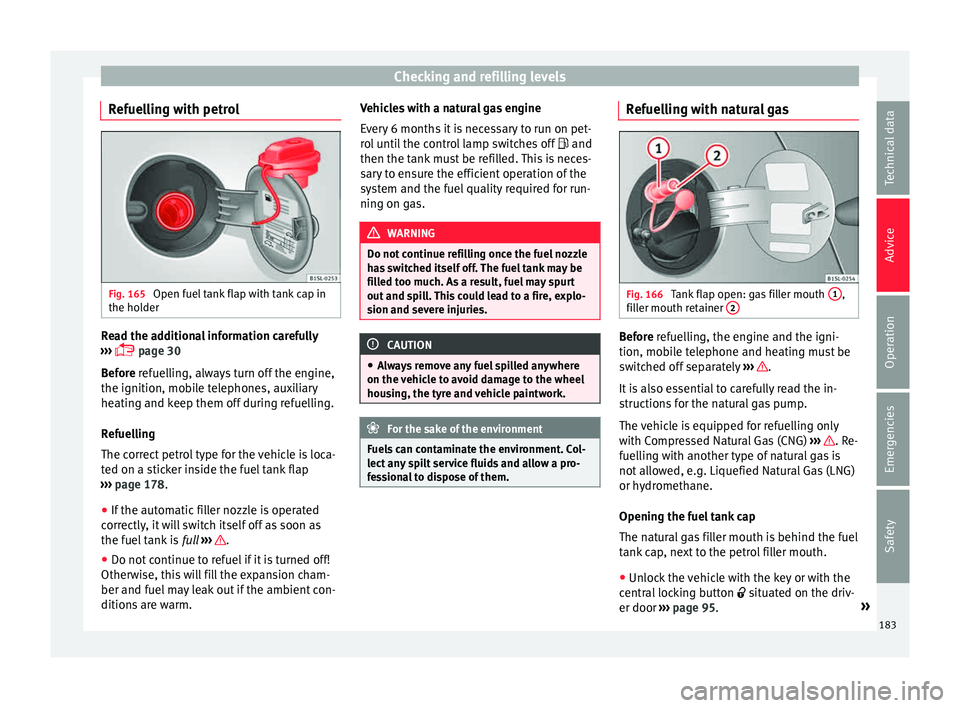
Refuelling with petrol Fig. 165
Open fuel tank flap with tank cap in
the ho l
der Read the additional information carefully
› ›
›
page 30
Before refuelling, always turn off the engine,
the ignition, mobile telephones, auxiliary
heating and keep them off during refuelling.
Refuelling
The correct petrol type for the vehicle is loca-
ted on a sticker inside the fuel tank flap
››› page 178.
● If the automatic filler nozzle is operated
correctly
, it will switch itself off as soon as
the fuel tank is full ››› .
● Do not continue to refuel if it is turned off!
Other w
i
se, this will fill the expansion cham-
ber and fuel may leak out if the ambient con-
ditions are warm. Vehicles with a natural gas engine
Ever
y 6 months it is necessary to run on pet-
rol until the control lamp switches off and
then the tank must be refilled. This is neces-
sary to ensure the efficient operation of the
system and the fuel quality required for run-
ning on gas. WARNING
Do not continue refilling once the fuel nozzle
ha s
switched itself off. The fuel tank may be
filled too much. As a result, fuel may spurt
out and spill. This could lead to a fire, explo-
sion and severe injuries. CAUTION
● Alw a
ys remove any fuel spilled anywhere
on the vehicle to avoid damage to the wheel
housing, the tyre and vehicle paintwork. For the sake of the environment
Fuels can contaminate the environment. Col-
lect an
y spilt service fluids and allow a pro-
fessional to dispose of them. Refuelling with natural gas
Fig. 166
Tank flap open: gas filler mouth 1 ,
fi l
l
er mouth retainer 2 Before r
efuelling, the engine and the igni-
tion, mo b
ile telephone and heating must be
switched off separately ››› .
It i
s
also essential to carefully read the in-
structions for the natural gas pump.
The vehicle is equipped for refuelling only
with Compressed Natural Gas (CNG) ››› . Re-
f uel
lin
g with another type of natural gas is
not allowed, e.g. Liquefied Natural Gas (LNG)
or hydromethane.
Opening the fuel tank cap
The natural gas filler mouth is behind the fuel
tank cap, next to the petrol filler mouth.
● Unlock the vehicle with the key or with the
central
locking button situated on the driv-
er door ››› page 95. »
183
Technical data
Advice
Operation
Emergencies
Safety
Page 186 of 232
Advice
● Pr e
s
s on the rear area of the flap and open
it.
Refuelling
Problem: If the ambient temperature is very
high, the natural gas pump protection
against overheating disconnects this auto-
matically.
● Remove the plug from the gas filler mouth
›››
Fig. 166 1 .
● Connect the pump filling nozzle to the gas
fi l
l
er mouth.
● The fuel tank will be full when the p
ump
compressor automatically cuts the supply.
● If you wish to finish refuelling in advance,
pres
s the button on the pump to stop the
flow.
Closing the fuel tank cap
● Check that the gas filler mouth retainer 2is not trapped with the filler nozzle. If neces-
s
ar
y
, place it in the filler mouth again.
● Insert the plug in the filler mouth.
● Close the tank flap. Make sure you hear it
click
into place. WARNING
Natural gas is a highly explosive, easily flam-
mab l
e substance. Incorrect handling of the
natural gas can cause accidents serious
burns and other injuries. ●
Bef or
e refuelling with natural gas, the fill-
ing mouth must be correctly engaged. If you
can smell gas, stop refuelling immediately. WARNING
The vehicle is not prepared to use liquefied
n at ur
al gas (LNG) and this fuel must not be
added under any circumstances. Liquefied
natural gas can cause the natural gas tank to
explode, resulting in serious injury. Note
● The fil lin
g nozzles of natural gas pumps
can differ in the way they are operated. If you
are unacquainted with the pump, it is advisa-
ble that a member of staff of the service sta-
tion performs the refuelling operation.
● Noises heard when refuelling are normal
and do not indicat
e the presence of a fault in
the system.
● The vehicle natural gas system is prepared
both for ref
uelling with a small compressor
(slow refuel) and a large compressor (fast re-
fuel) in natural gas service stations. Bonnet
W ork in
g in the engine compartment Read the additional information carefully
› ›
›
page 10 Before working in the engine compartment,
make s
ure that the vehicle is parked on hori-
zontal and firm ground.
The engine compartment of the vehicle is a
hazardous area. Never work on the engine or
in the engine compartment if you are not fa-
miliar with the operations to be carried out,
the applicable safety standards and especial-
ly if you do not have the necessary instru-
ments, liquids and tools ››› ! If required,
h av
e an
y work carried out by a specialised
workshop. Negligent work can cause serious
injury. WARNING
If the vehicle moves unexpectedly, this could
cau se seriou
s injury.
● Never work under the vehicle if it has not
been immobi
lized. If you must work under-
neath the vehicle with the wheels in contact
with the ground then it should be parked on
flat ground, the wheels should be prevented
from moving and the key should be removed
from the ignition.
● If you have to work underneath the vehicle,
you mus
t use suitable stands additionally to
support the vehicle, there is a risk of acci-
dent!. The jack is not intended for this kind of
work and its failure could lead to severe inju-
ries.
● Disconnect the Start-Stop system. 184
Page 199 of 232

Wheels and tyres
Wheels and tyres
T y
r
es
Introduction SEAT recommend that all work on tyres and
wheels
i
s carried out by a specialised work-
shop. These workshops have the necessary
special tools and replacement parts, trained
personnel and facilities for disposing of the
old tyres while respecting the environment.
SEAT recommends taking your car in for tech-
nical service. WARNING
The vehicle cannot be totally controlled or
brak ed if
the tyres (new or used) are worn or
damaged.
● Incorrect use of wheels and tyres could
make driv
ing more dangerous and result in
serious accidents and damage.
● All four wheels must be fitted with radial
tyre
s of the same type, size (rolling circumfer-
ence) and the same tread pattern.
● New tyres do not give maximum grip and
wil
l not have reached their maximum braking
capacity to start with, and therefore need
running in. To prevent accidents and major
damage, extreme caution should be taken for
the first 600 km. ●
Check ty
re pressures regularly and ensure
they are maintained at the pressures indica-
ted. If the tyre pressure is too low, they could
overheat, resulting in tread detachment or
even burst tyres.
● Never drive on damaged (punctured, cut,
crac
ked or dented) or worn tyres. Driving on
damaged or worn tyres could result in burst
tyres, serious accidents or damage. Worn or
damaged tyres must be replaced immediate-
ly.
● Never exceed the maximum permitted
speed or loa
ds specified for the type of tyre
fitted on your vehicle.
● The effectiveness of driver and brake assist
syst
ems also depends on the grip of the
tyres.
● If you notice unusual vibration or if the ve-
hicle p
ulls to one side when driving, stop the
car immediately and check the tyres and
wheels for damage.
● To minimise the risk of losing control of the
vehicl
e or causing a serious accident, never
undo the bolted joints of beadlock wheels.
● Never mount used tyres or wheels if you are
not sur
e of their previous history. They may
be damaged, although the damage is not im-
mediately visible.
● Old tyres, even if they have never been
used, ma
y lose air or burst unexpectedly
while driving, especially at high speeds, re-
sulting in serious accident and injury. If tyres
are over six years old, they should only be used in an emergency and with extreme cau-
tion.
Note
For technical reasons, it is not generally pos-
s ib l
e to use the wheels from other vehicles.
In some cases, this may also be true for the
same model of wheel. Please refer to the ve-
hicle documentation or ask at a technical
service. Handling tyres and wheels
Fig. 172
Diagram for changing wheels The tyres of a vehicle are the components
whic
h ar
e s
ubjected to most stress and are
the most underestimated. Tyres are very im-
portant, as the support offered by their nar-
row surface is the only point of contact be-
tween the vehicle and the road. »
197
Technical data
Advice
Operation
Emergencies
Safety
Page 200 of 232
Advice
The service life of tyres is dependent on tyre
pr e
s
sure, driving style, the care they receive
and the correct fitting.
The tyres and wheel rims are an essential
part of the vehicle's design. The tyres and
rims approved by SEAT are specially matched
to the characteristics of the vehicle and our
critical to good road holding and safe han-
dling.
Avoiding damage to tyres and wheels
● If you have to drive over a kerb or similar
obs
tacle, drive very slowly and as near as
possible at a right angle to the kerb.
● Inspect the tyres regularly for damage
(punct
ures, cuts, cracks, dents).
● Remove any foreign bodies found on the
outside of the ty
re tread and ensure that they
have not passed through the wall of the tyre
››› page 202.
● In addition, the instructions for tyre control
syst
ems should always be observed.
● Replace damaged or worn tyres as soon as
poss
ible ››› page 202.
● Regularly check tyres for non-visible dam-
age ››
› page 202.
● Never exceed the maximum permitted
speed or loa
ds specified for the type of tyre
fitted on your vehicle ››› page 205.
● Do not allow tyres (including the spare
wheel) to come int
o contact with aggressive substances, grease, oil, fuel or brake fluid
›››
.
● Lost valve caps should be replaced imme-
di at
ely
.
Tyres with directional tread pattern
Tyres with directional tread pattern have
been designed to operate best when rotating
in only one direction. An arrow on the tyre
sidewall indicates the direction of rotation on
tyres with directional tread ››› page 205. Al-
ways observe the direction of rotation indica-
ted when mounting the wheel. This guaran-
tees optimum grip and helps to avoid aqua-
planing, excessive noise and wear.
If the tyre is mounted in the opposite direc-
tion of rotation, drive with extreme caution,
as the tyre is no longer being used correctly.
This is of particular importance when the
road surface is wet. Change the tyre as soon
as possible or remount it with the correct di-
rection of rotation.
Interchanging tyres
To ensure that the wear is equal on all tyres
the wheels should be changed round from
time to time according to the system
››› Fig. 172. The useful life of all the tyres will
then be about the same time.
SEAT recommends you take the vehicle to a
specialised workshop to have the tyres
changed. Tyres over 6 years old
Tyr
es are subject to an ageing process as a
result of physical and chemical processes.
This may affect their performance. Tyres
which are stored for long periods of time
without being used, harden and become
more fragile than tyres which are in constant
use.
SEAT recommends that tyres over six years
old are replaced with new tyres. This also ap-
plies to tyres (including the spare wheel)
which appear to be in perfect condition on
the outside and which have a tread depth
within the values stipulated by the Law ››› .
The d at
e of
manufacture, part of the tyre
identification number (TIN), indicates the age
of the tyre ( ) ››› page 205.
Storing tyres
Mark tyres when you remove them to indicate
the direction of rotation (left, right, forwards,
backwards). This ensures you will be able to
mount them correctly when you replace
them. When removed, the wheels and/or
tyres should be stored in a cool, dry and pref-
erably dark location. Do not place tyres
mounted on the wheel in a vertical position.
Protect tyres not mounted on wheels from
dirt by storing them in suitable bags and
standing them on the ground on their tread.
198
Page 201 of 232
Wheels and tyres
WARNING
Aggressive fluids or substances could result
in v i
sible or invisible damage with the conse-
quent risks.
● Always ensure that tyres do not come into
contact
with chemical products, oil, grease,
fuel, brake fluid or other aggressive substan-
ces. WARNING
Old tyres, even if they have never been used,
ma y
lose air or burst unexpectedly while driv-
ing, resulting in serious accident or damage.
● If tyres are over six years old, they should
only be u
sed in an emergency and with ex-
treme caution. For the sake of the environment
Old tyres must be disposed of by qualified
personnel ac
cording to the laws in the coun-
try concerned. Wheels
The design of wheel bolts is matched to the
rims. If
diff
er
ent rims are fitted, the correct
wheel bolts with the right length and correct-
ly shaped bolt heads must be used. This en-
sures that wheels are fitted securely and that
the brake system functions correctly
››› page 71. For technical reasons, it is not generally pos-
sibl
e to use the wheels from other vehicles.
In some cases, this may also be true for the
same model of wheel.
The tyres and rims approved by SEAT are spe-
cially matched to the characteristics of the
vehicle and are critical to good road holding
and safe handling.
Note for Italy: A SEAT Service Centre should
be consulted whether different sized wheels
or tyres to those originally fitted by SEAT may
be fitted, as well as the combinations al-
lowed between the front axle (axle 1) and
back axle (axle 2).
Wheel bolts
Wheel bolts must be tightened to the correct
torque ››› page 71.
Beadlock wheel rims
Beadlock wheel rims have various compo-
nents. These are joined together by special
bolts using a special procedure. This ensures
good performance, a better seal, improved
safety and wheel run out. Therefore, worn
rims should always be replaced and must on-
ly be repaired in a specialised workshop.
SEAT recommends visiting a technical service
››› .Wheel rims with bolted trims
Wheel
rims
m
ay be fitted with interchangea-
ble trim parts which are attached to the rim
using self-locking bolts. Worn trims should
only be replaced at a specialised workshop.
SEAT recommends visiting a technical service
››› .
WARNING
The use of worn or damaged wheel rims could
mak e driv
ing more dangerous and result in
serious accidents and damage.
● Only wheel rims which have been approved
for use w
ith your vehicle should be used.
● Inspect wheel rims regularly for damage
and repl
ace as required. WARNING
If the bolted joints of wheel rims with bolted
ring trims ar
e not correctly tightened or loos-
ened, this could result in serious accident.
● Never loosen the bolted joints of wheel
rims with bo
lted ring trims.
● Any work relating to wheel rims with bolted
rims shoul
d be carried out at specialised
workshop. SEAT recommends taking your car
in for technical service. 199
Technical data
Advice
Operation
Emergencies
Safety