fuel pump Seat Mii 2015 Owner's manual
[x] Cancel search | Manufacturer: SEAT, Model Year: 2015, Model line: Mii, Model: Seat Mii 2015Pages: 232, PDF Size: 4.23 MB
Page 130 of 232
Operation
Air vents
Nev er c
lo
se the air vents ››› Fig. 141 A com-
p l
et
ely to ensure heating, cooling and venti-
lation inside the vehicle.
● To open the air vents press the recess with
one slat
.
● Change the air direction by turning the
slats.
● T
o close the air vents, fold the slats.
There are a
dditional air vents in the centre of
the dash panel and in the footwell area. CAUTION
Never place food, medicines or other heat-
sens itiv
e objects close to the air vents. Being
heat-sensitive, they may be damaged or
made unsuitable for use by the air coming
from the air vents. Air recirculation mode
Important
Air r
ec
ir
culation mode prevents the ambient
air from entering the interior.
When the outside temperature is very high or
very low, selecting manual air recirculation
mode for a short period refreshes or heats
the interior more quickly. ●
Switc
h off air recirculation mode by turning
the air distribution control to the ››› po-
s ition.
Sw it
ching the air recirculation mode on and
off
Switching on: Move the sliding control
››› Fig. 140 4 to the right to maximum.
S wit
c
hing off: Move the sliding control
››› Fig. 140 4 to the left to maximum.
WARNING
Stuffy or used air will increase fatigue and re-
duce driv er c
oncentration possibly resulting
in a serious accident.
● Never use recirculation mode for long peri-
ods a
s it does not refresh the air inside the
vehicle.
● If the cooling system is switched off and air
recir
culation mode switched on, the windows
can mist over very quickly, considerably limit-
ing visibility.
● Switch air recirculation mode off when it is
not requir
ed. CAUTION
Do not smoke when the air recirculation is ac-
tivat ed.
The smoke taken in could lie on the
cooling system vaporiser and on the dust and
pollen filter, leading to a permanently un-
pleasant smell. Driving
St eerin
g
Intr
oduction The power steering* is not hydraulic but elec-
tromec
h
anical. The advantage of this steer-
ing system is that it disposes of hydraulic
tubes, hydraulic oil, the pump, filter and oth-
er components. The electromechanical sys-
tem saves fuel. While a hydraulic system re-
quires oil pressure to be maintained, electro-
mechanical steering only requires energy
when the steering wheel is turned.
With the power steering system, the assisted
steering function automatically adjusts ac-
cording to the vehicle speed, the steering tor-
que and the wheel turning angle. The power
steering only works when the engine is run-
ning. WARNING
If the power steering is not working then the
st eerin
g wheel is much more difficult to turn
and the vehicle more difficult to control.
● The power steering only works when the
engine is
running.
● Never allow the vehicle to move when the
engine is
switched off.
● Never remove the key from the ignition if
the vehic
le is in motion. The steering may128
Page 184 of 232
AdviceFlashes for about 10
secondsState of the barsPossible cause ››› Solution
and the segments
remaining a)Reserve zone (four small segments)The fuel tank is almost empty.
The reserve tank is being used
››› page 30.Refuel as soon as possible ››› .
–The vehicle is running in natural gas operating mode.–
a)
This only applies to vehicles with the fuel gauge on the dash panel display.
Several warning and indication lamps light
up for a few seconds when the ignition is
switched on, signalling that the function is
being verified. They will switch off after a few
seconds.
In natural gas engines
The warning lamp lights up when both fuel
types (petrol and natural gas) have reached
reserve level.
The warning lamp lights up when the vehi-
cle is running in natural gas operating mode.
The warning lamp switches off when the
natural gas is exhausted. The engine
changes to operate with petrol.
Problem: if the vehicle is left parked for a
long time just after refuelling, the gas level
indicator does not accurately indicate the
same level shown after refuelling when the
vehicle is started up again. This is not due to
a leak in the system, but to a drop in pres-
sure in the gas tank for technical reasons af- ter a cooling phase immediately after refuel-
ling. WARNING
Driving with insufficient fuel reserve could re-
su lt
in the vehicle breaking down in traffic
and a serious accident.
● If the fuel level is too low then the fuel sup-
ply t
o the engine can become irregular espe-
cially on slopes.
● If the engine “is choked” or stalls due to
lack
of or irregularity of the fuel supply, the
power steering as well as all of the driver as-
sistance systems including braking assis-
tance will stop working.
● Always refuel when there is only one quar-
ter of the f
uel tank left to avoid running out of
fuel. CAUTION
● Alw a
ys pay attention to any lit control
lamps and to the corresponding descriptions and instructions to avoid damage to the vehi-
cl
e.
● Nev
er run the fuel tank completely dry. An
irregu
lar fuel supply may lead to ignition
faults and unburnt fuel could enter the ex-
haust system. This could damage the catalyt-
ic converter. Note
The arrow next to the fuel pump symbol on
the ins trument
panel ››› Fig. 163 indicates the
side of the vehicle on which the fuel tank flap
is located. 182
Page 185 of 232
Checking and refilling levels
Refuelling with petrol Fig. 165
Open fuel tank flap with tank cap in
the ho l
der Read the additional information carefully
› ›
›
page 30
Before refuelling, always turn off the engine,
the ignition, mobile telephones, auxiliary
heating and keep them off during refuelling.
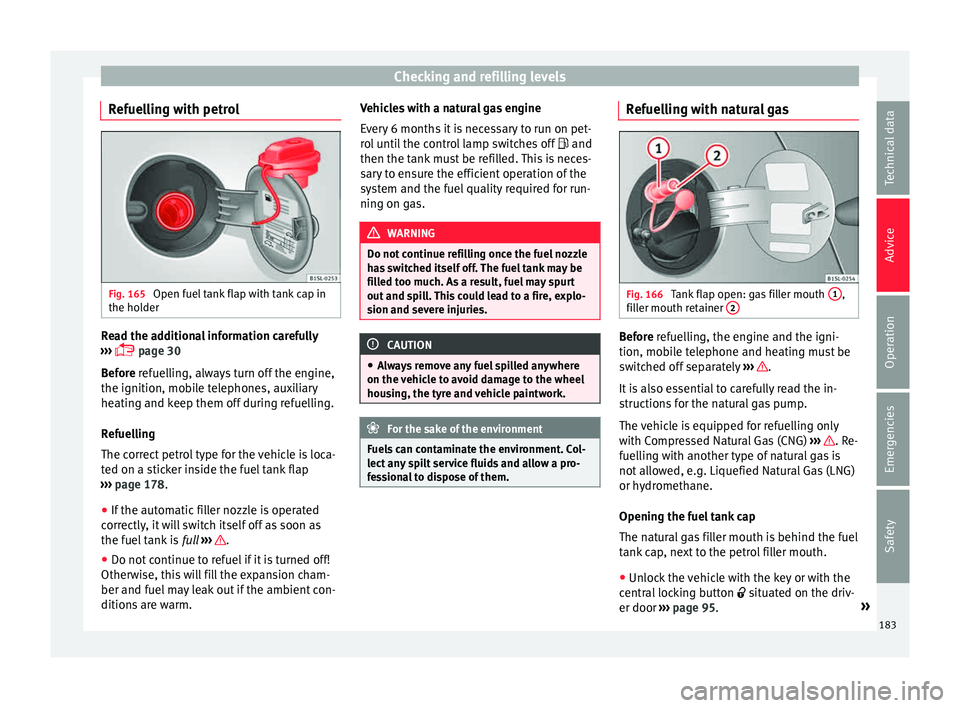
Refuelling
The correct petrol type for the vehicle is loca-
ted on a sticker inside the fuel tank flap
››› page 178.
● If the automatic filler nozzle is operated
correctly
, it will switch itself off as soon as
the fuel tank is full ››› .
● Do not continue to refuel if it is turned off!
Other w
i
se, this will fill the expansion cham-
ber and fuel may leak out if the ambient con-
ditions are warm. Vehicles with a natural gas engine
Ever
y 6 months it is necessary to run on pet-
rol until the control lamp switches off and
then the tank must be refilled. This is neces-
sary to ensure the efficient operation of the
system and the fuel quality required for run-
ning on gas. WARNING
Do not continue refilling once the fuel nozzle
ha s
switched itself off. The fuel tank may be
filled too much. As a result, fuel may spurt
out and spill. This could lead to a fire, explo-
sion and severe injuries. CAUTION
● Alw a
ys remove any fuel spilled anywhere
on the vehicle to avoid damage to the wheel
housing, the tyre and vehicle paintwork. For the sake of the environment
Fuels can contaminate the environment. Col-
lect an
y spilt service fluids and allow a pro-
fessional to dispose of them. Refuelling with natural gas
Fig. 166
Tank flap open: gas filler mouth 1 ,
fi l
l
er mouth retainer 2 Before r
efuelling, the engine and the igni-
tion, mo b
ile telephone and heating must be
switched off separately ››› .
It i
s
also essential to carefully read the in-
structions for the natural gas pump.
The vehicle is equipped for refuelling only
with Compressed Natural Gas (CNG) ››› . Re-
f uel
lin
g with another type of natural gas is
not allowed, e.g. Liquefied Natural Gas (LNG)
or hydromethane.
Opening the fuel tank cap
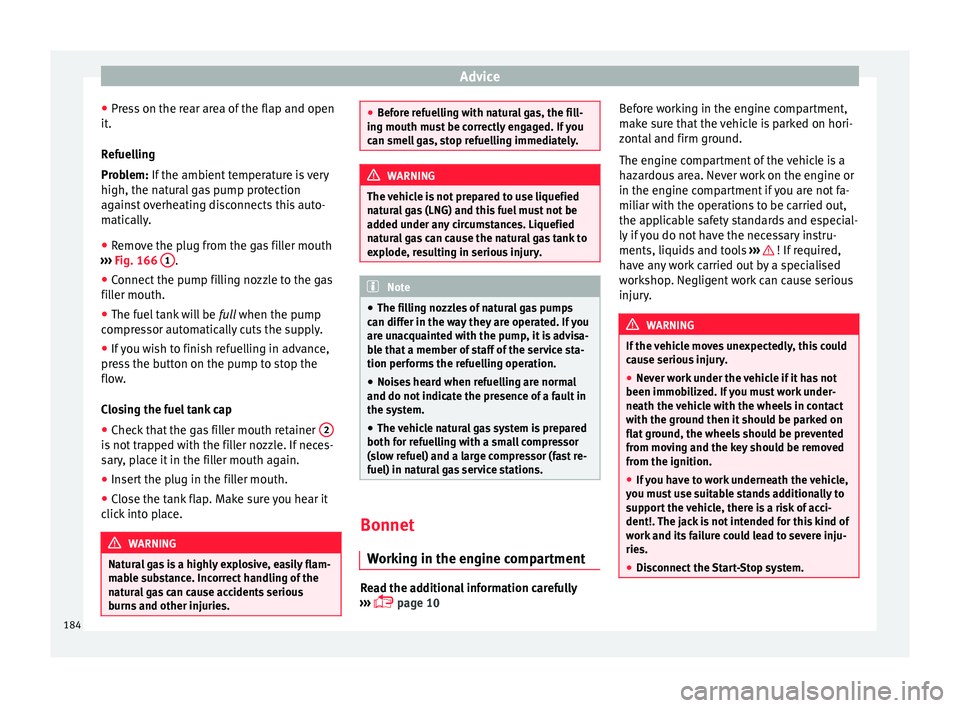
The natural gas filler mouth is behind the fuel
tank cap, next to the petrol filler mouth.
● Unlock the vehicle with the key or with the
central
locking button situated on the driv-
er door ››› page 95. »
183
Technical data
Advice
Operation
Emergencies
Safety
Page 186 of 232
Advice
● Pr e
s
s on the rear area of the flap and open
it.
Refuelling
Problem: If the ambient temperature is very
high, the natural gas pump protection
against overheating disconnects this auto-
matically.
● Remove the plug from the gas filler mouth
›››
Fig. 166 1 .
● Connect the pump filling nozzle to the gas
fi l
l
er mouth.
● The fuel tank will be full when the p
ump
compressor automatically cuts the supply.
● If you wish to finish refuelling in advance,
pres
s the button on the pump to stop the
flow.
Closing the fuel tank cap
● Check that the gas filler mouth retainer 2is not trapped with the filler nozzle. If neces-
s
ar
y
, place it in the filler mouth again.
● Insert the plug in the filler mouth.
● Close the tank flap. Make sure you hear it
click
into place. WARNING
Natural gas is a highly explosive, easily flam-
mab l
e substance. Incorrect handling of the
natural gas can cause accidents serious
burns and other injuries. ●
Bef or
e refuelling with natural gas, the fill-
ing mouth must be correctly engaged. If you
can smell gas, stop refuelling immediately. WARNING
The vehicle is not prepared to use liquefied
n at ur
al gas (LNG) and this fuel must not be
added under any circumstances. Liquefied
natural gas can cause the natural gas tank to
explode, resulting in serious injury. Note
● The fil lin
g nozzles of natural gas pumps
can differ in the way they are operated. If you
are unacquainted with the pump, it is advisa-
ble that a member of staff of the service sta-
tion performs the refuelling operation.
● Noises heard when refuelling are normal
and do not indicat
e the presence of a fault in
the system.
● The vehicle natural gas system is prepared
both for ref
uelling with a small compressor
(slow refuel) and a large compressor (fast re-
fuel) in natural gas service stations. Bonnet
W ork in
g in the engine compartment Read the additional information carefully
› ›
›
page 10 Before working in the engine compartment,
make s
ure that the vehicle is parked on hori-
zontal and firm ground.
The engine compartment of the vehicle is a
hazardous area. Never work on the engine or
in the engine compartment if you are not fa-
miliar with the operations to be carried out,
the applicable safety standards and especial-
ly if you do not have the necessary instru-
ments, liquids and tools ››› ! If required,
h av
e an
y work carried out by a specialised
workshop. Negligent work can cause serious
injury. WARNING
If the vehicle moves unexpectedly, this could
cau se seriou
s injury.
● Never work under the vehicle if it has not
been immobi
lized. If you must work under-
neath the vehicle with the wheels in contact
with the ground then it should be parked on
flat ground, the wheels should be prevented
from moving and the key should be removed
from the ignition.
● If you have to work underneath the vehicle,
you mus
t use suitable stands additionally to
support the vehicle, there is a risk of acci-
dent!. The jack is not intended for this kind of
work and its failure could lead to severe inju-
ries.
● Disconnect the Start-Stop system. 184