cooling Seat Mii 2016 Owner's manual
[x] Cancel search | Manufacturer: SEAT, Model Year: 2016, Model line: Mii, Model: Seat Mii 2016Pages: 232, PDF Size: 4.9 MB
Page 5 of 232
Table of Contents
Table of Contents
The e s
senti
als . . . . . . . . . . . . . . . . . . . . . . . . 5
Exterior view . . . . . . . . . . . . . . . . . . . . . . . . . . . . 5
Exterior view . . . . . . . . . . . . . . . . . . . . . . . . . . . . 6
Interior view (left guide) . . . . . . . . . . . . . . . . . . 7
How it works . . . . . . . . . . . . . . . . . . . . . . . . . . . . 8
Unlocking and locking . . . . . . . . . . . . . . . . . . . . 8
Before driving . . . . . . . . . . . . . . . . . . . . . . . . . . . 12
Airbags . . . . . . . . . . . . . . . . . . . . . . . . . . . . . . . . 14
Child seats . . . . . . . . . . . . . . . . . . . . . . . . . . . . . 16
Starting the vehicle . . . . . . . . . . . . . . . . . . . . . . 20
Lights and visibility . . . . . . . . . . . . . . . . . . . . . . 21
SEAT information system . . . . . . . . . . . . . . . . . . 22
Cruise control . . . . . . . . . . . . . . . . . . . . . . . . . . . 24
Warning lamps . . . . . . . . . . . . . . . . . . . . . . . . . . 24
Gearbox lever . . . . . . . . . . . . . . . . . . . . . . . . . . . 26
Air conditioning . . . . . . . . . . . . . . . . . . . . . . . . . 27
Fluid Level control . . . . . . . . . . . . . . . . . . . . . . . 31
Emergencies . . . . . . . . . . . . . . . . . . . . . . . . . . . . 34
Fuses . . . . . . . . . . . . . . . . . . . . . . . . . . . . . . . . . . 34
Bulbs . . . . . . . . . . . . . . . . . . . . . . . . . . . . . . . . . . 35
Action in the event of a puncture . . . . . . . . . . . 35
Changing a wheel . . . . . . . . . . . . . . . . . . . . . . . 36
Snow chains . . . . . . . . . . . . . . . . . . . . . . . . . . . . 41
Emergency towing of the vehicle . . . . . . . . . . . 42
How to jump start . . . . . . . . . . . . . . . . . . . . . . . . 43
Changing the wiper blades . . . . . . . . . . . . . . . . 45
Safety . . . . . . . . . . . . . . . . . . . . . . . . . . . . . . . . 47
Safe driving . . . . . . . . . . . . . . . . . . . . . . . . . . . . 47
Safety first! . . . . . . . . . . . . . . . . . . . . . . . . . . . . . 47
Driving advice . . . . . . . . . . . . . . . . . . . . . . . . . . . 47
Correct position of the vehicle occupants . . . . 48
Pedal area . . . . . . . . . . . . . . . . . . . . . . . . . . . . . . 52 Seat belts
. . . . . . . . . . . . . . . . . . . . . . . . . . . . . . 52
Why wear a seat belt? . . . . . . . . . . . . . . . . . . . . 52
How to properly adjust your seatbelt . . . . . . . . 56
Seat belt tensioners . . . . . . . . . . . . . . . . . . . . . . 58
Airbag system . . . . . . . . . . . . . . . . . . . . . . . . . . 59
Brief introduction . . . . . . . . . . . . . . . . . . . . . . . . 59
Airbag safety instructions . . . . . . . . . . . . . . . . . 62
Deactivating airbags . . . . . . . . . . . . . . . . . . . . . 63
Transporting children safely . . . . . . . . . . . . . . . 64
Safety for children . . . . . . . . . . . . . . . . . . . . . . . 64
Child seats . . . . . . . . . . . . . . . . . . . . . . . . . . . . . 66
Emergencies . . . . . . . . . . . . . . . . . . . . . . . . . . 70
Self-help . . . . . . . . . . . . . . . . . . . . . . . . . . . . . . . 70
In case of emergency . . . . . . . . . . . . . . . . . . . . . 70
Vehicle tool kit* . . . . . . . . . . . . . . . . . . . . . . . . . 70
Changing a wheel . . . . . . . . . . . . . . . . . . . . . . . 72
Tyre repair . . . . . . . . . . . . . . . . . . . . . . . . . . . . . . 72
Changing the windscreen wiper blades . . . . . . 75
Tow-starting and towing . . . . . . . . . . . . . . . . . . 75
Emergency locking and unlocking . . . . . . . . . . 77
Fuses and bulbs . . . . . . . . . . . . . . . . . . . . . . . . . 78
Fuses . . . . . . . . . . . . . . . . . . . . . . . . . . . . . . . . . . 78
Changing bulbs . . . . . . . . . . . . . . . . . . . . . . . . . 79
Operation . . . . . . . . . . . . . . . . . . . . . . . . . . . . . 87
General instrument panel . . . . . . . . . . . . . . . . . 87
Instrument panel . . . . . . . . . . . . . . . . . . . . . . . . 86
Instruments . . . . . . . . . . . . . . . . . . . . . . . . . . . . 88
Opening and closing . . . . . . . . . . . . . . . . . . . . . 92
Vehicle key set . . . . . . . . . . . . . . . . . . . . . . . . . . 92
Central locking* and locking system . . . . . . . . 94
Doors . . . . . . . . . . . . . . . . . . . . . . . . . . . . . . . . . . 98
Rear lid . . . . . . . . . . . . . . . . . . . . . . . . . . . . . . . . 99
Electric windows . . . . . . . . . . . . . . . . . . . . . . . . . 101
Sliding/tilting electric panoramic sunroof . . . . 102 Lights and visibility
. . . . . . . . . . . . . . . . . . . . . . 103
Lights . . . . . . . . . . . . . . . . . . . . . . . . . . . . . . . . . 103
Visibility . . . . . . . . . . . . . . . . . . . . . . . . . . . . . . . 108
Windscreen wiper and window wiper sys-
tems . . . . . . . . . . . . . . . . . . . . . . . . . . . . . . . . . . 108
Mirr
or . . . . . . . . . . . . . . . . . . . . . . . . . . . . . . . . . 111
Seats and head restraints . . . . . . . . . . . . . . . . . 112
Adjusting the seat and head restraints . . . . . . 112
Seat functions . . . . . . . . . . . . . . . . . . . . . . . . . . 113
Transport and practical equipment . . . . . . . . . 114
Transporting objects . . . . . . . . . . . . . . . . . . . . . 114
Practical equipment . . . . . . . . . . . . . . . . . . . . . . 116
Luggage compartment . . . . . . . . . . . . . . . . . . . . 123
Roof carrier . . . . . . . . . . . . . . . . . . . . . . . . . . . . . 127
Air conditioning . . . . . . . . . . . . . . . . . . . . . . . . . 130
Heating, ventilation and cooling . . . . . . . . . . . . 130
Driving . . . . . . . . . . . . . . . . . . . . . . . . . . . . . . . . 133
Steering . . . . . . . . . . . . . . . . . . . . . . . . . . . . . . . 133
Stopping and starting the engine . . . . . . . . . . . 135
Braking and parking . . . . . . . . . . . . . . . . . . . . . 137
Changing gear . . . . . . . . . . . . . . . . . . . . . . . . . . 143
Run-in and economical driving . . . . . . . . . . . . . 148
Engine management and exhaust gas purifica-
tion syst
em . . . . . . . . . . . . . . . . . . . . . . . . . . . . . 151
Driving tips . . . . . . . . . . . . . . . . . . . . . . . . . . . . . 152
Driver assistance systems . . . . . . . . . . . . . . . . . 153
Parking distance warning system* . . . . . . . . . . 153
Cruise control* (Cruise control system -
CCS)
. . . . . . . . . . . . . . . . . . . . . . . . . . . . . . . . . . . 155
Safety Assist* (City Safety Assist function) . . . . 156
Hill driving assistant* . . . . . . . . . . . . . . . . . . . . 160
Start-Stop System . . . . . . . . . . . . . . . . . . . . . . . . 161
Towing bracket device . . . . . . . . . . . . . . . . . . . . 163
Driving with a trailer . . . . . . . . . . . . . . . . . . . . . . 163
3
Page 29 of 232
The essentials
Reverse gear
Neutr al
(idlin
g)
Drive (forward)
R
N
D Tiptronic mode: pull the lever forwards
(+) to go up a g
ear or backwards ( –) to
go down a gear.
M
››› in Automatic gear change on
page 146
››› page 145 Air conditioning
Ho w doe
s
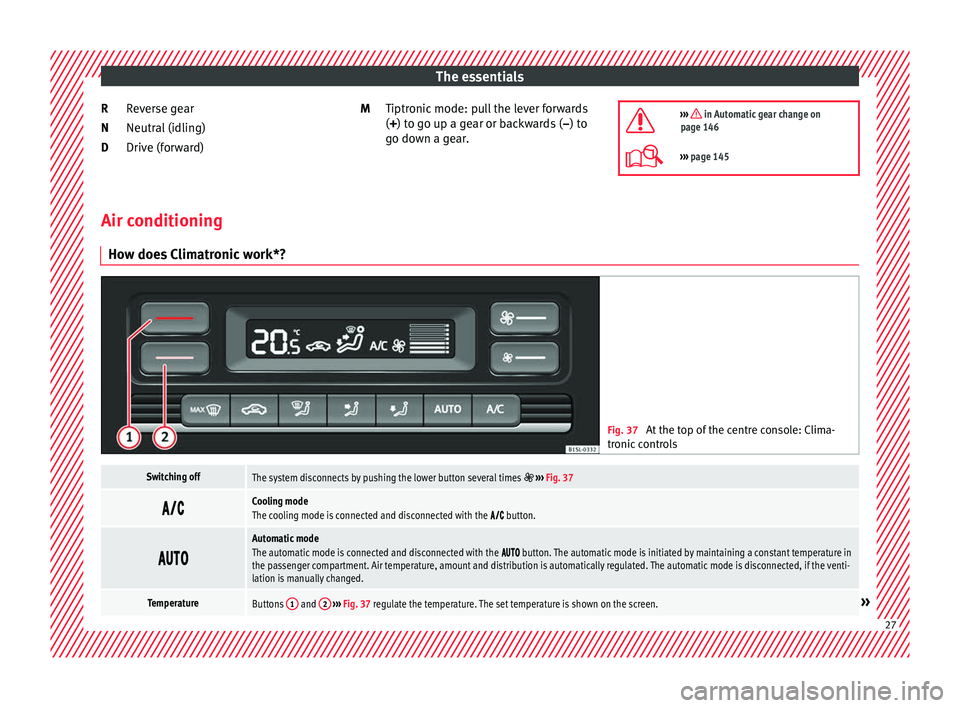
Climatronic work*? Fig. 37
At the top of the centre console: Clima-
tronic c
ontrols
Switching offThe system disconnects by pushing the lower button several times ››› Fig. 37
Cooling mode
The cooling mode is connected and disconnected with the button.
Automatic mode
The automatic mode is connected and disconnected with the button. The automatic mode is initiated by maintaining a constant temperature in
the passenger compartment. Air temperature, amount and distribution is automatically regulated. The automatic mode is disconnected, if the venti-
lation is manually changed.
TemperatureButtons 1 and 2
››› Fig. 37 regulate the temperature. The set temperature is shown on the screen.» 27
Page 31 of 232
The essentials
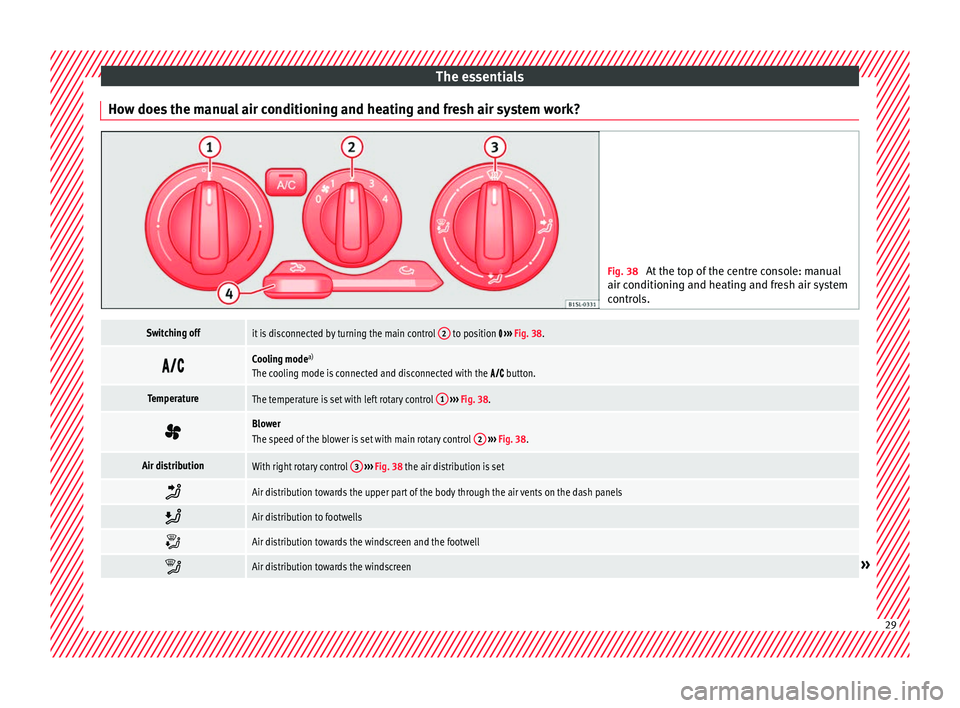
How does the manual air conditioning and heating and fresh air system work? Fig. 38
At the top of the centre console: manual
air conditionin g and he
ating and fresh air system
controls.
Switching offit is disconnected by turning the main control 2 to position
››› Fig. 38.
Cooling mode
a)
The cooling mode is connected and disconnected with the button.
TemperatureThe temperature is set with left rotary control 1
››› Fig. 38.
Blower
The speed of the blower is set with main rotary control
2
››› Fig. 38.
Air distributionWith right rotary control 3
››› Fig. 38 the air distribution is set
Air distribution towards the upper part of the body through the air vents on the dash panels
Air distribution to footwells
Air distribution towards the windscreen and the footwell
Air distribution towards the windscreen»
29
Page 34 of 232
The essentials
● Zone B : You can add oil but keep the level
in th at
zone.
● Zone C : Add oil up to zone
B .
T op
pin
g up engine oil
● Unscrew cap from oil filler opening.
● Add oil slowly.
● At the same time, check the level to ensure
you do not a
dd too much.
● When the oil level reaches at least zone B ,
u n
s
crew the engine oil filler cap carefully.
Specifications of engine oil with a service de-
pendent on time/distance travelled
44 kW - 55 kW Petrol en-
ginesVW 504 00, VW 502 00
Natural gas engineVW 502 00
››› in Topping up engine oil on
page 191
››› page 188 Coolant
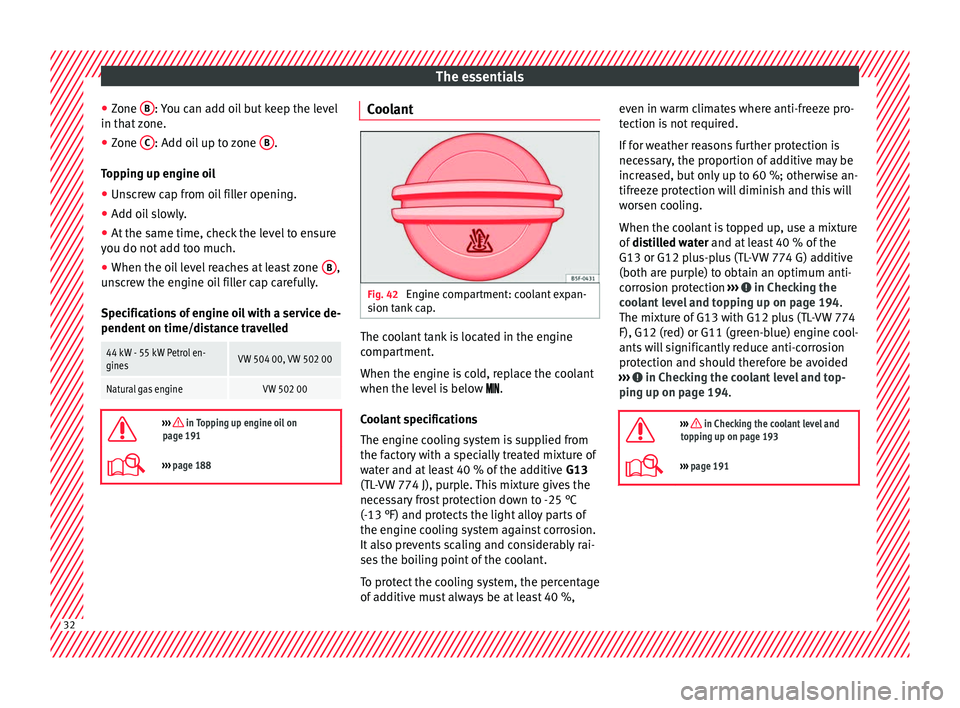
Fig. 42
Engine compartment: coolant expan-
s ion t
ank
cap. The coolant tank is located in the engine
c
omp
ar
tment.
When the engine is cold, replace the coolant
when the level is below .
Coolant specifications
The engine cooling system is supplied from
the factory with a specially treated mixture of
water and at least 40 % of the additive G13
(TL-VW 774 J), purple. This mixture gives the
necessary frost protection down to -25 °C
(-13 °F) and protects the light alloy parts of
the engine cooling system against corrosion.
It also prevents scaling and considerably rai-
ses the boiling point of the coolant.
To protect the cooling system, the percentage
of additive must always be at least 40 %, even in warm climates where anti-freeze pro-
tection is
not required.
If for weather reasons further protection is
necessary, the proportion of additive may be
increased, but only up to 60 %; otherwise an-
tifreeze protection will diminish and this will
worsen cooling.
When the coolant is topped up, use a mixture
of distilled water and at least 40 % of the
G13 or G12 plus-plus (TL-VW 774 G) additive
(both are purple) to obtain an optimum anti-
corrosion protection ››› in Checking the
c oo
l
ant level and topping up on page 194.
The mixture of G13 with G12 plus (TL-VW 774
F), G12 (red) or G11 (green-blue) engine cool-
ants will significantly reduce anti-corrosion
protection and should therefore be avoided
››› in Checking the coolant level and top-
pin g up on p
ag
e 194.
››› in Checking the coolant level and
topping up on page 193
››› page 191 32
Page 132 of 232
Operation
Air conditioning
He atin
g,
ventilation and cool-
ing
Introduction Read the additional information carefully
›› ›
page 27
One of the following systems can be installed
in the vehicle:
● Heating and fresh air system
● Manual air conditioning
● Climatronic
The heatin g and fr
esh air system heats and
ventilates the passenger compartment. The
heating and fresh air system cannot cool.
The manual air conditioning and the Clima-
tronic cool and dehumidify the air. Its opti-
mum output is achieved with the windows
and the glass sunroof closed. In case of con-
siderable heat build-up in the passenger
compartment, ventilating this compartment
can accelerate the cooling process.
Display of active functions
The luminous diodes (LED) that light up on
the rotary regulators and on the buttons that
indicate that the corresponding function is
activated. In the case of the Climatronic, the functions
that ar
e activated are shown on the control
panel display. WARNING
When visibility through the windows is poor,
the risk of
accidents or collisions taking place
is increased, which can lead to serious inju-
ries.
● To obtain good visibility, keep the windows
free of ic
e, snow and frost.
● Set the heating, the air conditioner and the
rear w
indow defroster so that the windows do
not mist over.
● Only put the car in gear when there is good
vis
ibility through the windows.
● Do not use the air recirculation for a long
time period. With the c
ooling disconnected
and the air recirculation connected, the win-
dows can quickly mist over and seriously ob-
struct visibility.
● Disconnect the air recirculation whenever it
is not
needed. WARNING
Stale air can quickly bring about fatigue for
the driver and r educ
e his/her capacity to con-
centrate, which could lead to collisions, acci-
dents and serious injuries.
● Never disconnect the blower for an exten-
ded time or never le
ave the air recirculation
disconnected for an extended time, since in the meantime, no outside fresh air shall enter
the pa
s
senger compartment. CAUTION
If the air conditioner does not work, discon-
nect it immedi
ately together with the defrost-
ing/demisting function (in the case of manual
air conditioning) and have the system
checked out by a specialised workshop. In
this way, other damage can be avoided. CAUTION
To avoid damage to the rear window defrost-
er , u nder no c
ircumstances should you stick
any adhesives on the electrical filaments of
the interior side of this defroster. Air recirculation
In air recirculation mode, no fresh air enters
the
v
ehic
le interior.
To connect the air recirculation, move the
regulator towards the right or press the
button .
T o di
s
connect the air recirculation, move the
regulator towards the left or press the but-
ton again
› ›
›
.
130
Page 133 of 232
Air conditioning
WARNING
Stale air can quickly bring about fatigue for
the driver and r educ
e his/her capacity to con-
centrate, which could lead to collisions, acci-
dents and serious injuries.
● Never use the air recirculation for an exten-
ded time, since in the me
antime, no outside
fresh air shall enter the passenger compart-
ment.
● With the cooling disconnected and the air
recir
culation connected, the windows can quickly mist over and seriously obstruct visi-
bi
lity
.
● Disconnect the air recirculation whenever it
is not
needed. CAUTION
Do not smoke when the air recirculation is
c onnect ed in
vehicles with an air conditioner.
Smoke taken in could settle in the cooling
system vaporiser and on the dust and pollen
filter, therefore leading to permanently un-
pleasant odours. Note
● Climatr onic:
When the reverse gear is en-
gaged, the air recirculation is briefly connec-
ted to avoid exhaust gas from entering the
passenger compartment.
● Whenever the outside temperature is very
high, it is
essential to connect the manual air
recirculation mode briefly so that the passen-
ger compartment may cool down more quick-
ly. Air vents
Fig. 143
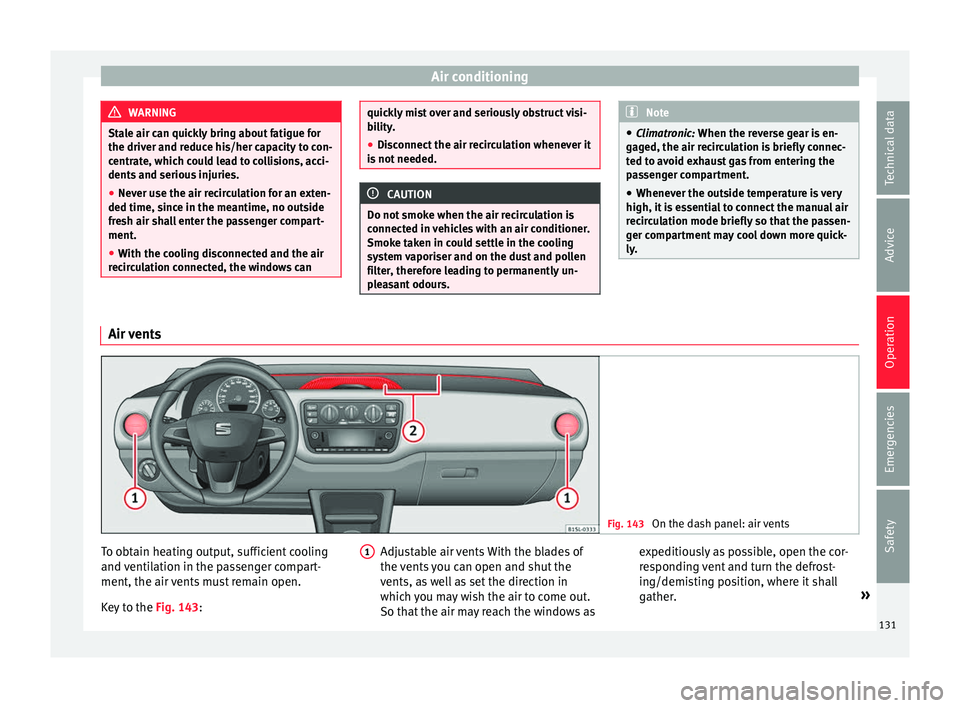
On the dash panel: air vents To obtain heating output, sufficient cooling
and
venti
lation in the passenger compart-
ment, the air vents must remain open.
Key to the Fig. 143: Adjustable air vents With the blades of
the vents
you can open and shut the
vents, as well as set the direction in
which you may wish the air to come out.
So that the air may reach the windows as
1 expeditiously as possible, open the cor-
r
e s
ponding vent and turn the defrost-
ing/demisting position, where it shall
gather. »
131
Technical data
Advice
Operation
Emergencies
Safety
Page 134 of 232
Operation
Non-adjustable air vents
Ther e ar
e no air
vents in the foot well and in
the rear area of the passenger compartment. 2 CAUTION
Never place food, medicines or other temper-
atur e-
sensitive objects close to the air vents.
Food, medicines and other objects sensitive to heat or cold may be damaged or made un-
suit
ab
le for use by the air coming from the
vents. Application tips and instructions for use
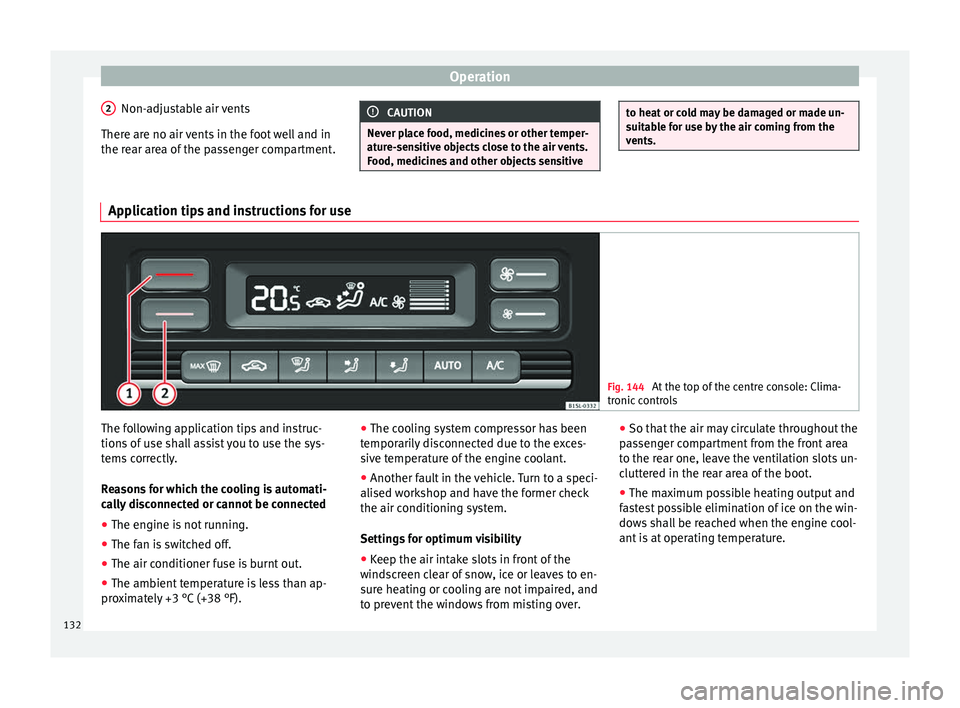
Fig. 144
At the top of the centre console: Clima-
tronic c
ontrols The following application tips and instruc-
tion
s of
use shall assist you to use the sys-
tems correctly.
Reasons for which the cooling is automati-
cally disconnected or cannot be connected
● The engine is not running.
● The fan is switched off.
● The air conditioner fuse is burnt out.
● The ambient temperature is less than ap-
prox
imately +3 °C (+38 °F). ●
The coolin
g system compressor has been
temporarily disconnected due to the exces-
sive temperature of the engine coolant.
● Another fault in the vehicle. Turn to a speci-
alised work
shop and have the former check
the air conditioning system.
Settings for optimum visibility
● Keep the air intake slots in front of the
winds
creen clear of snow, ice or leaves to en-
sure heating or cooling are not impaired, and
to prevent the windows from misting over. ●
So that the air m
ay circulate throughout the
passenger compartment from the front area
to the rear one, leave the ventilation slots un-
cluttered in the rear area of the boot.
● The maximum possible heating output and
fas
test possible elimination of ice on the win-
dows shall be reached when the engine cool-
ant is at operating temperature.
132
Page 135 of 232
Driving
Recommended settings in case of heating
and fr e
sh air sy
stem, and manual air condi-
tioning.
● Disconnect the air recirculation.
● Select speed o from the blo
wer.
● Put the temperature control in the inter-
mediate po
sition.
● Open and direct all of the air outlets on the
dash p
anel .
● Turn the air distribution regulator to the de-
sired po
sition.
● Manual air conditioning: pres
s the button
on the control panel to connect the cool-
in g.
The air i
s dehumidified in the cooling
mode.
Recommended settings in case of Climatron-
ic
● Press the button on the control panel.
● Set the temperature to +22 °C (+72 °F).
● Open the air vents on the dash panel and
dir ect
them.
M
aximum cooling or heating output in case
of Climatronic
While in gear, the maximum cooling and
heating output is set by pressing button 1or
2 several times
›
››
Fig. 144. The tempera-
ture is not regulated. ●
Maximum coo
ling output: set the cooling
below +16 °C (+60 °F). The following appears
on the screen LO.
● Maximum heating output: set the coo
ling
above +29 °C (+84 °F). The following appears
on the screen HI .
Dust and pollen filter
The dirt and pollen filter must be changed
regularly so that the air conditioning output
does not decrease.
If the vehicle is used frequently in areas
where the outside air is very contaminated, it
is possible that you may have to change the
filter prior to the next suggested service.
Water under the vehicle
When the outside humidity and ambient tem-
perature are high, it is possible that conden-
sation water may drip from the cooling evap-
orator and a puddle may from below the vehi-
cle. This is normal and does not indicate a
leak! Driving
St eerin
g
Intr
oduction The power steering* is not hydraulic but elec-
tromec
h
anical. The advantage of this steer-
ing system is that it disposes of hydraulic
tubes, hydraulic oil, the pump, filter and oth-
er components. The electromechanical sys-
tem saves fuel. While a hydraulic system re-
quires oil pressure to be maintained, electro-
mechanical steering only requires energy
when the steering wheel is turned.
With the power steering system, the assisted
steering function automatically adjusts ac-
cording to the vehicle speed, the steering tor-
que and the wheel turning angle. The power
steering only works when the engine is run-
ning. WARNING
If the power steering is not working then the
st eerin
g wheel is much more difficult to turn
and the vehicle more difficult to control.
● The power steering only works when the
engine is
running.
● Never allow the vehicle to move when the
engine is
switched off.
● Never remove the key from the ignition if
the vehic
le is in motion. The steering may » 133
Technical data
Advice
Operation
Emergencies
Safety
Page 151 of 232
Driving
Between 1,000 and 1,500 kilometres, gr adu-
a l
ly increase power until reaching the maxi-
mum speed and high engine speeds.
Running in new tyres and brake pads
● Replacement of wheel rims and new tyres
›››
page 199
● Notes on the brakes ›››
page 137 For the sake of the environment
If the engine is run in gently, the life of the
engine w i
ll be increased and the engine oil
consumption reduced. Environmental compatibility
Environmental protection is a top priority in
the de
s
ign, c
hoice of materials and manufac-
ture of your new SEAT.
Constructive measures to encourage recy-
cling
● Joints and connections designed for easy
dismantlin
g
● Modular construction to facilitate disman-
tling
● Incr
eased use of single-grade materials.
● Plastic parts and elastomers are marked in
accor
dance with ISO 1043, ISO 11469 and
ISO 1629. Choice of materials
●
Use of recycled materials.
● Use of compatible plastics in the same part
if its c
omponents are not easily separated.
● Use of recycled materials and/or materials
originating fr
om renewable sources.
● Reduction of volatile components, includ-
ing odour, in p
lastic materials.
● Use of CFC-free coolants.
Ban on heavy
metals, with the exceptions
dictated by law (Annex II of ELV Directive
2000/53/EC): cadmium, lead, mercury, hexa-
valent chromium.
Manufacturing methods
● Reduction of the quantity of thinner in the
protectiv
e wax for cavities.
● Use of plastic film as protection during ve-
hicle tr
ansport.
● Use of solvent-free adhesives.
● Use of CFC-free coolants in cooling sys-
tems.
● Recy
cling and energy recovery from resi-
dues (RDF).
● Impr
ovement in the quality of waste water.
● Use of systems for the recovery of residual
heat (therm
al recovery, enthalpy wheels,
etc.).
● The use of water-soluble paints. Economical and environmentally
friendly drivin
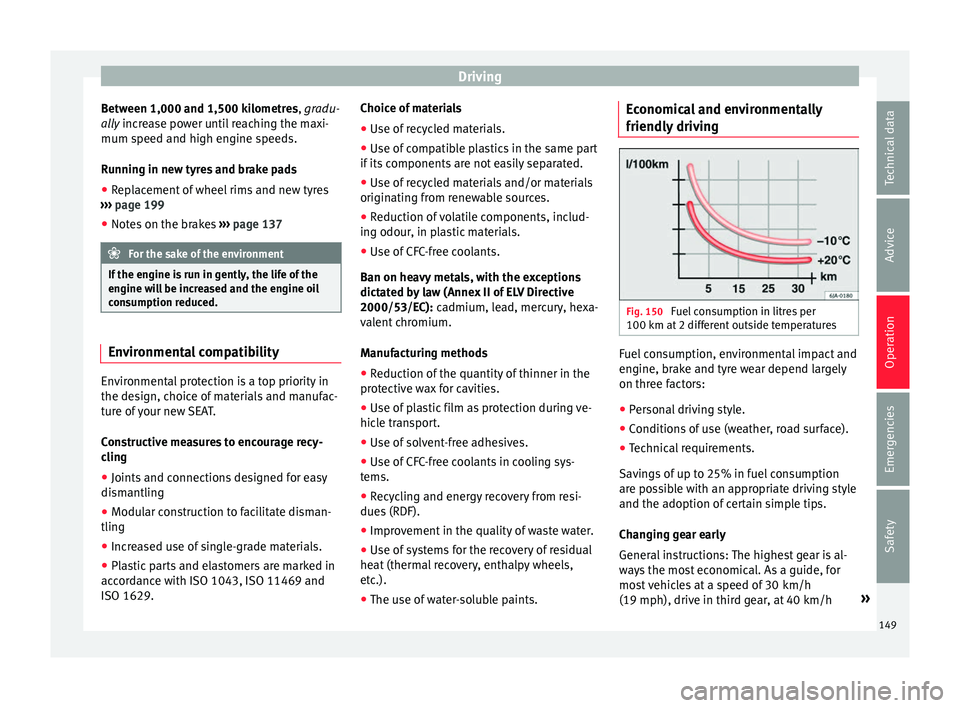
g Fig. 150
Fuel consumption in litres per
100 km at 2 diff
er
ent outside temperatures Fuel consumption, environmental impact and
en
gine, br
ak
e and tyre wear depend largely
on three factors:
● Personal driving style.
● Conditions of use (weather, road surface).
● Technical requirements.
Saving
s of up to 25% in fuel consumption
are possible with an appropriate driving style
and the adoption of certain simple tips.
Changing gear early
General instructions: The highest gear is al-
ways the most economical. As a guide, for
most vehicles at a speed of 30 km/h
(19 mph), drive in third gear, at 40 km/h »
149
Technical data
Advice
Operation
Emergencies
Safety
Page 152 of 232
Operation
(25 mph) in fourth gear and at 50 km/h
(31 mph) in fif th g
e
ar.
In addition, “skipping” gears when shifting
up helps to save fuel, weather and traffic
conditions permitting.
Do not wait until the last moment before
changing gear. Only use first gear when you
move off and change to second gear quickly.
Avoid the kick-down function in vehicles with
automatic gearbox.
Vehicles with a gear display help to achieve
an economical driving style as the display in-
dicates the best moment to change gear.
Let the vehicle roll
If you take your foot off the accelerator, the
fuel supply is stopped and consumption is
reduced.
Allow the vehicle to roll without accelerating,
for example when approaching a red traffic
light. However, if the vehicle is rolling too
slowly or the distance is too long, the clutch
pedal should be pressed to declutch. The en-
gine will then operate at idle speed.
If the vehicle is going to be at a standstill for
a period of time, switch off the engine; for ex-
ample, while waiting at a level crossing.
Think ahead and “flow” with the traffic
Frequent acceleration and braking considera-
bly increase fuel consumption. If you think ahead as you drive and keep a safe distance
from the v
ehicle in front, it is possible to slow
down by simply lifting your foot off the accel-
erator. This eliminates the need for constant
braking and acceleration.
Calm and steady driving
Constancy is more important than speed: The
more you drive at a constant speed, the lower
the fuel consumption.
When driving on the motorway, it is more effi-
cient to drive at a constant and more moder-
ate speed than to be continuously accelerat-
ing and braking. As a general rule, you will
reach your destination just as quickly when
you drive at a constant speed.
The cruise control function helps you to ach-
ieve a constant style of driving.
Moderate use of additional devices
It is important to travel in comfort, but con-
venience systems should be used ecological-
ly.
Some equipment, when connected, increase
fuel consumption considerably, for example:
● Air conditioning cooling system: If the air
conditioning sy
stem is required to cool to
significantly lower temperatures than the true
outside temperature, it will require a large
amount of energy from the engine. Therefore,
we recommend that the selected temperature for the vehicle is not too different to the out-
side temper
ature. It is a good idea to air the
vehicle before starting your journey and to
drive a short distance with the windows
open. Then you can close the windows and
switch on the air conditioning. Keep windows
closed when travelling at high speeds. Driv-
ing with the windows open increases fuel
consumption.
● Switch off the seat heating when the seats
have w
armed up.
● Switch off the heated rear window when it
is not
moist or covered in ice.
Avoid short journeys
Fuel consumption is much higher when the
engine is cold, immediately after it has been
started. It takes a few kilometres of driving
for the engine to warm up and to normalise
consumption.
The engine and catalytic converter need to
reach their proper working temperature in or-
der to minimise fuel consumption and emis-
sions. The ambient temperature has a deci-
sive influence.
Fig. 150 shows the difference in consump-
tion for the same journey at +20 °C (+68 °F)
and at -10 °C (+14 °F).
Therefore, unnecessary short journeys
should be avoided. Try to combine trips.
150