warning Seat Mii 2017 Owner's manual
[x] Cancel search | Manufacturer: SEAT, Model Year: 2017, Model line: Mii, Model: Seat Mii 2017Pages: 232, PDF Size: 4.91 MB
Page 205 of 232
Wheels and tyres
Replacement of wheel rims and new
ty r
e
s New tyres
● When tyres are new, drive with extreme
caution f or the fir
st 600 km, as all tyres need
to be run-in. Tyres which have not been run
in do not have such good grip or ››› brak-
ing c ap
acity ››› .
● All four wheels must be fitted with radial
tyr e
s of the same type, size (rolling circumfer-
ence) and the same tread pattern.
● The tread depth of new tyres may vary, ac-
cor din
g to the type and make of tyre and the
tread pattern.
Replacing tyres
● Where possible, always replace both
wheels on an ax
le (both wheels on the front
axle or both wheels on the rear axle) ››› .
● Only replace used tyres with those author-
i sed b
y
SEAT for the corresponding type vehi-
cle. Pay special attention to size, diameter,
and maximum load and speed capacity.
● Never use tyres which are larger than SEAT
appro
ved tyres. If the tyres are too big, they
may knock or rub against the chassis or other
components, resulting in damage. WARNING
New tyres do not give maximum grip and will
not h av
e reached their maximum braking ca-
pacity to start with, and therefore need run-
ning in.
● To prevent accidents and major damage,
extreme c
aution should be taken for the first
600 km. WARNING
There should be adequate space between the
tyr e
s and the vehicle in accordance with the
vehicle design. If this is not the case, the
tyres may rub against parts of the running
gear, chassis or brake lines, leading to faults
in the brake system or to tread detachment,
and the risk of burst tyres.
● The true tyre dimension should not be
great
er than the dimensions of tyres manu-
factured and approved by SEAT and should
not rub against parts of the vehicle. Note
Although tyres may be shown as being the
same s iz
e, the true dimensions of different
types of tyre may vary with respect to the
nominal size, or tread patterns may be differ-
ent. Note
If you use tyres that are approved by SEAT,
you c an be s
ure that the true tyre dimensions will be correct for your vehicle. For other tyre
models, the ty
r
e vendor should provide the
manufacturer's certificate with the tyre, indi-
cating that this type of tyre is suitable for
your vehicle. This certificate should always
be carried with the vehicle. Tyre pressures
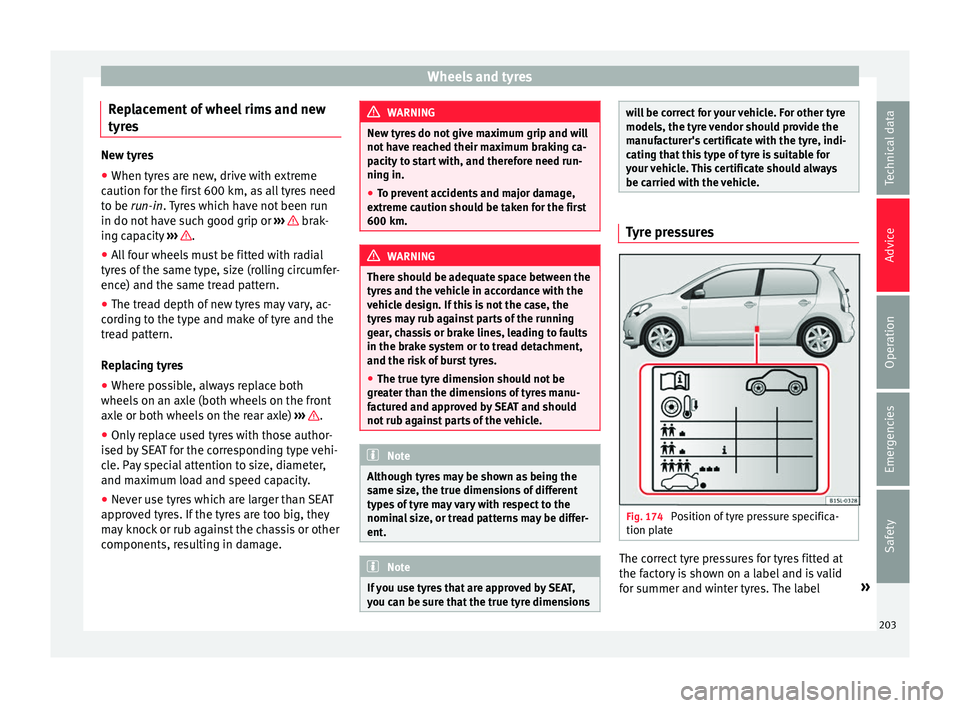
Fig. 174
Position of tyre pressure specifica-
tion p l
at
e The correct tyre pressures for tyres fitted at
the f
act
or
y is shown on a label and is valid
for summer and winter tyres. The label »
203
Technical data
Advice
Operation
Emergencies
Safety
Page 206 of 232
Advice
››› Fig. 174 i s
loc ated on the driver's door pil-
lar.
Under-inflation or over-inflation will reduce
the life of the tyres considerably and also im-
pair the car's handling ››› . It is essential to
m aint
ain the c
orrect tyre pressures, especial-
ly if driving at high speeds. Incorrect tyre
pressure causes premature wear and could
cause tyre blow-out.
The pressure should therefore be checked at
least once a month and before starting a
journey.
As a general rule, the pressures given are for
cold tyres. When the tyres are hot, the pres-
sures are greater.
Never deflate a hot tyre in order to obtain the
required pressure. This could result in very
low tyre pressures which may lead to sudden
blow-outs.
Tyre pressure monitoring system
Check tyre pressures only when the vehicle
has not been driven for more than a few kilo-
metres at low speeds in the past three hours.
● The tyre pressures should be checked regu-
larly, and on
ly when the tyres are cold. Al-
ways check all tyres, including the spare
wheel. Tyre pressures should be checked
more often in colder regions, and only when
the vehicle has not been driven recently. Al-
ways use a correctly-operating tyre gauge. ●
Adjust
tyre pressures to the loads carried in
the vehicle.
● After adjusting the tyre pressure, check that
the caps
are properly screwed on.
The spare wheel or temporary spare wheel
must always be kept at the maximum pres-
sure stipulated. WARNING
If tyre pressures are too high or too low, the
tyr e m
ay deflate or burst suddenly while driv-
ing. This could result in a serious accident.
● If the tyre pressure is too low, they could
overhe
at, resulting in tread detachment or
even burst tyres.
● When driving at high speeds and/or fully
loaded, the ty
re could suddenly overheat,
burst or be subject to tread detachment, with
the resultant loss of control of the vehicle.
● Tyre pressures which are too high or too
low reduc
e the service life of the tyre, affect-
ing the vehicle's performance.
● Tyre pressures should be checked regularly,
at le
ast once a month and before long jour-
neys.
● Adjust the pressures of all the tyres to the
vehicl
e load.
● Never deflate excess pressure from hot
tyre
s. CAUTION
● Tak e c
are not to tilt the manometer when
placing it on the valve. Otherwise, the valve
may be damaged.
● If tyre valves are not protected by caps, or if
the caps
are not screwed on correctly, they
may become damaged. Check that the caps
are identical to the standard caps and have
been correctly tightened. For the sake of the environment
Under-inflated tyres will increase fuel con-
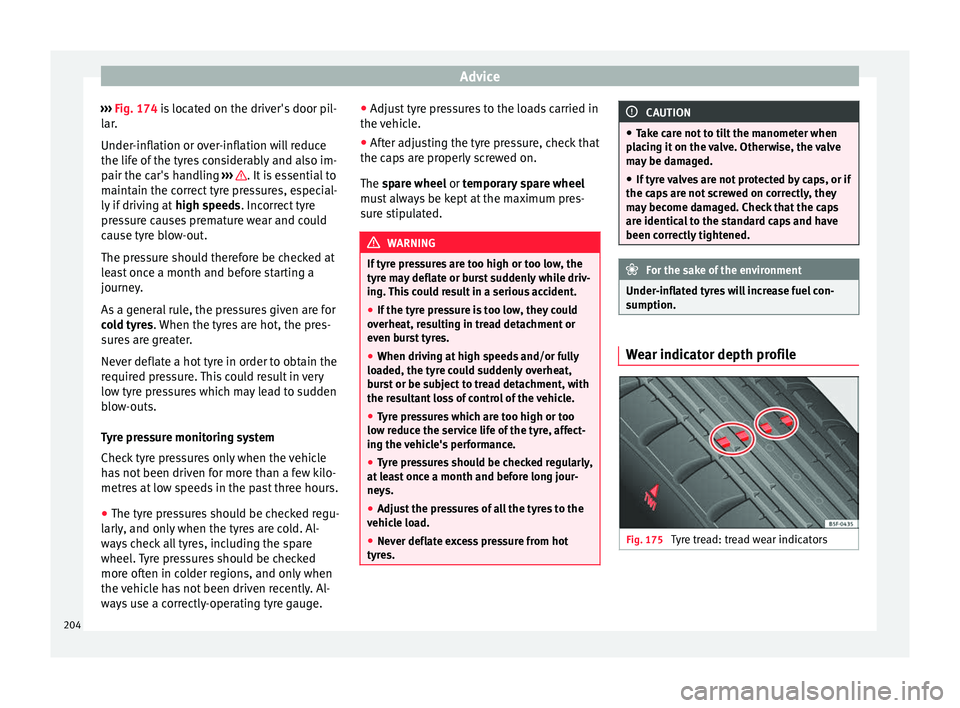
sumption. Wear indicator depth profile
Fig. 175
Tyre tread: tread wear indicators204
Page 207 of 232
Wheels and tyres
Tread depth
C er
t
ain driving conditions require a deeper
tread, as well as needing the tread to be ap-
proximately the same on the front and rear
tyres. This is particularly important when
driving in winter, in cold temperatures and on
wet roads ››› .
The minimum tr e
a
d depth required by law in
the majority of cases is 1.6 mm, measured in
the tread grooves next to the tread wear indi-
cators. Observe legal requirements in each
country.
The performance of winter tyres is much re-
duced when the tread has worn to 4 mm.
The tread depth of new tyres may vary, ac-
cording to the type and make of tyre and the
tread pattern.
Wear indicators on the tyre
The original tyres on your vehicle have
1.6 mm high ››› Fig. 175 tread wear indicators
running across the tread. A number of these
indicators are equally spaced around the tyre
tread. Certain marks on the tyre walls (e.g.
the letters “TWI” or other symbols) indicate
the position of the wear indicators.
Tread wear indicators indicate if a tyre is
worn. They must always be replaced before
the tyre tread has worn to the level of the in-
dicator. WARNING
Driving with worn tyres is dangerous, and
ma y
lead to loss of control of the vehicle with
serious consequences.
● Tyres must be replaced before the wear in-
dicator
s are at the same level as the tread
pattern.
● Worn tyres have significantly reduced grip,
espec
ially on wet surfaces, increasing the
risk of “aquaplaning”.
● Worn tyres make control of the vehicle
more difficu
lt in normal or difficult driving
conditions, increasing the braking distance
and the risk of skidding. Tyre damage
Damage to wheels and tyres is often invisible
t
o the n
ak
ed eye. If you notice unusual vibra-
tion or the car pulling to one side, this may
indicate that one of the tyres is damaged
››› .
● Slow down immediately if you think you
h av
e a d
amaged wheel.
● Check the wheels and tyres for damage.
● If tyres are worn, stop driving and seek
qualified ass
istance.
● If there is no visible exterior damage, drive
slowly
and carefully to the nearest special-
ised workshop and have the vehicle checked. Foreign bodies in the tyre
●
Do not remove foreign bodies if they have
penetrated thr
ough the tyre wall!
● You should obtain professional assistance
immediately
.
Tyre wear
The wear of tyres depends on a number of
factors, for example:
● Driving style.
● Unbalanced wheels.
● Running gear settings.
Driving
style: Driving round bends quickly or
sudden acceleration or braking speed accel-
erates tyre wear. When the driving style is
normal, if the tyres wear too quickly, have the
running gear settings checked at a special-
ised workshop.
Wheel run-out: The wheels on new vehicles
are balanced. However, certain circumstan-
ces may lead to imbalance (run-out), which is
detected as vibrations in the steering wheel.
Run-out leads to wear of the steering and
suspension. In the event of run out, the
wheels should be balanced again. When a
new wheel is fitted, it should be balanced
again.
Running gear settings : an incorrectly posi-
tioned running gear increases the wear of
tyres and affects your safety while driving. If »
205
Technical data
Advice
Operation
Emergencies
Safety
Page 208 of 232
Advice
tyres wear too quickly, have the wheel align-
ment c
hec
ked at a specialised workshop. WARNING
If you notice unusual vibration or the car pulls
to one s ide whi
le driving, this may indicate
that one of the tyres is damaged.
● Reduce speed immediately and stop, while
obser
ving the highway code.
● Check the wheels and tyres for damage.
● Never carry on driving on worn tyres or
wheels. Reque
st qualified assistance immedi-
ately.
● If there is no visible exterior damage, drive
slowly
and carefully to the nearest special-
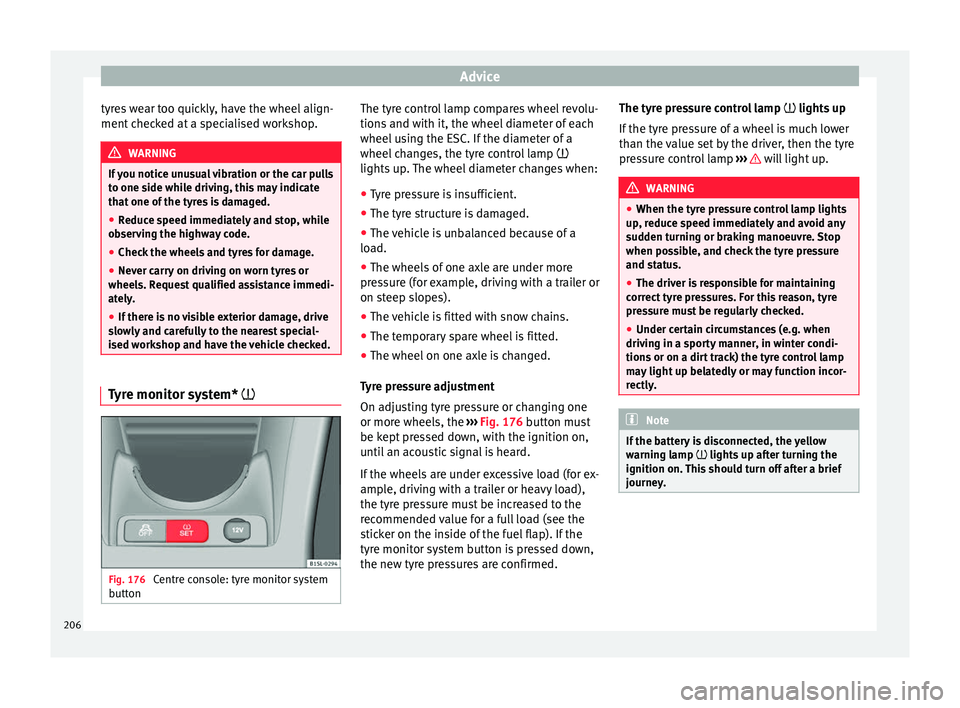
ised workshop and have the vehicle checked. Tyre monitor system*
Fig. 176
Centre console: tyre monitor system
b utt
on The tyre control lamp compares wheel revolu-
tion
s
and w
ith it, the wheel diameter of each
wheel using the ESC. If the diameter of a
wheel changes, the tyre control lamp
lights up. The wheel diameter changes when:
● Tyre pressure is insufficient.
● The tyre structure is damaged.
● The vehicle is unbalanced because of a
load.
● The wheel
s of one axle are under more
pres
sure (for example, driving with a trailer or
on steep slopes).
● The vehicle is fitted with snow chains.
● The temporary spare wheel is fitted.
● The wheel on one axle is changed.
Tyr
e pressure adjustment
On adjusting tyre pressure or changing one
or more wheels, the ››› Fig. 176 button must
be kept pressed down, with the ignition on,
until an acoustic signal is heard.
If the wheels are under excessive load (for ex-
ample, driving with a trailer or heavy load),
the tyre pressure must be increased to the
recommended value for a full load (see the
sticker on the inside of the fuel flap). If the
tyre monitor system button is pressed down,
the new tyre pressures are confirmed. The tyre pressure control lamp
lights up
If
the tyre pressure of a wheel is much lower
than the value set by the driver, then the tyre
pressure control lamp ››› will light up.
WARNING
● When the tyr e pr
essure control lamp lights
up, reduce speed immediately and avoid any
sudden turning or braking manoeuvre. Stop
when possible, and check the tyre pressure
and status.
● The driver is responsible for maintaining
correct
tyre pressures. For this reason, tyre
pressure must be regularly checked.
● Under certain circumstances (e.g. when
driving in a s
porty manner, in winter condi-
tions or on a dirt track) the tyre control lamp
may light up belatedly or may function incor-
rectly. Note
If the battery is disconnected, the yellow
warnin g l
amp lights up after turning the
ignition on. This should turn off after a brief
journey. 206
Page 209 of 232
Wheels and tyres
Spare wheel or temporary spare
wheel* Fig. 177
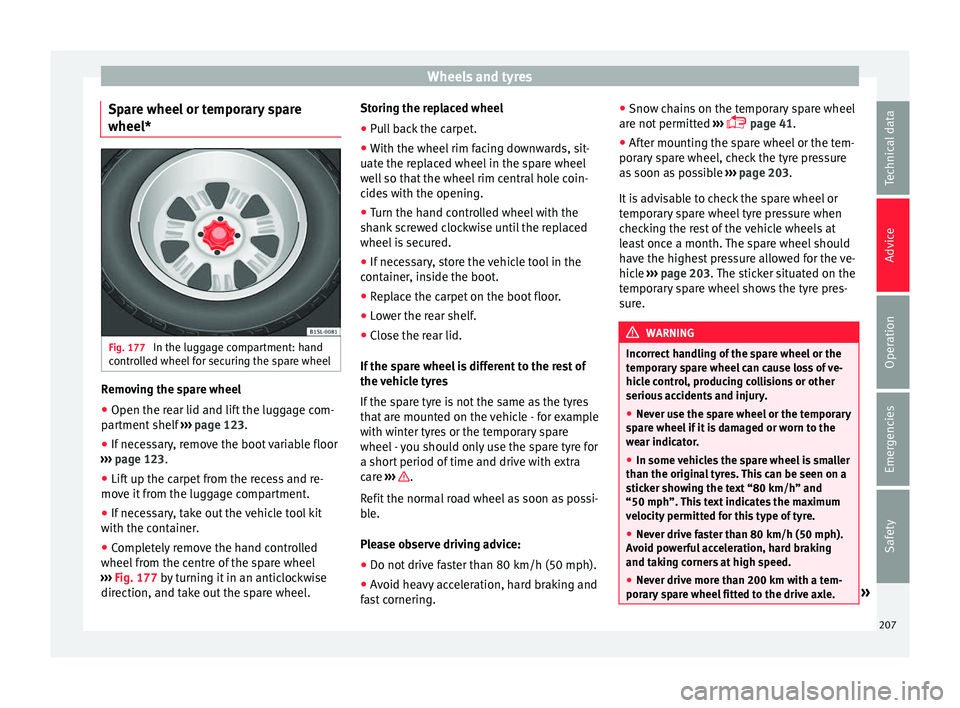
In the luggage compartment: hand
c ontr
o
lled wheel for securing the spare wheel Removing the spare wheel
● Open the rear lid and lift the luggage com-
p ar
tment
shelf ››› page 123.
● If necessary, remove the boot variable floor
›››
page 123.
● Lift up the carpet from the recess and re-
move it
from the luggage compartment.
● If necessary, take out the vehicle tool kit
with the cont
ainer.
● Completely remove the hand controlled
wheel from the c
entre of the spare wheel
››› Fig. 177 by turning it in an anticlockwise
direction, and take out the spare wheel. Storing the replaced wheel
● Pull back the carpet.
● With the wheel rim facing downwards, sit-
uate the rep
laced wheel in the spare wheel
well so that the wheel rim central hole coin-
cides with the opening.
● Turn the hand controlled wheel with the
shank s
crewed clockwise until the replaced
wheel is secured.
● If necessary, store the vehicle tool in the
container
, inside the boot.
● Replace the carpet on the boot floor.
● Lower the rear shelf.
● Close the rear lid.
If the sp
are wheel is different to the rest of
the vehicle tyres
If the spare tyre is not the same as the tyres
that are mounted on the vehicle - for example
with winter tyres or the temporary spare
wheel - you should only use the spare tyre for
a short period of time and drive with extra
care ››› .
R efit
the norm
al road wheel as soon as possi-
ble.
Please observe driving advice:
● Do not drive faster than 80 km/h (50 mph).
● Avoid heavy acceleration, hard braking and
fas
t cornering. ●
Snow ch
ains on the temporary spare wheel
are not permitted ›››
page 41.
● After mounting the spare wheel or the tem-
porary
spare wheel, check the tyre pressure
as soon as possible ››› page 203.
It is advisable to check the spare wheel or
temporary spare wheel tyre pressure when
checking the rest of the vehicle wheels at
least once a month. The spare wheel should
have the highest pressure allowed for the ve-
hicle ››› page 203. The sticker situated on the
temporary spare wheel shows the tyre pres-
sure. WARNING
Incorrect handling of the spare wheel or the
tempor ar
y spare wheel can cause loss of ve-
hicle control, producing collisions or other
serious accidents and injury.
● Never use the spare wheel or the temporary
spar
e wheel if it is damaged or worn to the
wear indicator.
● In some vehicles the spare wheel is smaller
than the origina
l tyres. This can be seen on a
sticker showing the text “80 km/h” and
“50 mph”. This text indicates the maximum
velocity permitted for this type of tyre.
● Never drive faster than 80 km/h (50 mph).
Avoid po
werful acceleration, hard braking
and taking corners at high speed.
● Never drive more than 200 km with a tem-
porary
spare wheel fitted to the drive axle. » 207
Technical data
Advice
Operation
Emergencies
Safety
Page 214 of 232
Technical data
Engine and gearbox code, paint number,
int erior equipment
.
Option
al extras, PR numbers.
These data are also provided in the Mainte-
nance Programme.
Specific vehicle weight information The instructions in the official vehicle docu-
ments t
ak
e precedence. All the technical data
provided in this documentation is applicable
to the basic model. The vehicle data label in
the Maintenance Programme or the vehicle
documentation shows which engine is instal-
led in your vehicle.
The figures may be different depending
whether additional equipment is fitted, for
different models and for special vehicles.
Kerb weight values shown in the following ta-
ble apply to a vehicle with driver (75 kg), liq-
uids including a fuel tank 90% full, in addi-
tion to tools and a spare wheel ››› . The
k erb w
eight
indicated increases with optional
equipment and retrofitting of accessories,
while proportionally reducing carrying ca-
pacity.
The load is equivalent to the following
weights:
● Passengers.
● Total equipment.
3 4 ●
Roof
lo
ad, included in the carrier. WARNING
Exceeding the maximum authorised weight
and the loa d on the ax
les could cause dam-
age to the vehicle, accidents and serious in-
juries.
● The real load on the axles should never ex-
ceed the max
imum permitted.
● The load and its distribution in the vehicle
have eff
ects on the vehicle handling and the
braking ability. Always drive at a suitable
speed. CAUTION
Distribute the load as uniformly and as low
down on the v
ehicle as possible. When trans-
porting heavy objects in the luggage com-
partment, these should be placed as far for-
ward as possible or over the rear axle to have
as little influence on handling as possible. Fuel consumption
Approved consumption values are derived
fr
om me
a
surements performed or supervised
by certified EU laboratories, according to the
legislation in force at the time (for more infor-
mation, see the Publications Office of the Eu-
ropean Union on the EUR-Lex website: © Eu-
ropean Union, http://eur-lex.europa.eu/) and
apply to the specified vehicle characteristics. The values relating to fuel consumption and
CO
2 emis
sions can be found in the documen-
tation provided to the purchaser of the vehi-
cle at the time of purchase.
Fuel consumption and CO 2 emissions depend
on the equipment/features of each individual
vehicle, as well as on the driving style, road
conditions, traffic conditions, environmental
conditions, load or number of passengers. Note
In practice, and considering all the factors
mentioned here, c on
sumption values can dif-
fer from those calculated in the current Euro-
pean regulations. Wheels
Ty
r
e pressure, snow chains and wheel
bolts Tyre pressure
The s
tic
k
er with the tyre pressure values can
be found on the inside of the fuel tank flap.
The tyre pressure values are given for cold
tyres ›››
page 203. The slightly raised pres-
sures of warm tyres must not be reduced.
››› 212
Page 215 of 232
Technical features
Snow chains
Sno w c
h
ains may be fitted only to the front
wheels.
Consult section ›››
page 41, Snow
chains.
Wheel bolts
After the wheels have been changed, the
tightening torque of the wheel bolts should
be checked as soon as possible with a torque
wrench ››› . The tightening torque for steel
and al lo
y
wheels is 110 Nm. WARNING
● Check the ty
re pressure at least once per
month. Checking the tyre pressure is very im-
portant. If the tyre pressure is too high or too
low, there is an increased danger of accidents
- particularly at high speeds.
● If the tightening torque of the wheel bolts
is t
oo low, they could loosen while the vehi-
cle is in motion. Risk of accident! If the tight-
ening torque is too high, the wheel bolts and
threads can be damaged. Note
We recommend that you ask your Technical
Serv ic
e for information about appropriate
wheel, tyre and snow chain size. 213
Technical data
Advice
Operation
Emergencies
Safety
Page 221 of 232
Index
Index
A
Abr o
a
d
extended stay abroad with your vehicle . . . . . 179
sale of vehicle . . . . . . . . . . . . . . . . . . . . . . . . . . 179
ABS see Anti-lock brake system . . . . . . . . . . . . . . . 137
Accessories . . . . . . . . . . . . . . . . . . . . . . . . . . . . . . 164
Acoustic alarm seatbelt unfastened . . . . . . . . . . . . . . . . . . . . . . 53
Adjust front seat . . . . . . . . . . . . . . . . . . . . . . . . . . . . . . 112
Adjusting lights . . . . . . . . . . . . . . . . . . . . . . . . . . . . . . . . . 107
rear head restraints . . . . . . . . . . . . . . . . . 51, 112
seats . . . . . . . . . . . . . . . . . . . . . . . . . . . . . . . . . . 48
Adjusting the head restraints rear head restraints . . . . . . . . . . . . . . . . . . . . . 112
Advice for driving spare wheel or temporary spare wheel . . . . . . 207
Airbag covers . . . . . . . . . . . . . . . . . . . . . . . . . . . . . 14
Airbags . . . . . . . . . . . . . . . . . . . . . . . . . . . . . . . . . . 58 description . . . . . . . . . . . . . . . . . . . . . . . . . . . . . 60
Airbag system . . . . . . . . . . . . . . . . . . . . . . . . . . 14, 58 activation . . . . . . . . . . . . . . . . . . . . . . . . . . . . . . 61
cleaning dash panel . . . . . . . . . . . . . . . . . . . . . 178
control and warning lamps . . . . . . . . . . . . . . . . 62
description . . . . . . . . . . . . . . . . . . . . . . . . . . . . . 60
front airbags . . . . . . . . . . . . . . . . . . . . . . . . . 14, 61
functioning . . . . . . . . . . . . . . . . . . . . . . . . . . . . . 61
locking the vehicle after deployment . . . . . . . . 95
repairs . . . . . . . . . . . . . . . . . . . . . . . . . . . . . . . . 166
side airbags . . . . . . . . . . . . . . . . . . . . . . . . . . . . 16
use of child seats . . . . . . . . . . . . . . . . . . . . . . . . 15
vehicle care . . . . . . . . . . . . . . . . . . . . . . . . . . . . 178 Air conditioning . . . . . . . . . . . . . . . . . . . . . . . . . . 129
air recir culation . . . . . . . . . . . . . . . . . . . . . . . . . 130
air vents . . . . . . . . . . . . . . . . . . . . . . . . . . . . . . 131
climatronic . . . . . . . . . . . . . . . . . . . . . . . . 28, 129
instructions for use . . . . . . . . . . . . . . . . . . . . . 132
malfunction . . . . . . . . . . . . . . . . . . . . . . . . . . . . 132
tips . . . . . . . . . . . . . . . . . . . . . . . . . . . . . . . . . . 132
water under vehicle . . . . . . . . . . . . . . . . . . . . . 133
Air recirculation . . . . . . . . . . . . . . . . . . . . . . . . . . 130 climatronic . . . . . . . . . . . . . . . . . . . . . . . . . . . . . 29
how it works . . . . . . . . . . . . . . . . . . . . . . . . . . . 130
switching off . . . . . . . . . . . . . . . . . . . . . . . . . . . 130
switching on . . . . . . . . . . . . . . . . . . . . . . . . . . . 130
Air vents . . . . . . . . . . . . . . . . . . . . . . . . . . . . . . . . 131
Antenna . . . . . . . . . . . . . . . . . . . . . . . . . . . 166, 180
Anti-freeze . . . . . . . . . . . . . . . . . . . . . . . . . . . . . . . 32
Anti-lock brake system . . . . . . . . . . . . . . . . . . . . . 137
Anti-lock system . . . . . . . . . . . . . . . . . . . . . . . . . . 138
Anti-puncture . . . . . . . . . . . . . . . . . . . . . . . . . . 35, 72
Anti-puncture kit . . . . . . . . . . . . . . . . . . . . . . . . 35, 72 check after 10 minutes . . . . . . . . . . . . . . . . . . . . 74
do not use . . . . . . . . . . . . . . . . . . . . . . . . . . . . . . 73
Anti-puncture set . . . . . . . . . . . . . . . . . . . . . . . . . . 72
Anti-theft security system . . . . . . . . . . . . . . . . . . . 97
Ashtray . . . . . . . . . . . . . . . . . . . . . . . . . . . . . . . . . 120
Aspects to take into account before starting the vehicle . . . . . . . . . . . . . . . . . . . . . . . . . . . . . . . . . 47
ASR see Traction control system . . . . . . . . . . . . . . . 137
Assistance systems brake assist system (BAS) . . . . . . . . . . . . . . . . 138
cruise control . . . . . . . . . . . . . . . . . . . . . . . . . . 155
electronic differential lock (EDS) . . . . . . . . . . . 138
optical parking system (OPS) . . . . . . . . . . . . . 154
parking aid . . . . . . . . . . . . . . . . . . . . . . . . . . . . 154
parking distance warning system . . . . . . . . . . 154
safety Assist . . . . . . . . . . . . . . . . . . . . . . . . . . . 156 traction control (ASR) . . . . . . . . . . . . . . . . . . . . 138
traction contr
ol (TC) . . . . . . . . . . . . . . . . . . . . . 138
Assisted starting . . . . . . . . . . . . . . . . . . . . . . . . . . 43
Audible warning control and warning lamps . . . . . . . . . . . . . . . . 25
lights . . . . . . . . . . . . . . . . . . . . . . . . . . . . . . . . . 103
speed . . . . . . . . . . . . . . . . . . . . . . . . . . . . . . . . . 24
Automatic belt retractor . . . . . . . . . . . . . . . . . . . . . 57
Automatic device disconnection battery . . . . . . . . . . . . . . . . . . . . . . . . . . . . . . . . 199
Automatic dipped beam control . . . . . . . . . . . . . 104
Automatic gearbox driving tips . . . . . . . . . . . . . . . . . . . . . . . . . . . . 145
ignition key removal lock . . . . . . . . . . . . . . . . . 134
kick-down . . . . . . . . . . . . . . . . . . . . . . . . . . . . . 145
malfunction . . . . . . . . . . . . . . . . . . . . . . . . . . . . 146
starting on a slope . . . . . . . . . . . . . . . . . . . . . . 145
stopping on a slope . . . . . . . . . . . . . . . . . . . . . 145
Automatic gear change . . . . . . . . . . . . . . . . . . . . 144
Axle loads . . . . . . . . . . . . . . . . . . . . . . . . . . . . . . . 212
B Bag support . . . . . . . . . . . . . . . . . . . . . . . . . . . . . 117
BAS see Brake assist system . . . . . . . . . . . . . . . . . . 138
Battery changing in the vehicle key . . . . . . . . . . . . . . . . 93
Battery acid . . . . . . . . . . . . . . . . . . . . . . . . . . . . . . 198
Before starting the vehicle . . . . . . . . . . . . . . . . . . 47
Belt tension device service and disposal . . . . . . . . . . . . . . . . . . . . . 58
Belt tensioner . . . . . . . . . . . . . . . . . . . . . . . . . . . . . 57
Belt tension limiter . . . . . . . . . . . . . . . . . . . . . . . . . 57
Belt tightening . . . . . . . . . . . . . . . . . . . . . . . . . . . . 57
Bonnet . . . . . . . . . . . . . . . . . . . . . . . . . . . . . 10, 187
Brake assist system . . . . . . . . . . . . . . . . . . . . . . . 137
219
Page 222 of 232
Index
Brake fluid . . . . . . . . . . . . . . . . . . . . . . . . . . . . . . . 33 spec
ific
ation . . . . . . . . . . . . . . . . . . . . . . . . . . . 194
Brakes . . . . . . . . . . . . . . . . . . . . . . . . . . . . . . . . . . 135 brake assist system . . . . . . . . . . . . . . . . . . . . . 137
brake fluid . . . . . . . . . . . . . . . . . . . . . . . . . . . . . 194
brake fluid level . . . . . . . . . . . . . . . . . . . . . . . . 195
brake pads . . . . . . . . . . . . . . . . . . . . . . . . . . . . 140
brake servo . . . . . . . . . . . . . . . . . . . . . . . . . . . . 141
changing the brake fluid . . . . . . . . . . . . . . . . . 195
control and warning lamps . . . . . . . . . . . . . . . 136
running in new brake pads . . . . . . . . . . . . . . . 140
Brake servo . . . . . . . . . . . . . . . . . . . . . . . . . 137, 141
Brake system . . . . . . . . . . . . . . . . . . . . . . . . . . . . 137 fault . . . . . . . . . . . . . . . . . . . . . . . . . . . . . . . . . . 141
Braking brake assist system . . . . . . . . . . . . . . . . . . . . . 137
Bulb fault see "Changing bulbs" . . . . . . . . . . . . . . . . . . . . 79
C Capacities . . . . . . . . . . . . . . . . . . . . . . . . . . . . . . . . 31 windscreen washer liquid reservoir . . . . . . . . 196
Capacity natural gas tank . . . . . . . . . . . . . . . . . . . . . . . . 186
Caring for paintwork . . . . . . . . . . . . . . . . . . . . . . . 173
Caring for the vehicle exterior . . . . . . . . . . . . . . . . . . . . . . . . . . . . . . . 171
Catalytic converter . . . . . . . . . . . . . . . . . . . . . . . . 152 control and warning lamps . . . . . . . . . . . . . . . 151
malfunction . . . . . . . . . . . . . . . . . . . . . . . . . . . . 151
CCS see cruise control . . . . . . . . . . . . . . . . . . . . . . . . 24
Central locking . . . . . . . . . . . . . . . . . . . . . . . . . . . . 94 emergency locking . . . . . . . . . . . . . . . . . . . . . . . . 9
opening doors individually . . . . . . . . . . . . . . . . 95 Central locking system
after airb ag deployment . . . . . . . . . . . . . . . . . . 95
description . . . . . . . . . . . . . . . . . . . . . . . . . . . . . 95
remote control key . . . . . . . . . . . . . . . . . . . . . . . 95
Changes . . . . . . . . . . . . . . . . . . . . . . . . . . . . . . . . 165
Changing a wheel . . . . . . . . . . . . . . . . . . . . . . 36, 72 subsequent tasks . . . . . . . . . . . . . . . . . . . . . . . . 41
wheel bolts . . . . . . . . . . . . . . . . . . . . . . . . . . . . . 38
Changing bulbs . . . . . . . . . . . . . . . . . . . . . . . . . . . 79 front bumper . . . . . . . . . . . . . . . . . . . . . . . . . . . . 81
headlights . . . . . . . . . . . . . . . . . . . . . . . . . . . . . . 80
number plate light . . . . . . . . . . . . . . . . . . . . . . . 83
rear lights . . . . . . . . . . . . . . . . . . . . . . . . . . . . . . 82
side turn signal . . . . . . . . . . . . . . . . . . . . . . . . . . 84
Changing gear . . . . . . . . . . . . . . . . . . . . . . . . . . . 142 automatic gear change . . . . . . . . . . . . . . . . . . 144
control and warning lamps . . . . . . . . . . . . . . . 142
engaging the gears (automatic gearbox) . . . . 144
tiptronic . . . . . . . . . . . . . . . . . . . . . . . . . . . . . . . 145
Changing the blades . . . . . . . . . . . . . . . . . . . . . . . 75
Changing the wiper blades . . . . . . . . . . . . . . . . . . 45
Charging the battery . . . . . . . . . . . . . . . . . . . . . . . 43
Child safety seat Securing with the seat belt . . . . . . . . . . . . . . . . 18
Child seat . . . . . . . . . . . . . . . . . . . . . . . . . . . . . 16, 65 disabling the front passenger front airbag . . . . 15
ISOFIX system . . . . . . . . . . . . . . . . . . . . . . . . 18, 69
mounting child seats . . . . . . . . . . . . . . . . . . . . . 17
mounting systems . . . . . . . . . . . . . . . . . . . . . . . 17
on the front passenger seat . . . . . . . . . . . . . . . . 68
on the rear seats . . . . . . . . . . . . . . . . . . . . . . . . . 69
regulations . . . . . . . . . . . . . . . . . . . . . . . . . . . . . 67
safety instructions . . . . . . . . . . . . . . . . . . . . 16, 64
Top Tether system . . . . . . . . . . . . . . . . . . . . . . . . 20
transporting children in the vehicle . . . . . . . . . 67
weight categories . . . . . . . . . . . . . . . . . . . . . . . . 67
Cigarette lighter . . . . . . . . . . . . . . . . . . . . . . . . . . 120 City Safety Assist function . . . . . . . . . . . . . . . . . . 156
contro l and warning lamps . . . . . . . . . . . . . . . 157
function . . . . . . . . . . . . . . . . . . . . . . . . . . . . . . . 158
sensor . . . . . . . . . . . . . . . . . . . . . . . . . . . . . . . . 158
special driving situations . . . . . . . . . . . . . . . . . 159
Cleaning . . . . . . . . . . . . . . . . . . . . . . . . . . . . . . . . 170 compartments . . . . . . . . . . . . . . . . . . . . . . . . . 177
dash panel . . . . . . . . . . . . . . . . . . . . . . . . . . . . 178
engine compartment . . . . . . . . . . . . . . . . . . . . 175
fabrics . . . . . . . . . . . . . . . . . . . . . . . . . . . . . . . . 176
padding . . . . . . . . . . . . . . . . . . . . . . . . . . . . . . . 177
seat belts . . . . . . . . . . . . . . . . . . . . . . . . . . . . . 178
textile covers . . . . . . . . . . . . . . . . . . . . . . . . . . . 177
washing the vehicle . . . . . . . . . . . . . . . . . . . . . 171
washing the vehicle with high pressure clean-ers . . . . . . . . . . . . . . . . . . . . . . . . . . . . . . . . . 172
wheels . . . . . . . . . . . . . . . . . . . . . . . . . . . . . . . . 174
windows . . . . . . . . . . . . . . . . . . . . . . . . . . . . . . 172
Cleaning the vehicle high pressure cleaners . . . . . . . . . . . . . . . . . . . 172
Climatronic adjusting the temperature . . . . . . . . . . . . . . . . . 28
air distribution . . . . . . . . . . . . . . . . . . . . . . . . . . 28
air recirculation . . . . . . . . . . . . . . . . . . . . . . . . . . 29
AUTO (automatic mode) . . . . . . . . . . . . . . . . . . . 28
controls . . . . . . . . . . . . . . . . . . . . . . . . . . . . . . . . 28
cooling mode . . . . . . . . . . . . . . . . . . . . . . . . . . . 28
fan . . . . . . . . . . . . . . . . . . . . . . . . . . . . . . . . . . . . 28
removing ice from windows . . . . . . . . . . . . . . . . 28
switch off . . . . . . . . . . . . . . . . . . . . . . . . . . . . . . . 28
Close . . . . . . . . . . . . . . . . . . . . . . . . . . . . . . . . . . . . 92 bonnet . . . . . . . . . . . . . . . . . . . . . . . . . . . . . . . . . 10
Closing . . . . . . . . . . . . . . . . . . . . . . . . . . . . . . . . . . 92 bonnet . . . . . . . . . . . . . . . . . . . . . . . . . . . . . . . . . 10
electric windows . . . . . . . . . . . . . . . . . . . . . . . . . 11
luggage compartment . . . . . . . . . . . . . . . . . . . 100
panoramic sunroof . . . . . . . . . . . . . . . . . . . . . . . 11
windows . . . . . . . . . . . . . . . . . . . . . . . . . . . . . . 101
220
Page 223 of 232
Index
Clothes hook . . . . . . . . . . . . . . . . . . . . . . . . . . . . 118
C ode number
. . . . . . . . . . . . . . . . . . . . . . . . . . . . .
71
Coming Home Function . . . . . . . . . . . . . . . . . . . . 105
Compartments . . . . . . . . . . . . . . . . . . . . . . . . . . . 115 centre console . . . . . . . . . . . . . . . . . . . . . . . . . 116
glove compartment . . . . . . . . . . . . . . . . 117, 118
passenger side . . . . . . . . . . . . . . . . . . . . 117, 118
Sunglasses storage compartment . . . . . . . . . . 117
Conformity certification . . . . . . . . . . . . . . . . . . . . 180
Control and warning lamps airbag system . . . . . . . . . . . . . . . . . . . . . . . . . . . 62
brake system . . . . . . . . . . . . . . . . . . . . . . . . . . . 136
catalytic converter . . . . . . . . . . . . . . . . . . . . . . 151
changing gear . . . . . . . . . . . . . . . . . . . . . . . . . . 142
City Safety Assist function . . . . . . . . . . . . . . . . 157
coolant . . . . . . . . . . . . . . . . . . . . . . . . . . . . . . . 192
cruise control . . . . . . . . . . . . . . . . . . . . . . . . . . 155
emission control system . . . . . . . . . . . . . . . . . 151
engine management . . . . . . . . . . . . . . . . . . . . 151
engine oil sensor . . . . . . . . . . . . . . . . . . . . . . . 189
ESC . . . . . . . . . . . . . . . . . . . . . . . . . . . . . . . . . . 136
for the seat belt . . . . . . . . . . . . . . . . . . . . . . . . . 53
fuel level . . . . . . . . . . . . . . . . . . . . . . . . . . . . . . 184
general view . . . . . . . . . . . . . . . . . . . . . . . . . . . . 25
generator . . . . . . . . . . . . . . . . . . . . . . . . . . . . . . 197
hill hold . . . . . . . . . . . . . . . . . . . . . . . . . . . . . . . 160
indication of brake pad wear . . . . . . . . . . . . . . 136
key . . . . . . . . . . . . . . . . . . . . . . . . . . . . . . . . . . . . 93
lights . . . . . . . . . . . . . . . . . . . . . . . . . . . . . . . . . 103
locking the steering column . . . . . . . . . . . . . . 147
on the driver door . . . . . . . . . . . . . . . . . . . . . . . . 98
refuelling . . . . . . . . . . . . . . . . . . . . . . . . . 184, 185
tyres . . . . . . . . . . . . . . . . . . . . . . . . . . . . . . . . . . 206
vehicle battery . . . . . . . . . . . . . . . . . . . . . . . . . 197
Controls for the windows . . . . . . . . . . . . . . . 11, 101
Control units . . . . . . . . . . . . . . . . . . . . . . . . . . . . . 167 reprogramming . . . . . . . . . . . . . . . . . . . . . . . . . 167 Coolant
check ing the level . . . . . . . . . . . . . . . . . . . . . . . 193
control and warning lamps . . . . . . . . . . . . . . . 192
filler neck . . . . . . . . . . . . . . . . . . . . . . . . . . . . . 193
topping up . . . . . . . . . . . . . . . . . . . . . . . . . . . . 193
Cooling system checking the coolant . . . . . . . . . . . . . . . . . . . . 192
topping up with coolant . . . . . . . . . . . . . . . . . . 192
Correct sitting position . . . . . . . . . . . . . . . . . . . . . 48 driver . . . . . . . . . . . . . . . . . . . . . . . . . . . . . . . . . . 48
Cruise control . . . . . . . . . . . . . . . . . . . . . . . . 24, 155 control and warning lamps . . . . . . . . . . . . . . . 155
operation . . . . . . . . . . . . . . . . . . . . . . . . . . . . . . 155
D Dangers in not using the seat belt . . . . . . . . . . . . 55
Dash panel . . . . . . . . . . . . . . . . . . . . . . . . . . . . . . . 87 airbag system . . . . . . . . . . . . . . . . . . . . . . . . . . 178
Data label . . . . . . . . . . . . . . . . . . . . . . . . . . . . . . . 211
Data registry . . . . . . . . . . . . . . . . . . . . . . . . . . . . . 167
Data storage during the journey . . . . . . . . . . . . . 167
Daytime running lights . . . . . . . . . . . . . . . . . . . . 104
De-icing the locks . . . . . . . . . . . . . . . . . . . . . . . . . 175
Diagnostics connector . . . . . . . . . . . . . . . . . . . . . 168
Digital clock . . . . . . . . . . . . . . . . . . . . . . . . . . . . . . 88
Dimensions . . . . . . . . . . . . . . . . . . . . . . . . . . . . . . 217
Direction of rotation tyres . . . . . . . . . . . . . . . . . . . . . . . . . . . . . . . . . . . 41
Disabling the front passenger front airbag . . . . . 15
Display . . . . . . . . . . . . . . . . . . . . . . . . . . . . . . . 88, 89
Disposal belt tension device . . . . . . . . . . . . . . . . . . . . . . . 58
Door cylinder . . . . . . . . . . . . . . . . . . . . . . . . . . . . . . 8
Door lock . . . . . . . . . . . . . . . . . . . . . . . . . . . . . . . . . . 8
Door release lever . . . . . . . . . . . . . . . . . . . . . . . . . . 8 interior . . . . . . . . . . . . . . . . . . . . . . . . . . . . . . . . . 87 Doors . . . . . . . . . . . . . . . . . . . . . . . . . . . . . . . . . . . . 98
chil dproof locks . . . . . . . . . . . . . . . . . . . . . . . . . 99
Emergency closing or opening . . . . . . . . . . . . . . 8
opening and closing . . . . . . . . . . . . . . . . . . . . . . 8
Drink holders . . . . . . . . . . . . . . . . . . . . . . . . . . . . 119 Centre console . . . . . . . . . . . . . . . . . . . . . . . . . 119
Driver see Correct sitting position . . . . . . . . . . . . . . . . 48
Driving automatic gearbox . . . . . . . . . . . . . . . . . . . . . . 145
data storage . . . . . . . . . . . . . . . . . . . . . . . . . . . 167
driving abroad . . . . . . . . . . . . . . . . . . . . . . . . . 152
driving through water . . . . . . . . . . . . . . . . . . . . 152
economical . . . . . . . . . . . . . . . . . . . . . . . . . . . . 149
fuel gauge . . . . . . . . . . . . . . . . . . . . . . . . . . . . . 184
fuel level too low . . . . . . . . . . . . . . . . . . . . . . . 185
parking downhill . . . . . . . . . . . . . . . . . . . . . . . . 140
parking uphill . . . . . . . . . . . . . . . . . . . . . . . . . . 140
safe . . . . . . . . . . . . . . . . . . . . . . . . . . . . . . . . . . . 47
starting on a slope . . . . . . . . . . . . . . . . . . . . . . 145
stopping on a slope . . . . . . . . . . . . . . . . . . . . . 145
through salt water . . . . . . . . . . . . . . . . . . . . . . 153
with a trailer . . . . . . . . . . . . . . . . . . . . . . . . . . . 163
Driving abroad headlights . . . . . . . . . . . . . . . . . . . . . . . . . . . . . 107
Driving in winter fuel consumption . . . . . . . . . . . . . . . . . . . . . . . 150
snow chains . . . . . . . . . . . . . . . . . . . . . . . . . . . . 41
traces of salt . . . . . . . . . . . . . . . . . . . . . . . . . . . 110
tread depth . . . . . . . . . . . . . . . . . . . . . . . . . . . . 205
tyre pressure . . . . . . . . . . . . . . . . . . . . . . . . . . . 204
windscreen washer reservoir . . . . . . . . . . . . . . 173
Driving through water . . . . . . . . . . . . . . . . . . . . . 152
Driving tips For a loaded vehicle . . . . . . . . . . . . . . . . . . . . . 114
Duplicate keys . . . . . . . . . . . . . . . . . . . . . . . . . . . . 92
Dust filter . . . . . . . . . . . . . . . . . . . . . . . . . . . . . . . 133
221