height Seat Mii 2017 User Guide
[x] Cancel search | Manufacturer: SEAT, Model Year: 2017, Model line: Mii, Model: Seat Mii 2017Pages: 232, PDF Size: 4.91 MB
Page 69 of 232
Transporting children safely
General information on transporting
c hi
l
dren in the vehicle Read the additional information carefully
›› ›
page 17.
Legal regulations and provisions will always
take priority over the descriptions of this in-
struction manual. There are different regula-
tions and provisions for the use of child seats
and their mountings ( ››› table on page 67).
In some countries, for example, the use of
child seats on certain seats in the vehicle
may be forbidden.
The physical principles and the forces acting
on the vehicle in the event of a collision or
other type of accidents also apply to children
››› page 52. However, unlike adults and
youngsters, children do not have fully devel-
oped muscle and bone structures. In the
event of an accident, children are subject to a
greater risk than adults of sustaining severe
injuries.
Given that children's bodies are not yet fully
developed, child restraint systems must be
used that are especially adapted to their
height, weight and constitution. There are
laws in force in many countries that indicate the use of approved seat systems for trans-
portin
g b
abies and children.
Only used authorised, approved child seats
that are suitable for the vehicle. Always con-
sult with a SEAT dealership or a Specialised
workshop should you have any doubts.
Specific child seat regulations for each coun-
try (selection)
Child seats must comply with the ECE-R 44 1)
regulation. You can get additional informa-
tion by consulting your SEAT dealership or at
the internet address www.seat.es. Categorisation of child seats according to
ECE
-R 44
Weight cat-egoryWeight ofthe childAge
Group 0up to 10 kgup to approximately. 9 months
Group 0+up to 13 kgup to approximately.18 months
Group 19 to 18 kgapprox. 8 months to31
/ 2 years
Group 215 to 25 kgapprox. 3 to 7 years
Group 322 to 36 kgapprox. 6 to 12 years Not all children fit in the seat of their weight
gr
oup
. Nor do al
l seats adapt to the vehicle.
Therefore, always check whether the child fits
properly in the child seat and whether the
seat can be installed safely in the vehicle.
Child seats approved under the ECE-R 44 reg-
ulation are fitted with the corresponding ap-
proval symbol. The sign is an upper-case E in
a circle with the identification number below
it. 1)
ECE-R: Economic Comi
ssion for Europe Regulation.
67
Technical data
Advice
Operation
Emergencies
Safety
Page 70 of 232
Safety
Use of the child seat on the front pas-
sen g
er se
at1) Transporting children on the front passenger
seat
i
s not permitted in all countries. Further-
more, not all child seats are approved for use
on the front passenger seat. Your SEAT deal-
ership has an updated list of all approved
child seats. Only used child seats that are ap-
proved for each vehicle.
The front airbag on the front passenger side
is highly dangerous for a child. The front pas-
senger seat is life-threatening to a child if he
or she is transported in a rear-facing child
seat.
If a rear-facing child seat is secured to the
front passenger seat, an inflating front airbag
can strike it with such great force that severe
or fatal injuries may result ››› . Therefore,
r e
ar
-facing child seats must never be placed
on the front passenger seat when the front
passenger front airbag is enabled.
Only use a rear-facing child seat on the front
passenger seat if the front passenger front
airbag is disabled. When it is disabled, the
yellow ›››
page 58 con-
trol lamp on the dash panel will be lit. If you
cannot disable the front passenger front air- bag and it remains activated, it is forbidden
to tran
sport children on the front passenger
seat ››› .
Thin g
s
to note if using a child seat on the
front passenger seat:
● The front passenger front airbag must
be
disabled when using a rear-facing child
seat ››› page 58.
● The seat backrest of the front passenger
seat mu
st be upright.
● The front passenger seat must be moved as
far bac
k as possible.
● A height-adjustable front passenger seat
must
be raised to its highest point.
Suitable child seats
The child seat must be authorised by the
manufacturer especially for use on a front
passenger seat with a front or side airbag.
Universal seats for children can be fitted in
the front passenger seat, in groups 0, 0+, 1,
2 or 3 according to the ECE-R 44 regulation. WARNING
If a child seat is mounted on the front passen-
ger se at, the ri
sk of the child sustaining se- vere or fatal injuries in the event of an acci-
dent inc
r
eases. Rear-facing child seats must
never be mounted on the front passenger
seat when the front passenger front airbag is
enabled. This is life-threatening to the child
should the front airbag deploy, as the child
seat would be struck by the inflated airbag
and thrown against the seat backrest. WARNING
If, in exceptional circumstances, a child must
be tr ans
ported in a rear-facing child seat on
the front passenger seat, strictly observe the
following:
● Always disable the front passenger front
airbag and le
ave it disabled.
● The child seat must be approved by the
manufact
urer for use on a front passenger
seat with front and side airbag.
● Follow the installation instructions of the
chil
d seat manufacturer and observe the
warnings.
● Move the front passenger seat as far back
as po
ssible and adjust it to its highest posi-
tion to keep as far away as possible from the
front airbag.
● Move the seat backrest to the upright posi-
tion. 1)
Compliance with current national legislation and
the manuf act
urer's instructions is required when us-
ing or installing child seats.
68
Page 71 of 232
Transporting children safely
●
Chil dr
en must always be protected with an
approved child restraint system suited to
their height and weight. Use of the child seat on the rear seat
If a child seat is mounted on the rear seat,
ad
apt
the position of the front passenger
seat so that the child has enough space.
Therefore, adapt the front passenger seat to
the size of the child seat and the height of
the child. Ensure the passenger is in the cor-
rect position ››› page 48.
Suitable child seats
The manufacturer must authorise the child
seat for use in the rear seats with side air-
bags.
Universal seats for children can be fitted in
the passenger seat, in groups 0, 0+, 1, 2 or 3
according to the ECE-R 44 regulation.
The rear seats are suitable for child seats
with the ISOFIX system specially designed
for this type of vehicle in accordance with
regulation ECE-R 44.
ISOFIX child seats approved for rear seats
ISOFIX child seats are divided into the follow-
ing certified categories: “universal”, “semi-
universal” or “specific categories for the ve-
hicle”. ●
If the ISOFIX c
hild seat is certified “univer-
sal”, it must be supported by the lower an-
chor points and the Top Tether retaining
strap.
● If the ISOFIX child seat is certified “semi-
univer
sal” or “specific categories for the ve-
hicle”, check that the child seat is certified
for the vehicle before employing it. The child
seat manufacturer supplies, in addition to
the ISOFIX child seat, a list of vehicles for
which the corresponding ISOFIX child seat
has been certified. If necessary, contact the
child seat manufacturer for an updated list of
vehicles.
69Technical data
Advice
Operation
Emergencies
Safety
Page 109 of 232
Lights and visibility
●
In some v ehic
les, the brake lights will flash
when braking abruptly at speeds of approxi-
mately 80 km/h (50 mph) to warn vehicles
travelling behind. If braking continues, the
hazard warning lights system will automati-
cally be turned on at a speed of less than ap-
proximately 10 km/h (6 mph). The brake
lights remain lit. Upon accelerating, the haz-
ard warning lights will be automatically
turned off. Adjusting the headlights
In those countries where vehicles drive on
the other s
ide of
the r
oad to the home coun-
try, the asymmetric dipped beam may dazzle
drivers of oncoming vehicles.
For this reason, stickers may be needed to
cover the headlights when driving abroad.
For further information, please refer to a spe-
cialised workshop. SEAT recommends visiting
a technical service. Note
The use of stickers to cover headlights is only
permitted o v
er a short period. To modify the
direction of the headlamps more permanent-
ly, please take the vehicle to a specialised
workshop. SEAT recommends taking your car
in for technical service. Headlight range control, lighting of
the in
s
trument
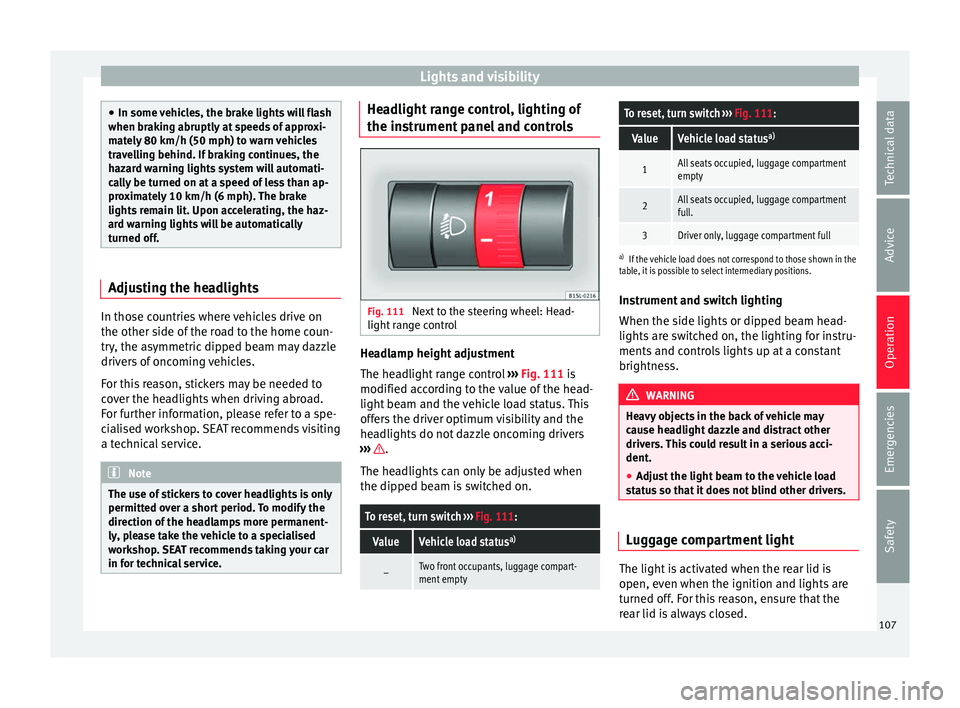
panel and controls Fig. 111
Next to the steering wheel: Head-
light r
an
ge control Headlamp height adjustment
The he
a
dlight
range control ››› Fig. 111 is
modified according to the value of the head-
light beam and the vehicle load status. This
offers the driver optimum visibility and the
headlights do not dazzle oncoming drivers
››› .
The he a
dlights
can only be adjusted when
the dipped beam is switched on.
To reset, turn switch ››› Fig. 111:
ValueVehicle load status a)
–Two front occupants, luggage compart-
ment empty
To reset, turn switch
››› Fig. 111:
ValueVehicle load status a)
1All seats occupied, luggage compartment
empty
2All seats occupied, luggage compartment
full.
3Driver only, luggage compartment full
a)
If the vehicle load does not correspond to those shown in the
table, it is possible to select intermediary positions.
Instrument and switch lighting
When the side lights or dipped beam head-
lights are switched on, the lighting for instru-
ments and controls lights up at a constant
brightness. WARNING
Heavy objects in the back of vehicle may
cau se he
adlight dazzle and distract other
drivers. This could result in a serious acci-
dent.
● Adjust the light beam to the vehicle load
stat
us so that it does not blind other drivers. Luggage compartment light
The light is activated when the rear lid is
open, ev
en when the ignition and lights
ar
e
turned off. For this reason, ensure that the
rear lid is always closed. 107
Technical data
Advice
Operation
Emergencies
Safety
Page 114 of 232
Operation
Seats and head restraints
Adju s
tin
g the seat and head re-
straints
Manual front seat adjustment Read the additional information carefully
›› ›
page 12 WARNING
The safe driving chapter contains important
inform ation, tip
s, suggestions and warnings
that you should read and observe for your
own safety and the safety of your passengers
››› page 48. WARNING
● Adjus t
the front seats only when the vehi-
cle is stationary. Failure to follow this instruc-
tion could result in an accident.
● Be careful when adjusting the seat height.
Carel
ess or uncontrolled adjustment can
cause injuries.
● The front seat backrests must not be re-
clined for driv
ing. Otherwise, seat belts and
the airbag system might not protect as they
should in case of an accident, increasing risk
of injury. Removing and fitting the rear head re-
s
tr
aint
s Fig. 119
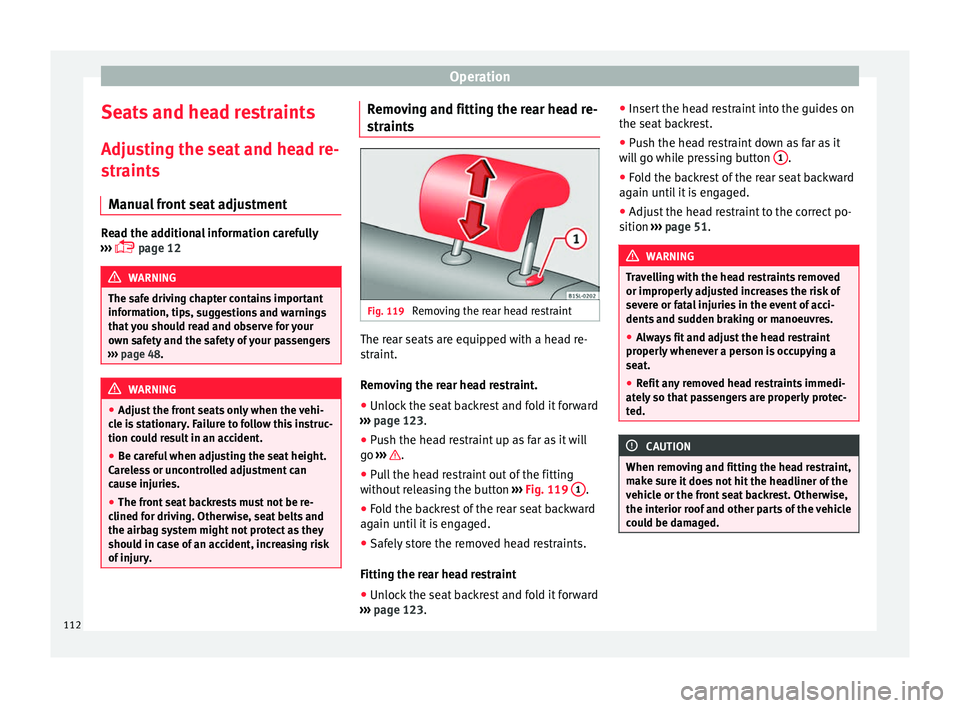
Removing the rear head restraint The rear seats are equipped with a head re-
s
tr
aint
.
Removing the rear head restraint.
● Unlock the seat backrest and fold it forward
›››
page 123.
● Push the head restraint up as far as it will
go ››
› .
● Pull the head restraint out of the fitting
w ithout
r
eleasing the button ››› Fig. 119 1 .
● Fold the backrest of the rear seat backward
ag ain u
nti
l it is engaged.
● Safely store the removed head restraints.
Fitting the re
ar head restraint
● Unlock the seat backrest and fold it forward
›››
page 123. ●
Insert
the head restraint into the guides on
the seat backrest.
● Push the head restraint down as far as it
wil
l go while pressing button 1 .
● Fold the backrest of the rear seat backward
ag ain u
nti
l it is engaged.
● Adjust the head restraint to the correct po-
sition ››
› page 51. WARNING
Travelling with the head restraints removed
or improperly a
djusted increases the risk of
severe or fatal injuries in the event of acci-
dents and sudden braking or manoeuvres.
● Always fit and adjust the head restraint
properly whenev
er a person is occupying a
seat.
● Refit any removed head restraints immedi-
ately so th
at passengers are properly protec-
ted. CAUTION
When removing and fitting the head restraint,
mak e s
ure it does not hit the headliner of the
vehicle or the front seat backrest. Otherwise,
the interior roof and other parts of the vehicle
could be damaged. 112
Page 117 of 232
Transport and practical equipment
WARNING
Driving with the rear lid unlocked or open
cou l
d cause serious injuries.
● Always drive with the rear lid closed.
● Secure all objects in the vehicle. Loose
items c
ould fall out of the vehicle and injure
other road users or damage other vehicles.
● Drive particularly carefully and think
ahead.
● A
void sudden manoeuvres and braking giv-
en that thi
s could cause an uncontrolled
movement of the open rear lid.
● When transporting objects that protrude
out of the lug
gage compartment, indicate
them suitably. Observe legal requirements.
● If objects must project out of the luggage
compar
tment, the rear lid must never be used
to “secure” or “attach” objects.
● If a baggage rack is fitted on the rear lid, it
should be r
emoved before travelling with the
rear lid open. WARNING
Toxic gases may enter the vehicle interior
when the re ar lid i
s open. This could cause
loss of consciousness, carbon monoxide poi-
soning, serious injury and accidents.
● To avoid toxic gases entering the vehicle al-
way
s drive with the rear lid closed.
● In exceptional circumstances, if you must
drive with the r
ear lid open, observe the fol- lowing to reduce the entry of toxic gases in-
side the
v
ehicle:
– Close all windows.
– Disable air recirculation mode.
– Open all of the air outlets on the instru-
ment panel.
– Switch on the blower to maximum. CAUTION
An open boot hatch changes the length and
height of the
vehicle. Driving a loaded vehicle
For the best handling when driving a loaded
v
ehic
l
e, note the following:
● Secure all objects ›››
page 114.
● Accelerate gently and carefully.
● Avoid sudden braking and manoeuvres.
● Brake early.
● If necessary, read the instructions for driv-
ing with a r
oof carrier system ››› page 127. WARNING
A sliding load could considerably affect the
st ab
ility and safety of the vehicle resulting in
an accident with serious consequences.
● Secure loads correctly so they do not move. ●
When tran s
porting heavy objects, use suit-
able ropes or straps.
● Lock the seat backs in vertical position. Practical equipment
Introduction Storage compartments must only be used to
st
or
e light or small objects. WARNING
In the event of sudden braking movements or
turn s, loo
se objects may be thrown around
the vehicle interior. This could cause serious
injuries to passengers and cause the driver to
lose control of the vehicle.
● Do not transport animals or place hard,
heavy or sh
arp objects inside the vehicle in:
open storage compartments, dash panel, rear
shelf, items of clothing or bags.
● While driving, always keep object compart-
ments c
losed. WARNING
Objects falling into the driver's footwell could
prev ent
use of the pedals. This could lead the
driver to lose control of the vehicle, increas-
ing the risk of a serious accident. » 115
Technical data
Advice
Operation
Emergencies
Safety
Page 127 of 232
Transport and practical equipment
Luggage compartment shelf* Fig. 137
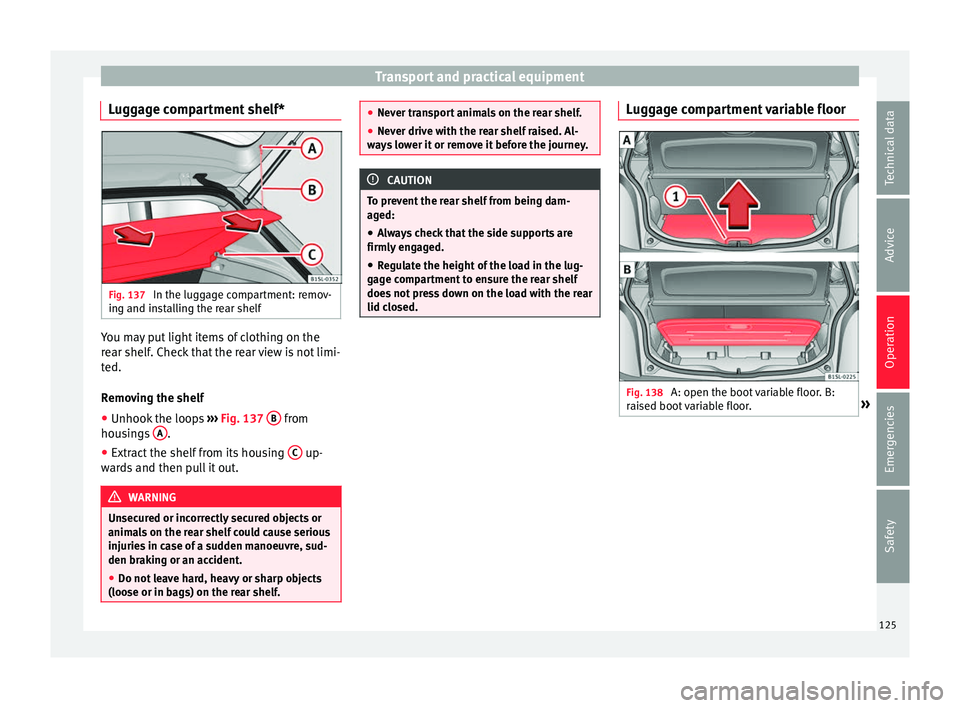
In the luggage compartment: remov-
in g and in
s
talling the rear shelf You may put light items of clothing on the
r
e
ar shelf
. Check that the rear view is not limi-
ted.
Removing the shelf
● Unhook the loops ›››
Fig. 137 B from
hou s
in
gs A .
● Extract the shelf from its housing C up-
w ar
d
s and then pull it out. WARNING
Unsecured or incorrectly secured objects or
anima l
s on the rear shelf could cause serious
injuries in case of a sudden manoeuvre, sud-
den braking or an accident.
● Do not leave hard, heavy or sharp objects
(loose or in bag
s) on the rear shelf. ●
Never tr an
sport animals on the rear shelf.
● Never drive with the rear shelf raised. Al-
way
s lower it or remove it before the journey. CAUTION
To prevent the rear shelf from being dam-
ag ed:
● Alw
ays check that the side supports are
firmly en
gaged.
● Regulate the height of the load in the lug-
gage c
ompartment to ensure the rear shelf
does not press down on the load with the rear
lid closed. Luggage compartment variable floor
Fig. 138
A: open the boot variable floor. B:
r ai
sed boot
variable floor. » 125
Technical data
Advice
Operation
Emergencies
Safety
Page 129 of 232
Transport and practical equipment
Retaining hooks Fig. 140
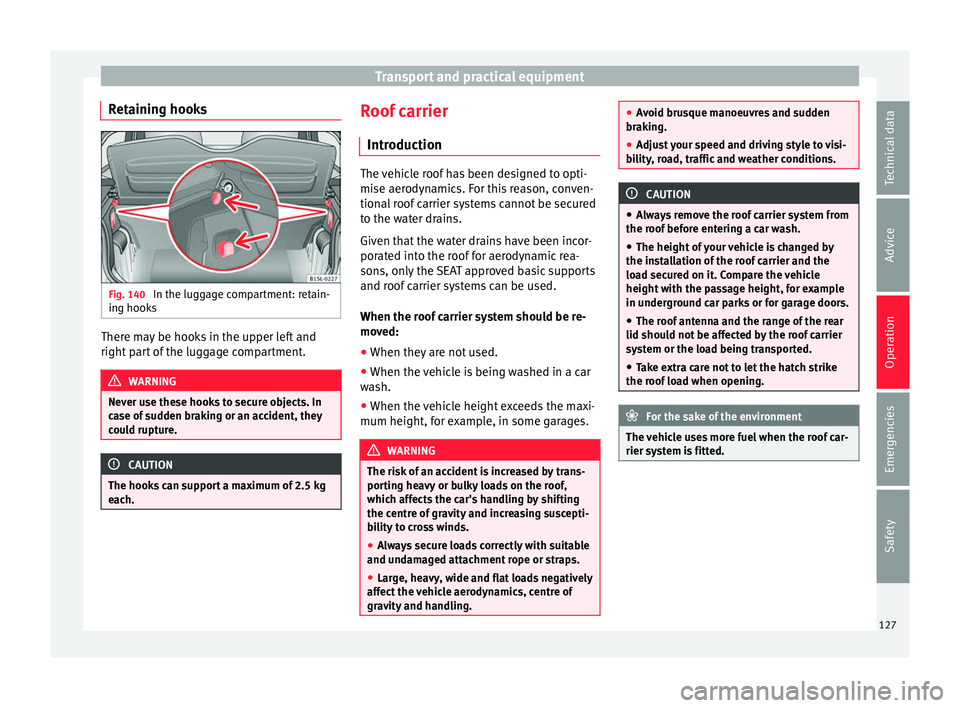
In the luggage compartment: retain-
in g hook
s There may be hooks in the upper left and
right
p
ar
t of the luggage compartment. WARNING
Never use these hooks to secure objects. In
ca se of
sudden braking or an accident, they
could rupture. CAUTION
The hooks can support a maximum of 2.5 kg
eac h. Roof carrier
Intr oduction The vehicle roof has been designed to opti-
mise aer
ody
namics. For this reason, conven-
tional roof carrier systems cannot be secured
to the water drains.
Given that the water drains have been incor-
porated into the roof for aerodynamic rea-
sons, only the SEAT approved basic supports
and roof carrier systems can be used.
When the roof carrier system should be re-
moved:
● When they are not used.
● When the vehicle is being washed in a car
wa sh.
● When the
vehicle height exceeds the maxi-
mum height, for ex
ample, in some garages. WARNING
The risk of an accident is increased by trans-
portin g he
avy or bulky loads on the roof,
which affects the car's handling by shifting
the centre of gravity and increasing suscepti-
bility to cross winds.
● Always secure loads correctly with suitable
and undam
aged attachment rope or straps.
● Large, heavy, wide and flat loads negatively
affect the
vehicle aerodynamics, centre of
gravity and handling. ●
Av oid bru
sque manoeuvres and sudden
braking.
● Adjust your speed and driving style to visi-
bility
, road, traffic and weather conditions. CAUTION
● Alw a
ys remove the roof carrier system from
the roof before entering a car wash.
● The height of your vehicle is changed by
the inst
allation of the roof carrier and the
load secured on it. Compare the vehicle
height with the passage height, for example
in underground car parks or for garage doors.
● The roof antenna and the range of the rear
lid should not
be affected by the roof carrier
system or the load being transported.
● Take extra care not to let the hatch strike
the roof lo
ad when opening. For the sake of the environment
The vehicle uses more fuel when the roof car-
rier sys t
em is fitted. 127
Technical data
Advice
Operation
Emergencies
Safety
Page 168 of 232
Advice
●
All
repairs and modifications to the vehicle
should only be performed by a specialised
workshop. Repairs and malfunctions in the air-
bag sy
s
tem When performing repairs and technical mod-
ification
s,
SEAT's directives must be ob-
served! ››› Modifications and repairs to the front bump-
er
, door
s, fr
ont seats, and repairs to the roof
or chassis should only be carried out in a
specialised workshop. These components
may contain parts or sensors belonging to
the airbag system.
If work is carried out on the airbag system or
parts have to be removed and fitted on the
system when performing other repair work,
parts of the airbag system may be damaged.
The consequence may be that, in the event of
an accident, the airbag inflates incorrectly or
does not inflate at all.
So that the effectiveness of the airbag is not
reduced and that removed parts do not cause
any injuries or environmental pollution, regu-
lations must be observed. These require-
ments are known to specialised workshops.
Modifications to the vehicle suspension may
affect the operation of the airbag system in
the event of collision. For example, if wheel and tyre combinations not approved by SEAT
are used, or if
the vehicle height is lowered,
the suspension is stiffened or the suspension
springs, telescopic arms, dampers, etc., are
modified, the results received by the airbag
sensors and sent to the control unit may not
be accurate. For example, some modifica-
tions to the suspension could increase the
force measured by the sensors and result in
the triggering of the airbag systems in colli-
sions. Under normal conditions, the meas-
ured values would be lower and the airbag
would not have been triggered. Other modifi-
cations may reduce the forces measured by
the sensors and prevent the airbags from be-
ing triggered when they should. WARNING
Repairs or modifications which are not per-
formed c orr
ectly may result in damage or er-
rors in the vehicle operation, affecting the ef-
fectiveness of the airbag systems. This could
result in serious or fatal accidents.
● All repairs and modifications to the vehicle
should on
ly be performed by a specialised
workshop.
● Airbag modules must never be repaired: if
damag
ed, they must be replaced.
● Never fit recycled or reused airbag compo-
nents in
your vehicle. WARNING
Modifications to the vehicle suspension, in-
cludin g the u
se of unauthorised wheel and
tyre combinations, may affect the perform-
ance of the airbags and increase the risk of
serious or fatal injury in the event of acci-
dent.
● Never fit suspension components which are
not identica
l to the original parts in the vehi-
cle.
● Never use wheel and tyre combinations not
appro
ved by SEAT. Retrofitting of mobile phones
An exterior aerial is required for the use of
tw
o-w
a
y radios in the vehicle.
The retro-fitting of electrical or electronic ap-
pliances in the vehicle is subject to their ap-
proval for use in your vehicle. Under certain
circumstances, this could mean that your ve-
hicle registration documents are no longer
valid.
SEAT has approved your vehicle for use with
two-way radios providing the following condi-
tions are observed:
● The exterior aerial must be mounted pro-
fes
sionally.
● The maximum transmitting power is 10
watts.
166
Page 174 of 232
Advice
●
Comp ar
e the distance between the vehicle
wheels and the distance between the guide-
rails of the car wash to prevent damage to the
wheels and tyres!
● Switch off the rain sensor before taking the
vehicl
e to an automatic car wash.
● Compare the height and width of your vehi-
cle w
ith the available height and width when
entering and driving through the car wash.
● Fold in exterior mirrors Electrically retracta-
ble e
xterior mirrors must not be folded in or
out by hand. Always use the electrical power
control.
● To avoid damaging the bonnet paintwork,
res
t the windscreen wipers on the windscreen
after drying the wiper blades. Do not let them
fall!
● Lock the rear lid to prevent it from opening
unexpect
edly while inside the car wash. Washing the vehicle with a high pres-
s
ur
e c
leaner When cleaning the vehicle with a high-pres-
s
ur
e c
leaner, always follow the operating in-
structions for the equipment. Pay special at-
tention to the required pressure of the jet
and the distance between the jet and the ve-
hicle ››› .
K eep a s uit
able distance from soft materials,
such as rubber hoses or insulating material,
and from the parking distance warning sys- tem sensors. The sensors of the parking dis-
tance w
arning system are situated on the rear
bumper ››› .
Do not u
se a no
zzle that sprays the water out
in a direct stream or one that has a rotating
jet for forcing off dirt ››› .
WARNING
The incorrect use of high pressure cleaning
equipment c ou
ld result in permanent dam-
age, visible or invisible, to the tyres or other
materials. This could result in a serious acci-
dent.
● Ensure there is a suitable distance between
the nozzl
e and the tyres.
● Never wash tyres with a concentrated jet or
so-cal
led “dirt blasters”. Even at large spray-
ing distances and short cleaning times, you
may damage the tyres. WARNING
After the vehicle has been washed, the brak-
ing eff ect
will be reduced (and the braking
distance increased) due to moisture (and ice
in winter) on the brakes.
● “Dry the brakes and remove ice” by braking
caref
ully. Ensure that you are not endanger-
ing other road-users or breaking traffic regu-
lations in the process. CAUTION
● The wat er t
emperature should not exceed
+60°C (+140°F).
● To avoid damage to the paintwork, do not
wash the
vehicle in full sun.
● To ensure that the system functions well,
the sensors
located on the bumper must be
kept clean and free from ice. When cleaning
with pressure hoses and steam cleaners, the
sensors should be sprayed only briefly. A dis-
tance of 10 cm between the sensors and the
steam / hose nozzle must be observed.
● Do not use a high pressure cleaner to re-
move ic
e or snow from windows
● Washing the vehicle in low temperatures:
When washin
g the vehicle with a hose, do
not direct water into the lock cylinders or the
gaps around the doors or roof. Locks and
seals could freeze! Cleaning windows and exterior mir-
r
or
s Cleaning windows and exterior mirrors
S
pr
a
y windows and exterior windows with a
standard window cleaner containing alcohol.
Dry the windows with a clean chamois leath-
er or a lint-free cloth. The chamois leathers
used on painted surfaces are not suitable for
cleaning windows because they are soiled
172