bonnet Seat Toledo 2013 User Guide
[x] Cancel search | Manufacturer: SEAT, Model Year: 2013, Model line: Toledo, Model: Seat Toledo 2013Pages: 258, PDF Size: 3.94 MB
Page 185 of 258
183
Checking and refilling levels
WARNING (Continued)
– Never work near naked flames.
– Always keep an approved fire extinguisher immediately available.
CAUTION
● When topping up fluids, make sure the correct fluid is put into the cor-
rect filler opening. Otherwise this can cause serious malfunctions or engine
damage!
● Never open the bonnet using the release catch. Risk of damage.
For the sake of the environment
Due to the environment-friendly disposal of fluids, the equipment necessary
and the knowledge required, fluids must be changed by an authorised SEAT
dealer during the service inspections of the vehicle.
Note
● Please contact an authorised SEAT dealer with any doubts regarding flu-
ids.
● Fluids of the correct specifications can be acquired from the selection of
SEAT Original Accessories. Opening and closing the bonnet
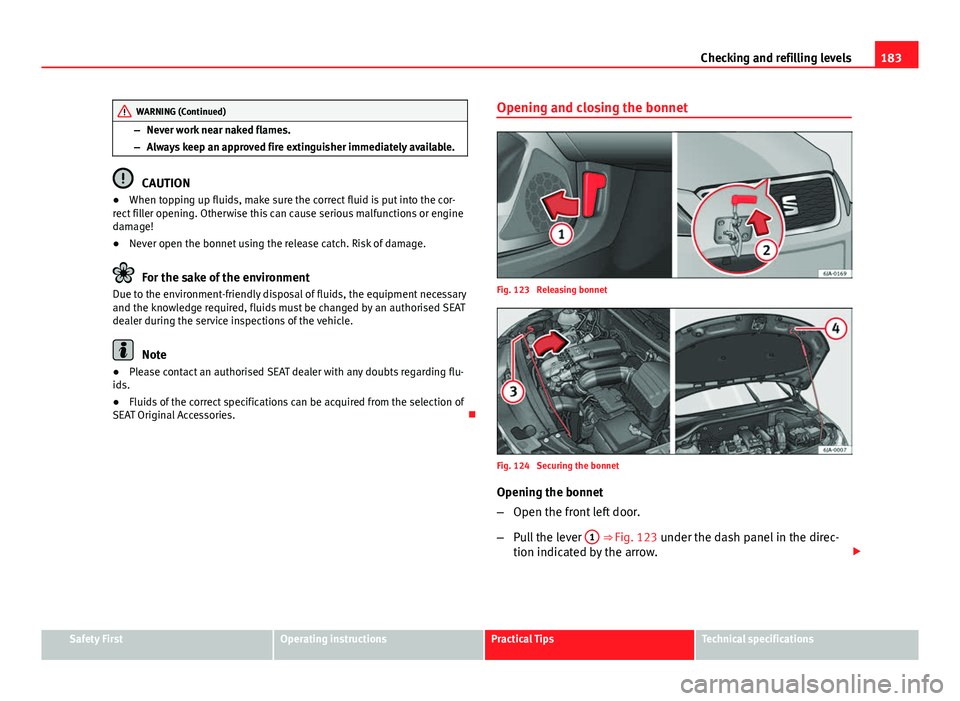
Fig. 123 Releasing bonnet
Fig. 124 Securing the bonnet
Opening the bonnet
– Open the front left door.
– Pull the lever 1
⇒ Fig. 123 under the dash panel in the direc-
tion indicated by the arrow.
Safety FirstOperating instructionsPractical TipsTechnical specifications
Page 186 of 258
184Checking and refilling levels
Before opening the bonnet, make sure that the windscreen wiper
arms are not lifted away from the glass. Otherwise the paintwork
may be damaged.
–Pull the release catch in the direction of the arrow 2
⇒ Fig. 123
and the bonnet will be released.
– Hold and lift the bonnet.
– Remove the support strut 3
⇒ Fig. 124 from its fastening in the
direction of the arrow and secure the raised bonnet so that the
end of the strut hooks onto the opening in the bonnet 4
.
Closing the bonnet
– Lift the bonnet slightly and unhook the support strut keeping
the bonnet open and insert it into its fastening 3
.
– Let the bonnet drop from a height of around 20 cm into the
catch Do not press down afterwards!
– Check that the bonnet is correctly closed.
Engine oil General notes
The engine comes with a special, multi-grade oil that can be used all year
round.
Because the use of high-quality oil is essential for the correct operation of
the engine and its long useful life, when topping up or changing oil, use on-
ly those oils that comply with VW standards. The specifications (VW standards) set out in the following page should ap-
pear on the container of the service oil; when the container displays the
specific standards for petrol and diesel engines together, it means that the
oil can be used for both types of engines.
We recommend that the oil change, indicated in the Maintenance Pro-
gramme, be performed by a Technical Service or a specialised workshop.
The correct oil specifications for your engine are listed in the
⇒ page 185,
Oil properties.
Service intervals
Service intervals can be flexible (LongLife service) or fixed (dependent on
time/distance travelled).
If the PR code that appears on the back of the “Maintenance Programme”
booklet is QG1, this means that your vehicle has the LongLife service pro-
grammed. If it has the codes QG0 or QG2 the interval service is dependent
on time/distance travelled.
Flexible service intervals (LongLife service intervals*)
Special oils and processes have been developed which, depending on the
characteristics and individual driving profiles, enable the extension of the
oil change service (LongLife service intervals).
Because this oil is essential for extending the service intervals, it must only
be used observing the following indications:
● Avoid mixing it with oil for fixed service intervals.
● Only in exceptional circumstances, if the engine oil level is too low
⇒ page 186 and LongLife oil is not available, it is permitted to top up
(once) with oil for fixed service intervals ⇒ page 185 (up to a maximum of
0.5 litres).
Fixed service intervals*
If your vehicle does not have the “LongLife service interval” or it has been
disabled (by request), you may use oils for fixed service intervals, which al-
so appear in ⇒ page 185, Oil properties. In this case, your vehicle must be
Page 188 of 258
186Checking and refilling levels
Checking the engine oil level
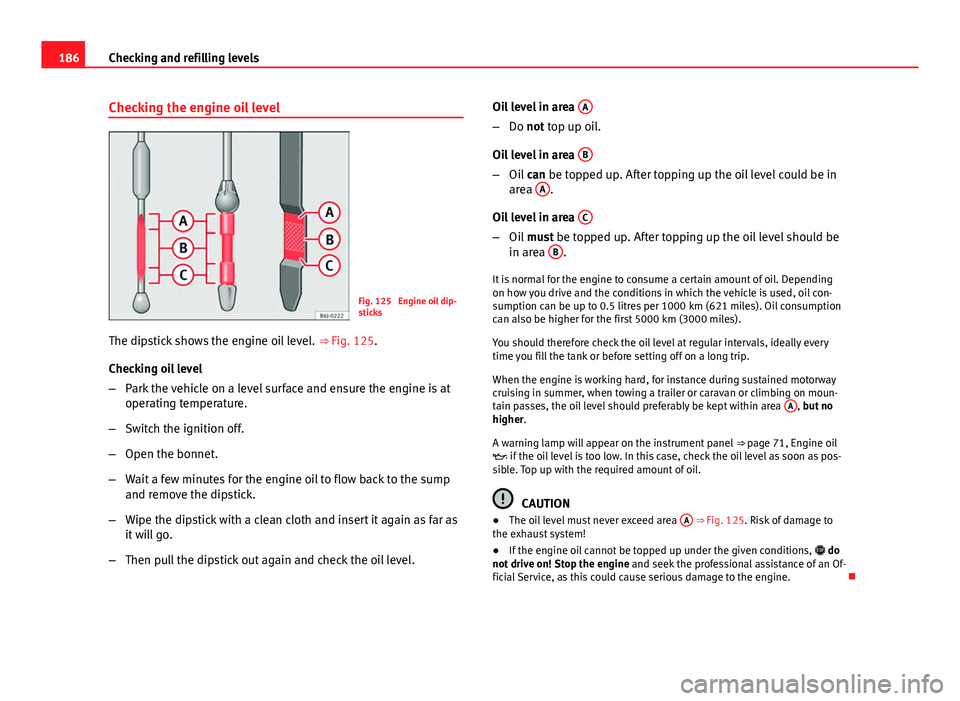
Fig. 125 Engine oil dip-
sticks
The dipstick shows the engine oil level. ⇒ Fig. 125.
Checking oil level
– Park the vehicle on a level surface and ensure the engine is at
operating temperature.
– Switch the ignition off.
– Open the bonnet.
– Wait a few minutes for the engine oil to flow back to the sump
and remove the dipstick.
– Wipe the dipstick with a clean cloth and insert it again as far as
it will go.
– Then pull the dipstick out again and check the oil level. Oil level in area
A
–
Do not top up oil.
Oil level in area B
–
Oil can be topped up. After topping up the oil level could be in
area A.
Oil level in area C
–
Oil must be topped up. After topping up the oil level should be
in area B.
It is normal for the engine to consume a certain amount of oil. Depending
on how you drive and the conditions in which the vehicle is used, oil con-
sumption can be up to 0.5 litres per 1000 km (621 miles). Oil consumption
can also be higher for the first 5000 km (3000 miles).
You should therefore check the oil level at regular intervals, ideally every
time you fill the tank or before setting off on a long trip.
When the engine is working hard, for instance during sustained motorway
cruising in summer, when towing a trailer or caravan or climbing on moun-
tain passes, the oil level should preferably be kept within area A
, but no
higher.
A warning lamp will appear on the instrument panel ⇒ page 71, Engine oil
if the oil level is too low. In this case, check the oil level as soon as pos-
sible. Top up with the required amount of oil.
CAUTION
● The oil level must never exceed area A ⇒ Fig. 125. Risk of damage to
the exhaust system!
● If the engine oil cannot be topped up under the given conditions, do
not drive on! Stop the engine and seek the professional assistance of an Of-
ficial Service, as this could cause serious damage to the engine.
Page 190 of 258
188Checking and refilling levels
Diesel enginesTop-up quantity (in litres)1.6 l/77 kW TDI CR6.5
CAUTION
● Anti-freeze that does not correspond to the correct specification may
particularly affect corrosion protection considerably.
● Faults caused by corrosion may lead to coolant leaks. Risk of serious en-
gine faults!
Checking coolant level
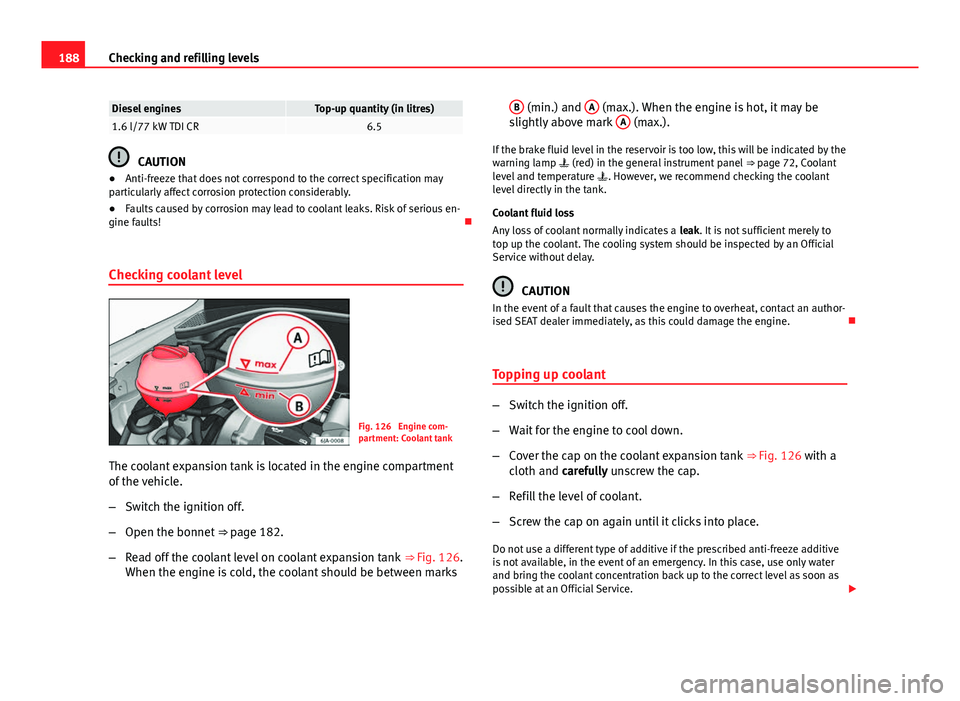
Fig. 126 Engine com-
partment: Coolant tank
The coolant expansion tank is located in the engine compartment
of the vehicle.
– Switch the ignition off.
– Open the bonnet ⇒ page 182.
– Read off the coolant level on coolant expansion tank ⇒
Fig. 126.
When the engine is cold, the coolant should be between marks B
(min.) and
A (max.). When the engine is hot, it may be
slightly above mark A (max.).
If the brake fluid level in the reservoir is too low, this will be indicated by the
warning lamp (red) in the general instrument panel ⇒ page 72, Coolant
level and temperature . However, we recommend checking the coolant
level directly in the tank.
Coolant fluid loss
Any loss of coolant normally indicates a leak. It is not sufficient merely to
top up the coolant. The cooling system should be inspected by an Official
Service without delay.
CAUTION
In the event of a fault that causes the engine to overheat, contact an author-
ised SEAT dealer immediately, as this could damage the engine.
Topping up coolant
– Switch the ignition off.
– Wait for the engine to cool down.
– Cover the cap on the coolant expansion tank ⇒ Fig. 126 with a
cloth and carefully unscrew the cap.
– Refill the level of coolant.
– Screw the cap on again until it clicks into place.
Do not use a different type of additive if the prescribed anti-freeze additive
is not available, in the event of an emergency. In this case, use only water
and bring the coolant concentration back up to the correct level as soon as
possible at an Official Service.
Page 191 of 258
189
Checking and refilling levels
Always top up with unused coolant.
Never fill the coolant tank above mark A
(max.) ⇒ Fig. 126 Excess coolant
is forced out of the cooling system through the overpressure valve in the fill-
er cap of the expansion tank when the engine heats up.
WARNING
● The anti-freeze additive and, therefore, the entire coolant, are a
health hazard. Avoid touching the coolant. Coolant fumes are also a
health hazard. Store the coolant additive in a safe place out of the reach
of children. Risk of poisoning!
● If splashed into eyes, rinse immediately with clean water and seek
immediate medical advice.
● Seek immediate medical advice if the coolant is accidentally inges-
ted.
CAUTION
If the engine oil cannot be topped up under the given conditions, do not
drive on. We recommend contacting an authorised SEAT dealer, as this can
damage the engine.
Radiator fan
The radiator is driven by an electric motor and controlled according to the
temperature of the coolant.
After the engine has been stopped and the ignition switched off, the radia-
tor fan may continue running for around 10 minutes. Brake fluid
Checking brake fluid level
Fig. 127 Engine com-
partment: Brake fluid res-
ervoir
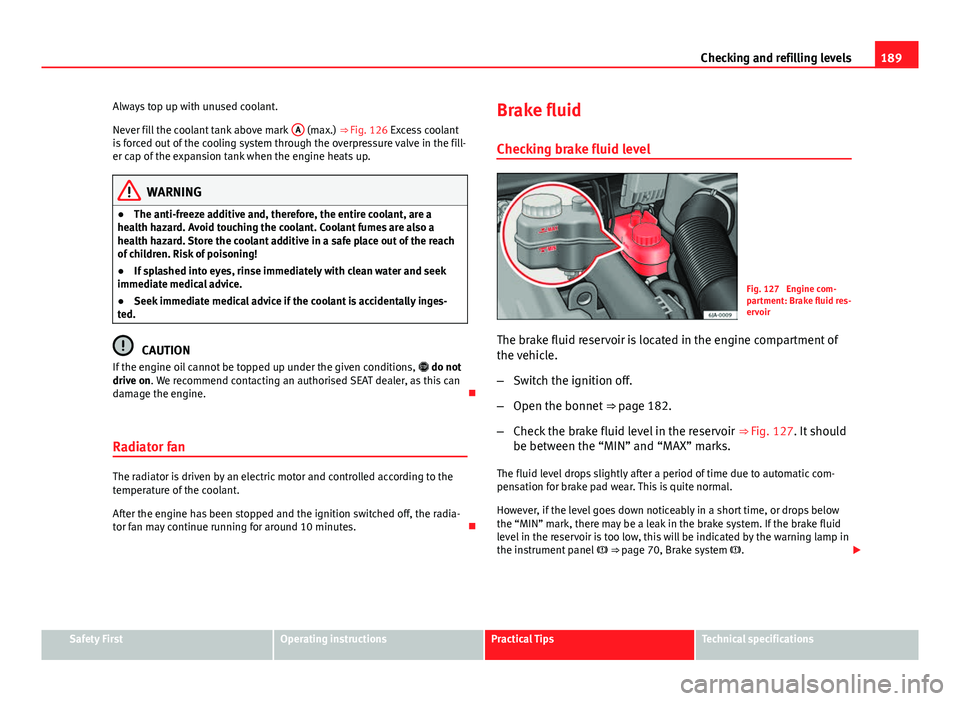
The brake fluid reservoir is located in the engine compartment of
the vehicle.
– Switch the ignition off.
– Open the bonnet ⇒ page 182.
– Check the brake fluid level in the reservoir ⇒ Fig. 127. It should
be between the “MIN” and “MAX” marks.
The fluid level drops slightly after a period of time due to automatic com-
pensation for brake pad wear. This is quite normal.
However, if the level goes down noticeably in a short time, or drops below
the “MIN” mark, there may be a leak in the brake system. If the brake fluid
level in the reservoir is too low, this will be indicated by the warning lamp in
the instrument panel
⇒ page 70, Brake system .
Safety FirstOperating instructionsPractical TipsTechnical specifications
Page 225 of 258
223
Fuses and bulbs
● Before changing a bulb, make sure you have the correct new bulb.
● Do not touch the glass part of the bulb with your bare hands, use a cloth
or paper towel instead. Otherwise, the fingerprints left on the glass will va-
porise as a result of the heat generated by the bulb, they will be deposited
on the reflector and will impair its surface.
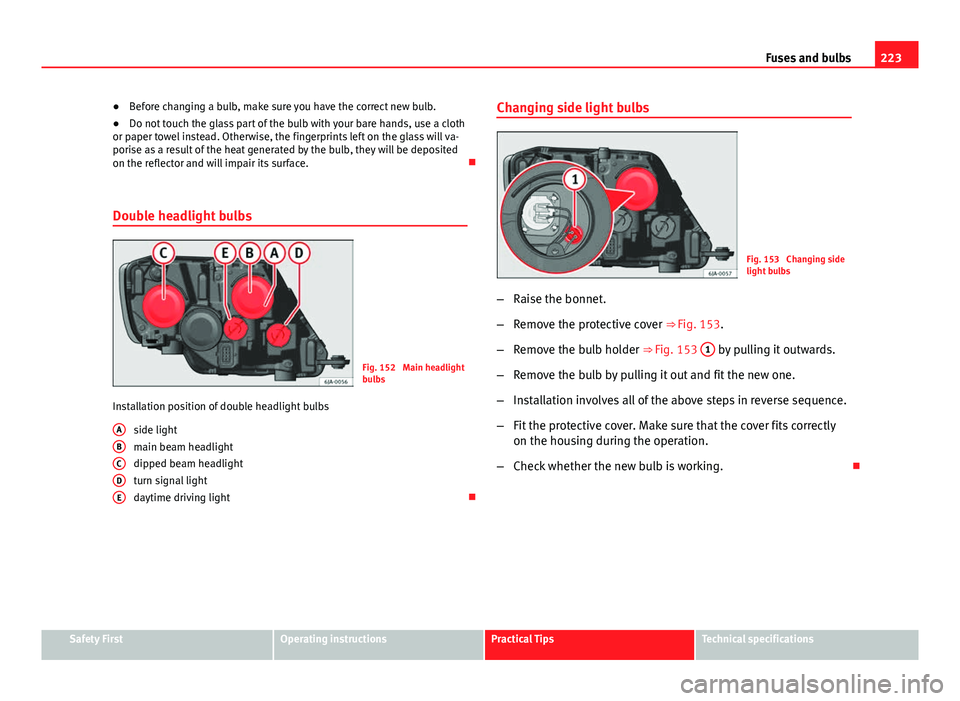
Double headlight bulbs
Fig. 152 Main headlight
bulbs
Installation position of double headlight bulbs side light
main beam headlight
dipped beam headlight
turn signal light
daytime driving light
A
BCDE
Changing side light bulbs
Fig. 153 Changing side
light bulbs
– Raise the bonnet.
– Remove the protective cover ⇒ Fig. 153.
– Remove the bulb holder ⇒ Fig. 153 1
by pulling it outwards.
– Remove the bulb by pulling it out and fit the new one.
– Installation involves all of the above steps in reverse sequence.
– Fit the protective cover. Make sure that the cover fits correctly
on the housing during the operation.
– Check whether the new bulb is working.
Safety FirstOperating instructionsPractical TipsTechnical specifications
Page 226 of 258
224Fuses and bulbs
Changing main beam headlight bulbs
Fig. 154 Changing main
beam headlight bulbs
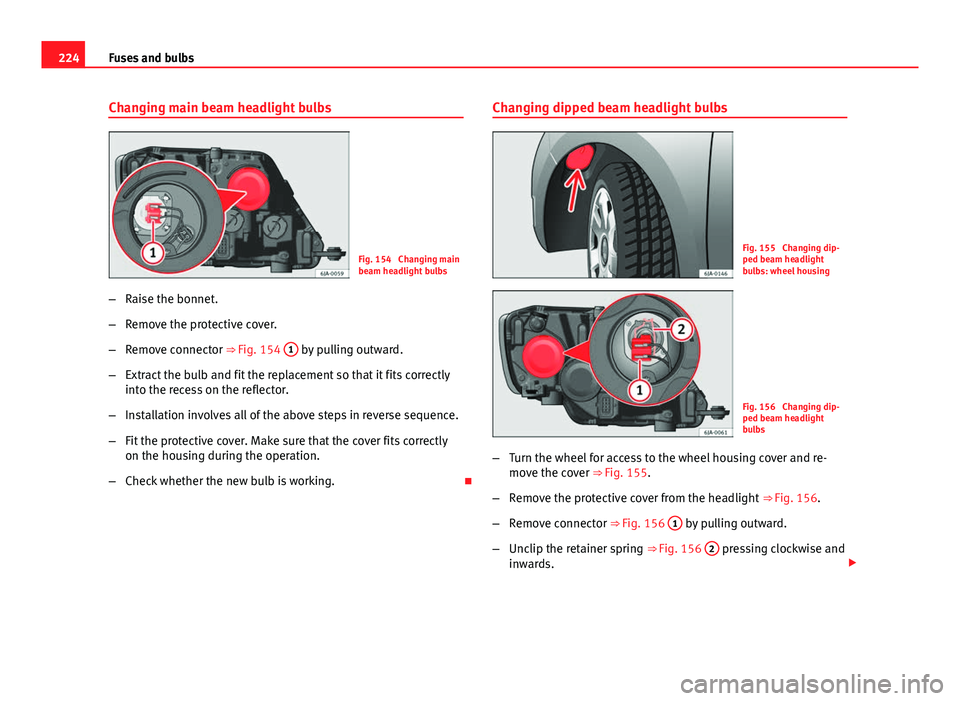
– Raise the bonnet.
– Remove the protective cover.
– Remove connector ⇒ Fig. 154 1
by pulling outward.
– Extract the bulb and fit the replacement so that it fits correctly
into the recess on the reflector.
– Installation involves all of the above steps in reverse sequence.
– Fit the protective cover. Make sure that the cover fits correctly
on the housing during the operation.
– Check whether the new bulb is working. Changing dipped beam headlight bulbs
Fig. 155 Changing dip-
ped beam headlight
bulbs: wheel housing
Fig. 156 Changing dip-
ped beam headlight
bulbs
– Turn the wheel for access to the wheel housing cover and re-
move the cover ⇒ Fig. 155.
– Remove the protective cover from the headlight ⇒
Fig. 156.
– Remove connector ⇒
Fig. 156 1
by pulling outward.
– Unclip the retainer spring ⇒
Fig. 156 2
pressing clockwise and
inwards.
Page 227 of 258
225
Fuses and bulbs
– Extract the bulb and fit the replacement so that the lug on the
base fits into the recess on the reflector.
– Fit the connector.
– Fit the protective cover. Make sure that the cover fits correctly
on the housing during the operation.
– Replace the wheel housing cover.
– Check whether the new bulb is working.
Changing turn signal light bulbs
Fig. 157 Changing turn
signal light bulbs
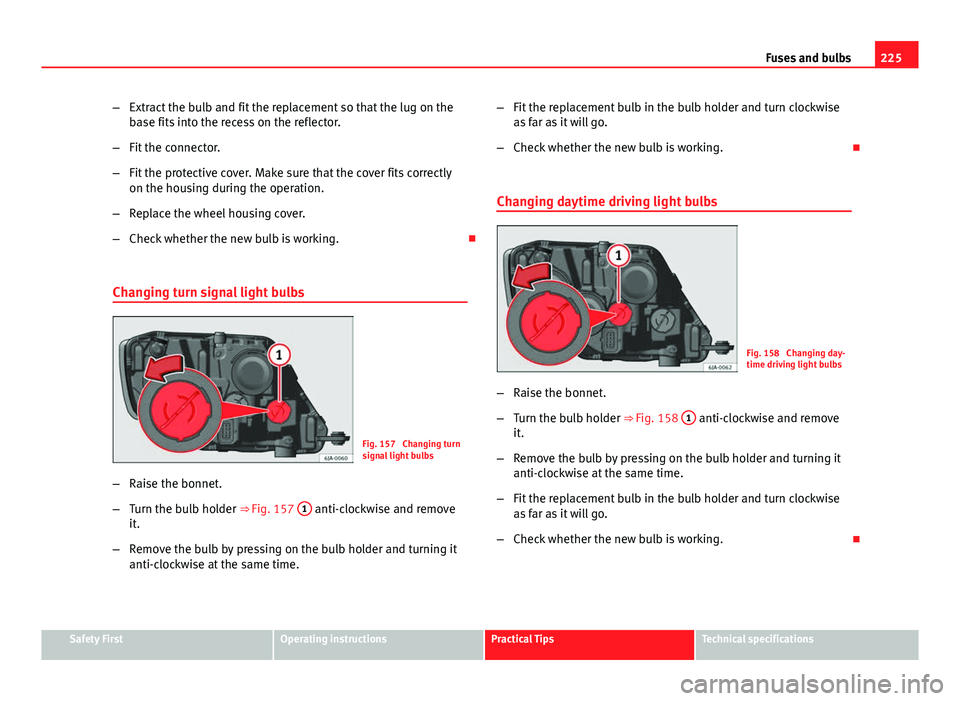
– Raise the bonnet.
– Turn the bulb holder ⇒ Fig. 157 1
anti-clockwise and remove
it.
– Remove the bulb by pressing on the bulb holder and turning it
anti-clockwise at the same time. –
Fit the replacement bulb in the bulb holder and turn clockwise
as far as it will go.
– Check whether the new bulb is working.
Changing daytime driving light bulbs
Fig. 158 Changing day-
time driving light bulbs
– Raise the bonnet.
– Turn the bulb holder ⇒ Fig. 158 1
anti-clockwise and remove
it.
– Remove the bulb by pressing on the bulb holder and turning it
anti-clockwise at the same time.
– Fit the replacement bulb in the bulb holder and turn clockwise
as far as it will go.
– Check whether the new bulb is working.
Safety FirstOperating instructionsPractical TipsTechnical specifications
Page 249 of 258
Index
A
ABS . . . . . . . . . . . . . . . . . . . . . . . . . . . . . . . . . . 145control lamp . . . . . . . . . . . . . . . . . . . . . . . . . 73
Accessories . . . . . . . . . . . . . . . . . . . . . . . . . . . . 204
Adjusting the seat belt height . . . . . . . . . . . . . . 29
Adjustment seats . . . . . . . . . . . . . . . . . . . . . . . . . . . . . . 111
steering wheel . . . . . . . . . . . . . . . . . . . . . . 140
Aerial . . . . . . . . . . . . . . . . . . . . . . . . . . . . . . . . . 173 see radio reception . . . . . . . . . . . . . . . . . . 175
Airbag . . . . . . . . . . . . . . . . . . . . . . . . . . . . . . . . . 31
Airbag covers . . . . . . . . . . . . . . . . . . . . . . . . . . . 37
Airbag system . . . . . . . . . . . . . . . . . . . . . . . . . . . 31 control lamp . . . . . . . . . . . . . . . . . . . . . . . . . 33
Curtain airbags . . . . . . . . . . . . . . . . . . . . . . . 41
Front airbags . . . . . . . . . . . . . . . . . . . . . . . . 35
Side airbags . . . . . . . . . . . . . . . . . . . . . . . . . 38
air conditioning air conditioning . . . . . . . . . . . . . . . . . . . . . 129
Air conditioning air conditioning . . . . . . . . . . . . . . . . . 132, 134
Climatronic . . . . . . . . . . . . . . . . . . . . . . . . . 135
Air recirculation manual air conditioning . . . . . . . . . . . . . . 134
Alarm . . . . . . . . . . . . . . . . . . . . . . . . . . . . . . . . . . 91
Anti-lock system . . . . . . . . . . . . . . . . . . . . . . . . 145
Anti-theft alarm system . . . . . . . . . . . . . . . . . . . 91 Armrest . . . . . . . . . . . . . . . . . . . . . . . . . . . . . . . 111
rear . . . . . . . . . . . . . . . . . . . . . . . . . . . . . . . 114
Ashtrays . . . . . . . . . . . . . . . . . . . . . . . . . . . . . . 121
Aspects to take into account before starting the vehicle . . . . . . . . . . . . . . . . . . . . . . . . . . . . . . . . 8
ASR . . . . . . . . . . . . . . . . . . . . . . . . . . . . . . . . . . 145 Assistance systems . . . . . . . . . . . . . . . . . . . 73
control lamp . . . . . . . . . . . . . . . . . . . . . . . . . 73
Assistance system ABS . . . . . . . . . . . . . . . . . . . . . . . . . . . . . . . 145
ASR . . . . . . . . . . . . . . . . . . . . . . . . . . . . . . . 145
START-STOP . . . . . . . . . . . . . . . . . . . . . . . . . 154
Assistance systems ABS . . . . . . . . . . . . . . . . . . . . . . . . . . . . . . . . 73
cruise control . . . . . . . . . . . . . . . . . . . . . . . 152
EDL . . . . . . . . . . . . . . . . . . . . . . . . . . . . . . . 145
ESC . . . . . . . . . . . . . . . . . . . . . . . . . . . . 72, 144
parking aid . . . . . . . . . . . . . . . . . . . . . . . . . 151
Audible warning . . . . . . . . . . . . . . . . . . . . . . . . . 21
Auto-check system . . . . . . . . . . . . . . . . . . . . . . . 68
Automatic disconnection of electrical equip- ment . . . . . . . . . . . . . . . . . . . . . . . . . . . . . . . . 194
Automatic gearbox . . . . . . . . . . . . . . . . . . . . . . 146 back-up programme . . . . . . . . . . . . . . . . . . 150
Driving programmes . . . . . . . . . . . . . . . . . 149
instructions for use . . . . . . . . . . . . . . . . . . 146
kick-down . . . . . . . . . . . . . . . . . . . . . . . . . . 149
manual release of the selector lever . . . . . 150
parking . . . . . . . . . . . . . . . . . . . . . . . . . . . . 147
Selector lever lock . . . . . . . . . . . . . . . . . . . 149 selector lever positions . . . . . . . . . . . . . . . 147
starting . . . . . . . . . . . . . . . . . . . . . . . . . . . . 147
stopping . . . . . . . . . . . . . . . . . . . . . . . . . . . 147
Tiptronic . . . . . . . . . . . . . . . . . . . . . . . . . . . 148
AUX-IN . . . . . . . . . . . . . . . . . . . . . . . . . . . . . . . . . 81
B
Back-up automatic gearbox . . . . . . . . . . . . . . . . . . . 150
Battery automatic disconnection of electricalequipment . . . . . . . . . . . . . . . . . . . . . . . . 194
changing . . . . . . . . . . . . . . . . . . . . . . . . . . . 194
charging . . . . . . . . . . . . . . . . . . . . . . . . . . . 193
checking acid level . . . . . . . . . . . . . . . . . . . 193
safety instructions . . . . . . . . . . . . . . . . . . . 191
winter service . . . . . . . . . . . . . . . . . . . . . . . 193
Before starting the vehicle . . . . . . . . . . . . . . . . . 8
Bonnet closing . . . . . . . . . . . . . . . . . . . . . . . . . . . . 183
opening . . . . . . . . . . . . . . . . . . . . . . . . . . . . 183
Brake assist . . . . . . . . . . . . . . . . . . . . . . . . . . . 144
Brake fluid checking . . . . . . . . . . . . . . . . . . . . . . . . . . . 189
brakes brake fluid . . . . . . . . . . . . . . . . . . . . . . . . . . 189
247
Index