cooling Seat Toledo 2013 User Guide
[x] Cancel search | Manufacturer: SEAT, Model Year: 2013, Model line: Toledo, Model: Seat Toledo 2013Pages: 258, PDF Size: 3.94 MB
Page 137 of 258
135
Heating and air conditioning
Switching off air recirculation mode
– Press button
1 ⇒ Fig. 98 ⇒ page 132 again and the lamp
in the button will switch off.
If air distribution control C
⇒ Fig. 98 ⇒
page 132 is in position , air recir-
culation mode switches off automatically Press the button to switch air
recirculation mode back on in this position.
WARNING
Never use the air recirculation system for too long, as it prevents fresh air
from entering the vehicle and “used” air can cause tiredness, reduce your
attention span and cause the windows to mist over. This increases the
risk of an accident. Switch off the air recirculation system as soon as the
windows begin to mist over.
Climatronic* (automatic air conditioning) General notes
Climatronic automatically maintains a comfortable temperature. To do so, it
automatically regulates the supplied air temperature and the blower and air
distribution levels. The system also allows for the effect of sunlight, so there
is no need for manual adjustment. Automatic operations ⇒ page 136 guar-
antee maximum comfort any time of year.
Climatronic description
Cooling only works if the following conditions are met:
● The engine is running
● the outside temperature is above +2 °C (+36 °F)
● AC
18 ⇒ Fig. 99 ⇒ page 136 on. In order to ensure engines subject to heavy loads are cooled, the air condi-
tioning compressor is switched off in the event of high coolant tempera-
tures.
Recommended setting for all seasons
●
Set the required temperature, we recommend +22 °C (72 °F).
● Press the AUTO
button 12 ⇒
Fig. 99 ⇒ page 136.
● Adjust vents 3 ⇒ page 129 and 4 so that the air flow is directed slightly
upwards.
Change between degrees Centigrade and degrees Fahrenheit
Keep the AUTO
and AC buttons
⇒ Fig. 99 ⇒ page 136 pressed down at the
same time. The data is displayed on the screen in the units required.
Note
A visit to the specialised service once a year is recommended to clean the
Climatronic system.
Safety FirstOperating instructionsPractical TipsTechnical specifications
Page 138 of 258

136Heating and air conditioning
Controls
Fig. 99 Climatronic: controls
Buttons/controls
Interior temperature setting
Display Selected interior temperature
Degrees Centigrade or Fahrenheit
Automatic air conditioning mode
Defrost or demist windscreen
Air flow direction
Air recirculation
Cooling on/off
Selected blower speed
Buttons/controls Set blower speed
Interior temperature sensor
1
23456789
1011
Automatic mode
Defrost or demist windscreen
Air distribution to windows
Air distribution to upper body
Air distribution to footwells
Air recirculation
Cooling on/off
Note
The interior temperature sensor 11 ⇒ Fig. 99 ⇒
page 136 is at the bottom.
Do not cover it with stickers or the like, as this could have a negative effect
on Climatronic operations.
Automatic mode
Automatic mode is used to maintain a constant temperature and
demist the windows inside the vehicle.
Switching on automatic mode
– Adjust to temperatures from +18 °C (+64 °F) to +29 °C (+84 °F).
– Adjust vents 3 ⇒ page 129 and 4 so that the air flow is directed
slightly upwards.
– Press the AUTO
button 12 ⇒
Fig. 99 and AUTO displayed on the
screen.
Automatic mode is switched off by pressing the air distribution buttons or
increasing or decreasing the blower speed. However, the temperature re-
mains regulated.
12
131415161718
Page 139 of 258
137
Heating and air conditioning
Temperature selection
– When you switch on the ignition, control 1 ⇒ Fig. 99
⇒ page 136 can be used to set the required interior tempera-
ture.
The interior temperature can be adjusted between +18 °C (+64 °F) and
+29 °C (+84 °F). The temperature is regulated automatically within this
range. If a temperature below +18 °C (+64 °F) is selected, “LO” is displayed
on the screen. If a temperature above +29 °C (+84 °F) is selected, “HI” is
displayed on the screen. At both extremes, Climatronic works at maximum
cooling or heating power, respectively. The temperature is not regulated.
In the event of prolonged, irregular distribution of the air flow from the out-
lets (particularly the footwells) and significant differences in temperature,
e.g. on leaving the vehicle, sensitive people may catch a cold.
Air recirculation
Air recirculation prevents unpleasant smells, e.g. when passing
through a tunnel or in queuing traffic, from entering the interior.
Switching on air recirculation mode
– Press button
17 ⇒ Fig. 99 ⇒ page 136 and the
symbol
is displayed on the screen.
Switching off air recirculation mode
– Press button
17 ⇒ Fig. 99 ⇒ page 136 and the
symbol
disappears from the screen.
WARNING
Never use the air recirculation system for too long, as it prevents fresh air
from entering the vehicle and “used” air can cause tiredness, reduce your
attention span and cause the windows to mist over. This increases the
risk of an accident. Switch off the air recirculation system as soon as the
windows begin to mist over.
Note
If air recirculation mode remains on for 15 minutes, the symbol will
start to flash on the screen to indicate prolonged air recirculation. If air recir-
culation is not switched off, the symbol will continue to flash for 5 minutes.
Blower selection
Climatronic automatically regulates the blower speed according to
the interior temperature. It is possible, however, to set the blower
speed to suit requirements.
– Turn rotary control 10
⇒ Fig. 99 ⇒
page 136 anti-clockwise (de-
crease speed) or clockwise (increase speed).
Climatronic will switch off when the blower switches off.
WARNING
● “Used air” can cause tiredness, reduce attention spans and cause the
windows to mist over. This increases the risk of an accident.
● Do not switch off Climatronic for longer than necessary.
● Switch Climatronic back on as soon as the windows begin to mist
over.
Safety FirstOperating instructionsPractical TipsTechnical specifications
Page 163 of 258
161
Driving and the environment
Environmental friendliness
Environmental protection is a top priority in the design, choice of materials
and manufacture of your new SEAT.
Constructive measures to encourage recycling
● Joints and connections designed for easy dismantling
● Modular construction to facilitate dismantling
● Increased use of single-grade materials.
● Plastic parts and elastomers are marked in accordance with ISO 1043,
ISO 11469 and ISO 1629.
Choice of materials
● Use of recycled materials.
● Use of compatible plastics in the same part if its components are not
easily separated.
● Use of recycled materials and/or materials originating from renewable
sources.
● Reduction of volatile components, including odour, in plastic materials.
● Use of CFC-free coolants.
Ban on heavy metals, with the exceptions dictated by law (Annex II of ELV
Directive 2000/53/EC): cadmium, lead, mercury, hexavalent chromium.
Manufacturing methods
● Reduction of the quantity of thinner in the protective wax for cavities.
● Use of plastic film as protection during vehicle transport.
● Use of solvent-free adhesives.
● Use of CFC-free coolants in cooling systems.
● Recycling and energy recovery from residues (RDF).
● Improvement in the quality of waste water. ●
Use of systems for the recovery of residual heat (thermal recovery, en-
thalpy wheels, etc.).
● The use of water-soluble paints
Driving abroad General notes
It is possible that in some countries the SEAT dealer network is limited or
inexistent. Therefore it is difficult to acquire certain spare parts and the
workers at the specialised workshops can only carry out limited repair
works. SEAT will inform you about the technical requirements of your vehi-
cle, necessary maintenance work and possibilities for repair.
Unleaded petrol
Refuel only using unleaded petrol ⇒ page 157, Catalytic converter in petrol
engine vehicles. Automobile associations will provide information regarding
the network of petrol stations offering unleaded petrol.
Headlights
Your dipped beam headlights are adjusted in an asymmetrical formation.
The side of the road on which you are driving is illuminated more brightly.
If you are driving in a foreign country where traffic drives on the opposite
side of the road this will dazzle the oncoming traffic. In order to avoid daz-
zling oncoming traffic, it is essential to have the headlights adjusted at an
authorised SEAT dealer.
Safety FirstOperating instructionsPractical TipsTechnical specifications
Page 184 of 258
182Checking and refilling levels
● Water allowed to collect in the fuel filter can cause engine faults.
● Your vehicle is not prepared for use of biofuel (RME) and, therefore, this
fuel must not be used for refuelling or driving. The use of biofuel (RME)
could cause serious damage to the engine or the fuel system.
Engine compartment
Introduction
Always be aware of the danger of injury and scalding as well as the risk of
accident or fire when working in the engine compartment, e.g. when check-
ing and refilling fluids. Therefore, always observe the warnings and follow
all general safety precautions. The engine compartment of any motor vehi-
cle is a potentially hazardous area .
WARNING
● Never open the bonnet if you see steam, smoke or coolant escaping
from the engine compartment. Risk of scalding! Wait until no steam or
coolant can be seen before opening the bonnet.
● Switch off the engine and remove the key from the ignition.
● Engage neutral in vehicles with manual gearbox and move the selec-
tor lever to position P in vehicles with automatic gearbox.
● Apply the handbrake firmly.
● Wait for the engine to cool down.
● For safety reasons, the bonnet must always be closed when the vehi-
cle is moving. Therefore, after closing the bonnet always check that it is
properly secured.
WARNING (Continued)
● Should you notice that the bonnet is not safely secured when the ve-
hicle is moving, stop the vehicle immediately and close the bonnet prop-
erly. Risk of accident!
● Keep children away from the engine compartment.
● Do not touch hot engine parts. Risk of burns!
● Never spill fluids on hot engine compartments. These fluids can
cause a fire (e.g. antifreeze in coolant).
● Take care not to cause short circuits in the electrical system, especial-
ly when working on the battery.
● Never touch the radiator fan when the engine is hot. The fan may start
running suddenly!
● Do not unscrew the cap on the coolant expansion tank when the en-
gine is hot. The cooling system is under pressure!
● Protect face, hands and arms from any hot steam or hot coolant re-
leased by covering the cap with a large, thick rag when opening the ex-
pansion tank.
● Do not leave any objects, such as cloths and tools, in the engine com-
partment.
● When working underneath the vehicle, secure it so that it cannot roll
away and support it safely on suitable supports. The hydraulic jack is not
sufficient for this purpose. Risk of injuries!
● If any tests have to be performed with the engine running, there is an
extra safety risk from rotating parts, such as the drive belt, alternator
and radiator fan, etc., and from the high-voltage ignition system. You
should also note the following:
–Never touch the electrical wiring of the ignition system.
– Keep away from moving engine parts when wearing jewellery,
loose clothing or long hair. Risk of fatal injuries! All jewellery must be
removed, hair tied back and close-fitting clothing worn.
● Observe the following additional warnings if work on the fuel system
or the electrical system is necessary.
–Always disconnect the battery from the on-board network.
– Do not smoke.
Page 189 of 258
187
Checking and refilling levels
Topping up engine oil
– Check the engine oil level ⇒ page 186, Checking the engine oil
level.
– Unscrew the cap from the filler opening.
– Put in the specified grade of oil 0.5 litres at a time ⇒ page 184.
– Check the oil level ⇒ page 186.
– Replace the oil filler cap carefully and push the dipstick all the
way in.
Changing engine oil
Engine oil must be changed with the frequency indicated in the Mainte-
nance Programme or according to the service interval indicator ⇒ page 59.
CAUTION
Do not mix engine oil with additives. Risk of damage to the engine! Damage
caused by these products is not covered by the warranty.
Note
Wash your skin thoroughly if it comes into contact with engine oil. Coolant
General notes
The cooling system is factory-filled with an anti-freeze product.
Coolant consists of a mixture of water and 40% anti-freeze additive. This
mixture gives the required anti-freeze protection at temperatures down to
+25 °C (+77 °F) and protects the cooling and heating system against corro-
sion. It also prevents scaling and raises the boiling point of the coolant con-
siderably.
The coolant concentration must not be reduced by adding water, even in
warmer seasons or in warm countries. The concentration of the anti-freeze
additive in the coolant must be at least 40 %.
If greater anti-freeze protection is required in very cold climates, the propor-
tion of the anti-freeze additive can be increased, but only up to 60 % (anti-
freeze protection down to approx. -40 °C (-40 °F). Any excess in this propor-
tion would reduce the anti-freeze protection and affect the cooling effect.
Vehicles for countries with cold climate are are supplied with coolant protec-
tion down to around -35 °C (-31 °F). The proportion of the antifreeze addi-
tive in these countries should always be at least 50 %.
The type of anti-freeze to be used for topping up is indicated on the coolant
tank cover ⇒ Fig. 126.
Amount of coolant
Petrol enginesTop-up quantity (in litres)1.2 l/55 kW MPI4.21.2 l/63 kW TSI7.01.2 l/77 kW TSI7.01.4 l/90 kW TSI7.0
Safety FirstOperating instructionsPractical TipsTechnical specifications
Page 190 of 258
188Checking and refilling levels
Diesel enginesTop-up quantity (in litres)1.6 l/77 kW TDI CR6.5
CAUTION
● Anti-freeze that does not correspond to the correct specification may
particularly affect corrosion protection considerably.
● Faults caused by corrosion may lead to coolant leaks. Risk of serious en-
gine faults!
Checking coolant level
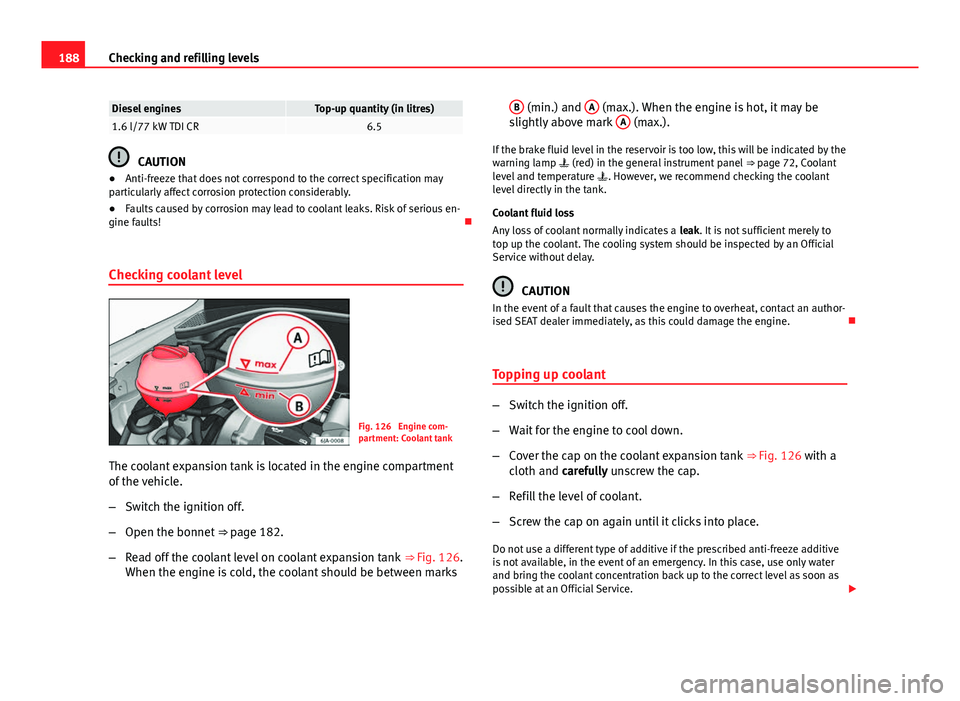
Fig. 126 Engine com-
partment: Coolant tank
The coolant expansion tank is located in the engine compartment
of the vehicle.
– Switch the ignition off.
– Open the bonnet ⇒ page 182.
– Read off the coolant level on coolant expansion tank ⇒
Fig. 126.
When the engine is cold, the coolant should be between marks B
(min.) and
A (max.). When the engine is hot, it may be
slightly above mark A (max.).
If the brake fluid level in the reservoir is too low, this will be indicated by the
warning lamp (red) in the general instrument panel ⇒ page 72, Coolant
level and temperature . However, we recommend checking the coolant
level directly in the tank.
Coolant fluid loss
Any loss of coolant normally indicates a leak. It is not sufficient merely to
top up the coolant. The cooling system should be inspected by an Official
Service without delay.
CAUTION
In the event of a fault that causes the engine to overheat, contact an author-
ised SEAT dealer immediately, as this could damage the engine.
Topping up coolant
– Switch the ignition off.
– Wait for the engine to cool down.
– Cover the cap on the coolant expansion tank ⇒ Fig. 126 with a
cloth and carefully unscrew the cap.
– Refill the level of coolant.
– Screw the cap on again until it clicks into place.
Do not use a different type of additive if the prescribed anti-freeze additive
is not available, in the event of an emergency. In this case, use only water
and bring the coolant concentration back up to the correct level as soon as
possible at an Official Service.
Page 191 of 258
189
Checking and refilling levels
Always top up with unused coolant.
Never fill the coolant tank above mark A
(max.) ⇒ Fig. 126 Excess coolant
is forced out of the cooling system through the overpressure valve in the fill-
er cap of the expansion tank when the engine heats up.
WARNING
● The anti-freeze additive and, therefore, the entire coolant, are a
health hazard. Avoid touching the coolant. Coolant fumes are also a
health hazard. Store the coolant additive in a safe place out of the reach
of children. Risk of poisoning!
● If splashed into eyes, rinse immediately with clean water and seek
immediate medical advice.
● Seek immediate medical advice if the coolant is accidentally inges-
ted.
CAUTION
If the engine oil cannot be topped up under the given conditions, do not
drive on. We recommend contacting an authorised SEAT dealer, as this can
damage the engine.
Radiator fan
The radiator is driven by an electric motor and controlled according to the
temperature of the coolant.
After the engine has been stopped and the ignition switched off, the radia-
tor fan may continue running for around 10 minutes. Brake fluid
Checking brake fluid level
Fig. 127 Engine com-
partment: Brake fluid res-
ervoir
The brake fluid reservoir is located in the engine compartment of
the vehicle.
– Switch the ignition off.
– Open the bonnet ⇒ page 182.
– Check the brake fluid level in the reservoir ⇒ Fig. 127. It should
be between the “MIN” and “MAX” marks.
The fluid level drops slightly after a period of time due to automatic com-
pensation for brake pad wear. This is quite normal.
However, if the level goes down noticeably in a short time, or drops below
the “MIN” mark, there may be a leak in the brake system. If the brake fluid
level in the reservoir is too low, this will be indicated by the warning lamp in
the instrument panel
⇒ page 70, Brake system .
Safety FirstOperating instructionsPractical TipsTechnical specifications
Page 193 of 258
191
Checking and refilling levels
CAUTION
● Never mix the windscreen washing water with anti-freeze used for the
cooling system or other additives.
● If the vehicle is equipped with a headlight washer system, only mix a de-
tergent that does not damage polycarbonates with the water.
Note
On topping up the fluid, do not move the filter on the container opening, as
this could contaminate the fluid pipes and, therefore, lead to a windscreen
washer malfunction.
Battery Introduction
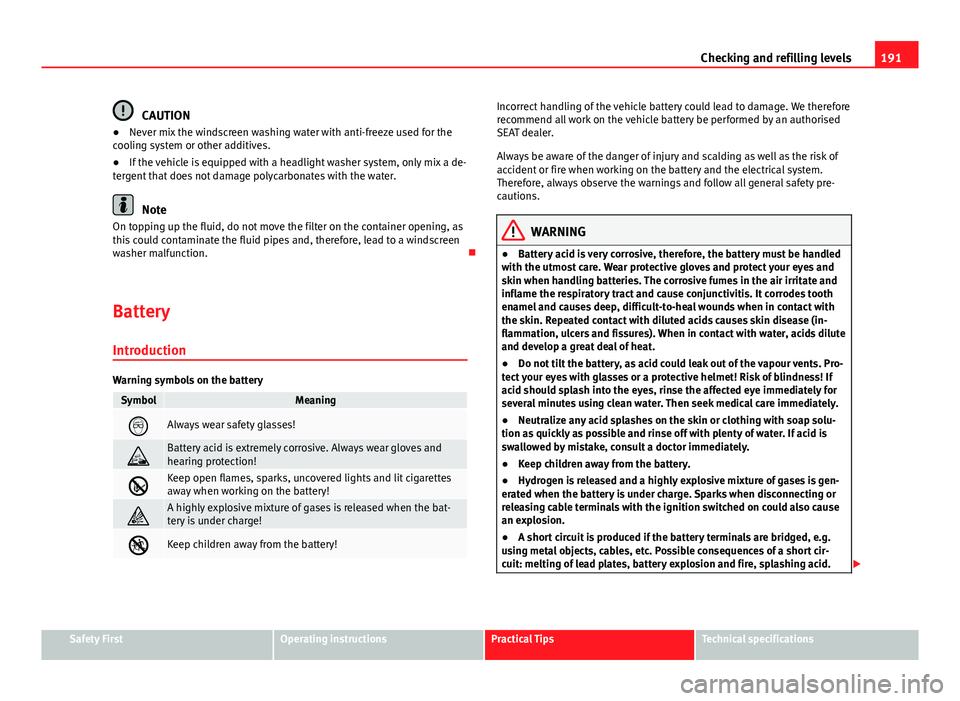
Warning symbols on the battery
SymbolMeaning
Always wear safety glasses!
Battery acid is extremely corrosive. Always wear gloves and
hearing protection!
Keep open flames, sparks, uncovered lights and lit cigarettes
away when working on the battery!
A highly explosive mixture of gases is released when the bat-
tery is under charge!
Keep children away from the battery!
Incorrect handling of the vehicle battery could lead to damage. We therefore
recommend all work on the vehicle battery be performed by an authorised
SEAT dealer.
Always be aware of the danger of injury and scalding as well as the risk of
accident or fire when working on the battery and the electrical system.
Therefore, always observe the warnings and follow all general safety pre-
cautions.
WARNING
● Battery acid is very corrosive, therefore, the battery must be handled
with the utmost care. Wear protective gloves and protect your eyes and
skin when handling batteries. The corrosive fumes in the air irritate and
inflame the respiratory tract and cause conjunctivitis. It corrodes tooth
enamel and causes deep, difficult-to-heal wounds when in contact with
the skin. Repeated contact with diluted acids causes skin disease (in-
flammation, ulcers and fissures). When in contact with water, acids dilute
and develop a great deal of heat.
● Do not tilt the battery, as acid could leak out of the vapour vents. Pro-
tect your eyes with glasses or a protective helmet! Risk of blindness! If
acid should splash into the eyes, rinse the affected eye immediately for
several minutes using clean water. Then seek medical care immediately.
● Neutralize any acid splashes on the skin or clothing with soap solu-
tion as quickly as possible and rinse off with plenty of water. If acid is
swallowed by mistake, consult a doctor immediately.
● Keep children away from the battery.
● Hydrogen is released and a highly explosive mixture of gases is gen-
erated when the battery is under charge. Sparks when disconnecting or
releasing cable terminals with the ignition switched on could also cause
an explosion.
● A short circuit is produced if the battery terminals are bridged, e.g.
using metal objects, cables, etc. Possible consequences of a short cir-
cuit: melting of lead plates, battery explosion and fire, splashing acid.
Safety FirstOperating instructionsPractical TipsTechnical specifications