fuel consumption Seat Toledo 2013 User Guide
[x] Cancel search | Manufacturer: SEAT, Model Year: 2013, Model line: Toledo, Model: Seat Toledo 2013Pages: 258, PDF Size: 3.94 MB
Page 161 of 258
159
Driving and the environment
Avoid driving at full speed
Fuel can be saved by driving at a slower speed.
Accelerating slowly not only considerably reduces fuel consumption, but al-
so reduces the environmental impact and vehicle wear.
If possible, you should never take advantage of the maximum speed of your
vehicle. Fuel consumption, exhaust emissions of toxic substances and
noise levels all increase very rapidly at higher speeds.
You can reduce fuel consumption by about one half if you do not drive faster
than three quarters of top speed.
Reduce idling
Idling also consumes fuel.
In a vehicle that does not have the START-STOP function, stop the engine in
traffic jams, level crossings and at traffic lights that remain red for a long
period of time. After 30-40 seconds with the engine switched off, the fuel
savings are greater that the quantity of fuel required to restart the engine
again.
When the engine is idling, a great deal of time is required in order for the
engine to reach operating temperature. When heating the vehicle, however,
engine waste and emissions of toxic substances are elevated. Therefore, im-
mediately begin driving after switching on the engine. Doing so avoids high
engine speeds.
Regular maintenance
A badly tuned engine unnecessarily consumes a large quantity of fuel. Conditions for economical driving can be created with regular maintenance
at an Official Service. Maintenance of your vehicle has positive repercus-
sions on traffic safety and conserving the value of the vehicle.
A badly tuned engine can result in fuel consumption that is 10% higher
than normal!
Additionally, check the
oil level after refuelling. Oil consumption depends
to a great extent on the engine load and engine speed. Depending on your
driving style, oil consumption can reach 0.5 litres per 1000 km (600 miles).
It is normal for the oil consumption of a new engine not to reach its mini-
mum level until after a period of running in time. Therefore, the oil con-
sumption of a new vehicle can only be judged correctly after covering 5000
km (3000 miles).
For the sake of the environment
● An additional reduction in consumption can be achieved using high-per-
formance synthetic oils.
● In order to detect leaks in good time, check the ground underneath the
vehicle regularly. If you notice stains from oils or other operating liquids,
contact an Official Service.
Note
We recommend that you have regular maintenance performed on your vehi-
cle a the SEAT Authorised Service.
Safety FirstOperating instructionsPractical TipsTechnical specifications
Page 162 of 258
160Driving and the environment
Make less short journeys
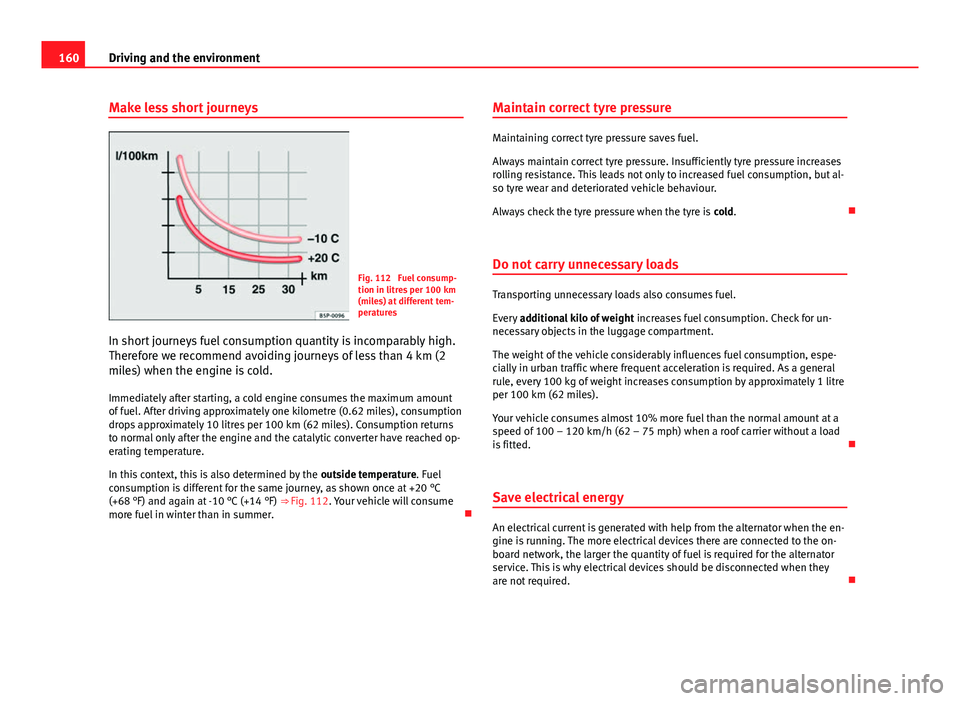
Fig. 112 Fuel consump-
tion in litres per 100 km
(miles) at different tem-
peratures
In short journeys fuel consumption quantity is incomparably high.
Therefore we recommend avoiding journeys of less than 4 km (2
miles) when the engine is cold. Immediately after starting, a cold engine consumes the maximum amount
of fuel. After driving approximately one kilometre (0.62 miles), consumption
drops approximately 10 litres per 100 km (62 miles). Consumption returns
to normal only after the engine and the catalytic converter have reached op-
erating temperature.
In this context, this is also determined by the outside temperature. Fuel
consumption is different for the same journey, as shown once at +20 °C
(+68 °F) and again at -10 °C (+14 °F) ⇒ Fig. 112. Your vehicle will consume
more fuel in winter than in summer. Maintain correct tyre pressure
Maintaining correct tyre pressure saves fuel.
Always maintain correct tyre pressure. Insufficiently tyre pressure increases
rolling resistance. This leads not only to increased fuel consumption, but al-
so tyre wear and deteriorated vehicle behaviour.
Always check the tyre pressure when the tyre is
cold.
Do not carry unnecessary loads
Transporting unnecessary loads also consumes fuel.
Every additional kilo of weight increases fuel consumption. Check for un-
necessary objects in the luggage compartment.
The weight of the vehicle considerably influences fuel consumption, espe-
cially in urban traffic where frequent acceleration is required. As a general
rule, every 100 kg of weight increases consumption by approximately 1 litre
per 100 km (62 miles).
Your vehicle consumes almost 10% more fuel than the normal amount at a
speed of 100 – 120 km/h (62 – 75 mph) when a roof carrier without a load
is fitted.
Save electrical energy
An electrical current is generated with help from the alternator when the en-
gine is running. The more electrical devices there are connected to the on-
board network, the larger the quantity of fuel is required for the alternator
service. This is why electrical devices should be disconnected when they
are not required.
Page 182 of 258
180Checking and refilling levels
–Press the tank flap with your hand to close it.
– Check that the fuel flap is correctly closed.
CAUTION
● Switch off the auxiliary heater (heater and independent heater) before
filling the tank.
● The fuel tank is full as soon as the automatic filler nozzle cuts out. Do
not continue filling, as this will fill the expansion chamber.
Note
The fuel tank capacity is around 55 litres, of which 7 litres are the reserve.
Unleaded petrol
Your vehicle must only be run on unleaded petrol that complies with the
Standard EN 228 (in Germany, also DIN 51626 – 1, or E10 for unleaded pet-
rol with 95 and 91 octane rating (RON) or DIN 51626 – 2, or E5 for unleaded
petrol with 95 and 98 RON).
Prescribed fuel – unleaded petrol (95/91 RON)
Use unleaded petrol with 95 RON. Unleaded petrol with 91 RON can also be
used, although this will result in a slight loss of power.
If, as an emergency measure, you have to fill the tank with petrol with a low-
er RON to that prescribed, use only moderate engine speeds and light throt-
tle. High engine speed and full throttle can seriously damage the engine!
Fill up with petrol with the correct RON as soon as possible.
Prescribed fuel – unleaded petrol (min. 95 RON)
Use unleaded petrol with 95 RON. If unleaded petrol with
95 RON is not available, you can fill up with petrol
with 91 RON as an emergency measure. In this case, use only moderate en-
gine speeds and a light throttle. High engine speed and full throttle can se-
riously damage the engine! Fill up with petrol with the correct RON as soon
as possible.
Petrol with a RON below 91 cannot be used, even as an emergency meas-
ure. Risk of seriously damaging the engine!
Unleaded petrol with higher RON
Unleaded petrol with a higher RON to that prescribed can be used without
limits.
In vehicles running on prescribed unleaded petrol with 95/91 RON, there is
no notable increase in power or lower fuel consumption when petrol with a
RON higher than 95 is used.
In vehicles running on prescribed unleaded petrol with min. 95 RON, there
is an increase in power and a lower fuel consumption when petrol with a
RON higher than 95 is used.
Prescribed fuel – unleaded petrol (98/(95) RON)
Use unleaded petrol with 98 RON. Unleaded petrol with 95 RON can also be
used, although this will result in a slight loss of power.
If unleaded petrol with 98 or 95 RON is not available, you can fill up with
petrol with 91 RON as an emergency measure. In this case, use only moder-
ate engine speeds and a light throttle. High engine speed and full throttle
can seriously damage the engine! Fill up with petrol with the correct RON as
soon as possible.
Petrol with a RON below 91 cannot be used, even as an emergency meas-
ure. Risk of seriously damaging the engine!
Petrol additives
The quality of the fuel influences the behaviour, performance and service
life of the engine. This is why the petrol you use should carry suitable addi-
tives already included by the petrol industry, free of metals. These additives
Page 198 of 258
196Wheels and tyres
Wheels and tyres
Wheels
Introduction
WARNING
● During the first 500 km (300 miles), new tyres do not give maximum
grip, therefore you should drive carefully. Risk of accident!
● Never drive with damaged tyres. Risk of accident!
● Only use wheels and tyres that been authorised by SEAT or your vehi-
cle model. Failure to do so could impair road safety. Risk of accident!
● Never exceed the maximum speed permitted for your tyres. Risk of ac-
cident due to tyre damage and loss of vehicle control.
● Under-inflated tyres are submitted to greater rolling resistance. This
means that they can overheat at high speeds. This can cause tread sepa-
ration and even tyre blow-out.
● For driving safety, tyres should be replaced at least in pairs according
to the axle and not individually. The tyres with the deepest tread should
always be used on the front wheels.
● Never fit used tyres of an unknown age or prior use.
● Tyres must be immediately changed at the very latest when they have
worn down to the tread wear indicators.
● Worn tyres reduce the necessary grip at high speeds on damp surfa-
ces. This could lead to “aquaplaning” (uncontrolled vehicle movement –
“skidding” on damp surfaces).
● Damaged wheels and tyres must be replaced immediately.
WARNING (Continued)
● Do not use summer or winter tyres that are more than 6 or 4 years old
respectively.
● Wheel bolts should be clean and screw easily. However, they must
never be treated with grease or oil.
● If the tightening torque of the wheel bolts is too low, they could loos-
en while the vehicle is moving. Risk of accident! If the tightening torque
of the wheel bolts is too high, the bolts and threads could be damaged,
leading to the permanent deforming of the rim support surfaces.
● Incorrectly handled wheel bolts could lead to a wheel coming loose
while the vehicle is moving. Risk of accident!
● The national regulations on the use of snow tyres and chains should
be observed.
CAUTION
● Where a spare wheel that is not compatible with the wheels fitted is
used, follow the instructions ⇒ page 199.
● The prescribed tightening torque for wheel bolts on steel and alloy
wheels is 120 Nm.
● Protect your tyres from coming into contact with oil, grease and fuel.
● Replace any lost valve caps immediately.
For the sake of the environment
Under-inflated tyres increases fuel consumption.
Page 204 of 258

202Wheels and tyres
WARNING
● If the warning lamp lights up, slow down immediately and avoid
any severe braking or steering manoeuvres. Stop and check the tyres and
their pressure as soon as possible.
● Under certain conditions (e.g. sporty driving style, driving on loose
surfaces or in the winter) the warning lamp may take a while to light
up or may remain switched off.
● Despite the tyre pressure monitoring system, the driver remains re-
sponsible for maintaining the correct tyre pressure. You must therefore
check the tyre pressure often.
Note
● The tyre pressure monitoring system is not a replacement for regularly
checking the tyre pressure, as it is unable to recognise an even drop in pres-
sure.
● The tyre pressure monitoring system is unable to warn of a sudden drop
in tyre pressure, e.g. a puncture. In this case, try to stop the vehicle carefully
with no severe braking or steering manoeuvres.
● To ensure the tyre pressure monitoring system works correctly, the basic
setting must be performed every 10 000 km (6000 miles) or once a year.
Wheel bolts
The wheel bolts are matched to the rims. When installing different wheels,
e.g. to fit light alloy wheels or wheels with winter tyres, it is important to use
the correct wheel bolts with the right length and correctly shaped bolt
heads. The is essential for the secure fit of the wheels and for the proper
function of the brake system. Winter tyres
Winter tyres will significantly improve handling of the vehicle in winter road
conditions. The design of summer tyres (width, rubber compound, tread
pattern) gives less grip at temperatures below +7 °C (45 °F), on ice and
snow. This applies particularly to vehicles equipped with
wide section tyres
or high speed tyres (code letters H or V on the sidewall).
In order to preserve the performance of the vehicle as much as possible,
winter tyres must be fitted on all four wheels, the minimum depth of the
tread must be 4 mm and the maximum age must be 4 years.
You can use winter tyres of a lower speed rating if the maximum speed limit
of these tyres will not be exceeded, even if the maximum speed limit for the
vehicle is higher.
For the sake of the environment
Summer tyres should be fitted again in time, as they give better handling on
roads free of snow and ice and at temperatures over +7 °C (45 °F). Summer
tyres have a shorter braking distance, produce less rolling noise and do not
wear down as quickly. They also reduce fuel consumption.
Snow chains
Snow chains must only be used on the front wheels.
In winter road conditions, snow chains not only help to improve grip but al-
so improve the braking capacity.
For technical reasons snow chains may only be used on tyres with the fol-
lowing wheel rim/tyre combinations.
Page 235 of 258
233
Description of the data
Technical specifications Description of the data
Important information
Important
The information in the vehicle documentation always takes
precedence over the information in this Instruction Manual. All technical specifications provided in this documentation are valid for the
standard model in Spain. The vehicle data card included in the Mainte-
nance Programme or the vehicle registration documentation shows which
engine is installed in the vehicle.
The figures may be different depending whether additional equipment is fit-
ted, for different models, for special vehicles and for other countries.
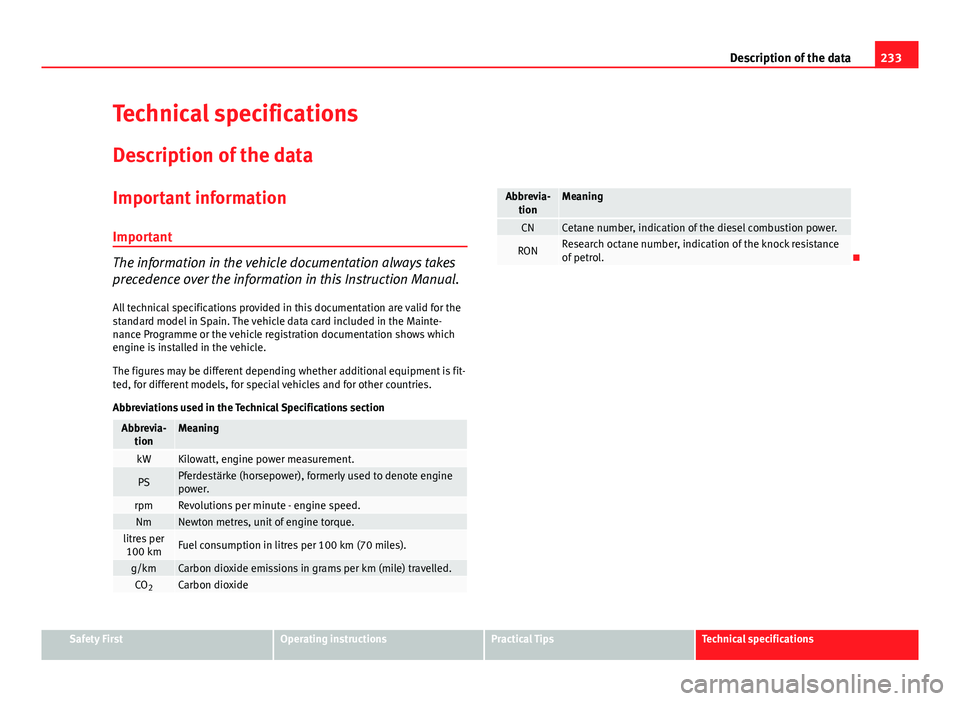
Abbreviations used in the Technical Specifications section
Abbrevia- tionMeaning
kWKilowatt, engine power measurement.
PSPferdestärke (horsepower), formerly used to denote engine
power.
rpmRevolutions per minute - engine speed.NmNewton metres, unit of engine torque.litres per100 kmFuel consumption in litres per 100 km (70 miles).
g/kmCarbon dioxide emissions in grams per km (mile) travelled.CO 2Carbon dioxide
Abbrevia-
tionMeaning
CNCetane number, indication of the diesel combustion power.
RONResearch octane number, indication of the knock resistance
of petrol.
Safety FirstOperating instructionsPractical TipsTechnical specifications
Page 236 of 258
234Description of the data
Vehicle identification data on the data sticker
Fig. 173 Data sticker
Fig. 174 Type plate
Vehicle data sticker
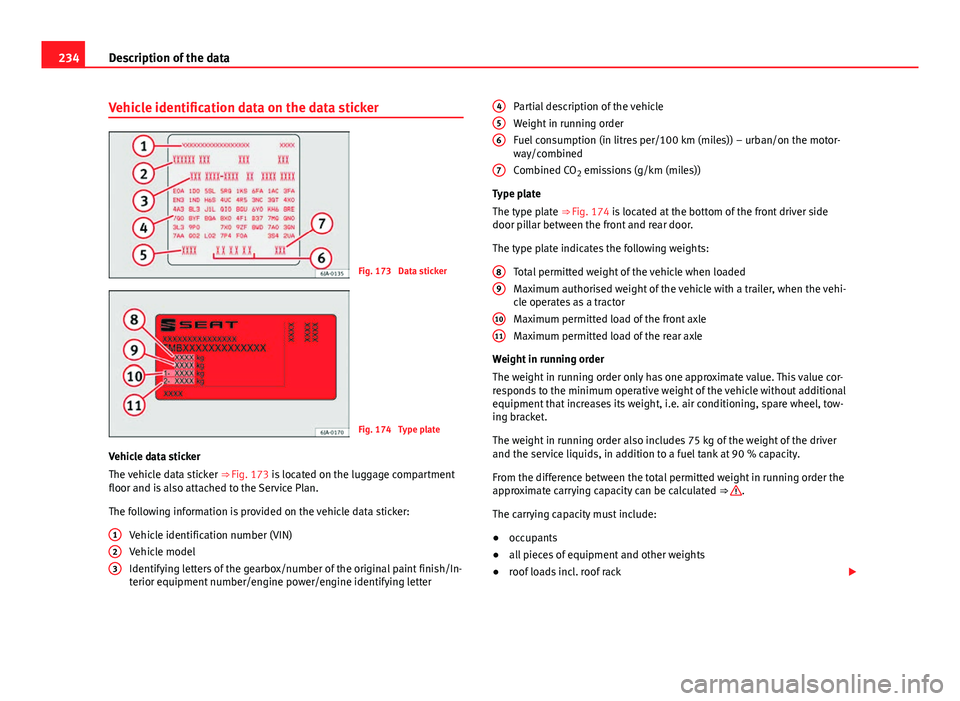
The vehicle data sticker ⇒ Fig. 173 is located on the luggage compartment
floor and is also attached to the Service Plan.
The following information is provided on the vehicle data sticker:
Vehicle identification number (VIN)
Vehicle model
Identifying letters of the gearbox/number of the original paint finish/In-
terior equipment number/engine power/engine identifying letter
1
23
Partial description of the vehicle
Weight in running order
Fuel consumption (in litres per/100 km (miles)) – urban/on the motor-
way/combined
Combined CO
2 emissions (g/km (miles))
Type plate
The type plate ⇒ Fig. 174 is located at the bottom of the front driver side
door pillar between the front and rear door.
The type plate indicates the following weights:
Total permitted weight of the vehicle when loaded
Maximum authorised weight of the vehicle with a trailer, when the vehi-
cle operates as a tractor
Maximum permitted load of the front axle
Maximum permitted load of the rear axle
Weight in running order
The weight in running order only has one approximate value. This value cor-
responds to the minimum operative weight of the vehicle without additional
equipment that increases its weight, i.e. air conditioning, spare wheel, tow-
ing bracket.
The weight in running order also includes 75 kg of the weight of the driver
and the service liquids, in addition to a fuel tank at 90 % capacity.
From the difference between the total permitted weight in running order the
approximate carrying capacity can be calculated ⇒
.
The carrying capacity must include:
● occupants
● all pieces of equipment and other weights
● roof loads incl. roof rack
4
56
7
89
1011
Page 237 of 258

235
Description of the data
● equipment that is not included in the running order weight
● when using the towing bracket, the drawbar load (max. 50 kg)
Calculating fuel consumption and CO 2 emissions according to the ECE
regulations and the EU specifications
Calculation of fuel consumption for urban driving starts when cold-starting
the engine. Then, normal city driving is simulated.
In extra-urban driving fuel consumption calculation, the vehicle brakes and
accelerated in all gears, as in daily use of the vehicle. The driving speed
moves between a range of 0 and 120 km/h (75 mph).
The consumption value in combined driving is composed of 37 % of the val-
ue of urban driving and 63 % of the value of extra-urban driving.
WARNING
The maximum permitted weight values must not be exceeded – Risk of
an accident and damage to the vehicle!
Note
● If you wish to calculate the exact weight of your vehicle please contact a
SEAT dealer.
● Depending on the volume of equipment, the driving style, road condi-
tions, weather conditions and the condition of the vehicle, the consumption
values can differ from the theoretical values reproduced here. Information on fuel consumption
Fuel consumption
The consumption and emission details shown on the vehicle
data sticker differ from one vehicle to another.
The vehicle fuel consumption and CO 2 emissions can be consulted on the
vehicle data sticker in the spare wheel well, inside the luggage compart-
ment and on the rear cover of the Maintenance Programme.
The fuel consumption and CO 2 emission values refer to the weight category
assigned to your vehicle according to the engine and gearbox combination,
as well as the specific equipment fitted, and is only used to compare be-
tween the different models.
The fuel consumption and CO 2 emissions do not depend only on the per-
formance of the vehicle, they can also differ from the established values de-
pending on other factors such as driving style, road conditions, traffic con-
ditions, environmental conditions, load and number of passengers.
Calculation of fuel consumption
The consumption values have been calculated based on measurements per-
formed or supervised by certified CE laboratories according to the latest ver-
sion of directives 715/2007/EC and 80/1268/CEE (for more information
consult the European Union Publications Office at EUR-Lex: © European Un-
ion, http://eur-lex.europa.eu/en/index.htm) and are valid for the kerb
weight indicated for the vehicle.
Note
In practice, and considering all the factors mentioned here, consumption
values can differ from those calculated in the current European regulations.
Safety FirstOperating instructionsPractical TipsTechnical specifications
Page 241 of 258
239
Technical Data
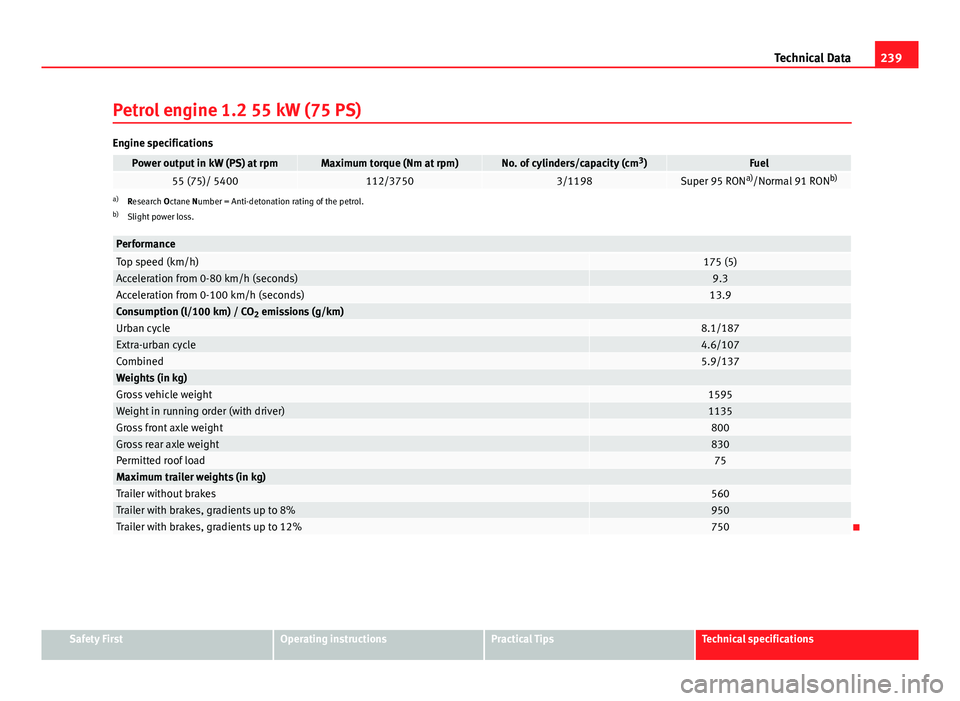
Petrol engine 1.2 55 kW (75 PS)
Engine specifications
Power output in kW (PS) at rpmMaximum torque (Nm at rpm)No. of cylinders/capacity (cm 3
)Fuel55 (75)/ 5400112/37503/1198Super 95 RON a)
/Normal 91 RON b)a)
Research Octane Number = Anti-detonation rating of the petrol.
b) Slight power loss.
PerformanceTop speed (km/h)175 (5)Acceleration from 0-80 km/h (seconds)9.3Acceleration from 0-100 km/h (seconds)13.9Consumption (l/100 km) / CO 2 emissions (g/km)Urban cycle8.1/187Extra-urban cycle4.6/107Combined5.9/137Weights (in kg)Gross vehicle weight1595Weight in running order (with driver)1135Gross front axle weight800Gross rear axle weight830Permitted roof load75Maximum trailer weights (in kg)Trailer without brakes560Trailer with brakes, gradients up to 8%950Trailer with brakes, gradients up to 12%750
Safety FirstOperating instructionsPractical TipsTechnical specifications
Page 242 of 258
240Technical Data
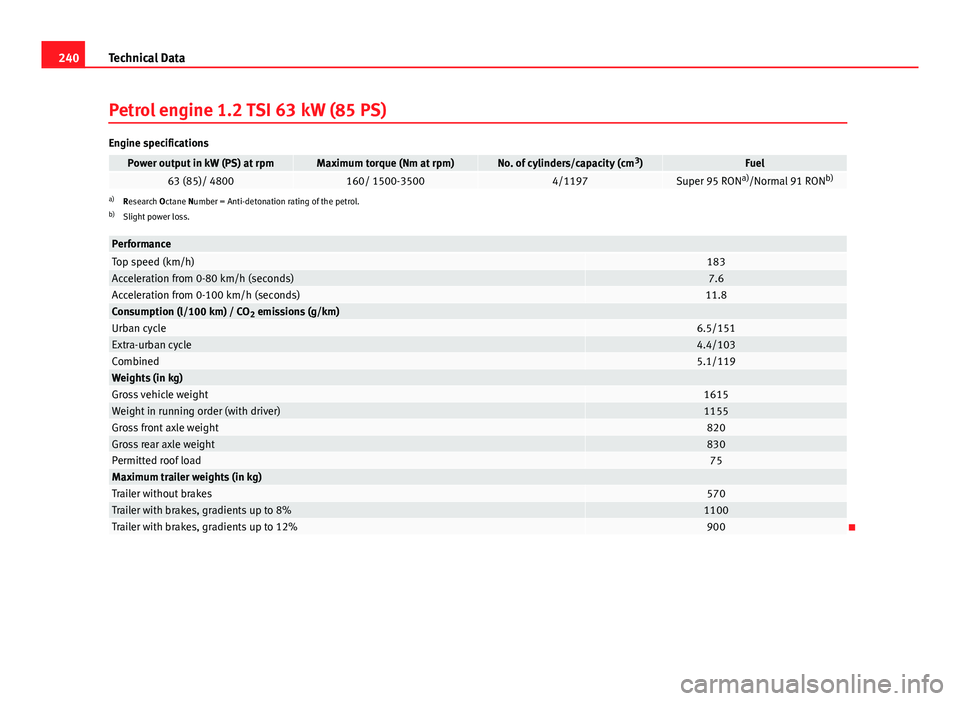
Petrol engine 1.2 TSI 63 kW (85 PS)
Engine specifications
Power output in kW (PS) at rpmMaximum torque (Nm at rpm)No. of cylinders/capacity (cm 3
)Fuel63 (85)/ 4800160/ 1500-35004/1197Super 95 RON a)
/Normal 91 RON b)a)
Research Octane Number = Anti-detonation rating of the petrol.
b) Slight power loss.
PerformanceTop speed (km/h)183Acceleration from 0-80 km/h (seconds)7.6Acceleration from 0-100 km/h (seconds)11.8Consumption (l/100 km) / CO 2 emissions (g/km)Urban cycle6.5/151Extra-urban cycle4.4/103Combined5.1/119Weights (in kg)Gross vehicle weight1615Weight in running order (with driver)1155Gross front axle weight820Gross rear axle weight830Permitted roof load75Maximum trailer weights (in kg)Trailer without brakes570Trailer with brakes, gradients up to 8%1100Trailer with brakes, gradients up to 12%900