height Seat Toledo 2013 User Guide
[x] Cancel search | Manufacturer: SEAT, Model Year: 2013, Model line: Toledo, Model: Seat Toledo 2013Pages: 258, PDF Size: 3.94 MB
Page 113 of 258
111
Seats and storage
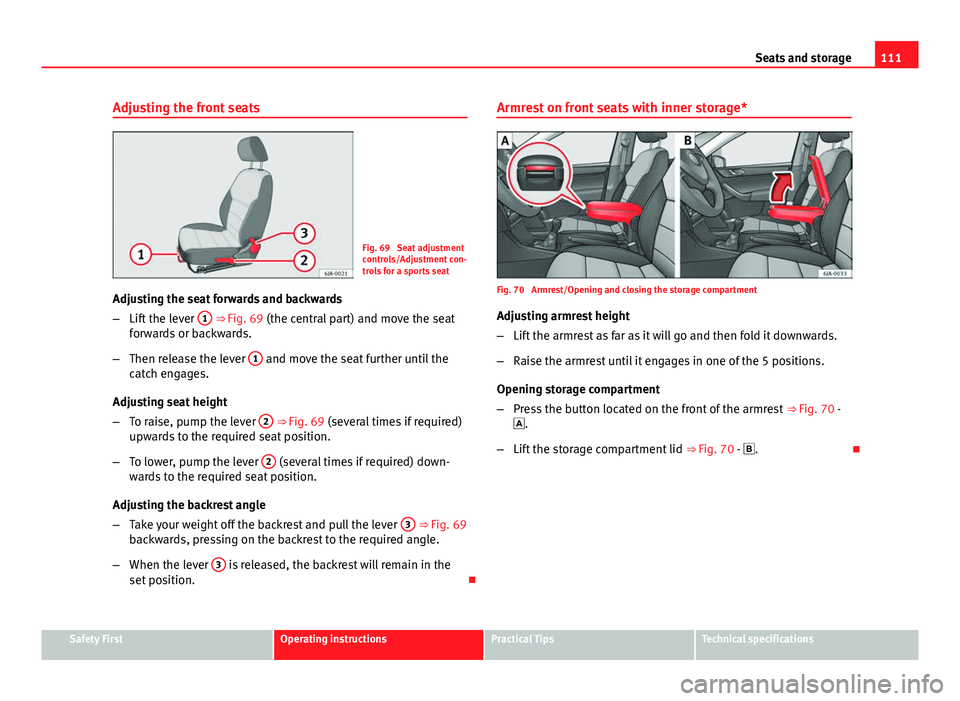
Adjusting the front seats
Fig. 69 Seat adjustment
controls/Adjustment con-
trols for a sports seat
Adjusting the seat forwards and backwards
– Lift the lever 1
⇒ Fig. 69 (the central part) and move the seat
forwards or backwards.
– Then release the lever 1
and move the seat further until the
catch engages.
Adjusting seat height
– To raise, pump the lever 2
⇒ Fig. 69 (several times if required)
upwards to the required seat position.
– To lower, pump the lever 2
(several times if required) down-
wards to the required seat position.
Adjusting the backrest angle
– Take your weight off the backrest and pull the lever 3
⇒ Fig. 69
backwards, pressing on the backrest to the required angle.
– When the lever 3
is released, the backrest will remain in the
set position. Armrest on front seats with inner storage*
Fig. 70 Armrest/Opening and closing the storage compartment
Adjusting armrest height
– Lift the armrest as far as it will go and then fold it downwards.
– Raise the armrest until it engages in one of the 5 positions.
Opening storage compartment
– Press the button located on the front of the armrest ⇒ Fig. 70 -
.
– Lift the storage compartment lid ⇒ Fig. 70 - .
Safety FirstOperating instructionsPractical TipsTechnical specifications
Page 115 of 258
113
Seats and storage
Head restraints cannot be moved up or down or removed on sports
seats.
Adjusting height
– Take hold of the sides of the head restraint and pull upwards.
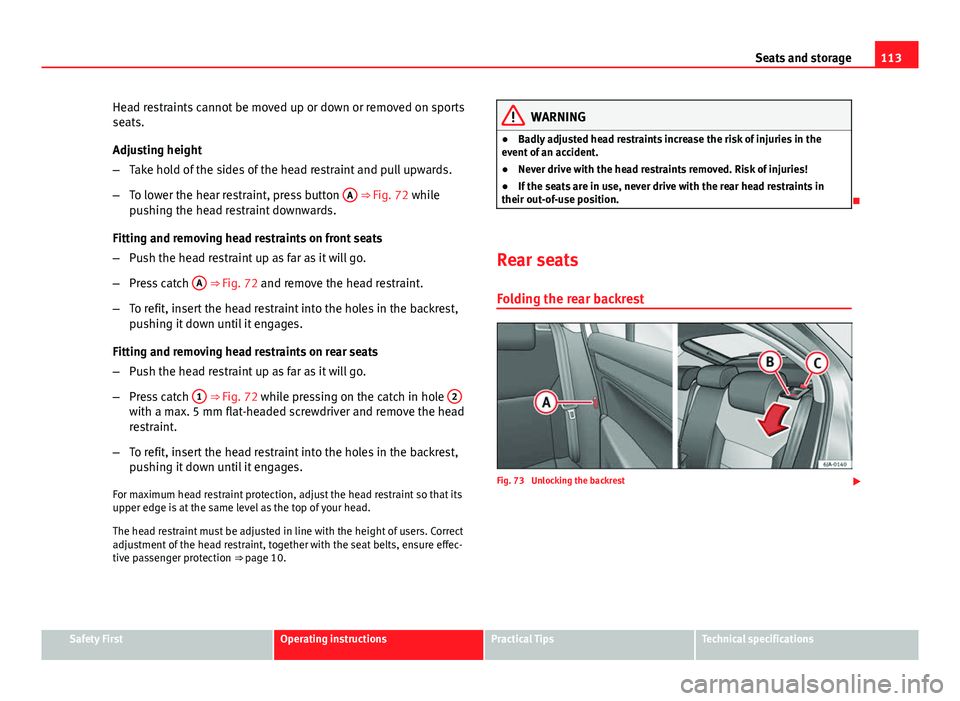
– To lower the hear restraint, press button A
⇒ Fig. 72 while
pushing the head restraint downwards.
Fitting and removing head restraints on front seats
– Push the head restraint up as far as it will go.
– Press catch A
⇒ Fig. 72 and remove the head restraint.
– To refit, insert the head restraint into the holes in the backrest,
pushing it down until it engages.
Fitting and removing head restraints on rear seats
– Push the head restraint up as far as it will go.
– Press catch 1
⇒ Fig. 72 while pressing on the catch in hole 2with a max. 5 mm flat-headed screwdriver and remove the head
restraint.
– To refit, insert the head restraint into the holes in the backrest,
pushing it down until it engages.
For maximum head restraint protection, adjust the head restraint so that its
upper edge is at the same level as the top of your head.
The head restraint must be adjusted in line with the height of users. Correct
adjustment of the head restraint, together with the seat belts, ensure effec-
tive passenger protection ⇒ page 10.
WARNING
● Badly adjusted head restraints increase the risk of injuries in the
event of an accident.
● Never drive with the head restraints removed. Risk of injuries!
● If the seats are in use, never drive with the rear head restraints in
their out-of-use position.
Rear seats
Folding the rear backrest
Fig. 73 Unlocking the backrest
Safety FirstOperating instructionsPractical TipsTechnical specifications
Page 120 of 258
118Seats and storage
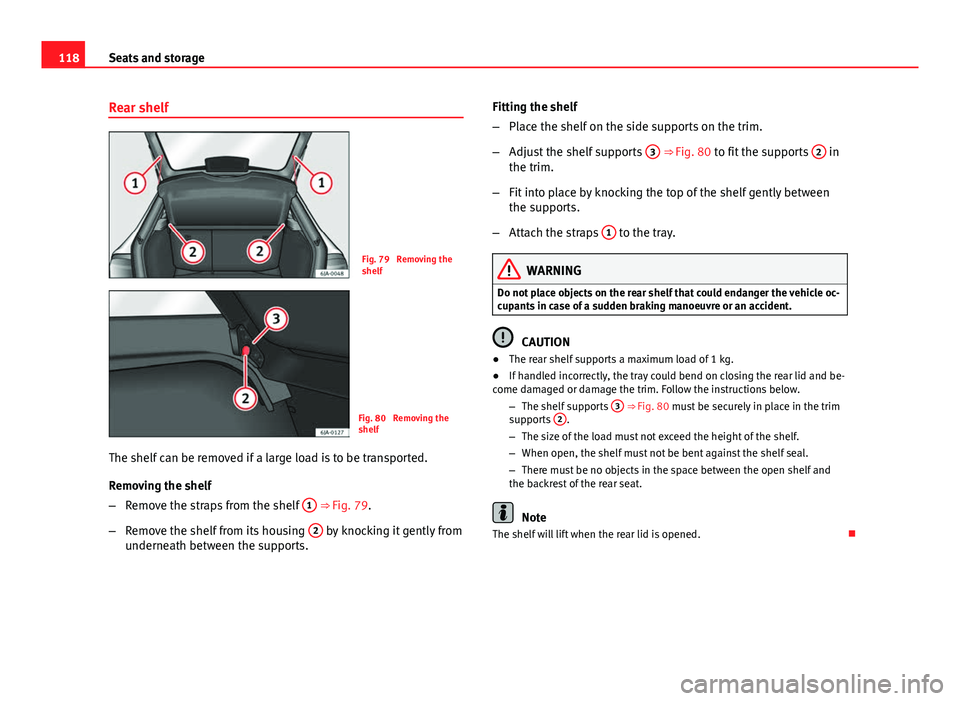
Rear shelf
Fig. 79 Removing the
shelf
Fig. 80 Removing the
shelf
The shelf can be removed if a large load is to be transported.
Removing the shelf
– Remove the straps from the shelf 1
⇒ Fig. 79.
– Remove the shelf from its housing 2
by knocking it gently from
underneath between the supports. Fitting the shelf
–
Place the shelf on the side supports on the trim.
– Adjust the shelf supports 3
⇒ Fig. 80 to fit the supports 2 in
the trim.
– Fit into place by knocking the top of the shelf gently between
the supports.
– Attach the straps 1
to the tray.
WARNING
Do not place objects on the rear shelf that could endanger the vehicle oc-
cupants in case of a sudden braking manoeuvre or an accident.
CAUTION
● The rear shelf supports a maximum load of 1 kg.
● If handled incorrectly, the tray could bend on closing the rear lid and be-
come damaged or damage the trim. Follow the instructions below.
–The shelf supports 3
⇒ Fig. 80 must be securely in place in the trim
supports 2.
– The size of the load must not exceed the height of the shelf.
– When open, the shelf must not be bent against the shelf seal.
– There must be no objects in the space between the open shelf and
the backrest of the rear seat.
Note
The shelf will lift when the rear lid is opened.
Page 121 of 258
119
Seats and storage
Roof carrier*
Introduction
WARNING
● The load on the roof carrier must be properly secured. Risk of acci-
dent!
● Always secure the load using retaining straps in good condition.
● Distribute the load evenly.
● When transporting heavy or large objects on the roof, any change in
the normal vehicle behaviour due to a change in the centre of gravity or
an increased wind resistance must be taken into account. Risk of acci-
dent! For this reason, a suitable speed and driving style must be used.
● Avoid sudden manoeuvres and braking.
● Adjust your driving style to suit visibility, the weather and road and
traffic conditions.
● Never exceed the allowed axle loads or allowed maximum weight.
Risk of accident!
CAUTION
● Only use SEAT-authorised roof carriers.
● Where roof carriers from other systems are used or where they are not
fitted properly, any damage caused to the vehicle will not be covered by the
warranty. Therefore, carefully follow the Instruction Manual for installation
of the roof carrier.
● On vehicles fitted with a sliding sunroof, make sure it does not hit the
load on the roof when opened
● Remember that the rear lid must not hit the roof load.
● The total height of the vehicle increases according to the roof load. Com-
pare the height of the vehicle with the heights of bridges or, for example,
the size of the garage door. ●
Do not forget to remove the roof carrier before entering an automatic
carwash.
● Take into account that the load must not damage the aerial located on
the roof.
For the sake of the environment
The increased air resistance means that the vehicle uses more fuel.
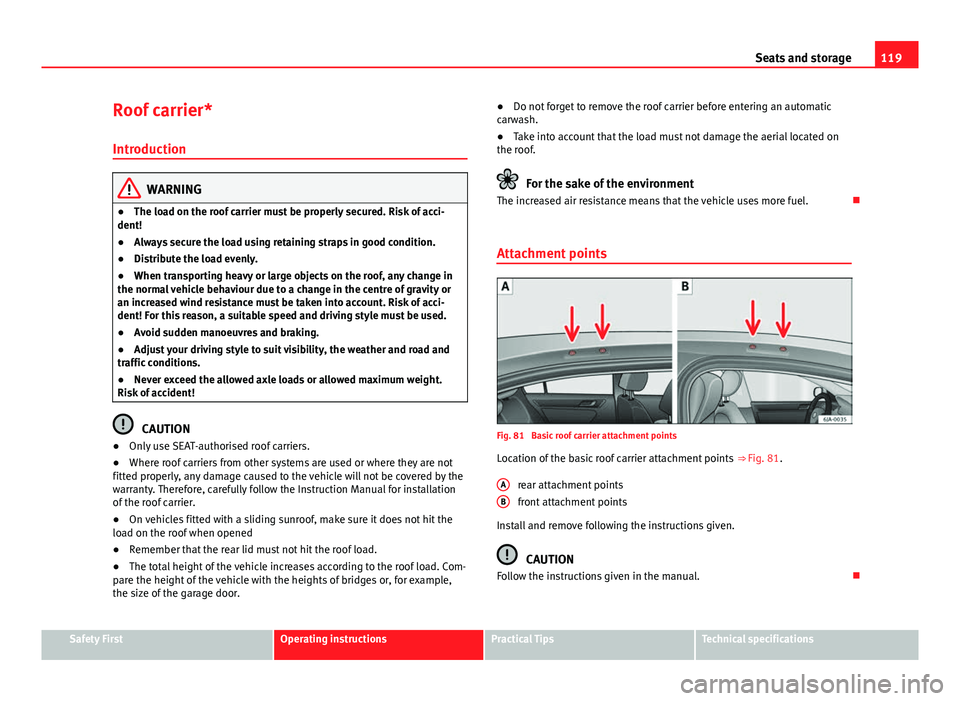
Attachment points
Fig. 81 Basic roof carrier attachment points
Location of the basic roof carrier attachment points ⇒ Fig. 81.
rear attachment points
front attachment points
Install and remove following the instructions given.
CAUTION
Follow the instructions given in the manual.
A
B
Safety FirstOperating instructionsPractical TipsTechnical specifications
Page 131 of 258
129
Heating and air conditioning
While in motion, the air conditioning should not be switched on if the win-
dows are open.
If the interior temperature can be reached without switching on the air con-
ditioning, the fresh air mode should be used.
For the sake of the environment
This saves on fuel and reduces emissions.
Faults
If the air conditioning does not work at outside temperatures above +5 °C
(+41 °F) then the system is faulty. This may be due to one of the following
reasons:
● One of the fuses has blown. Check the fuse and replace if necessary
⇒ page 219.
● The air conditioning compressor has switched off temporarily because
of an increased engine coolant temperature ⇒ page 58.
If you cannot repair the fault yourself or where the cooling power continues
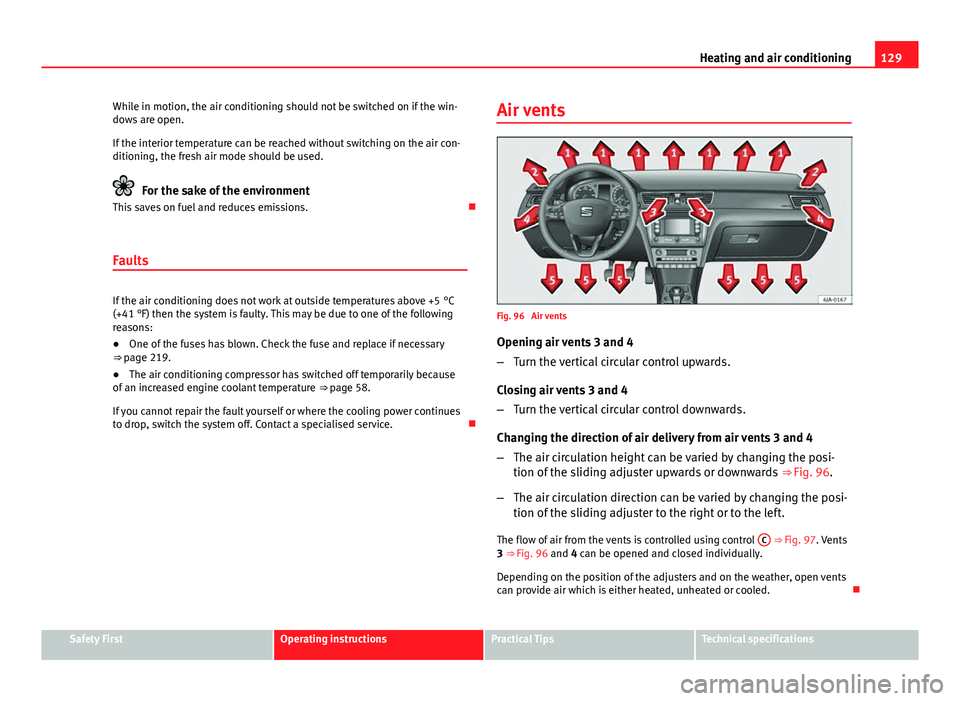
to drop, switch the system off. Contact a specialised service. Air ventsFig. 96 Air vents
Opening air vents 3 and 4
– Turn the vertical circular control upwards.
Closing air vents 3 and 4
– Turn the vertical circular control downwards.
Changing the direction of air delivery from air vents 3 and 4
– The air circulation height can be varied by changing the posi-
tion of the sliding adjuster upwards or downwards ⇒ Fig. 96.
– The air circulation direction can be varied by changing the posi-
tion of the sliding adjuster to the right or to the left.
The flow of air from the vents is controlled using control C
⇒ Fig. 97. Vents
3 ⇒ Fig. 96 and 4 can be opened and closed individually.
Depending on the position of the adjusters and on the weather, open vents
can provide air which is either heated, unheated or cooled.
Safety FirstOperating instructionsPractical TipsTechnical specifications
Page 164 of 258

162Driving and the environment
Note
You will receive information about the modification of the headlights at an
authorised SEAT dealer.
Preventing damage to the vehicle
In order to prevent damage to the vehicle, take special care:
● on roads in poor condition
● when mounting the kerb
● when approaching very steep ramps, etc.
● with the parts of the vehicle situated on the lower part of the vehicle, i.e.
the spoiler, the exhaust pipe,
This applies especially to vehicles with a very low suspension (sport) and
when the vehicle is fully loaded.
Driving through water
Fig. 113 Driving through
water To prevent the vehicle from being damaged when driving through water (i.e.
flooded roads), please observe the following:
●
Determine the depth of the water before entering. The water can reach a
maximum height of below the door sill ⇒ Fig. 113.
● Drive at a maximum pace of walking speed. Driving at a higher speed
can cause a wave in front of the vehicle, which can cause water to enter the
engine air intake system or other parts of the vehicle.
● Never stop in the water, never reverse and never stop the engine.
● Before driving through water deactivate the START-STOP system
⇒ page 154.
WARNING
● Driving through water, dirt and mud can reduce braking capability
and prolong the braking distance – Risk of accident!
● Do not carry out any sudden or strong braking manoeuvres after driv-
ing through water.
● Clean and dry the brakes as soon as possible after driving through
water by breaking intermittently. Carry out braking in order to dry the
brakes and clean the brake discs only if traffic so permits. Do not put oth-
er drivers at risk.
CAUTION
● In the event of driving through water the parts of the vehicle can be seri-
ously damaged, such as the engine, gearbox, catalytic converter, suspen-
sion or the electrical system.
● Oncoming vehicles that drive through water can cause waves that ex-
ceed your vehicle's permitted level for driving through water.
● There may be pot-holes mud or rocks under the water that can hinder or
prevent driving through water.
● Do not drive through salt water. The salt can cause rust. All components
that are exposed to salt water must be rinsed immediately with fresh water.
Page 186 of 258
184Checking and refilling levels
Before opening the bonnet, make sure that the windscreen wiper
arms are not lifted away from the glass. Otherwise the paintwork
may be damaged.
–Pull the release catch in the direction of the arrow 2
⇒ Fig. 123
and the bonnet will be released.
– Hold and lift the bonnet.
– Remove the support strut 3
⇒ Fig. 124 from its fastening in the
direction of the arrow and secure the raised bonnet so that the
end of the strut hooks onto the opening in the bonnet 4
.
Closing the bonnet
– Lift the bonnet slightly and unhook the support strut keeping
the bonnet open and insert it into its fastening 3
.
– Let the bonnet drop from a height of around 20 cm into the
catch Do not press down afterwards!
– Check that the bonnet is correctly closed.
Engine oil General notes
The engine comes with a special, multi-grade oil that can be used all year
round.
Because the use of high-quality oil is essential for the correct operation of
the engine and its long useful life, when topping up or changing oil, use on-
ly those oils that comply with VW standards. The specifications (VW standards) set out in the following page should ap-
pear on the container of the service oil; when the container displays the
specific standards for petrol and diesel engines together, it means that the
oil can be used for both types of engines.
We recommend that the oil change, indicated in the Maintenance Pro-
gramme, be performed by a Technical Service or a specialised workshop.
The correct oil specifications for your engine are listed in the
⇒ page 185,
Oil properties.
Service intervals
Service intervals can be flexible (LongLife service) or fixed (dependent on
time/distance travelled).
If the PR code that appears on the back of the “Maintenance Programme”
booklet is QG1, this means that your vehicle has the LongLife service pro-
grammed. If it has the codes QG0 or QG2 the interval service is dependent
on time/distance travelled.
Flexible service intervals (LongLife service intervals*)
Special oils and processes have been developed which, depending on the
characteristics and individual driving profiles, enable the extension of the
oil change service (LongLife service intervals).
Because this oil is essential for extending the service intervals, it must only
be used observing the following indications:
● Avoid mixing it with oil for fixed service intervals.
● Only in exceptional circumstances, if the engine oil level is too low
⇒ page 186 and LongLife oil is not available, it is permitted to top up
(once) with oil for fixed service intervals ⇒ page 185 (up to a maximum of
0.5 litres).
Fixed service intervals*
If your vehicle does not have the “LongLife service interval” or it has been
disabled (by request), you may use oils for fixed service intervals, which al-
so appear in ⇒ page 185, Oil properties. In this case, your vehicle must be
Page 200 of 258
198Wheels and tyres
Unusual vibration or the car pulling to one side may indicate that one of the
tyres is damaged. Reduce speed immediately and stop if you suspect that
damage may have occurred! Check the tyres for damage (blisters, cracks,
etc.). If no external damage is visible, drive slowly and carefully to the near-
est Official Service and have the vehicle inspected.
Handling wheels and tyres
Fig. 132 Changing
wheels around
Changing wheels around
If the wear is visibly greater on the front tyres, they should be exchanged for
the rear tyres as shown in the diagram ⇒ Fig. 132. All the tyres will then last
for about the same time.
To ensure that the wear is equal on all tyres and maintain their optimum
useful life, they should be changed around every 10 000 km (6000 miles).
Storing tyres
When you remove the tyres, mark them in order to maintain the same direc-
tion of rotation when they are installed again.
When removed, the wheels and/or tyres should be stored in a cool, dry and
preferably dark location. Store tyres in a vertical position if they are not fit-
ted on wheel rims. Replacing tyres and wheels
All four wheels must be fitted only with tyres of the same type, size and the
same tread pattern.
The correct tyre/wheel combinations specified for your vehicle are listed in
its registration documentation.
Understanding the tyre designations makes it easier to choose the correct
tyres. The tyre designation is marked on the sidewall. For example.
195/55 R 15 85 H
This contains the following information:
195Tyre width in mm55Height/width ratio in %RTyre construction – Radial15Rim diameter in inches85Load rating codeHSpeed rating code letter
The tyres are subject to the following maximum speed limits:
Speed rating code letterMaximum speed limitQ160 km/h (99 mph)R170 km/h (106 mph)S180 km/h (112 mph)T190 km/h (118 mph)U200 km/h (124 mph)H210 km/h (130 mph)V240 km/h (149 mph)W270 km/h (168 mph)
Page 248 of 258
246Technical Data
Dimensions
Length / Width (mm)4482/1715Height at kerb weight (mm)1466Front and rear projections (mm)876/1004Wheelbase (mm)2602Turning circle diameter (m)10.2Front/reara)
track width (mm)1463/1500a) This data will change depending on the type of wheel rim.
Capacities
CapacitiesFuel tank 55 litresWindscreen washer fluid container
with headlight washer 3.5 litres/ 4.5 litres
Tyre pressureSummer tyres:
Correct tyre pressure can be seen on the sticker on the inside of the tank
flap.
Winter tyres:
The pressure of these tyres is 0.2 bar higher than that of summer tyres
(2.9 psi / 20 kPa).
Page 249 of 258
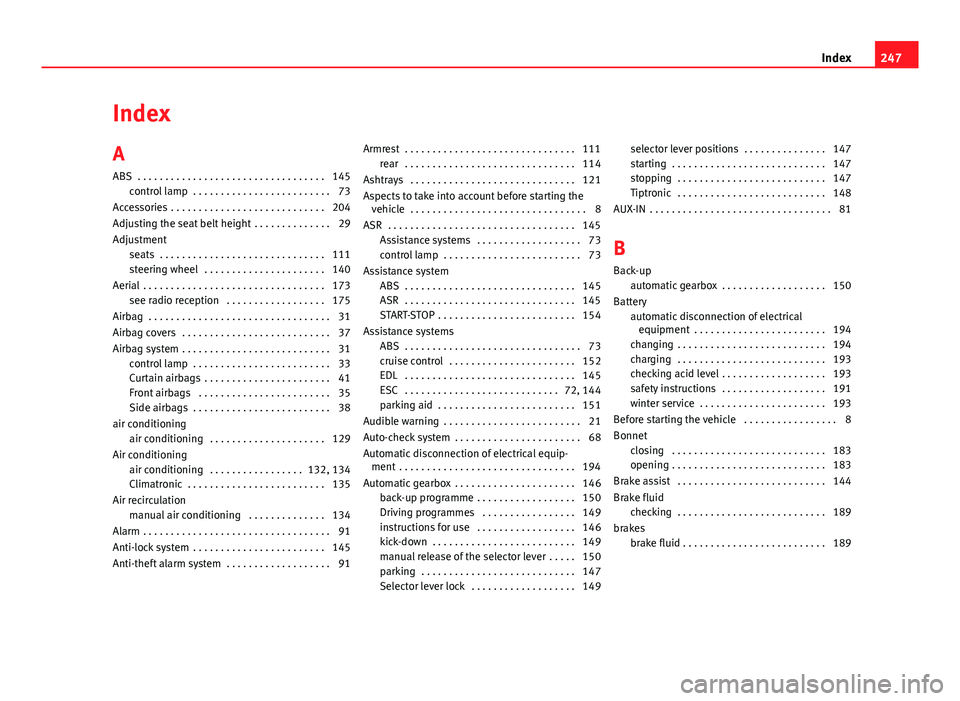
Index
A
ABS . . . . . . . . . . . . . . . . . . . . . . . . . . . . . . . . . . 145control lamp . . . . . . . . . . . . . . . . . . . . . . . . . 73
Accessories . . . . . . . . . . . . . . . . . . . . . . . . . . . . 204
Adjusting the seat belt height . . . . . . . . . . . . . . 29
Adjustment seats . . . . . . . . . . . . . . . . . . . . . . . . . . . . . . 111
steering wheel . . . . . . . . . . . . . . . . . . . . . . 140
Aerial . . . . . . . . . . . . . . . . . . . . . . . . . . . . . . . . . 173 see radio reception . . . . . . . . . . . . . . . . . . 175
Airbag . . . . . . . . . . . . . . . . . . . . . . . . . . . . . . . . . 31
Airbag covers . . . . . . . . . . . . . . . . . . . . . . . . . . . 37
Airbag system . . . . . . . . . . . . . . . . . . . . . . . . . . . 31 control lamp . . . . . . . . . . . . . . . . . . . . . . . . . 33
Curtain airbags . . . . . . . . . . . . . . . . . . . . . . . 41
Front airbags . . . . . . . . . . . . . . . . . . . . . . . . 35
Side airbags . . . . . . . . . . . . . . . . . . . . . . . . . 38
air conditioning air conditioning . . . . . . . . . . . . . . . . . . . . . 129
Air conditioning air conditioning . . . . . . . . . . . . . . . . . 132, 134
Climatronic . . . . . . . . . . . . . . . . . . . . . . . . . 135
Air recirculation manual air conditioning . . . . . . . . . . . . . . 134
Alarm . . . . . . . . . . . . . . . . . . . . . . . . . . . . . . . . . . 91
Anti-lock system . . . . . . . . . . . . . . . . . . . . . . . . 145
Anti-theft alarm system . . . . . . . . . . . . . . . . . . . 91 Armrest . . . . . . . . . . . . . . . . . . . . . . . . . . . . . . . 111
rear . . . . . . . . . . . . . . . . . . . . . . . . . . . . . . . 114
Ashtrays . . . . . . . . . . . . . . . . . . . . . . . . . . . . . . 121
Aspects to take into account before starting the vehicle . . . . . . . . . . . . . . . . . . . . . . . . . . . . . . . . 8
ASR . . . . . . . . . . . . . . . . . . . . . . . . . . . . . . . . . . 145 Assistance systems . . . . . . . . . . . . . . . . . . . 73
control lamp . . . . . . . . . . . . . . . . . . . . . . . . . 73
Assistance system ABS . . . . . . . . . . . . . . . . . . . . . . . . . . . . . . . 145
ASR . . . . . . . . . . . . . . . . . . . . . . . . . . . . . . . 145
START-STOP . . . . . . . . . . . . . . . . . . . . . . . . . 154
Assistance systems ABS . . . . . . . . . . . . . . . . . . . . . . . . . . . . . . . . 73
cruise control . . . . . . . . . . . . . . . . . . . . . . . 152
EDL . . . . . . . . . . . . . . . . . . . . . . . . . . . . . . . 145
ESC . . . . . . . . . . . . . . . . . . . . . . . . . . . . 72, 144
parking aid . . . . . . . . . . . . . . . . . . . . . . . . . 151
Audible warning . . . . . . . . . . . . . . . . . . . . . . . . . 21
Auto-check system . . . . . . . . . . . . . . . . . . . . . . . 68
Automatic disconnection of electrical equip- ment . . . . . . . . . . . . . . . . . . . . . . . . . . . . . . . . 194
Automatic gearbox . . . . . . . . . . . . . . . . . . . . . . 146 back-up programme . . . . . . . . . . . . . . . . . . 150
Driving programmes . . . . . . . . . . . . . . . . . 149
instructions for use . . . . . . . . . . . . . . . . . . 146
kick-down . . . . . . . . . . . . . . . . . . . . . . . . . . 149
manual release of the selector lever . . . . . 150
parking . . . . . . . . . . . . . . . . . . . . . . . . . . . . 147
Selector lever lock . . . . . . . . . . . . . . . . . . . 149 selector lever positions . . . . . . . . . . . . . . . 147
starting . . . . . . . . . . . . . . . . . . . . . . . . . . . . 147
stopping . . . . . . . . . . . . . . . . . . . . . . . . . . . 147
Tiptronic . . . . . . . . . . . . . . . . . . . . . . . . . . . 148
AUX-IN . . . . . . . . . . . . . . . . . . . . . . . . . . . . . . . . . 81
B
Back-up automatic gearbox . . . . . . . . . . . . . . . . . . . 150
Battery automatic disconnection of electricalequipment . . . . . . . . . . . . . . . . . . . . . . . . 194
changing . . . . . . . . . . . . . . . . . . . . . . . . . . . 194
charging . . . . . . . . . . . . . . . . . . . . . . . . . . . 193
checking acid level . . . . . . . . . . . . . . . . . . . 193
safety instructions . . . . . . . . . . . . . . . . . . . 191
winter service . . . . . . . . . . . . . . . . . . . . . . . 193
Before starting the vehicle . . . . . . . . . . . . . . . . . 8
Bonnet closing . . . . . . . . . . . . . . . . . . . . . . . . . . . . 183
opening . . . . . . . . . . . . . . . . . . . . . . . . . . . . 183
Brake assist . . . . . . . . . . . . . . . . . . . . . . . . . . . 144
Brake fluid checking . . . . . . . . . . . . . . . . . . . . . . . . . . . 189
brakes brake fluid . . . . . . . . . . . . . . . . . . . . . . . . . . 189
247
Index