ECU Seat Toledo 2013 Owner's Guide
[x] Cancel search | Manufacturer: SEAT, Model Year: 2013, Model line: Toledo, Model: Seat Toledo 2013Pages: 258, PDF Size: 3.94 MB
Page 84 of 258
82Communication
The MDI input is composed of the USB and AUX-IN inputs.
The purpose of the MDI input is to connect external devices (i.e. iPod ®
, mp3
players or USB memories) in order to play music using the audio system or
the navigation system.
In order to connect Apple multimedia devices (such as an iPod ®
/iPhone ®
…)
the corresponding adaptor from the SEAT Original Accessories catalogue is
required.
Voice control
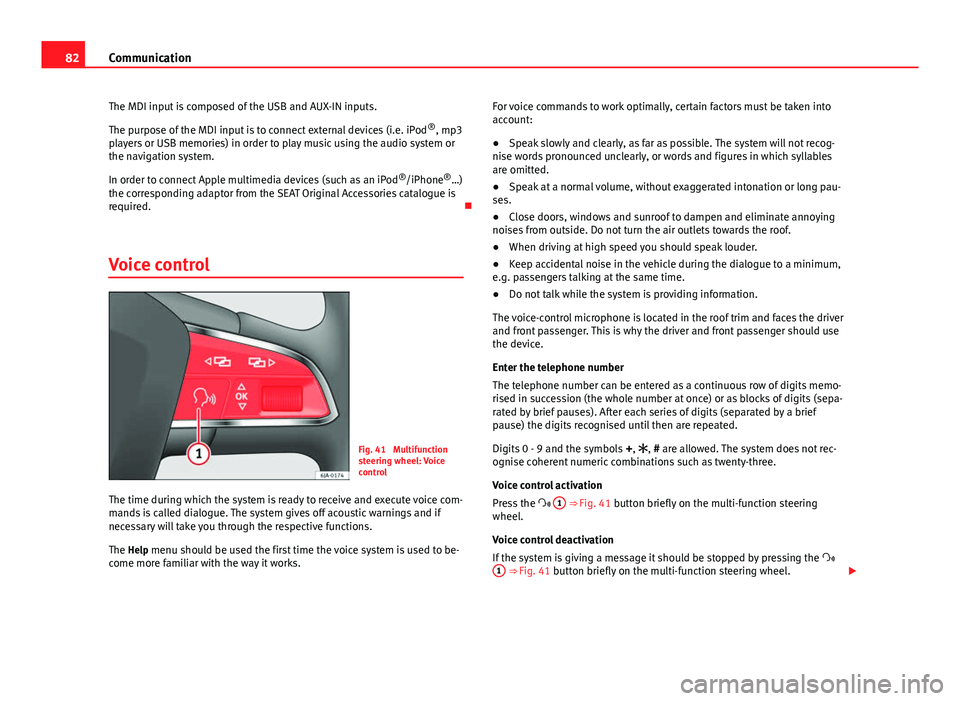
Fig. 41 Multifunction
steering wheel: Voice
control
The time during which the system is ready to receive and execute voice com-
mands is called dialogue. The system gives off acoustic warnings and if
necessary will take you through the respective functions.
The Help menu should be used the first time the voice system is used to be-
come more familiar with the way it works. For voice commands to work optimally, certain factors must be taken into
account:
●
Speak slowly and clearly, as far as possible. The system will not recog-
nise words pronounced unclearly, or words and figures in which syllables
are omitted.
● Speak at a normal volume, without exaggerated intonation or long pau-
ses.
● Close doors, windows and sunroof to dampen and eliminate annoying
noises from outside. Do not turn the air outlets towards the roof.
● When driving at high speed you should speak louder.
● Keep accidental noise in the vehicle during the dialogue to a minimum,
e.g. passengers talking at the same time.
● Do not talk while the system is providing information.
The voice-control microphone is located in the roof trim and faces the driver
and front passenger. This is why the driver and front passenger should use
the device.
Enter the telephone number
The telephone number can be entered as a continuous row of digits memo-
rised in succession (the whole number at once) or as blocks of digits (sepa-
rated by brief pauses). After each series of digits (separated by a brief
pause) the digits recognised until then are repeated.
Digits 0 - 9 and the symbols +, , # are allowed. The system does not rec-
ognise coherent numeric combinations such as twenty-three.
Voice control activation
Press the 1
⇒ Fig. 41 button briefly on the multi-function steering
wheel.
Voice control deactivation
If the system is giving a message it should be stopped by pressing the
1
⇒ Fig. 41 button briefly on the multi-function steering wheel.
Page 90 of 258
88Opening and closing
Locking the vehicle with the key
–Turn the key in the driver door lock cylinder in the reverse direc-
tion to its lock position B ⇒ Fig. 45.
● The doors and the rear lid are locked.
● The courtesy lights switch off.
● The Safe lock is immediately activated.
● Warning lamp on the driver door starts to flash.
Note
The vehicle doors cannot be locked if the driver door is open.
Central lock button
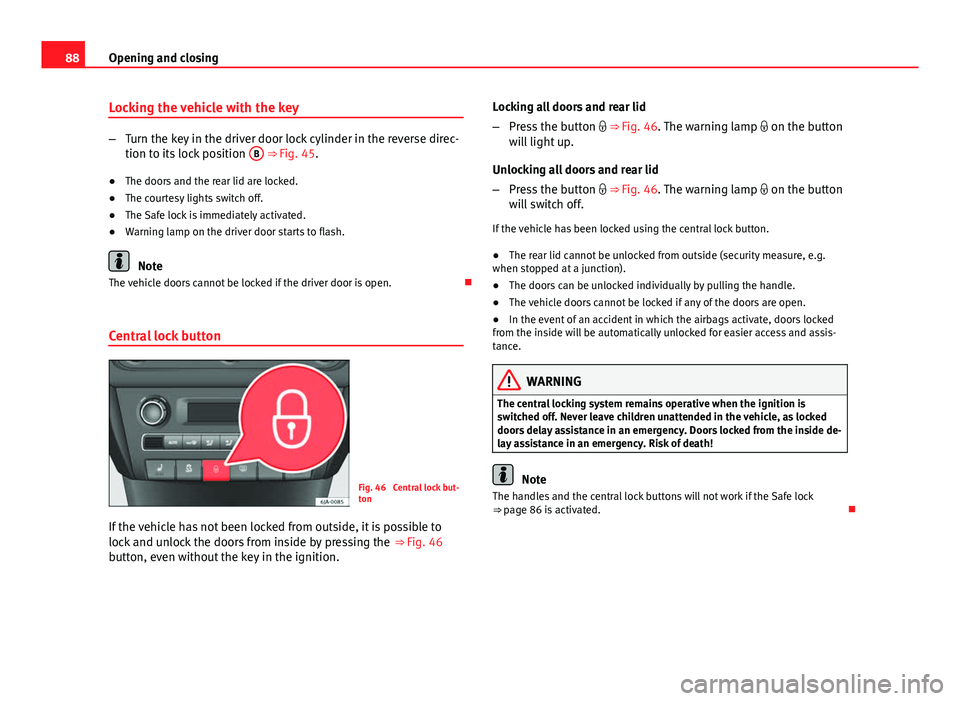
Fig. 46 Central lock but-
ton
If the vehicle has not been locked from outside, it is possible to
lock and unlock the doors from inside by pressing the ⇒ Fig. 46
button, even without the key in the ignition. Locking all doors and rear lid
–
Press the button ⇒ Fig. 46. The warning lamp on the button
will light up.
Unlocking all doors and rear lid
– Press the button ⇒ Fig. 46. The warning lamp on the button
will switch off.
If the vehicle has been locked using the central lock button.
● The rear lid cannot be unlocked from outside (security measure, e.g.
when stopped at a junction).
● The doors can be unlocked individually by pulling the handle.
● The vehicle doors cannot be locked if any of the doors are open.
● In the event of an accident in which the airbags activate, doors locked
from the inside will be automatically unlocked for easier access and assis-
tance.
WARNING
The central locking system remains operative when the ignition is
switched off. Never leave children unattended in the vehicle, as locked
doors delay assistance in an emergency. Doors locked from the inside de-
lay assistance in an emergency. Risk of death!
Note
The handles and the central lock buttons will not work if the Safe lock
⇒ page 86 is activated.
Page 110 of 258
108Lights and visibility
Set the windscreen wiper arms to the service position before
changing the blades.
Service position for changing wiper blades
–Close the bonnet.
– Switch the ignition on and off.
– Press the lever to position 4
⇒ Fig. 65 ⇒ page 106, the wind-
screen wiper arms are set to the service position.
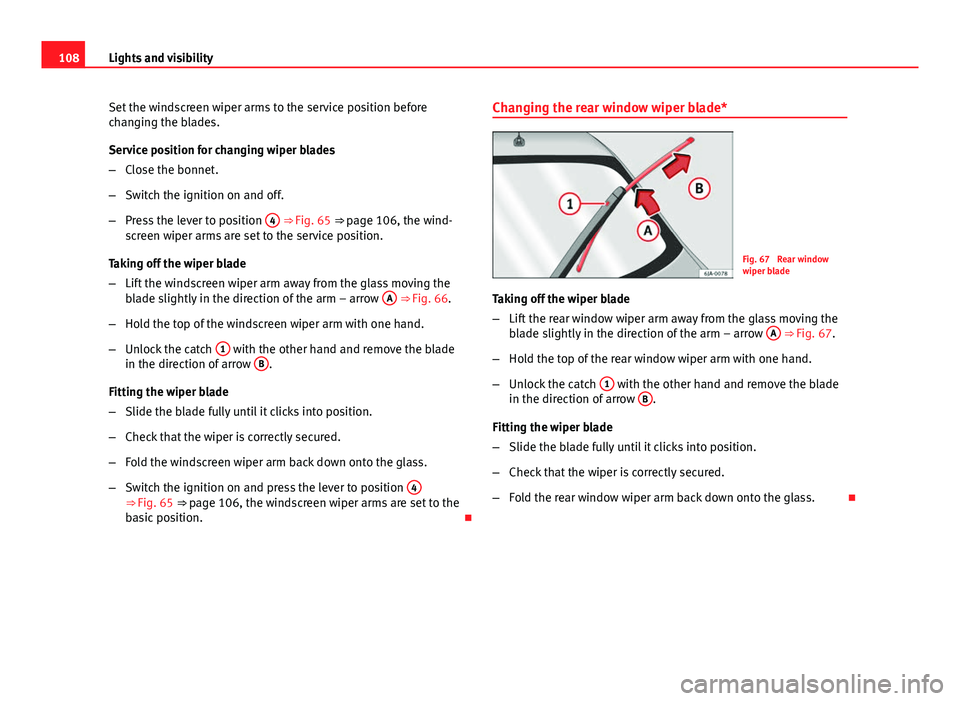
Taking off the wiper blade
– Lift the windscreen wiper arm away from the glass moving the
blade slightly in the direction of the arm – arrow A
⇒ Fig. 66.
– Hold the top of the windscreen wiper arm with one hand.
– Unlock the catch 1
with the other hand and remove the blade
in the direction of arrow B.
Fitting the wiper blade
– Slide the blade fully until it clicks into position.
– Check that the wiper is correctly secured.
– Fold the windscreen wiper arm back down onto the glass.
– Switch the ignition on and press the lever to position 4
⇒ Fig. 65 ⇒
page 106, the windscreen wiper arms are set to the
basic position. Changing the rear window wiper blade*
Fig. 67 Rear window
wiper blade
Taking off the wiper blade
– Lift the rear window wiper arm away from the glass moving the
blade slightly in the direction of the arm – arrow A
⇒ Fig. 67.
– Hold the top of the rear window wiper arm with one hand.
– Unlock the catch 1
with the other hand and remove the blade
in the direction of arrow B.
Fitting the wiper blade
– Slide the blade fully until it clicks into position.
– Check that the wiper is correctly secured.
– Fold the rear window wiper arm back down onto the glass.
Page 117 of 258
115
Seats and storage
Luggage compartment
Introduction
Please observe the following points to ensure the vehicle handles
well at all times:
– Distribute the load as evenly as possible.
– Place heavy objects as far forward in the luggage compartment
as possible.
– Secure luggage using the fastening rings or retaining net
⇒ page 116.
During an accident, even small and light objects can have so much kinetic
energy that they can cause very severe injuries. The amount of kinetic ener-
gy depends on the speed of the vehicle and the weight of the object. How-
ever, the speed of the vehicle is the most important factor.
Example: An unsecured object weighing 4.5 kg produces energy corre-
sponding to 20 times its weight in a frontal collision at 50 km/h (31 mph).
This means that its weight “reaches” around 90 kg. You can imagine the se-
verity of the injuries that might be sustained if this “projectile” strikes an
occupant as it flies through the vehicle interior.
WARNING
● Store objects in the luggage compartment and secure to the fastening
points.
● In an accident or sudden manoeuvre, loose objects in the interior can
be flung forwards and possibly injure vehicle occupants or others. This
risk is increased if the flying objects hit and trigger an airbag. In this
case, any rebounding objects could injure vehicle occupants. Risk of fatal
injuries!
● Take into account that transporting heavy objects changes the centre
of gravity that could also cause changes in vehicle handling. Risk of acci-
dent! Therefore, always adjust your speed and driving style to suit these
circumstances.
● Securing the load to the rings using unsuitable or damage straps
could lead to injuries in the event of an accident or sudden braking ma-
noeuvre. Secure suitable straps safely to the rings to ensure this does
not happen.
● Position the load so that it cannot moved forwards during a sudden
braking manoeuvre. Risk of injuries!
● If transporting sharp or dangerous objects in the space provided
when the rear seats are folded, ensure the safety of the occupant of the
remaining rear seat ⇒ page 13.
● If the rear seat located alongside a folding seat is occupied, ensure
safety by placing the load so that it stops the seat from folding back-
wards in the event of a collision, for example.
● Never drive with the rear lid open or half-closed, exhaust gases may
penetrate into the interior of the vehicle. Danger of poisoning!
● Never exceed the allowed axle loads or allowed maximum weight.
Risk of accident!
● Never transport passengers in the luggage compartment!
Safety FirstOperating instructionsPractical TipsTechnical specifications
Page 118 of 258
116Seats and storage
CAUTION
Make sure sharp objects stored in the luggage compartment cannot not
damage the rear window heating filaments.
Note
Tyre pressure must be adapted to suit the load ⇒ page 197, Tyre useful life.
Luggage compartment light
The light switches on automatically when the rear lid is opened. The light
switches off automatically 10 seconds after the rear lid has been opened.
Category N1 vehicles
Category N1 vehicles with no protection grille must use a retaining set com-
pliant with Standard EN 12195 (1 – 4) to secure the load. Retaining elements*
Fig. 75 Luggage com-
partment: Retaining ele-
ments
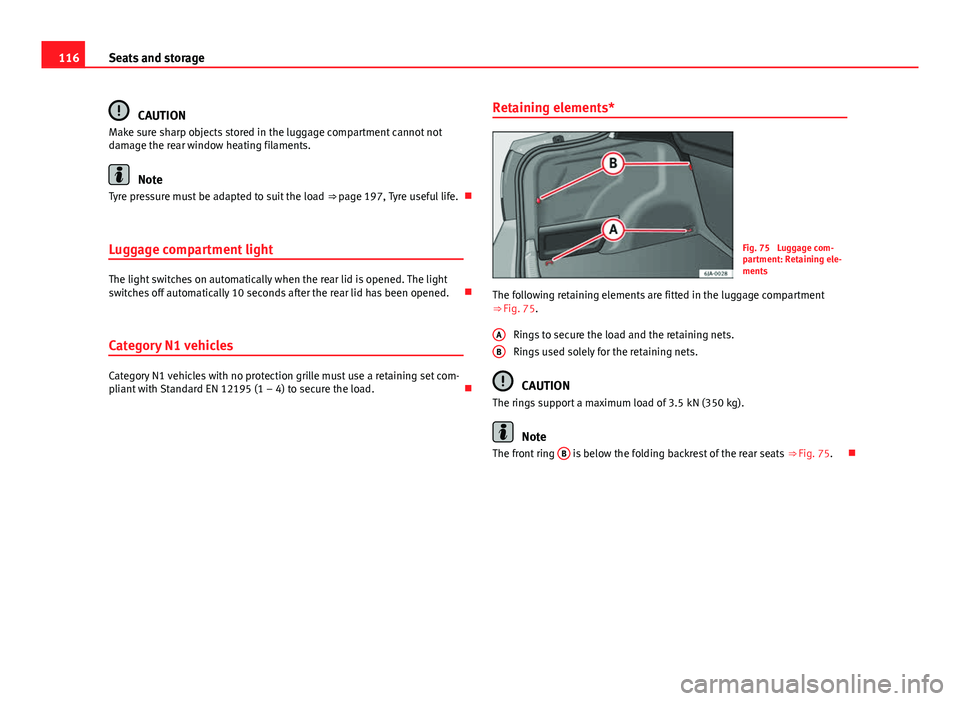
The following retaining elements are fitted in the luggage compartment
⇒ Fig. 75.
Rings to secure the load and the retaining nets.
Rings used solely for the retaining nets.
CAUTION
The rings support a maximum load of 3.5 kN (350 kg).
Note
The front ring B is below the folding backrest of the rear seats
⇒ Fig. 75.
A
B
Page 119 of 258
117
Seats and storage
Hook*
Fig. 76 Luggage com-
partment: hook
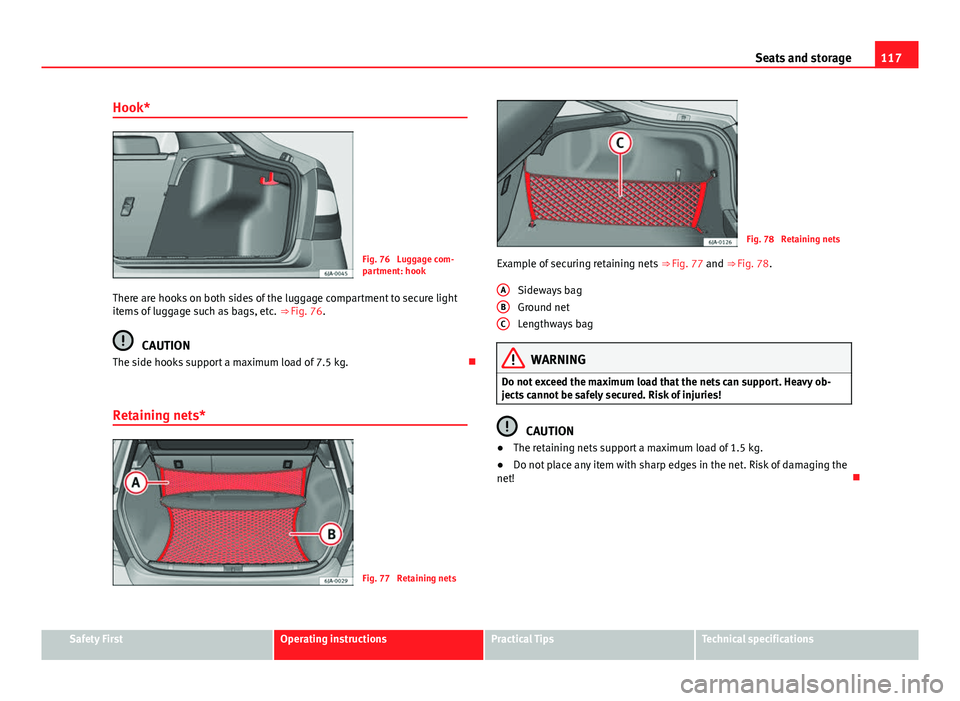
There are hooks on both sides of the luggage compartment to secure light
items of luggage such as bags, etc. ⇒ Fig. 76.
CAUTION
The side hooks support a maximum load of 7.5 kg.
Retaining nets*
Fig. 77 Retaining nets
Fig. 78 Retaining nets
Example of securing retaining nets ⇒ Fig. 77 and ⇒ Fig. 78.
Sideways bag
Ground net
Lengthways bag
WARNING
Do not exceed the maximum load that the nets can support. Heavy ob-
jects cannot be safely secured. Risk of injuries!
CAUTION
● The retaining nets support a maximum load of 1.5 kg.
● Do not place any item with sharp edges in the net. Risk of damaging the
net!
A
BC
Safety FirstOperating instructionsPractical TipsTechnical specifications
Page 120 of 258
118Seats and storage
Rear shelf
Fig. 79 Removing the
shelf
Fig. 80 Removing the
shelf
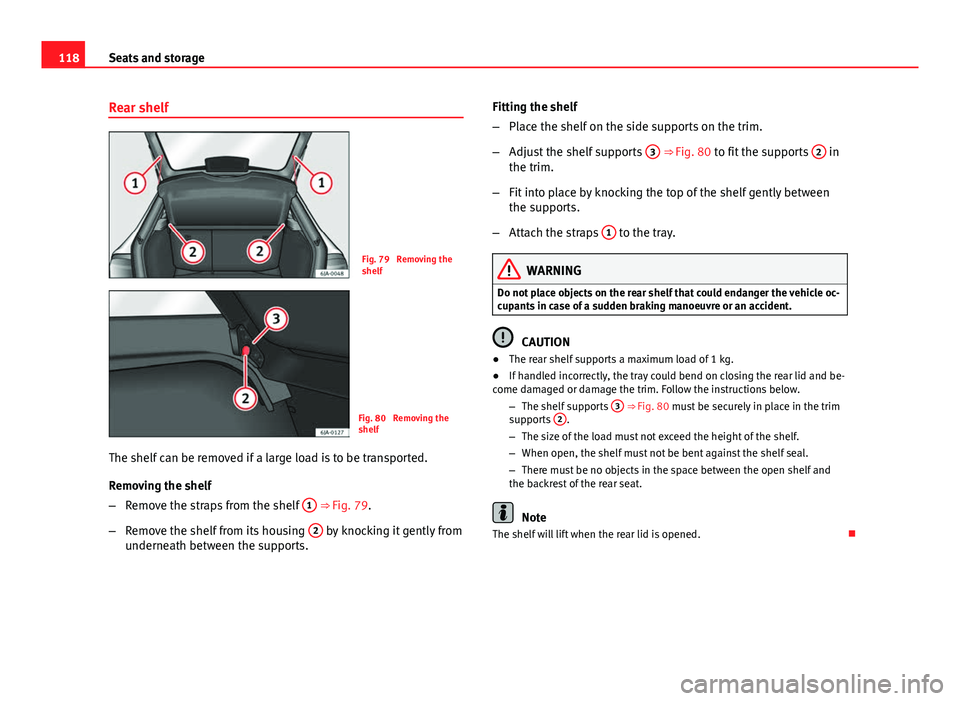
The shelf can be removed if a large load is to be transported.
Removing the shelf
– Remove the straps from the shelf 1
⇒ Fig. 79.
– Remove the shelf from its housing 2
by knocking it gently from
underneath between the supports. Fitting the shelf
–
Place the shelf on the side supports on the trim.
– Adjust the shelf supports 3
⇒ Fig. 80 to fit the supports 2 in
the trim.
– Fit into place by knocking the top of the shelf gently between
the supports.
– Attach the straps 1
to the tray.
WARNING
Do not place objects on the rear shelf that could endanger the vehicle oc-
cupants in case of a sudden braking manoeuvre or an accident.
CAUTION
● The rear shelf supports a maximum load of 1 kg.
● If handled incorrectly, the tray could bend on closing the rear lid and be-
come damaged or damage the trim. Follow the instructions below.
–The shelf supports 3
⇒ Fig. 80 must be securely in place in the trim
supports 2.
– The size of the load must not exceed the height of the shelf.
– When open, the shelf must not be bent against the shelf seal.
– There must be no objects in the space between the open shelf and
the backrest of the rear seat.
Note
The shelf will lift when the rear lid is opened.
Page 121 of 258
119
Seats and storage
Roof carrier*
Introduction
WARNING
● The load on the roof carrier must be properly secured. Risk of acci-
dent!
● Always secure the load using retaining straps in good condition.
● Distribute the load evenly.
● When transporting heavy or large objects on the roof, any change in
the normal vehicle behaviour due to a change in the centre of gravity or
an increased wind resistance must be taken into account. Risk of acci-
dent! For this reason, a suitable speed and driving style must be used.
● Avoid sudden manoeuvres and braking.
● Adjust your driving style to suit visibility, the weather and road and
traffic conditions.
● Never exceed the allowed axle loads or allowed maximum weight.
Risk of accident!
CAUTION
● Only use SEAT-authorised roof carriers.
● Where roof carriers from other systems are used or where they are not
fitted properly, any damage caused to the vehicle will not be covered by the
warranty. Therefore, carefully follow the Instruction Manual for installation
of the roof carrier.
● On vehicles fitted with a sliding sunroof, make sure it does not hit the
load on the roof when opened
● Remember that the rear lid must not hit the roof load.
● The total height of the vehicle increases according to the roof load. Com-
pare the height of the vehicle with the heights of bridges or, for example,
the size of the garage door. ●
Do not forget to remove the roof carrier before entering an automatic
carwash.
● Take into account that the load must not damage the aerial located on
the roof.
For the sake of the environment
The increased air resistance means that the vehicle uses more fuel.
Attachment points
Fig. 81 Basic roof carrier attachment points
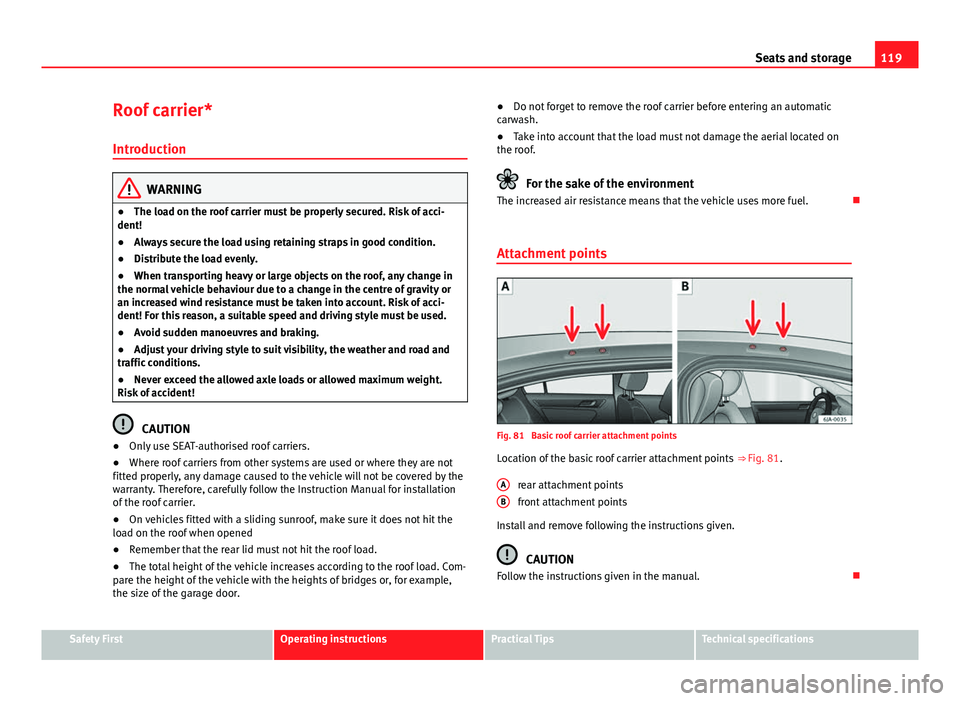
Location of the basic roof carrier attachment points ⇒ Fig. 81.
rear attachment points
front attachment points
Install and remove following the instructions given.
CAUTION
Follow the instructions given in the manual.
A
B
Safety FirstOperating instructionsPractical TipsTechnical specifications
Page 127 of 258
125
Seats and storage
WARNING
Do not place heavy objects in the pockets. Risk of injury!
CAUTION
Do not place overly large objects in the pockets (e.g. bottles) or objects with
sharp edges. Risk of damage to the pockets and the upholstery.
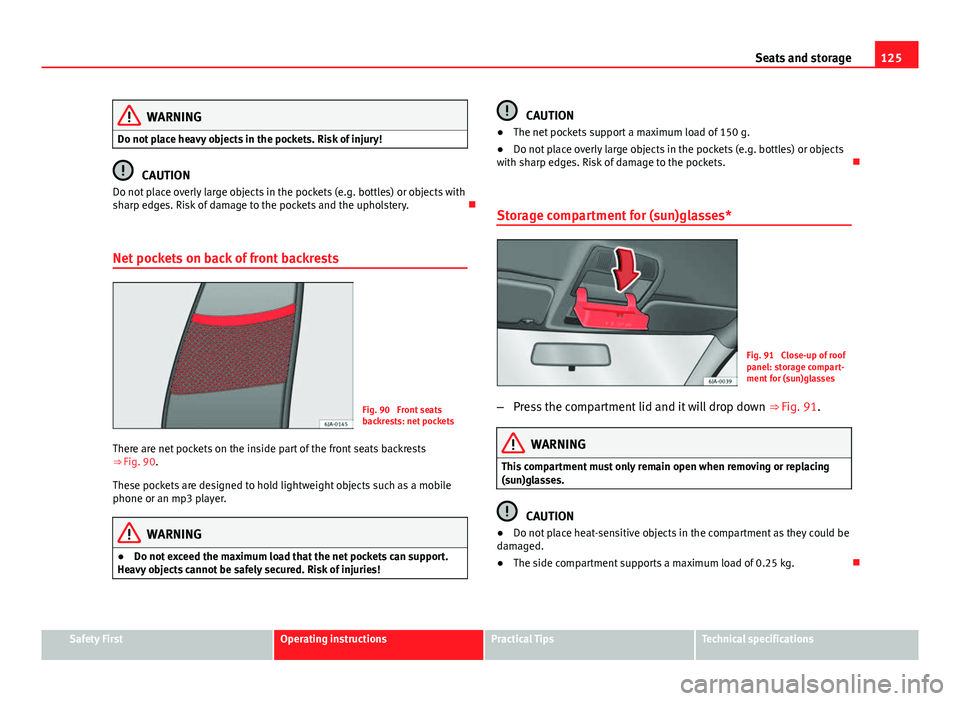
Net pockets on back of front backrests
Fig. 90 Front seats
backrests: net pockets
There are net pockets on the inside part of the front seats backrests
⇒ Fig. 90.
These pockets are designed to hold lightweight objects such as a mobile
phone or an mp3 player.
WARNING
● Do not exceed the maximum load that the net pockets can support.
Heavy objects cannot be safely secured. Risk of injuries!
CAUTION
● The net pockets support a maximum load of 150 g.
● Do not place overly large objects in the pockets (e.g. bottles) or objects
with sharp edges. Risk of damage to the pockets.
Storage compartment for (sun)glasses*
Fig. 91 Close-up of roof
panel: storage compart-
ment for (sun)glasses
– Press the compartment lid and it will drop down ⇒ Fig. 91.
WARNING
This compartment must only remain open when removing or replacing
(sun)glasses.
CAUTION
● Do not place heat-sensitive objects in the compartment as they could be
damaged.
● The side compartment supports a maximum load of 0.25 kg.
Safety FirstOperating instructionsPractical TipsTechnical specifications
Page 141 of 258
139
Driving
Driving Starting and stopping the engine
Introduction
WARNING
● Never adjust the steering wheel while the vehicle is moving!
● Maintain at least 25 cm distance between the steering wheel and the
upper part of your body 1
⇒ Fig. 100
⇒ page 140. The airbag system
will not be able to give the required protection if the minimum distance is
not observed. This can cause a risk of fatal injury!
● For safety reasons, the steering wheel adjustment lever must always
be pushed securely against the steering column to prevent the steering
wheel from accidentally changing position while driving. Risk of acci-
dent!
● If the steering wheel is adjusted closer to your face, the protective ef-
fect of the driver airbag will be decreased in the event of an accident.
Check that the steering wheel is pointing towards the upper part of your
body.
● When driving, always hold the steering wheel with both hands on the
outside part at the 9 o'clock and 3 o'clock positions. Never hold the
steering wheel at the 12 o'clock position, or in any other manner (e.g. in
the centre of the steering wheel). In such cases, if the airbag is triggered,
you may sustain injuries to the arms, hands and head.
● When moving with the engine switched off, the ignition key must al-
ways remain in position 2
⇒ Fig. 101 ⇒
page 141 (ignition on). The
control lamps will light up in this position. Otherwise, the steering lock
could engage suddenly. Risk of accident!
WARNING (Continued)
● Do not remove the key from the ignition until the vehicle has come to
a standstill and is secure (e.g. the handbrake is engaged). Otherwise, the
steering lock could suddenly engage. Risk of accident!
● Always take the ignition key with you when you leave the vehicle.
This is particularly important if you leave children in the vehicle. Children
could start the engine, for example, with the subsequent risk of accident.
● Never leave the engine running in unventilated or closed rooms. The
exhaust gases contain carbon monoxide, an odourless and colourless
poisonous gas. Risk of fatal accidents! Carbon monoxide can cause peo-
ple to lose consciousness and can cause death.
● Never leave the vehicle unattended if the engine is running.
● Never switch the engine off until the vehicle is stationary. Risk of ac-
cident!
CAUTION
● Turning the steering wheel fully in either direction when the vehicle is
stationary and the engine in gear puts the power steering under great
stress. This could lead to noise. Never leave the steering wheel turned fully
in either direction for more than 15 seconds. Risk of damage to the power
steering system!
● The starter motor may only be used (key position 3
⇒ Fig. 101
⇒ page 141 in the ignition) if the engine is off. Using the starter motor
when the engine is running could cause damage.
● Immediately release the ignition key when the engine starts, otherwise
damage could be caused to the starter motor.
● When the engine is cold, you should avoid high engine speeds, driving
at full throttle and over-loading the engine before it reaches operating tem-
perature. Risk of engine damage!
Safety FirstOperating instructionsPractical TipsTechnical specifications