air condition Seat Toledo 2013 Owner's Guide
[x] Cancel search | Manufacturer: SEAT, Model Year: 2013, Model line: Toledo, Model: Seat Toledo 2013Pages: 258, PDF Size: 3.94 MB
Page 140 of 258
138Heating and air conditioning
Windscreen defrosting
Switching on windscreen defrosting
–Press button
13 ⇒ Fig. 99 ⇒ page 136.
Switching off windscreen defrosting
– Press button
13 ⇒ Fig. 99 ⇒ page 136 several times or
press the AUTO button.
The temperature is regulated automatically. The air output is increased from
vents 1 ⇒ page 129 and 2.
Page 144 of 258
142Driving
● If the engine does not start after 10 seconds, turn the key back to posi-
tion 1
. Repeat the action after 30 seconds.
● Release the handbrake before moving off.
Switching off the engine
Stop the engine by turning the ignition key to position 1 ⇒ Fig. 101
⇒ page 141.
Brakes and brake servo systems Introduction
WARNING
● The brake servo only works when the engine is running. Braking
when the engine is switched off requires more strength on the brake ped-
al. Risk of accident!
● Press down on the clutch pedal when stopping and braking with a
manual gearbox, petrol engine vehicle at low speed. Otherwise, the
brake servo might not work properly. Risk of accident!
● In the event of damage to the standard front spoiler or where a differ-
ent front spoiler, hubcaps, etc. are subsequently fitted, make sure the air
vent to the brakes on the front wheels is not blocked. Otherwise, braking
operations may be impaired. Risk of accident!
● Always fully release the handbrake. If it is only partially released, this
will cause overheating of the rear brakes, which can impair the function
of the brake system. Risk of accident!
WARNING (Continued)
● Never leave children unsupervised in the vehicle. They could release
the handbrake or move the gear lever. The vehicle could start moving.
Risk of accident!
● Insufficient fuel can cause the engine to run irregularly or to switch
off. Brake assist systems could be impaired. Risk of accident!
● Always adjust your driving style to suit visibility, the weather and
road and traffic conditions. The best vehicle safety offered by brake as-
sist systems must never encourage you to run greater risks. Risk of acci-
dent!
CAUTION
● Observe the information concerning new brake pads ⇒ page 157.
● Where braking is not necessary, do not wear down the brake pads by
pressing down gently on the brake pedal. This causes the brakes to over-
heat, increasing their wear and increasing braking distances.
● To ensure the brake assist systems work properly, all wheels must be fit-
ted with tyres approved by the manufacturer.
Note
● If you brake suddenly and the brake system control unit regards the sit-
uation as hazardous for the drivers behind you, the brake lights will begin
to flash automatically. After reducing speed to approx. 10 km/h (6 mph) or
stopping the vehicle, the brake lights will stop flashing and the hazard
warning lights will switch on. The hazard warning lights are automatically
switched off when you accelerate or restart the vehicle.
● On long, steep gradients, reduce your speed and change to a lower gear
(manual gearbox) or move the selector lever to a lower gear position (auto-
matic gearbox). This uses the force of the engine and the brakes do not suf-
fer as much. If you still have to brake, do so intermittently, pressing down
repeatedly on the brake pedal.
Page 145 of 258
143
Driving
● Vehicle modifications (e.g. to the engine, brakes, frame or a combina-
tion of wheels and tyres) could impair the brake assist systems
⇒ page 204, Accessories, modifications and spare parts.
● In the event of a fault in the ABS system, the ESC, ASR and EDL are
switched off automatically. A fault in the ABS is indicated by the
⇒ page 73 warning lamp.
Brakes
Wear
The rate of wear of the brake pads depends on the driving style and on the
way in which the vehicle is used. The brake pads will wear more quickly if
you use your vehicle frequently in urban traffic and short trips or drive in a
sporty style. Under these demanding conditions, visit your specialised serv-
ice, even before the scheduled service date, so that the thickness of the
brake pads can be measured.
Wet roads or road salt
If brakes are wet or frozen, or if you are driving on roads which have been
gritted with salt, braking power may set in later than normal. Dry the brakes
as soon as possible by braking repeatedly.
Corrosion
Long periods of inactivity and little use can lead to rust on the brake discs
and dirt on the brake pads. Where the brake system is subjected to light
stress or in the case of corrosion, clean the brake discs by braking fully sev-
eral times at a high speed.
Brake system fault
If you notice that the braking distance suddenly increases and the brake
pedal can be pressed down more fully, there may be a fault in the brake sys-
tem. Visit a specialised service immediately and adjust your driving style to
the extent of the damage and to limit the effect of the brakes. Low brake fluid level
Insufficient brake fluid could cause faults in the brake system. The brake flu-
id level is controlled electronically
⇒ page 70, Brake system .
Brake servo
The brake servo supplements the pressure you exert on the brake pedal.
The brake servo only works when the engine is running.
Handbrake
Fig. 102 Centre console:
handbrake
Applying the handbrake
– Pull the handbrake lever up all the way.
Releasing the handbrake
– Pull the handbrake lever up slightly and press the unlock button
at the same time ⇒ Fig. 102.
– Keep the button pressed down and push the lever all the way
down.
Safety FirstOperating instructionsPractical TipsTechnical specifications
Page 157 of 258
155
Driving
● Engine at operating temperature
● Vehicle's battery sufficiently charged
● Vehicle not on a very steep slope
● Engine speed below 1200 rpm
● Vehicle's battery temperature is neither too high nor too low
● Sufficient brake system pressure
● Difference between outside temperature and set interior temperature
not too great
● Vehicle speed since last time the engine started was above 3 km/h (2
mph)
● Particulate filter ⇒ page 74 not being cleaned
● Front wheels not overly turned (steering wheel turned less than three
quarters of a turn)
Conditions for engine start up (Start phase)
● Clutch pedal pressed
● Max./min. temperature set
● Windscreen defrost function switched on
● High blower speed
● START-STOP button pressed
Conditions for automatic engine start up without driver involvement
● Vehicle moving at a speed of over 3 km/h (2 mph)
● Difference between outside temperature and interior temperature is too
great
● Vehicle's battery insufficiently charged
● Insufficient brake system pressure
If the driver seat belt is unfastened for more than 30 seconds in Stop phase,
the engine must be started using the ignition key. Please observe the mes-
sages on the general instrument panel display. Warnings on the instrument panel display (valid for vehicles not fitted with
an informative display)
FAULT: START-STOPFault in the START-STOP systemSTART-STOP IMPOSSIBLEEngine cannot be automatically shut
down
START-STOP ACTIVEAutomatic engine shut down (Stop
phase)
SWITCH OFF IGNITIONSwitch the ignition offSTART MANUALLYStart the engine manually
WARNING
● If the engine is switched off, neither the brake servo or the power
steering will work.
● Do not move the vehicle when the engine is switched off.
CAUTION
Switch off the START-STOP system ⇒ page 162 before driving through a
pool of water on the road.
Note
● The battery temperature may reflect the changes in outside temperature
after several hours. If the vehicle has been stopped outside at temperatures
below zero or in direct sunlight, for example, the battery temperature may
take several hours to reach the values required for the correct operating of
the START-STOP system.
● If the Climatronic system is operating automatically, this could impair
automatic engine shut down in certain conditions.
Safety FirstOperating instructionsPractical TipsTechnical specifications
Page 164 of 258

162Driving and the environment
Note
You will receive information about the modification of the headlights at an
authorised SEAT dealer.
Preventing damage to the vehicle
In order to prevent damage to the vehicle, take special care:
● on roads in poor condition
● when mounting the kerb
● when approaching very steep ramps, etc.
● with the parts of the vehicle situated on the lower part of the vehicle, i.e.
the spoiler, the exhaust pipe,
This applies especially to vehicles with a very low suspension (sport) and
when the vehicle is fully loaded.
Driving through water
Fig. 113 Driving through
water To prevent the vehicle from being damaged when driving through water (i.e.
flooded roads), please observe the following:
●
Determine the depth of the water before entering. The water can reach a
maximum height of below the door sill ⇒ Fig. 113.
● Drive at a maximum pace of walking speed. Driving at a higher speed
can cause a wave in front of the vehicle, which can cause water to enter the
engine air intake system or other parts of the vehicle.
● Never stop in the water, never reverse and never stop the engine.
● Before driving through water deactivate the START-STOP system
⇒ page 154.
WARNING
● Driving through water, dirt and mud can reduce braking capability
and prolong the braking distance – Risk of accident!
● Do not carry out any sudden or strong braking manoeuvres after driv-
ing through water.
● Clean and dry the brakes as soon as possible after driving through
water by breaking intermittently. Carry out braking in order to dry the
brakes and clean the brake discs only if traffic so permits. Do not put oth-
er drivers at risk.
CAUTION
● In the event of driving through water the parts of the vehicle can be seri-
ously damaged, such as the engine, gearbox, catalytic converter, suspen-
sion or the electrical system.
● Oncoming vehicles that drive through water can cause waves that ex-
ceed your vehicle's permitted level for driving through water.
● There may be pot-holes mud or rocks under the water that can hinder or
prevent driving through water.
● Do not drive through salt water. The salt can cause rust. All components
that are exposed to salt water must be rinsed immediately with fresh water.
Page 166 of 258
164Driving the vehicle with a trailer
Driving the vehicle with a trailer
Driving the vehicle with a trailer
Technical requirements
If your vehicle has a factory-fitted towing bracket or is equipped with a se-
lection of SEAT Original Accessories, it meets all the relevant technical and
legal requirements.
In vehicles with a towing bracket it is possible to remove the ball joint, situ-
ated (together with the special assembly instructions) in the housing for the
spare wheel in the vehicle luggage compartment ⇒ page 207, Vehicle tool
kit*.
Your vehicle is fitted with a 13-pole power socket for the electrical connec-
tion between the trailer and the vehicle. If the trailer you are going to use
has a 7-pin connector, the corresponding adaptor, acquired from the SEAT
Original Accessories Catalogue, can be used.
If a towing bracket is to be retro-fitted to the car, it must be done according
to the instructions of the towing bracket manufacturer.
Note
Any queries that may arise can be directed to an authorised SEAT dealer.
Trailer weight
Trailer weight
The combined vehicle and trailer must be balanced. To do so use the maxi-
mum permitted towing bracket load. An insufficient weight exerted by the trailer drawbar on the ball joint of the towing bracket will have a negative
impact upon the response of the vehicle-trailer assembly on the road.
Weight distribution
Distribute loads in the trailer so that heavy objects are as near to the axle as
possible. Ensure that the objects do not move.
If the towing vehicle is empty and the trailer loaded then the load distribu-
tion is incorrect. However, if these conditions cannot be avoided, drive very
slowly.
Tyre pressure values
Correct the tyre pressure in your vehicle to “total load” ⇒
page 197, Tyre
useful life.
Trailer weight
Never exceed the authorised trailer weight under any circumstances
⇒ page 233, Description of the data.
The trailer weights listed are only applicable for altitudes up to 1000 m
above sea level. Due to a lower air density the engine power decreases de-
pending on the increase in altitude, this also causes the climbing ability to
decrease, which requires a reduction of the weight of the vehicle with a
trailer by 10 % for every 1000 m increase in altitude. The weight of the as-
sembly is calculated by adding the vehicle weight (loaded) to the trailer
weight (loaded). Always drive with special care when towing a trailer.
The towed load and support load information that is displayed on the tow-
ing bracket manufacturers label are only values for the verification of the
device. The correct figures for your specific vehicle, which are usually lower
than these figures, are given in the documentation of your vehicle.
Page 178 of 258
176Care of the vehicle and cleaning
Note
● Make sure, when washing the vehicle, that the least amount of water
possible enters the lock cylinders.
● We recommend the use of products from the selection of SEAT Original
Accessories to care for the door lock cylinder.
Wheels
Wheel trims
If you wash the vehicle regularly, you must also thoroughly wash the wheel
trims. Regularly remove any brake abrasion residue and road salt from the
wheels, otherwise the wheel material could be damaged. Repair any dam-
age to the wheel paintwork immediately.
Alloy wheels
After thorough washing, treat the wheels with a protective product for alloy
wheels. Do not use abrasive products to care for the wheels.
WARNING
Moisture, ice and road salt may affect braking efficiency. Risk of acci-
dent!
CAUTION
Heavy dirt on the wheels could lead to their misalignment. This could result
in vibrations being transmitted to the steering wheel that under certain con-
ditions may cause premature steering wear. This dirt must be removed.
Note
We recommend you leave paint damage repairs to a SEAT Authorised Serv-
ice. Underbody sealant
The underside of the vehicle is coated to permanently protect it from chemi-
cal and mechanical agents.
Given that damage to the
protective coating during driving cannot be com-
pletely ruled out, we recommend you check the condition of the protective
coating on the underbody and suspension at regular intervals, preferably
before the start and end of the coldest season of the year.
Authorised SEAT dealers have suitable special products and the necessary
facilities and are aware of the techniques required for their application. We
therefore recommend all touch-up work or additional anti-corrosion meas-
ures be performed by an authorised SEAT dealer.
WARNING
Do not apply underseal or anti-corrosion coatings to the exhaust pipes,
catalytic converter, particulate filter or heat shields on the exhaust sys-
tem. Once the engine has reached operating temperature, these substan-
ces could catch fire. Risk of fire!
Cavity waxing
All cavities on the vehicle exposed to corrosion are permanently factory-pro-
tected by a wax solution .
This wax solution does not need to be checked or touched up. Should wax
run out of the cavities at high ambient temperatures, remove it using a plas-
tic scraper and clean away any stains using lighter fluid.
Page 236 of 258
234Description of the data
Vehicle identification data on the data sticker
Fig. 173 Data sticker
Fig. 174 Type plate
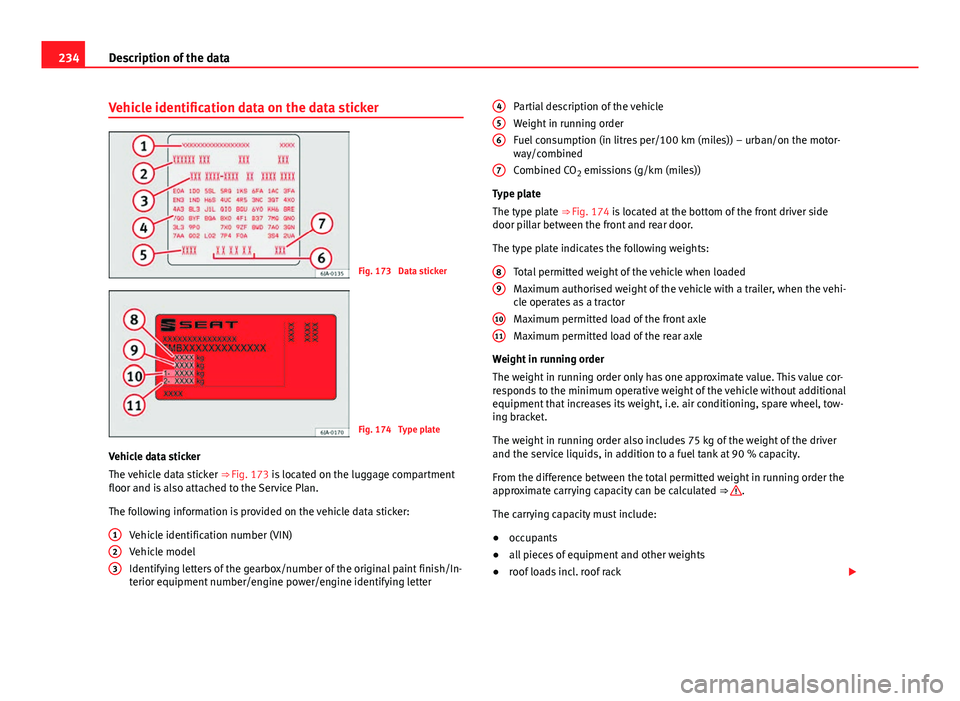
Vehicle data sticker
The vehicle data sticker ⇒ Fig. 173 is located on the luggage compartment
floor and is also attached to the Service Plan.
The following information is provided on the vehicle data sticker:
Vehicle identification number (VIN)
Vehicle model
Identifying letters of the gearbox/number of the original paint finish/In-
terior equipment number/engine power/engine identifying letter
1
23
Partial description of the vehicle
Weight in running order
Fuel consumption (in litres per/100 km (miles)) – urban/on the motor-
way/combined
Combined CO
2 emissions (g/km (miles))
Type plate
The type plate ⇒ Fig. 174 is located at the bottom of the front driver side
door pillar between the front and rear door.
The type plate indicates the following weights:
Total permitted weight of the vehicle when loaded
Maximum authorised weight of the vehicle with a trailer, when the vehi-
cle operates as a tractor
Maximum permitted load of the front axle
Maximum permitted load of the rear axle
Weight in running order
The weight in running order only has one approximate value. This value cor-
responds to the minimum operative weight of the vehicle without additional
equipment that increases its weight, i.e. air conditioning, spare wheel, tow-
ing bracket.
The weight in running order also includes 75 kg of the weight of the driver
and the service liquids, in addition to a fuel tank at 90 % capacity.
From the difference between the total permitted weight in running order the
approximate carrying capacity can be calculated ⇒
.
The carrying capacity must include:
● occupants
● all pieces of equipment and other weights
● roof loads incl. roof rack
4
56
7
89
1011
Page 249 of 258
Index
A
ABS . . . . . . . . . . . . . . . . . . . . . . . . . . . . . . . . . . 145control lamp . . . . . . . . . . . . . . . . . . . . . . . . . 73
Accessories . . . . . . . . . . . . . . . . . . . . . . . . . . . . 204
Adjusting the seat belt height . . . . . . . . . . . . . . 29
Adjustment seats . . . . . . . . . . . . . . . . . . . . . . . . . . . . . . 111
steering wheel . . . . . . . . . . . . . . . . . . . . . . 140
Aerial . . . . . . . . . . . . . . . . . . . . . . . . . . . . . . . . . 173 see radio reception . . . . . . . . . . . . . . . . . . 175
Airbag . . . . . . . . . . . . . . . . . . . . . . . . . . . . . . . . . 31
Airbag covers . . . . . . . . . . . . . . . . . . . . . . . . . . . 37
Airbag system . . . . . . . . . . . . . . . . . . . . . . . . . . . 31 control lamp . . . . . . . . . . . . . . . . . . . . . . . . . 33
Curtain airbags . . . . . . . . . . . . . . . . . . . . . . . 41
Front airbags . . . . . . . . . . . . . . . . . . . . . . . . 35
Side airbags . . . . . . . . . . . . . . . . . . . . . . . . . 38
air conditioning air conditioning . . . . . . . . . . . . . . . . . . . . . 129
Air conditioning air conditioning . . . . . . . . . . . . . . . . . 132, 134
Climatronic . . . . . . . . . . . . . . . . . . . . . . . . . 135
Air recirculation manual air conditioning . . . . . . . . . . . . . . 134
Alarm . . . . . . . . . . . . . . . . . . . . . . . . . . . . . . . . . . 91
Anti-lock system . . . . . . . . . . . . . . . . . . . . . . . . 145
Anti-theft alarm system . . . . . . . . . . . . . . . . . . . 91 Armrest . . . . . . . . . . . . . . . . . . . . . . . . . . . . . . . 111
rear . . . . . . . . . . . . . . . . . . . . . . . . . . . . . . . 114
Ashtrays . . . . . . . . . . . . . . . . . . . . . . . . . . . . . . 121
Aspects to take into account before starting the vehicle . . . . . . . . . . . . . . . . . . . . . . . . . . . . . . . . 8
ASR . . . . . . . . . . . . . . . . . . . . . . . . . . . . . . . . . . 145 Assistance systems . . . . . . . . . . . . . . . . . . . 73
control lamp . . . . . . . . . . . . . . . . . . . . . . . . . 73
Assistance system ABS . . . . . . . . . . . . . . . . . . . . . . . . . . . . . . . 145
ASR . . . . . . . . . . . . . . . . . . . . . . . . . . . . . . . 145
START-STOP . . . . . . . . . . . . . . . . . . . . . . . . . 154
Assistance systems ABS . . . . . . . . . . . . . . . . . . . . . . . . . . . . . . . . 73
cruise control . . . . . . . . . . . . . . . . . . . . . . . 152
EDL . . . . . . . . . . . . . . . . . . . . . . . . . . . . . . . 145
ESC . . . . . . . . . . . . . . . . . . . . . . . . . . . . 72, 144
parking aid . . . . . . . . . . . . . . . . . . . . . . . . . 151
Audible warning . . . . . . . . . . . . . . . . . . . . . . . . . 21
Auto-check system . . . . . . . . . . . . . . . . . . . . . . . 68
Automatic disconnection of electrical equip- ment . . . . . . . . . . . . . . . . . . . . . . . . . . . . . . . . 194
Automatic gearbox . . . . . . . . . . . . . . . . . . . . . . 146 back-up programme . . . . . . . . . . . . . . . . . . 150
Driving programmes . . . . . . . . . . . . . . . . . 149
instructions for use . . . . . . . . . . . . . . . . . . 146
kick-down . . . . . . . . . . . . . . . . . . . . . . . . . . 149
manual release of the selector lever . . . . . 150
parking . . . . . . . . . . . . . . . . . . . . . . . . . . . . 147
Selector lever lock . . . . . . . . . . . . . . . . . . . 149 selector lever positions . . . . . . . . . . . . . . . 147
starting . . . . . . . . . . . . . . . . . . . . . . . . . . . . 147
stopping . . . . . . . . . . . . . . . . . . . . . . . . . . . 147
Tiptronic . . . . . . . . . . . . . . . . . . . . . . . . . . . 148
AUX-IN . . . . . . . . . . . . . . . . . . . . . . . . . . . . . . . . . 81
B
Back-up automatic gearbox . . . . . . . . . . . . . . . . . . . 150
Battery automatic disconnection of electricalequipment . . . . . . . . . . . . . . . . . . . . . . . . 194
changing . . . . . . . . . . . . . . . . . . . . . . . . . . . 194
charging . . . . . . . . . . . . . . . . . . . . . . . . . . . 193
checking acid level . . . . . . . . . . . . . . . . . . . 193
safety instructions . . . . . . . . . . . . . . . . . . . 191
winter service . . . . . . . . . . . . . . . . . . . . . . . 193
Before starting the vehicle . . . . . . . . . . . . . . . . . 8
Bonnet closing . . . . . . . . . . . . . . . . . . . . . . . . . . . . 183
opening . . . . . . . . . . . . . . . . . . . . . . . . . . . . 183
Brake assist . . . . . . . . . . . . . . . . . . . . . . . . . . . 144
Brake fluid checking . . . . . . . . . . . . . . . . . . . . . . . . . . . 189
brakes brake fluid . . . . . . . . . . . . . . . . . . . . . . . . . . 189
247
Index