brake light Seat Toledo 2013 Owner's Guide
[x] Cancel search | Manufacturer: SEAT, Model Year: 2013, Model line: Toledo, Model: Seat Toledo 2013Pages: 258, PDF Size: 3.94 MB
Page 160 of 258
158Driving and the environment
Fuel consumption also depends on factors that cannot be influenced by the
driver. It is normal for consumption to be greater in winter or in difficult con-
ditions, on roads in poor condition, when towing a trailer, etc.
Fuel consumption can also vary considerably from that stated by the manu-
facturer due to the outside temperature, the weather and driving style.
The vehicle has factory-fitted technical conditions in order to save fuel and
to operate in economic mode. SEAT pays special attention to minimize the
environmental impact. Take the following indications in this chapter into ac-
count in order to conserve and to take advantage of these qualities:
The engine speed must be maintained at the maximum in order to prevent
vehicle resonance and high fuel consumption.
Foresighted driving
The vehicle consumes the majority of fuel when accelerating, therefore
avoid unnecessary acceleration and braking. If you think ahead when driv-
ing, you will need to brake less and thus accelerate less. For example, when
approaching a red traffic light, allow the vehicle to decelerate freely or use
the engine braking effect. Saving energy when changing gear
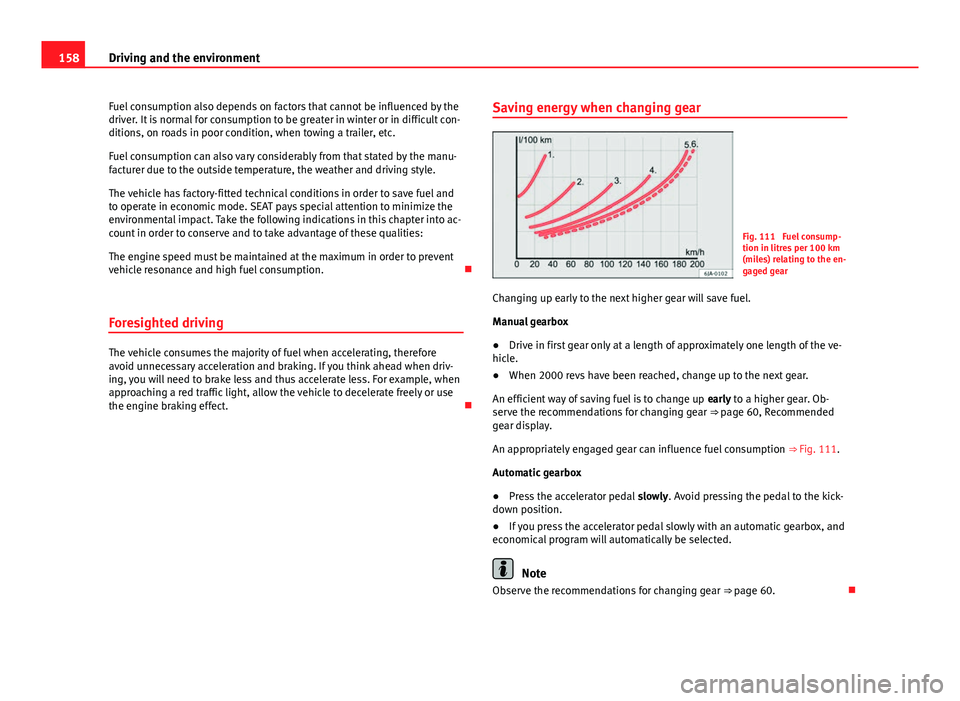
Fig. 111 Fuel consump-
tion in litres per 100 km
(miles) relating to the en-
gaged gear
Changing up early to the next higher gear will save fuel.
Manual gearbox
● Drive in first gear only at a length of approximately one length of the ve-
hicle.
● When 2000 revs have been reached, change up to the next gear.
An efficient way of saving fuel is to change up early to a higher gear. Ob-
serve the recommendations for changing gear ⇒ page 60, Recommended
gear display.
An appropriately engaged gear can influence fuel consumption ⇒ Fig. 111.
Automatic gearbox
● Press the accelerator pedal slowly. Avoid pressing the pedal to the kick-
down position.
● If you press the accelerator pedal slowly with an automatic gearbox, and
economical program will automatically be selected.
Note
Observe the recommendations for changing gear ⇒ page 60.
Page 164 of 258

162Driving and the environment
Note
You will receive information about the modification of the headlights at an
authorised SEAT dealer.
Preventing damage to the vehicle
In order to prevent damage to the vehicle, take special care:
● on roads in poor condition
● when mounting the kerb
● when approaching very steep ramps, etc.
● with the parts of the vehicle situated on the lower part of the vehicle, i.e.
the spoiler, the exhaust pipe,
This applies especially to vehicles with a very low suspension (sport) and
when the vehicle is fully loaded.
Driving through water
Fig. 113 Driving through
water To prevent the vehicle from being damaged when driving through water (i.e.
flooded roads), please observe the following:
●
Determine the depth of the water before entering. The water can reach a
maximum height of below the door sill ⇒ Fig. 113.
● Drive at a maximum pace of walking speed. Driving at a higher speed
can cause a wave in front of the vehicle, which can cause water to enter the
engine air intake system or other parts of the vehicle.
● Never stop in the water, never reverse and never stop the engine.
● Before driving through water deactivate the START-STOP system
⇒ page 154.
WARNING
● Driving through water, dirt and mud can reduce braking capability
and prolong the braking distance – Risk of accident!
● Do not carry out any sudden or strong braking manoeuvres after driv-
ing through water.
● Clean and dry the brakes as soon as possible after driving through
water by breaking intermittently. Carry out braking in order to dry the
brakes and clean the brake discs only if traffic so permits. Do not put oth-
er drivers at risk.
CAUTION
● In the event of driving through water the parts of the vehicle can be seri-
ously damaged, such as the engine, gearbox, catalytic converter, suspen-
sion or the electrical system.
● Oncoming vehicles that drive through water can cause waves that ex-
ceed your vehicle's permitted level for driving through water.
● There may be pot-holes mud or rocks under the water that can hinder or
prevent driving through water.
● Do not drive through salt water. The salt can cause rust. All components
that are exposed to salt water must be rinsed immediately with fresh water.
Page 167 of 258
165
Driving the vehicle with a trailer
WARNING
● Exceeding the maximum established load per axle and the maximum
towing bracket load in addition to the maximum permitted load or the
load of the vehicle + trailer assembly can cause accidents and serious in-
juries.
● A sliding load could considerably affect the stability and safety of the
vehicle + trailer assembly, resulting in accidents and serious injuries.
Towing a trailer
Exterior mirrors
Check whether you can see enough of the road behind the trailer with the
standard rear vision mirrors. If this is not the case, you should have addi-
tional exterior mirrors fitted. Observe the relevant statutory requirements of
the country you are in.
Headlights
Before starting a journey, also check the headlight beam settings with the
trailer hitched up. Adjust the headlight range settings if necessary
⇒ page 99, Range control of main lights .
Driving speed
For your own safety do not drive faster than the maximum permitted speed
indicated on the trailer.
At all times, immediately reduce speed if you detect the slightest swaying
movement of the trailer. Never try to “return the trailer to a straight posi-
tion” by accelerating.
Brakes
Brake in due course! If the trailer has an overrun brake, apply the brakes
gently at first and then, firmly. This will prevent the jerking that can be caused by locking of trailer wheels. Change to a lower gear in good time be-
fore descending a slope in order to take advantage of the engine brake.
The trailer is incorporated into the vehicle anti-theft alarm system.
●
When the vehicle has a factory-fitted anti-theft alarm and a towing
bracket
● When the trailer is electrically connected to the vehicle via the towing
bracket socket
● When the vehicle electrical device and the towing bracket are operation-
al
● When the vehicle is locked and the vehicle anti-theft alarm device is ac-
tivated
Once the electrical connection is interrupted with the vehicle trailer locked,
the alarm sounds.
Always switch off the vehicle anti-theft alarm device before connecting or
disconnecting a trailer. The vehicle anti-theft alarm device could cause the
alarm to sound ⇒ page 91, Anti-theft alarm system*.
Engine overheating
In the event that the coolant temperature gauge needle moves to the right
section of the scale or to the red area, immediately reduce speed. If the con-
trol lamp flashes on the general instrument panel, stop the vehicle and
switch off the engine. Wait several minutes and check the coolant level in
the tank ⇒ page 188.
Please observe the following indications ⇒ page 72, Coolant level and tem-
perature .
The coolant temperature can be reduced by switching on the heating.
Safety FirstOperating instructionsPractical TipsTechnical specifications
Page 168 of 258
166Driving the vehicle with a trailer
WARNING
● Adjust your speed to suit the road and traffic conditions.
● An electrical installation that is connected incorrectly or by non-spe-
cialised personnel can prevent the connection of the current to the trailer
and cause faults in the electrical system operation throughout the entire
vehicle, leading to accidents and serious injury.
● All electrical work must be carried out only by the specialised serv-
ices.
● Never directly connect the trailer electrical device to the electrical
sockets of the reverse driving lights or other sources of electrical current.
CAUTION
● Avoid corners, and sudden and sharp braking.
● Once the trailing arm has been removed, place the corresponding cover
on the hole of the fastening point. This prevents dirt from entering the hole
– see the trailer system assembly manual.
Note
● In the event of frequent journeys with a trailer, we recommend also hav-
ing the vehicle inspected in-between the service intervals.
● When connecting and disconnecting the trailer, the handbrake must be
applied.
● For technical reasons, trailers with LED reverse lights cannot be incorpo-
rated into the vehicle anti-theft alarm system.
Page 174 of 258

172Care of the vehicle and cleaning
Care of the vehicle and cleaning
Care of the vehicle
Introduction
Regular and suitable care helps to maintain the useful life of your vehicle.
This may also be one of the requirements for upholding any warranty claims
in the event of corrosion or paint defects.
We recommend you use cleaning products from the SEAT Original Accesso-
ries programme available in SEAT dealers. Please follow the instructions for
use on the packaging.
WARNING
● Cleaning products and other materials used for car care can damage
the health if misused.
● Always keep car care materials in a safe place out of the reach of chil-
dren. Risk of poisoning!
● When washing the car during the winter season: Moisture and ice on
the brakes may affect braking efficiency. Risk of accident!
● The ignition must always be switched off when the car is washed.
Risk of accident!
● Do not clean the underside of the car or inside the wheel arches with-
out protecting your hands and arms. You may cut yourself on sharp metal
parts!
● Perfumes and air fresheners inside the vehicle may be harmful to
health at high temperatures in the interior.
CAUTION
● Check the colour stability of your clothing to avoid damaging or visibly
staining the fabric (leather), upholstery and fabric trim.
● Cleaning products containing solvents may damage the material being
cleaned.
● Do not wash the vehicle in direct sunlight. Risk of damage to paintwork.
● If washing the vehicle with a hose in winter, do not direct the jet of water
directly at the locks or at the door seals or bonnet. Risk of freezing.
● Do not use insect sponges or abrasive household sponges, etc. on pain-
ted surfaces. Risk of damage to the painted surface.
● Do not put stickers on the inner side of the window in areas where heat-
ing elements or the aerial is located. This could cause damage and, in the
case of the aerial, radio and navigation system reception faults.
● Do not clean the inner side of the window with sharp objects or corro-
sive or acidic cleaning products. Risk of damaging the heating elements or
the aerial.
● Do not attach any fragrance or air freshener to the dash panel. Risk of
damage to the dash panel.
● To avoid damaging the parking aid system sensors, spray them only
briefly at a minimum distance of 10 cm when cleaning the vehicle with a
high-pressure or steam cleaner.
● Do not clean the roof panel with a brush. Risk of damage to the panel
surface!
For the sake of the environment
● The packaging of the product used to care for your vehicle is hazardous
waste. It must be disposed of according to current local law.
● Only wash the car in special wash bays.
Page 178 of 258
176Care of the vehicle and cleaning
Note
● Make sure, when washing the vehicle, that the least amount of water
possible enters the lock cylinders.
● We recommend the use of products from the selection of SEAT Original
Accessories to care for the door lock cylinder.
Wheels
Wheel trims
If you wash the vehicle regularly, you must also thoroughly wash the wheel
trims. Regularly remove any brake abrasion residue and road salt from the
wheels, otherwise the wheel material could be damaged. Repair any dam-
age to the wheel paintwork immediately.
Alloy wheels
After thorough washing, treat the wheels with a protective product for alloy
wheels. Do not use abrasive products to care for the wheels.
WARNING
Moisture, ice and road salt may affect braking efficiency. Risk of acci-
dent!
CAUTION
Heavy dirt on the wheels could lead to their misalignment. This could result
in vibrations being transmitted to the steering wheel that under certain con-
ditions may cause premature steering wear. This dirt must be removed.
Note
We recommend you leave paint damage repairs to a SEAT Authorised Serv-
ice. Underbody sealant
The underside of the vehicle is coated to permanently protect it from chemi-
cal and mechanical agents.
Given that damage to the
protective coating during driving cannot be com-
pletely ruled out, we recommend you check the condition of the protective
coating on the underbody and suspension at regular intervals, preferably
before the start and end of the coldest season of the year.
Authorised SEAT dealers have suitable special products and the necessary
facilities and are aware of the techniques required for their application. We
therefore recommend all touch-up work or additional anti-corrosion meas-
ures be performed by an authorised SEAT dealer.
WARNING
Do not apply underseal or anti-corrosion coatings to the exhaust pipes,
catalytic converter, particulate filter or heat shields on the exhaust sys-
tem. Once the engine has reached operating temperature, these substan-
ces could catch fire. Risk of fire!
Cavity waxing
All cavities on the vehicle exposed to corrosion are permanently factory-pro-
tected by a wax solution .
This wax solution does not need to be checked or touched up. Should wax
run out of the cavities at high ambient temperatures, remove it using a plas-
tic scraper and clean away any stains using lighter fluid.
Page 190 of 258
188Checking and refilling levels
Diesel enginesTop-up quantity (in litres)1.6 l/77 kW TDI CR6.5
CAUTION
● Anti-freeze that does not correspond to the correct specification may
particularly affect corrosion protection considerably.
● Faults caused by corrosion may lead to coolant leaks. Risk of serious en-
gine faults!
Checking coolant level
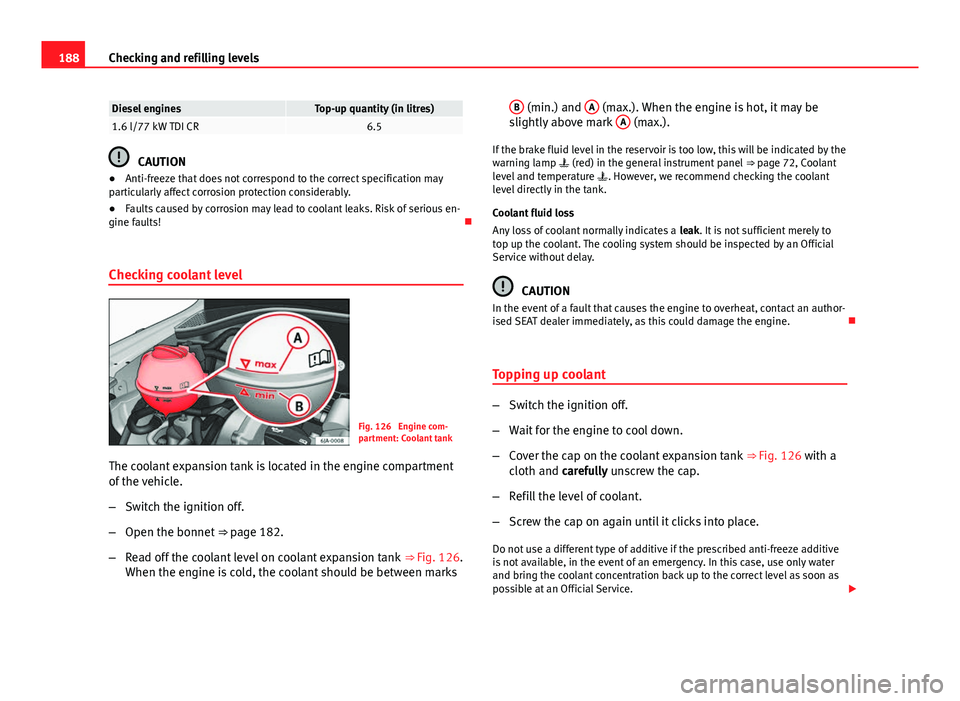
Fig. 126 Engine com-
partment: Coolant tank
The coolant expansion tank is located in the engine compartment
of the vehicle.
– Switch the ignition off.
– Open the bonnet ⇒ page 182.
– Read off the coolant level on coolant expansion tank ⇒
Fig. 126.
When the engine is cold, the coolant should be between marks B
(min.) and
A (max.). When the engine is hot, it may be
slightly above mark A (max.).
If the brake fluid level in the reservoir is too low, this will be indicated by the
warning lamp (red) in the general instrument panel ⇒ page 72, Coolant
level and temperature . However, we recommend checking the coolant
level directly in the tank.
Coolant fluid loss
Any loss of coolant normally indicates a leak. It is not sufficient merely to
top up the coolant. The cooling system should be inspected by an Official
Service without delay.
CAUTION
In the event of a fault that causes the engine to overheat, contact an author-
ised SEAT dealer immediately, as this could damage the engine.
Topping up coolant
– Switch the ignition off.
– Wait for the engine to cool down.
– Cover the cap on the coolant expansion tank ⇒ Fig. 126 with a
cloth and carefully unscrew the cap.
– Refill the level of coolant.
– Screw the cap on again until it clicks into place.
Do not use a different type of additive if the prescribed anti-freeze additive
is not available, in the event of an emergency. In this case, use only water
and bring the coolant concentration back up to the correct level as soon as
possible at an Official Service.
Page 191 of 258
189
Checking and refilling levels
Always top up with unused coolant.
Never fill the coolant tank above mark A
(max.) ⇒ Fig. 126 Excess coolant
is forced out of the cooling system through the overpressure valve in the fill-
er cap of the expansion tank when the engine heats up.
WARNING
● The anti-freeze additive and, therefore, the entire coolant, are a
health hazard. Avoid touching the coolant. Coolant fumes are also a
health hazard. Store the coolant additive in a safe place out of the reach
of children. Risk of poisoning!
● If splashed into eyes, rinse immediately with clean water and seek
immediate medical advice.
● Seek immediate medical advice if the coolant is accidentally inges-
ted.
CAUTION
If the engine oil cannot be topped up under the given conditions, do not
drive on. We recommend contacting an authorised SEAT dealer, as this can
damage the engine.
Radiator fan
The radiator is driven by an electric motor and controlled according to the
temperature of the coolant.
After the engine has been stopped and the ignition switched off, the radia-
tor fan may continue running for around 10 minutes. Brake fluid
Checking brake fluid level
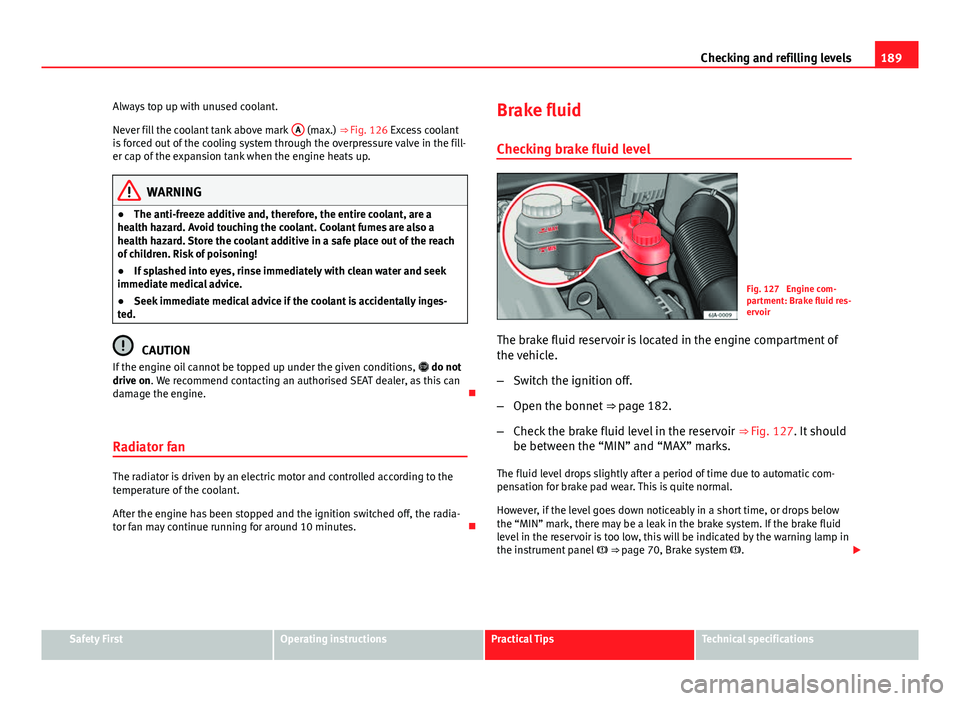
Fig. 127 Engine com-
partment: Brake fluid res-
ervoir
The brake fluid reservoir is located in the engine compartment of
the vehicle.
– Switch the ignition off.
– Open the bonnet ⇒ page 182.
– Check the brake fluid level in the reservoir ⇒ Fig. 127. It should
be between the “MIN” and “MAX” marks.
The fluid level drops slightly after a period of time due to automatic com-
pensation for brake pad wear. This is quite normal.
However, if the level goes down noticeably in a short time, or drops below
the “MIN” mark, there may be a leak in the brake system. If the brake fluid
level in the reservoir is too low, this will be indicated by the warning lamp in
the instrument panel
⇒ page 70, Brake system .
Safety FirstOperating instructionsPractical TipsTechnical specifications
Page 192 of 258
190Checking and refilling levels
WARNING
If the fluid level has dropped below the MIN mark, do not drive on.
Risk of accident! Seek professional help.
Changing the brake fluid
Brake fluid absorbs moisture. Therefore, it gradually absorbs moisture from
the atmosphere. If the water content in the brake fluid is too high, the brake
system could corrode. The water content also reduces the boiling point of
the brake fluid.
The brake fluid must comply with one of the following standards or specifi-
cations:
● VW 50114
● FMVSS 116 DOT4
WARNING
Heavy use of the brakes may cause a vapour lock if the brake fluid is left
in the brake system for too long. This would seriously affect the efficien-
cy of the brakes and the safety of the vehicle.
CAUTION
Brake fluid damages the vehicle paintwork. Windscreen washer
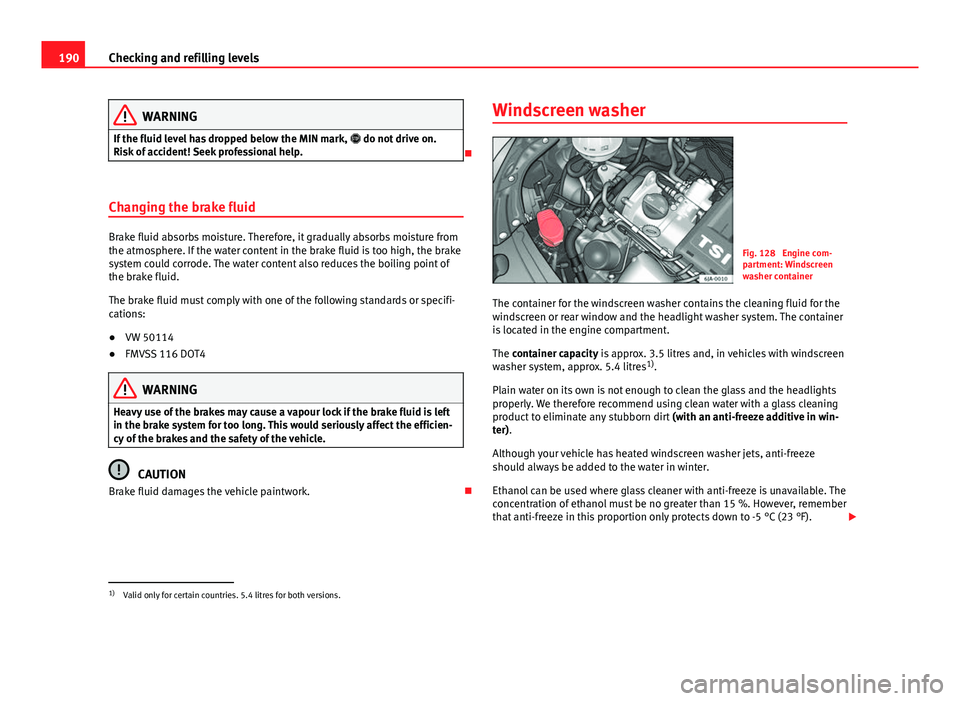
Fig. 128 Engine com-
partment: Windscreen
washer container
The container for the windscreen washer contains the cleaning fluid for the
windscreen or rear window and the headlight washer system. The container
is located in the engine compartment.
The container capacity is approx. 3.5 litres and, in vehicles with windscreen
washer system, approx. 5.4 litres 1)
.
Plain water on its own is not enough to clean the glass and the headlights
properly. We therefore recommend using clean water with a glass cleaning
product to eliminate any stubborn dirt (with an anti-freeze additive in win-
ter).
Although your vehicle has heated windscreen washer jets, anti-freeze
should always be added to the water in winter.
Ethanol can be used where glass cleaner with anti-freeze is unavailable. The
concentration of ethanol must be no greater than 15 %. However, remember
that anti-freeze in this proportion only protects down to -5 °C (23 °F).
1)
Valid only for certain countries. 5.4 litres for both versions.
Page 204 of 258

202Wheels and tyres
WARNING
● If the warning lamp lights up, slow down immediately and avoid
any severe braking or steering manoeuvres. Stop and check the tyres and
their pressure as soon as possible.
● Under certain conditions (e.g. sporty driving style, driving on loose
surfaces or in the winter) the warning lamp may take a while to light
up or may remain switched off.
● Despite the tyre pressure monitoring system, the driver remains re-
sponsible for maintaining the correct tyre pressure. You must therefore
check the tyre pressure often.
Note
● The tyre pressure monitoring system is not a replacement for regularly
checking the tyre pressure, as it is unable to recognise an even drop in pres-
sure.
● The tyre pressure monitoring system is unable to warn of a sudden drop
in tyre pressure, e.g. a puncture. In this case, try to stop the vehicle carefully
with no severe braking or steering manoeuvres.
● To ensure the tyre pressure monitoring system works correctly, the basic
setting must be performed every 10 000 km (6000 miles) or once a year.
Wheel bolts
The wheel bolts are matched to the rims. When installing different wheels,
e.g. to fit light alloy wheels or wheels with winter tyres, it is important to use
the correct wheel bolts with the right length and correctly shaped bolt
heads. The is essential for the secure fit of the wheels and for the proper
function of the brake system. Winter tyres
Winter tyres will significantly improve handling of the vehicle in winter road
conditions. The design of summer tyres (width, rubber compound, tread
pattern) gives less grip at temperatures below +7 °C (45 °F), on ice and
snow. This applies particularly to vehicles equipped with
wide section tyres
or high speed tyres (code letters H or V on the sidewall).
In order to preserve the performance of the vehicle as much as possible,
winter tyres must be fitted on all four wheels, the minimum depth of the
tread must be 4 mm and the maximum age must be 4 years.
You can use winter tyres of a lower speed rating if the maximum speed limit
of these tyres will not be exceeded, even if the maximum speed limit for the
vehicle is higher.
For the sake of the environment
Summer tyres should be fitted again in time, as they give better handling on
roads free of snow and ice and at temperatures over +7 °C (45 °F). Summer
tyres have a shorter braking distance, produce less rolling noise and do not
wear down as quickly. They also reduce fuel consumption.
Snow chains
Snow chains must only be used on the front wheels.
In winter road conditions, snow chains not only help to improve grip but al-
so improve the braking capacity.
For technical reasons snow chains may only be used on tyres with the fol-
lowing wheel rim/tyre combinations.