display Seat Toledo 2013 Owner's Guide
[x] Cancel search | Manufacturer: SEAT, Model Year: 2013, Model line: Toledo, Model: Seat Toledo 2013Pages: 258, PDF Size: 3.94 MB
Page 74 of 258
72Controls and displays
WARNING
If the vehicle has to be stopped for technical reasons, park it a safe dis-
tance away from moving traffic, switch off the engine and turn on the
hazard warning lights ⇒ page 101.
Coolant level and temperature
If the warning lamp (blue) is lit up, the engine has not yet reached its op-
erating temperature 1)
. Avoid high engine speeds, hard acceleration and
submitting the engine to high loads.
If the warning lamp (red) is lit up or flashing, the coolant temperature is
too high or its level is too low.
The informative display indicates:
Check coolant! Instruction Manual!
Stop the vehicle, switch off the engine, check the coolant level ⇒ page 188
and refill if necessary ⇒ page 188.
If the coolant is situated in the prescribed area, the high temperature may
be due to a fault in the cooling system fan. Check the radiator fan fuse and
replace it if necessary ⇒ page 221, Changing fuses in the engine compart-
ment.
If the warning lamp (red) remains lit up, despite both the coolant level
and the radiator fan fuse being in correct condition, stop the vehicle!
Seek professional help.
WARNING
● If the vehicle has to be stopped for technical reasons, park it a safe
distance away from moving traffic, switch off the engine and turn on the
hazard warning lights ⇒ page 101.
● Take care when opening the coolant reservoir. When the engine is
warm or hot, the system is pressurised – Danger of burns! Wait for the
engine to cool before opening the cover.
● Do not touch the fan. The fan can switch on automatically regardless
of whether the ignition is switched on.
Power steering
If the warning lamp, is lit up there is a fault in the power steering.
The power steering system functions with reduced power steering effect.
Seek professional help.
Stability Control (ESC)
If the control lamp flashes, the ESC is working.
If the warning lamp lights up on ignition the ESC system may have
switched off due to technical reasons. Turn off the ignition and turn it on
again. Upon switching on the ignition again, if the warning lamp has switch-
ed off, this means the ESC is functioning correctly again.
If the warning lamp, is lit up there is a fault in the ESC.
1)
This does not apply to vehicles equipped with an informative display.
Page 75 of 258
73
Controls and displays
The informative display indicates: Report No.: Stability control (ESC)
or Report No.: Traction control system (ASR)
Seek professional help.
Further information ⇒ page 144, Stability system (ESC).
Note
If the battery is disconnected and connected again, the yellow warning
lamp lights up when the ignition is switched on. This warning lamp must
switch off after covering a short distance.
Traction control system (ASR)
If the control lamp
flashes, the ASR is working.
If the warning lamp lights up on ignition the ASR system may have
switched off due to technical reasons. Turn off the ignition and turn it on
again. Upon switching on the ignition again, if the warning lamp has switch-
ed off, this means the ASR is functioning correctly again.
If the warning lamp, remains lit up there is a fault in the ASR.
The informative display indicates: Report No.: Traction control system (ASR)
Seek professional help.
Further information ⇒ page 145, Traction control system (ASR). Anti-lock system (ABS)
If the warning lamp, is lit up there is a fault in the ABS.
The informative display indicates: ABS fault
The brake system alone is operational in the vehicle, without ABS.
Seek professional help.
WARNING
● If the vehicle has to be stopped for technical reasons, park it a safe
distance away from moving traffic, switch off the engine and turn on the
hazard warning lights ⇒ page 101.
● If the warning lamp ⇒ page 70 lights up together with the warning
lamp , , Stop the vehicle! Seek professional help.
● A fault in the Anti-lock brake system (ABS) can lead to longer braking
distances – Risk of accident!
Rear fog light
The control lamp lights up when the rear fog light is switched on
⇒ page 99.
Safety FirstOperating instructionsPractical TipsTechnical specifications
Page 76 of 258
74Controls and displays
Bulb fault
The control lamp lights up when there is a fault in a bulb:
● For several seconds after switching on the ignition
● When connecting a faulty bulb
This is indicated on the informative display, e.g.: Check the front right dipped beam headlight!
Note
The rear side lights and number plate light contain several bulbs. The con-
trol lamp lights up only when there is a fault in all the number plate
bulbs or side light bulbs (of a combined tail light). Therefore it is advisable
to regularly check the bulb operation.
Emission control system
If the warning lamp is lit up, there is a fault in the emission system. The
engine control unit allows driving to continue in an emergency program.
Seek professional help.
Preheating (diesel engines)
When you switch on the ignition, the warning lamp lights up. The engine
can be started straight away when the lamp switches off.
If the warning lamp does not light up or if it does not switch off , there is
a fault in the glow plug system. If the warning lamp
starts to flash while driving, there is a fault in the
engine power control electronic system. The engine control unit allows driv-
ing to continue in an emergency program.
Seek professional help.
Engine management system (petrol engines)
If the warning lamp is lit up, there is a fault in the engine management
system. The engine control unit allows driving to continue in an emergency
program.
Seek professional help.
Particulate filter (diesel engines)
The particulate filter eliminates soot from emissions. The particles accumu-
late in the filter where they are normally burned off.
If the warning lamp is lit up, the filter is obstructed by soot.
In order for the filter to clean itself (if the traffic conditions ⇒
so permit) it
is essential to drive for at least 15 minutes (or until the warning lamp
switches off) with 4th or 5th gear engaged (automatic gearbox: position S)
at a minimum speed of 60 km/h (37 mph) with the engine speed between
1800-2500 rpm.
The warning lamp switches off once the filter has been successfully
cleaned.
If the cleaning process is not successful, the warning lamp does not
switch off and the warning lamp starts to flash.
The informative display indicates:
Page 77 of 258
75
Controls and displays
Diesel particulate filter. Instruction Manual!
The engine control unit allows driving to continue in an emergency program.
When switching the ignition off and on again, the warning lamp also
lights up.
Seek professional help.
WARNING
● The particulate filter attains very high temperatures. Therefore, do
not park the vehicle in places where the exhaust pipe could come into
contact with dry grass or with highly-flammable materials. Risk of fire!
● Always adjust your speed to suit the weather, road, terrain and traffic
conditions. Never be encouraged, by the recommendations shown in the
warning lamps, to fail to respect traffic legislation.
CAUTION
While the warning lamp is lit up, the fuel consumption is high, and in
certain conditions, the engine power is reduced.
Note
● In order for the particulate filter to burn off soot in a correct manner,
avoid carrying out frequent short journeys.
● Using diesel fuel with a high sulphur count can considerably reduce the
useful life of the particulate filter. The specialised service provides informa-
tion about the countries where fuel with a high sulphur content is used.
Fuel reserve
The warning lamp lights up when approximately only 7 litres of fuel re-
main in the tank. The informative display indicates:
Refuel! Fuel range…km...(miles)
Note
The message on the display switches off only after refuelling and carrying
out a short journey.
Airbag system
If the warning lamp is lit up, there is a fault in the airbag system.
The informative display indicates: Airbag fault!
The airbag system availability is controlled electronically, regardless of
whether an airbag is disabled.
If the front airbag, side airbag, head protection airbag or the belt tensioner
are disabled using the diagnostics system:
● After switching on the ignition, the warning lamp lights up for around
4 seconds and flashes for another 12 seconds.
The informative display indicates:
Airbag/belt tensioner disabled!
Safety FirstOperating instructionsPractical TipsTechnical specifications
Page 78 of 258
76Controls and displays
If the front passenger airbag has been disabled with the airbag switch loca-
ted in the storage compartment side:
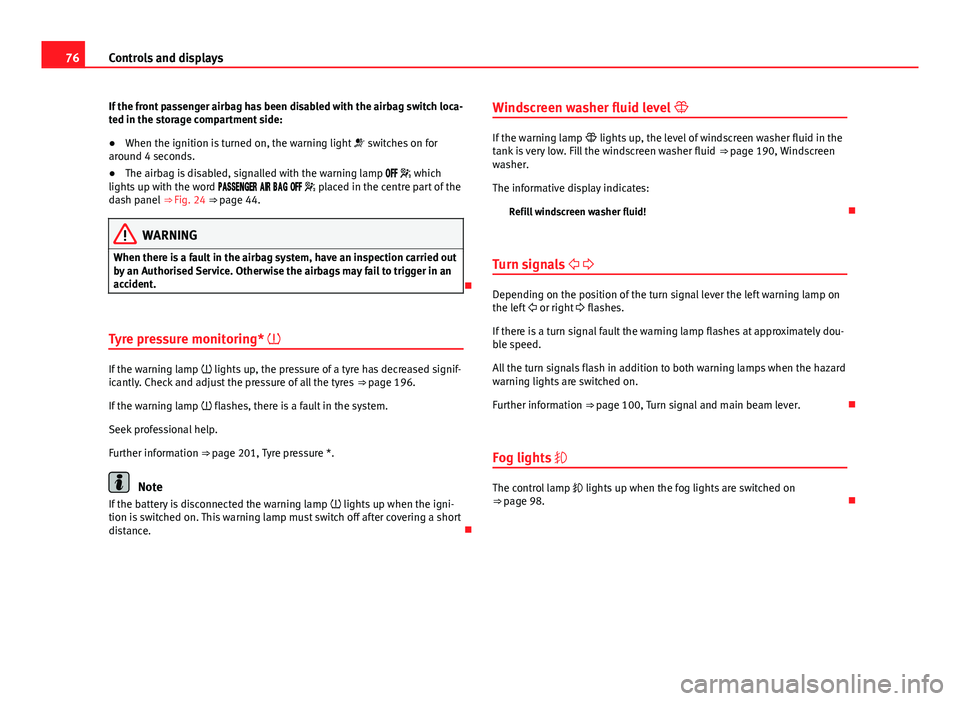
● When the ignition is turned on, the warning light switches on for
around 4 seconds.
● The airbag is disabled, signalled with the warning lamp which
lights up with the word placed in the centre part of the
dash panel ⇒ Fig. 24 ⇒ page 44.
WARNING
When there is a fault in the airbag system, have an inspection carried out
by an Authorised Service. Otherwise the airbags may fail to trigger in an
accident.
Tyre pressure monitoring*
If the warning lamp lights up, the pressure of a tyre has decreased signif-
icantly. Check and adjust the pressure of all the tyres ⇒ page 196.
If the warning lamp flashes, there is a fault in the system.
Seek professional help.
Further information ⇒ page 201, Tyre pressure *.
Note
If the battery is disconnected the warning lamp lights up when the igni-
tion is switched on. This warning lamp must switch off after covering a short
distance. Windscreen washer fluid level
If the warning lamp lights up, the level of windscreen washer fluid in the
tank is very low. Fill the windscreen washer fluid ⇒ page 190, Windscreen
washer.
The informative display indicates:
Refill windscreen washer fluid!
Turn signals
Depending on the position of the turn signal lever the left warning lamp on
the left or right flashes.
If there is a turn signal fault the warning lamp flashes at approximately dou-
ble speed.
All the turn signals flash in addition to both warning lamps when the hazard
warning lights are switched on.
Further information ⇒ page 100, Turn signal and main beam lever.
Fog lights
The control lamp lights up when the fog lights are switched on
⇒ page 98.
Page 79 of 258
77
Controls and displays
Cruise speed
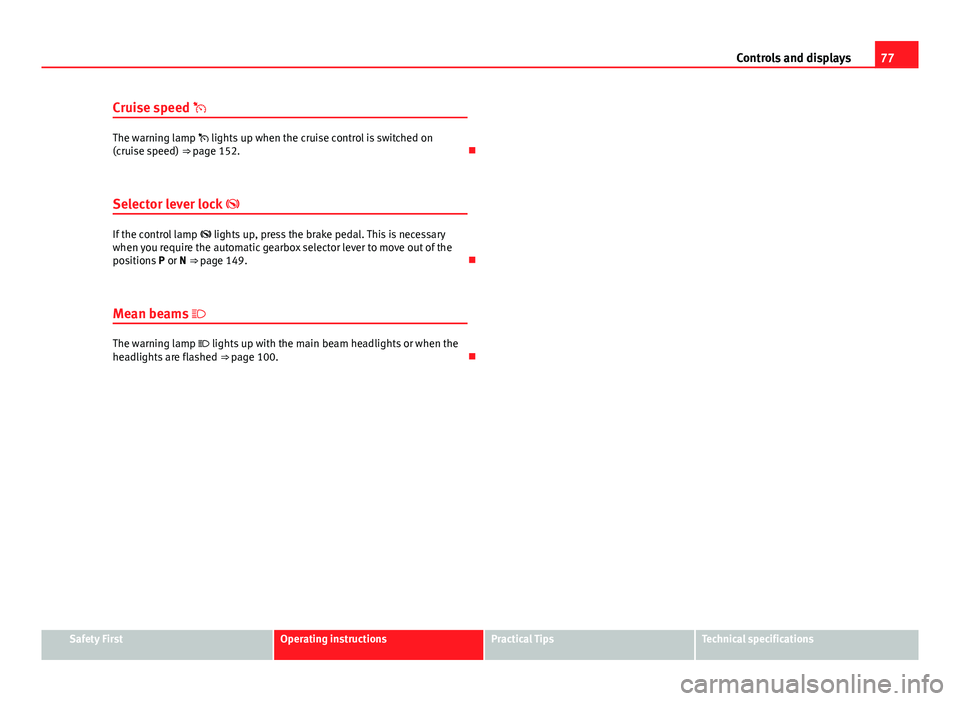
The warning lamp lights up when the cruise control is switched on
(cruise speed) ⇒ page 152.
Selector lever lock
If the control lamp lights up, press the brake pedal. This is necessary
when you require the automatic gearbox selector lever to move out of the
positions P or N ⇒ page 149.
Mean beams
The warning lamp lights up with the main beam headlights or when the
headlights are flashed ⇒ page 100.
Safety FirstOperating instructionsPractical TipsTechnical specifications
Page 89 of 258
87
Opening and closing
If the Safe lock is out of service, the control lamp on the driver door will
flash quickly for 2 seconds before switching off for 30 seconds and then
flashing at a slower rate.
The Safe lock is re-activated on unlocking and locking the vehicle again.
If the vehicle is locked and the Safe lock is deactivated, the vehicle can be
opened from inside by pulling on the door handle.
WARNING
Do not leave people or animals in locked vehicles with the Safe lock acti-
vated: the doors and windows cannot then be opened from the inside.
Doors locked in this manner could delay assistance in an emergency.
Risk of death!
Note
● The anti-theft alarm switches on automatically when the vehicle is
locked, even if the Safe lock is deactivated. The Vehicle interior monitoring,
however, is not activated.
● Given that the Safe function will be activated on locking the vehicle,
CHECK DEADLOCK will be shown on the general instrument panel display. On
vehicles equipped with an informative display, Caution SAFE! On-board docu-
mentation! will be indicated. Unlocking the vehicle with the key
Fig. 45 Key positions
during vehicle locking
and unlocking
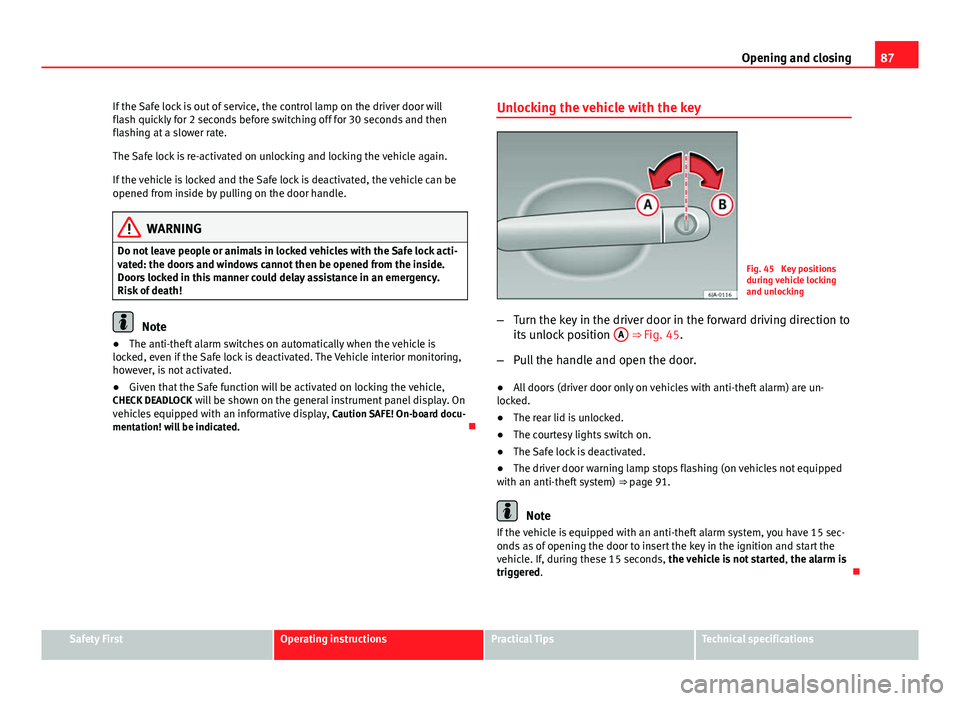
– Turn the key in the driver door in the forward driving direction to
its unlock position A
⇒ Fig. 45.
– Pull the handle and open the door.
● All doors (driver door only on vehicles with anti-theft alarm) are un-
locked.
● The rear lid is unlocked.
● The courtesy lights switch on.
● The Safe lock is deactivated.
● The driver door warning lamp stops flashing (on vehicles not equipped
with an anti-theft system) ⇒ page 91.
Note
If the vehicle is equipped with an anti-theft alarm system, you have 15 sec-
onds as of opening the door to insert the key in the ignition and start the
vehicle. If, during these 15 seconds, the vehicle is not started , the alarm is
triggered.
Safety FirstOperating instructionsPractical TipsTechnical specifications
Page 96 of 258
94Opening and closing
Opening the rear lid
–Pull on the release lever and lift the rear lid ⇒ Fig. 50. The rear
lid will automatically open.
Closing the rear lid
– Hold the rear lid by one of the two handles on the interior lining
and close it, pushing slightly.
This system may or may not be operative, depending on the situation of the
vehicle.
If the rear lid is locked then it cannot be opened, however if it is unlocked
then the opening system is operative and the rear lid may be opened.
To lock/unlock, press the button
or the button
1 on the remote control
key.
A warning appears on the instrument panel display if the rear lid is open or
not properly closed.* An audible warning is also given if the rear lid is
opened while the vehicle is moving faster than 6 km/h (4 mph).*
WARNING
● Always close the rear lid properly. Risk of accident or injury.
● The rear lid must not be opened when the reverse or rear fog lights
are lit. This may damage the tail lights
● Do not close the rear lid by pushing it down with your hand on the
rear window. The glass could smash. Risk of injury!
● Ensure the rear lid is locked after closing it. If not, it may open unex-
pectedly while driving.
WARNING (Continued)
● Never allow children to play in or around the vehicle. A locked vehicle
can be subjected to extremely high and low temperatures, depending on
the time of year, thus causing serious injuries/illness. It could even have
fatal consequences. Close and lock both the rear lid and all the other
doors when you are not using the vehicle.
● Closing the rear lid without observing and ensuring it is clear could
cause serious injury to you and to third parties. Make sure that no one is
in the path of the rear lid.
● Never drive with the rear lid open or half-closed, exhaust gases may
penetrate into the interior of the vehicle. Danger of poisoning!
● If you only open the rear lid, do not leave the key inside. The vehicle
will not be opened if the key is left inside.
Manual release of the rear lid
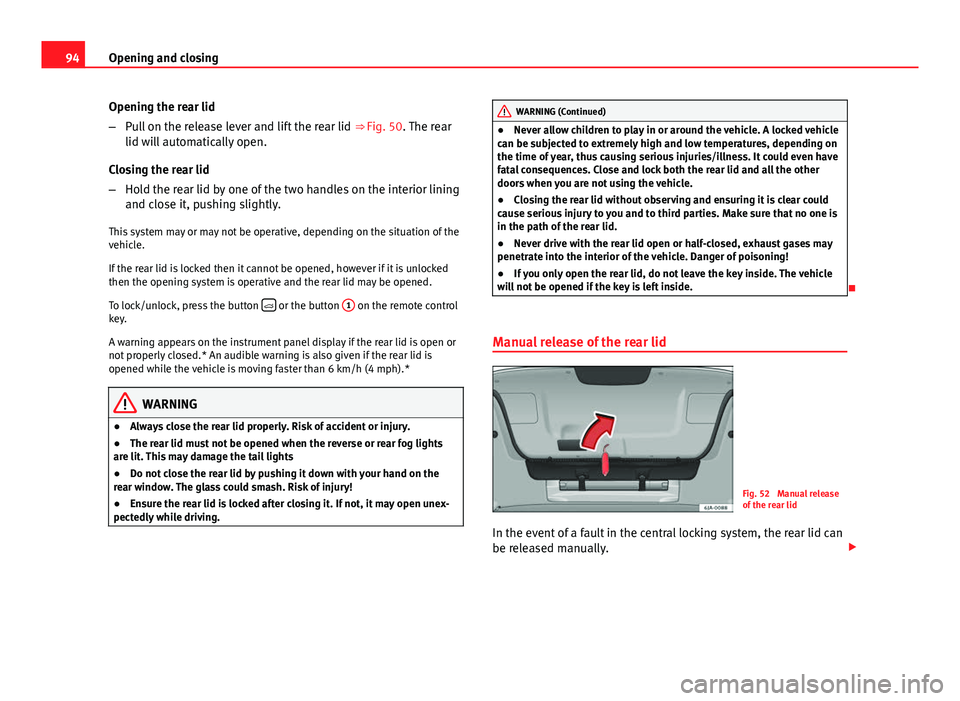
Fig. 52 Manual release
of the rear lid
In the event of a fault in the central locking system, the rear lid can
be released manually.
Page 104 of 258
102Lights and visibility
Note
Switch on the hazard warning lights to warn other road users, for example:
● When reaching the tail end of a traffic jam
● If the vehicle has a technical fault or you are involved in an emergency
situation.
Interior lights
Interior lighting – version 1
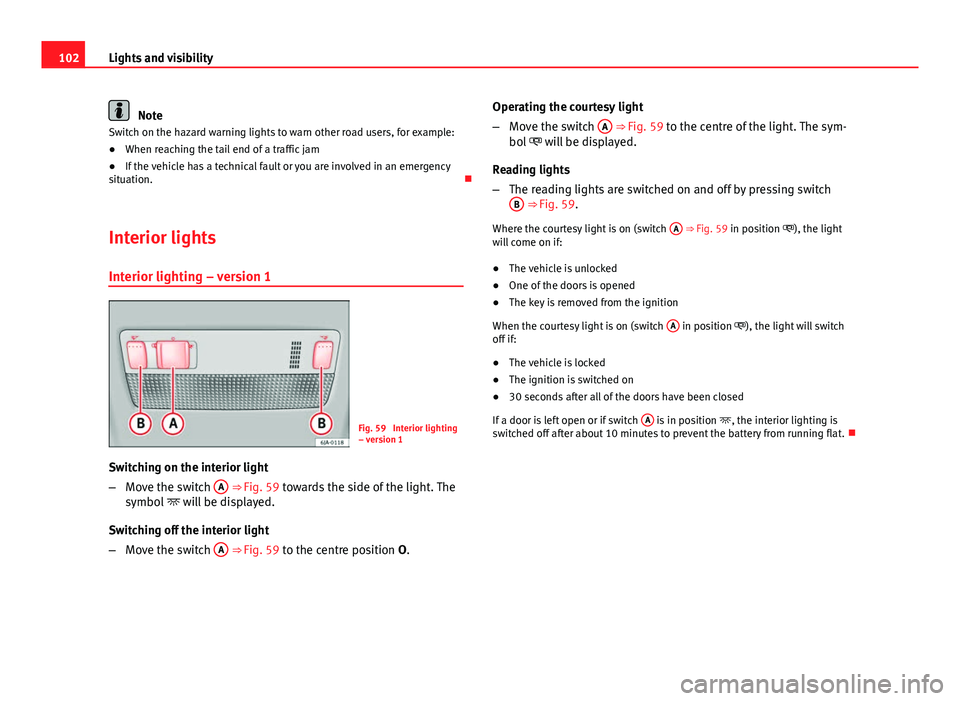
Fig. 59 Interior lighting
– version 1
Switching on the interior light
– Move the switch A
⇒ Fig. 59 towards the side of the light. The
symbol will be displayed.
Switching off the interior light
– Move the switch A
⇒
Fig. 59 to the centre position O
. Operating the courtesy light
–
Move the switch A
⇒ Fig. 59 to the centre of the light. The sym-
bol will be displayed.
Reading lights
– The reading lights are switched on and off by pressing switch
B
⇒ Fig. 59.
Where the courtesy light is on (switch A
⇒ Fig. 59 in position ), the light
will come on if:
● The vehicle is unlocked
● One of the doors is opened
● The key is removed from the ignition
When the courtesy light is on (switch A
in position ), the light will switch
off if:
● The vehicle is locked
● The ignition is switched on
● 30 seconds after all of the doors have been closed
If a door is left open or if switch A
is in position
, the interior lighting is
switched off after about 10 minutes to prevent the battery from running flat.
Page 137 of 258
135
Heating and air conditioning
Switching off air recirculation mode
– Press button
1 ⇒ Fig. 98 ⇒ page 132 again and the lamp
in the button will switch off.
If air distribution control C
⇒ Fig. 98 ⇒
page 132 is in position , air recir-
culation mode switches off automatically Press the button to switch air
recirculation mode back on in this position.
WARNING
Never use the air recirculation system for too long, as it prevents fresh air
from entering the vehicle and “used” air can cause tiredness, reduce your
attention span and cause the windows to mist over. This increases the
risk of an accident. Switch off the air recirculation system as soon as the
windows begin to mist over.
Climatronic* (automatic air conditioning) General notes
Climatronic automatically maintains a comfortable temperature. To do so, it
automatically regulates the supplied air temperature and the blower and air
distribution levels. The system also allows for the effect of sunlight, so there
is no need for manual adjustment. Automatic operations ⇒ page 136 guar-
antee maximum comfort any time of year.
Climatronic description
Cooling only works if the following conditions are met:
● The engine is running
● the outside temperature is above +2 °C (+36 °F)
● AC
18 ⇒ Fig. 99 ⇒ page 136 on. In order to ensure engines subject to heavy loads are cooled, the air condi-
tioning compressor is switched off in the event of high coolant tempera-
tures.
Recommended setting for all seasons
●
Set the required temperature, we recommend +22 °C (72 °F).
● Press the AUTO
button 12 ⇒
Fig. 99 ⇒ page 136.
● Adjust vents 3 ⇒ page 129 and 4 so that the air flow is directed slightly
upwards.
Change between degrees Centigrade and degrees Fahrenheit
Keep the AUTO
and AC buttons
⇒ Fig. 99 ⇒ page 136 pressed down at the
same time. The data is displayed on the screen in the units required.
Note
A visit to the specialised service once a year is recommended to clean the
Climatronic system.
Safety FirstOperating instructionsPractical TipsTechnical specifications