heating Seat Toledo 2013 Owner's Guide
[x] Cancel search | Manufacturer: SEAT, Model Year: 2013, Model line: Toledo, Model: Seat Toledo 2013Pages: 258, PDF Size: 3.94 MB
Page 140 of 258
138Heating and air conditioning
Windscreen defrosting
Switching on windscreen defrosting
–Press button
13 ⇒ Fig. 99 ⇒ page 136.
Switching off windscreen defrosting
– Press button
13 ⇒ Fig. 99 ⇒ page 136 several times or
press the AUTO button.
The temperature is regulated automatically. The air output is increased from
vents 1 ⇒ page 129 and 2.
Page 142 of 258
140Driving
● Do not tow-start the engine. Risk of engine damage! In vehicles with a
catalytic converter, unburnt fuel could reach the catalytic converter and
catch fire in it. This would lead to a fault in the catalytic converter. Use the
battery from another vehicle for help in starting the engine ⇒ page 214,
Jump-starting.
● After the engine has been working hard for a long time, leave the engine
idling for about one minute before switching it off at the end of a journey.
This will stop the engine from overheating.
For the sake of the environment
Do not warm up the engine when the vehicle is stationary. If possible, move
off immediately after starting the engine. This will help the engine reach op-
erating temperature more quickly, reducing the quantity of emissions.
Note
● The engine can only be started with the original SEAT key.
● Loud running noises may be heard briefly after cold-starting the engine.
This is normal and is no cause for concern.
● After the engine has been stopped and the ignition switched off, the ra-
diator fan may continue running for around 10 minutes.
● If the engine still does not start after a second attempt, the fuel pump
fuse might have blown. Check the fuse and replace if necessary
⇒ page 219 or contact your Specialised Service.
● You should always engage the steering lock when you leave the vehicle.
This will hinder any attempts at theft. Adjusting the steering wheel position
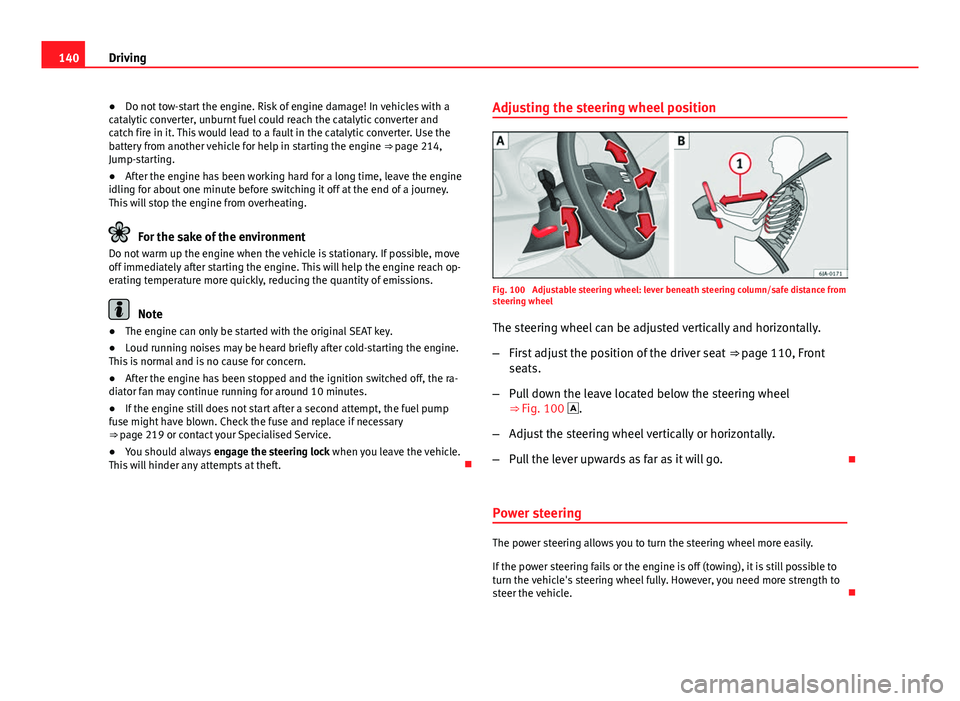
Fig. 100 Adjustable steering wheel: lever beneath steering column/safe distance from
steering wheel
The steering wheel can be adjusted vertically and horizontally.
– First adjust the position of the driver seat ⇒ page 110, Front
seats.
– Pull down the leave located below the steering wheel
⇒ Fig. 100 .
– Adjust the steering wheel vertically or horizontally.
– Pull the lever upwards as far as it will go.
Power steering
The power steering allows you to turn the steering wheel more easily.
If the power steering fails or the engine is off (towing), it is still possible to
turn the vehicle's steering wheel fully. However, you need more strength to
steer the vehicle.
Page 143 of 258

141
Driving
Start-up lock security system (immobiliser)
There is an electronic chip in the key. The electronic immobiliser is deactiva-
ted when the key is inserted into the ignition. The electronic immobiliser is
automatically activated when the key is removed from the ignition.
The engine will not start if an unauthorised key is used.
The informative display indicates: Immobiliser active!
Ignition lock
Fig. 101 Ignition key po-
sitions
Petrol engines 1
– Ignition switched off, engine stopped, steering can be locked
2
– Ignition switched on
3
– Starting Diesel engines
1
– Fuel supply stopped, ignition switched off, engine stopped,
steering can be locked
2
– Engine pre-heating, ignition switched on
3
– Starting
To engage the Steering lock without the key in the ignition, turn the steer-
ing wheel slightly until it engages
If the steering lock is engaged and it is difficult or impossible to turn the key
to position 2
, release the lock by turning the steering wheel slightly in
both directions.
Starting the engine
Vehicles with a diesel engine are equipped with a glow plug system. When
you switch on the ignition, the glow plug warning lamp will light up. The
engine can be started straight away when the lamp switches off.
Do not connect electrical appliances during preheating so as not the drain
the vehicle battery unnecessarily.
Starting the engine
● Move the gearbox lever into neutral or move the selector lever to posi-
tion P or N and pull firmly on the handbrake.
● Press the clutch pedal all the way down 2
⇒ Fig. 101 ⇒ page 141 and
start the engine 3 – without pressing the accelerator. Keep the clutch ped-
al pressed down until the engine starts.
● Release the ignition key as soon as the engine starts. The key returns to
position 2
.
Safety FirstOperating instructionsPractical TipsTechnical specifications
Page 144 of 258
142Driving
● If the engine does not start after 10 seconds, turn the key back to posi-
tion 1
. Repeat the action after 30 seconds.
● Release the handbrake before moving off.
Switching off the engine
Stop the engine by turning the ignition key to position 1 ⇒ Fig. 101
⇒ page 141.
Brakes and brake servo systems Introduction
WARNING
● The brake servo only works when the engine is running. Braking
when the engine is switched off requires more strength on the brake ped-
al. Risk of accident!
● Press down on the clutch pedal when stopping and braking with a
manual gearbox, petrol engine vehicle at low speed. Otherwise, the
brake servo might not work properly. Risk of accident!
● In the event of damage to the standard front spoiler or where a differ-
ent front spoiler, hubcaps, etc. are subsequently fitted, make sure the air
vent to the brakes on the front wheels is not blocked. Otherwise, braking
operations may be impaired. Risk of accident!
● Always fully release the handbrake. If it is only partially released, this
will cause overheating of the rear brakes, which can impair the function
of the brake system. Risk of accident!
WARNING (Continued)
● Never leave children unsupervised in the vehicle. They could release
the handbrake or move the gear lever. The vehicle could start moving.
Risk of accident!
● Insufficient fuel can cause the engine to run irregularly or to switch
off. Brake assist systems could be impaired. Risk of accident!
● Always adjust your driving style to suit visibility, the weather and
road and traffic conditions. The best vehicle safety offered by brake as-
sist systems must never encourage you to run greater risks. Risk of acci-
dent!
CAUTION
● Observe the information concerning new brake pads ⇒ page 157.
● Where braking is not necessary, do not wear down the brake pads by
pressing down gently on the brake pedal. This causes the brakes to over-
heat, increasing their wear and increasing braking distances.
● To ensure the brake assist systems work properly, all wheels must be fit-
ted with tyres approved by the manufacturer.
Note
● If you brake suddenly and the brake system control unit regards the sit-
uation as hazardous for the drivers behind you, the brake lights will begin
to flash automatically. After reducing speed to approx. 10 km/h (6 mph) or
stopping the vehicle, the brake lights will stop flashing and the hazard
warning lights will switch on. The hazard warning lights are automatically
switched off when you accelerate or restart the vehicle.
● On long, steep gradients, reduce your speed and change to a lower gear
(manual gearbox) or move the selector lever to a lower gear position (auto-
matic gearbox). This uses the force of the engine and the brakes do not suf-
fer as much. If you still have to brake, do so intermittently, pressing down
repeatedly on the brake pedal.
Page 147 of 258
145
Driving
The HHC is activated on gradients of over 5 %, as the driver door is closed.
It only works to start on hills, moving both forwards and in reverse. It is not
activated during start-up down hill.
Anti-lock system (ABS)
The ABS system prevents the wheels locking during braking. This helps the
driver keep control of the vehicle.
The driver is made aware of ABS assistance by the pulsating of the brake
pedal and a characteristic noise.
Keep the brake pedal pressed down while the ABS is working. The ABS will
switch off when the brake pedal is released. Never brake intermittently
while the ABS is working!
Traction control system (ASR)
If the wheels start to slide, the ASR adapts the engine speed to the driving
conditions. Particularly in unfavourable conditions, ASR helps starting, ac-
celerating and hill starts.
The 1)
warning lamp in the general instrument panel flashes when the
system is working. Electronic differential lock
If one of the wheels starts to skid, the EDL brakes that wheel, transmitting
the driving force to the other wheels. This increases vehicle stability and im-
proves driving stability.
To prevent the disc brake of the braking wheel from overheating, the EDL
cuts out automatically if subjected to excessive loads. The vehicle will con-
tinue to function normally without EDL. The EDL will switch on again auto-
matically when the brake has cooled down.
Manual gearbox
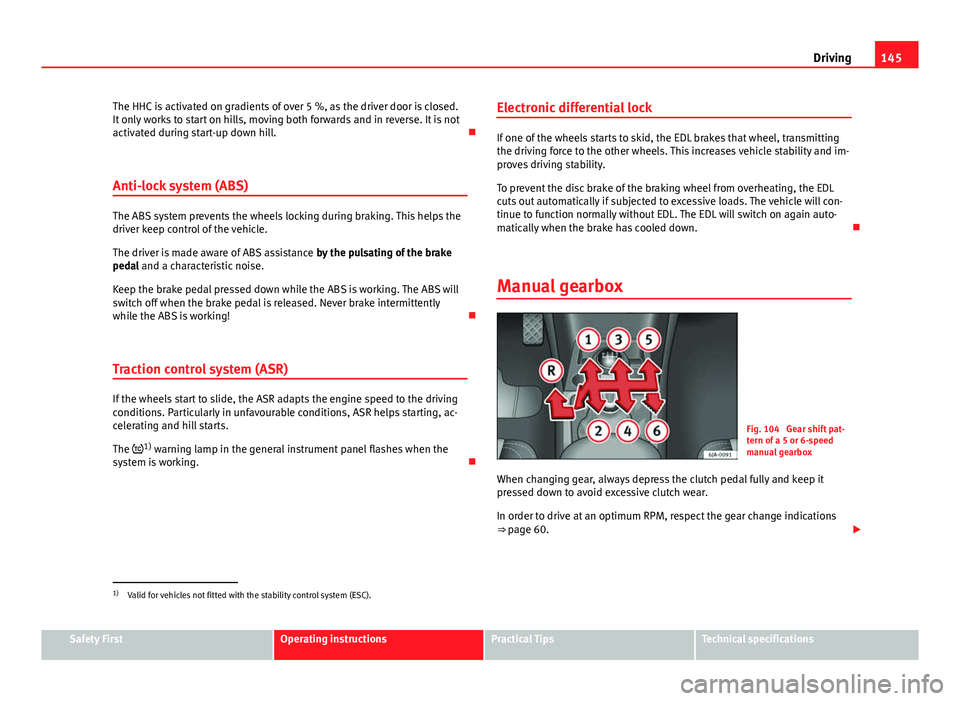
Fig. 104 Gear shift pat-
tern of a 5 or 6-speed
manual gearbox
When changing gear, always depress the clutch pedal fully and keep it
pressed down to avoid excessive clutch wear.
In order to drive at an optimum RPM, respect the gear change indications
⇒ page 60.
1)
Valid for vehicles not fitted with the stability control system (ESC).
Safety FirstOperating instructionsPractical TipsTechnical specifications
Page 161 of 258
159
Driving and the environment
Avoid driving at full speed
Fuel can be saved by driving at a slower speed.
Accelerating slowly not only considerably reduces fuel consumption, but al-
so reduces the environmental impact and vehicle wear.
If possible, you should never take advantage of the maximum speed of your
vehicle. Fuel consumption, exhaust emissions of toxic substances and
noise levels all increase very rapidly at higher speeds.
You can reduce fuel consumption by about one half if you do not drive faster
than three quarters of top speed.
Reduce idling
Idling also consumes fuel.
In a vehicle that does not have the START-STOP function, stop the engine in
traffic jams, level crossings and at traffic lights that remain red for a long
period of time. After 30-40 seconds with the engine switched off, the fuel
savings are greater that the quantity of fuel required to restart the engine
again.
When the engine is idling, a great deal of time is required in order for the
engine to reach operating temperature. When heating the vehicle, however,
engine waste and emissions of toxic substances are elevated. Therefore, im-
mediately begin driving after switching on the engine. Doing so avoids high
engine speeds.
Regular maintenance
A badly tuned engine unnecessarily consumes a large quantity of fuel. Conditions for economical driving can be created with regular maintenance
at an Official Service. Maintenance of your vehicle has positive repercus-
sions on traffic safety and conserving the value of the vehicle.
A badly tuned engine can result in fuel consumption that is 10% higher
than normal!
Additionally, check the
oil level after refuelling. Oil consumption depends
to a great extent on the engine load and engine speed. Depending on your
driving style, oil consumption can reach 0.5 litres per 1000 km (600 miles).
It is normal for the oil consumption of a new engine not to reach its mini-
mum level until after a period of running in time. Therefore, the oil con-
sumption of a new vehicle can only be judged correctly after covering 5000
km (3000 miles).
For the sake of the environment
● An additional reduction in consumption can be achieved using high-per-
formance synthetic oils.
● In order to detect leaks in good time, check the ground underneath the
vehicle regularly. If you notice stains from oils or other operating liquids,
contact an Official Service.
Note
We recommend that you have regular maintenance performed on your vehi-
cle a the SEAT Authorised Service.
Safety FirstOperating instructionsPractical TipsTechnical specifications
Page 167 of 258
165
Driving the vehicle with a trailer
WARNING
● Exceeding the maximum established load per axle and the maximum
towing bracket load in addition to the maximum permitted load or the
load of the vehicle + trailer assembly can cause accidents and serious in-
juries.
● A sliding load could considerably affect the stability and safety of the
vehicle + trailer assembly, resulting in accidents and serious injuries.
Towing a trailer
Exterior mirrors
Check whether you can see enough of the road behind the trailer with the
standard rear vision mirrors. If this is not the case, you should have addi-
tional exterior mirrors fitted. Observe the relevant statutory requirements of
the country you are in.
Headlights
Before starting a journey, also check the headlight beam settings with the
trailer hitched up. Adjust the headlight range settings if necessary
⇒ page 99, Range control of main lights .
Driving speed
For your own safety do not drive faster than the maximum permitted speed
indicated on the trailer.
At all times, immediately reduce speed if you detect the slightest swaying
movement of the trailer. Never try to “return the trailer to a straight posi-
tion” by accelerating.
Brakes
Brake in due course! If the trailer has an overrun brake, apply the brakes
gently at first and then, firmly. This will prevent the jerking that can be caused by locking of trailer wheels. Change to a lower gear in good time be-
fore descending a slope in order to take advantage of the engine brake.
The trailer is incorporated into the vehicle anti-theft alarm system.
●
When the vehicle has a factory-fitted anti-theft alarm and a towing
bracket
● When the trailer is electrically connected to the vehicle via the towing
bracket socket
● When the vehicle electrical device and the towing bracket are operation-
al
● When the vehicle is locked and the vehicle anti-theft alarm device is ac-
tivated
Once the electrical connection is interrupted with the vehicle trailer locked,
the alarm sounds.
Always switch off the vehicle anti-theft alarm device before connecting or
disconnecting a trailer. The vehicle anti-theft alarm device could cause the
alarm to sound ⇒ page 91, Anti-theft alarm system*.
Engine overheating
In the event that the coolant temperature gauge needle moves to the right
section of the scale or to the red area, immediately reduce speed. If the con-
trol lamp flashes on the general instrument panel, stop the vehicle and
switch off the engine. Wait several minutes and check the coolant level in
the tank ⇒ page 188.
Please observe the following indications ⇒ page 72, Coolant level and tem-
perature .
The coolant temperature can be reduced by switching on the heating.
Safety FirstOperating instructionsPractical TipsTechnical specifications
Page 174 of 258

172Care of the vehicle and cleaning
Care of the vehicle and cleaning
Care of the vehicle
Introduction
Regular and suitable care helps to maintain the useful life of your vehicle.
This may also be one of the requirements for upholding any warranty claims
in the event of corrosion or paint defects.
We recommend you use cleaning products from the SEAT Original Accesso-
ries programme available in SEAT dealers. Please follow the instructions for
use on the packaging.
WARNING
● Cleaning products and other materials used for car care can damage
the health if misused.
● Always keep car care materials in a safe place out of the reach of chil-
dren. Risk of poisoning!
● When washing the car during the winter season: Moisture and ice on
the brakes may affect braking efficiency. Risk of accident!
● The ignition must always be switched off when the car is washed.
Risk of accident!
● Do not clean the underside of the car or inside the wheel arches with-
out protecting your hands and arms. You may cut yourself on sharp metal
parts!
● Perfumes and air fresheners inside the vehicle may be harmful to
health at high temperatures in the interior.
CAUTION
● Check the colour stability of your clothing to avoid damaging or visibly
staining the fabric (leather), upholstery and fabric trim.
● Cleaning products containing solvents may damage the material being
cleaned.
● Do not wash the vehicle in direct sunlight. Risk of damage to paintwork.
● If washing the vehicle with a hose in winter, do not direct the jet of water
directly at the locks or at the door seals or bonnet. Risk of freezing.
● Do not use insect sponges or abrasive household sponges, etc. on pain-
ted surfaces. Risk of damage to the painted surface.
● Do not put stickers on the inner side of the window in areas where heat-
ing elements or the aerial is located. This could cause damage and, in the
case of the aerial, radio and navigation system reception faults.
● Do not clean the inner side of the window with sharp objects or corro-
sive or acidic cleaning products. Risk of damaging the heating elements or
the aerial.
● Do not attach any fragrance or air freshener to the dash panel. Risk of
damage to the dash panel.
● To avoid damaging the parking aid system sensors, spray them only
briefly at a minimum distance of 10 cm when cleaning the vehicle with a
high-pressure or steam cleaner.
● Do not clean the roof panel with a brush. Risk of damage to the panel
surface!
For the sake of the environment
● The packaging of the product used to care for your vehicle is hazardous
waste. It must be disposed of according to current local law.
● Only wash the car in special wash bays.
Page 177 of 258
175
Care of the vehicle and cleaning
Plastic parts
Exterior plastic parts will come clean using a damp cloth. If this is not suffi-
cient, plastic parts can also be treated with special solvent-free plastic
cleaning detergents.
Do not use paint cleaners, polishes or wax on plastic parts.
Windows and exterior mirrors
Remove snow and ice from windows and rear vision mirrors with a plastic
scraper only. To avoid damaging the surface of the glass, the scraper should
only be pushed in one direction and not moved to and fro.
The windows should also be cleaned on the inside at regular intervals.
Use a separate cloth or chamois to dry the windows and rear vision mirrors.
Do not use the chamois used to polish the bodywork to dry the windows.
Waxing and polishing residues could cause smears on the glass and hinder
visibility.
CAUTION
● Never use warm or hot water to remove snow and ice from the windows
and mirrors. Risk of cracking glass!
● Make sure you do not damage the paintwork on the vehicle on removing
snow and ice from the windows and rear vision mirrors.
● Do not remove the snow or ice from windows and mirrors that are dirty
with thick particles, e.g. gravel, sand or road salt. Risk of damage to surface
of glass and windows. Radio reception and aerial
In vehicles factory-fitted with an audio and navigation system, the aerial
may be installed in different places:
●
Inside the rear window next to the heating elements
● on the roof of the vehicle.
Headlights
Use soap and clean, hot water to clean the front headlights.
CAUTION
● Never rub the headlights dry and do not use sharp objects to clean the
plastic glass material. These could damage the protective paint and cause
the headlights to crack.
● Do not use aggressive cleaning products or chemical solvents to clean
the glass. This could damage the headlights.
Care of rubber seals
The weatherstrips on doors and windows will remain pliable and last longer
if they are occasionally treated with a suitable rubber care product. This will
prevent premature ageing and leaks. If they are correctly cared for, the seals
will be less likely to freeze up in the winter.
Door lock cylinder
Special products must be used to defrost lock cylinders.
Safety FirstOperating instructionsPractical TipsTechnical specifications
Page 179 of 258
177
Care of the vehicle and cleaning
WARNING
Note the regulations concerning safety and environmental protection if
you use lighter fluid to remove the wax. Risk of fire!
Leatherette and upholstery
Leatherette can be cleaned with a damp cloth. If this is not sufficient, these
parts should only be cleaned with solvent-free plastic care and cleaning
products.
Textile covers and trim parts on doors, rear lid, etc. can be cleaned with spe-
cial detergents, e.g. dry foam. A soft sponge or brush or a micro-fibre cloth
for normal cleaning can be used. Use special products to clean the headlin-
er.
Some upholstery, such as dark jeans fabric, is sometimes not durable
enough. This can cause damage or visible colouring of the seat upholstery
(leather or fabric), even under normal conditions of use. This is particularly
applicable to light-coloured seat upholstery (fabric or leather). This is not an
upholstery defect but indicates that the dye in the item of clothing is not
solid enough.
Heated seat upholstery
Do not clean the seat upholstery with damp products, as this could damage
the seat heating system.
Clean the upholstery with special products, e.g. dry foam, etc. Natural leather
Leather should be looked after from time to time, depending on its use.
Normal cleaning
Moisten a cotton or woollen cloth with water and wipe over the leather sur-
faces.
More stubborn dirt
Do not let the water soak through the leather or penetrate into the seams.
Dry the leather with a soft, dry cloth.
Removing stains
Remove fresh water-based stains such as coffee, tea, juices, blood, etc.
with an absorbent cloth or kitchen roll. Use the special detergent to clean
dried-on stains.
Remove fresh fat-based stains such as butter, mayonnaise, chocolate, etc.
with an absorbent cloth or kitchen roll or with the special detergent if the
stain has not yet soaked through the surface.
Use a grease-dissolving product to treat
dried-in, fat-based stains.
Treat less common stains such as ball-pen and other inks, felt-tip pens, nail
polish, dispersion paint, shoe cream etc. with a special leather stain remov-
er.
Leather care
The leather should be treated twice a year with a special leather-care prod-
uct.
Apply the protective product very sparingly.
Dry the leather with a soft, dry cloth.
Safety FirstOperating instructionsPractical TipsTechnical specifications