wheel Seat Toledo 2013 Repair Manual
[x] Cancel search | Manufacturer: SEAT, Model Year: 2013, Model line: Toledo, Model: Seat Toledo 2013Pages: 258, PDF Size: 3.94 MB
Page 211 of 258
209
Self-help
– Lower the vehicle.
– Tighten the wheel bolts firmly in diagonal sequence with the
box spanner and then the anti-theft wheel bolt ⇒ page 209.
– Replace the hub cap and/or the bolt covers.
Note
● All bolts must be clean and turn easily.
● Never grease or oil the wheel bolts!
● Note the direction of rotation when putting on a tyre with directional
tread pattern ⇒ page 196.
After changing a wheel
Tasks that must be carried out after changing a wheel.
– Place the wheel with the defective tyre in the spare wheel well
and secure it using a special bolt ⇒ page 199.
– Put the vehicle tools back in their storage location.
– Check the tyre pressure of the newly fitted spare wheel as soon
as possible.
– Have the tightening torque of the wheel bolts checked as soon
as possible with a torque wrench.
– Have the flat tyre replaced or ask an Official Service about the
possibility of repair.
Note
● If you notice that the wheel bolts are rusty and difficult to turn when
changing a wheel, they must be replaced before having the tightening tor-
que checked.
● Drive carefully and at moderate speeds until the tightening torque of the
wheel bolts has been checked.
Loosening and tightening wheel bolts
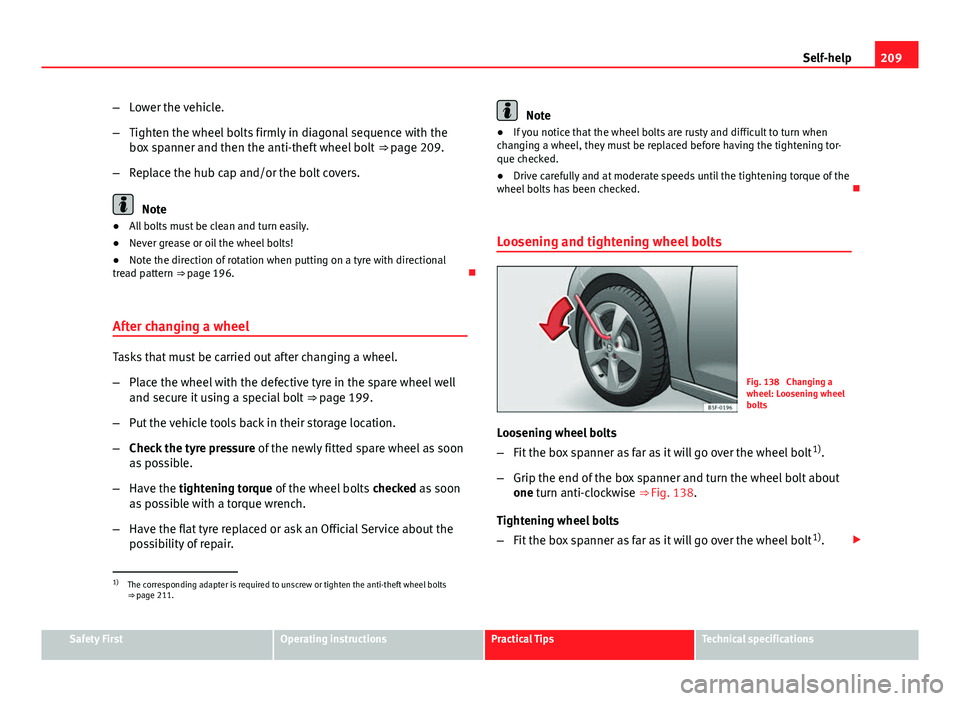
Fig. 138 Changing a
wheel: Loosening wheel
bolts
Loosening wheel bolts
– Fit the box spanner as far as it will go over the wheel bolt 1)
.
– Grip the end of the box spanner and turn the wheel bolt about
one turn anti-clockwise ⇒ Fig. 138.
Tightening wheel bolts
– Fit the box spanner as far as it will go over the wheel bolt 1)
.
1)
The corresponding adapter is required to unscrew or tighten the anti-theft wheel bolts
⇒ page 211.
Safety FirstOperating instructionsPractical TipsTechnical specifications
Page 212 of 258

210Self-help
–Grip the box spanner as close to the end as possible and tight-
en the bolt firmly by turning clockwise.
WARNING
The wheel bolts should only be loosened slightly (about one turn) before
raising the vehicle with the jack. Risk of accident!
Note
If the wheel bolt is very tight, it may be possible to loosen it by pushing
down the end of the box spanner carefully with your foot. Hold on to the ve-
hicle for support and take care not to slip.
Raising the vehicle
Fig. 139 Changing a
wheel: Jacking points
Fig. 140 Fitting the jack
To place the jack, locate the jacking point under the door sill clos-
est to the wheel to be changed ⇒ Fig. 139. The jacking point is di-
rectly underneath the stamp on the door sill.
– Turn the crank handle on the jack to wind it up under the jack-
ing point until its claw is directly below the jacking point of the
door sill.
– Adjust the jack so that its claw surrounds the jacking point on
the door sill ⇒ Fig. 140 - B underneath the stamp on the door
sill.
– Make sure that the base of the jack is entirely supported on a
flat surface and that it is vertical ⇒ Fig. 140 to the point where
the claw surrounds the jacking point on the door sill.
– Continue to wind up the jack using the crank handle until the
defective wheel is clear off the ground.
Page 213 of 258
211
Self-help
Anti-theft wheel bolts*
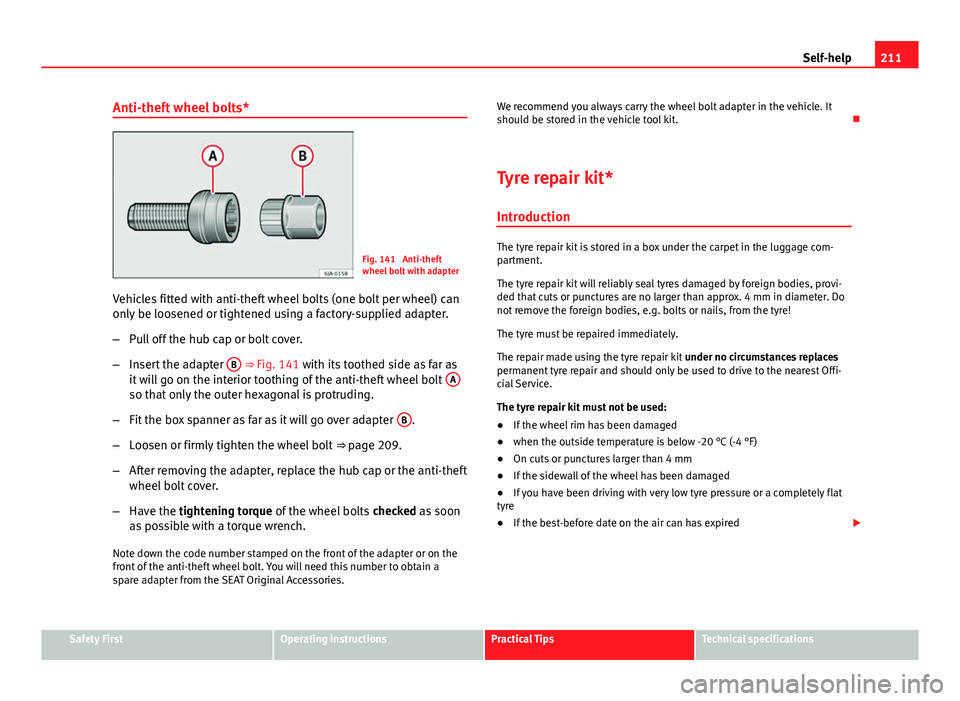
Fig. 141 Anti-theft
wheel bolt with adapter
Vehicles fitted with anti-theft wheel bolts (one bolt per wheel) can
only be loosened or tightened using a factory-supplied adapter.
– Pull off the hub cap or bolt cover.
– Insert the adapter B
⇒ Fig. 141 with its toothed side as far as
it will go on the interior toothing of the anti-theft wheel bolt A
so that only the outer hexagonal is protruding.
– Fit the box spanner as far as it will go over adapter B
.
– Loosen or firmly tighten the wheel bolt ⇒ page 209.
– After removing the adapter, replace the hub cap or the anti-theft
wheel bolt cover.
– Have the tightening torque of the wheel bolts checked as soon
as possible with a torque wrench.
Note down the code number stamped on the front of the adapter or on the
front of the anti-theft wheel bolt. You will need this number to obtain a
spare adapter from the SEAT Original Accessories. We recommend you always carry the wheel bolt adapter in the vehicle. It
should be stored in the vehicle tool kit.
Tyre repair kit* Introduction
The tyre repair kit is stored in a box under the carpet in the luggage com-
partment.
The tyre repair kit will reliably seal tyres damaged by foreign bodies, provi-
ded that cuts or punctures are no larger than approx. 4 mm in diameter. Do
not remove the foreign bodies, e.g. bolts or nails, from the tyre!
The tyre must be repaired immediately.
The repair made using the tyre repair kit under no circumstances replaces
permanent tyre repair and should only be used to drive to the nearest Offi-
cial Service.
The tyre repair kit must not be used:
● If the wheel rim has been damaged
● when the outside temperature is below -20 °C (-4 °F)
● On cuts or punctures larger than 4 mm
● If the sidewall of the wheel has been damaged
● If you have been driving with very low tyre pressure or a completely flat
tyre
● If the best-before date on the air can has expired
Safety FirstOperating instructionsPractical TipsTechnical specifications
Page 215 of 258
213
Self-help
Before using the tyre repair kit
The following jobs must be performed before using the tyre repair
kit:
– If you have a flat tyre, stop the vehicle well away from moving
traffic. Stop on flat, solid ground.
– All vehicle occupants should leave the vehicle. Vehicle occu-
pants should waiting in a safe place, e.g. behind the roadside
crash barrier) while the wheel is being changed.
– Switch off the ignition and engage neutral or move the selector
lever on the automatic gearbox to position P.
– Apply the handbrake firmly.
– Check whether the tyre can be repaired using the tyre repair kit
⇒ page 211.
– If towing a trailer, unhitch it.
– Take the tyre repair kit out of the luggage compartment.
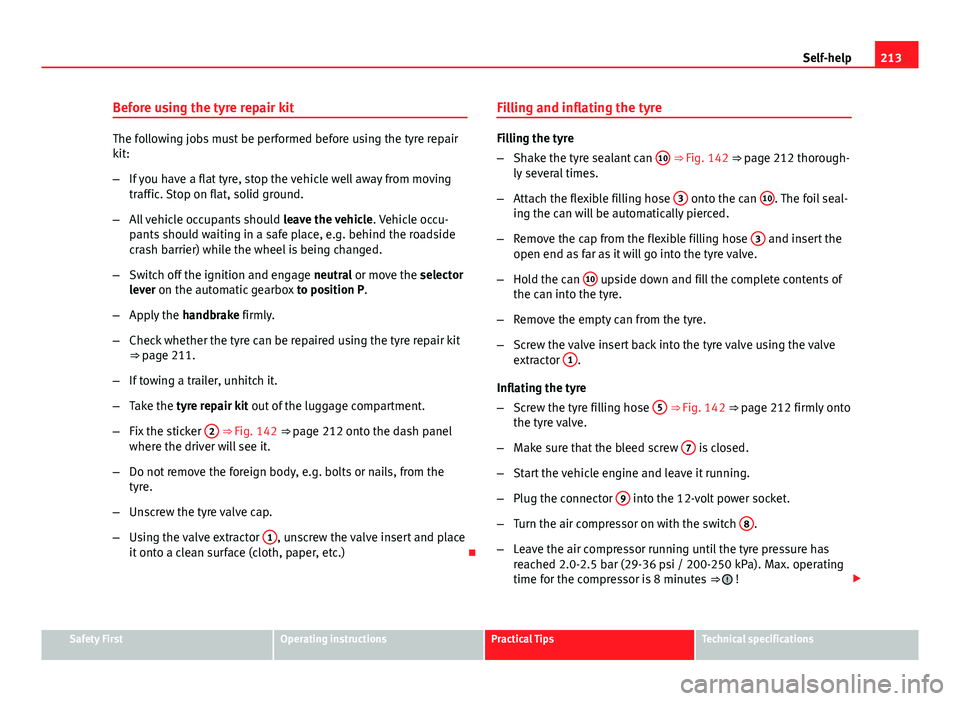
– Fix the sticker 2
⇒ Fig. 142 ⇒
page 212 onto the dash panel
where the driver will see it.
– Do not remove the foreign body, e.g. bolts or nails, from the
tyre.
– Unscrew the tyre valve cap.
– Using the valve extractor 1
, unscrew the valve insert and place
it onto a clean surface (cloth, paper, etc.) Filling and inflating the tyre
Filling the tyre
–
Shake the tyre sealant can 10
⇒ Fig. 142 ⇒ page 212 thorough-
ly several times.
– Attach the flexible filling hose 3
onto the can 10. The foil seal-
ing the can will be automatically pierced.
– Remove the cap from the flexible filling hose 3
and insert the
open end as far as it will go into the tyre valve.
– Hold the can 10
upside down and fill the complete contents of
the can into the tyre.
– Remove the empty can from the tyre.
– Screw the valve insert back into the tyre valve using the valve
extractor 1
.
Inflating the tyre
– Screw the tyre filling hose 5
⇒ Fig. 142 ⇒ page 212 firmly onto
the tyre valve.
– Make sure that the bleed screw 7
is closed.
– Start the vehicle engine and leave it running.
– Plug the connector 9
into the 12-volt power socket.
– Turn the air compressor on with the switch 8
.
– Leave the air compressor running until the tyre pressure has
reached 2.0-2.5 bar (29-36 psi / 200-250 kPa). Max. operating
time for the compressor is 8 minutes ⇒
!
Safety FirstOperating instructionsPractical TipsTechnical specifications
Page 218 of 258

216Self-help
Connecting negative terminals with the engine block
–Connect one end 3
⇒ Fig. 143 to the negative terminal of the
boosting battery B.
– Attach the other end 4
to a solid metal part firmly attached to
the engine block or to the engine block itself.
Starting the engine
– Start the engine of the vehicle and let it run at idling speed.
– Now start the engine of the vehicle with the discharged battery.
– If the engine fails to start, do not operate the start for longer
than 10 seconds. Wait for about 30 seconds and try again.
– Remove the jump leads from the engine in exactly the opposite
sequence to that described above. Jump-starting vehicles with the START-STOP system
Fig. 144 Jump-starting
vehicles with the START-
STOP system
In vehicles fitted with the START-STOP system, the booster cable cannot be
directly connected to the negative terminal of the vehicle battery but must
be attached to the engine earthing point.
Towing the vehicle
Introduction
Vehicles with manual gearbox can be towed using a towbar or tow-
rope. They can also be towed with either the front or rear wheels
lifted off the road.
Vehicles with automatic gearbox can be towed using a towbar or
towrope. They can also be towed with the front wheels lifted off the
Page 219 of 258

217
Self-help
road. If the vehicle is towed with the rear wheels lifted off the road
the automatic gearbox will be damaged!
It is easier and safer to tow a vehicle with a towbar. A towrope
should only be used if you do not have a towbar.
Follow the instructions below when towing a vehicle:
Notes for the driver of the towing vehicle
– Engage the clutch very gently when starting to move or on vehi-
cles with automatic gearbox press the accelerator carefully.
– On vehicles with manual gearbox, the towrope must be taut be-
fore driving off.
The maximum towing speed is 50 km/h (31 mph).
Notes for the driver of the towed vehicle
– The ignition should be switched on so that the steering wheel
lock is not engaged and the turn signals, horn and windscreen
wipers and washers can be used.
– Put the gear lever in neutral or move the selector lever to posi-
tion N (automatic gearbox).
The brake servo and power steering only work when the engine is
running. Considerably more effort is required on the brake pedal
and steering wheel when the engine is switched off.
Ensure the towrope remains taut at all times when towing.
CAUTION
● Do not tow-start the engine. Risk of engine damage! In vehicles with a
catalytic converter, unburnt fuel could reach the catalytic converter and
catch fire in it. This could damage and destroy the catalytic converter. Use
the battery from another vehicle for help in starting the engine ⇒ page 215,
Starting the engine.
● If, due to a fault, there is no oil in the gearbox, the car may only be tow-
ed with the driven wheels lifted clear of the road and transported on a spe-
cial vehicle transporter or trailer.
● If normal towing is not possible or if the vehicle is to be towed for further
than 50 km (31 miles), the vehicle must be transported on a special vehicle
transporter or trailer.
● The towrope should be slightly elastic to reduce the loading on both ve-
hicles during towing. It is advisable to use a towrope made of synthetic fibre
or similar material only.
● Do not pull too hard with the towing vehicle and always take care to
avoid jerking the towrope. When towing on a loose surface there is always a
risk of overloading and damaging the anchorage points.
● Attach the towrope or towbar only to the towline anchorages or to the
removable towing bracket ⇒ page 164, or ⇒ page 218.
Note
● We recommend you use the towrope or towbar available in the SEAT
Original Accessories programme from authorised SEAT dealers.
● Towing a vehicle requires some experience. Both drivers should be fa-
miliar with the technique required for towing. Inexperienced drivers should
not attempt to tow away another vehicle or to have their vehicle towed.
● Note the legal regulations concerning towing, particularly those regard-
ing the signalling of the towed and towing vehicle.
● The towrope must not be twisted, as under certain circumstances this
could unscrew the front towline anchorage.
Safety FirstOperating instructionsPractical TipsTechnical specifications
Page 222 of 258
220Fuses and bulbs
Fuses in the dash panel
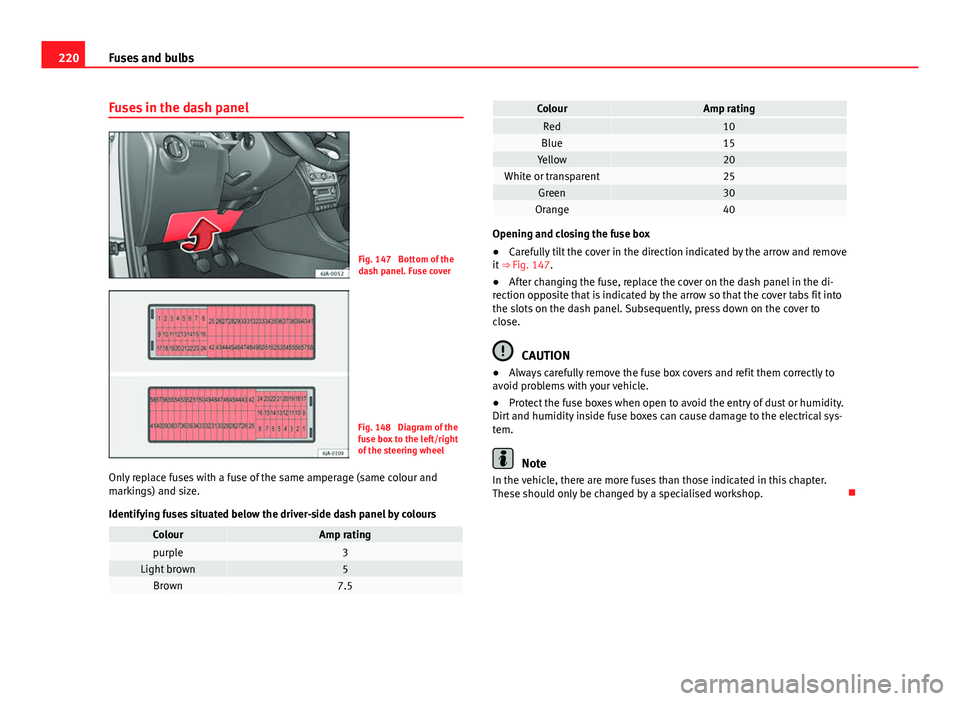
Fig. 147 Bottom of the
dash panel. Fuse cover
Fig. 148 Diagram of the
fuse box to the left/right
of the steering wheel
Only replace fuses with a fuse of the same amperage (same colour and
markings) and size.
Identifying fuses situated below the driver-side dash panel by colours
ColourAmp ratingpurple3Light brown5Brown7.5
ColourAmp ratingRed10Blue15Yellow20White or transparent25Green30Orange40
Opening and closing the fuse box
● Carefully tilt the cover in the direction indicated by the arrow and remove
it ⇒ Fig. 147.
● After changing the fuse, replace the cover on the dash panel in the di-
rection opposite that is indicated by the arrow so that the cover tabs fit into
the slots on the dash panel. Subsequently, press down on the cover to
close.
CAUTION
● Always carefully remove the fuse box covers and refit them correctly to
avoid problems with your vehicle.
● Protect the fuse boxes when open to avoid the entry of dust or humidity.
Dirt and humidity inside fuse boxes can cause damage to the electrical sys-
tem.
Note
In the vehicle, there are more fuses than those indicated in this chapter.
These should only be changed by a specialised workshop.
Page 224 of 258
222Fuses and bulbs
Changing bulbs
Introduction
Changing bulbs requires a certain degree of practical skill. If in doubt, we
recommend you have defective bulbs changed by a specialised service or,
in case of an emergency, seek professional assistance.
● Switch off the ignition and all of the lights before changing a bulb.
● Do not touch the glass part of the bulb with your bare hands. The finger-
prints left on the glass will vaporise as a result of the heat generated by the
bulb, causing a reduction in bulb life and condensation on the mirror sur-
face, thus reducing effectiveness.
● A bulb must only be replaced by one of the same type. The type is indi-
cated on the bulb, either on the glass part or on the base.
● There is a storage area for the bulb box in the spare wheel well or below
the carpet in the luggage compartment.
The light source used for each function is listed below:
Double headlights
H7 Long Life
H7
W5W Long Life PY21W NA P21W Super Long Life
Dipped beam:
Main beam:
Side lights:
Turn signals:
Daytime driving lights:
WARNING
● Take particular care when working on components in the engine com-
partment if the engine is warm. Risk of burns.
● Bulbs are highly sensitive to pressure. The glass can break when you
touch the bulb, causing injury.
● The high voltage element of gas discharge bulbs* (xenon light) must
be handled correctly. Otherwise, there is a risk of death.
● When changing bulbs, please take care not to injure yourself on sharp
parts in the headlight housing.
CAUTION
● Remove the ignition key before working on the electric system. Other-
wise, a short circuit could occur.
● Switch off the lights and the parking light before changing a bulb.
For the sake of the environment
Please ask your specialist retailer how to dispose of used bulbs in the prop-
er manner.
Note
● Depending on weather conditions (cold or wet), the front lights, the fog
lights, the rear lights and the turn signals may be temporarily misted. This
has no influence on the useful life of the lighting system. By switching on
the lights, the area through which the beam of light is projected will quickly
be demisted. However, the edges may continue to be misted.
● Please check at regular intervals that all lighting (especially the exterior
lighting) on your vehicle is functioning properly. This is not only in the inter-
est of your own safety, but also in that of all other road users.
Page 226 of 258
224Fuses and bulbs
Changing main beam headlight bulbs
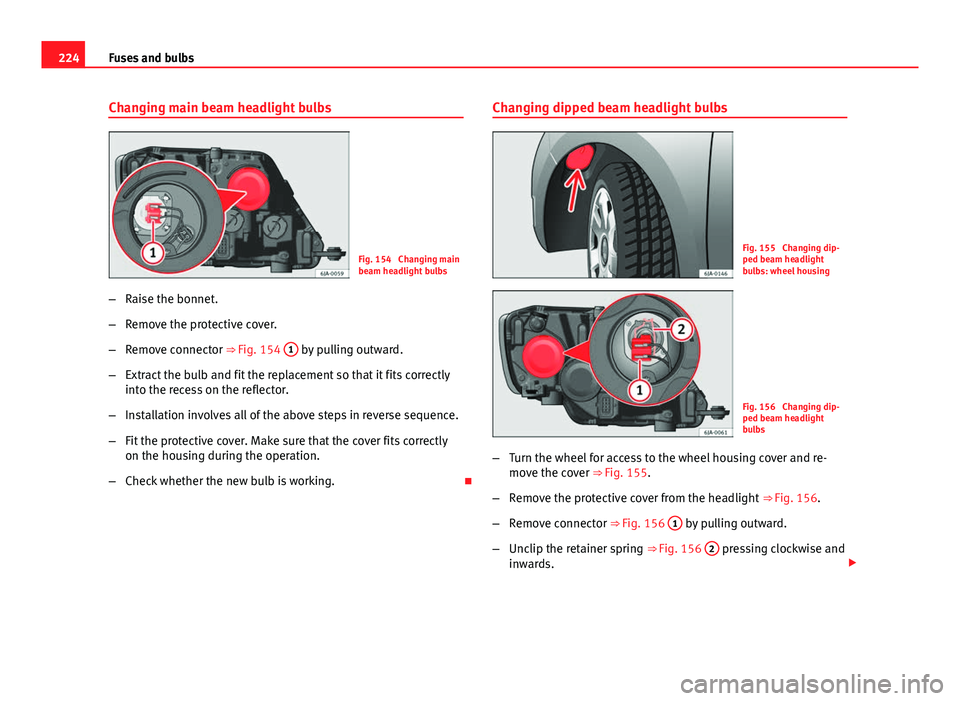
Fig. 154 Changing main
beam headlight bulbs
– Raise the bonnet.
– Remove the protective cover.
– Remove connector ⇒ Fig. 154 1
by pulling outward.
– Extract the bulb and fit the replacement so that it fits correctly
into the recess on the reflector.
– Installation involves all of the above steps in reverse sequence.
– Fit the protective cover. Make sure that the cover fits correctly
on the housing during the operation.
– Check whether the new bulb is working. Changing dipped beam headlight bulbs
Fig. 155 Changing dip-
ped beam headlight
bulbs: wheel housing
Fig. 156 Changing dip-
ped beam headlight
bulbs
– Turn the wheel for access to the wheel housing cover and re-
move the cover ⇒ Fig. 155.
– Remove the protective cover from the headlight ⇒
Fig. 156.
– Remove connector ⇒
Fig. 156 1
by pulling outward.
– Unclip the retainer spring ⇒
Fig. 156 2
pressing clockwise and
inwards.
Page 227 of 258
225
Fuses and bulbs
– Extract the bulb and fit the replacement so that the lug on the
base fits into the recess on the reflector.
– Fit the connector.
– Fit the protective cover. Make sure that the cover fits correctly
on the housing during the operation.
– Replace the wheel housing cover.
– Check whether the new bulb is working.
Changing turn signal light bulbs
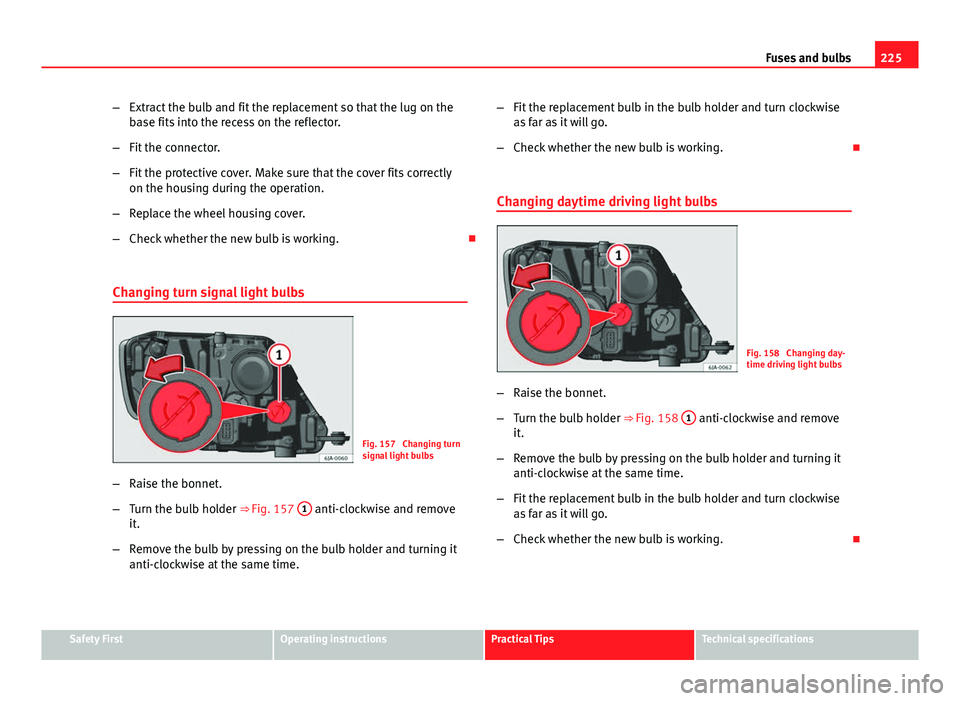
Fig. 157 Changing turn
signal light bulbs
– Raise the bonnet.
– Turn the bulb holder ⇒ Fig. 157 1
anti-clockwise and remove
it.
– Remove the bulb by pressing on the bulb holder and turning it
anti-clockwise at the same time. –
Fit the replacement bulb in the bulb holder and turn clockwise
as far as it will go.
– Check whether the new bulb is working.
Changing daytime driving light bulbs
Fig. 158 Changing day-
time driving light bulbs
– Raise the bonnet.
– Turn the bulb holder ⇒ Fig. 158 1
anti-clockwise and remove
it.
– Remove the bulb by pressing on the bulb holder and turning it
anti-clockwise at the same time.
– Fit the replacement bulb in the bulb holder and turn clockwise
as far as it will go.
– Check whether the new bulb is working.
Safety FirstOperating instructionsPractical TipsTechnical specifications