fuel Seat Toledo 2015 Service Manual
[x] Cancel search | Manufacturer: SEAT, Model Year: 2015, Model line: Toledo, Model: Seat Toledo 2015Pages: 248, PDF Size: 5.06 MB
Page 218 of 248
Advice
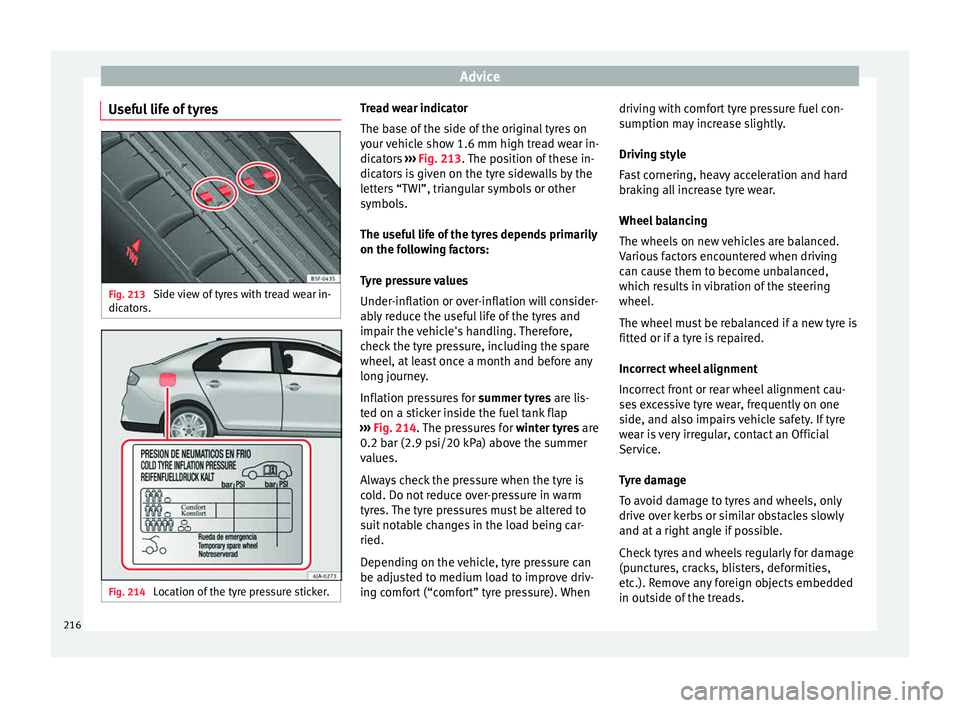
Useful life of tyres Fig. 213
Side view of tyres with tread wear in-
dic at
or
s. Fig. 214
Location of the tyre pressure sticker. Tread wear indicator
The b
ase of
the side of the original tyres on
your vehicle show 1.6 mm high tread wear in-
dicators ››› Fig. 213. The position of these in-
dicators is given on the tyre sidewalls by the
letters “TWI”, triangular symbols or other
symbols.
The useful life of the tyres depends primarily
on the following factors:
Tyre pressure values
Under-inflation or over-inflation will consider-
ably reduce the useful life of the tyres and
impair the vehicle's handling. Therefore,
check the tyre pressure, including the spare
wheel, at least once a month and before any
long journey.
Inflation pressures for summer tyres are lis-
ted on a sticker inside the fuel tank flap
››› Fig. 214. The pressures for winter tyres are
0.2 bar (2.9 psi/20 kPa) above the summer
values.
Always check the pressure when the tyre is
cold. Do not reduce over-pressure in warm
tyres. The tyre pressures must be altered to
suit notable changes in the load being car-
ried.
Depending on the vehicle, tyre pressure can
be adjusted to medium load to improve driv-
ing comfort (“comfort” tyre pressure). When driving with comfort tyre pressure fuel con-
sumption ma
y increase slightly.
Driving style
Fast cornering, heavy acceleration and hard
braking all increase tyre wear.
Wheel balancing
The wheels on new vehicles are balanced.
Various factors encountered when driving
can cause them to become unbalanced,
which results in vibration of the steering
wheel.
The wheel must be rebalanced if a new tyre is
fitted or if a tyre is repaired.
Incorrect wheel alignment
Incorrect front or rear wheel alignment cau-
ses excessive tyre wear, frequently on one
side, and also impairs vehicle safety. If tyre
wear is very irregular, contact an Official
Service.
Tyre damage
To avoid damage to tyres and wheels, only
drive over kerbs or similar obstacles slowly
and at a right angle if possible.
Check tyres and wheels regularly for damage
(punctures, cracks, blisters, deformities,
etc.). Remove any foreign objects embedded
in outside of the treads.
216
Page 220 of 248
Advice
means, for example, that the tyre was pro-
duc ed in the 27th w
eek
of 2012.
Follow the instructions ››› page 218 if you
only have a temporary spare wheel.
Tyres with directional tread pattern The direction of rotation is indicated by the
arro
w
s on the tyre sidewall . The direction of
rotation indicated must be respected. This
guarantees optimum grip and helps avoid ex-
cessive noise, wear and aquaplaning.
In the event of a flat tyre, a spare wheel with
an undetermined tread pattern or an oppo-
site tread pattern must be used and you must
drive carefully, as in these cases the tyres no
longer offer maximum performance. Spare wheel
Sp ar
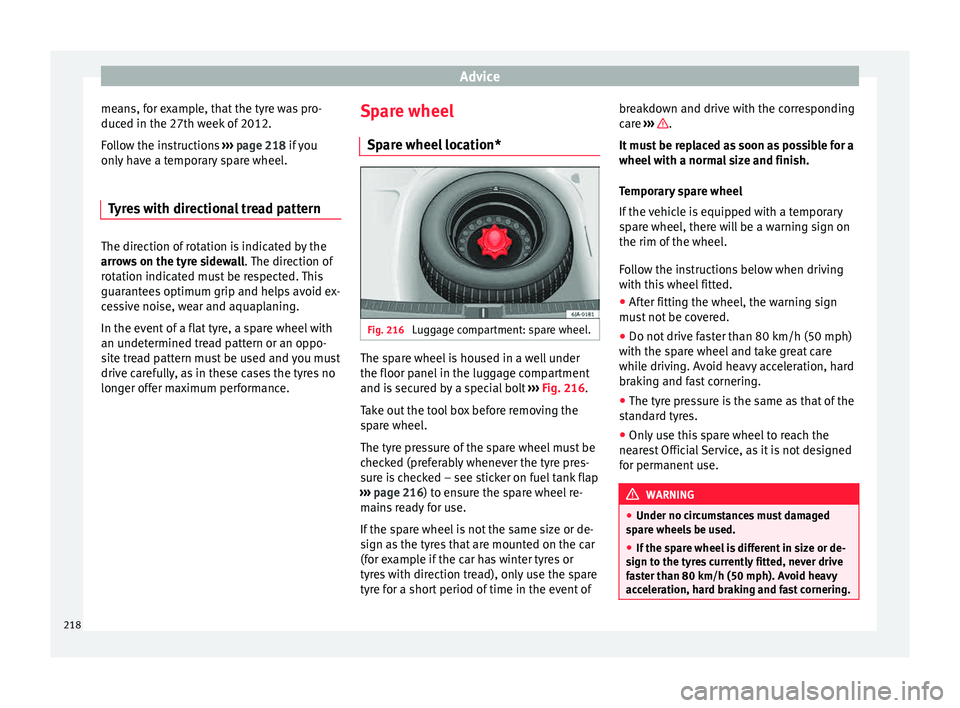
e wheel location* Fig. 216
Luggage compartment: spare wheel. The spare wheel is housed in a well under
the floor p
anel
in the lug
gage compartment
and is secured by a special bolt ››› Fig. 216.
Take out the tool box before removing the
spare wheel.
The tyre pressure of the spare wheel must be
checked (preferably whenever the tyre pres-
sure is checked – see sticker on fuel tank flap
››› page 216) to ensure the spare wheel re-
mains ready for use.
If the spare wheel is not the same size or de-
sign as the tyres that are mounted on the car
(for example if the car has winter tyres or
tyres with direction tread), only use the spare
tyre for a short period of time in the event of breakdown and drive with the corresponding
care
›
›› .
It mu
s
t be replaced as soon as possible for a
wheel with a normal size and finish.
Temporary spare wheel
If the vehicle is equipped with a temporary
spare wheel, there will be a warning sign on
the rim of the wheel.
Follow the instructions below when driving
with this wheel fitted.
● After fitting the wheel, the warning sign
must
not be covered.
● Do not drive faster than 80 km/h (50 mph)
with the sp
are wheel and take great care
while driving. Avoid heavy acceleration, hard
braking and fast cornering.
● The tyre pressure is the same as that of the
stand
ard tyres.
● Only use this spare wheel to reach the
neare
st Official Service, as it is not designed
for permanent use. WARNING
● Under no cir c
umstances must damaged
spare wheels be used.
● If the spare wheel is different in size or de-
sign to the ty
res currently fitted, never drive
faster than 80 km/h (50 mph). Avoid heavy
acceleration, hard braking and fast cornering. 218
Page 222 of 248
Advice
temperatures below +7°C (45°F), on ice and
s no
w
. This applies particularly to vehicles
equipped with wide section tyres or high
speed tyres (code letters H or V on the side-
wall).
In order to preserve the performance of the
vehicle as much as possible, winter tyres
must be fitted on all four wheels, the mini-
mum depth of the tread must be 4 mm and
the maximum age must be 4 years.
You can use winter tyres of a lower speed rat-
ing if the maximum speed limit of these tyres
will not be exceeded, even if the maximum
speed limit for the vehicle is higher. For the sake of the environment
Summer tyres should be fitted again in time,
as they
give better handling on roads free of
snow and ice and at temperatures over +7°C
(45°F). Summer tyres have a shorter braking
distance, produce less rolling noise and do
not wear as quickly. They also reduce fuel
consumption. 220
Page 223 of 248
Technical specifications
Technical data
T ec
hnic
al specifications
Important information Important The information in the vehicle documentation
alwa
y
s takes precedence over the informa-
tion in this Instruction Manual.
All technical specifications provided in this
documentation are valid for the standard
model in Spain. The vehicle data card inclu-
ded in the Maintenance Programme or the
vehicle registration documents shows which
engine is installed in the vehicle.
The figures may be different depending
whether additional equipment is fitted, for
different models, for special vehicles and for
other countries. Abbreviations used in the Technical Specifi-
cation
s
section
kWKilowatt, engine power measurement.
PSPferdestärke (horsepower), formerly
used to denote engine power.
rpmRevolutions per minute - engine speed.
NmNewton metres, unit of engine torque.
litres per100 kmFuel consumption in litres per 100 km
(70 miles).
g/kmCarbon dioxide emissions in grams per
km (mile) travelled.
CO 2Carbon dioxide
CNCetane number, indication of the diesel
combustion power.
RONResearch octane number, indication of
the knock resistance of petrol. 221
Technical data
Advice
Operation
Emergencies
Safety
Page 224 of 248
Technical data
Identification data contained on the
d at
a s
ticker Fig. 217
Data sticker. Vehicle data sticker
The
v
ehic
le data sticker ››› Fig. 217 is located
on the boot floor and is also attached to the
Maintenance Programme.
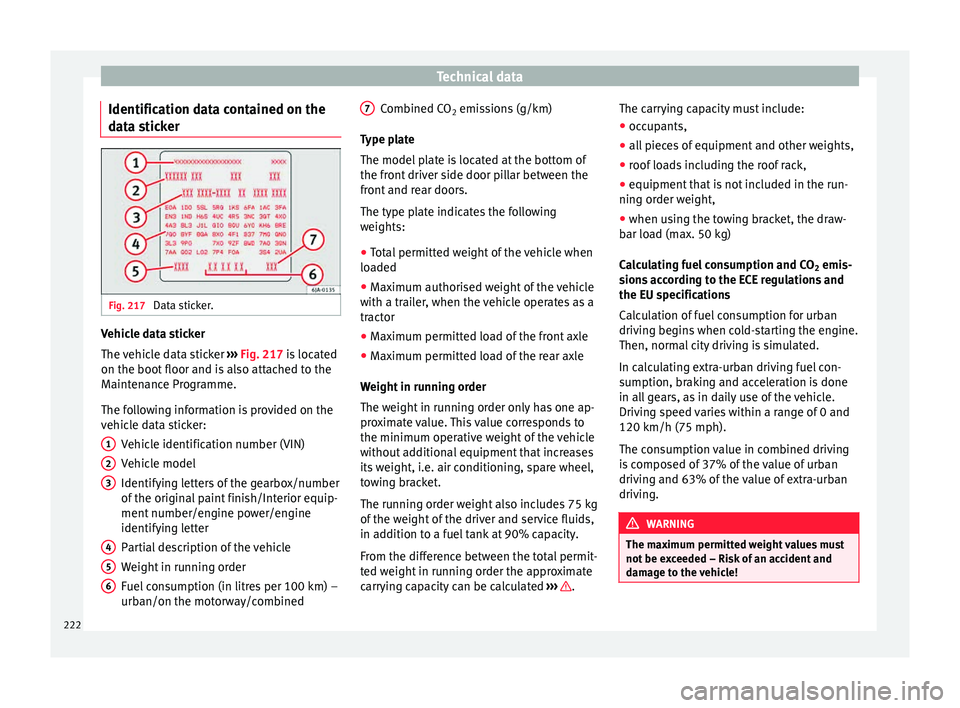
The following information is provided on the
vehicle data sticker:
Vehicle identification number (VIN)
Vehicle model
Identifying letters of the gearbox/number
of the original paint finish/Interior equip-
ment number/engine power/engine
identifying letter
Partial description of the vehicle
Weight in running order
Fuel consumption (in litres per 100 km) –
urban/on the motorway/combined
1 2
3
4
5
6 Combined CO
2 emi
s
s
ions (g/km)
Type plate
The model plate is located at the bottom of
the front driver side door pillar between the
front and rear doors.
The type plate indicates the following
weights:
● Total permitted weight of the vehicle when
loaded
● M
aximum authorised weight of the vehicle
with a trai
ler, when the vehicle operates as a
tractor
● Maximum permitted load of the front axle
● Maximum permitted load of the rear axle
Weight in ru
nning order
The weight in running order only has one ap-
proximate value. This value corresponds to
the minimum operative weight of the vehicle
without additional equipment that increases
its weight, i.e. air conditioning, spare wheel,
towing bracket.
The running order weight also includes 75 kg
of the weight of the driver and service fluids,
in addition to a fuel tank at 90% capacity.
From the difference between the total permit-
ted weight in running order the approximate
carrying capacity can be calculated ››› .
7 The carrying capacity must include:
●
occupants,
● all pieces of equipment and other weights,
● roof loads including the roof rack,
● equipment that is not included in the run-
nin g or
der w
eight,
● when using the towing bracket, the draw-
bar loa
d (max. 50 kg)
Calculating fuel consumption and CO 2 emis-
sions according to the ECE regulations and
the EU specifications
Calculation of fuel consumption for urban
driving begins when cold-starting the engine.
Then, normal city driving is simulated.
In calculating extra-urban driving fuel con-
sumption, braking and acceleration is done
in all gears, as in daily use of the vehicle.
Driving speed varies within a range of 0 and
120 km/h (75 mph).
The consumption value in combined driving
is composed of 37% of the value of urban
driving and 63% of the value of extra-urban
driving. WARNING
The maximum permitted weight values must
not be e x
ceeded – Risk of an accident and
damage to the vehicle! 222
Page 225 of 248
Technical specifications
Note
● If y
ou wish to calculate the exact weight of
your vehicle please contact a SEAT dealer.
● Depending on the volume of equipment,
driving s
tyle, road conditions, weather condi-
tions and the condition of the vehicle, con-
sumption values can differ from the theoreti-
cal values stated here. Information on fuel consump-
tion
Fuel c
onsumption The consumption and emission details
sho
wn on the
v
ehicle data sticker differ from
one vehicle to another.
Vehicle fuel consumption and CO 2 emissions
appear on the vehicle data sticker in the
spare wheel well, inside the boot and on the
rear cover of the Maintenance Programme.
The fuel consumption and CO 2 emission val-
ues refer to the weight category assigned to
your vehicle according to the engine and
gearbox combination, as well as the specific
equipment fitted, and is only used to com-
pare between the different models.
The fuel consumption and CO 2 emissions do
not depend only on the performance of the
vehicle, they can also differ from the estab- lished values depending on other factors
such a
s driving style, road conditions, traffic
conditions, environmental conditions, load
and number of passengers.
Calculation of fuel consumption
The consumption values have been calcula-
ted based on measurements performed or
supervised by certified CE laboratories ac-
cording to the latest version of directives
715/2007/EC and 80/1268/CEE (for more in-
formation consult the European Union Publi-
cations Office at EUR-Lex: © European Union,
http://eur-lex.europa.eu/en/index.htm) and
are valid for the kerb weight indicated for the
vehicle. Note
In practice, and considering all the factors
mentioned here, c on
sumption values can dif-
fer from those calculated in the current Euro-
pean regulations. Weights
Kerb weight refers to the basic model with a
f
uel
t
ank filled to 90% capacity and without
optional extras. The figure quoted includes
75 kg to allow for the weight of the driver.
Special versions, optional equipment fittings
or retro-fitting accessories will increase the
weight of the vehicle ››› . WARNING
● Ple a
se note that the centre of gravity may
shift when transporting heavy objects; this
may affect vehicle handling and lead to an ac-
cident. Always adjust your speed and driving
style to suit road conditions and require-
ments.
● Never exceed the gross axle weight rating
or the gros
s vehicle weight rating. If the per-
missible axle load or the permissible total
weight is exceeded, the driving characteris-
tics of the vehicle may change, which could
lead to accidents, injuries and damage to the
vehicle. Driving with a trailer
Tr
ai
ler weights Trailer weight
The tr
ai
l
er weights and drawbar loads ap-
proved are selected in intensive trials accord-
ing to precisely defined criteria. The ap-
proved trailer weights are valid for vehicles in
the EU for maximum speeds of 80 km/h (50
mph) (in certain circumstances up to 100
km/h (62 mph)). The figures may be different
in other countries. All data in the official vehi-
cle documentation takes precedence over
these data at all times ››› .
»
223
Technical data
Advice
Operation
Emergencies
Safety
Page 226 of 248
Technical data
Drawbar loads
The maximum permitt ed dr
a
wbar load on the
ball joint of the towing bracket must not ex-
ceed 50 kg.
In the interest of road safety, we recommend
that you always tow approaching the maxi-
mum drawbar load. The response of the trail-
er on the road will be poor, if the drawbar
load is too small.
If the maximum permissible drawbar load
cannot be met (e.g. with small, empty and
light-weight single axle trailers or tandem
axle trailers with a wheelbase of less than 1
metre), a minimum of 4% of the actual trailer
weight is legally required for the drawbar
load. WARNING
● For s af
ety reasons, do not exceed the 80
km/h (50 mph) limit. This is also valid in
countries where higher speeds are permitted.
● Never exceed the maximum trailer weights
or the drawb
ar load. If the permissible axle
load or the permissible total weight is excee-
ded, the driving characteristics of the vehicle
may change, leading to accidents, injuries
and damage to the vehicle. Wheels
Ty
r
e pressure, snow chains, wheel
bolts Tyre pressures
The stic
k
er with the tyre pressure values can
be found on the inside of the fuel tank flap.
The tyre pressure values given there are for
cold tyres. Do not reduce the slightly raised
pressures of warm tyres ››› .
The pre s
sure for winter tyres is 0.2 bar
(2.9 psi / 20 kPa) higher than that of summer
tyres.
Snow chains
Snow chains may be fitted only to the front
wheels.
Consult the section “wheels” of this manual.
Wheel bolts
After the wheels have been changed, the
tightening torque of the wheel bolts should
be checked as soon as possible with a torque
wrench ››› . The tightening torque for steel
and al lo
y
wheels is 120 Nm. WARNING
● Check the ty
re pressure at least once per
month. Checking the tyre pressure is very im-
portant. If the tyre pressure is too high or too low, there is an increased danger of accidents
- par
tic
ularly at high speeds.
● If the tightening torque of the wheel bolts
is t
oo low, they could loosen while the vehi-
cle is in motion. Risk of accident! If the tight-
ening torque is too high, the wheel bolts and
threads can be damaged. Note
We recommend that you ask your Technical
Ser vic
e for information about appropriate
wheel, tyre and snow chain size. 224
Page 227 of 248
Technical specifications
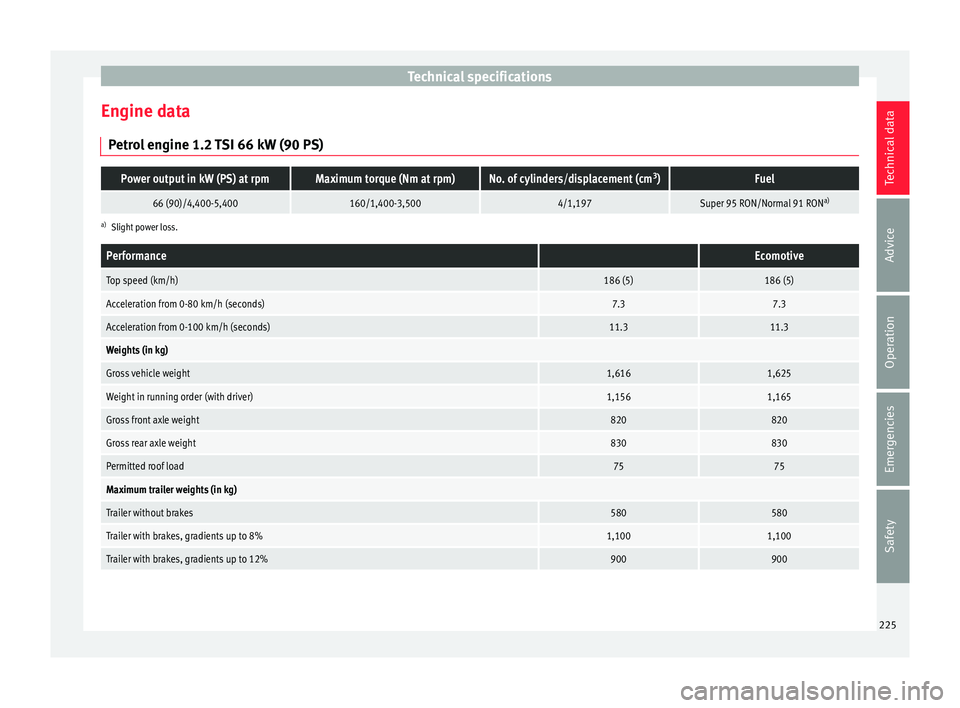
Engine data P etr
o
l engine 1.2 TSI 66 kW (90 PS)
Power output in kW (PS) at rpmMaximum torque (Nm at rpm)No. of cylinders/displacement (cm 3
)Fuel
66 (90)/4,400-5,400160/1,400-3,5004/1,197Super 95 RON/Normal 91 RON a)
a)
Slight power loss.
Performance Ecomotive
Top speed (km/h)186 (5)186 (5)
Acceleration from 0-80 km/h (seconds)7.37.3
Acceleration from 0-100 km/h (seconds)11.311.3
Weights (in kg)
Gross vehicle weight1,6161,625
Weight in running order (with driver)1,1561,165
Gross front axle weight820820
Gross rear axle weight830830
Permitted roof load7575
Maximum trailer weights (in kg)
Trailer without brakes580580
Trailer with brakes, gradients up to 8%1,1001,100
Trailer with brakes, gradients up to 12%900900 225
Technical data
Advice
Operation
Emergencies
Safety
Page 228 of 248
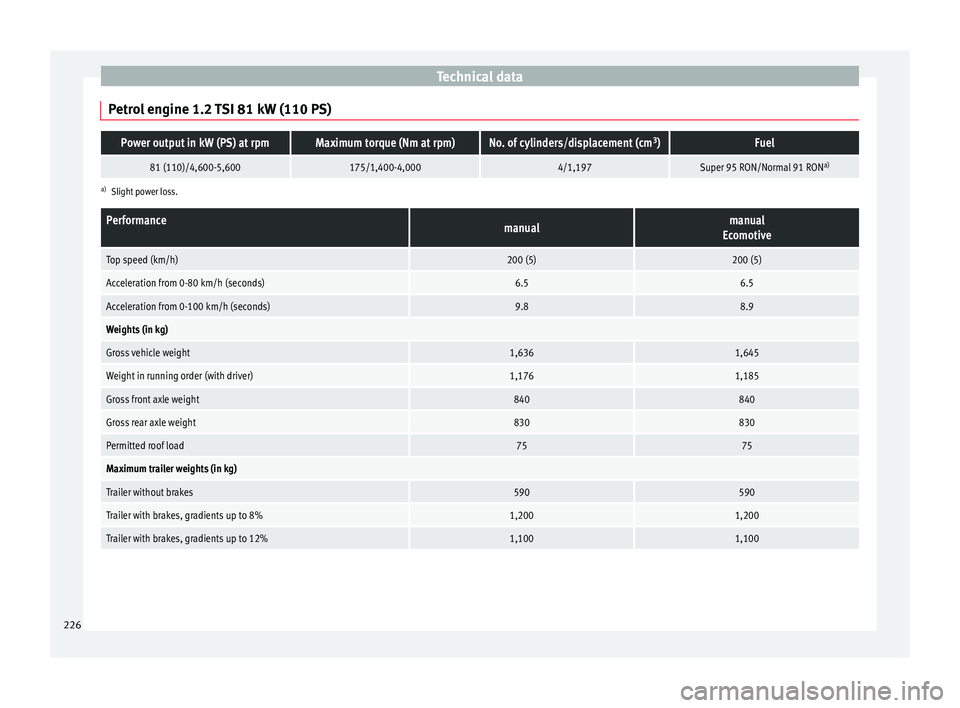
Technical data
Petrol engine 1.2 TSI 81 kW (110 PS)Power output in kW (PS) at rpmMaximum torque (Nm at rpm)No. of cylinders/displacement (cm 3
)Fuel
81 (110)/4,600-5,600175/1,400-4,0004/1,197Super 95 RON/Normal 91 RON a)
a)
Slight power loss.
Performancemanualmanual
Ecomotive
Top speed (km/h)200 (5)200 (5)
Acceleration from 0-80 km/h (seconds)6.56.5
Acceleration from 0-100 km/h (seconds)9.88.9
Weights (in kg)
Gross vehicle weight1,6361,645
Weight in running order (with driver)1,1761,185
Gross front axle weight840840
Gross rear axle weight830830
Permitted roof load7575
Maximum trailer weights (in kg)
Trailer without brakes590590
Trailer with brakes, gradients up to 8%1,2001,200
Trailer with brakes, gradients up to 12%1,1001,100 226
Page 229 of 248
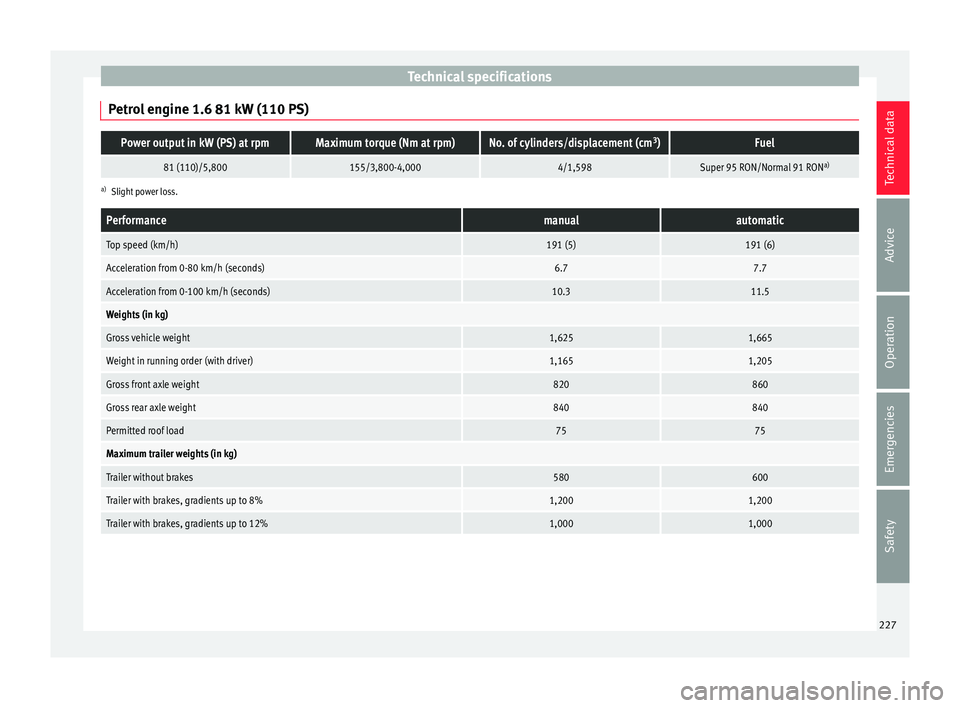
Technical specifications
Petrol engine 1.6 81 kW (110 PS)Power output in kW (PS) at rpmMaximum torque (Nm at rpm)No. of cylinders/displacement (cm 3
)Fuel
81 (110)/5,800155/3,800-4,0004/1,598Super 95 RON/Normal 91 RON a)
a)
Slight power loss.
Performancemanualautomatic
Top speed (km/h)191 (5)191 (6)
Acceleration from 0-80 km/h (seconds)6.77.7
Acceleration from 0-100 km/h (seconds)10.311.5
Weights (in kg)
Gross vehicle weight1,6251,665
Weight in running order (with driver)1,1651,205
Gross front axle weight820860
Gross rear axle weight840840
Permitted roof load7575
Maximum trailer weights (in kg)
Trailer without brakes580600
Trailer with brakes, gradients up to 8%1,2001,200
Trailer with brakes, gradients up to 12%1,0001,000 227
Technical data
Advice
Operation
Emergencies
Safety