child lock Seat Toledo 2016 User Guide
[x] Cancel search | Manufacturer: SEAT, Model Year: 2016, Model line: Toledo, Model: Seat Toledo 2016Pages: 248, PDF Size: 5.82 MB
Page 116 of 248
Operation
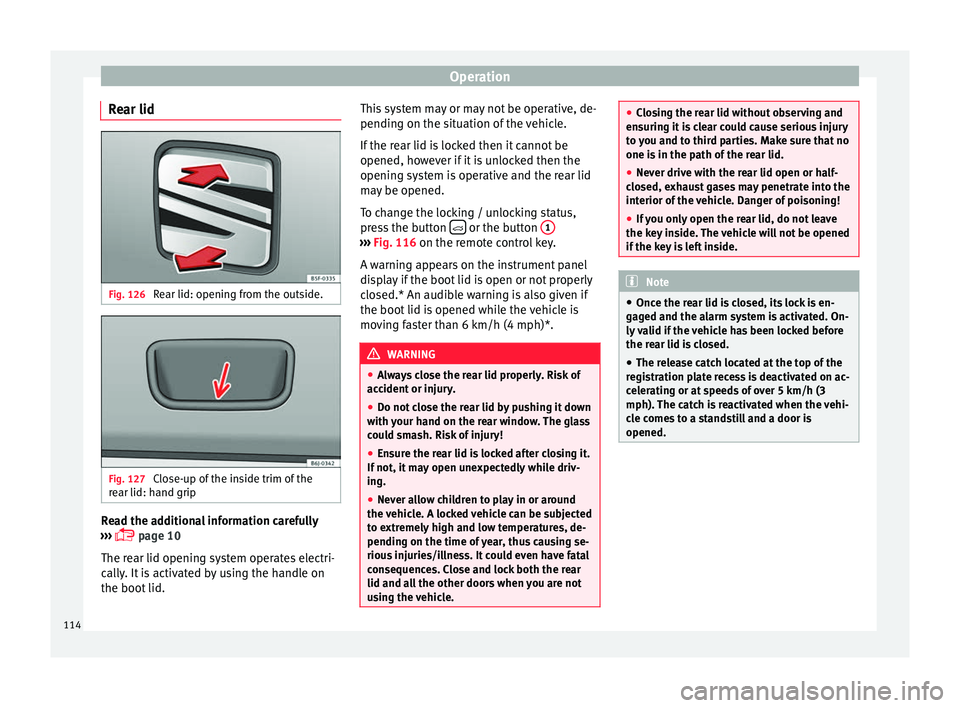
Rear lid Fig. 126
Rear lid: opening from the outside. Fig. 127
Close-up of the inside trim of the
r e
ar lid: h
and grip Read the additional information carefully
› ›
›
page 10
The rear lid opening system operates electri-
cally. It is activated by using the handle on
the boot lid. This system may or may not be operative, de-
pending on the sit
uation of the vehicle.
If the rear lid is locked then it cannot be
opened, however if it is unlocked then the
opening system is operative and the rear lid
may be opened.
To change the locking / unlocking status,
press the button or the button
1 ›››
Fig. 116 on the r emot
e c
ontrol key.
A warning appears on the instrument panel
display if the boot lid is open or not properly
closed.* An audible warning is also given if
the boot lid is opened while the vehicle is
moving faster than 6 km/h (4 mph)*. WARNING
● Alw a
ys close the rear lid properly. Risk of
accident or injury.
● Do not close the rear lid by pushing it down
with y
our hand on the rear window. The glass
could smash. Risk of injury!
● Ensure the rear lid is locked after closing it.
If not, it m
ay open unexpectedly while driv-
ing.
● Never allow children to play in or around
the vehic
le. A locked vehicle can be subjected
to extremely high and low temperatures, de-
pending on the time of year, thus causing se-
rious injuries/illness. It could even have fatal
consequences. Close and lock both the rear
lid and all the other doors when you are not
using the vehicle. ●
Clo s
ing the rear lid without observing and
ensuring it is clear could cause serious injury
to you and to third parties. Make sure that no
one is in the path of the rear lid.
● Never drive with the rear lid open or half-
closed, e
xhaust gases may penetrate into the
interior of the vehicle. Danger of poisoning!
● If you only open the rear lid, do not leave
the key in
side. The vehicle will not be opened
if the key is left inside. Note
● Onc e the r e
ar lid is closed, its lock is en-
gaged and the alarm system is activated. On-
ly valid if the vehicle has been locked before
the rear lid is closed.
● The release catch located at the top of the
regi
stration plate recess is deactivated on ac-
celerating or at speeds of over 5 km/h (3
mph). The catch is reactivated when the vehi-
cle comes to a standstill and a door is
opened. 114
Page 117 of 248
Opening and closing
Opening and closing of electric
w indo
w
s
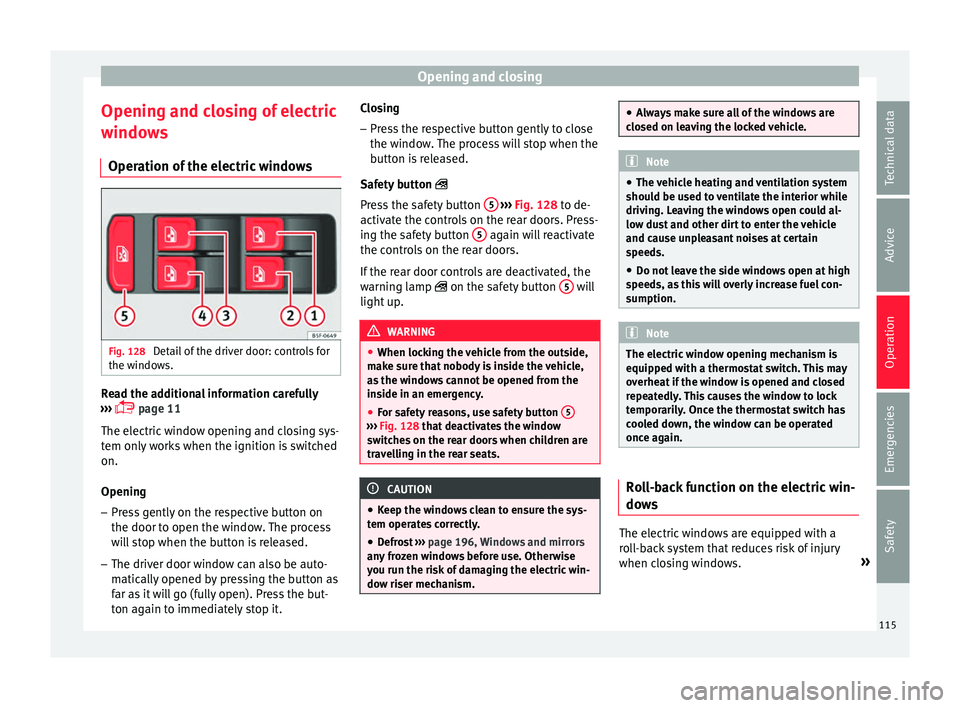
Operation of the electric windows Fig. 128
Detail of the driver door: controls for
the w indo
w
s. Read the additional information carefully
› ›
›
page 11
The electric window opening and closing sys-
tem only works when the ignition is switched
on.
Opening
– Press gently on the respective button on
the door to open the windo
w. The process
will stop when the button is released.
– The driver door window can also be auto-
matical
ly opened by pressing the button as
far as it will go (fully open). Press the but-
ton again to immediately stop it. Closing
– Press the respective button gently to close
the window
. The process will stop when the
button is released.
Safety button
Press the safety button 5
› ››
Fig. 128
t
o de-
activate the controls on the rear doors. Press-
ing the safety button 5 again will reactivate
the c ontr
o
ls on the rear doors.
If the rear door controls are deactivated, the
warning lamp on the safety button 5 will
light up
. WARNING
● When lock in
g the vehicle from the outside,
make sure that nobody is inside the vehicle,
as the windows cannot be opened from the
inside in an emergency.
● For safety reasons, use safety button 5 ›››
Fig. 128 that de
activates the window
switches on the rear doors when children are
travelling in the rear seats. CAUTION
● Keep the w indo
ws clean to ensure the sys-
tem operates correctly.
● Defrost ››› page 196, Windows and mirrors
an
y frozen windows before use. Otherwise
you run the risk of damaging the electric win-
dow riser mechanism. ●
Alw a
ys make sure all of the windows are
closed on leaving the locked vehicle. Note
● The vehic
le heating and ventilation system
should be used to ventilate the interior while
driving. Leaving the windows open could al-
low dust and other dirt to enter the vehicle
and cause unpleasant noises at certain
speeds.
● Do not leave the side windows open at high
speeds, a
s this will overly increase fuel con-
sumption. Note
The electric window opening mechanism is
equipped w ith a thermo
stat switch. This may
overheat if the window is opened and closed
repeatedly. This causes the window to lock
temporarily. Once the thermostat switch has
cooled down, the window can be operated
once again. Roll-back function on the electric win-
do
w
s The electric windows are equipped with a
r
o
l
l-back system that reduces risk of injury
when closing windows. »
115
Technical data
Advice
Operation
Emergencies
Safety
Page 139 of 248
Transport and practical equipment
CAUTION
● The comp ar
tments are designed to hold
small objects with a total weight of 1.5 kg.
● Make sure you do not damage the storage
compar
tment or the boot trim when using the
compartment. Storing objects
Lo a
ding the luggage compartment All luggage and other loose objects must be
s
af
ely
secured in the luggage compartment.
Unsecured objects which shift back and forth
could impair the driving safety or driving
characteristics of the vehicle by shifting the
centre of gravity. – Distribute the load evenly in the luggage
compar
tment.
– Place heavy objects as far forward as possi-
ble in the lug
gage compartment.
– Place the heavy objects first.
– Secure heavy objects to the fastening rings
›››
page 137. WARNING
● Loo se lug
gage and other objects in the lug-
gage compartment could cause serious inju-
ries. ●
Alw a
ys stow objects in the luggage com-
partment and secure them on the fastening
rings.
● Use suitable straps to secure heavy ob-
jects.
● D
uring sudden manoeuvres or accidents,
loose ob
jects can be thrown forward, injuring
vehicle occupants or passers-by. This in-
creased risk of injury will be further increased
if a loose object is struck by an inflating air-
bag. If this happens, objects may shoot out-
ward like a missile. Risk of fatal injury.
● Please note that the centre of gravity may
shift when tr
ansporting heavy objects; this
may affect vehicle handling and lead to an ac-
cident. Therefore, it is essential to adjust
your speed and driving style accordingly, to
avoid accidents.
● Never exceed the allowed axle weights or
allo
wed maximum weight. If said weights are
exceeded, the driving characteristics of the
vehicle may change, leading to accidents, in-
juries and damage to the vehicle.
● Never leave your vehicle unattended, espe-
cia
lly when the rear lid is open. Children
could climb into the luggage compartment,
closing the door behind them; they will be
trapped and run the risk of death.
● Never allow children to play in or around
the vehic
le. Close and lock all the doors and
rear lid when you leave the vehicle. Before
you lock the vehicle, make sure that there are
no adults or children in the vehicle. Note
● Air cir c
ulation in the vehicle helps reduce
fogging of the windows. Used air escapes
through ventilation slits in the side trim of
the luggage compartment. Ensure that the
ventilation slots are never covered.
● Straps for securing the load to the fasten-
ing ring
s are commercially available. Fastening rings*
There can be four fastening rings in the lug-
g
ag
e c
ompartment for fastening luggage and
other objects.
– Always use suitable and undamaged straps
to secur
e luggage and other objects to the
fastening rings ››› in Loading the lug-
g ag
e c
ompartment on page 137.
– Pull up the fastening rings to attach the
strap
s.
During a collision or an accident, even small
and light objects can build up so much ener-
gy that they can cause very severe injuries.
The amount of kinetic “energy” depends on
the speed of the vehicle and the weight of
the object. The most significant factor, how-
ever, is the speed of the vehicle.
Example: An object weighing 4.5 kg is lying
unsecured in the vehicle. During a frontal col-
lision at a speed of 50 km/h (31 mph), this »
137
Technical data
Advice
Operation
Emergencies
Safety
Page 151 of 248
Driving
It is possible, however, to set the blower
s peed t
o s
uit requirements.
● Turn control 10
› ››
Fig. 171
c
ounter-clock-
wise (to lower the speed) or clockwise (to in-
crease the speed).
Climatronic will switch off when the blower
switches off. WARNING
Read and observe the safety warnings ›››
in
Genera l
notes on page 142. Windscreen defrost
Switching on windscreen defrosting
●
Press the button
12
› ›
›
Fig. 171.
Switching off windscreen defrosting
● Press button
12
› ›
›
Fig. 171 several
times or press the AUTO button.
The t emper
at
ure is regulated automatically.
The air output is increased from vents 1
››› page 143 and 2. Driving
St ar
tin
g and stopping the en-
gine
Introduction Read the additional information carefully
›› ›
page 18 WARNING
● When mov in
g with the engine switched off,
the ignition key must always remain in posi-
tion 2
››› Fig. 172 ›
›› page 151 (ignition on).
The control lamps will light up in this posi-
tion. Otherwise, the steering lock could en-
gage suddenly. Risk of accident!
● Do not remove the key from the ignition un-
til the
vehicle has come to a standstill and is
secure (e.g. the handbrake is engaged). Oth-
erwise, the steering lock could suddenly en-
gage. Risk of accident!
● Always take the ignition key with you when
you le
ave the vehicle. This is particularly im-
portant if you leave children in the vehicle.
Children could, for example, start the engine
with the subsequent risk of accident.
● Never leave the engine running in unventi-
lated or c
losed rooms. The exhaust gases
contain carbon monoxide, an odourless and
colourless poisonous gas. Risk of fatal acci-
dents! Carbon monoxide can cause people to
lose consciousness and can cause death. ●
Never l e
ave the vehicle unattended if the
engine is running.
● Never switch the engine off until the vehi-
cle h
as come to a complete stop. Risk of acci-
dent! CAUTION
● Turnin g the s
teering wheel fully in either
direction when the vehicle is stationary and
the engine is in gear puts the power steering
under great stress. This could lead to noise.
Never leave the steering wheel turned fully in
either direction for more than 15 seconds.
Risk of damage to the power steering system!
● The starter motor may only be used (key
position 3
››› Fig. 172 ›
›› page 151 in the ig-
nition) if the engine is off. Using the starter
motor when the engine is running could dam-
age it.
● Immediately release the ignition key when
the engine st
arts, otherwise damage could be
caused to the starter motor.
● When the engine is cold, you should avoid
high engine speed
s, driving at full throttle
and over-loading the engine before it reaches
operating temperature. Risk of engine dam-
age!
● Do not tow-start the engine. Risk of engine
damag
e! In vehicles with a catalytic convert-
er, fuel that has not been burned could reach
the catalytic converter and catch fire in it.
This would lead to a fault in the catalytic con-
verter. You may use the battery from another » 149
Technical data
Advice
Operation
Emergencies
Safety
Page 154 of 248
Operation
● Immedi at
ely
after pushing the start-up but-
ton, keep the vehicle key next to the steering
column ››› Fig. 174.
● The ignition connects and the engine starts
automatic
ally.
Emergency disconnection
If the engine does not stop after briefly press-
ing the start-up button, an emergency dis-
connect will be required:
● Press the starter button twice within 1 sec-
ond or pres
s it once for more than 2 seconds
››› .
● The engine turns off automatically.
En gine r
e
start feature
If no valid key is detected inside the vehicle
after the engine stops, you will only have 5
seconds to restart it. A warning will display
on the dash panel screen.
After this interval, it will not be possible to
start the engine without a valid key inside
the vehicle. WARNING
Any accidental movement of the vehicle could
re s
ult in serious injury.
● When pressing the start-up button, do not
pre
ss the brake or clutch pedal, this way the
engine will start immediately. WARNING
If vehicle keys are used negligently or with-
out due c ar
e, this may cause accidents and
serious injury.
● Never leave any key inside the vehicle
when exitin
g. Otherwise, a child or unauthor-
ised person could lock the vehicle, start the
engine or connect the ignition and, in this
way, operate electronic equipment (e.g. the
windows). Note
In diesel vehicles with the Keyless Access
sys t
em, there may be a delay in the engine
starting if it requires preheating. Starting the engine
Vehicles with a
diesel
en
gine are equipped
with a glow plug system. When you switch on
the ignition, the glow plug warning lamp
will light up. The engine can be started
straight away when the lamp switches off.
Do not connect electrical appliances during
preheating so as not the drain the vehicle
battery unnecessarily.
Starting the engine
● Move the gearbox lever into neutral or
move the sel
ector lever to position P or N and
pull firmly on the handbrake. ●
Pres
s the clutch pedal all the way down
and start the engine 3
› ››
Fig. 172
› ›
› page 151, without pressing the accelera-
tor. Keep the clutch pedal pressed down until
the engine starts.
● Release the ignition key as soon as the en-
gine star
ts. The key returns to position 2 .
● If the engine does not start after 10 sec-
ond s, t
urn the k
ey back to position 1 . Re-
pe at
the action af
ter 30 seconds.
● Release the handbrake before moving off.
Switching off the engine with the key Stop the engine by turning the ignition key to
po
s
ition 1
› ›
› Fig. 172
››› page 151.
Brakes and brake servo sys-
tems Introduction WARNING
● The brak e ser
vo only works when the en-
gine is running. Braking when the engine is
switched off requires applying more strength
to the brake pedal. Risk of accident!
● Press down on the clutch pedal when stop-
ping and brak
ing with a manual gearbox,152
Page 155 of 248

Driving
petrol engine vehicle at low speed. Other-
wi
se, the br
ake servo might not work proper-
ly. Risk of accident!
● In the event of damage to the standard
front s
poiler or where a different front spoil-
er, wheel trims, etc. are subsequently fitted,
make sure the air vent to the brakes on the
front wheels is not blocked. Otherwise, brak-
ing operations may be impaired. Risk of acci-
dent!
● Always fully release the handbrake. If it is
only p
artially released, this will cause over-
heating of the rear brakes, which can impair
the function of the brake system. Risk of acci-
dent!
● Never leave children unsupervised in the
vehicl
e. They could release the handbrake or
move the gear lever. The vehicle could start
moving. Risk of accident!
● Insufficient fuel can cause the engine to run
irregu
larly or to switch off. Brake assist sys-
tems could be impaired. Risk of accident!
● Always adjust your driving style to suit visi-
bility
, the weather and road and traffic condi-
tions. The best vehicle safety offered by
brake assist systems must never encourage
you to run greater risks. Risk of accident! CAUTION
● Ob ser
ve the information concerning new
brake pads ››› page 161.
● Where braking is not necessary, do not
wear do
wn the brake pads by pressing down gently on the brake pedal. This causes the
brak
e
s to overheat, increasing their wear and
increasing braking distances.
● To ensure the brake assist systems work
properly, a
ll wheels must be fitted with tyres
approved by the manufacturer. Note
● If y
ou brake suddenly and the brake system
control unit regards the situation as hazard-
ous for the drivers behind you, the brake
lights will begin to flash automatically. After
reducing speed to approximately 10 km/h (6
mph) or stopping the vehicle, the brake lights
will stop flashing and the hazard warning
lights will switch on. The hazard warning
lights are automatically switched off when
you accelerate or restart the vehicle.
● On long, steep gradients, reduce your
speed and ch
ange to a lower gear (manual
gearbox) or move the selector lever to a lower
gear position (automatic gearbox). This uses
the force of the engine and the brakes do not
suffer as much. If you still have to brake, do
so intermittently, pressing down repeatedly
on the brake pedal.
● Vehicle modifications (e.g. to the engine,
brake
s, frame or a combination of wheels and
tyres) could impair the brake assist systems
››› page 192, Accessories and modifications
to the vehicle .
● In the event of a fault in the ABS system,
the ESC, T
CS and EDL are switched off auto- matically. A fault in the ABS is indicated by
the
›››
page 155 warning lamp. Control lamp
The warning lamp il
lumin
ates if the brake
fluid level is too low or if there is a fault in the
ABS system.
The informative display indicates:
Brake fluid Instruction Manual!
Stop the vehicle, switch off the engine and
check the level of the brake fluid
››› page 209 WARNING
● The fo l
lowing indications must be taken in-
to account when opening the engine com-
partment to check the brake fluid
››› page 202, Engine compartment.
● If the warning lamp illumin
ates together
with the warning lamp ››› page 155, ,
stop the vehicle! Go to a technical service.
● A fault in the brake system or in the Anti-
lock br
ake system (ABS) can lead to longer
braking distances – Risk of accident! 153
Technical data
Advice
Operation
Emergencies
Safety
Page 195 of 248
Care and maintenance
●
The modification of the s
uspension of the
vehicle wheels, including the use of non-per-
mitted combinations of tyres and rims can al-
ter the operation of the airbag system and in-
crease the risk of serious or fatal injuries in
an accident.
● During all jobs on the airbag system, in ad-
dition to the remo
val and fitting of parts of
the system in the course of other repair jobs,
parts of the airbag system can be damaged.
Therefore in the event of an accident, this
may cause the airbags to activate incorrectly
or not activate at all. Radio and aerial reception
In vehicles factory-fitted with an audio or
n
av
ig
ation system, the aerial may be instal-
led in different places:
● inside the rear window next to the heating
elements,
● on the roof
of the vehicle.
Care and cleaning Introduction Regular and suitable care helps to
m
aint ain
the u
seful life of your vehicle. This may also
be one of the requirements for upholding any warranty claims in the event of corrosion or
paint def
ects.
We recommend you use cleaning products
from the SEAT Original Accessories pro-
gramme available in SEAT dealers. Please fol-
low the instructions for use on the packag-
ing. WARNING
● Cle
aning products and other materials used
for car care can damage the health if mis-
used.
● Always keep car care materials in a safe
plac
e out of the reach of children. Risk of poi-
soning!
● When washing the car during the winter
season: Moi
sture and ice on the brakes may
affect braking efficiency. Risk of accident!
● The ignition must always be switched off
when the car is
washed. Risk of accident!
● Do not clean the underside of the car or in-
side the wheel ar
ches without protecting your
hands and arms. You may cut yourself on
sharp metal parts!
● Perfumes and air fresheners inside the ve-
hicle m
ay be harmful to health at high tem-
peratures in the interior. CAUTION
● Check the c
olour-fastness of your clothing
to avoid damaging or visibly staining the fab-
ric (leather), upholstery and fabric trim. ●
Cle
aning products containing solvents may
damage the material being cleaned.
● Do not wash the vehicle in direct sunlight.
Risk of
damage to paintwork.
● If washing the vehicle with a hose in win-
ter, do not
direct the jet of water directly at
the locks or at the door seals or bonnet. Risk
of freezing.
● Do not use sponges for removing insects or
abras
ive household sponges, etc. on painted
surfaces. Risk of damage to the painted sur-
face!
● Do not put stickers on the inner side of the
rear w
indow in areas where heating elements
or the aerial are located. This could cause
damage and, in the case of the aerial, radio
and navigation system reception faults.
● Do not clean the inside of the window with
sharp ob
jects or corrosive or acidic cleaning
products. Risk of damaging the heating ele-
ments or the aerial.
● Do not attach any fragrance or air freshener
to the da
sh panel. Risk of damage to the
dash panel!
● To avoid damaging the parking aid system
sensors, s
pray them only briefly at a mini-
mum distance of 10 cm when cleaning the ve-
hicle with a high-pressure or steam cleaner.
● Do not clean the roof panel with a brush.
Risk of
damage to the panel surface! » 193
Technical data
Advice
Operation
Emergencies
Safety
Page 236 of 248
Index
Boot hook . . . . . . . . . . . . . . . . . . . . . . . . . . . . . . . . .
139
r et
aining elements . . . . . . . . . . . . . . . . . . . . . . 139
retaining nets . . . . . . . . . . . . . . . . . . . . . . . . . . 139
Brake assist . . . . . . . . . . . . . . . . . . . . . . . . . . . . . 154
Brake fluid . . . . . . . . . . . . . . . . . . . . . . . . . . . . . . . 41 checking . . . . . . . . . . . . . . . . . . . . . . . . . . . . . . 209
Brakes brake fluid . . . . . . . . . . . . . . . . . . . . . . . . . . . . . 209
control lamp . . . . . . . . . . . . . . . . . . . . . . . . . . . 153
handbrake . . . . . . . . . . . . . . . . . . . . . . . . . . . . . 154
running in . . . . . . . . . . . . . . . . . . . . . . . . . . . . . 161
Brake servo . . . . . . . . . . . . . . . . . . . . . . . . . . . . . . 154
Braking brake assist . . . . . . . . . . . . . . . . . . . . . . . . . . . . 154
Bulb failure control lamp . . . . . . . . . . . . . . . . . . . . . . . . . . . 116
C Capacities . . . . . . . . . . . . . . . . . . . . . . . . . . . . . . . . 39
Car-care products . . . . . . . . . . . . . . . . . . . . . . . . . 193
Care of vehicle door lock cylinder . . . . . . . . . . . . . . . . . . . . . . . 196
leatherette . . . . . . . . . . . . . . . . . . . . . . . . . . . . . 197
natural leather . . . . . . . . . . . . . . . . . . . . . . . . . 198
seat belts . . . . . . . . . . . . . . . . . . . . . . . . . . . . . 198
upholstery . . . . . . . . . . . . . . . . . . . . . . . . . . . . . 197
washing by hand . . . . . . . . . . . . . . . . . . . . . . . 194
Carrier system . . . . . . . . . . . . . . . . . . . . . . . . . . . . 141
Catalytic converter . . . . . . . . . . . . . . . . . . . . . . . . 164 malfunction . . . . . . . . . . . . . . . . . . . . . . . . . . . . 164
CCS . . . . . . . . . . . . . . . . . . . . . . . . . . . . . . . . . . . . . 31
Central locking . . . . . . . . . . . . . . . . . . . . . . . . . . . 104 anti-theft alarm . . . . . . . . . . . . . . . . . . . . . . . . . 112
central locking button . . . . . . . . . . . . . . . . . . . 109
closing . . . . . . . . . . . . . . . . . . . . . . . . . . . . . . . . 108
individualised settings . . . . . . . . . . . . . . . . . . 107 keyless Access . . . . . . . . . . . . . . . . . . . . . . . . . 110
lockin
g . . . . . . . . . . . . . . . . . . . . . . . . . . . . . . . . 108
locking manually . . . . . . . . . . . . . . . . . . . . . . . . 10
opening . . . . . . . . . . . . . . . . . . . . . . . . . . . . . . . 108
unlocking . . . . . . . . . . . . . . . . . . . . . . . . . . . . . 108
Central locking system . . . . . . . . . . . . . . . . . . . . . 107
Cetane number (diesel fuel) . . . . . . . . . . . . . . . . 201
Change a bulb . . . . . . . . . . . . . . . . . . . . . . . . . . . . 83
Changing a wheel . . . . . . . . . . . . . . . . . . . . . . 46, 75 subsequent work . . . . . . . . . . . . . . . . . . . . . . . . 49
Changing bulbs daytime driving light . . . . . . . . . . . . . . . . . . . . . 86
dipped beam . . . . . . . . . . . . . . . . . . . . . . . . . . . 85
double headlight bulbs . . . . . . . . . . . . . . . . . . . 84
main beam headlight . . . . . . . . . . . . . . . . . . . . . 85
side light . . . . . . . . . . . . . . . . . . . . . . . . . . . . . . . 85
turn signal . . . . . . . . . . . . . . . . . . . . . . . . . . . . . . 86
Changing bulbs on the number plate . . . . . . . . . . 91 removing the bulb holder . . . . . . . . . . . . . . . . . 91
Changing bulbs on the side panel . . . . . . . . . . . . 88 fitting the rear light . . . . . . . . . . . . . . . . . . . . . . 89
removing the bulb holder . . . . . . . . . . . . . . . . . 88
removing the rear light . . . . . . . . . . . . . . . . . . . . 87
Changing lights on the side panel . . . . . . . . . . . . 87
Changing oil . . . . . . . . . . . . . . . . . . . . . . . . . . . . . 208
Changing rear lights on the rear lid changing bulbs . . . . . . . . . . . . . . . . . . . . . . . . . . 90
fitting the bulb-holder . . . . . . . . . . . . . . . . . . . . 90
Changing settings CAR menu . . . . . . . . . . . . . . . . . . . . . . . . . . . . . . 21
Changing tail lights (on the rear lid . . . . . . . . . . . 89
Changing the bulbs fog light . . . . . . . . . . . . . . . . . . . . . . . . . . . . . . . . 86
Changing the rear lights on the rear lid removing the bulb holder . . . . . . . . . . . . . . . . . 89
Charging the battery . . . . . . . . . . . . . . . . . . . . . . . 51 Checking levels
engine comp artment . . . . . . . . . . . . . . . . . . . . 205
Child-proof locking . . . . . . . . . . . . . . . . . . . . . . . . 112 electric windows . . . . . . . . . . . . . . . . . . . . . . . . 115
Child seat categorisation in groups . . . . . . . . . . . . . . . . . . 74
Child seats . . . . . . . . . . . . . . . . . . . . . . . . . . . . 16, 74 ISOFIX system . . . . . . . . . . . . . . . . . . . . . . . . . . . 17
safety instructions . . . . . . . . . . . . . . . . . . . . 16, 73
securing with the seat belt . . . . . . . . . . . . . . . . 16
Top Tether system . . . . . . . . . . . . . . . . . . . . . . . . 17
Cigarette lighter . . . . . . . . . . . . . . . . . . . . . . . . . . 133
City Emergency braking function . . . . . . . . . . . . . 180
Cleaning . . . . . . . . . . . . . . . . . . . . . . . . . . . . . . . . 193 chromed parts . . . . . . . . . . . . . . . . . . . . . . . . . 195
headlights . . . . . . . . . . . . . . . . . . . . . . . . . . . . . 196
leatherette . . . . . . . . . . . . . . . . . . . . . . . . . . . . . 197
natural leather . . . . . . . . . . . . . . . . . . . . . . . . . 198
plastic parts . . . . . . . . . . . . . . . . . . . . . . . . . . . 196
upholstery . . . . . . . . . . . . . . . . . . . . . . . . 197, 198
washing the vehicle . . . . . . . . . . . . . . . . . . . . . 194
wheels . . . . . . . . . . . . . . . . . . . . . . . . . . . . . . . . 197
windows . . . . . . . . . . . . . . . . . . . . . . . . . . . . . . 196
Cleaning and thawing windows . . . . . . . . . . . . . 196
Climatronic . . . . . . . . . . . . . . . . . . . . . . . . . . . . . . . 36 adjusting the temperature . . . . . . . . . . . . . . . . 148
air recirculation . . . . . . . . . . . . . . . . . . . . . . . . . 148
automatic mode . . . . . . . . . . . . . . . . . . . . . . . . 148
blower selection . . . . . . . . . . . . . . . . . . . . . . . . 148
windscreen defrost . . . . . . . . . . . . . . . . . . . . . . 149
Close . . . . . . . . . . . . . . . . . . . . . . . . . . . . . . . . . . . 104
Closing central locking . . . . . . . . . . . . . . . . . . . . . . . . . 108
vehicle with Keyless Access . . . . . . . . . . . . . . . 110
windows . . . . . . . . . . . . . . . . . . . . . . . . . . . . . . 115
Coat hooks . . . . . . . . . . . . . . . . . . . . . . . . . . . . . . 135
Coming Home and Leaving Home . . . . . . . . . . . . 121
234
Page 237 of 248
Index
Coming Home and Leaving Home Function . . . . 121
C ontr
o
l and warning lamps
alternator . . . . . . . . . . . . . . . . . . . . . . . . . . . . . 212
brakes . . . . . . . . . . . . . . . . . . . . . . . . . . . . . . . . 153
diesel particulate filter . . . . . . . . . . . . . . . . . . . 164
emission control . . . . . . . . . . . . . . . . . . . . . . . . 165
engine oil . . . . . . . . . . . . . . . . . . . . . . . . . . . . . 206
instrument panel . . . . . . . . . . . . . . . . . . . . . . . . 34
lights . . . . . . . . . . . . . . . . . . . . . . . . . . . . . . . . . 116
Controls and displays general instrument panel . . . . . . . . . . . . . . . . . . 93
Controls on the steering wheel operating the audio system . . . . . . . . . . . . . . . 101
operating the telephone and audio system . . 102
Cooling system checking coolant . . . . . . . . . . . . . . . . . . . . . . . 208
engine coolant temperature display . . . . . . . . . 97
topping up coolant . . . . . . . . . . . . . . . . . . . . . . 208
Correct position . . . . . . . . . . . . . . . . . . . . . . . . . . . 56
Correct sitting position front passenger . . . . . . . . . . . . . . . . . . . . . . . . . 57
rear seat passengers . . . . . . . . . . . . . . . . . . . . . 58
Cruise control . . . . . . . . . . . . . . . . . . . . . . . . 31, 174 adjusting the stored speed . . . . . . . . . . . . . . . 175
setting the speed . . . . . . . . . . . . . . . . . . . . . . . 175
temporary deactivation . . . . . . . . . . . . . . . . . . 175
turning off the cruise control system . . . . . . . 176
D Damage to the vehicle . . . . . . . . . . . . . . . . . . . . . 166
Dash panel . . . . . . . . . . . . . . . . . . . . . . . . . . . . . . . 32
Data sticker . . . . . . . . . . . . . . . . . . . . . . . . . . . . . . 221
Deactivating the front passenger front airbag . . . 14
Deactivation of front airbag . . . . . . . . . . . . . . . 68, 71
Defrosting rear window . . . . . . . . . . . . . . . . . . . . 123
Diesel diesel particulate filter . . . . . . . . . . . . . . . . . . . 164 engine oil . . . . . . . . . . . . . . . . . . . . . . . . . . . . . 205
preheatin
g . . . . . . . . . . . . . . . . . . . . . . . . . . . . 149
refuelling . . . . . . . . . . . . . . . . . . . . . . . . . . . . . . 201
Diesel particulate filter malfunction . . . . . . . . . . . . . . . . . . . . . . . . . . . . 164
Digital clock . . . . . . . . . . . . . . . . . . . . . . . . . . . . . . 94
Dimensions . . . . . . . . . . . . . . . . . . . . . . . . . . . . . . 231
Direction of rotation tyres . . . . . . . . . . . . . . . . . . . . . . . . . . . . . . . . . . . 49
Display . . . . . . . . . . . . . . . . . . . . . . . . . . . . . . . 94, 95
Disposal seat belt tensioners . . . . . . . . . . . . . . . . . . . . . . 66
Door cylinder . . . . . . . . . . . . . . . . . . . . . . . . . . . . . . 9
Door handle . . . . . . . . . . . . . . . . . . . . . . . . . . . . . . . 9
Door lock . . . . . . . . . . . . . . . . . . . . . . . . . . . . . . . . . . 9
Doors child-proof locking . . . . . . . . . . . . . . . . . . . . . . 112
opening and closing . . . . . . . . . . . . . . . . . . . . . . 9
Drink holder centre console . . . . . . . . . . . . . . . . . . . . . . . . . 132
rear seat armrest . . . . . . . . . . . . . . . . . . . . . . . 133
Driver see Correct sitting position . . . . . . . . . 56, 57, 58
Driver information system CD/radio indication . . . . . . . . . . . . . . . . . . . . . . 23
engine oil temperature display . . . . . . . . . . . . . 28
operation with the windscreen wiper lever . . . . 23
Driving abroad headlights . . . . . . . . . . . . . . . . . . . . . . . . . . . . . 122
Driving data . . . . . . . . . . . . . . . . . . . . . . . . . . . . . . 23 data summary . . . . . . . . . . . . . . . . . . . . . . . . . . . 27
memory . . . . . . . . . . . . . . . . . . . . . . . . . . . . . . . . 26
Driving through water . . . . . . . . . . . . . . . . . . . . . 166
Driving with a trailer . . . . . . . . . . . . . . . . . . 184, 223
Dynamic headlight range control . . . . . . . . . . . . 117 E
E10
see
Ethanol (fuel) . . . . . . . . . . . . . . . . . . . . . . . 200
Easy Connect . . . . . . . . . . . . . . . . . . . . . . . . . . 21, 99
Economical driving . . . . . . . . . . . . . . . . . . . . . . . . . . . . . . . . 162
EDL see Electronic differential lock . . . . . . . . 154, 156
Efficiency programme additional electrical appliances . . . . . . . . . . . . 28
saving tips . . . . . . . . . . . . . . . . . . . . . . . . . . . . . . 28
Electric windows . . . . . . . . . . . . . . . . . . . . . . 11, 115
Electronic differential lock . . . . . . . . . . . . . 154, 156
Electronic immobiliser . . . . . . . . . . . . . . . . . . . 9, 150
Electronic Stability Control (ESC) . . . . . . . . . . . . 154
Emergencies . . . . . . . . . . . . . . . . . . . . . . . . . . . . . . 75 automatic gearbox backup programme . . . . . 160
bulbs . . . . . . . . . . . . . . . . . . . . . . . . . . . . . . . . . . 44
changing a wheel . . . . . . . . . . . . . . . . . . . . . 46, 75
emergency towing of the vehicle . . . . . . . . . . . . 50
hazard warning lights . . . . . . . . . . . . . . . . . . . 121
jump leads . . . . . . . . . . . . . . . . . . . . . . . . . . . . . 51
puncture . . . . . . . . . . . . . . . . . . . . . . . . . . . . . . . 44
replacing a blown fuse . . . . . . . . . . . . . . . . . . . . 43
Emergency fuses . . . . . . . . . . . . . . . . . . . . . . . . . . . . . . . . . . 43
Emergency operation front passenger door . . . . . . . . . . . . . . . . . . . . . 10
selector lever . . . . . . . . . . . . . . . . . . . . . . . . . . . 35
Emission control system control lamp . . . . . . . . . . . . . . . . . . . . . . . . . . . 165
Emissions data . . . . . . . . . . . . . . . . . . . . . . . . . . . 221
Engine assisted starting . . . . . . . . . . . . . . . . . . . . . . . . . 51
preheating . . . . . . . . . . . . . . . . . . . . . . . . . . . . 149
run-in . . . . . . . . . . . . . . . . . . . . . . . . . . . . . . . . . 161
Start-Stop system . . . . . . . . . . . . . . . . . . . . . . . 181
235
Page 242 of 248
Index
Rubber seals car
e
. . . . . . . . . . . . . . . . . . . . . . . . . . . . . . . . . . 196
Run-in new engine . . . . . . . . . . . . . . . . . . . . . . . . . . . . 161
new tyres . . . . . . . . . . . . . . . . . . . . . . . . . . . . . . 215
the first 1,500 km . . . . . . . . . . . . . . . . . . . . . . . 161
Running in brake pads . . . . . . . . . . . . . . . . . . . . . . . . . . . . 161
the tyres . . . . . . . . . . . . . . . . . . . . . . . . . . . . . . 161
S Safe . . . . . . . . . . . . . . . . . . . . . . . . . . . . . . . . . . . . 108 driving safe . . . . . . . . . . . . . . . . . . . . . . . . . . . . . 55
Safety child safety . . . . . . . . . . . . . . . . . . . . . . . . . . . . . 72
child seats . . . . . . . . . . . . . . . . . . . . . . . . . . . . . . 72
deactivating the front passenger airbag . . . . . . 14
Safe driving . . . . . . . . . . . . . . . . . . . . . . . . . . . . . 55
Safety equipment . . . . . . . . . . . . . . . . . . . . . . . . . . 55
Safety instructions head-protection airbags . . . . . . . . . . . . . . . . . . 70
side airbags . . . . . . . . . . . . . . . . . . . . . . . . . . . . 69
using child seats . . . . . . . . . . . . . . . . . . . . . 16, 73
Safety notes seat belt tensioners . . . . . . . . . . . . . . . . . . . . . . 66
using seat belts . . . . . . . . . . . . . . . . . . . . . . . . . 62
Saving tips (efficiency programme) . . . . . . . . . . . 28
Seat belt position for pregnant women . . . . . . . . . . . . . . . . . . . 12, 64
seat belts . . . . . . . . . . . . . . . . . . . . . . . . . . . 12, 64
Seat belt release . . . . . . . . . . . . . . . . . . . . . . . . . . 64
Seat belts . . . . . . . . . . . . . . . . . . . . . . . . . . . . . . . . 61 adjustment . . . . . . . . . . . . . . . . . . . . . . . . . . 12, 64
cleaning . . . . . . . . . . . . . . . . . . . . . . . . . . . . . . 198
control lamp . . . . . . . . . . . . . . . . . . . . . . . . . . . . 61
height adjustment . . . . . . . . . . . . . . . . . . . . . . . 65
protective function . . . . . . . . . . . . . . . . . . . . . . . 61 safety notes . . . . . . . . . . . . . . . . . . . . . . . . . . . . 62
unfa
stened . . . . . . . . . . . . . . . . . . . . . . . . . . . . . 63
Seat belt tensioners . . . . . . . . . . . . . . . . . . . . . 13, 65
Seat heating . . . . . . . . . . . . . . . . . . . . . . . . . . . . . 128
Selector lever positions . . . . . . . . . . . . . . . . . . . . . . . . . . . . . . 158
Selector lever lock . . . . . . . . . . . . . . . . . . . . . . . . 159
Selector lever (automatic gearbox) malfunction . . . . . . . . . . . . . . . . . . . . . . . . . . . . 159
manual release . . . . . . . . . . . . . . . . . . . . . . . . . . 35
Service interval indication . . . . . . . . . . . . . . . . . . . 30
Service notification: read . . . . . . . . . . . . . . . . . . . . 31
Side airbags description . . . . . . . . . . . . . . . . . . . . . . . . . . . . . 15
safety instructions . . . . . . . . . . . . . . . . . . . . . . . 69
see also Airbag system . . . . . . . . . . . . . . . . . . . 15
Signal lever . . . . . . . . . . . . . . . . . . . . . . . . . . . . . . . 19
Sitting position driver . . . . . . . . . . . . . . . . . . . . . . . . . . . . . . . . . . 56
Snow chains . . . . . . . . . . . . . . . . . . . . . . . . . 49, 224
Spanner symbol . . . . . . . . . . . . . . . . . . . . . . . . . . . 30
Spare wheel . . . . . . . . . . . . . . . . . . . . . . . . . . . . . 218
Speed warning device . . . . . . . . . . . . . . . . . . . . . . 29
Start-Stop operating . . . . . . . . . . . . . . . . . . . . . . . . . . . . . . 181
Start-Stop System . . . . . . . . . . . . . . . . . . . . . . . . . 181
Starter button . . . . . . . . . . . . . . . . . . . . . . . . . . . . 151
Starting the engine . . . . . . . . . . . . . . . . . . 149, 152
Starting the vehicle . . . . . . . . . . . . . . . . . . . . . . . . 18
Steering steering lock . . . . . . . . . . . . . . . . . . . . . . . . . . . 149
Steering wheel adjustment . . . . . . . . . . . . . . . . . . . . . . . . . . . . . 13
setting . . . . . . . . . . . . . . . . . . . . . . . . . . . . . . . . . 57
Steering wheel controls . . . . . . . . . . . . . . . . . . . . 100
Storage luggage compartment . . . . . . . . . . . . . . . . . . . 138 Storage compartment . . . . . . . . . . . . . . . . . . . . . 131
front se ats . . . . . . . . . . . . . . . . . . . . . . . . . . . . . 132
glasses . . . . . . . . . . . . . . . . . . . . . . . . . . . . . . . 135
in front door . . . . . . . . . . . . . . . . . . . . . . . . . . . 136
in the centre console . . . . . . . . . . . . . . . . . . . . 136
in the luggage compartment . . . . . . . . . . . . . . 136
passenger side . . . . . . . . . . . . . . . . . . . . . . . . . 131
reflective vest . . . . . . . . . . . . . . . . . . . . . . . . . . 132
Storage compartments . . . . . . . . . . . . . . . . . . . . 131
Sun visors . . . . . . . . . . . . . . . . . . . . . . . . . . . . . . . 124
Switch hazard warning lights . . . . . . . . . . . . . . . . . . . 121
Switching off the engine with the key . . . . . . . . . . . . . . . . . . . . . . . . . . . . 152
Switching off the lights . . . . . . . . . . . . . . . . . . . . 116
Switching on the lights . . . . . . . . . . . . . . . . . . . . 116
Switching the ignition on and off . . . . . . . . . . . . 149
System Easy Connect . . . . . . . . . . . . . . . . . . . . . . . 99
T
Tailgate locking time extension see Luggage compartment . . . . . . . . . . . . . . . 113
Technical specifications . . . . . . . . . . . . . . . . . . . . 221
Temperature display engine oil . . . . . . . . . . . . . . . . . . . . . . . . . . . . . . 28
outside temperature . . . . . . . . . . . . . . . . . . . . . . 24
Temperature selection heating . . . . . . . . . . . . . . . . . . . . . . . . . . . . . . . 144
Tightening torque of wheel bolts . . . . . . . . . . . . 224
Timer . . . . . . . . . . . . . . . . . . . . . . . . . . . . . . . . . . . . 28 lap times . . . . . . . . . . . . . . . . . . . . . . . . . . . . . . . 28
menu . . . . . . . . . . . . . . . . . . . . . . . . . . . . . . . . . . 28
statistics . . . . . . . . . . . . . . . . . . . . . . . . . . . . . . . 28
Tiptronic (automatic gearbox) . . . . . . . . . . 157, 159
Tiredness detection . . . . . . . . . . . . . . . . . . . . . . . 182
Top speed . . . . . . . . . . . . . . . . . . . . . . . . . . . . . . . . 29
Top Tether . . . . . . . . . . . . . . . . . . . . . . . . . . . . . . . . 17
240