towing Seat Toledo 2016 Owner's Guide
[x] Cancel search | Manufacturer: SEAT, Model Year: 2016, Model line: Toledo, Model: Seat Toledo 2016Pages: 248, PDF Size: 5.82 MB
Page 186 of 248
Operation
Towing bracket device
Driv in
g w
ith a trailer
Technical requirements If your vehicle has a factory-fitted towing
brac
k
et or is equipped with a selection of
SEAT Original Accessories, it meets all the rel-
evant technical and legal requirements.
In vehicles with a towing bracket it is possi-
ble to remove the ball joint, situated (togeth-
er with the special assembly instructions) in
the housing for the spare wheel in the vehi-
cle luggage compartment ›››
page 75, Vehicle
tool kit*.
Your vehicle is fitted with a 13-pole power
socket for the electrical connection between
the trailer and the vehicle. If the trailer you
are going to use has a 7-pin connector, the
corresponding adaptor, acquired from the
SEAT Original Accessories Catalogue, can be
used.
If a towing bracket is to be retro-fitted to the
car, it must be done according to the instruc-
tions of the towing bracket manufacturer. Note
Any queries that may arise can be directed to
an authorised S EA
T dealer. Trailer weight
Trailer weight
The comb
ined
vehicle and trailer must be
balanced. To do so use the maximum permit-
ted towing bracket load. An insufficient
weight exerted by the trailer drawbar on the
ball joint of the towing bracket will have a
negative impact upon the response of the ve-
hicle-trailer assembly on the road.
Weight distribution
Distribute loads in the trailer so that heavy
objects are as near to the axle as possible.
Ensure that the objects do not move.
If the towing vehicle is empty and the trailer
loaded then the load distribution is incorrect.
However, if these conditions cannot be avoi-
ded, drive very slowly.
Tyre pressure values
Correct the tyre pressure in your vehicle to
“total load” ›››
page 216, Useful life of tyres .
Trailer weight
Never exceed the authorised trailer weight
under any circumstances ›››
page 221, Tech-
nical specifications .
The trailer weights listed are only applicable
for altitudes up to 1000 m above sea level.
Due to lower air density, engine power de-
creases depending on the increase in alti- tude, this also reduces climbing ability,
which r
equir
es a reduction of the weight of
the vehicle with a trailer by 10% for every
1000 m increase in altitude. The weight of
the assembly is calculated by adding the ve-
hicle weight (loaded) to the trailer weight
(loaded). Always drive with special care when
towing a trailer.
The towed load and support load information
that is displayed on the towing bracket man-
ufacturers label are only values for the verifi-
cation of the device. The correct figures for
your specific vehicle, which are usually lower
than these figures, are given in the documen-
tation of your vehicle. WARNING
● Exc eedin
g the maximum established load
per axle and the maximum towing bracket
load in addition to the maximum permitted
load or the load of the vehicle + trailer as-
sembly can cause accidents and serious inju-
ries.
● A sliding load can considerably affect the
stab
ility and safety of the vehicle + trailer as-
sembly, resulting in accidents and serious in-
juries. 184
Page 187 of 248

Towing bracket device
Driving with a trailer Exterior mirrors
Check
whether
you can see enough of the
road behind the trailer with the standard rear
vision mirrors. If this is not the case, you
should have additional exterior mirrors fitted.
Observe the relevant statutory requirements
of the country you are in.
Headlights
Before starting a journey, also check the
headlight beam settings with the trailer
hitched up. Adjust the headlight range set-
tings if necessary ›››
page 117, Main light
range control .
Driving speed
For your own safety do not drive faster than
the maximum permitted speed indicated on
the trailer.
At all times, immediately reduce speed if you
detect the slightest swaying movement of the
trailer. Never try to “return the trailer to a
straight position” by accelerating.
Brakes
Brake in due course! If the trailer has an over-
run brake, apply the brakes gently at first and
then, firmly. This will prevent the jerking that
can be caused by locking of trailer wheels.
Change to a lower gear in good time before descending a slope in order to take advant-
age of
the en
gine brake.
The trailer is incorporated into the vehicle's
anti-theft alarm system:
● When the vehicle has a factory-fitted anti-
theft al
arm and a towing bracket.
● When the trailer is electrically connected to
the vehic
le via the towing bracket socket.
● When the vehicle electrical device and the
tow
ing bracket are operational.
● When the vehicle is locked and the vehi-
cle's
anti-theft alarm device is activated.
Once the electrical connection is interrupted
with the vehicle trailer locked, the alarm
sounds.
Always switch off the vehicle anti-theft alarm
device before connecting or disconnecting a
trailer. The vehicle anti-theft alarm device
could cause the alarm to sound ››› page 112,
Anti-theft alarm system*.
Engine overheating
In the event that the coolant temperature
gauge needle moves to the right section of
the scale or to the red area, immediately re-
duce speed. If the control lamp flashes on
the general instrument panel, stop the vehi-
cle and switch off the engine. Wait several
minutes and check the coolant level in the
tank ››› page 208. Please observe the following indications
›››
page 208, Control lamp .
The coolant temperature can be reduced by
switching on the heating. WARNING
● Adjus t
your speed to suit the road and traf-
fic conditions.
● An electrical installation that is connected
incorrectly
or by non-specialised personnel
can prevent the connection of the current to
the trailer and cause faults in the operation of
the electrical system throughout the entire
vehicle, leading to accidents and serious in-
jury.
● All electrical work must be carried out only
by s
pecialised services.
● Never directly connect the trailer electrical
device t
o the electrical sockets of the reverse
driving lights or other sources of electrical
current. CAUTION
● Av oid c
orners, and sudden and sharp brak-
ing.
● Once the trailing arm has been removed,
plac
e the corresponding cover on the hole of
the fastening point. This prevents dirt from
entering the hole – see the trailer system as-
sembly manual. » 185
Technical data
Advice
Operation
Emergencies
Safety
Page 188 of 248
Operation
Note
● In the event of
frequent journeys with a
trailer, we recommend also having the vehi-
cle inspected in between the service inter-
vals.
● When connecting and disconnecting the
trail
er, the handbrake must be applied.
● For technical reasons, trailers with LED re-
verse light
s cannot be incorporated into the
vehicle anti-theft alarm system. Towing bracket device for trail-
er
Intr oduction If the vehicle is equipped with a towing
br
ac
k
et device from the factory or is a genu-
ine SEAT accessory, it meets all national tech-
nical and legal requirements for towing.
Your vehicle is fitted with a 13-pin power
socket for the electrical connection between
the trailer and the vehicle. If the towing
bracket is equipped with a 7-pin connector,
you can use the corresponding available
adaptor that is a genuine SEAT accessory.
The towing device has a maximum vertical
load of 50 kg. WARNING
● Bef or
e driving with the ball-headed bar fit-
ted, verify its correct assembly and place-
ment in the clamping bush.
● Do not use the ball-headed bar if it is not
correctly
placed and fixed in the clamping
bush.
● Do not use the towing device for towing if it
is d
amaged or has missing parts.
● Do not modify or adapt the towing device
connection.
● Never di
sengage the ball-headed bar with
the trail
er still hitched. CAUTION
Be careful not to damage the paint on the
bumper when h andlin
g the ball-headed bar. Description
Fig. 195
Towing bracket device support for
hit c
hin
g/ball-headed bar. The ball-headed bar is detachable. It is loca-
t
ed in the s
p
are wheel compartment or in the
spare wheel compartment in the boot
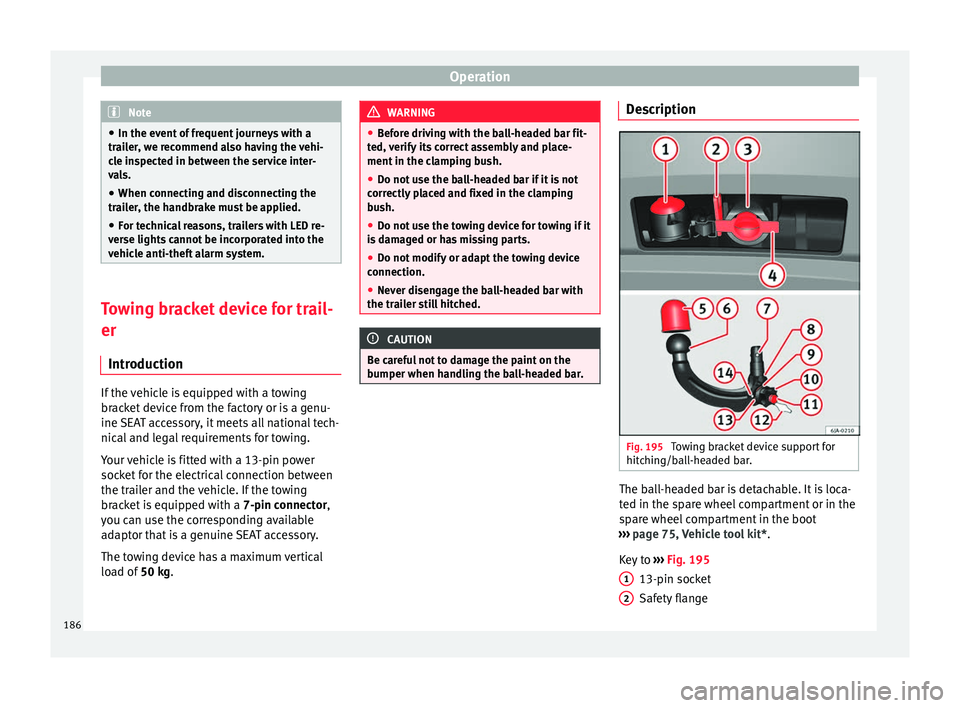
››› page 75, Vehicle tool kit*.
Key to ››› Fig. 195
13-pin socket
Safety flange
1 2
186
Page 189 of 248
Towing bracket device
Clamping bush
C l
ampin
g bush cap
Ball head cover
Ball-headed bar
Locking balls
Centred
Red marking on the manual regulator
Manual regulator
Key
Key slot cover
Red marking on the manual regulator
White marking on the ball-headed bar Note
Contact an Authorised Service Partner if you
lose y
our key. 3
4
5
6
7
8
9
10
11
12
13
14 Placing in service position
Fig. 196
Placing in service position. Fig. 197
Service position. Before assembling, place the ball-headed bar
in ser
v
ic
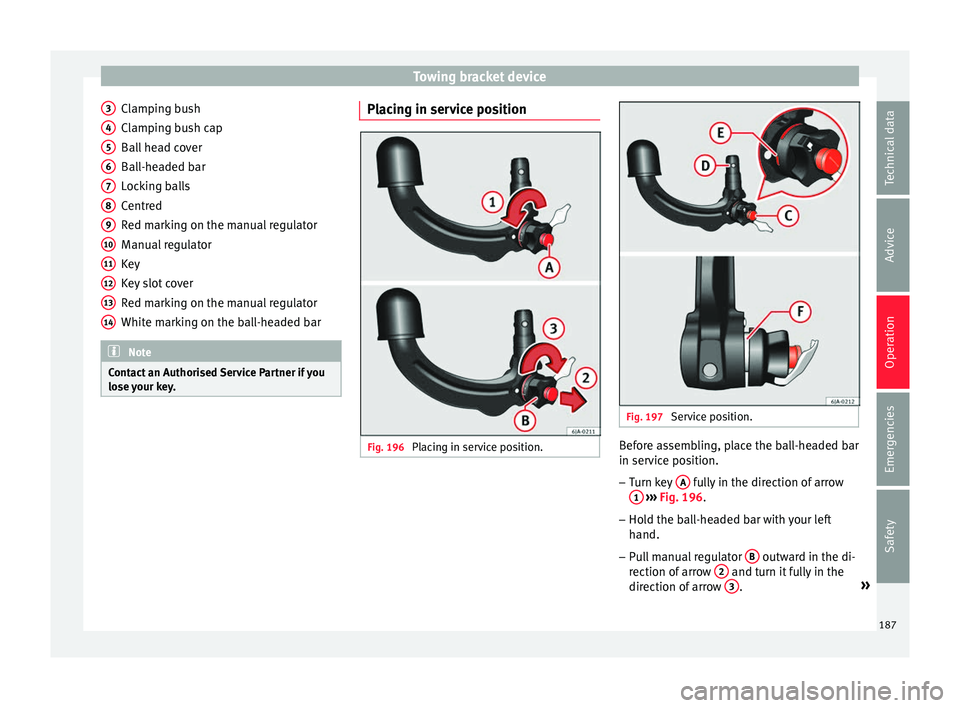
e position.
– Turn key A fully in the direction of arrow
1
› ›
› Fig. 196
.
– Hold the ball-headed bar with your left
hand.
– Pu
ll manual regulator B outward in the di-
r ection of
arr
ow 2 and turn it fully in the
dir ection of
arr
ow 3 .
»
187
Technical data
Advice
Operation
Emergencies
Safety
Page 191 of 248
Towing bracket device
– Verif
y
the correct placement of the ball-
headed bar ››› page 189. WARNING
● Do not ho l
d the manual regulator with your
hand when fitting the ball-headed bar since
you could sustain injuries to your fingers.
● When mounting the ball-headed bar, al-
way
s lock it with a key and remove the key
from the slot.
● The ball-headed bar must not be in the
servic
e position with the key in the key slot.
● If the ball-headed bar is not placed in the
servic
e position you will not be able to place
it in the clamping bush. CAUTION
When removing the key, always place the
co v
er over the key slot of the manual regula-
tor to prevent dirt from entering. Note
Once removed, place the clamping bush cap
in an appr opri
ate location in the boot. Verification of correct placement
Fig. 200
Correct placement of the ball-head-
ed b ar
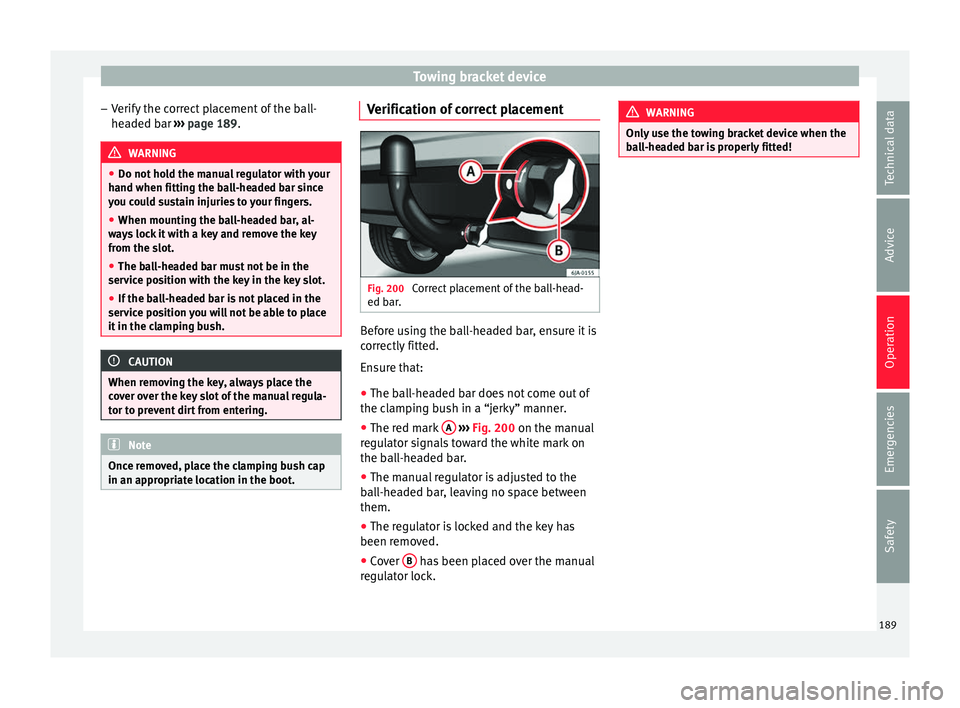
. Before using the ball-headed bar, ensure it is
c
orr
ectly
fitted.
Ensure that:
● The ball-headed bar does not come out of
the clampin
g bush in a “jerky” manner.
● The red mark A
› ›
› Fig. 200
on the manual
regulator signals toward the white mark on
the ball-headed bar.
● The manual regulator is adjusted to the
ball-he
aded bar, leaving no space between
them.
● The regulator is locked and the key has
been remov
ed.
● Cover B has been placed over the manual
r e gu
lator lock. WARNING
Only use the towing bracket device when the
ba l
l-headed bar is properly fitted! 189
Technical data
Advice
Operation
Emergencies
Safety
Page 193 of 248
Towing bracket device
●
Cle
an the ball-headed bar thoroughly be-
fore returning it to the on-board toolbox. Use and maintenance
Cover the clamping bush with the cap to pre-
vent
dir
t from entering.
Before hooking on the trailer, check the ball
head and, if necessary, lubricate it with ade-
quate lubricant.
Place the protective cover over the ball head
when storing the bar. This way, you will avoid
getting the boot dirty.
If it gets dirty, clean and dry the clamping
bush thoroughly with an appropriate prod-
uct. CAUTION
The top part of the clamping bush opening is
lubricat ed. B
e careful not to remove this lu-
brication. 191
Technical data
Advice
Operation
Emergencies
Safety
Page 224 of 248
Technical data
Partial description of the vehicle
Di amet
er of
authorised tyre in inches 1)
Type plate
The model plate is located at the bottom of
the B pillar, between the front and rear doors,
on the right-hand side.
The type plate indicates the following
weights:
● Total permitted weight of the vehicle when
loaded
● M
aximum authorised weight of the vehicle
with a trai
ler, when the vehicle operates as a
tractor
● Maximum permitted load of the front axle
● Maximum permitted load of the rear axle
Weight in ru
nning order
The weight in running order only has one ap-
proximate value. This value corresponds to
the minimum operative weight of the vehicle
without additional equipment that increases
its weight, i.e. air conditioning, spare wheel,
towing bracket.
The running order weight also includes 75 kg
of the weight of the driver and service fluids,
in addition to a fuel tank at 90% capacity. 4 5 From the difference between the total permit-
t
ed w
eight
in running order the approximate
carrying capacity can be calculated ››› .
The c arr
y
ing capacity must include:
● occupants,
● all pieces of equipment and other weights,
● roof loads including the roof rack,
● equipment that is not included in the run-
ning order w
eight,
● when using the towing bracket, the draw-
bar loa
d (max. 50 kg)
Calculating fuel consumption and CO 2 emis-
sions according to the ECE regulations and
the EU specifications
Calculation of fuel consumption for urban
driving begins when cold-starting the engine.
Then, normal city driving is simulated.
In calculating extra-urban driving fuel con-
sumption, braking and acceleration is done
in all gears, as in daily use of the vehicle.
Driving speed varies within a range of 0 and
120 km/h (75 mph).
The consumption value in combined driving
is composed of 37% of the value of urban
driving and 63% of the value of extra-urban
driving. WARNING
The maximum permitted weight values must
not be e x
ceeded – Risk of an accident and
damage to the vehicle! Note
● If y
ou wish to calculate the exact weight of
your vehicle please contact a SEAT dealer.
● Depending on the volume of equipment,
driving s
tyle, road conditions, weather condi-
tions and the condition of the vehicle, con-
sumption values can differ from the theoreti-
cal values stated here. Information on fuel consump-
tion
Fuel
c
onsumption Approved consumption values are derived
fr
om me
a
surements performed or supervised
by certified EU laboratories, according to the
legislation in force at the time (for more infor-
mation, see the Publications Office of the Eu-
ropean Union on the EUR-Lex website: © Eu-
ropean Union, http://eur-lex.europa.eu/) and
apply to the specified vehicle characteristics. 1)
Valid only for certain countries.
222
Page 225 of 248
Technical specifications
The values relating to fuel consumption and
C O
2 emi
s
sions can be found in the documen-
tation provided to the purchaser of the vehi-
cle at the time of purchase.
Fuel consumption and CO 2 emissions depend
on the equipment/features of each individual
vehicle, as well as on the driving style, road
conditions, traffic conditions, environmental
conditions, load or number of passengers. Note
In practice, and considering all the factors
mentioned here, c on
sumption values can dif-
fer from those calculated in the current Euro-
pean regulations. Weights
Kerb weight refers to the basic model with a
f
uel
t
ank filled to 90% capacity and without
optional extras. The figure quoted includes
75 kg to allow for the weight of the driver.
Special versions, optional equipment fittings
or retro-fitting accessories will increase the
weight of the vehicle ››› .
WARNING
● Ple a
se note that the centre of gravity may
shift when transporting heavy objects; this
may affect vehicle handling and lead to an ac-
cident. Always adjust your speed and driving style to suit road conditions and require-
ments.
●
Nev er e
xceed the gross axle weight rating
or the gros
s vehicle weight rating. If the per-
missible axle load or the permissible total
weight is exceeded, the driving characteris-
tics of the vehicle may change, which could
lead to accidents, injuries and damage to the
vehicle. Driving with a trailer
Tr ai
ler weights Trailer weight
The tr
ai
l
er weights and drawbar loads ap-
proved are selected in intensive trials accord-
ing to precisely defined criteria. The ap-
proved trailer weights are valid for vehicles in
the EU for maximum speeds of 80 km/h (50
mph) (in certain circumstances up to 100
km/h (62 mph)). The figures may be different
in other countries. All data in the official vehi-
cle documentation takes precedence over
these data at all times ››› .
Dr a
wb
ar loads
The maximum permitted drawbar load on the
ball joint of the towing bracket must not ex-
ceed 50 kg. In the interest of road safety, we recommend
that
you always tow approaching the maxi-
mum drawbar load. The response of the trail-
er on the road will be poor, if the drawbar
load is too small.
If the maximum permissible drawbar load
cannot be met (e.g. with small, empty and
light-weight single axle trailers or tandem
axle trailers with a wheelbase of less than 1
metre), a minimum of 4% of the actual trailer
weight is legally required for the drawbar
load. WARNING
● For s af
ety reasons, you should not drive at
speeds above 80 km/h (50 mph) when towing
a trailer. This also applies in countries where
higher speeds are permitted.
● Never exceed the maximum trailer weights
or the drawb
ar load. If the permissible axle
load or the permissible total weight is excee-
ded, the driving characteristics of the vehicle
may change, leading to accidents, injuries
and damage to the vehicle. 223
Technical data
Advice
Operation
Emergencies
Safety
Page 237 of 248
Index
Coming Home and Leaving Home Function . . . . 121
C ontr
o
l and warning lamps
alternator . . . . . . . . . . . . . . . . . . . . . . . . . . . . . 212
brakes . . . . . . . . . . . . . . . . . . . . . . . . . . . . . . . . 153
diesel particulate filter . . . . . . . . . . . . . . . . . . . 164
emission control . . . . . . . . . . . . . . . . . . . . . . . . 165
engine oil . . . . . . . . . . . . . . . . . . . . . . . . . . . . . 206
instrument panel . . . . . . . . . . . . . . . . . . . . . . . . 34
lights . . . . . . . . . . . . . . . . . . . . . . . . . . . . . . . . . 116
Controls and displays general instrument panel . . . . . . . . . . . . . . . . . . 93
Controls on the steering wheel operating the audio system . . . . . . . . . . . . . . . 101
operating the telephone and audio system . . 102
Cooling system checking coolant . . . . . . . . . . . . . . . . . . . . . . . 208
engine coolant temperature display . . . . . . . . . 97
topping up coolant . . . . . . . . . . . . . . . . . . . . . . 208
Correct position . . . . . . . . . . . . . . . . . . . . . . . . . . . 56
Correct sitting position front passenger . . . . . . . . . . . . . . . . . . . . . . . . . 57
rear seat passengers . . . . . . . . . . . . . . . . . . . . . 58
Cruise control . . . . . . . . . . . . . . . . . . . . . . . . 31, 174 adjusting the stored speed . . . . . . . . . . . . . . . 175
setting the speed . . . . . . . . . . . . . . . . . . . . . . . 175
temporary deactivation . . . . . . . . . . . . . . . . . . 175
turning off the cruise control system . . . . . . . 176
D Damage to the vehicle . . . . . . . . . . . . . . . . . . . . . 166
Dash panel . . . . . . . . . . . . . . . . . . . . . . . . . . . . . . . 32
Data sticker . . . . . . . . . . . . . . . . . . . . . . . . . . . . . . 221
Deactivating the front passenger front airbag . . . 14
Deactivation of front airbag . . . . . . . . . . . . . . . 68, 71
Defrosting rear window . . . . . . . . . . . . . . . . . . . . 123
Diesel diesel particulate filter . . . . . . . . . . . . . . . . . . . 164 engine oil . . . . . . . . . . . . . . . . . . . . . . . . . . . . . 205
preheatin
g . . . . . . . . . . . . . . . . . . . . . . . . . . . . 149
refuelling . . . . . . . . . . . . . . . . . . . . . . . . . . . . . . 201
Diesel particulate filter malfunction . . . . . . . . . . . . . . . . . . . . . . . . . . . . 164
Digital clock . . . . . . . . . . . . . . . . . . . . . . . . . . . . . . 94
Dimensions . . . . . . . . . . . . . . . . . . . . . . . . . . . . . . 231
Direction of rotation tyres . . . . . . . . . . . . . . . . . . . . . . . . . . . . . . . . . . . 49
Display . . . . . . . . . . . . . . . . . . . . . . . . . . . . . . . 94, 95
Disposal seat belt tensioners . . . . . . . . . . . . . . . . . . . . . . 66
Door cylinder . . . . . . . . . . . . . . . . . . . . . . . . . . . . . . 9
Door handle . . . . . . . . . . . . . . . . . . . . . . . . . . . . . . . 9
Door lock . . . . . . . . . . . . . . . . . . . . . . . . . . . . . . . . . . 9
Doors child-proof locking . . . . . . . . . . . . . . . . . . . . . . 112
opening and closing . . . . . . . . . . . . . . . . . . . . . . 9
Drink holder centre console . . . . . . . . . . . . . . . . . . . . . . . . . 132
rear seat armrest . . . . . . . . . . . . . . . . . . . . . . . 133
Driver see Correct sitting position . . . . . . . . . 56, 57, 58
Driver information system CD/radio indication . . . . . . . . . . . . . . . . . . . . . . 23
engine oil temperature display . . . . . . . . . . . . . 28
operation with the windscreen wiper lever . . . . 23
Driving abroad headlights . . . . . . . . . . . . . . . . . . . . . . . . . . . . . 122
Driving data . . . . . . . . . . . . . . . . . . . . . . . . . . . . . . 23 data summary . . . . . . . . . . . . . . . . . . . . . . . . . . . 27
memory . . . . . . . . . . . . . . . . . . . . . . . . . . . . . . . . 26
Driving through water . . . . . . . . . . . . . . . . . . . . . 166
Driving with a trailer . . . . . . . . . . . . . . . . . . 184, 223
Dynamic headlight range control . . . . . . . . . . . . 117 E
E10
see
Ethanol (fuel) . . . . . . . . . . . . . . . . . . . . . . . 200
Easy Connect . . . . . . . . . . . . . . . . . . . . . . . . . . 21, 99
Economical driving . . . . . . . . . . . . . . . . . . . . . . . . . . . . . . . . 162
EDL see Electronic differential lock . . . . . . . . 154, 156
Efficiency programme additional electrical appliances . . . . . . . . . . . . 28
saving tips . . . . . . . . . . . . . . . . . . . . . . . . . . . . . . 28
Electric windows . . . . . . . . . . . . . . . . . . . . . . 11, 115
Electronic differential lock . . . . . . . . . . . . . 154, 156
Electronic immobiliser . . . . . . . . . . . . . . . . . . . 9, 150
Electronic Stability Control (ESC) . . . . . . . . . . . . 154
Emergencies . . . . . . . . . . . . . . . . . . . . . . . . . . . . . . 75 automatic gearbox backup programme . . . . . 160
bulbs . . . . . . . . . . . . . . . . . . . . . . . . . . . . . . . . . . 44
changing a wheel . . . . . . . . . . . . . . . . . . . . . 46, 75
emergency towing of the vehicle . . . . . . . . . . . . 50
hazard warning lights . . . . . . . . . . . . . . . . . . . 121
jump leads . . . . . . . . . . . . . . . . . . . . . . . . . . . . . 51
puncture . . . . . . . . . . . . . . . . . . . . . . . . . . . . . . . 44
replacing a blown fuse . . . . . . . . . . . . . . . . . . . . 43
Emergency fuses . . . . . . . . . . . . . . . . . . . . . . . . . . . . . . . . . . 43
Emergency operation front passenger door . . . . . . . . . . . . . . . . . . . . . 10
selector lever . . . . . . . . . . . . . . . . . . . . . . . . . . . 35
Emission control system control lamp . . . . . . . . . . . . . . . . . . . . . . . . . . . 165
Emissions data . . . . . . . . . . . . . . . . . . . . . . . . . . . 221
Engine assisted starting . . . . . . . . . . . . . . . . . . . . . . . . . 51
preheating . . . . . . . . . . . . . . . . . . . . . . . . . . . . 149
run-in . . . . . . . . . . . . . . . . . . . . . . . . . . . . . . . . . 161
Start-Stop system . . . . . . . . . . . . . . . . . . . . . . . 181
235
Page 241 of 248
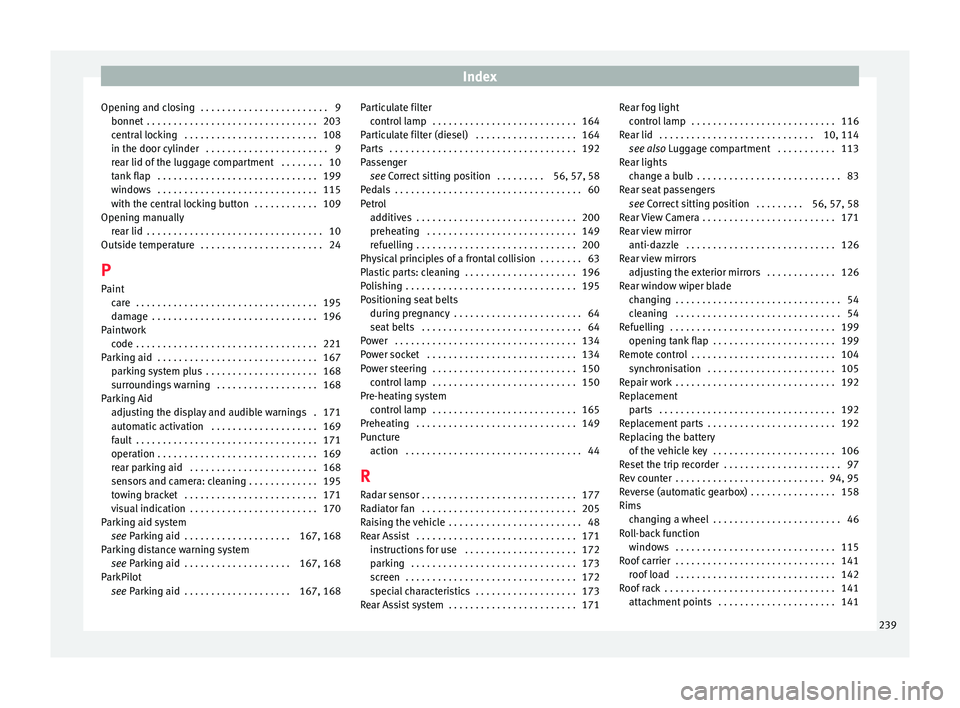
Index
Opening and closing . . . . . . . . . . . . . . . . . . . . . . . . 9 bonnet . . . . . . . . . . . . . . . . . . . . . . . . . . . . . . . .
203
c entr
al locking . . . . . . . . . . . . . . . . . . . . . . . . . 108
in the door cylinder . . . . . . . . . . . . . . . . . . . . . . . 9
rear lid of the luggage compartment . . . . . . . . 10
tank flap . . . . . . . . . . . . . . . . . . . . . . . . . . . . . . 199
windows . . . . . . . . . . . . . . . . . . . . . . . . . . . . . . 115
with the central locking button . . . . . . . . . . . . 109
Opening manually rear lid . . . . . . . . . . . . . . . . . . . . . . . . . . . . . . . . . 10
Outside temperature . . . . . . . . . . . . . . . . . . . . . . . 24
P Paint care . . . . . . . . . . . . . . . . . . . . . . . . . . . . . . . . . . 195
damage . . . . . . . . . . . . . . . . . . . . . . . . . . . . . . . 196
Paintwork code . . . . . . . . . . . . . . . . . . . . . . . . . . . . . . . . . . 221
Parking aid . . . . . . . . . . . . . . . . . . . . . . . . . . . . . . 167 parking system plus . . . . . . . . . . . . . . . . . . . . . 168
surroundings warning . . . . . . . . . . . . . . . . . . . 168
Parking Aid adjusting the display and audible warnings . 171
automatic activation . . . . . . . . . . . . . . . . . . . . 169
fault . . . . . . . . . . . . . . . . . . . . . . . . . . . . . . . . . . 171
operation . . . . . . . . . . . . . . . . . . . . . . . . . . . . . . 169
rear parking aid . . . . . . . . . . . . . . . . . . . . . . . . 168
sensors and camera: cleaning . . . . . . . . . . . . . 195
towing bracket . . . . . . . . . . . . . . . . . . . . . . . . . 171
visual indication . . . . . . . . . . . . . . . . . . . . . . . . 170
Parking aid system see Parking aid . . . . . . . . . . . . . . . . . . . . 167, 168
Parking distance warning system see Parking aid . . . . . . . . . . . . . . . . . . . . 167, 168
ParkPilot see Parking aid . . . . . . . . . . . . . . . . . . . . 167, 168 Particulate filter
contro l lamp . . . . . . . . . . . . . . . . . . . . . . . . . . . 164
Particulate filter (diesel) . . . . . . . . . . . . . . . . . . . 164
Parts . . . . . . . . . . . . . . . . . . . . . . . . . . . . . . . . . . . 192
Passenger see Correct sitting position . . . . . . . . . 56, 57, 58
Pedals . . . . . . . . . . . . . . . . . . . . . . . . . . . . . . . . . . . 60
Petrol additives . . . . . . . . . . . . . . . . . . . . . . . . . . . . . . 200
preheating . . . . . . . . . . . . . . . . . . . . . . . . . . . . 149
refuelling . . . . . . . . . . . . . . . . . . . . . . . . . . . . . . 200
Physical principles of a frontal collision . . . . . . . . 63
Plastic parts: cleaning . . . . . . . . . . . . . . . . . . . . . 196
Polishing . . . . . . . . . . . . . . . . . . . . . . . . . . . . . . . . 195
Positioning seat belts during pregnancy . . . . . . . . . . . . . . . . . . . . . . . . 64
seat belts . . . . . . . . . . . . . . . . . . . . . . . . . . . . . . 64
Power . . . . . . . . . . . . . . . . . . . . . . . . . . . . . . . . . . 134
Power socket . . . . . . . . . . . . . . . . . . . . . . . . . . . . 134
Power steering . . . . . . . . . . . . . . . . . . . . . . . . . . . 150 control lamp . . . . . . . . . . . . . . . . . . . . . . . . . . . 150
Pre-heating system control lamp . . . . . . . . . . . . . . . . . . . . . . . . . . . 165
Preheating . . . . . . . . . . . . . . . . . . . . . . . . . . . . . . 149
Puncture action . . . . . . . . . . . . . . . . . . . . . . . . . . . . . . . . . 44
R
Radar sensor . . . . . . . . . . . . . . . . . . . . . . . . . . . . . 177
Radiator fan . . . . . . . . . . . . . . . . . . . . . . . . . . . . . 205
Raising the vehicle . . . . . . . . . . . . . . . . . . . . . . . . . 48
Rear Assist . . . . . . . . . . . . . . . . . . . . . . . . . . . . . . 171 instructions for use . . . . . . . . . . . . . . . . . . . . . 172
parking . . . . . . . . . . . . . . . . . . . . . . . . . . . . . . . 173
screen . . . . . . . . . . . . . . . . . . . . . . . . . . . . . . . . 172
special characteristics . . . . . . . . . . . . . . . . . . . 173
Rear Assist system . . . . . . . . . . . . . . . . . . . . . . . . 171 Rear fog light
contro l lamp . . . . . . . . . . . . . . . . . . . . . . . . . . . 116
Rear lid . . . . . . . . . . . . . . . . . . . . . . . . . . . . . 10, 114 see also Luggage compartment . . . . . . . . . . . 113
Rear lights change a bulb . . . . . . . . . . . . . . . . . . . . . . . . . . . 83
Rear seat passengers see Correct sitting position . . . . . . . . . 56, 57, 58
Rear View Camera . . . . . . . . . . . . . . . . . . . . . . . . . 171
Rear view mirror anti-dazzle . . . . . . . . . . . . . . . . . . . . . . . . . . . . 126
Rear view mirrors adjusting the exterior mirrors . . . . . . . . . . . . . 126
Rear window wiper blade changing . . . . . . . . . . . . . . . . . . . . . . . . . . . . . . . 54
cleaning . . . . . . . . . . . . . . . . . . . . . . . . . . . . . . . 54
Refuelling . . . . . . . . . . . . . . . . . . . . . . . . . . . . . . . 199 opening tank flap . . . . . . . . . . . . . . . . . . . . . . . 199
Remote control . . . . . . . . . . . . . . . . . . . . . . . . . . . 104 synchronisation . . . . . . . . . . . . . . . . . . . . . . . . 105
Repair work . . . . . . . . . . . . . . . . . . . . . . . . . . . . . . 192
Replacement parts . . . . . . . . . . . . . . . . . . . . . . . . . . . . . . . . . 192
Replacement parts . . . . . . . . . . . . . . . . . . . . . . . . 192
Replacing the battery of the vehicle key . . . . . . . . . . . . . . . . . . . . . . . 106
Reset the trip recorder . . . . . . . . . . . . . . . . . . . . . . 97
Rev counter . . . . . . . . . . . . . . . . . . . . . . . . . . . . 94, 95
Reverse (automatic gearbox) . . . . . . . . . . . . . . . . 158
Rims changing a wheel . . . . . . . . . . . . . . . . . . . . . . . . 46
Roll-back function windows . . . . . . . . . . . . . . . . . . . . . . . . . . . . . . 115
Roof carrier . . . . . . . . . . . . . . . . . . . . . . . . . . . . . . 141 roof load . . . . . . . . . . . . . . . . . . . . . . . . . . . . . . 142
Roof rack . . . . . . . . . . . . . . . . . . . . . . . . . . . . . . . . 141 attachment points . . . . . . . . . . . . . . . . . . . . . . 141
239