length SKODA 105S 1980 User Guide
[x] Cancel search | Manufacturer: SKODA, Model Year: 1980, Model line: 105S, Model: SKODA 105S 1980Pages: 238, PDF Size: 47.09 MB
Page 117 of 238
5. Turning force
of box and column only. The
maximum permitted
turning force of the box and
column only (drag
link
attached to steering box
but allowed to slide freely
across idler) is 1.2kg
2.5lbs when test is carried out as in (2).
lf the force
is excessive, lubricate
universal joints
and check
thatthe drag link assembly is free to move. Repeat
test. lf still excessive remove
the steering box,
which can be removed
with the track rod still
attached.
TIME ALLOWANCE 5 mins.
6. Turning force to rotate
Steering Box input
shaft. With some form
of coupling (coupling from
'S'
type Steering Box) test the force required to
rotate the shaft; maximum prmitted
torque0.1 6kg
1.16ft lbs.
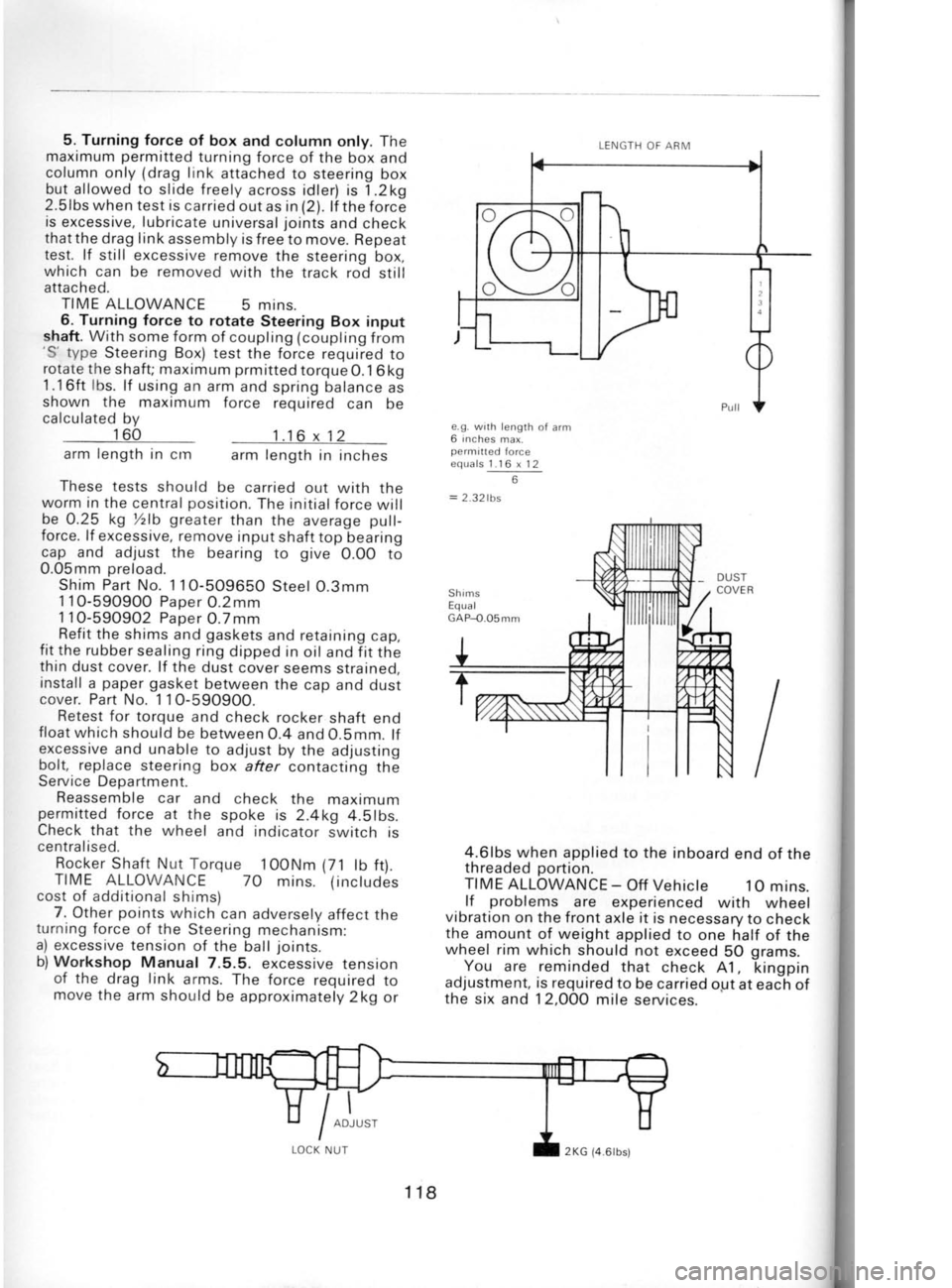
lf using an arm and spring balance as
shown the maximum force required
can be
calculated bv
160
arm length
in crn
arm length
in inches
These tests should be carried out with the
worm in the central position.
The initial force will
be 0.25 kg %lb greater
than the average pull-
force. lf excessive, remove
input shaft top bearing
cap and adjust the
bearing to give
0.OO to
0.05mm preload.
Shim Part No. 11O-509650
Steel O.3mm
1 10-59O90O Paoer
O.2mm
1 10-590902 Paper
O.7mm
Refit the shims and gaskets
and retaining cap,
fit the rubber sealing ring
dipped in oil and f it the
thin dust cover. lf the dust cover seems strained,
install a paper
gasket
between the cap and dust
cover. Part No. 1 1O-5909O0.
Retest for torque
and check rocker
shaft end
float which should be between
O.4 and O.5mm. lf
excessive and unable to adjust by the adjusting
bolt, replace steering box after contacting
the
Service Department.
Reassemble car and check the maxtmum
permitted force at the
spoke is 2.4kg 4.5lbs.
Check that the wheel
and indicator switch is
ce ntra lised.
Rocker Shaft Nut Torque
100Nm (71
lb ft).
TIME ALLOWANCE
7O mins. (inctudes
cost of additional shims)
7. Other points
which can adversely
affect the
turning force of the
Steering mechanism:
a) excessive tension
of the ball joints.
b) Workshop
Manual 7.5.5. excessive tenston
of the drag link
arms. The force required to
move the arm should be approximately 2kg or e.g.
wrth length
of arm
6 inches
max.
permitted force
equals 1.16 x 12
6
= 2.32lbs
DUST
COVER
4.6lbs when applied to the inboard
end of the
threaded portion.
TIME ALLOWANCE -
Off Vehicte 1O mins.
lf problems
are experienced
with wheel
vibration on the front
axle it is necessary to check
the amount of weight applied to one half of the
wheel rim which should not exceed
50 grams.
You are reminded
that check A1, kingpin
adjustment, is required
to be carried ogt at each of
the six and 12,0OO mile services.
1.16 x12
UST
I
ADJ
UT LENGTH
OF ARM
118 2KG
{4.6lbs)
Page 137 of 238

I
I
T
!
(
(
t I
t
t
t I
'l
(
r
o cc
fold
ot the moment of
the opplicotion of the
brokes, ond led
through o rubber hose (tube)
to
the booster.
Removol ond Refitting
The broke booster is held down on the pedol
brocket by nuts ond spring
woshers. The lug of
the control volve press
button connects it with
the broke pedol,
on which it is secured by o re-
toining ring. These
mounting ports
or the con-
nections of the vocuum supply
ore to be hondl-
ed only when removing
or refitting the broke
booster.
However, we odvise you
to hove this
iob done
in o speciolized
repoir shop properly
instructed
by the broke
monufocturer. All rubber ports (in
the terms of current mointenonce,
this is
procticolly the seol of the press
button control-
ling the moster cylinder)
must be protected
from the effects of the broke fluid or other
lubriconts. Use petrol
for cleoning the rubben
ports.
Adiustment 1. Adiust the cleononce
between the broke
booster press
button ond the cylinder piston
whenever the moster
cylinder or the'broke
booster ore reploced,
or whenever there is ony
doubt concerning
the correctness
of the os-
sembly of the moster cylinder
with the broke
booster. Meosure the distonce between the
cylinder bottom recess
ond the cylinder flonge
nroting surfoce os well os the length of the
press button protruding
over the moting surfoce
of the booster.
Compore the meosurings
ond
odiust the length of the press
button by rototing
its threoded
end to obtoin o cleoronce of 0.5 to
1 mm between the press
button ond the piston.
Still better, you
can use special
tools Mp6.
'14'lA.
Fit it on the
moster cylinder, push
its spindle into the cylinder till its rounded
end
rests ogoinst
the piston,
ond lock it in this po-
sitio-n with the respective
retoining screw.
Apply
the fixture to the booster
ond rotote the boostei press
button so thot it
iust touches the
lower
flot port
of the fixture spindle.
2. lf it is necessory
to level
the broke pedol
with the clutch pedol,
odiust the length
of the
contnol volve press
button lug.
Remove the broke
booster from the pedol
brocket, slip off the collor (cup),
connect the
booster with the pedol,
ond refit it tempororily
to the brocket.
Now rotote the hexogon on the
threods of the lug till both the clutch ond broke
pedol ore level. Remove once more the booster
from the pedol
ond pedol
brocket, neinstoll the
collor (cup),
ond complete the f inol reossembly.
9.7 BRAKE FLUID TANK, PIPING AND HOSES
Tonk ond Filling Hose
The broke fluid tonk is held in position
in its
brocket by o slip-over
clomp. Speciol rubber
hoses connect it with the broke ond clutch
moster cylinders.
Hose clips ore used to secure
the hoses on the tonk outlet sockets.
Both the
side ond centre outlet of the tonk ore con-
nected to the bnoke moster cylinder, the third
outlet being connected to the clutch moster
cylinder (see Fig. 12.111).
Pressure Piping ond Hoses
The rigid port
of the hydroulic line consists
of speciol steel pipes.
Their connections with
other ports of the line ore seoled off by clomp-
ing on the conicol surfoces-
lf these conicol surfoces
become domoged,
remove them ond form new ones by floring the
pipes. To do this, use the coulking holder,
type
MP 9-151. Clomp the pipe
in the holder so thot
it is level with its upper edge ond flore the pipe
with c coulking chisel. The holder is designed
to be clomped in o vice.
The holder
hos two drilled holes of 5 ond
6 mm in diometer so thot it con be used olso for
repoirs of pipes
of the clutch line. For dio.
5 mm holes, use the MP 9-152 ond for dio. 6 mm
holes, the MP 9-153 coulking chisel.
The flexiblepqrt
of the hydroulic line consists
of speciol hoses.
When fitting them to the reor
wheel cylinders, turn them in o position
which
will prevent
their contoct with ony ports
of the
cor in both extreme positions
of the cor sus-
pension. This is why the nipples ot the reor
wheels ore inclined
downword through on
ongle of 30 degrees from
the horizontol plone.
9.8 HAND BRAKE
The hond-broke
lever between the front seots
controls the tie-rod which octuotes the rocker
(see Fig.9.8/1). Cobles connected
to the rocker
Fig. 9.612
-
Broke Booster Press
Button
Adiusting Fixture
MP6 141A tx r5?2
140
Page 141 of 238
r 0.3-t0,5
Ihe permissible
out-of-bolonce must not ex-
ceed 50 grommes
on the rim rodius. Every new
tyre is provided
with o coloured dot on its side,
indicoting its lightest point.
Fit the tyre olwoys
with this dot focing
the tube volve.
ln this
position, the volve octs os on odditionol weight
compensoting the wheel overoll unbolonce to
o consideroble extent.
lf dynomic boloncing of the wheel is not
possible, bolonce the wheel stoticolly with the
greotest possible qssuroc|.
Boloncing weights
of 30, 50, 75,
ond 100 grommes
ore ovoiloble.
10.4 TUBED TYRES
For mounting,
dismounting,
ond repoirs of
conventionol tyres with inner tubes (for
por-
ticulors, see the preceding
Chopters), the usuol
procedures ore opplicoble. The permissible run-
out (untrue
running)
of the rim is the some os
for tubeless tyres (Chopter
10.5).
10.5 TUBELESS TYRES
The oir-tight seoling of these tyres requires
more core ond o different hondling thon thot of
the tyres with inner
tubes.
Preporotlon of Rirrr
13elore mounting the tyre, inspect the rim for
ony technicol defects. The points
to be checked
ore the rim shoulder ond the moting foce for
the tyre beods,
in oddition to the overoll con-
dition of the rim. lf ony defects ore found, the
rim must be reconditioned.
A sotisfoctory rim
nrust comply with the following conditions:
o) The
rim shoulder ond the tyre volve hole
must not be distorted;
there must be no
shcrp edges or protrusions
likely to domoge
the tyre beod. Minor unevennesses
con be
hornmered flot ond smoothed
with o file.
The moximum eccentric running
of the rim
side must not exceed 1.5 mm.
b) The moting surfoces
must be obsolutely
cleon (free
from stuck-on rubber, rust,
etc.).
Cleon them with emery poper
or o wire brush
ond coot them with point.
lnstolling of Tyre
Volve
Cleon the rim with o dry rog. Push
the rubber
volve into
the hole in the rim
or pull
it in
by
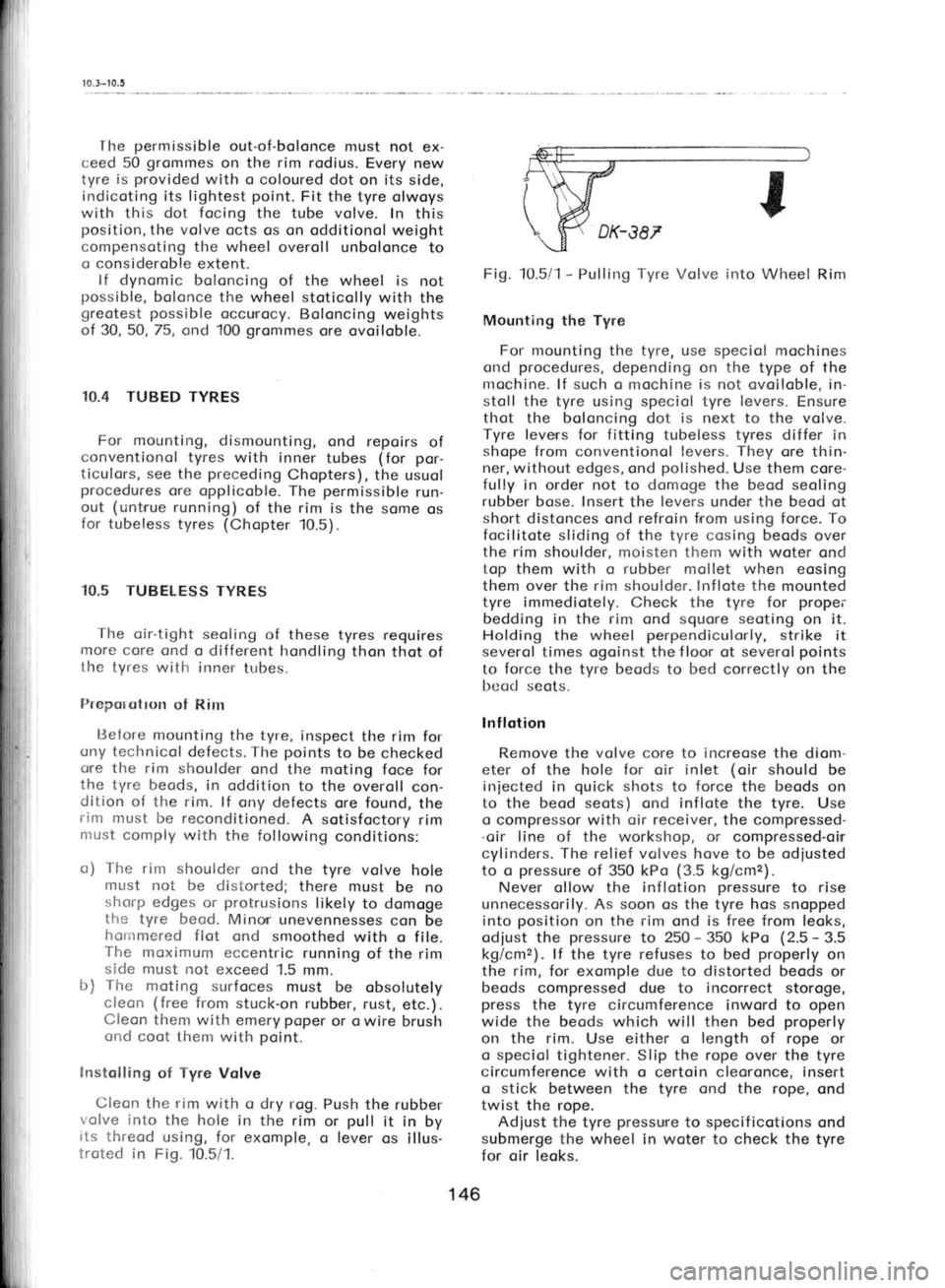
its threod using, for exomple,
o lever
os illus-
troted in Fig. 10.5/1. Fig. 10.5/1
-
Pulling Tyre Volve
irrto Wheel Rim
Mounting the Tyre
For mounting the tyre, use speciol mochines
ond procedures,
depending on the type of the
nrochine. lf such o mochine is not ovoiloble, in-
stoll the tyre using speciol tyre levers.
Ensure
thot the boloncing dot is next to the volve.
Tyre leverrs for fitting tubeless tyres
differ in
shope from conventionol levers. They
ore thin-
ner, without edges, ond polished.
Use them core-
fully in order not to domoge the
beod seoling
rubber bose. Insert the levers
under the beod
ot
short distonces ond refroin from using force. To
focilitote sliding of the tyre cosing beods over
the rim shoulder, moisten them with woter ond
top them with o rubber
mollet when eosing
them over the rim shoulder. Inflote
the mounted
tyre immediotely. Check the tyre for propei'
bedding in the rim ond
squore seoting
on it.
Holding the wheel perpendiculorly,
strike it
severol times ogoinst the f loor ot severol points
to force the tyre beods
to bed
correctly on the
bcad seots.
lnf lotion
Remove the volve
core to increose
the diom-
eter of the hole for oir inlet (oir
should be
iniected in quick
shots to force
the beods
on
to the beod seots) ond inflote the tyre. Use
o compressor with oir receiver, the
compressed-
.oir line of the
workshop, or
compressed-oirr
cylinders. The relief volves hove to be odiusted
to o pressure
of 350 kPo (3.5
kg/cmz).
Never ollow the inflotion pressure
to rise
unnecessorily. As soon os the tyre hos snopped
into position
on the rim
ond is free from leoks,
odiust the pressure
to 250 -
350 kPo (2.5 -
3.5
kg/cmz). lf the tyre refuses to
bed properly
on
the rim,
for exomple due to distorted beods or
beods compressed due to incorrect storoge,
press the tyre circumference inword to open
wide the beods which will then bed properly
on the rim. Use either o length of
rope or
o speciol tightener. Slip the rope over the
tyre
circumference with o certoin cleoronce, insert
o stick
between the tyre ond the rope, ond
twist the rope.
Adiust the tyre pressure
to specif
icotions ond
submerge the wheel in woter to check the
tyre
for oir leoks.
146
Page 146 of 238
11.4-11.5
I
I
I
F
r
t'
on to the coolont tonk.
Hose
clips ore formed
either by metol strips
or lengths
of wire. When
tightening the wire clips, toke core not to
domoge the rubber of the hoses.
To Fosten Pipes ond
Hoses
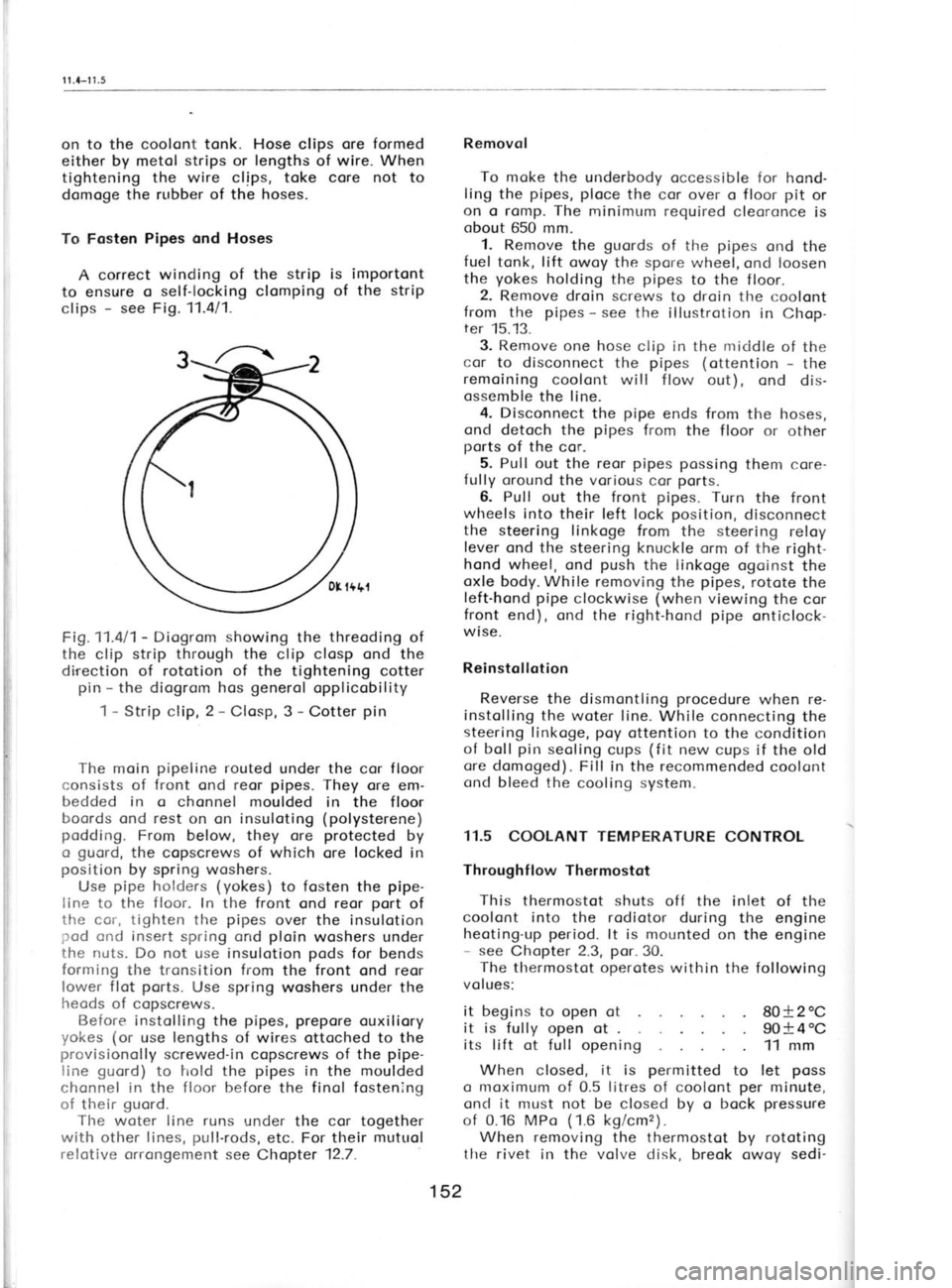
A correct winding of the strip is importont
to ensure o self-locking clomping of the strip
clips -
see Fig. 11.411.
Fig.11.Al1- Diogrom showing
the threoding
of
the clip strip through
the clip closp ond
the
direction of rototion of
the tightening cotter
pin -
the diogrom hos generol
opplicobility
1 -
Strip clip,2 -
Closp, 3 -
Cotter pin
The moin pipeline
routed under the cor f loor
consists of front ond reor pipes.
They ore em-
bedded in o chonnel moulded in the floor
boords ond rest on on insuloting (polysterene)
podding. From below, they ore protected
by
o guord,
the copscrews of which ore locked
in
position by spring woshers.
Use pipe
holders (yokes) to fosten the pipe-
line to the floor. In
the front
ond reor port
of
the cor, tighten
the pipes
over the insulotion
lrod ond insert
spring ond ploin
woshers under
the nuts.
Do not use insulotion pods
for bends
forming the tronsition from
the front
ond reor
lower flot ports.
Use spring woshers under
the
heods of copscrews.
Before instolling the pipes, prepore
ouxiliory
yokes (or use lengths of wires ottoched to the
provisionolly screwed-in copscrews of the pipe-
line guord) to liold the pipes
in the moulded
chonnel in
the floor before
the finol fostening
of their guord.
The woter line runs
under the cor together
with other lines, pull-rods,
etc. For their mutuol
ref otive orrongement see Chopter 12.7. Removol
To moke the underbody occessible for hond-
ling the pipes,
ploce
the cor over o floor pit
or
on o romp. The minimum required cleoronce is
obout 650 mnr.
1. Remo.re the guords
of the pipes
ond the
fuel tonk, lift owoy the spore wheel, ond loosen
the yokes
holding the pipes
to the floor.
2. Remove droin screws to droin the coolont
from the pipes -
see the illustrotion in Chop-
ter 15.'13.
3. Remove one hose clip in the middle
of the
cor to disconnect
the pipes
(ottention -
the
remoining coolont will f low out), ond dis-
ossemble the line.
4. Disconnect the pipe
ends from the hoses,
ond detoch the pipes
from the floor or other
ports of the cor.
5. Pull out the reor pipes
possing
them core-
fully oround the vorious cor ports.
6. Pull out the front pipes.
Turn
the front
wheels into their left lock position,
disconnect
the steering linkoge from the steering
reloy
lever ond the steering knuckle orm of the
right-
hond wheel, ond push
the linkoge ogoinst the
oxle body. While removing the pipes,
rotote the
left-hond pipe clockwise (when
viewing the cor
front end), ond the right-hond pipe
onticlock-
wise.
Reinstollotion Reverse the dismontling procedure
when re-
instolling the woter line. While connecting the
steering linkoge, poy
ottention to the condition
of boll pin
seoling cups (fit
new cups if the old
ore domoged). Fill in the recommended
coolont
ond bleed the cooling system.
11.5 COOLANT TEMPERATURE CONTROL
Throughf low Thermostot
This thermostot shuts off the inlet of the
coolont into the rodiotor
during the engine
heoting-up period. lt is mounted on the engine
- see Chopter 2.3, por.
30.
The thermostot operotes within the following
volues:
it begins to open ot 80+2"C
it is fully open ot 90+4oC
its lift ot full opening
11 mm
When closed, it
is permitted
to let poss
o nroximum
of 0.5 litres
of coolont per
minute,
ond it must not be closed by o bock pressure
of 0.16 MPo (1.6
kg/cm2).
When removing the thermostot by rototing
tlre rivet in the volve disk, breok owoy sedi-
I i
i 152
Page 148 of 238
c
I'
b
o ir
fi$r
++$$
$$fr0$0$$$$$. $'$j,$,0$$$$+$
t'$'i$$0',$$$$ 0 0
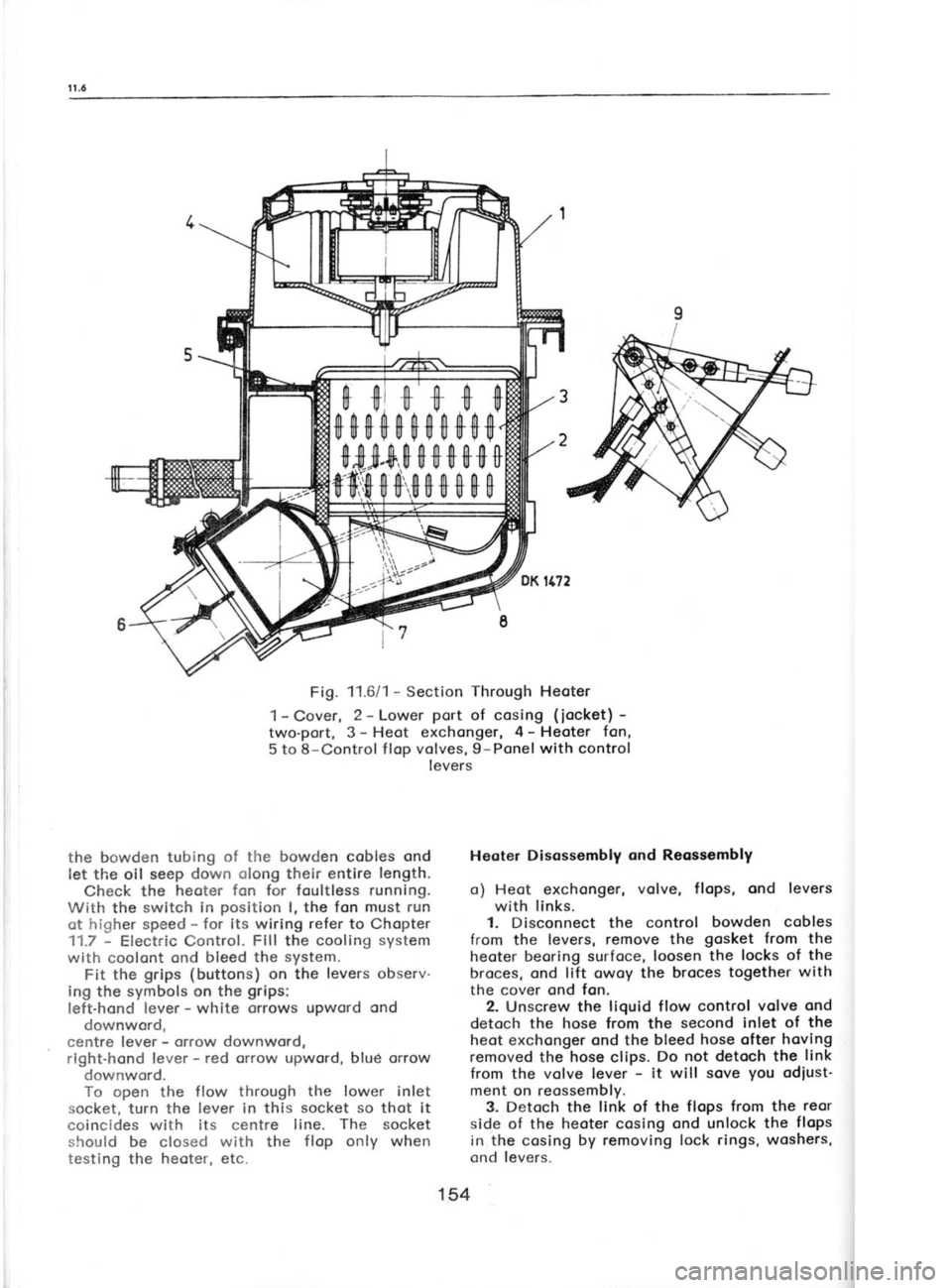
Fig. 11.6/1 -
Section Through
Heoter
1- Cover, 2 -
Lower port
of cosing (iocket) -
two-port, 3- Heot exchonger, 4-
Heoter fan,
5 to 8-Control f lop volves, 9-Ponel with control
levers
the bowden tubing of the
bowden cobles ond
let the oil seep down olong
their entire length.
Check the heoter fon for foultless running.
With the switch in position
I, the fon must run
ot higher speed -
for its wiring refer
to Chopter
11.7 -
Electric Control. Fill
the cooling system
with coolont ond bleed the system.
Fit the grips (buttons)
on the levers observ-
ing the symbols on the grips:
left-hond lever -
white orrows upword ond
downword,
centre lever -
orrow downword,
right-hond lever -
red orrow upword, blud orrow
downword.
To open the flow through the lower inlet
socket, turn the lever in this socket so
thot it
coincides with its centre line. The socket
should be closed with
the flop only
when
testing the heoter, etc. Heoter Disossembly
ond Reossembly
o) Heot exchonger, volve,
flops, ond levers
with links.
1. Disconnect the control bowden
cobles
from the levers, remove the gosket
from the
heoter beoring surfoce, loosen the
locks of the
broces, ond lift owoy the broces together
with
the cover ond fon.
2. Unscrew the liquid flow control volve ond
detoch the hose from
the second
inlet of the
heot exchonger ond the bleed hose ofter hoving
removed the hose
clips. Do not detoch
the link
from the volve lever -
it will sove you
odiust'
ment on reossembly.
3. Detoch the link of the flops from the reor
side of the heoter cosing ond unlock the flops
in the cosing by removing lock rings, woshers,
ond levers.
154
Page 173 of 238

I
I
t
b
c ll
e
c
tl
d n
tN'
>
\'
J I
(Il
qt3
Fig. 13.5i3 -
Vocuum Control Course -
opplicoble to both
regulotor models
copscrew fostening the distributor brocket to
the support on the engine (do
not loosen the
brocket clomping bolt).
Refit the distributor on the engine by
re-
versing this procedure. The
coupling on
tlre
shoft is osymmetricol ond it hos to engoge into
the heod of the drive shoft in the engine. To
seot properly
o new distributor
or o distributor,
the brocket of which hos
been loosened, refer
to Chopter 2.3, por.25
to 27.
Distributor Disossembly ond Reossembly
This should be done in speciolizedworkshops,
especiolly with regord
to the checking of the
mechonicol condition or o repoir
of the dis-
tributor. lt is recommended
to use o suitoble
holder for doing the moiority of the required
iobs in
o verticol position.
When reossembling
the distributor, lubricote
the sliding points
oc-
cording to Chopter 15.3
but bewore of over-
lubricotion.
Remove olso the copscrew
on the bottom of
the distributor housing ond drip some low-pour
point oil into the hole to increose the oil reserve
of the shoft
sel-lubricoting beoring -
see Chop-
ter 15.2 "Speciol
Oils".
Disossembly 1. Remove the distributor cop ond the breoker
orm.
2. Remove the coupling from the shoft (note
the relotive position
of the eccentric dogs ond
the breoker
orm).
3. Remove
the circlip from
the pivot
ond litt
owoy the breoker orm.
4. Remove
the subossembly
of the terminol
"1" (current supply to distributor).
5. Screw off the copocitor. 6. Screw
off
the retoining springs.
7. Lilt owoy the vocuum chomber (do
19t
open it, o chonge of the curve is on.improboble
d'efect; do not chonge the screw-in depth
of the
pull-rod).
' 8. Lift owoy the contoct breoker
bose plote
with pocking piece from
the housing.
g. Litt owoy the shoft with the
centrifugol
governor. -
10. lf necessory, disossemble further
the sub'
ossembly of the shoft with the centrif
ugol
governor (odvonce mechonism) ond
com.
l?;h.',0, ReossemblY
1. Reossemble the centrifugol governor
(the
weights must be free
to rotote on the pins).
2. lnstoll the reossembled shoft
with the res'
pective woshers into
the distributor housing.
3. Fit the contoct breoker bose plote
with the
f ixed contoct holder ond pocking
piece into the
housing. 4. Fit the pull-rod on
the pin
ond lock it in
position, screw down the vocuum chiomber with
the copocitor. Check the
ignition odvonce po-
sition for the first cYlinder.
5. Screw down
the retoining springs
with
shims (the
spring with
the dog opposite to
the
terminol "1"i;
the bose plote must
rotote freely
in the distributor housing.
6. Reosemble the terminol "1".
7. Fit the breoker orm
on
the pivot
ond lock
it in position. Adiust the contoct breoker point
gop (lift) ond check the
contoct
Pressure'
"
if. 'Stip
woshers on
the shoft in
the originol
sequence, slip on the coupling ond
lock
it in
position^ 9. Fit the lubricoting felt
into the hole of
the
com ond instoll the breoker orm.
10. Fit the distributor cop
in position.
11. Check the distributor operotion.
Checking A def inite indicotion of the condition of
the
distributor (during on operotionol check
os
well
os ofter o
repoir) con be obtoined by testing
the distributor on
o test stond with
o circulor
spork gop.
After o preliminory
odiustment of
the
contoc-t breoker point gop,
the stond is
used for
check i ng:
1. The contoct point
contoct ongle.
2. The spork ongulor distribution (with o
tol-
eronce of -+45
ongle minutes within
the entire
operotionol ronge).
3. The rongJ ond course of the
centrifugol
ond vocuum control. 4. The
operotion ot
moximum speed (length
of spork on spork goP -
4 mm) for o
brief period
(obout 2 minutes).
180
t
5
2tD zsa !l!
F llti
rc
Page 199 of 238
Reverse
the
dismontling procedure
to rein'
stoll tl-re window ond its winder. The
loterol
ploy con be odiusted by odiusting (swinging
out) the centre post
ofter hoving loosened the
respective bolts ond nuts -
see Fig. '14.6/6
ond/
or 14.617.
Use this occosion to lubricote inner door
mechonisms -
see Chopter 15.12.
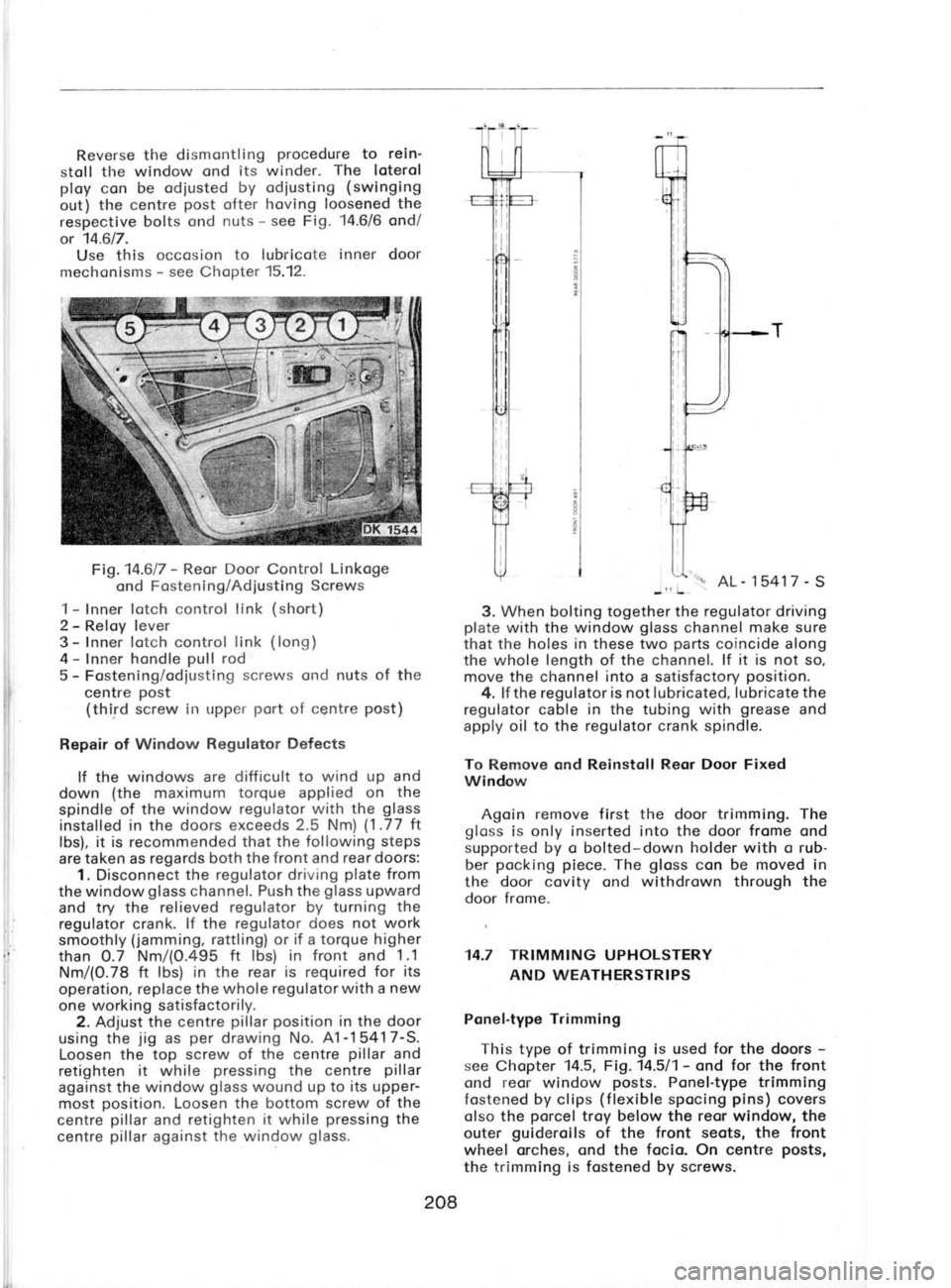
Fig.14.617 -
Reor Door Control Linkoge
ond Fostening/Adiusting Screws
1 -
Inner lotch control link (short)
2 -
Reloy lever
3 -
lnner lotch control link
(long)
4 -
Inner hondle pull
rod
5 -
Fostening/odiusting screws ond nuts
of
the
centre post
(third screw in upper port
of centre post)
Repair of Window Regulator Defects
lf the windows are difficult to wind up and
down (the
maximum torque applied on the
spindle of the window regulator with the glass
installed in the doors exceeds 2.5 Nm) (1.77
tt
lbs), it is recommended that the following steps
are taken as regards both the front
and rear doors:
1. Disconnect the regulator driving plate
from
the window glass
channel. Push the glass
upward
and try the relieved regulator by turning the
regulator crank. lf the regulator does not work
smoothly (jamming,
rattling) or if
a torque higher
than O.7 Nm/(O.495 ft lbs) in front and 1.1
Nm/(0.78 ft lbs) in the rear is required for its
operation, replace the whole regulator with a new
one working satisfactorily.
2. Adjust the centre pillar position
in the door
using the jig
as per
drawing No. A1-1 5417-S.
Loosen the top screw of the centre pillar
and
retighten it while pressing
the centre pillar
against the window glass
wound up to its upper-
most position.
Loosen the bottom screw of the
centre pillar
and retighten it while pressing
the
centre pillar
against the
window glass. 5417
-
S
-l! L
3. When bolting together the regulator driving
plate with the window glass
channel make sure
that the holes in these two parts
coincide along
the whole length of the channel. lf it is not so,
move the
channel into a satisfactory position.
4. lf the regulator is
not lubricated, lubricate the
regulator cable in the
tubing with grease
and
apply oil to the regulator
crank spindle.
To Remove ond Reinstoll Reor Door Fixed
Window
Agoin remove first the door trimming. The
gloss is only inserted
into the door frome ond
supported by o bolted-down holder with o rub-
ber pocking piece.
The gloss
con be moved in
the door
covity ond withdrown through the
door frome.
14.7 TRIMMING UPHOLSTERY AND WEATHERSTRIPS
Ponel-type Trimming
This type of trimming is used for
the doors -
see Chopter 14.5, Fig.14.511- ond for
the front
ond reor window posts.
Ponel-type trimming
fostened by clips (flexible
spocing pins)
covers
olso the porcel
troy below the reor window, the
outer guideroils
of the front seots, the front
wheel orches, ond the focia. On centre posts,
the trimming is fostened by screws.
208
Page 216 of 238
friction focing. lnodequote
ploy
results irr o too
short free trovel of the clutch pedol
ond on
olmost immediote clutch disengogement. Access
to the releose
cylinder con be goined
os de-
scribed in the previous porogroph
on clutch
lubricotion. Hold the rod protruding from
the
relose cylinder ond force
from it corefully the
releose lever, ogoinst which it is restingi
the
lever con be relieved by disengoging the ten-
sion (pull-off
) springs.
ln service, the forcing-off
must be ot leost
2 mm. Adiust it to 4
to 5 mm by odiusting the
length of the rod. After hoving
loosened the nut
on the rod
of the releose cylinder, rotote
the
releose finger to obtoin the correct rod
length.
Then retighten the nut, thus locking the releose
f inger in its position
on the rod.
lf the ploy
is correctly od justed,
the f ree
trovel of the
clutch pedol
pod should ronge
from 40 to 50 mm. lt should not be ollowed to
drop below '!0
to 15 mm. lf the described od-
justing procedure foils to bring the required
result, it is necessory to odjust the clutch
mech-
onism in occordonce with
informotion con
toined in Chopter 3.2.
Bleeding the Glutch Hydroulic System
The movement of the clutch pedol
is trons-
mitted hydroulicolly to the clutch releose cylin-
der. The couses ond symptoms of penetrotion
of oir into the hydroulic
system (similor
to the
broke hydroulic system) ore described in detoil
in the section deoling with brokes. The pro-
cedure of bleeding the clutch is the some os
wherr bleeding the brokes -
see Chopter 15.8.
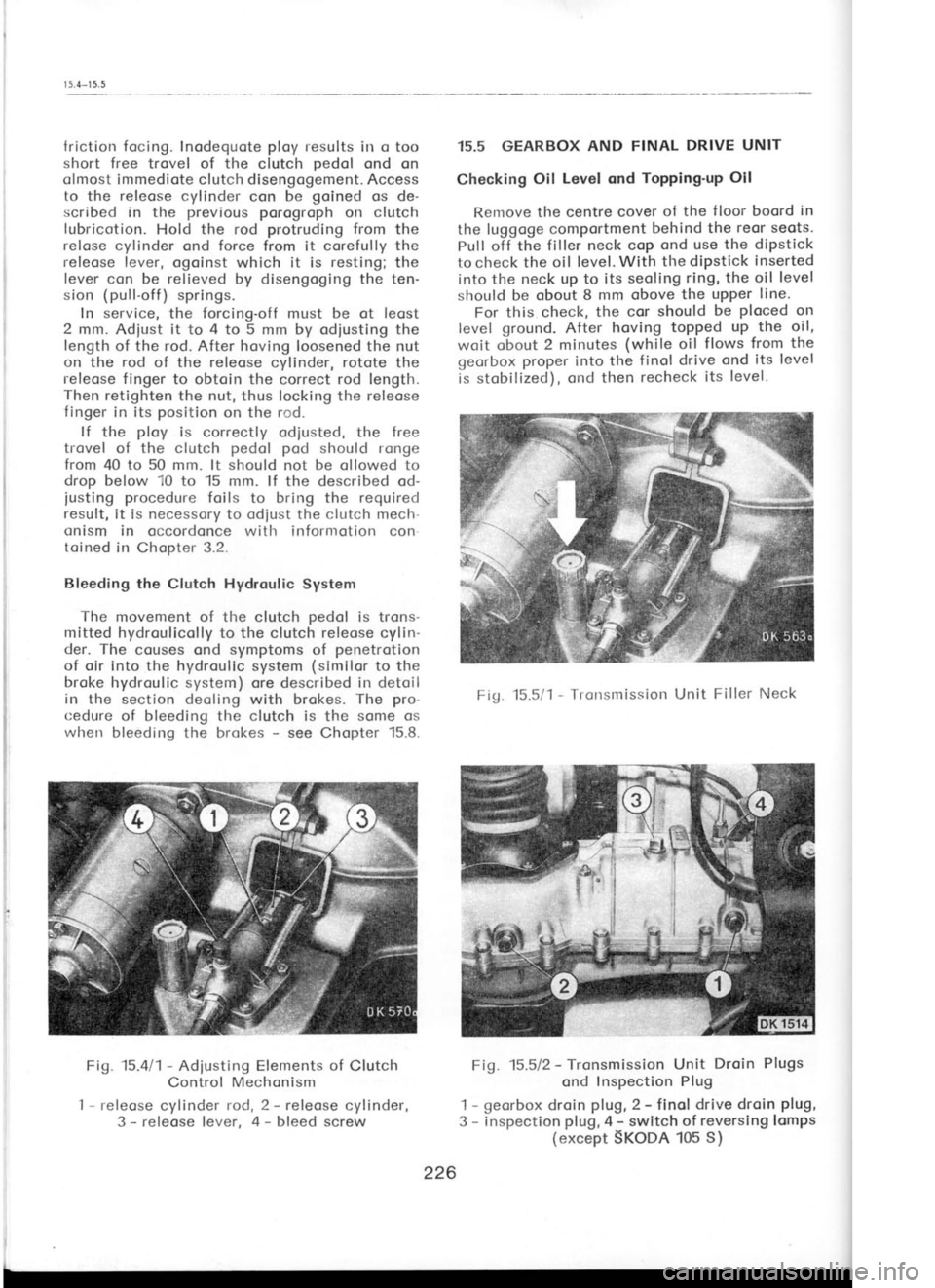
Fig. 15.411-
Adiusting Elements of
Clutch
Control Mechonism
I -
releose cylinder rod, 2 -
releose cylinder,
3 -
releose lever, 4 -
bleed screw 15.5 GEARBOX
AND FINAL DRIVE UNIT
Checking Oil
Level ond Topping'up
Oil
Renrove the centre cover ol the
f loor boord in
the luggoge comportment behind the
reor seots.
Pull off the filler neck cop ond use
the dipstick
to check the oil level. With the diPstick inserted
into the neck up to its seoling ring, the oil level
should be obout 8 mm obove the upper line'
For this check, the cor
should be ploced
on
level ground.
After hoving topped up the oil,
woit obout 2 minutes (while
oil flows from the
georbox proper
into the finol drive ond its level
is stobilized), ond then recheck
its level-
Fig. 15.5/1 -
Tronsmission Unit Filler Neck
Fig. 15.512 -
Tronsmission Unit Droin
Plugs
ond Inspection Plug
1 -
georbox droin plug,
2 -
finol drive droin plug,
3 -
inspection plug,
4 -
switch of reversing lcmps
(except SKoDA 105 S)
ffi
;rt'i,*
tiiffi
ii.! i;
br'ill
226
Page 222 of 238

the
pipes) The
greoter portion of
the f illing
will 'flow
out through the
outlets ond
this will
suffice in the
event of
droining before dismon'
tling the engine.
3.-Uncouple the
hoses from
the engine line
in the engine boy -
See Fi1.15.131A. Proceeding
from und6r the vehicle, pull
the hoses
behind
the cross beorer of
the georbox,
ond let the
liquid flow
from the hoses.
4. Remove the
droin plug of
the cylinder
block ond, if necessory, free
the out'f low using
o length of wire,
etc.
N ot e : In oll, obout 85 0/0
(10.5 litres) of the
coolont will f low out,
ond the difference should
be reckoned with when
refilling the
system-
All ontifreezes ore
to o certoin extent hormful
to the skin. lt is therefore necessory to
protect
oneself qgoinst
contoct with
the liquid, es-
peciolly the eyes (do not touch them
with Fig.15.13/4
-
Heoter Line on
Engine
ond Droin Plug
1 -
droin plug
2 *
pump ond heoter connecting line
3 -
thermostot ond
heoter connecting lirre
fingers soilded witlr
the liquid). Wosh
ony
stolns off the skin os quickly os possible with
soop woter etc.
Rinse the stoins off
the vor-
nished cor bodY with woter.
Fridex-Spolqno Antifreeze
As clreody mentioned, the cooling system is
f illed with this liquid,
or with o solution
of its
concent'rote with
soft
woter, in the
foctory.
For the preporotion of this solution
olw.oys
use soft ond cleon woter. In the following
toble,
its concentrotion in
dependence on
its freezing
resistonce is indicoted. Alternotively, the
con-
centrotion con be determined from
the density.
Fig.15.1312 -
Cooling System
Bleed Cock
Fig.-15.13/3 -
Fuel Tonk
Droin Guord
Sheet ond
PiPe
Plugs Densit
I ot
+20'
I
i
-- I 1.029
; t.oqs I 1.055 1.O57
1.062
| 1.067
I
i 1.074
i 1.080
I
Volume
Ports
Fridex Spolono
i Woter
21 1
38 1
44 47
I
53 -1,5 ity
ot +20 oCFreezi
ng
point "C
-10 -20
-25
-27
-30
-35
-40 -45
-60
79
2
62 '1,5
56 53 1
47 4I
232