check oil SKODA 120 LS 1980 Owner's Manual
[x] Cancel search | Manufacturer: SKODA, Model Year: 1980, Model line: 120 LS, Model: SKODA 120 LS 1980Pages: 238, PDF Size: 47.09 MB
Page 129 of 238
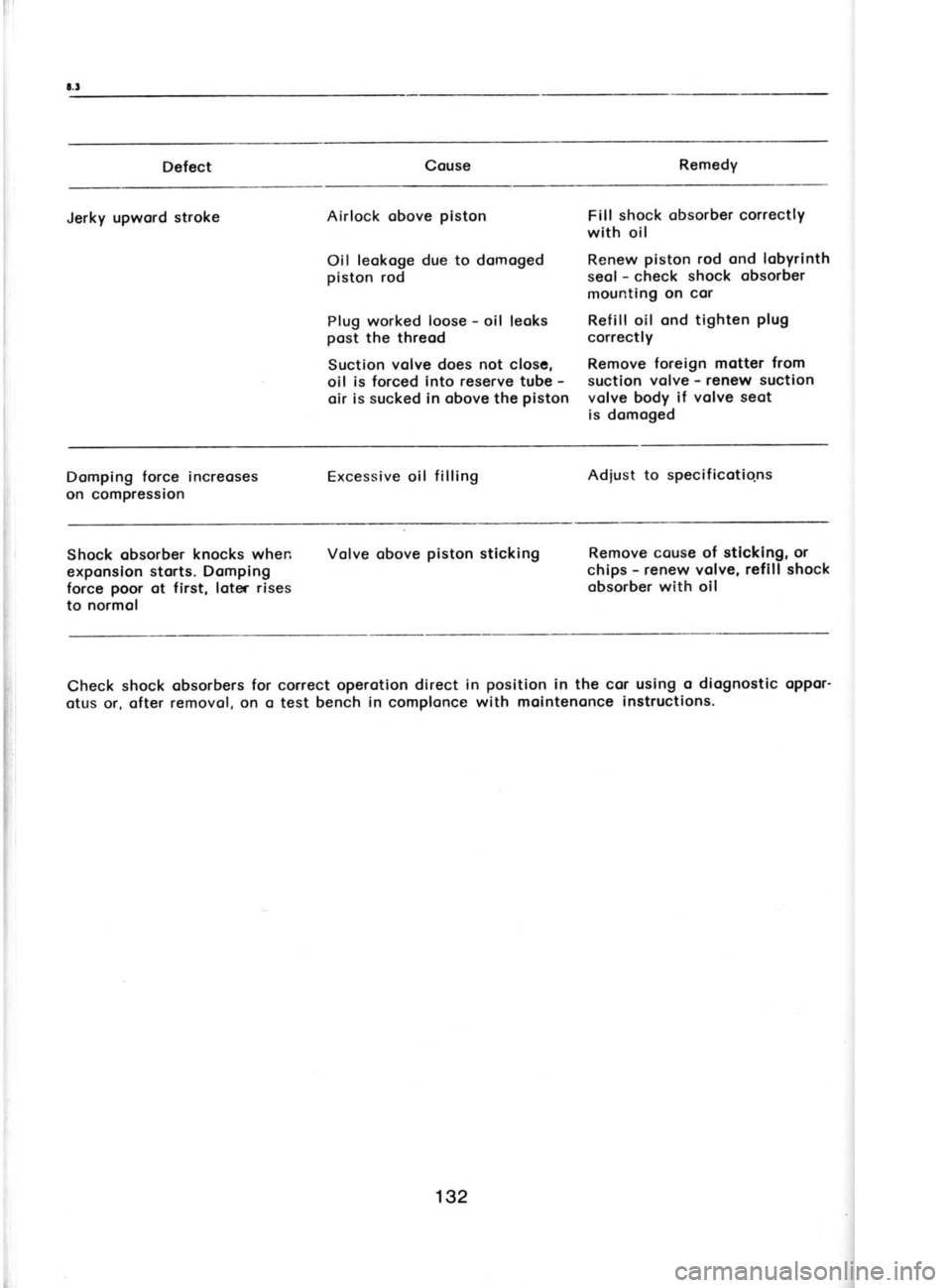
Defect
Remedy
Jerky upword stroke Airlock
obove plston
Oil leokoge due to domoged
piston rod
Plug worked loose -
oil leoks
post the threod
Suction volve does not closc,
oil is forced Into reserve
tube -
oir is sucked
in obove
the plston Flll
shock obsorber
correctly
wlth oil
Renew piston
rod ond lobyrinth
seol -
check shock
obsorber
mountlng on cor
Reflll oil ond tighten plug
correctly
Remove foreign motter
from
suction volve -
renew suction
volve body lf volve seot
is domoged
Domping force increoses
on compression Excessive
oil filling Adiust to specificotio.ns
Shock obsorber knocks when
exponslon storts. Domping
force poor
ot first. loter rises
to normol Volve obove
piston
sticking Remove couse of
stlcklng, or
chlps -
renew volve, reflll shock
obsorber with oll
Check shock obsorbers for correct operotlon direct in position
in the cor uslng o diognostic
oppor'
otus or, ofter removol, on o
test bench in
complonce with molntenonce
instructlons.
132
Page 141 of 238

r 0.3-t0,5
Ihe permissible
out-of-bolonce must not ex-
ceed 50 grommes
on the rim rodius. Every new
tyre is provided
with o coloured dot on its side,
indicoting its lightest point.
Fit the tyre olwoys
with this dot focing
the tube volve.
ln this
position, the volve octs os on odditionol weight
compensoting the wheel overoll unbolonce to
o consideroble extent.
lf dynomic boloncing of the wheel is not
possible, bolonce the wheel stoticolly with the
greotest possible qssuroc|.
Boloncing weights
of 30, 50, 75,
ond 100 grommes
ore ovoiloble.
10.4 TUBED TYRES
For mounting,
dismounting,
ond repoirs of
conventionol tyres with inner tubes (for
por-
ticulors, see the preceding
Chopters), the usuol
procedures ore opplicoble. The permissible run-
out (untrue
running)
of the rim is the some os
for tubeless tyres (Chopter
10.5).
10.5 TUBELESS TYRES
The oir-tight seoling of these tyres requires
more core ond o different hondling thon thot of
the tyres with inner
tubes.
Preporotlon of Rirrr
13elore mounting the tyre, inspect the rim for
ony technicol defects. The points
to be checked
ore the rim shoulder ond the moting foce for
the tyre beods,
in oddition to the overoll con-
dition of the rim. lf ony defects ore found, the
rim must be reconditioned.
A sotisfoctory rim
nrust comply with the following conditions:
o) The
rim shoulder ond the tyre volve hole
must not be distorted;
there must be no
shcrp edges or protrusions
likely to domoge
the tyre beod. Minor unevennesses
con be
hornmered flot ond smoothed
with o file.
The moximum eccentric running
of the rim
side must not exceed 1.5 mm.
b) The moting surfoces
must be obsolutely
cleon (free
from stuck-on rubber, rust,
etc.).
Cleon them with emery poper
or o wire brush
ond coot them with point.
lnstolling of Tyre
Volve
Cleon the rim with o dry rog. Push
the rubber
volve into
the hole in the rim
or pull
it in
by
its threod using, for exomple,
o lever
os illus-
troted in Fig. 10.5/1. Fig. 10.5/1
-
Pulling Tyre Volve
irrto Wheel Rim
Mounting the Tyre
For mounting the tyre, use speciol mochines
ond procedures,
depending on the type of the
nrochine. lf such o mochine is not ovoiloble, in-
stoll the tyre using speciol tyre levers.
Ensure
thot the boloncing dot is next to the volve.
Tyre leverrs for fitting tubeless tyres
differ in
shope from conventionol levers. They
ore thin-
ner, without edges, ond polished.
Use them core-
fully in order not to domoge the
beod seoling
rubber bose. Insert the levers
under the beod
ot
short distonces ond refroin from using force. To
focilitote sliding of the tyre cosing beods over
the rim shoulder, moisten them with woter ond
top them with o rubber
mollet when eosing
them over the rim shoulder. Inflote
the mounted
tyre immediotely. Check the tyre for propei'
bedding in the rim ond
squore seoting
on it.
Holding the wheel perpendiculorly,
strike it
severol times ogoinst the f loor ot severol points
to force the tyre beods
to bed
correctly on the
bcad seots.
lnf lotion
Remove the volve
core to increose
the diom-
eter of the hole for oir inlet (oir
should be
iniected in quick
shots to force
the beods
on
to the beod seots) ond inflote the tyre. Use
o compressor with oir receiver, the
compressed-
.oir line of the
workshop, or
compressed-oirr
cylinders. The relief volves hove to be odiusted
to o pressure
of 350 kPo (3.5
kg/cmz).
Never ollow the inflotion pressure
to rise
unnecessorily. As soon os the tyre hos snopped
into position
on the rim
ond is free from leoks,
odiust the pressure
to 250 -
350 kPo (2.5 -
3.5
kg/cmz). lf the tyre refuses to
bed properly
on
the rim,
for exomple due to distorted beods or
beods compressed due to incorrect storoge,
press the tyre circumference inword to open
wide the beods which will then bed properly
on the rim. Use either o length of
rope or
o speciol tightener. Slip the rope over the
tyre
circumference with o certoin cleoronce, insert
o stick
between the tyre ond the rope, ond
twist the rope.
Adiust the tyre pressure
to specif
icotions ond
submerge the wheel in woter to check the
tyre
for oir leoks.
146
Page 148 of 238

c
I'
b
o ir
fi$r
++$$
$$fr0$0$$$$$. $'$j,$,0$$$$+$
t'$'i$$0',$$$$ 0 0
Fig. 11.6/1 -
Section Through
Heoter
1- Cover, 2 -
Lower port
of cosing (iocket) -
two-port, 3- Heot exchonger, 4-
Heoter fan,
5 to 8-Control f lop volves, 9-Ponel with control
levers
the bowden tubing of the
bowden cobles ond
let the oil seep down olong
their entire length.
Check the heoter fon for foultless running.
With the switch in position
I, the fon must run
ot higher speed -
for its wiring refer
to Chopter
11.7 -
Electric Control. Fill
the cooling system
with coolont ond bleed the system.
Fit the grips (buttons)
on the levers observ-
ing the symbols on the grips:
left-hond lever -
white orrows upword ond
downword,
centre lever -
orrow downword,
right-hond lever -
red orrow upword, blud orrow
downword.
To open the flow through the lower inlet
socket, turn the lever in this socket so
thot it
coincides with its centre line. The socket
should be closed with
the flop only
when
testing the heoter, etc. Heoter Disossembly
ond Reossembly
o) Heot exchonger, volve,
flops, ond levers
with links.
1. Disconnect the control bowden
cobles
from the levers, remove the gosket
from the
heoter beoring surfoce, loosen the
locks of the
broces, ond lift owoy the broces together
with
the cover ond fon.
2. Unscrew the liquid flow control volve ond
detoch the hose from
the second
inlet of the
heot exchonger ond the bleed hose ofter hoving
removed the hose
clips. Do not detoch
the link
from the volve lever -
it will sove you
odiust'
ment on reossembly.
3. Detoch the link of the flops from the reor
side of the heoter cosing ond unlock the flops
in the cosing by removing lock rings, woshers,
ond levers.
154
Page 150 of 238

1 1.8-11.10
11.8 HEATER
CONNECTING LINE
The line is o
combinotion of steel pipes
ond
rubber hoses. All connections must be tightened
with clips of
the strip
type (see
Fig. 11.411) or
the wire type (bleed
hose). Toke
core not to
overtighten the clips of the lotter type os there
is o risk of domoging the rubber.
The hose from the pipe
of the thermostot
body on the engine is routed to the heoter
through the f loor tunnel, the return bronch
possing ogoin through the tunnel to the pipe
of
the pump.
Arronge the hoses olong the sides
of
the floor tunnel so
thot they do not touch other
ports in the tunnel.
For detoiled informotion obout the routing of
the hoses refer to
Chopter 12.7.
11.9 otl COOLER
The oil cooler is stondord
equipment of
Skodo
120 LS models. lts construction resembles thot
of the rodiotor. lt is
instolled in the
engine
comportment (boy)
ond ottoched to the right-
-hond engine guord.
Speciol pressure
hoses
connect it with the engine. lts connecting
diogrom is shown in
Fig. 11.911.
As regords oil coolers for subtropicol ond
tropicol regions, refer to
Chopters 16.1
ond '16.2.
Fi9.11.9/1 -
Oil Cooler-to-engine Connecting
Diogrom
1 -
Outlet from engine-right-hond cooler socket,
2 -
Oil cooler, 3 -
Inlet into engine -
left-hond
cooler socket Removol ond
Refitting
Disconnect the hoses fronr the engine ond,
occording to circumstonces ond the purpose
of
the removol, detoch the oil cooler from
the
engine guord
or remove the engine guord
together with the cooler ond brocket. Empty the
oil contoined in the hoses ond the oil cooler
into o suitoble vessel. When refitting the oil
cooler into the cor,
proceed in occordonce with the circumstonces
of the removol. Secure the bolts conecting the
oil cooler with the engine guord
ond the brocket
(the brocket being locoted between the cooler
ond the guord)
with spring
woshers. Bolt down
the guord
over ploin
woshers ond use o spring
wosher for the bolted connection of the brocket
with the bodywork.
Use seoling
woshers when connecting hoses
to the engine ond the oil cooler, ond put
o seoling wosher olso under the bolt. Close the
bolt of the engine port
ot the flonge with the
pressure switch. Fosten the hoses so thot they
ore not stressed in their bends. The
hose from
the timing geor
cover should be routed horizon-
tolly ond the hose ot
the engine inlet so thot
it includes o downword ongle of obout 15 de-
grees with the horizontol plone. Top up
oil in
the engine.
11.10 COOLING SYSTEM DEFECTS,
TESTING, REPAIRS, AND
CLEANING
Defects ond Testing o) lf there is o marked loss of coolont, check
oll connections for leokoge. The
loss of coolont
con olso be coused by o leokoge of the rodiotor
(or heoter). lf the leokoge point
is not visible,
pressure-test the system without removing it
from the cor. Admit seoled-off oir ot o pressure
of 0.12 MPo
(1.2 kglcmz) into the filler neck ond look for
ploces where the coolont is seeping or dripping
out. Inspect not only the rodiotor but olso the
lreoter. An excessive loss of the coolont con be olso
coused by engine overheoting. In thot cose,
look for the couse of engine overheoting.
b) Points to check if the engine
is overheoting
- coolont level
- operotion of thermostots ond rodiotor fon
- condition of rodiotor (whether
clogged out-
side with dirt, or whether cooted inside with
scole)
c) Points to check if the engine does not worm
up properly:
- operotion of thermostots
DX
tfSJ
156
Page 171 of 238

junction
with the olternoto,r occording to
Chop-
ier 13.3 ond mointoining
o constont voltoge of
tlre power
supply set within the
entire ronge
of
service speeds.
Tlre voltoge regulotor
is instolled orr the body
cross beorer, to
the right of the engine ond
beside the ignition coil.
To focilitote hondling
of its leods' especiolly
the occess to their
connections, it
is recom-
rrrended to remove the regulotor fostening
screws. For disconnecting procedures,
see
Chopter 13.3 "Alternotor
lnstollotion ond Gen-
erol lnstructions".
DK 1565
Fig.13.411- Internol
Wiring Diogrom of
Alternotol with
Voltoge Regulotor ond
Outer
Connections
Altenrotor: B, R, M -
olternotor outlets
f -
olternotor phose
windings
m -
olternotor field winding
D1,2,3, 4, 5, 6 -
moin diodes
D7, 8,9 -
olternotor ouxiliory diodes
D10 -
olternotor choking diode
Voltoge regulotor:
R, M, 15/54 -
regulotor outlets
reg -
regulotor tension winding
Rk -
boloncing resistor
Ro -
protective resistor
Rr -
odiustoble resistor
Kr -
regulotor contocts
Outer connections: K -
worning lomp (1.5
W)
S -
switch (switch
box)
B -
bottery
Checking Voltoge Regulotor
on Cor
The regulotor operotion con be offected by
loosened connections ond on imperfect eorth- ing.
lf the wsrning lomp does not go
o.ut when
driving, i. e., if it glows
ot increosed engine
speed brightly or dimly,
or if it does not stort
glowing ofter stopping
the engine ond
o new
iurning of the ignition key in
the switch box,
the voitoge regulotor
is probobly
foulty. Another
symptom of o regulotor
foilure is
o poor
chorg-
irrg of tlre bottery or its
overchorging.. lf there
is nothing wrong with the regulotor, check the
reguloted voltoge over the regulotor which
slrould reod 13.2 volts ot the
minimum ond 14.8
volts ot the moximunr. This check
in the
cor
is only tentotive ond only
o check on
the test
bench'con be considered os definite ond
bind'
i ng.
Electricol Adiustment
The voltoge regulotot- should be tested
ond
odjusted only on o test bench
in o connection
slrown in Fig. 13.412.
At o lood of some
2
onrperes, the checked
voltoge should correspond to
volues specified
in the column "Checking".
lf the checked volt-
oge is within the specified ronge, do
not odiust
the regulotor. Othenwise odiust it to the volues
specified in the column "Adiustment".
lf woter
evoporotes obnormolly from the bottery, odiust
the voltoge regulotor to the bosic volues of
"Adiustment" utilizing the lower section of
the
toleronce zone.
Fig.13.al2 -
Wiring Diogrom of
Regulotor Tested
ond Adiusted on
o
G -
olternotor
REG -
voltoge regulotor
A -
ommeter
V -
voltmeter
S -
switch
R -
lood resistor
B -
bottery DK
1566
Voltoge Test Bench
178
Page 173 of 238

I
I
t
b
c ll
e
c
tl
d n
tN'
>
\'
J I
(Il
qt3
Fig. 13.5i3 -
Vocuum Control Course -
opplicoble to both
regulotor models
copscrew fostening the distributor brocket to
the support on the engine (do
not loosen the
brocket clomping bolt).
Refit the distributor on the engine by
re-
versing this procedure. The
coupling on
tlre
shoft is osymmetricol ond it hos to engoge into
the heod of the drive shoft in the engine. To
seot properly
o new distributor
or o distributor,
the brocket of which hos
been loosened, refer
to Chopter 2.3, por.25
to 27.
Distributor Disossembly ond Reossembly
This should be done in speciolizedworkshops,
especiolly with regord
to the checking of the
mechonicol condition or o repoir
of the dis-
tributor. lt is recommended
to use o suitoble
holder for doing the moiority of the required
iobs in
o verticol position.
When reossembling
the distributor, lubricote
the sliding points
oc-
cording to Chopter 15.3
but bewore of over-
lubricotion.
Remove olso the copscrew
on the bottom of
the distributor housing ond drip some low-pour
point oil into the hole to increose the oil reserve
of the shoft
sel-lubricoting beoring -
see Chop-
ter 15.2 "Speciol
Oils".
Disossembly 1. Remove the distributor cop ond the breoker
orm.
2. Remove the coupling from the shoft (note
the relotive position
of the eccentric dogs ond
the breoker
orm).
3. Remove
the circlip from
the pivot
ond litt
owoy the breoker orm.
4. Remove
the subossembly
of the terminol
"1" (current supply to distributor).
5. Screw off the copocitor. 6. Screw
off
the retoining springs.
7. Lilt owoy the vocuum chomber (do
19t
open it, o chonge of the curve is on.improboble
d'efect; do not chonge the screw-in depth
of the
pull-rod).
' 8. Lift owoy the contoct breoker
bose plote
with pocking piece from
the housing.
g. Litt owoy the shoft with the
centrifugol
governor. -
10. lf necessory, disossemble further
the sub'
ossembly of the shoft with the centrif
ugol
governor (odvonce mechonism) ond
com.
l?;h.',0, ReossemblY
1. Reossemble the centrifugol governor
(the
weights must be free
to rotote on the pins).
2. lnstoll the reossembled shoft
with the res'
pective woshers into
the distributor housing.
3. Fit the contoct breoker bose plote
with the
f ixed contoct holder ond pocking
piece into the
housing. 4. Fit the pull-rod on
the pin
ond lock it in
position, screw down the vocuum chiomber with
the copocitor. Check the
ignition odvonce po-
sition for the first cYlinder.
5. Screw down
the retoining springs
with
shims (the
spring with
the dog opposite to
the
terminol "1"i;
the bose plote must
rotote freely
in the distributor housing.
6. Reosemble the terminol "1".
7. Fit the breoker orm
on
the pivot
ond lock
it in position. Adiust the contoct breoker point
gop (lift) ond check the
contoct
Pressure'
"
if. 'Stip
woshers on
the shoft in
the originol
sequence, slip on the coupling ond
lock
it in
position^ 9. Fit the lubricoting felt
into the hole of
the
com ond instoll the breoker orm.
10. Fit the distributor cop
in position.
11. Check the distributor operotion.
Checking A def inite indicotion of the condition of
the
distributor (during on operotionol check
os
well
os ofter o
repoir) con be obtoined by testing
the distributor on
o test stond with
o circulor
spork gop.
After o preliminory
odiustment of
the
contoc-t breoker point gop,
the stond is
used for
check i ng:
1. The contoct point
contoct ongle.
2. The spork ongulor distribution (with o
tol-
eronce of -+45
ongle minutes within
the entire
operotionol ronge).
3. The rongJ ond course of the
centrifugol
ond vocuum control. 4. The
operotion ot
moximum speed (length
of spork on spork goP -
4 mm) for o
brief period
(obout 2 minutes).
180
t
5
2tD zsa !l!
F llti
rc
Page 179 of 238

(
1
z
Strike the
slip-over ring off the circlip
(towords the motor windlng). Open the circlip
ond pull
it off the shoft together with the re-
leosed ports.
8. lf necessory, re-turn the commutotor ond
scrope or mill out the insulotion between the
lominotions. "Mikonit"
should be 0.4 to 0.8 mm
below the octive surfoce.
Note: The
switch connot be further token
opat. lf
defective, lt hcs to be reploced with
o new one. When cleoning ports
of the storter
motor, do not dip the ormoture or the pinion
with the idler into petrol
or onother degreosing
ogent.The some opplles to the end shieldswith
beorings. By dipping them in o degreosing
ogent, the beorings become procticolly
worth-
less"
Storter Motor Reossembly 1. Lubricote the hellx of the ormoture shoft
with greose -
see Chopter 15.2 'Lubriconts
of
foreing mokeu ond fit the pinion
with the idler
ond the slip-over ring in posltion.
Fit the
circlip
into the groove
in the shoft, ond drive the slip-
on ring over it. The pinion
with the idler must
move freely olong the shoft.
2. Slip the respective
woshers on the shoft in
their originol sequence (corrier
ring, distonce
ring, fibre ring, distonce ring) ond insert the
ormoture with the engoging lever
into the drive
end shield. 3. Suspend the switch
ormoture into the
pre-engoging lever ond bolt down the switch
lightly. Fit the lever pin
into the drive
end
shield ond lock it in position
with the retoiner.
4. Tighten the copscrews of the switch
ond
fit the stotor on the drive
end shield.
5. Instoll the respective
woshers into
the
commutotor end shield in
their originol se-
quence (the dished wosher with its centre
focing the shield, then the ploin
wosher, the
toothed wosher, ond the drive wosher).
6. Fit the commutotor end shield with lifted
brushes on the shoft (in
the position
occording
to the recess
for the excitotion outlet ond the
notch) ond screw in the clomping bolts.
7. Instoll the brush interconnecting strip ond
bolt it down together with the field winding
outlets to the positive
brush holders, lower the
brushes. 8. Fit the Insuloting strip in position
ond bolt
down the cover. 9. Test the storter mottr.
Diognosing Storter Motor Defects in Cor
o) lf the storter motor refuses
to operote, look
first for on interrupted connection between
the bottery ond
the storter
motor, the engine
eorthing ond the storter
motor, or the engine
eorthing ond the bottery. lf these connec-
tions ore in order (current
flows to the ter' DK
1575
Fig. 13.10/3 -
Storter Motor Testlng Connection
minols u30"
ond "50"
with switched on
ignition), stort looking for o foilure of the
storter motor switch. Even in this instonce,
the couse con be o fully dischorged or foulty
bottery.
b) lf the storter motor
continues running
even
ofter the ignition key hos been switched in
the switch box from the position "START",
it hos to be stopped without ony deloy by
disconnecting the bottery (using
its eorthed
pole).
c) lf the storter motor hos no power
to cronk
the engine, stort with switched-on heod-
lights. A
morked dimming indicotes c poorly
chorged bottery.
Tentotive Checking of
Storter Motor
Outside Cor
Connect the terminol "30'of
the storter
motor to o properly
chorged bottery ond incor'
porote on ommeter with o wide
meosuring ronge
into the circuit -
see Fig. 13.10/3.
Stort the
engine (feed
current to the terminol "50").
The
volue of the current ot idling speed must
not
exceed 65 omperes (not
considering the peok
ot
the first momentous deflection).
The storter motor must run noiselessly,
smoothly, ond the pinion
must move smoothly
into ond out of the rest position
(engoge
ond
diesengoge). The engoged pinion
must not ro-
tote direct on the foce of the slip-on ring. The
run-out of the storter motor must not lost longer
thon 8 seconds ofter the disconnection of the
switch from the current supply.
Inspect the brush pressure
springs. The
brushes must
beor on the commutotor by ot
leost two thirds of their surfoce ond they must
move freely in their cells.
The ormoture should hove o noticeoble oxiol
cleoronce (ploy)
not exceeding 0.7 mm.
At
o slight rototion of the pinion
in the direction
of the storter motor rototion,
the idlor must
slip
freely.
186
Page 212 of 238
I-
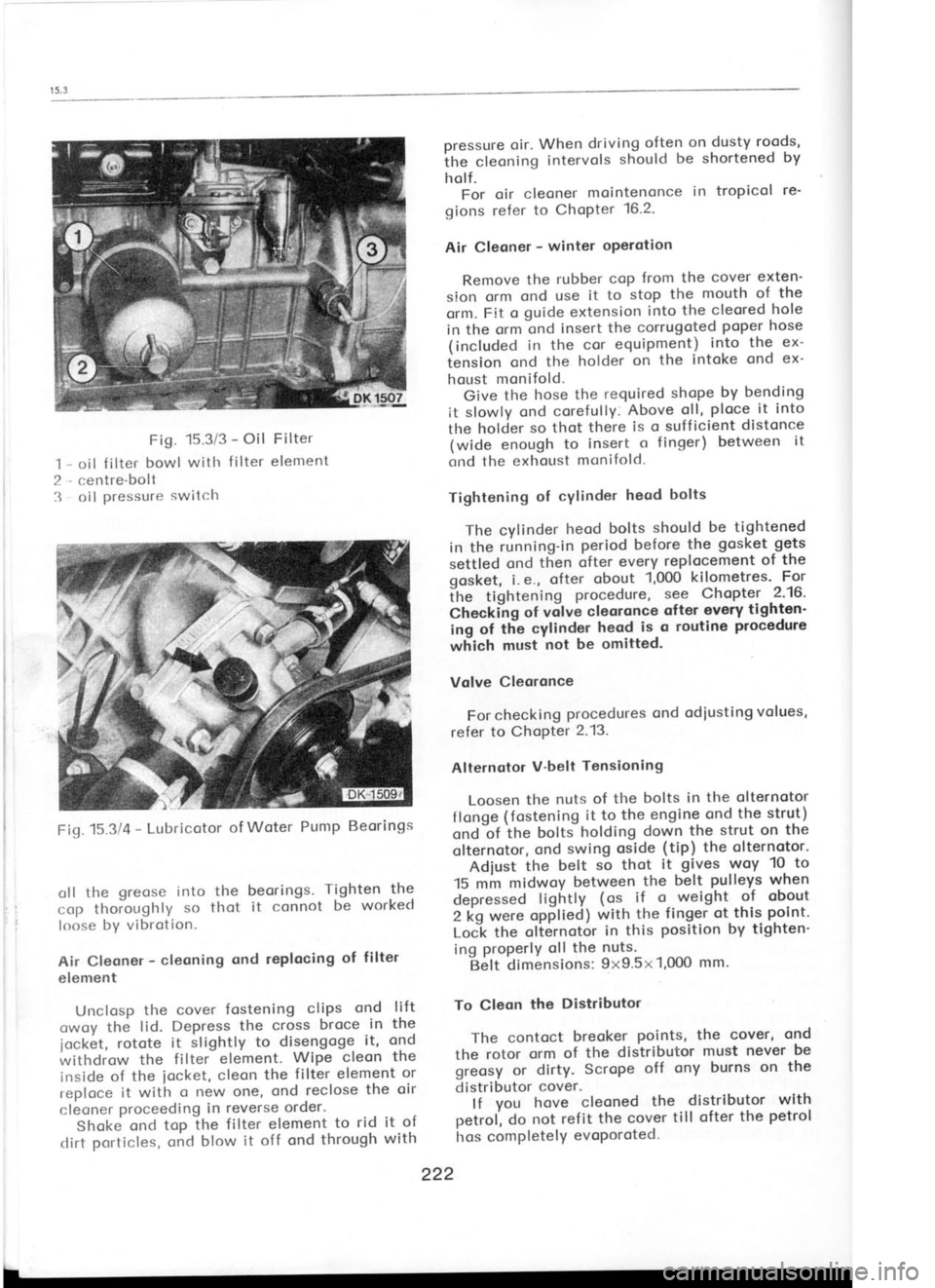
.'t Fig.
15.3/3 -
Oil Filter
oil f ilter bowl
witlr f ilter
element
centre-boll oil pressure
switclr pressure
oir. When driving often
on dusty roods,
ihe cleoning intervols
should
be shortened by
holf. For oir cleoner mointenonce in tropicol
re'
gions refer to
ChoPter 16.2.
Air Cleoner -
winter oPerotion
Remove the rubber
cop from
the cover exten-
sion orm ond
use it to stop the mouth of
the
orm. Fit o guide extension into
the cleored hole
in the ornr ond
insert the
corrugoted poper hose
(included in the
cor equipment) into
the
ex-
iension ond
the holder on the
intoke ond
ex-
houst monifold.
Give the
hose the required shope by
bending
it slowly ond corefully. Above
oll, ploce
it into
the holcier so thot
there is
o suff icient distonce
(wide enough to
insert o
finger) between it
crnd the exhot-tst monifold.
Tightening of
cYlinder heod bolts
The cylinder heod
bolts should be tightened
in the running-in period before
the gosket gets
settled ond then
ofter every replocement of the
gosket, i.e., ofter
obout 1,000
kilometres' For
itre tightening procedure,
s9e
Chopter
-2'16'
Check'ilg of vilve
cleoronce ofter
every tighten'
ing of tlie
cylinder heod
is o
routine procedure
which must not be omitted.
Volve Cleoronce
For checking procedures
ond odiusting volues,
refer to ChoPter 2.13.
Alternotor V'belt
Tensioning
Loosen the
nuts of the bolts
in the olternotor
f longe (fostening
it to
the engine ond
the strut)
ond'of itre
bottJ holding down
the strut on
the
olternotor, ond
swing
oside (tip)
the olternotor'
Adiust the
belt so
thot it gives
woy 10- to
15 mm midwoy between the
belt pulleys
when
depressed lightly (ot
if o- weight of obout
2 kg were opplieal with
the
finger ot this point'
LoCk the
olternotor in
this position
by tighten-
ing properlY
oll the nuts.
Belt dimensions: 9x9.5x1,0O0 mm.
To Cleon the
Distributor
The contoct breoker points, the
cover, ond
the rotor orm
of the distributor must never
be
greosy or dirty. Scrope off
ony burns on the
distributor cover.
lf you hove
cleoned the
distributor with
oetrol, do
not ref it the cover till ofter
the petrol
hos comPletelY evoPoroted.
222
oll
the greose
into the beorings. Tighten
the
cop thoioughly so
thot it connot be worked
loose by vibrotion.
Air Cleoner -
cleoning ond
replocing of
filter
element
Unclosp the cover
fostening clips
and lift
owoy the lid. Depress the
cross broce in
the
1ock6t, rotote
it
slightly to disengoge it, ond
withdrow the filter
element. Wipe
cleon the
inside of the
iocket, cleon
the filter
element or
reploce it with o new
one, ond reclose the oir
cleoner proceeding
in reverse order.
Shoke ond
top the filtet element to
rid it of
clirt porticles, oncl
blow it off ond through with
Fiq.15314
-
Lubricotor of
Woter Pump Beorings
Page 214 of 238

Fig.
15.3/8 -
Distributor Adiusting Elements
1 -
contoct holder, 2 -
rotor orm, 3- com,
4 -
distributor brocket, 5 -
distributor brocket
clomping bolt
Alwoys turn the engine clockwise to eliminote ony ploy
in the distributor drive geor
ond to
ovoid loosening of the bolt. To relieve the
com-
pression resistonce, it
is recommended to bock
off the sporking plugs.
b) Stroboscopic method:
When using this method, the volues of the
bosic ignition timing ond
the odvonce con-
trolled by the centrifugol timing control (for
its
diogrom refer to Chopter 13.5) should be odded
upwhile multiplying bytwo
the odded upvolues
occording to the diogrom. Any effect of the
vocuum control must be
eliminoted by discorr-
necting the respective hose (connecting
the
distributor vocuum unit with the corburettor).
The meosuring procedure
is indicoted by the
diognostic equipment itself.
To Adiust ldling Speed
Use the oir-correction screw (speed
cor-
rection screw). The speed decreoses when ro-
toting the screw clockwise ond increoses when
rototing it onticlockwise.
Adiust the idling speed in occordonce with
the tochometer ond within the limits specified
in the following porogroph "To
Adiust ldle
Run". The engine must be wormed-up
before
storting the odjusting procedure (see
olso the
following porogrophs) ond its ignition must be
in perfect
condition (distributor
contoct-breoker
points, sporking plug
electrodes, ond ignition
odvonce).
N o t e : For the bosic position
of the odiusting
screw refer to Chopter 2.19 - "Mointenonce
ond
Adiusting". Fig.
15.3/9 -
Air-correction Screw -
idling speed
correction screw
To Adiust ldle
Run
Acljust the contoct-breoker point
gop,
the gop
of the sporking plug
electrodes, ond
the ig-
nition odvonce. Then check
the
volve cleoronce
(if there is no cleoronce, odiust
the
volves),
cleon the oir intoke filter
element, ond moke
sure thot the occelerotor pedol link hos
the re'
quired free trovel -
see Chopter 12.2-
Use o needle to remove the plug
covering
the fost-idling screw
ond let the engine run ot
obout 2,000 r. p.
m. to ottoin on oil temperoture
of 70oC. Insert the probe
of the thermonreter
into the hole for the oil diPstick'
Now connect the
speed indicotor (tocho-
meter) ond the onolyzer of
corbon
.monoxide
(contoined in exhoust fumes). Use
the oir'cor-
iection screw (Fig.
15.3/9) to set the
speed
-r-?n
at 800 l;; t.
p. ni. cnd the fost-idling screw
(Fiq. 15.3/10) to odiust the
content of corbon
moioxide to 2*0.50/s or the oir-fuel proportion-
by-weight mixing rotio,
comporoble with
the
specif ied corbon monoxide content, to
1+.2 +$.t.
After about one minute of
the continued idle
running recheck the odiustment ond
correct it,
if necelsory. Close the hole
with the
fost-idling
screw by driving in o
new plug with
its bottom
outword.
Note: For the bosic position of
odiusting
screws refer to Chopter 2.19 - "Mointenonce
ond Adjustment".
To Lubricote Accelerotor Mechonism
Pour severol drops of oil into
the end of the
bowden coble tubing ond lubricote both
ioints
(on top ond below)- of the corburettor pull-rod
itself with obout one drop of oil. Then
depress
224
Page 216 of 238
friction focing. lnodequote
ploy
results irr o too
short free trovel of the clutch pedol
ond on
olmost immediote clutch disengogement. Access
to the releose
cylinder con be goined
os de-
scribed in the previous porogroph
on clutch
lubricotion. Hold the rod protruding from
the
relose cylinder ond force
from it corefully the
releose lever, ogoinst which it is restingi
the
lever con be relieved by disengoging the ten-
sion (pull-off
) springs.
ln service, the forcing-off
must be ot leost
2 mm. Adiust it to 4
to 5 mm by odiusting the
length of the rod. After hoving
loosened the nut
on the rod
of the releose cylinder, rotote
the
releose finger to obtoin the correct rod
length.
Then retighten the nut, thus locking the releose
f inger in its position
on the rod.
lf the ploy
is correctly od justed,
the f ree
trovel of the
clutch pedol
pod should ronge
from 40 to 50 mm. lt should not be ollowed to
drop below '!0
to 15 mm. lf the described od-
justing procedure foils to bring the required
result, it is necessory to odjust the clutch
mech-
onism in occordonce with
informotion con
toined in Chopter 3.2.
Bleeding the Glutch Hydroulic System
The movement of the clutch pedol
is trons-
mitted hydroulicolly to the clutch releose cylin-
der. The couses ond symptoms of penetrotion
of oir into the hydroulic
system (similor
to the
broke hydroulic system) ore described in detoil
in the section deoling with brokes. The pro-
cedure of bleeding the clutch is the some os
wherr bleeding the brokes -
see Chopter 15.8.
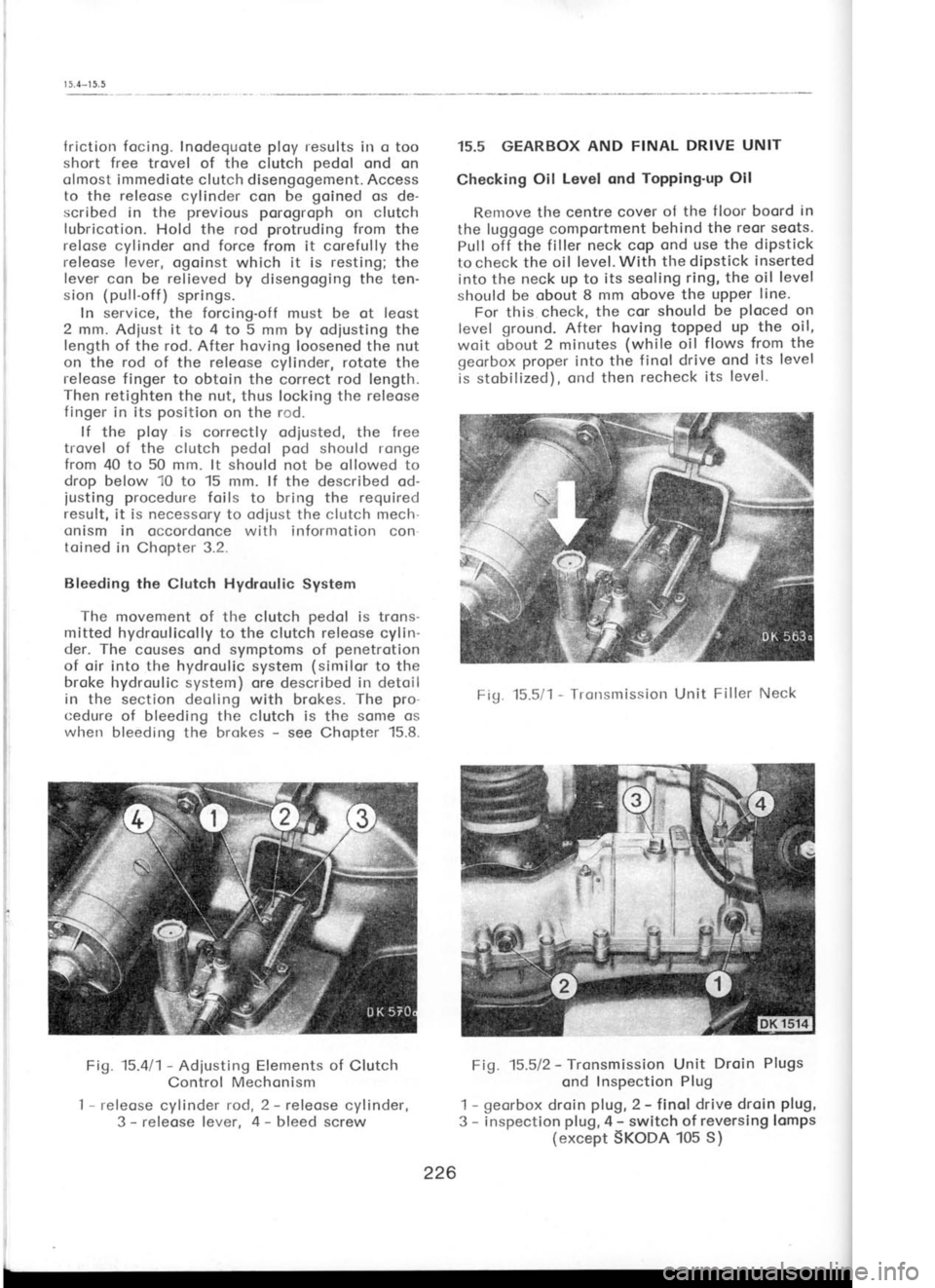
Fig. 15.411-
Adiusting Elements of
Clutch
Control Mechonism
I -
releose cylinder rod, 2 -
releose cylinder,
3 -
releose lever, 4 -
bleed screw 15.5 GEARBOX
AND FINAL DRIVE UNIT
Checking Oil
Level ond Topping'up
Oil
Renrove the centre cover ol the
f loor boord in
the luggoge comportment behind the
reor seots.
Pull off the filler neck cop ond use
the dipstick
to check the oil level. With the diPstick inserted
into the neck up to its seoling ring, the oil level
should be obout 8 mm obove the upper line'
For this check, the cor
should be ploced
on
level ground.
After hoving topped up the oil,
woit obout 2 minutes (while
oil flows from the
georbox proper
into the finol drive ond its level
is stobilized), ond then recheck
its level-
Fig. 15.5/1 -
Tronsmission Unit Filler Neck
Fig. 15.512 -
Tronsmission Unit Droin
Plugs
ond Inspection Plug
1 -
georbox droin plug,
2 -
finol drive droin plug,
3 -
inspection plug,
4 -
switch of reversing lcmps
(except SKoDA 105 S)
ffi
;rt'i,*
tiiffi
ii.! i;
br'ill
226