engine SKODA CITIGO 2012 1.G Repair Manual
[x] Cancel search | Manufacturer: SKODA, Model Year: 2012, Model line: CITIGO, Model: SKODA CITIGO 2012 1.GPages: 157, PDF Size: 3.9 MB
Page 140 of 157
Fuses and light bulbs
Fuses
ä
Introduction
This chapter contains information on the following subjects:
Fuses on the underside of the dash panel 138
Fuses in the engine compartment 140
Fuses in the dash panel 140
Individual electrical circuits are protected by fuses.
› Before replacing a fuse, switch off the ignition and the appropriate consumer
› Find out which fuse belongs to the component that is not operat-
ing » page 138, Fuses on the underside of the dash panel , » page 140, Fuses
in the engine compartment , or »
page 140, Fuses in the dash panel .
› Take the plastic clip out of its fixture in the cover of the fuse box, place it on the
relevant fuse and pull it out.
› A blown fuses is recognisable by the molten metal strip. Replace the faulty fuse
with a new one of the
same amperage.
Colour coding of fuses Colour Maximum amperage
purple 3
light brown 5
brown 7.5
red 10
blue 15
yellow 20
white 25
green 30
orange 40 WARNING
Always read and observe the warnings before completing any work in the en-
gine compartment » page 108, Engine compartment . CAUTION
■ Never “repair” fuses and also do not replace them with a fuse of a higher am-
perage - risk of fire! This may also cause damage at another part of the electrical
system.
■ Have the electrical system checked as quickly as possible by a ŠKODA specialist
garage if a newly inserted fuse blows again after a short time. Note
■ We recommend always carrying replacement fuses in the vehicle. A box of re-
placement fuses can be purchased from
ŠKODA Original Accessories.
■ Multiple fuses may exist for a single power consuming device.
■ Multiple power consuming devices can share a single fuse. Ð Fuses on the underside of the dash panel
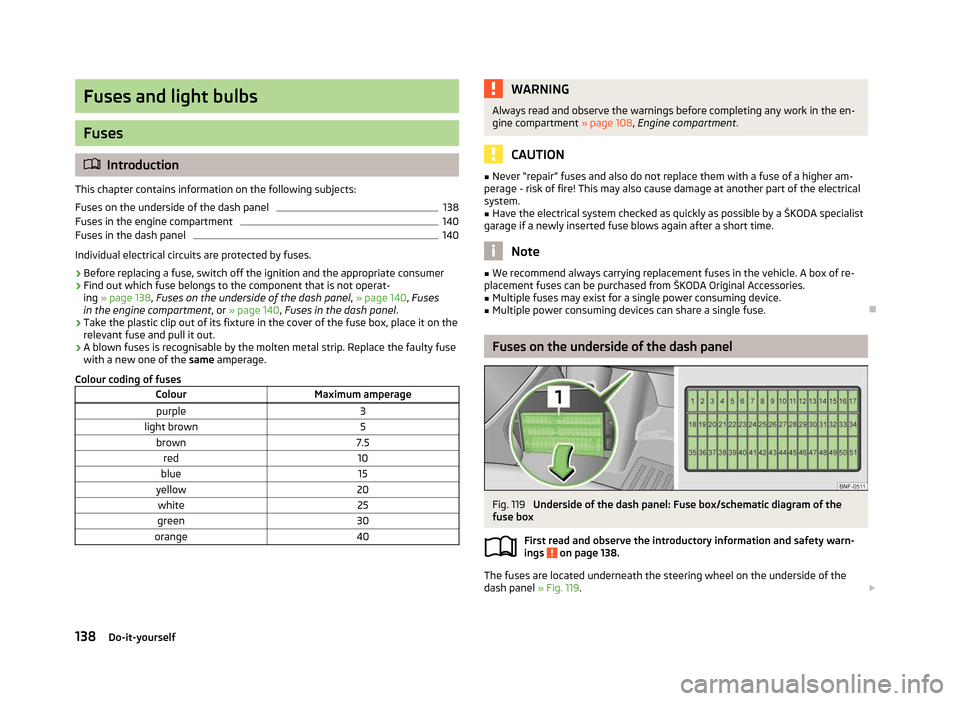
Fig. 119
Underside of the dash panel: Fuse box/schematic diagram of the
fuse box
First read and observe the introductory information and safety warn-
ings on page 138.
The fuses are located underneath the steering wheel on the underside of the
dash panel » Fig. 119. £
ä
138 Do-it-yourself
Page 141 of 157
›
Press the locking mechanism 1
and carefully open the cover in the direction of
the arrow.
› After the fuse has been replaced, fold the cover upwards in the opposite direc-
tion of the arrow so that it audibly latches.
Fuse assignment on the underside of the dash panel No. Power consumer
1 Telephone, radiator fan, instrument cluster, engine control unit
2 Diagnostic connection, AC compressor
3 Clutch pedal switch, brake pedal switch
4 Daytime running lights 5 Switch wiring harness
6 Headlamp beam adjustment, exterior mirror adjustment
7-8 Automated transmission 9 Airbag
10 Park Assist 11 Low beam
12 Rear fog light
13 Low beam
14 Rear window wiper 15 Light switch
16 Steering force assistance 17 Windscreen washer
18 Reverse light switch 19 Injection valves, coolant pump
20 ABS/ESP, switch wiring harness 21 Switch illumination, number plate light
22 Daytime running lights
23 Light switch
24-26 Switch wiring harness 27 Interior light
28 Diagnostic connector 29 Central control unit
30 Exterior mirror heater 31 Cooler fan, regulator valve, lambda probe No. Power consumer
32 Turn signal, brake light
33 Main beam
34 Instrument cluster, main beam 35 Not assigned
36 Cigarette lighter, 12-volt power socket 37 Air blower for heating and air conditioning
38 Radio 39 Panoramic sliding roof, horn
40 Engine control unit 41 Central locking system
42 Ignition module
43 Seat heaters
44 Fuel pump 45 Light switch
46 Rear window heater 47 Power windows - right
48 Horn 49 Windscreen wipers50 Fog lights 51 Power windows - left Ð
139
Fuses and light bulbs
Page 142 of 157
Fuses in the engine compartment
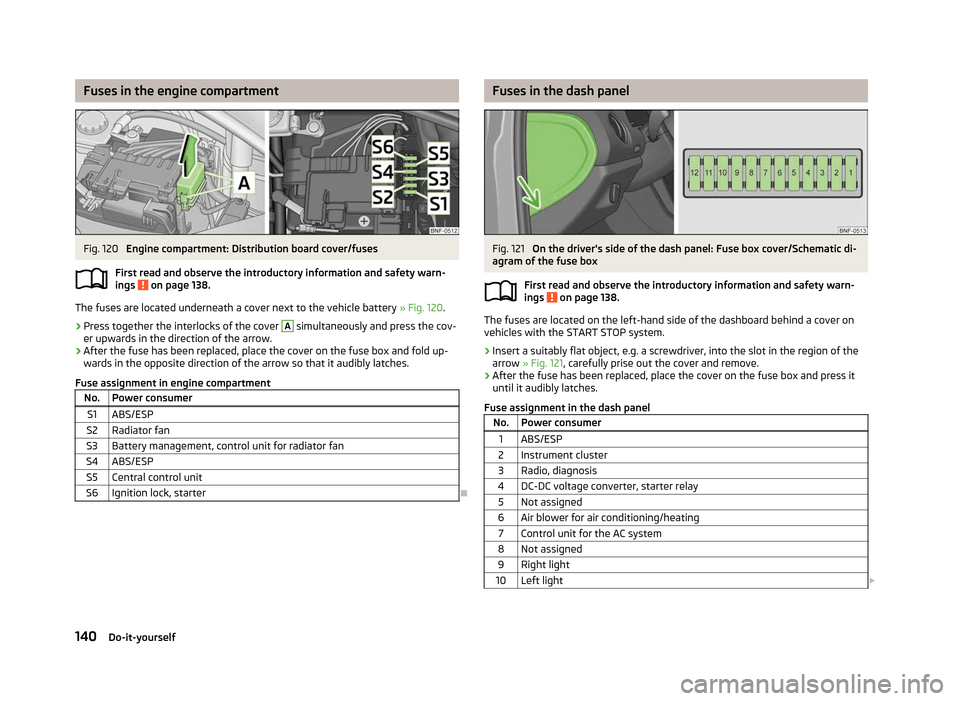
Fig. 120
Engine compartment: Distribution board cover/fuses
First read and observe the introductory information and safety warn-
ings on page 138.
The fuses are located underneath a cover next to the vehicle battery
» Fig. 120.
› Press together the interlocks of the cover A
simultaneously and press the cov-
er upwards in the direction of the arrow.
› After the fuse has been replaced, place the cover on the fuse box and fold up-
wards in the opposite direction of the arrow so that it audibly latches.
Fuse assignment in engine compartment No. Power consumer
S1 ABS/ESP
S2 Radiator fan
S3 Battery management, control unit for radiator fan
S4 ABS/ESP S5 Central control unit
S6 Ignition lock, starter Ð
ä Fuses in the dash panel
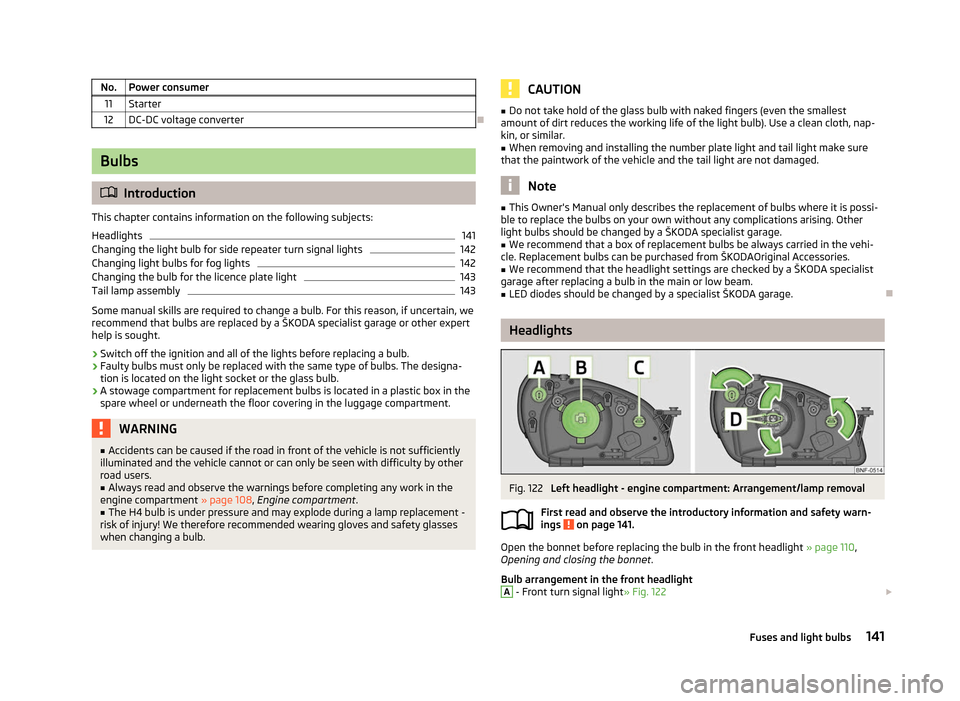
Fig. 121
On the driver's side of the dash panel: Fuse box cover/Schematic di-
agram of the fuse box
First read and observe the introductory information and safety warn-
ings on page 138.
The fuses are located on the left-hand side of the dashboard behind a cover on
vehicles with the
START STOP system.
› Insert a suitably flat object, e.g. a screwdriver, into the slot in the region of the
arrow » Fig. 121, carefully prise out the cover and remove.
› After the fuse has been replaced, place the cover on the fuse box and press it
until it audibly latches.
Fuse assignment in the dash panel No. Power consumer
1 ABS/ESP
2 Instrument cluster
3 Radio, diagnosis
4 DC-DC voltage converter, starter relay 5 Not assigned
6 Air blower for air conditioning/heating 7 Control unit for the AC system
8 Not assigned 9 Right light
10 Left light £ ä
140 Do-it-yourself
Page 143 of 157
No. Power consumer
11 Starter
12 DC-DC voltage converter Ð
Bulbs
ä
Introduction
This chapter contains information on the following subjects:
Headlights 141
Changing the light bulb for side repeater turn signal lights 142
Changing light bulbs for fog lights 142
Changing the bulb for the licence plate light 143
Tail lamp assembly 143
Some manual skills are required to change a bulb. For this reason, if uncertain, we
recommend that bulbs are replaced by a ŠKODA specialist garage or other expert
help is sought.
› Switch off the ignition and all of the lights before replacing a bulb.
› Faulty bulbs must only be replaced with the same type of bulbs. The designa-
tion is located on the light socket or the glass bulb.
› A stowage compartment for replacement bulbs is located in a plastic box in the
spare wheel or underneath the floor covering in the luggage compartment. WARNING
■ Accidents can be caused if the road in front of the vehicle is not sufficiently
illuminated and the vehicle cannot or can only be seen with difficulty by other
road users.
■ Always read and observe the warnings before completing any work in the
engine compartment » page 108, Engine compartment .
■ The H4 bulb is under pressure and may explode during a lamp replacement -
risk of injury! We therefore recommended wearing gloves and safety glasses
when changing a bulb. CAUTION
■ Do not take hold of the glass bulb with naked fingers (even the smallest
amount of dirt reduces the working life of the light bulb). Use a clean cloth, nap-
kin, or similar. ■ When removing and installing the number plate light and tail light make sure
that the paintwork of the vehicle and the tail light are not damaged. Note
■ This Owner's Manual only describes the replacement of bulbs where it is possi-
ble to replace the bulbs on your own without any complications arising. Other
light bulbs should be changed by a
ŠKODA specialist garage.
■ We recommend that a box of replacement bulbs be always carried in the vehi-
cle. Replacement bulbs can be purchased from
ŠKODAOriginal Accessories.
■ We recommend that the headlight settings are checked by a ŠKODA specialist
garage after replacing a bulb in the main or low beam.
■ LED diodes should be changed by a specialist ŠKODA garage. Ð Headlights
Fig. 122
Left headlight - engine compartment: Arrangement/lamp removal
First read and observe the introductory information and safety warn-
ings on page 141.
Open the bonnet before replacing the bulb in the front headlight
» page 110,
Opening and closing the bonnet .
Bulb arrangement in the front headlight A
- Front turn signal light
» Fig. 122 £
ä
141
Fuses and light bulbs
Page 147 of 157
Technical data
Technical data
Introductory information
The details given in the vehicle's technical documentation always take prece-
dence over the details in the Owner's Manual. Please refer to the official vehicle
registration documents or consult a
ŠKODA Service Partner to determine which
engine your vehicle is equipped with.
The listed performance values were determined without performance-reducing
equipment, e.g. air conditioning system.
Vehicle identification number (VIN)
The vehicle identification number - VIN (vehicle body number) is stamped into the
engine compartment on the right hand suspension strut dome. This number is al-
so located on a sign on the lower left hand edge below the windscreen (together
with a VIN bar code).
Engine number
The engine number is stamped into the engine block. ÐData on the vehicle sticker and the type plate
Fig. 128
Vehicle data sticker/type plate Vehicle data sticker
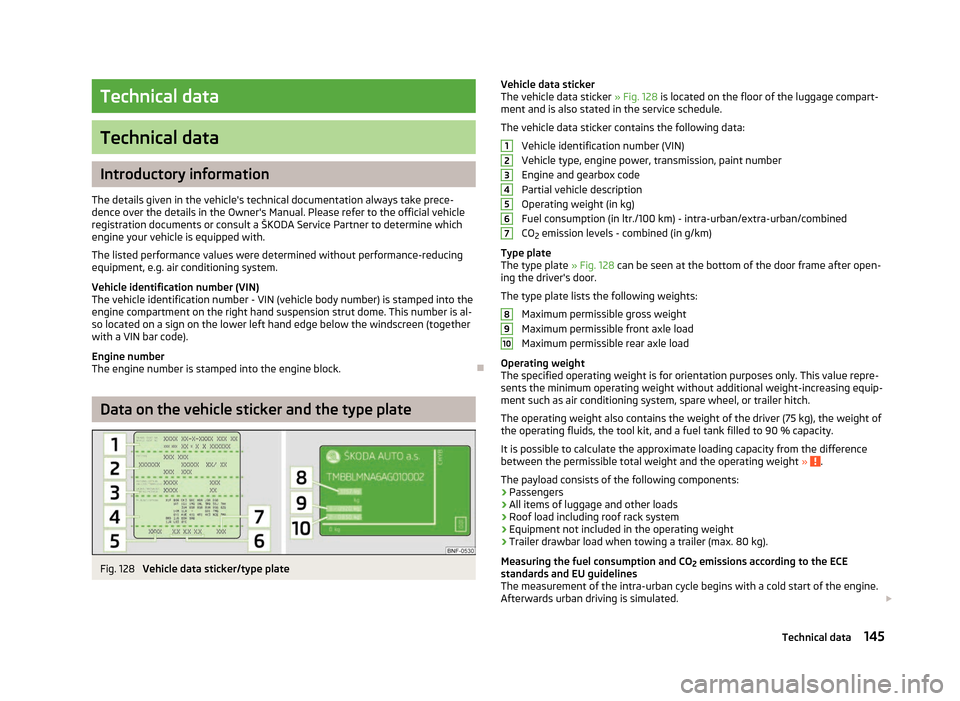
The vehicle data sticker » Fig. 128 is located on the floor of the luggage compart-
ment and is also stated in the service schedule.
The vehicle data sticker contains the following data: Vehicle identification number (VIN)
Vehicle type, engine power, transmission, paint number
Engine and gearbox code
Partial vehicle description
Operating weight (in
kg)
Fuel consumption (in ltr./100 km) - intra-urban/extra-urban/combined
CO 2 emission levels - combined (in g/km)
Type plate
The type plate » Fig. 128 can be seen at the bottom of the door frame after open-
ing the driver's door.
The type plate lists the following weights:
Maximum permissible gross weight
Maximum permissible front axle load
Maximum permissible rear axle load
Operating weight
The specified operating weight is for orientation purposes only. This value repre-
sents the minimum operating weight without additional weight-increasing equip-
ment such as air conditioning system, spare wheel, or trailer hitch.
The operating weight also contains the weight of the driver (75 kg), the weight of
the operating fluids, the tool kit, and a fuel tank filled to 90 % capacity.
It is possible to calculate the approximate loading capacity from the difference
between the permissible total weight and the operating weight » .
The payload consists of the following components:
› Passengers
› All items of luggage and other loads
› Roof load including roof rack system
› Equipment not included in the operating weight
› Trailer drawbar load when towing a trailer (max. 80 kg).
Measuring the fuel consumption and CO 2 emissions according to the ECE
standards and EU guidelines
The measurement of the intra-urban cycle begins with a cold start of the engine.
Afterwards urban driving is simulated. £ 1
2
3
4
5
6
7
8
9
10
145
Technical data
Page 148 of 157
In the extra-urban driving cycle, the vehicle is accelerated and decelerated in all
gears, corresponding to daily routine driving conditions. The driving speed varies
between 0 and 120 km/h.
The calculation of the combined fuel consumption considers a weighting of about
37
% for the intra-urban cycle and 63 % for the extra-urban cycle. WARNING
Do not exceed the specified maximum permissible weights - risk of accident
and damage. Note
■ If required, you can find out the precise weight of your vehicle by contacting a
ŠKODA
Service Partner.
■ Depending on the range of equipment, style of driving, traffic situation, weather
influences and vehicle condition, consumption values may deviate from the indi-
cated values. ÐDimensions
Dimensions (mm) Length 3563
Width 1641/1645a)
Width including exterior mirror 1910
Height 1478/1463b)
Clearance 136/121b)
Wheel base 2420
Track gauge front/rear 1428/1424a)
Valid for vehicles with rear side doors.
b) The value corresponds to the status with the Green tec package. ÐSpecifications and engine oil capacity
The engine has been factory-filled with a high-grade oil that can be use through-
out the year - except in extreme climate zones. Various oils can be mixed together when refilling.
Engine oils are, of course, undergoing continuous further development. Thus the
information stated in this Owner's Manual is only correct at the time of publica-
tion.
ŠKODA Service Partners are informed about the latest changes by
ŠKODA. We
therefore recommend that the oil change is completed by a ŠKODA Service Part-
ner.
The specifications (VW standards) stated in the following can be indicated sepa-
rately or together with other specifications on the bottle.
The oil capacities include oil filter change. Check the oil level when filling; do not
over fill. The oil level must be between the markings » page 111, Checking the en-
gine oil level .
Specifications and capacity (in l) Engine SpecificationFilling level
1.0 l/44 kW VW 502 00, VW 504 00a)
3.4
1.0 l/55 kW VW 502 00, VW 504 00a)
3.4
1.0 l/50 kW - CNG VW 502 003.4 a)
The use of an engine oil with the VW 504 00 specification requires the use of a fuel according to the
EN 228 standard » page 105, Unleaded petrol or a fuel of comparable quality. Note
■ Before a long drive we recommend that you purchase and carry with you engine
oil which complies with the specification for your vehicle. ■ We recommend that you use oils from ŠKODA Original Accessories. Ð146
Technical data
Page 149 of 157
Vehicle-specific information depending on engine type
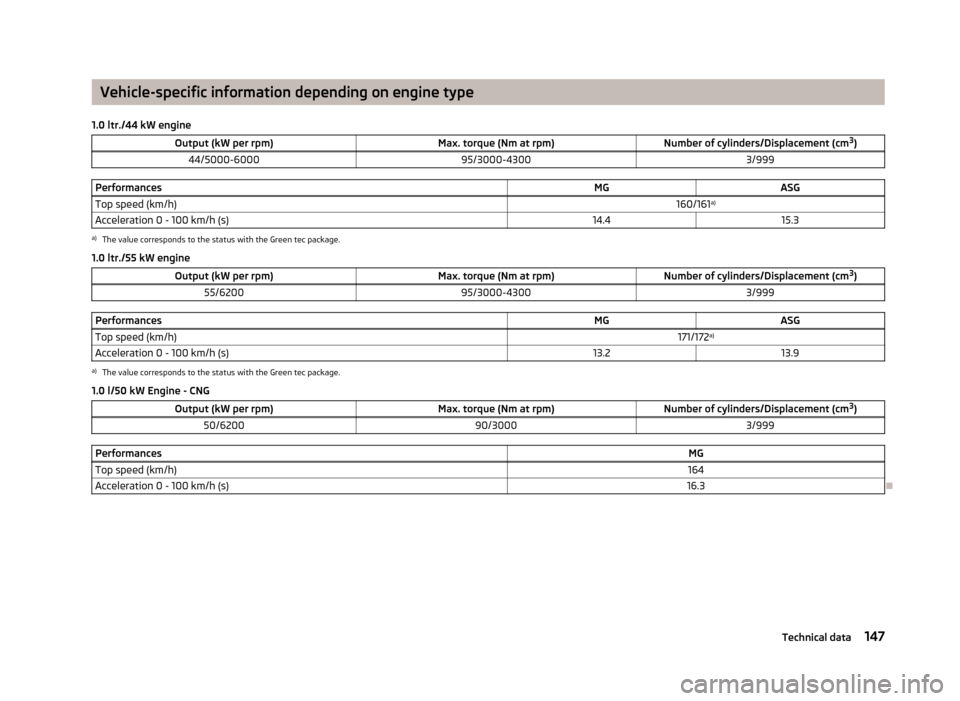
1.0 ltr./44 kW engineOutput (kW per rpm) Max. torque (Nm at rpm)Number of cylinders/Displacement (cm3
)
44/5000-6000 95/3000-4300 3/999Performances
MGASG
Top speed (km/h) 160/161a)
Acceleration 0 - 100 km/h (s) 14.415.3a)
The value corresponds to the status with the Green tec package.
1.0 ltr./55
kW engine Output (kW per rpm) Max. torque (Nm at rpm)Number of cylinders/Displacement (cm3
)
55/6200 95/3000-4300 3/999Performances
MGASG
Top speed (km/h) 171/172a)
Acceleration 0 - 100 km/h (s) 13.213.9a)
The value corresponds to the status with the Green tec package.
1.0 l/50
kW Engine - CNG Output (kW per rpm) Max. torque (Nm at rpm)Number of cylinders/Displacement (cm3
)
50/6200 90/30003/999Performances
MG
Top speed (km/h) 164
Acceleration 0 - 100 km/h (s) 16.3 Ð
147
Technical data
Page 150 of 157
Index
A
ABS 61
Warning light 17
Accessories 125
Adjusting Exterior mirror 36
Interior mirror 35
Adjusting seats 75
Adjustment Seat 38
Aerial 98
Airbag Deployment 82
Front airbag 83
Side airbag Head-Thorax 84
Switching off 85
System description 82
Air conditioning system 53
Recirculated air mode 55
Antilock brake system 61
Ash tray 45
Assistance systems ESC 60
Assist systems ABS 17, 61
City Safe Drive 66
Cruise control systems (CCS) 63
EDL 61
ESC 17
Parking aid 62
START/STOP 65
TCS 61
Traction Control System (TCS) 17
Visual parking system 63Automatic gearbox 69
Dynamic shift programme 71
Information for driving 69
Kickdown 71
Operational faults 71
Parking 69
Selector lever positions 70
Starting off 69
Stopping 69
Tiptronic 70
Automatic load deactivation 118
Avoiding damage to your vehicle 95
B
Before setting off 74
Belts 78
Belt tensioners 80
Bonnet Closing 110
Opening 110
Brake assist 60
Brake booster 60
Brake fluid Checking 113
Brakes Handbrake 60
Running in 91
Warning light 15
Braking Brake fluid 113
Breakdown kit 132
Bulbs Replacing 141
Button in the driver's door Electrical power windows 26
C
Car computer see Multifunction display 11Car jack 127
Carrier 44
Catalytic converter 91
Central locking button 23
Central locking system 21
lock 22
unlock 22
Changes 125
Changing Engine oil 112
Wheel 128
Charging a vehicle battery 117
Checking Battery electrolyte level 116
Brake fluid 113
Coolant level 112
Engine oil 111
Oil level 111
Windscreen washer fluid 114
Children and safety 87
Child safety Side airbag 88
Child safety lock 21
Child seat Classification 88
ISOFIX 89
on the front passenger seat 87
Suitability 89
TOP TETHER 90
Chrome parts refer to Taking care of your vehicle 99
Cigarette lighter 46
City Safe Drive 66
Warning light 19
Cleaning 97
Artificial leather 101
Headlight lenses 100
Material coverings 102
Materials 101
Natural leather 102
148 Index
Page 151 of 157
Plastic parts 99
Wheels 101
Clock 12
Clothes hooks 50
CNG 106
Fuel gauge 9
Refuelling 106
Cockpit 12-volt power socket 46
Ash tray 45
Cigarette lighter 46
Cup holder 45
General view 7
Light 32
Storage compartments 47
Compartments 47
Compressed natural gas see CNG 106
Computer see Multifunction display 11
Coolant Checking 112
Replenishing 113
Correct seated position 75
Counter for distance driven 10
Cruise control system (CCS) 63
Cup holder 45
D
Dash panel insert 8
Daytime running light 30
Defrsoting rear window 33
Digital clock 12
Dipstick 111
Display Fuel level 9
Service interval 10
Distance driven 10Door
Child safety lock 21
Door opening lever locking of 22
Door opening leverl unlocking of 22
Doors Emergency locking 25
Driving Abroad 95
Driving through water on the street 96
Emissions 145
Fuel consumption 145
Towing a trailer 126
E
Economical and environmentally friendly driving 92
EDL 61
Electrical power windows Button in the driver's door 26
Electronic differential lock 61
Electronic immobiliser 57
Emergency Changing a wheel 128
Hazard warning light system 31
Jump-starting 134
locking of the doors 25
Towing the vehicle 136
Tyre repair 132
Unlocking the luggage compartment lid 26
Emissions 145
Engine Running in 91
Starting and stopping the engine 56
Engine compartment Brake fluid 113
Coolant 112
Overview 110
Vehicle battery 115Engine oil
Capacity 146
Changing 112
Checking 111
Replenishing 111
Specification 146
Engine revolutions counter 9
Environment 92
Environmental compatibility 94
Environmentally friendly driving 92
ESC Function 60
Warning light 17
F
Fire extinguisher 127
First-aid kit 127
Floor mats 62
Front airbag 83
Front seats 38
Fuel 104
Fuel gauge 9
refer to Fuel 104
Refuelling 104
Unleaded petrol 105
Fuel consumption 92
Fuses Assignment 138
Replacing 138
G
Gear Recommended gear 10
General view Cockpit 7
H
Handbrake 60
149
Index
Page 152 of 157
Head-Thorax 84
Headlights Driving abroad 95
Head restraint 40
Heating 52
Exterior mirror 36
Rear window 33
recommended settings 53
Seats 39
Heating rear window 33
Horn 7
I
Ignition 58
Ignition lock 58
Immobiliser 57
Instrument cluster 8
ISOFIX 89
J
Jacking points Raise vehicle 131
Jump-starting 134
L
Lever Main beam 31
Turn signal 31
Light Cockpit 32
Daytime running light 30
Fog lights 30
Hazard warning light system 31
Headlight beam adjustment 30
Headlight flasher 32
Low beam 29
Main beam 31
Parking light 29, 30Rear fog light 30
Replacing bulbs 141
Turn signal 31
Lights Switching lights on and off 29
Loads 145
Lock Central locking system 22
Locking Door opening lever 22
Emergency locking 25
Remote control 24
Locking and unlocking from the inside 23
luggage compartment see luggage compartment lid 25
Luggage compartment Bag hooks 42
cover 43
Emergency unlocking 26
Fixing nets 43
Lashing eyes 42
Unlocking the luggage compartment lid 26
Luggage compartment lid 25
M
Mirror Additional interior mirror 36
Exterior 36
Vanity 33
Mobile phone 72
Multifunction display Functions 11
Memory 11
Operation 12
O
Oil refer to Engine oil 111Onboard computer
see Multifunction display 11
Operation in winter De-icing windows 100
Vehicle battery 117
Outside temperature 12
Overview Engine compartment 110
Warning lights 14
P
Paint see Paint damage 99
Paint damage 99
Parking Parking aid 62
Visual parking system 63
Parking ticket holder 50
Passive Safety 74
Periodic wiping 34
Petrol refer to Fuel 105
Polishing the paintwork refer to Taking care of your vehicle 99
Power steering 57
Power windows Button in the driver's door 27
Preservation refer to Taking care of your vehicle 99
R
Radiator fan 113
Radio reception Operating problem 100
Raise vehicle 131
Rear mirror Exterior 36
Interior 35
150 Index