towing SKODA CITIGO 2013 1.G User Guide
[x] Cancel search | Manufacturer: SKODA, Model Year: 2013, Model line: CITIGO, Model: SKODA CITIGO 2013 1.GPages: 176, PDF Size: 10.54 MB
Page 58 of 176
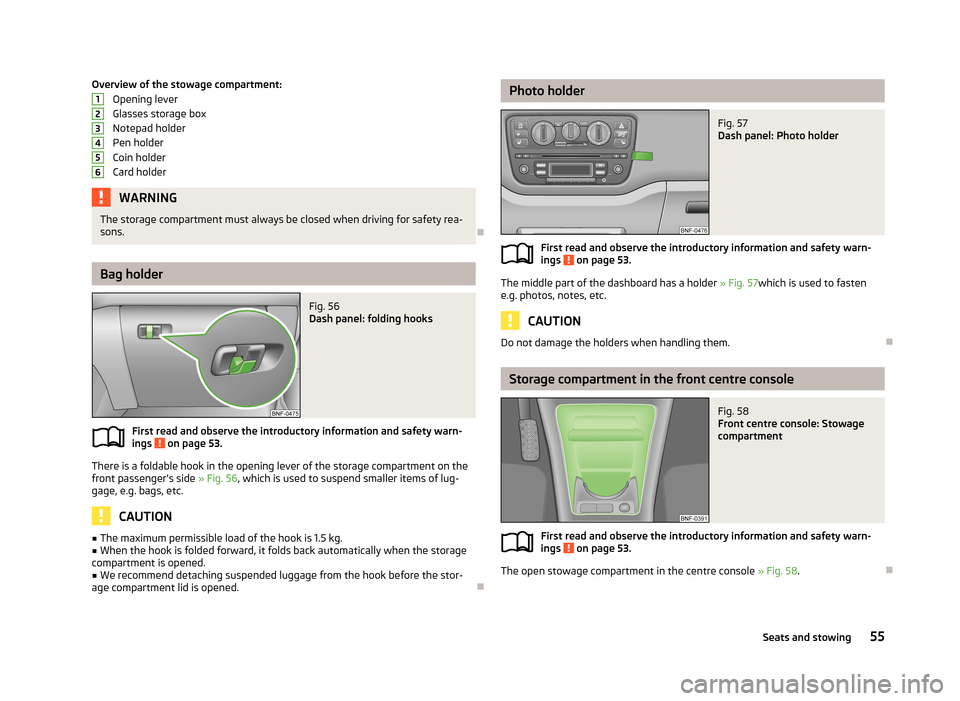
Overview of the stowage compartment:Opening lever
Glasses storage box
Notepad holder
Pen holder
Coin holder
Card holderWARNINGThe storage compartment must always be closed when driving for safety rea-
sons.
Bag holder
Fig. 56
Dash panel: folding hooks
First read and observe the introductory information and safety warn-
ings on page 53.
There is a foldable hook in the opening lever of the storage compartment on the
front passenger's side » Fig. 56, which is used to suspend smaller items of lug-
gage, e.g. bags, etc.
CAUTION
■ The maximum permissible load of the hook is 1.5 kg.■When the hook is folded forward, it folds back automatically when the storage
compartment is opened.■
We recommend detaching suspended luggage from the hook before the stor-
age compartment lid is opened.
123456Photo holderFig. 57
Dash panel: Photo holder
First read and observe the introductory information and safety warn- ings on page 53.
The middle part of the dashboard has a holder » Fig. 57which is used to fasten
e.g. photos, notes, etc.
CAUTION
Do not damage the holders when handling them.
Storage compartment in the front centre console
Fig. 58
Front centre console: Stowage
compartment
First read and observe the introductory information and safety warn-
ings on page 53.
The open stowage compartment in the centre console » Fig. 58.
55Seats and stowing
Page 70 of 176
It is still fully possible to steer the vehicle if the power steering fails or if the en-gine is not running (e.g. when towing). However, greater physical effort is re-
quired to turn the steering wheel.
If there is a fault in the power steering, the warning light or
lights up in the
instrument cluster » page 18.
Starting and stopping the engine
Introduction
This chapter contains information on the following subjects:
Electronic immobilizer
68
Ignition lock
68
Starting the engine
68
Switching off the engine
68
The engine can only be started using a correctly coded original key.
The engine running noises may louder at first be louder for a short time afterstarting the cold engine. This is quite normal and is not an operating problem.
WARNING■ When driving, the ignition key must always be in the position 2 » Fig. 68 on
page 68 (ignition switched on) without the engine running. This position is
indicated by the warning lights coming on. If this is not the case, this could re-
sult in unexpected locking of the steering wheel – risk of accident!■
Only pull the ignition key from the ignition lock when the vehicle has come
to a complete stop (by applying the handbrake). Otherwise, the steering could
be blocked – risk of accident!
■
When leaving the vehicle, the ignition must always be removed. This is par-
ticularly important if children are left in the vehicle. Children could otherwise
start the engine for example – risk of accident or injury!
■
Never leave the vehicle unattended with the engine running.
■
Never switch off the engine before the vehicle is stationary – risk of acci-
dent!
WARNING■ Never leave the engine running in unventilated or closed rooms. The ex-
haust gases from the engine contain substances such as odourless and col-
ourless carbon monoxide (a poisonous gas) – risk to life!■
Carbon monoxide can cause unconsciousness and death.
CAUTION
■ The starter must only be operated when the engine is not running and the vehi-
cle is at a standstill. The starter or engine can be damaged if the starter is activa-
ted when the engine is running 3
» Fig. 68 on page 68.
■
If the engine does not start up after a second attempt, the fuse for the fuel
pump may have a fault. Check the fuse and replace if necessary » page 154,
Fuses on the underside of the dash panel , or seek assistance from a specialist ga-
rage.
■
Let go of the ignition key as soon as the engine starts otherwise the starter
could be damaged.
■
Do not tow start the engine – there is a risk of damaging the engine and the
catalytic converter. The battery from another vehicle can be used as a jump-start
aid » page 150 , Jump-starting .
CAUTION
■
Avoid high engine revolutions, full throttle and high engine loads before the en-
gine has reached its operating temperature – risk of damaging the engine!■
Do not switch the engine off immediately at the end of your journey after the
engine has been operated over a prolonged period at high loads but leave it to
run at an idling speed for about 1 minute. This prevents any possible accumulation
of heat when the engine is switched off.
For the sake of the environment
Do not warm up the engine while the vehicle is stationary. If possible, start your
journey as soon as the engine has started. Through this the engine reaches its
operating temperature more rapidly and the pollutant emissions are lower.
Note
After switching off the ignition, the radiator fan can intermittently continue to op-
erate for approx. 10 minutes.
67Starting-off and Driving
Page 116 of 176
WARNINGObserve the following instructions for handling the airbag system.■It is prohibited to manipulate individual parts of the airbag system, as this
might result in the airbag being deployed.■
Never install any airbag parts into the vehicle that have been removed from
old cars or have been recycled.
■
Never install damaged airbag parts in the vehicle. The airbags may then not
be deployed properly or even at all in the event of an accident.
■
No modifications of any kind must be made to parts of the airbag system.
WARNING■ A change to the vehicle's wheel suspension, including the use of non-ap-
proved wheels and tire combinations, can alter the functioning of the airbag system - risk of accident and fatal injury!■
Never make any changes to the front bumper or the bodywork.
WARNINGThe airbag control unit operates using pressure sensors located in the front
doors. For this reason, no adjustments may be carried out to the doors or door
panels (e.g. installation of additional loudspeakers). Resulting damage can have a negative impact on the function of the airbag system. Any work on thefront doors and door panels must be carried out by a specialist garage. The
following instructions must be observed.■
Never drive with inner door panels removed.
■
Never drive if parts of the inner door panel have been removed and the re-
sulting openings have not been properly sealed.
■
Never drive if the loudspeakers in the doors have been removed, unless the
loudspeaker openings have been properly sealed.
■
Always make sure that the openings are covered or filled if additional loud-
speakers or other equipment parts have been installed in the inner door pan-
els.
Trailer operation
First read and observe the introductory information and safety warn-
ings
on page 110.
The vehicle is not approved for towing a trailer. The vehicle is not factory-equip-
ped with a towing device and it cannot be retrofitted with a towing device.
WARNINGNever attach a towing device to the vehicle.
Washing your car
Introduction
This chapter contains information on the following subjects:
Washing by hand
114
Automatic car wash systems
114
Washing with a high-pressure cleaner
114
The best way to protect your vehicle against harmful environmental influences is frequent washing.
How often the vehicle should be washed depends on factors such as: › Frequency of use.
› Parking situation (garage, under trees etc.).
› Season.
› Weather conditions.
› Environmental influences.
The longer insect residues, bird droppings, tree sap, road and industrial dust, tar,
soot particles, road salt and other aggressive deposits remain adhering to the paintwork of your vehicle, the more detrimental their destructive effect can be.
High temperatures, such as those caused by intensive sun's rays, accentuate this
caustic effect.
It is essential to also thoroughly clean the underside of the vehicle at the end of
the winter.
113Vehicle care
Page 134 of 176
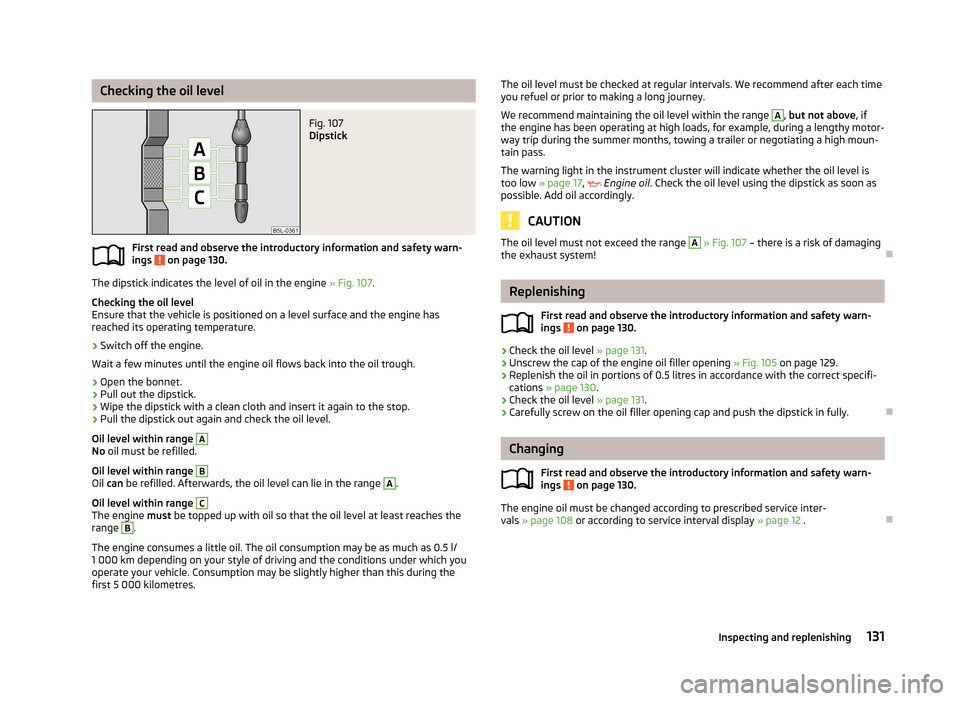
Checking the oil levelFig. 107
Dipstick
First read and observe the introductory information and safety warn-
ings on page 130.
The dipstick indicates the level of oil in the engine » Fig. 107.
Checking the oil level
Ensure that the vehicle is positioned on a level surface and the engine has reached its operating temperature.
›
Switch off the engine.
Wait a few minutes until the engine oil flows back into the oil trough.
›
Open the bonnet.
›
Pull out the dipstick.
›
Wipe the dipstick with a clean cloth and insert it again to the stop.
›
Pull the dipstick out again and check the oil level.
Oil level within range
A
No oil must be refilled.
Oil level within range
B
Oil can be refilled. Afterwards, the oil level can lie in the range
A
.
Oil level within range
C
The engine must be topped up with oil so that the oil level at least reaches the
range
B
.
The engine consumes a little oil. The oil consumption may be as much as 0.5 l/
1 000 km depending on your style of driving and the conditions under which you
operate your vehicle. Consumption may be slightly higher than this during the
first 5 000 kilometres.
The oil level must be checked at regular intervals. We recommend after each time
you refuel or prior to making a long journey.
We recommend maintaining the oil level within the range A
, but not above , if
the engine has been operating at high loads, for example, during a lengthy motor-
way trip during the summer months, towing a trailer or negotiating a high moun- tain pass.
The warning light in the instrument cluster will indicate whether the oil level is too low » page 17 , Engine oil . Check the oil level using the dipstick as soon as
possible. Add oil accordingly.
CAUTION
The oil level must not exceed the range A » Fig. 107 – there is a risk of damaging
the exhaust system!
Replenishing
First read and observe the introductory information and safety warn-
ings
on page 130.
›
Check the oil level » page 131.
›
Unscrew the cap of the engine oil filler opening » Fig. 105 on page 129.
›
Replenish the oil in portions of 0.5 litres in accordance with the correct specifi-
cations » page 130 .
›
Check the oil level » page 131.
›
Carefully screw on the oil filler opening cap and push the dipstick in fully.
Changing
First read and observe the introductory information and safety warn-ings
on page 130.
The engine oil must be changed according to prescribed service inter-
vals » page 108 or according to service interval display » page 12 .
131Inspecting and replenishing
Page 147 of 176
Do-it-yourself
Emergency equipment and self-help
Emergency equipment
Introduction
This chapter contains information on the following subjects:
First aid kit and warning triangle
144
Vehicle tool kit
144
First aid kit and warning triangle
First read and observe the introductory information given on page 144.
The warning triangle can be stowed away underneath the floor covering of the
luggage compartment.
WARNINGThe first-aid kit and warning triangle must always be secured safely so that
they do not come loose when making an emergency braking or in a vehicle
collision which could cause injuries to occupants.
Note
■ Pay attention to the expiration date of the first-aid kit.■We recommend using a first-aid kit from ŠKODA Original Accessories, which are
available from a ŠKODA Partner.
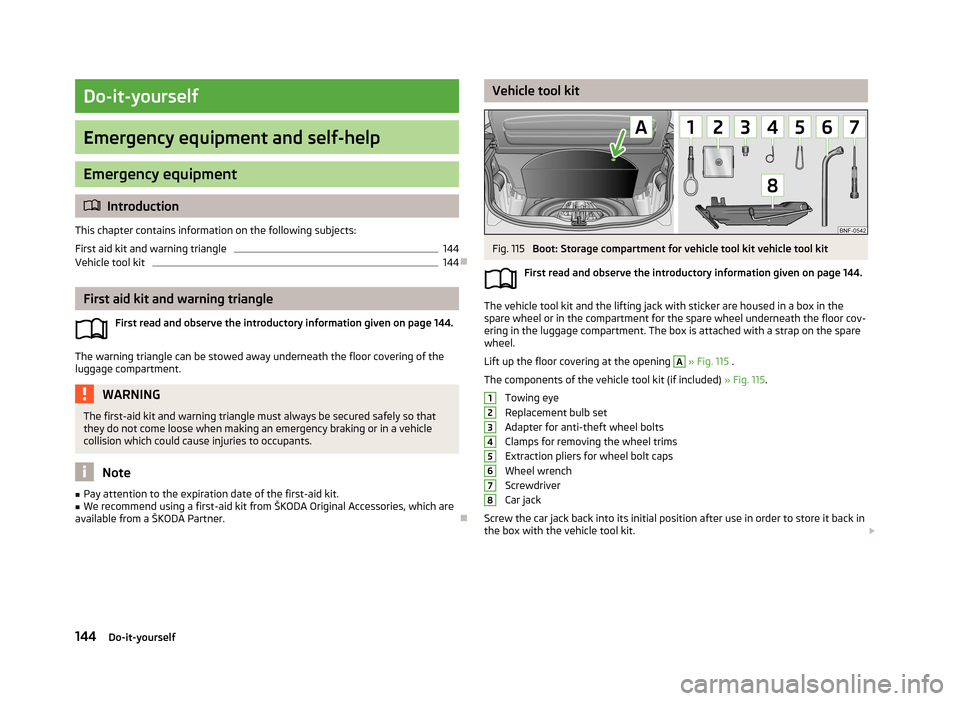
Vehicle tool kitFig. 115
Boot: Storage compartment for vehicle tool kit vehicle tool kit
First read and observe the introductory information given on page 144.
The vehicle tool kit and the lifting jack with sticker are housed in a box in the spare wheel or in the compartment for the spare wheel underneath the floor cov-
ering in the luggage compartment. The box is attached with a strap on the spare wheel.
Lift up the floor covering at the opening
A
» Fig. 115 .
The components of the vehicle tool kit (if included) » Fig. 115.
Towing eye
Replacement bulb set
Adapter for anti-theft wheel bolts
Clamps for removing the wheel trims
Extraction pliers for wheel bolt caps
Wheel wrench
Screwdriver
Car jack
Screw the car jack back into its initial position after use in order to store it back in
the box with the vehicle tool kit.
12345678144Do-it-yourself
Page 155 of 176
Negative cable – colour coding in the majority of cases is black.
Jump-starting in vehicles with the START-STOP system
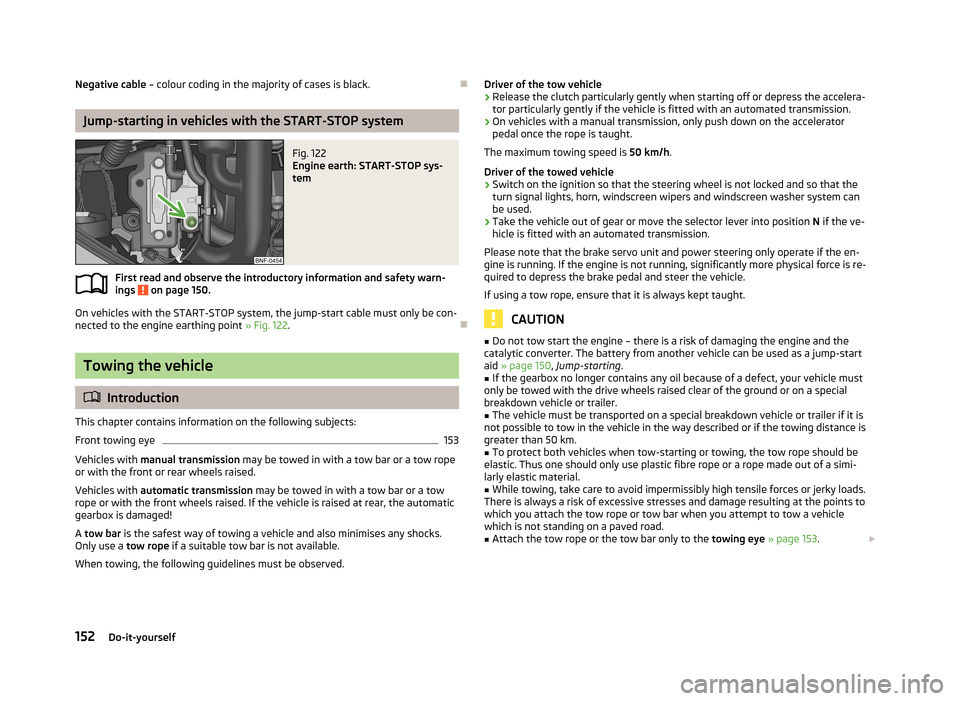
Fig. 122
Engine earth: START-STOP sys-
tem
First read and observe the introductory information and safety warn- ings on page 150.
On vehicles with the START-STOP system, the jump-start cable must only be con-
nected to the engine earthing point » Fig. 122.
Towing the vehicle
Introduction
This chapter contains information on the following subjects:
Front towing eye
153
Vehicles with manual transmission may be towed in with a tow bar or a tow rope
or with the front or rear wheels raised.
Vehicles with automatic transmission may be towed in with a tow bar or a tow
rope or with the front wheels raised. If the vehicle is raised at rear, the automatic
gearbox is damaged!
A tow bar is the safest way of towing a vehicle and also minimises any shocks.
Only use a tow rope if a suitable tow bar is not available.
When towing, the following guidelines must be observed.
Driver of the tow vehicle›Release the clutch particularly gently when starting off or depress the accelera-
tor particularly gently if the vehicle is fitted with an automated transmission.›
On vehicles with a manual transmission, only push down on the accelerator pedal once the rope is taught.
The maximum towing speed is 50 km/h.
Driver of the towed vehicle
›
Switch on the ignition so that the steering wheel is not locked and so that the turn signal lights, horn, windscreen wipers and windscreen washer system can
be used.
›
Take the vehicle out of gear or move the selector lever into position N if the ve-
hicle is fitted with an automated transmission.
Please note that the brake servo unit and power steering only operate if the en-
gine is running. If the engine is not running, significantly more physical force is re-
quired to depress the brake pedal and steer the vehicle.
If using a tow rope, ensure that it is always kept taught.
CAUTION
■ Do not tow start the engine – there is a risk of damaging the engine and the
catalytic converter. The battery from another vehicle can be used as a jump-start
aid » page 150 , Jump-starting .■
If the gearbox no longer contains any oil because of a defect, your vehicle must
only be towed with the drive wheels raised clear of the ground or on a special
breakdown vehicle or trailer.
■
The vehicle must be transported on a special breakdown vehicle or trailer if it is
not possible to tow in the vehicle in the way described or if the towing distance is greater than 50 km.
■
To protect both vehicles when tow-starting or towing, the tow rope should be
elastic. Thus one should only use plastic fibre rope or a rope made out of a simi-
larly elastic material.
■
While towing, take care to avoid impermissibly high tensile forces or jerky loads.
There is always a risk of excessive stresses and damage resulting at the points to
which you attach the tow rope or tow bar when you attempt to tow a vehicle which is not standing on a paved road.
■
Attach the tow rope or the tow bar only to the towing eye » page 153 .
152Do-it-yourself
Page 156 of 176
Note■We recommend using a tow rope from ŠKODA Original Accessories, which is
available from a ŠKODA Partner.■
Towing another vehicle requires a certain amount of practice. Both drivers
should be familiar with the particular points about towing a vehicle. Unskilled
drivers should not attempt to tow in another vehicle or to be towed in.
■
When towing, respect the national legal provisions, especially those which re-
late to the identification of the towing vehicle and the vehicle being towed.
■
The tow rope must not be twisted as it may in certain circumstances result in
the front towing eye being unscrewed out of your vehicle.
Front towing eye
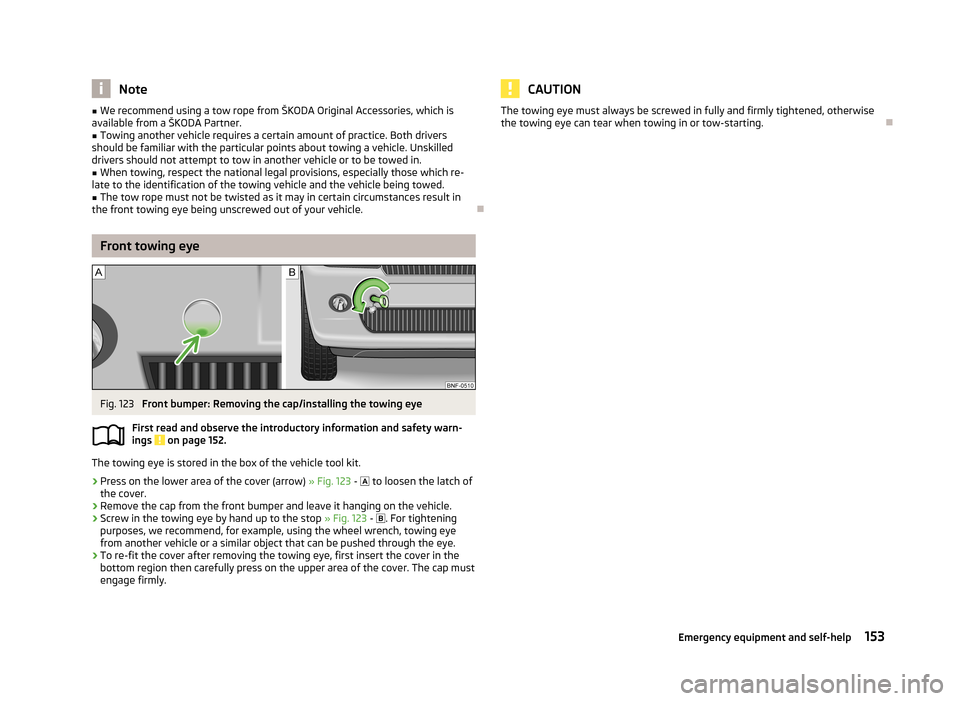
Fig. 123
Front bumper: Removing the cap/installing the towing eye
First read and observe the introductory information and safety warn- ings
on page 152.
The towing eye is stored in the box of the vehicle tool kit.
›
Press on the lower area of the cover (arrow) » Fig. 123 -
to loosen the latch of
the cover.
›
Remove the cap from the front bumper and leave it hanging on the vehicle.
›
Screw in the towing eye by hand up to the stop » Fig. 123 -
. For tightening
purposes, we recommend, for example, using the wheel wrench, towing eye
from another vehicle or a similar object that can be pushed through the eye.
›
To re-fit the cover after removing the towing eye, first insert the cover in the
bottom region then carefully press on the upper area of the cover. The cap must
engage firmly.
CAUTIONThe towing eye must always be screwed in fully and firmly tightened, otherwise
the towing eye can tear when towing in or tow-starting.
153Emergency equipment and self-help
Page 169 of 176
Jump-starting150
locking of the doors25
Towing the vehicle152
Tyre repair148
Unlocking the luggage compartment lid29
Emergency equipment First aid kit
144
Jack144
Vehicle tool kit144
Warning triangle144
Emissions161
Engine Running in
73
Engine compartment127
Brake fluid133
Coolant132
Overview129
Vehicle battery134
Engine oil130
Capacity130
Changing131
Checking131
Replenishing131
Specifications130
Warning light17
Engine revolutions counter11
Environment74
Environmental compatibility77
Environmentally friendly driving74
ESC Function
80
Warning light18
F
Films
116
First aid kit144
Fog lights35
Footmats71
see footmats71
Front airbag99
Front seats42
Fuel122
Fuel gauge11
refer to Fuel122
Refuelling122
Unleaded petrol123
Fuel consumption74
Fuel gauge Fuel gauge
11
Fuses Assignment
154
Colour coding154
Replacing154
G
Gear changing Gear stick
70
Gearshift Information on the switched gearshift
12
Recommended gear12
General view Cockpit
9
H
Handbrake
70
Hazard warning light system36
Head-Thorax100
Headlights Driving abroad
79
Replacing a bulb157
Head restraint45
Heating Control elements
58
Defrost windows59
Exterior mirrors41
operating58
Rear window37
Recommended settings59
Seats44
Heating and air-conditioning57
Hill hold control80
Horn9
I
Ignition
68
Ignition lock68
Immobilizer68
Inertia reels97
Instrument cluster10
Overview10
ISOFIX106
J
Jack
144
Jacking points Raise vehicle
147
Jump-starting150, 151
K
Key Starting the engine
68
L
Lashing eyes
47
Lever Main beam
34
Turn signal34
Windscreen wipers39
lever control71
See lever control71
light low beam
33
on and off33
parking light33
Light Cockpit
36, 37
166Index
Page 171 of 176
R
Radiator fan
129
Raise vehicle147
Rear-view mirror Exterior mirrors
41
Rear fog light35
Rear mirror40
Interior mirror40
Rear seats45
Folding forward45
Rear window heating37
Rear windows Closing
31
Opening31
Recirculated air mode61
Recommended gear12
Refuelling122
Fuel122
Regulation Headlight beam
34
Remote control27
locking28
Synchronisation process28
unlocking28
Remote control key Replacing the battery
23
Repairs and technical alterations110
Replace vehicle battery
137
Replace vehicle battery
137
Replacing Bulb for the fog light
158
Bulb for the licence plate light159
Bulb for the side turn signal lights158
Bulbs157
Bulbs in the tail light159
Fuses154
Fuses in the dash panel156
Fuses in the engine compartment156
Windscreen wiper blade40
Windscreen wiper blades39
Replenishing Coolant
133
Engine oil131
Windscreen washer fluid129
Roof rack mounting points
50
Roof rack system Roof load
50
Running-in The first 1500 km
73
Running in Brake pads
74
Engine73
Tyres74
S
Safe securing system
26
Safety90
Child safety103
Child safety seats103
Correct seated position91
Head restraints45
ISOFIX106
TOP TETHER107
Safety belt Warning light
21
Saving electrical energy74
Seals Taking care of your vehicle
116
Seat Adjusting
43
Seat belts94
Belt tensioners97
Cleaning121
fastening and unfastening96
Inertia reels97
The physical principle of a frontal collision95
Warning light17
Seats Folding forwards
45
Head restraints45
Heating44
Seats and stowing42
Service111
Service display12
Service intervals108
Setting Air conditioning system
61
Heating59
Setting the clock Clock
14
Shifting gears Driving and saving energy
75
Side airbag100
Sliding/tilting roof31
Closing31
Opening and tilting31
Operation31
Snow chains143
Spare wheel141
Speedometer11
Speed symbol See Wheels
141
Spoiler112
START-STOP85
Manually activating/deactivating the system86
Operating conditions of the system85
Starting/shutting down the engine85
Starting and stopping the engine with the key67
Starting engine Jump-starting
150
Starting the engine Jump-starting
151
Key68
168Index
Page 172 of 176
START STOPJump-starting152
Warning light21
Steering force assistance66
Steering wheel66
Storage53
Storage compartment Bag holder
55
Storage compartment on the driver's side54
Storage compartment on the front passenger side
54
Storage compartment with lid on the front pas- senger side
54
Storage compartments53
Meshed pockets on the front seat rests56
Multimedia holder56
Photo holder55
Storage compartment in the front centre console 55 Storage compartments in front of the rear seats
56
Sun visors38
Switching off the engine68
T
Taking care of the vehicle Natural leather
119
Seat belts121
Taking care of your vehicle Automatic car wash system
114
Cavity protection117
Chrome parts116
Cleaning the wheels118
Decorative films116
Door lock cylinders117
Headlight lenses117
High-pressure cleaner114
Plastic parts116
Polishing the paintwork115
Rubber seals116
Taking care of the interior118
Taking care of your vehicle exterior115
Washing113
Washing by hand114
Wash system114
Wax treatment115
Taking care of your vehicles Fabric covers
120
TCS81
Technical data161
Tiptronic see automatic gearbox
72
Tools144
TOP TETHER107
Towing152
Towing device113
Towing eye153
Traction Control System81
Warning light19
Transport Luggage compartment
46
Roof rack system49
Transporting children safely103
Turn signal34
Two-way radio systems63
Type plate161
Tyre load-bearing capacity See Wheels
140
Tyre repair Check pressure
150
Preparations149
Sealing and inflating the tyre149
Tyres138
Inflation pressure139
New140
See Wheels140
Sizes139
Tyre wear indicator139
U
Underbody protection
118
Unleaded petrol79
unlock Central locking system
26
Unlocking Remote control
28
Vehicle key22
Unlocking and locking22
Useful equipment50
V
Vehicle battery Automatic load deactivation
137
charging136
Checking the electrolyte level135
Operation in winter136
Safety instructions134
Vehicle care108
Alcantara120
Artificial leather120
Cloths120
Vehicle data sticker161
Vehicle dimensions162
Vehicle height162
vehicle identification number - VIN161
Vehicle key locking
22
unlocking22
Vehicle length162
Vehicles with CNG mode See CNG
123
Vehicles with natural gas mode See CNG
123
Vehicle tool kit144
Vehicle width162
Visibility37
Visors see Sun visors
38
Visual parking system82
169Index