oil dipstick SKODA CITIGO 2013 1.G Owner's Manual
[x] Cancel search | Manufacturer: SKODA, Model Year: 2013, Model line: CITIGO, Model: SKODA CITIGO 2013 1.GPages: 176, PDF Size: 10.54 MB
Page 132 of 176
›Take the bonnet support out of its holder 3
» Fig. 104 in the direction if the
arrow and secure the opened bonnet by inserting the end of the support in the
opening 4
designed for it.
Closing
›
Lift the bonnet slightly and unhook the bonnet support. Insert the bonnet sup-
port into the holder
3
designed for this purpose » Fig. 104.
›
Let the bonnet drop into the lock carrier lock from a height of around 20 cm – do
not push it in .
WARNINGCheck that the bonnet is closed properly.
CAUTION
Never open the bonnet using the locking lever » Fig. 103.
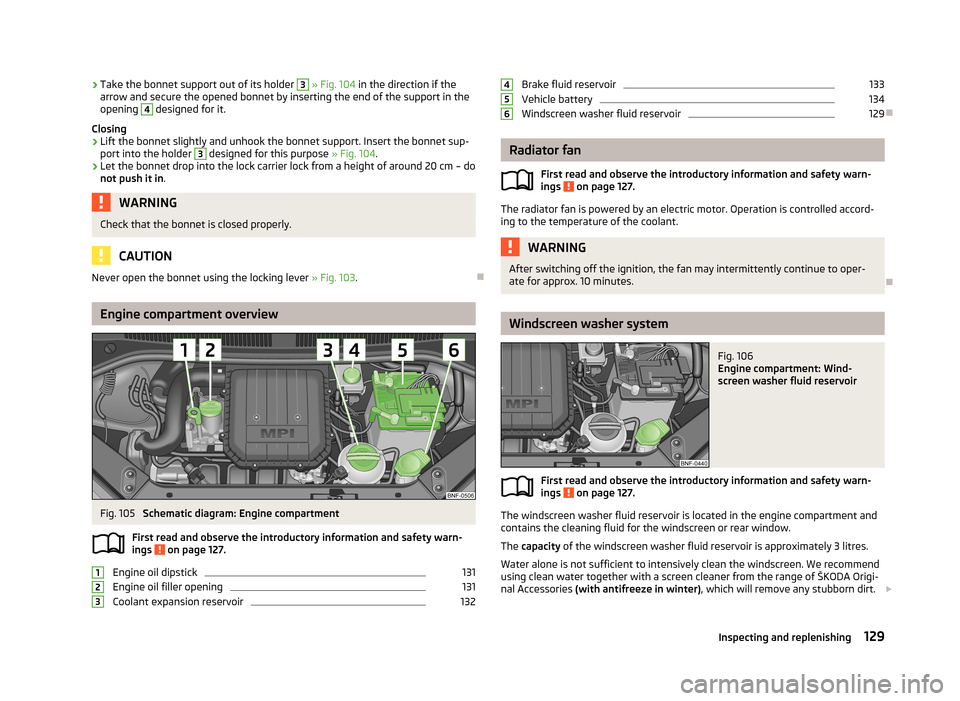
Engine compartment overview
Fig. 105
Schematic diagram: Engine compartment
First read and observe the introductory information and safety warn- ings
on page 127.
Engine oil dipstick
131
Engine oil filler opening
131
Coolant expansion reservoir
132123Brake fluid reservoir133Vehicle battery134
Windscreen washer fluid reservoir
129
Radiator fan
First read and observe the introductory information and safety warn-
ings
on page 127.
The radiator fan is powered by an electric motor. Operation is controlled accord-
ing to the temperature of the coolant.
WARNINGAfter switching off the ignition, the fan may intermittently continue to oper-
ate for approx. 10 minutes.
Windscreen washer system
Fig. 106
Engine compartment: Wind-
screen washer fluid reservoir
First read and observe the introductory information and safety warn- ings on page 127.
The windscreen washer fluid reservoir is located in the engine compartment and
contains the cleaning fluid for the windscreen or rear window.
The capacity of the windscreen washer fluid reservoir is approximately 3 litres.
Water alone is not sufficient to intensively clean the windscreen. We recommend using clean water together with a screen cleaner from the range of ŠKODA Origi-
nal Accessories (with antifreeze in winter) , which will remove any stubborn dirt.
456129Inspecting and replenishing
Page 134 of 176
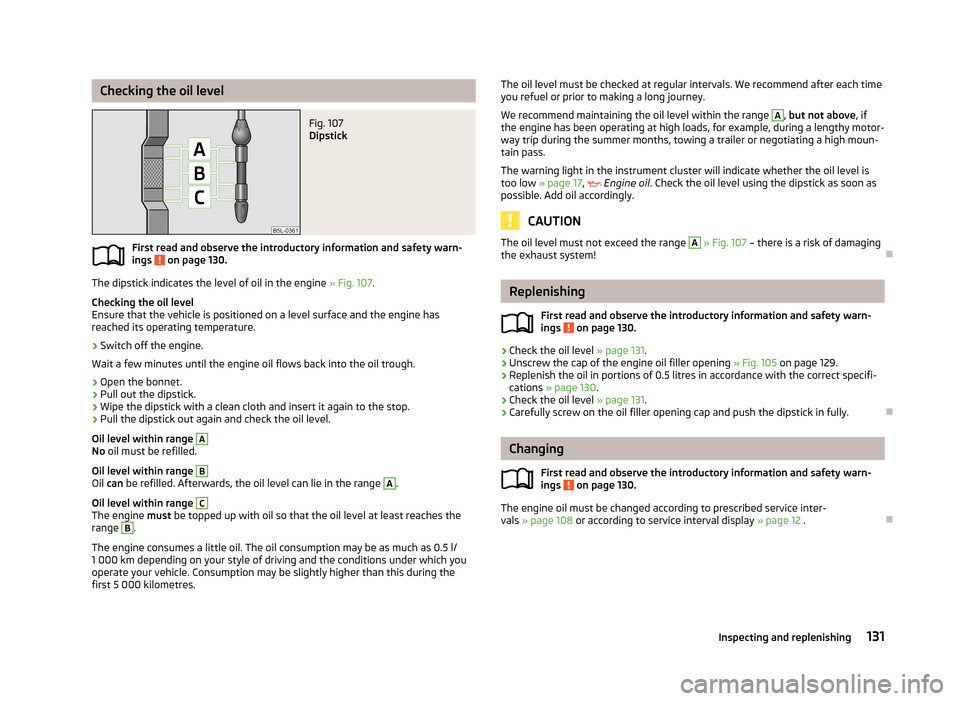
Checking the oil levelFig. 107
Dipstick
First read and observe the introductory information and safety warn-
ings on page 130.
The dipstick indicates the level of oil in the engine » Fig. 107.
Checking the oil level
Ensure that the vehicle is positioned on a level surface and the engine has reached its operating temperature.
›
Switch off the engine.
Wait a few minutes until the engine oil flows back into the oil trough.
›
Open the bonnet.
›
Pull out the dipstick.
›
Wipe the dipstick with a clean cloth and insert it again to the stop.
›
Pull the dipstick out again and check the oil level.
Oil level within range
A
No oil must be refilled.
Oil level within range
B
Oil can be refilled. Afterwards, the oil level can lie in the range
A
.
Oil level within range
C
The engine must be topped up with oil so that the oil level at least reaches the
range
B
.
The engine consumes a little oil. The oil consumption may be as much as 0.5 l/
1 000 km depending on your style of driving and the conditions under which you
operate your vehicle. Consumption may be slightly higher than this during the
first 5 000 kilometres.
The oil level must be checked at regular intervals. We recommend after each time
you refuel or prior to making a long journey.
We recommend maintaining the oil level within the range A
, but not above , if
the engine has been operating at high loads, for example, during a lengthy motor-
way trip during the summer months, towing a trailer or negotiating a high moun- tain pass.
The warning light in the instrument cluster will indicate whether the oil level is too low » page 17 , Engine oil . Check the oil level using the dipstick as soon as
possible. Add oil accordingly.
CAUTION
The oil level must not exceed the range A » Fig. 107 – there is a risk of damaging
the exhaust system!
Replenishing
First read and observe the introductory information and safety warn-
ings
on page 130.
›
Check the oil level » page 131.
›
Unscrew the cap of the engine oil filler opening » Fig. 105 on page 129.
›
Replenish the oil in portions of 0.5 litres in accordance with the correct specifi-
cations » page 130 .
›
Check the oil level » page 131.
›
Carefully screw on the oil filler opening cap and push the dipstick in fully.
Changing
First read and observe the introductory information and safety warn-ings
on page 130.
The engine oil must be changed according to prescribed service inter-
vals » page 108 or according to service interval display » page 12 .
131Inspecting and replenishing
Page 168 of 176
Oil level131
Windscreen washer fluid129
Children and safety103
Child safety Side airbag
104
Child safety lock23
Child seat Classification
105
ISOFIX106
on the front passenger seat104
TOP TETHER107
Use of child seats105
Use of ISOFIX child seats106
Chrome parts refer to Taking care of your vehicle
116
Cigarette lighter52
City Safe Drive86
Warning light21
Cleaning108
Alcantara120
Artificial leather120
cloths120
Covers of electrically heated seats120
Headlight lenses117
Natural leather119
Plastic parts116
Wheels118
Clock14
Clothes hooks53
CNG123
Checking125
Fuel gauge11
Labels126
Natural gas as fuel125
Quality126
Refuelling124
Safe fuel126
Switching from CNG to petrol mode125
Cockpit 12-volt power socket
52
Ash tray51
Cigarette lighter52
Cup holder51
General view9
Light36, 37
Storage compartments53
Compartments53
Compressed natural gas See CNG
123
Computer see multifunction display
13
Coolant132
Checking132
Replenishing133
Warning light18
Correct seated position91
Driver92
Front passenger92
Instructions92
Rear seats92
Counter for distance driven12
Cruise Control System83
Cup holder51
D
DAY LIGHT Daytime running light
34
Daytime running light34
Deactivating an airbag101
Decorative films116
Defrosting rear window37
Delayed locking of the boot lid see Boot lid
29
Digital clock14
Dipstick131
Disconnecting and reconnecting vehicle battery
137
Display Service interval
12
Distance driven12
Door Child safety lock23
Closing24
Opening24
Door opening lever locking of
24
Door opening leverl unlocking of
24
Doors Emergency locking
25
Driving Abroad
79
Driving through water on streets78
Emissions161
Fuel consumption161
Trailer operation113
Driving economically Economical gear changing
75
Driving through water78
E
Economical and environmentally friendly driving
74
Economical driving Ballast
76
Driving at full throttle75
Idling75
Looking ahead75
Regular maintenance76
Saving energy77
Short distances76
Tyre inflation pressure76
EDS81
Electrical power windows Button in the driver's door
30
Electronic Differential Lock81
Electronic immobilizer68
Emergency Changing a wheel
145
Hazard warning light system36
jump-starting151
165Index