trailer SKODA CITIGO 2013 1.G Owner's Manual
[x] Cancel search | Manufacturer: SKODA, Model Year: 2013, Model line: CITIGO, Model: SKODA CITIGO 2013 1.GPages: 176, PDF Size: 10.54 MB
Page 76 of 176
When the accelerator pedal is fully depressed, the Kick-down function is activated
in any forward driving mode.
The gearbox shifts down one or more gears depending on the vehicle speed and engine speed, and the vehicle accelerates.
The gearbox does not shift up into the highest gear until the engine has reached
its maximum revolutions for this gear range.WARNINGRapid acceleration, particularly on slippery roads, can lead to loss of vehicle
control – risk of accident!
Operational faults
First read and observe the introductory information and safety warn-
ings
on page 71.
In the event of a fault in the automatic gearbox, warning lights may light up in the instrument panel » page 20,
Automated transmission
.
Emergency programme
The transmission switches to the emergency programme, if there is a fault in the
automatic transmission.
Indications of an activated emergency programme include the following.
› Only certain gears are selected.
› The reverse gear
R cannot be used.
Gearbox overheating
The gearbox may become too hot due to frequent repeated starting or stop-and-
go traffic, for example.
The vehicle does not start off after engaging the selector lever position
If the vehicle does not start off, the problem may be that the selector lever is not
completely in the selected position. In such an instance, press the brake pedal
and put the selector lever into the required position.
Running in
Introduction
This chapter contains information on the following subjects:
New engine
73
New tyres
74
New brake pads
74
New engine
First read and observe the introductory information given on page 73.
The engine has to be run in during the first 1 500 kilometres.
Up to 1 000 kilometres
›
Do not drive faster than 3/4 of the maximum speed of the gear in use, i.e. 3/4 of
the maximum permissible engine speed.
›
No full throttle.
›
Avoid high engine speeds.
›
Do not tow a trailer.
From 1 000 up to 1 500 kilometres
Gradually increase the power output of the engine up to the full speed of the
gear engaged, i.e. up to the maximum permissible engine speed.
The red scale of the rev counter indicates the range in which the system beginsto limit the engine speed.
During the first operating hours the engine has higher internal friction than later until all of the moving parts have harmonized. The driving style which you adopt
during the first approx.1 500 kilometres plays a decisive part in the success of running in your car.
Never drive at unnecessarily high engine speeds even after the running-in period.
On vehicles fitted with a manual gearbox, at the very latest shift up into the next
gear when the red area is reached. Observe the recommended gear » page 12,
Recommended gear . Very high engine speeds when accelerating (accelerator) are
automatically restricted »
.
73Starting-off and Driving
Page 84 of 176
The brake pressure drops gradually the more you operate the accelerator pedal. Ifthe vehicle does not start off within 2 seconds, it starts to roll back.
The HHC is active as of a 5 % slope, if the driver door is closed. HHC is always only active on slopes when in forward or reverse start off. When driving downhill, it isinactive.
Antilock Braking System (ABS)
First read and observe the introductory information and safety warn-
ings
on page 80.
ABS prevents the wheels locking when braking. Thus helping the driver to main-
tain control of the vehicle.
The intervention of the ABS is noticeable from the pulsating movements of the
brake pedal which is accompanied by noises.
When the ABS system is active, do not brake periodically or reduce the pressure
on the brake pedal.
Traction Control System (TCS)
First read and observe the introductory information and safety warn-
ings
on page 80.
If the wheels are slipping, the TCS adapts the engine speed to the conditions of
the road surface. The TCS makes it much easier to start off, accelerate and climb
steep hills even if the conditions of the road surface are unfavourable.
The TCS function is automatically activated each time the ignition is switched on.
During an intervention of the system, the warning light flashes in the instru-
ment cluster.
If there is a fault in the TCS, the warning light then lights up in the instrument cluster
» page 19 .
Electronic Differential Lock (EDL)
First read and observe the introductory information and safety warn-
ings
on page 80.
If one of the wheels starts to spin, the EDL system brakes the spinning wheel and transfers the driving force to the other wheels. This ensures the stability of the
vehicle and a quick journey.
The EDL switches off automatically in order to avoid excessive heat generation
on the brake of the wheel being braked. The vehicle can continue to be driven
and has the same characteristics as a vehicle not fitted with EDL. The EDL
switches on again automatically as soon as the brake has cooled down.
Parking aid
Introduction
This chapter contains information on the following subjects:
Function
82
Visual parking system
82WARNING■ The parking aid is not a substitute for the driver paying proper attention and
it is always the driver's responsibility to take care when reversing the vehicle
or carrying out similar manoeuvres. Pay particular attention to small children
and animals as they are not recognised by the parking aid sensors.■
Before reversing, you should make sure that there are no small obstacles,
such as rocks, thin posts, trailer drawbars etc. behind your vehicle. Such ob-
stacles may not be recognised by the parking aid sensors.
■
Under certain circumstances, surfaces of certain objects and types of cloth-
ing cannot reflect the system signals. Thus, these objects or people who wear
such clothing are not recognised by the System sensors.
■
External sound sources can have a detrimental effect on the system. Under
adverse conditions, this may cause objects or people to not be recognised by the system.
81Assist systems
Page 111 of 176
General Maintenance
Vehicle care
Service intervals
Introduction
This chapter contains information on the following subjects:
Overview of service intervals
108
Fixed service intervals QI1 - QI4
109
Variable service interval QI6
109
Information about the ŠKODA service
109
The Service Interval Display in the instrument cluster will remind you to carry out
every service stipulated by the manufacturer at the right time, in order to avoid
forgetting any.
A timely and adequate performance of servicing works is one of the requirements
for the settlement of possible warranty claims.
The completion of services can be verified through the service schedule and the
respective receipts.
The service intervals are matched to normal operating conditions. In case of difficult operating conditions, it is necessary to have some servicingwork performed before the date of the next service or between the service inter-
vals stated. This applies mainly to the cleaning or the replacement of the air filter
insert in regions with heavy dust pollution as well as checking and replacing the
toothed belt, but also vehicles with diesel particle filter which can use the engine
oil more intensely.
These severe conditions are:
› Fuel containing sulphur
› Frequent short trips
› Longer idling mode of the engine (e.g. taxi vehicles)
› Operation in areas with heavy dust pollution
› Frequent trailer operation
›
Predominantly stop-and-go traffic as tends to occur in city driving, for example
› Operation predominantly during winter.
A service consultant at the specialist garage will tell you whether the operating conditions of your vehicle make it necessary for such work to be carried out be-
tween the normal service intervals.
Different service charges may apply, depending on the scope of necessary works
as well as the model, features and condition of your vehicle.
Note
■ The customer is responsible for covering the cost of all services including
changing or replenishing the operating fluid, even during the warranty period, un-
less the ŠKODA AUTO a.s. warranty terms or other agreements state otherwise.■
You will be informed about the scope of the service with regard to a particular
service event by the specialist garage.
Overview of service intervals
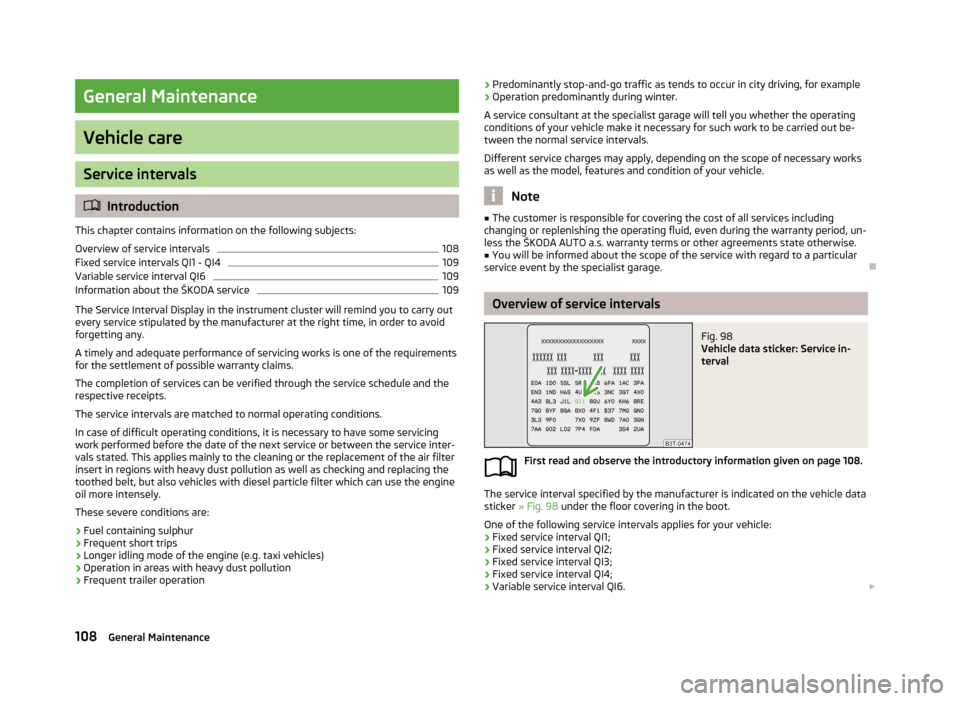
Fig. 98
Vehicle data sticker: Service in-
terval
First read and observe the introductory information given on page 108.
The service interval specified by the manufacturer is indicated on the vehicle data sticker » Fig. 98 under the floor covering in the boot.
One of the following service intervals applies for your vehicle: › Fixed service interval QI1;
› Fixed service interval QI2;
› Fixed service interval QI3;
› Fixed service interval QI4;
› Variable service interval QI6.
108General Maintenance
Page 113 of 176
ŠKODA Service Partners feature modern, specially developed tools and equip-
ment. Here, trained specialists have a comprehensive range of ŠKODA Original
Parts and ŠKODA Original Accessories at their disposal.
All ŠKODA service partners operate in accordance with the latest guidelines and
instructions of the manufacturer. All service work is therefore carried out on time and in accordance with the quality standards. Adhering to these instructions and
guidelines helps ensure road safety and helps keep your vehicle in a good techni-
cal condition.
In addition, the ŠKODA service partners offer an array of other services. ŠKODA Service Partners are therefore properly prepared to service your vehicleand to provide quality work. We therefore recommend that you have your vehicle
maintained by a ŠKODA service partner.
Modifications, adjustments and technical alterations
Introduction
This chapter contains information on the following subjects:
Tests required by law
111
ŠKODA Service Partners
111
ŠKODA Original Parts
111
ŠKODA Original Accessories
111
Spoiler
112
Airbags
112
Trailer operation
113
The instructions and guidelines from ŠKODA AUTO a.s. must be observed when
carrying out all modifications, repairs or technical alterations to your vehicle.
Adhering to these instructions and guidelines helps ensure road safety and helps
keep your vehicle in a good technical condition. After carrying out modifications,
repairs or technical alterations, the vehicle will comply with German road trans-
port regulations (StVZO)
Always consult a ŠKODA Partner » page 111 before buying accessories or parts,
or before carrying out any modifications, repairs or technical alterations to your
vehicle.
WARNING■ If work on your vehicle is not carried out properly, this can lead to operation-
al faults - risk of accident and serious injuries.■
We recommend only having these modifications and technical alterations
carried out by a specialist garage.
■
Interference on the electronic components and their software can lead to
operational faults. This interference can also impair not directly affected sys-
tems because of the networking of the electronic components. The operation- al safety of the vehicle may be at significant risk and can lead to increased
wear of parts.
■
The ŠKODA Partner does not assume any liability for products that have not
been approved by ŠKODA AUTO a.s. even though these may be products with
an operational approval or that have been approved by a government testing
institute.
WARNING■ We advise you only to use ŠKODA Original Accessories and ŠKODA Original
Parts which have been expressly approved for use on your vehicle. Reliability,
safety and suitability for your vehicle are guaranteed with these.■
ŠKODA Original Accessories and ŠKODA Original Parts can be purchased
from ŠKODA Partners, who will also perform the professional assembly of the purchased parts.
For the sake of the environment
Technical documents regarding alterations carried out on the vehicle must be
kept by the vehicle user in order to be handed over to the recyclers at a later
date. This ensures that the vehicle is recycled in an environmentally sound man-
ner.
Note
Any damage caused by technical alterations made without the approval of the
manufacturer is excluded from the warranty service schedule.
110General Maintenance
Page 116 of 176
WARNINGObserve the following instructions for handling the airbag system.■It is prohibited to manipulate individual parts of the airbag system, as this
might result in the airbag being deployed.■
Never install any airbag parts into the vehicle that have been removed from
old cars or have been recycled.
■
Never install damaged airbag parts in the vehicle. The airbags may then not
be deployed properly or even at all in the event of an accident.
■
No modifications of any kind must be made to parts of the airbag system.
WARNING■ A change to the vehicle's wheel suspension, including the use of non-ap-
proved wheels and tire combinations, can alter the functioning of the airbag system - risk of accident and fatal injury!■
Never make any changes to the front bumper or the bodywork.
WARNINGThe airbag control unit operates using pressure sensors located in the front
doors. For this reason, no adjustments may be carried out to the doors or door
panels (e.g. installation of additional loudspeakers). Resulting damage can have a negative impact on the function of the airbag system. Any work on thefront doors and door panels must be carried out by a specialist garage. The
following instructions must be observed.■
Never drive with inner door panels removed.
■
Never drive if parts of the inner door panel have been removed and the re-
sulting openings have not been properly sealed.
■
Never drive if the loudspeakers in the doors have been removed, unless the
loudspeaker openings have been properly sealed.
■
Always make sure that the openings are covered or filled if additional loud-
speakers or other equipment parts have been installed in the inner door pan-
els.
Trailer operation
First read and observe the introductory information and safety warn-
ings
on page 110.
The vehicle is not approved for towing a trailer. The vehicle is not factory-equip-
ped with a towing device and it cannot be retrofitted with a towing device.
WARNINGNever attach a towing device to the vehicle.
Washing your car
Introduction
This chapter contains information on the following subjects:
Washing by hand
114
Automatic car wash systems
114
Washing with a high-pressure cleaner
114
The best way to protect your vehicle against harmful environmental influences is frequent washing.
How often the vehicle should be washed depends on factors such as: › Frequency of use.
› Parking situation (garage, under trees etc.).
› Season.
› Weather conditions.
› Environmental influences.
The longer insect residues, bird droppings, tree sap, road and industrial dust, tar,
soot particles, road salt and other aggressive deposits remain adhering to the paintwork of your vehicle, the more detrimental their destructive effect can be.
High temperatures, such as those caused by intensive sun's rays, accentuate this
caustic effect.
It is essential to also thoroughly clean the underside of the vehicle at the end of
the winter.
113Vehicle care
Page 134 of 176
Checking the oil levelFig. 107
Dipstick
First read and observe the introductory information and safety warn-
ings on page 130.
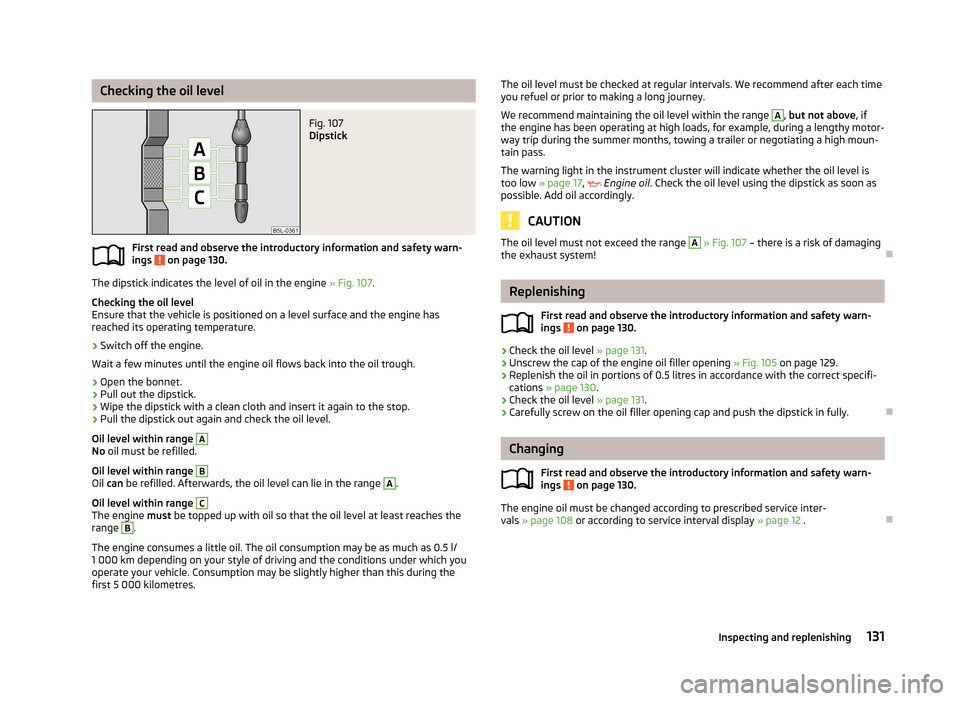
The dipstick indicates the level of oil in the engine » Fig. 107.
Checking the oil level
Ensure that the vehicle is positioned on a level surface and the engine has reached its operating temperature.
›
Switch off the engine.
Wait a few minutes until the engine oil flows back into the oil trough.
›
Open the bonnet.
›
Pull out the dipstick.
›
Wipe the dipstick with a clean cloth and insert it again to the stop.
›
Pull the dipstick out again and check the oil level.
Oil level within range
A
No oil must be refilled.
Oil level within range
B
Oil can be refilled. Afterwards, the oil level can lie in the range
A
.
Oil level within range
C
The engine must be topped up with oil so that the oil level at least reaches the
range
B
.
The engine consumes a little oil. The oil consumption may be as much as 0.5 l/
1 000 km depending on your style of driving and the conditions under which you
operate your vehicle. Consumption may be slightly higher than this during the
first 5 000 kilometres.
The oil level must be checked at regular intervals. We recommend after each time
you refuel or prior to making a long journey.
We recommend maintaining the oil level within the range A
, but not above , if
the engine has been operating at high loads, for example, during a lengthy motor-
way trip during the summer months, towing a trailer or negotiating a high moun- tain pass.
The warning light in the instrument cluster will indicate whether the oil level is too low » page 17 , Engine oil . Check the oil level using the dipstick as soon as
possible. Add oil accordingly.
CAUTION
The oil level must not exceed the range A » Fig. 107 – there is a risk of damaging
the exhaust system!
Replenishing
First read and observe the introductory information and safety warn-
ings
on page 130.
›
Check the oil level » page 131.
›
Unscrew the cap of the engine oil filler opening » Fig. 105 on page 129.
›
Replenish the oil in portions of 0.5 litres in accordance with the correct specifi-
cations » page 130 .
›
Check the oil level » page 131.
›
Carefully screw on the oil filler opening cap and push the dipstick in fully.
Changing
First read and observe the introductory information and safety warn-ings
on page 130.
The engine oil must be changed according to prescribed service inter-
vals » page 108 or according to service interval display » page 12 .
131Inspecting and replenishing
Page 155 of 176
Negative cable – colour coding in the majority of cases is black.
Jump-starting in vehicles with the START-STOP system
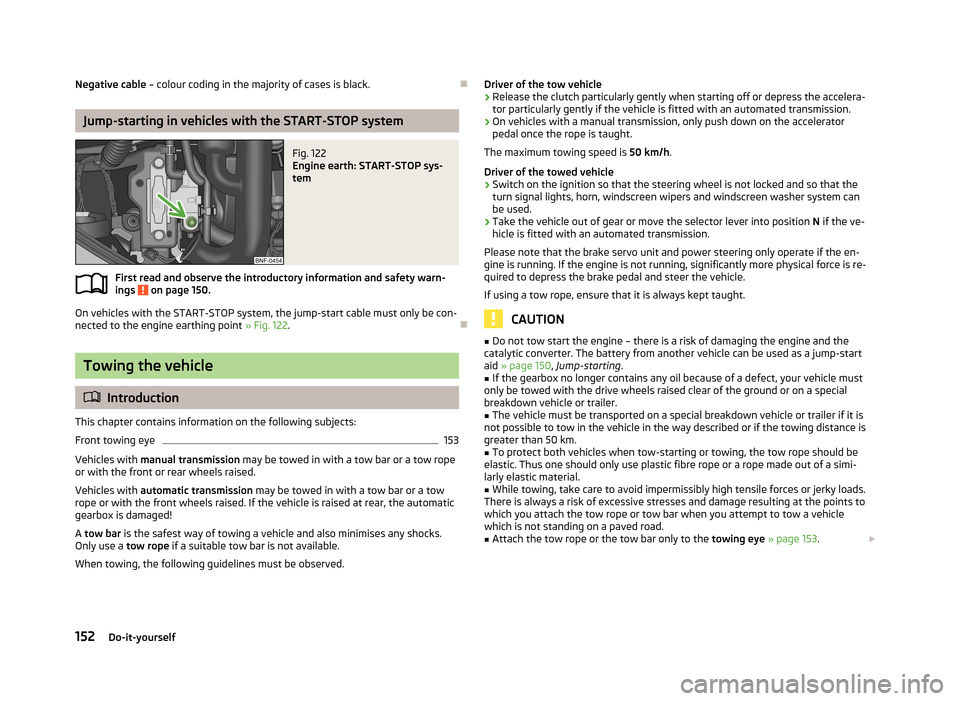
Fig. 122
Engine earth: START-STOP sys-
tem
First read and observe the introductory information and safety warn- ings on page 150.
On vehicles with the START-STOP system, the jump-start cable must only be con-
nected to the engine earthing point » Fig. 122.
Towing the vehicle
Introduction
This chapter contains information on the following subjects:
Front towing eye
153
Vehicles with manual transmission may be towed in with a tow bar or a tow rope
or with the front or rear wheels raised.
Vehicles with automatic transmission may be towed in with a tow bar or a tow
rope or with the front wheels raised. If the vehicle is raised at rear, the automatic
gearbox is damaged!
A tow bar is the safest way of towing a vehicle and also minimises any shocks.
Only use a tow rope if a suitable tow bar is not available.
When towing, the following guidelines must be observed.
Driver of the tow vehicle›Release the clutch particularly gently when starting off or depress the accelera-
tor particularly gently if the vehicle is fitted with an automated transmission.›
On vehicles with a manual transmission, only push down on the accelerator pedal once the rope is taught.
The maximum towing speed is 50 km/h.
Driver of the towed vehicle
›
Switch on the ignition so that the steering wheel is not locked and so that the turn signal lights, horn, windscreen wipers and windscreen washer system can
be used.
›
Take the vehicle out of gear or move the selector lever into position N if the ve-
hicle is fitted with an automated transmission.
Please note that the brake servo unit and power steering only operate if the en-
gine is running. If the engine is not running, significantly more physical force is re-
quired to depress the brake pedal and steer the vehicle.
If using a tow rope, ensure that it is always kept taught.
CAUTION
■ Do not tow start the engine – there is a risk of damaging the engine and the
catalytic converter. The battery from another vehicle can be used as a jump-start
aid » page 150 , Jump-starting .■
If the gearbox no longer contains any oil because of a defect, your vehicle must
only be towed with the drive wheels raised clear of the ground or on a special
breakdown vehicle or trailer.
■
The vehicle must be transported on a special breakdown vehicle or trailer if it is
not possible to tow in the vehicle in the way described or if the towing distance is greater than 50 km.
■
To protect both vehicles when tow-starting or towing, the tow rope should be
elastic. Thus one should only use plastic fibre rope or a rope made out of a simi-
larly elastic material.
■
While towing, take care to avoid impermissibly high tensile forces or jerky loads.
There is always a risk of excessive stresses and damage resulting at the points to
which you attach the tow rope or tow bar when you attempt to tow a vehicle which is not standing on a paved road.
■
Attach the tow rope or the tow bar only to the towing eye » page 153 .
152Do-it-yourself
Page 164 of 176
Technical data
Technical data
Vehicle data
Introduction
This chapter contains information on the following subjects:
Vehicle identification data
161
Dimensions
162
Vehicle-specific information depending on engine type
163
The details given in the vehicle's technical documentation always take prece-
dence over the details in the Owner's Manual.
The listed performance values were determined without performance-reducing
equipment, e.g. air conditioning system.
Vehicle identification data
Fig. 133
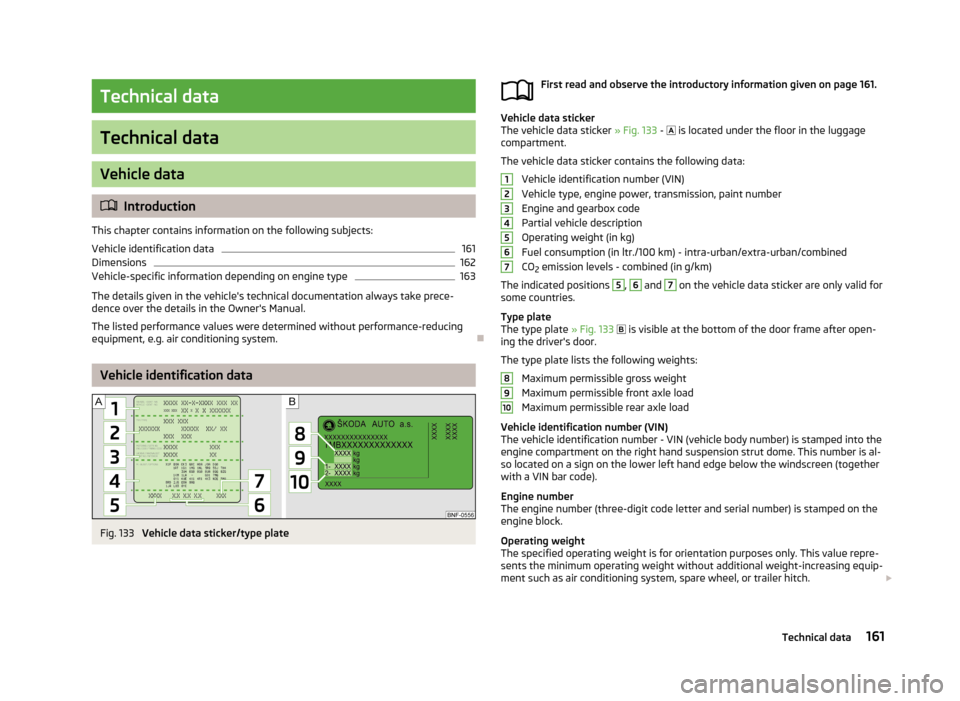
Vehicle data sticker/type plate
First read and observe the introductory information given on page 161.
Vehicle data sticker
The vehicle data sticker » Fig. 133 - is located under the floor in the luggage
compartment.
The vehicle data sticker contains the following data: Vehicle identification number (VIN)
Vehicle type, engine power, transmission, paint number
Engine and gearbox code
Partial vehicle description
Operating weight (in kg) Fuel consumption (in ltr./100 km) - intra-urban/extra-urban/combinedCO 2 emission levels - combined (in g/km)
The indicated positions
5
,
6
and
7
on the vehicle data sticker are only valid for
some countries.
Type plate
The type plate » Fig. 133
is visible at the bottom of the door frame after open-
ing the driver's door.
The type plate lists the following weights: Maximum permissible gross weight
Maximum permissible front axle load
Maximum permissible rear axle load
Vehicle identification number (VIN)
The vehicle identification number - VIN (vehicle body number) is stamped into the
engine compartment on the right hand suspension strut dome. This number is al-
so located on a sign on the lower left hand edge below the windscreen (together
with a VIN bar code).
Engine number
The engine number (three-digit code letter and serial number) is stamped on the
engine block.
Operating weight
The specified operating weight is for orientation purposes only. This value repre- sents the minimum operating weight without additional weight-increasing equip-ment such as air conditioning system, spare wheel, or trailer hitch.
12345678910161Technical data
Page 168 of 176
Oil level131
Windscreen washer fluid129
Children and safety103
Child safety Side airbag
104
Child safety lock23
Child seat Classification
105
ISOFIX106
on the front passenger seat104
TOP TETHER107
Use of child seats105
Use of ISOFIX child seats106
Chrome parts refer to Taking care of your vehicle
116
Cigarette lighter52
City Safe Drive86
Warning light21
Cleaning108
Alcantara120
Artificial leather120
cloths120
Covers of electrically heated seats120
Headlight lenses117
Natural leather119
Plastic parts116
Wheels118
Clock14
Clothes hooks53
CNG123
Checking125
Fuel gauge11
Labels126
Natural gas as fuel125
Quality126
Refuelling124
Safe fuel126
Switching from CNG to petrol mode125
Cockpit 12-volt power socket
52
Ash tray51
Cigarette lighter52
Cup holder51
General view9
Light36, 37
Storage compartments53
Compartments53
Compressed natural gas See CNG
123
Computer see multifunction display
13
Coolant132
Checking132
Replenishing133
Warning light18
Correct seated position91
Driver92
Front passenger92
Instructions92
Rear seats92
Counter for distance driven12
Cruise Control System83
Cup holder51
D
DAY LIGHT Daytime running light
34
Daytime running light34
Deactivating an airbag101
Decorative films116
Defrosting rear window37
Delayed locking of the boot lid see Boot lid
29
Digital clock14
Dipstick131
Disconnecting and reconnecting vehicle battery
137
Display Service interval
12
Distance driven12
Door Child safety lock23
Closing24
Opening24
Door opening lever locking of
24
Door opening leverl unlocking of
24
Doors Emergency locking
25
Driving Abroad
79
Driving through water on streets78
Emissions161
Fuel consumption161
Trailer operation113
Driving economically Economical gear changing
75
Driving through water78
E
Economical and environmentally friendly driving
74
Economical driving Ballast
76
Driving at full throttle75
Idling75
Looking ahead75
Regular maintenance76
Saving energy77
Short distances76
Tyre inflation pressure76
EDS81
Electrical power windows Button in the driver's door
30
Electronic Differential Lock81
Electronic immobilizer68
Emergency Changing a wheel
145
Hazard warning light system36
jump-starting151
165Index
Page 170 of 176
Daytime running light34
Headlight beam adjustment34
Parking light36
Replacing bulbs157
Lighting Luggage compartment
46
light on and off33
Lights33
Fog lights35
Hazard warning light system36
Headlight flasher34
Main beam34
Rear fog light35
Turn signal34
Warning lights16
Loading floor49
Loads161
Lock Central locking system
26
locking Vehicle key
22
Locking Door opening lever
24
Emergency locking25
Remote control28
Locking and unlocking from the inside27
low beam33
Luggage compartment Cover
48
Emergency unlocking29
Fixing nets48
Lashing eyes47
Lighting46
see luggage compartment lid29
Unlocking the luggage compartment lid29
Variable loading floor49
Luggage compartment cover48
Luggage compartment lid28, 29
Luggage storage Bag hooks
47
M
Main beam
34
Maintenance76
Decorative films116
Manual gear changing see gear changing
70
Materials defect liability5
MFA see multifunction display
13
Mirror Exterior mirrors
41
Mirrors Interior mirror
40
Vanity38
Mobile phone63
Modes of automated transmission71
Modifications110
Modifications and technical alterations Airbags
112
Service111
Spoiler112
Trailer operation113
Move & Fun63, 64
Multifunction display Functions
13
Memory13
Operation14
N
N1
47
Nets48
O
Oil See Engine oil
131
On-board computer see multifunction display
13
Operating windscreenwipers39
Operation in winter De-icing windows
117
Vehicle battery136
Outside temperature14
Overview Engine compartment
129
Warning lights16
P
Paintwork See Paintwork care
115
Paintwork care115
Parking Parking aid
81
Visual parking system82
parking light33
Parking ticket holder53
Part replacement110
Passive safety Before setting off
90
Driving safety91
Safety equipment90
Passive Safety90
Pedals71
Footmats71
Petrol refer to Fuel
123
Polishing the paintwork See Taking care of your vehicle
115
Power socket 12 V
52
Power steering66
Power windows Button in the driver's door
30
167Index