winter tyres SKODA CITIGO 2013 1.G Owner's Manual
[x] Cancel search | Manufacturer: SKODA, Model Year: 2013, Model line: CITIGO, Model: SKODA CITIGO 2013 1.GPages: 176, PDF Size: 10.54 MB
Page 6 of 176
Table of Contents
Materials defect liability and ŠKODA warranty for
new cars5
Mobility warranty and ŠKODA extended
warranty.
6
Abbreviations
Using the system
Cockpit
9
Overview
8
warning lights and instruments
10
Instrument cluster
10
Multifunction display (MFA)
13
Warning lights
16
Unlocking and locking
22
Unlocking and locking
22
Central locking system
25
Remote control
27
Luggage compartment lid
28
Electrical power windows
30
Power sliding/tilting roof
31
Lights and visibility
33
Lights
33
Indoor Lighting
36
Visibility
37
Windscreen wipers and washers
38
Rear mirror
40
Seats and stowing
42
Front seats
42
Rear seats
45
Luggage compartment
46
Roof rack system
49Useful equipment50Storage compartments53
Heating and air-conditioning
57
Heating, ventilation and cooling
57
Heating
58
Air conditioning system
59
Communication and multimedia
63
Telephone and Move & Fun
63
Driving
Starting-off and Driving
66
Steering
66
Starting and stopping the engine
67
Brakes
68
Manual gear changing and pedals
70
Automated transmission
71
Running in
73
Economical driving and environmental
sustainability
74
Avoiding damage to your vehicle
78
Driving abroad
79
Assist systems
80
Brake assist systems
80
Parking aid
81
Cruise Control System
83
START-STOP
85
City Safe Drive
86
Safety
Passive Safety
90
General information
90
Correct seated position
91
Seat belts
94
Using seat belts
94
Inertia reels and belt tensioners
96Airbag system98Description of the airbag system98
Airbag overview
99
Deactivating airbags
101
Transporting children safely
103
Child seat
103
Fastening systems
105
General Maintenance
Vehicle care
108
Service intervals
108
Modifications, adjustments and technical
alterations
110
Washing your car
113
Taking care of your vehicle exterior
115
Taking care of the interior
118
Inspecting and replenishing
122
Fuel
122
Vehicles with CNG (compressed natural gas)
mode
123
Engine compartment
127
Engine oil
130
Coolant
132
Brake fluid
133
Vehicle battery
134
Wheels
138
Tyres and wheel rims
138
Winter operation
143
Do-it-yourself
Emergency equipment and self-help
144
Emergency equipment
144
Changing a wheel
145
Tyre repair
1483Table of Contents
Page 77 of 176
With vehicles with a manual gearbox, do not drive at unnecessarily low engine
speeds. Shift down a gear when the engine is no longer running smoothly. Ob-
serve the recommended gear » page 12, Recommended gear .
CAUTION
■
The engine is not protected from excessive engine revs caused by shifting
down at the wrong time. This can result in a sudden increase in revs beyond the
permissible maximum rpm, thereby causing engine damage.■
Never rev up a cold engine when the vehicle is stationary or when driving in in-
dividual gears.
For the sake of the environment
Do not drive at unnecessarily high engine speeds. Shifting up sooner helps save
fuel, reduces engine noise and protects the environment.
New tyres
First read and observe the introductory information given on page 73.
New tyres must firstly be “run in” since they do not offer optimal grip at first.
Therefore, drive especially carefully for the first 500 km or so.
New brake pads
First read and observe the introductory information given on page 73.
New brake pads do not initially provide optimal braking performance. They firstneed to be “run in”. Therefore, drive especially carefully for the first 200 km or so.
Economical driving and environmental sustainability
Introduction
This chapter contains information on the following subjects:
Looking ahead
75
Economical gear changing
75
Avoiding full throttle
75
Reducing idling
75
Avoiding short distances
76
Checking tyre inflation pressure
76
Avoiding unnecessary ballast
76
Regular maintenance
76
Saving electrical energy
77
Environmental compatibility
77
The technical requirements for low fuel usage and economic efficiency of the ve-
hicle have already been built into the vehicle at the works. ŠKODA places a partic-
ular emphasis on minimising negative effects on the environment.
It is necessary to take note of the guidelines given in this chapter in order tomake best use of these characteristics and to maintain their effectiveness.
Fuel consumption, environmental pollution and the wear to the engine, brakes
and tyres depend essentially on the following three factors:
› your personal driving style
› operating conditions
› technical requirements
The fuel economy by can be improved by 10 -15 % by always looking ahead and
driving in an economical way.
Fuel consumption is also be influenced by external factors which are beyond the
driver's control. Consumption increases during the winter or under difficult condi-
tions, on poor roads, etc.
Fuel consumption can vary considerably from the manufacturer's data, as a result
of outside temperatures, weather and driving style.
Such an engine speed should be adhered to when accelerating, in order to avoid a
high fuel consumption and resonance of the vehicle.
74Driving
Page 79 of 176
In vehicles not equipped with the START-STOP system, turn off the engine when
in a traffic jam, at a level crossing or traffic lights with longer wait times.
Even after just 30 – 40 seconds you will have saved more fuel than that is needed
when you start the engine up again.
If an engine is only idling it takes much longer for it to reach its normal operating
temperature. Wear-and-tear and pollutant emissions, though, are particularly
high in the warming-up phase. Therefore, start driving as soon as the engine has
started, High engine speeds should however be avoided.
Avoiding short distances
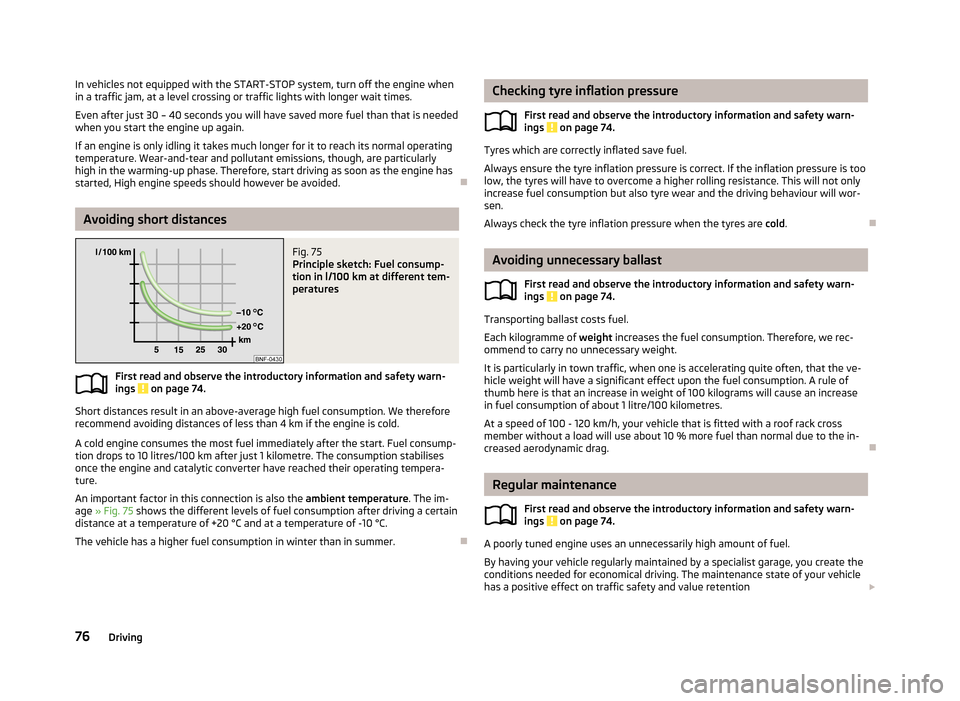
Fig. 75
Principle sketch: Fuel consump-
tion in l/100 km at different tem-
peratures
First read and observe the introductory information and safety warn-
ings on page 74.
Short distances result in an above-average high fuel consumption. We therefore
recommend avoiding distances of less than 4 km if the engine is cold.
A cold engine consumes the most fuel immediately after the start. Fuel consump-tion drops to 10 litres/100 km after just 1 kilometre. The consumption stabilises
once the engine and catalytic converter have reached their operating tempera- ture.
An important factor in this connection is also the ambient temperature. The im-
age » Fig. 75 shows the different levels of fuel consumption after driving a certain
distance at a temperature of +20 °C and at a temperature of -10 °C.
The vehicle has a higher fuel consumption in winter than in summer.
Checking tyre inflation pressure
First read and observe the introductory information and safety warn-ings
on page 74.
Tyres which are correctly inflated save fuel.
Always ensure the tyre inflation pressure is correct. If the inflation pressure is too
low, the tyres will have to overcome a higher rolling resistance. This will not only increase fuel consumption but also tyre wear and the driving behaviour will wor-
sen.
Always check the tyre inflation pressure when the tyres are cold.
Avoiding unnecessary ballast
First read and observe the introductory information and safety warn-
ings
on page 74.
Transporting ballast costs fuel.
Each kilogramme of weight increases the fuel consumption. Therefore, we rec-
ommend to carry no unnecessary weight.
It is particularly in town traffic, when one is accelerating quite often, that the ve-
hicle weight will have a significant effect upon the fuel consumption. A rule of
thumb here is that an increase in weight of 100 kilograms will cause an increase in fuel consumption of about 1 litre/100 kilometres.
At a speed of 100 - 120 km/h, your vehicle that is fitted with a roof rack crossmember without a load will use about 10 % more fuel than normal due to the in-
creased aerodynamic drag.
Regular maintenance
First read and observe the introductory information and safety warn-
ings
on page 74.
A poorly tuned engine uses an unnecessarily high amount of fuel.
By having your vehicle regularly maintained by a specialist garage, you create the conditions needed for economical driving. The maintenance state of your vehicle has a positive effect on traffic safety and value retention
76Driving
Page 143 of 176
Always check the inflation pressure when the tyres are cold. Do not reduce the
higher pressure of warm tyres.
With greater additional load, adjust the tyre inflation pressure accordingly.
Driving style
Fast cornering, sharp acceleration and braking increase the wear of your tyres.
Balancing wheels
The wheels of a new vehicle are balanced. When driving, however, there are a
range of factors that may result in an imbalance. This may become apparent by a
“vibration” in the steering.
Have the wheels rebalanced after replacing the tyres.
Wheel alignment errors
Incorrect wheel alignment at the front or rear leads to excess wear of the tyres.
Tyre damage
Drive over kerbs and other such obstacles slowly and at right angles wherever
possible in order to avoid damage to tyres and wheel trims.
We recommend checking your tyres and wheel rims for damage (punctures, cuts,
splits and bulges, etc.) on a regular basis. Remove foreign bodies (e.g. small
stones) from the tyre tread immediately.
Replacing wheels
If significantly greater wear is present on the front tyres, we recommend replac-
ing the front wheels with the rear wheels as shown in the diagram » Fig. 112 . You
will then obtain approximately the same life for all the tyres.
We recommend that you swap the tyres every 10,000 km in order to achieve even
wear on all tyres and to ensure optimal service life for the tyres.
Storing tyres
Identify disassembled tyres so that the previous direction of rotation can be
maintained if the tyres are reassembled.
Always store wheels or tyres in a cool, dry place that is as dark as possible. Tyres
which are not fixed to a wheel trim should be stored upright.
Wear indicators
The base of the tread of the tyres has 1.6 mm high wear indicators installed. These wear indicators are located multiple times depending on the make and are evenly spaced around the circumference of the tyre » Fig. 111 -
. Markings on the
walls of the tyres through the letters “TWI”, triangular symbols or other symbols identify the position of the wear indicators.Tyre age
Tyres age and lose their original characteristics, even if they are not being used.
Therefore, we recommend not using summer or winter tyres older than 6 or 4 years old respectively.
New tyres
First read and observe the introductory information and safety warn-
ings
on page 138.
Only use radial tyres of the same type, size (rolling circumference) and tread pat-
tern on one axle on all four wheels.
The tyre/wheel combinations which are approved for your vehicle are indicated in
your vehicle documents.
Where possible, replace tyres by axle. Always fit the tyres with the deeper tread
depth to the front wheels.
Explanation of tyre markings
175/65 R 14 82 T
What this means is:
175Tyre width in mm » Fig. 111 on page 139 - 65Height/width ratio in % » Fig. 111 on page 139 - RCode letter for the type of tyre – Radial » Fig. 111 on page 139 - 14Diameter of wheel in inches » Fig. 111 on page 139 - 82Load index » TSpeed symbol »
The date of manufacture is stated on the tyre wall (possibly on the inside). e.g.
DOT ... 10 13 ..
means, for example, that the tyre was manufactured in the 10th week of 2013.
Load index
This indicates the maximum permissible load for each individual tyre. 462 kg
475 kg
487 kg
515 kg
81828385140General Maintenance
Page 144 of 176
545 kg
615 kg
630 kg
650 kg
Speed symbol
This indicates the maximum permissible vehicle speed with fitted tyres in each
category.
150 km/h
160 km/h
170 km/h
180 km/h
190 km/h
200 km/h
210 km/h
CAUTION
The information about the load index and the speed symbol is listed in your vehi-
cle documents.
Unidirectional tyres
First read and observe the introductory information and safety warn-
ings
on page 138.
The direction of rotation of the tyres is marked by arrows on the wall of the tyre.
The indicated direction of rotation must be adhered to in order to ensure the op- timal characteristics of these tyres.
These characteristics mainly relate to the following: › Increased driving stability.
› Reduced risk of aquaplaning.
› Reduced tyre noise and tyre wear.
87919293PQRSTUHSpare wheelFig. 113
Luggage compartment: Spare
wheel
First read and observe the introductory information and safety warn-
ings on page 138.
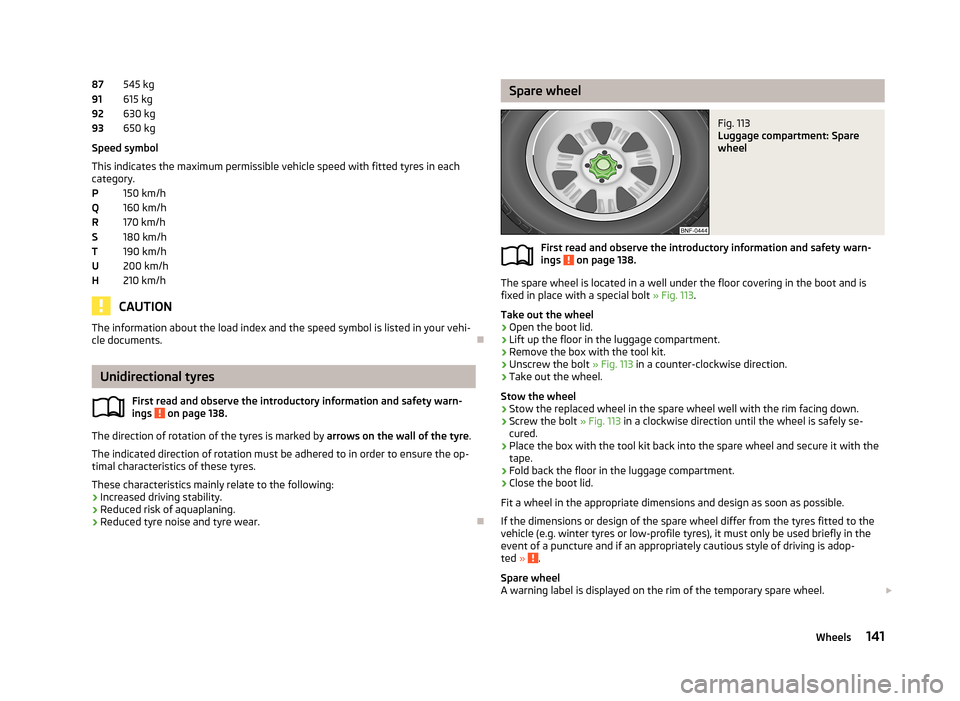
The spare wheel is located in a well under the floor covering in the boot and is
fixed in place with a special bolt » Fig. 113.
Take out the wheel
›
Open the boot lid.
›
Lift up the floor in the luggage compartment.
›
Remove the box with the tool kit.
›
Unscrew the bolt » Fig. 113 in a counter-clockwise direction.
›
Take out the wheel.
Stow the wheel
›
Stow the replaced wheel in the spare wheel well with the rim facing down.
›
Screw the bolt » Fig. 113 in a clockwise direction until the wheel is safely se-
cured.
›
Place the box with the tool kit back into the spare wheel and secure it with the
tape.
›
Fold back the floor in the luggage compartment.
›
Close the boot lid.
Fit a wheel in the appropriate dimensions and design as soon as possible.
If the dimensions or design of the spare wheel differ from the tyres fitted to the
vehicle (e.g. winter tyres or low-profile tyres), it must only be used briefly in the
event of a puncture and if an appropriately cautious style of driving is adop-
ted »
.
Spare wheel
A warning label is displayed on the rim of the temporary spare wheel.
141Wheels
Page 146 of 176
Wheel boltsFirst read and observe the introductory information and safety warn-ings
on page 138.
Wheels and wheel bolts are matched to each other in terms of design. Each time
you fit other wheels rims, e.g. light alloy wheel rims or wheels with winter tyres,
you must also use the matching wheel bolts with the correct length and dome
shape. The right fastening of wheels depends on this.
Winter operation
Introduction
This chapter contains information on the following subjects:
Winter tyres
143
Snow chains
143
Winter tyres
First read and observe the introductory information given on page 143.
Fitting winter tyres will significantly improve the handling of your vehicle when
driving in wintry road conditions. Summer tyres have less grip on ice, snow and at
temperatures below 7 °C. This is especially true of wide tyres or high-speed tyres .
In order to achieve the best possible handling properties, winter tyres must be fit-
ted on all 4 wheels, the minimum tread depth must be 4 mm and tyres must be
no older than 4 years.
Winter tyres of a lower speed category can be used provided that the permissible
maximum speed of these tyres is not exceeded even if the possible maximum speed of the vehicle is higher.
For the sake of the environmentFit the summer tyres on again in good time as they provide better handling prop-
erties, a shorter braking distance, less tyre noise, and reduced tyre wear on roadswhich are free of snow and ice as well as at temperatures above 7 °C. The fuel
consumption is also lower.
Snow chains
First read and observe the introductory information given on page 143.
When driving in wintry road conditions, snow chains improve not only traction,
but also the braking performance.
Snow chains must only be mounted on the front wheels.
For technical reasons, it is only permissible to fit snow chains with the following wheel/tyre combinations.
Tyre sizeRim165/70 R145J x 14 ET 35
Only fit snow chains with links and locks not larger than 15 mm.
Remove the full wheel trims before installing the snow chains.
CAUTION
■
The chains must be removed when driving on roads which are free of snow.
They adversely affect the handling of your vehicle, damage the tyres and are rap-
idly destroyed.■
Remove the full wheel trims before installing the snow chains.
143Wheels
Page 172 of 176
START STOPJump-starting152
Warning light21
Steering force assistance66
Steering wheel66
Storage53
Storage compartment Bag holder
55
Storage compartment on the driver's side54
Storage compartment on the front passenger side
54
Storage compartment with lid on the front pas- senger side
54
Storage compartments53
Meshed pockets on the front seat rests56
Multimedia holder56
Photo holder55
Storage compartment in the front centre console 55 Storage compartments in front of the rear seats
56
Sun visors38
Switching off the engine68
T
Taking care of the vehicle Natural leather
119
Seat belts121
Taking care of your vehicle Automatic car wash system
114
Cavity protection117
Chrome parts116
Cleaning the wheels118
Decorative films116
Door lock cylinders117
Headlight lenses117
High-pressure cleaner114
Plastic parts116
Polishing the paintwork115
Rubber seals116
Taking care of the interior118
Taking care of your vehicle exterior115
Washing113
Washing by hand114
Wash system114
Wax treatment115
Taking care of your vehicles Fabric covers
120
TCS81
Technical data161
Tiptronic see automatic gearbox
72
Tools144
TOP TETHER107
Towing152
Towing device113
Towing eye153
Traction Control System81
Warning light19
Transport Luggage compartment
46
Roof rack system49
Transporting children safely103
Turn signal34
Two-way radio systems63
Type plate161
Tyre load-bearing capacity See Wheels
140
Tyre repair Check pressure
150
Preparations149
Sealing and inflating the tyre149
Tyres138
Inflation pressure139
New140
See Wheels140
Sizes139
Tyre wear indicator139
U
Underbody protection
118
Unleaded petrol79
unlock Central locking system
26
Unlocking Remote control
28
Vehicle key22
Unlocking and locking22
Useful equipment50
V
Vehicle battery Automatic load deactivation
137
charging136
Checking the electrolyte level135
Operation in winter136
Safety instructions134
Vehicle care108
Alcantara120
Artificial leather120
Cloths120
Vehicle data sticker161
Vehicle dimensions162
Vehicle height162
vehicle identification number - VIN161
Vehicle key locking
22
unlocking22
Vehicle length162
Vehicles with CNG mode See CNG
123
Vehicles with natural gas mode See CNG
123
Vehicle tool kit144
Vehicle width162
Visibility37
Visors see Sun visors
38
Visual parking system82
169Index
Page 173 of 176
W
Warning lights
16
Warning symbols16
Warning triangle144
Warranty5
Washing108
Automatic car wash system114
by hand114
Chrome parts116
High-pressure cleaner114
Water Driving through
78
Wax treatment See Taking care of your vehicle
115
Weights161
Wheel bolts Anti-theft wheel bolt
148
Caps142
Loosening and tightening146
Wheel rims138
Wheels Bolts
143
Changing145
Full trim142
General information138
Load index140
Replacing wheels139
Service life of tyres139
Snow chains143
Spare wheel141
Speed symbol141
Storing wheels139
Tyre pressure139
Tyre sizes139
Tyre wear indicator139
Unidirectional tyres141
Winter tyres143
Windows117
De-icing117
See Electrical power windows30
Windscreen washer fluid Checking129
Replenishing129
Winter129
Windscreen washer system129
Windscreen washers39
Windscreen wipers Cleaning the windscreen wiper blades
39, 40
Replacing the rear windscreen wiper blade40
Replacing the windscreen wiper blades39
Windscreen washer fluid129
Windscreen wipers and washers38
Winter operation143
Snow chains143
Winter tyres143
Winter tyres See Wheels
143
170Index