belt SKODA CITIGO 2017 User Guide
[x] Cancel search | Manufacturer: SKODA, Model Year: 2017, Model line: CITIGO, Model: SKODA CITIGO 2017Pages: 172, PDF Size: 24.54 MB
Page 26 of 172
Use of child safety seats which are secured with a safety belt
Never use a rear-facing child seat on the front passenger seat if the passenger airbag is activated. This child safety seat is positioned in the deployment area of
the front passenger airbag. The airbag may cause the child severe, or even fatal injuries, in the event of it being deployed.
Read and observe
and on page 21 first.
Overview of the usability of child seats fastened with a seat belt on the different seat types, in accordance with the ECE-R 16 standard.GroupFront passenger seatRear seats0
up to 10 kgUU0
up to 13 kgUU1
9-18 kgUU2
15-25 kgUU3
22-36 kgUU
The seat is suitable for the use of approved child seats in the “Universal”
weight group category.
Fastening systems
Introduction
This chapter contains information on the following subjects:
Attachment points of the system
24
Use of child safety seats with the
system
25
Attachment points of the
system
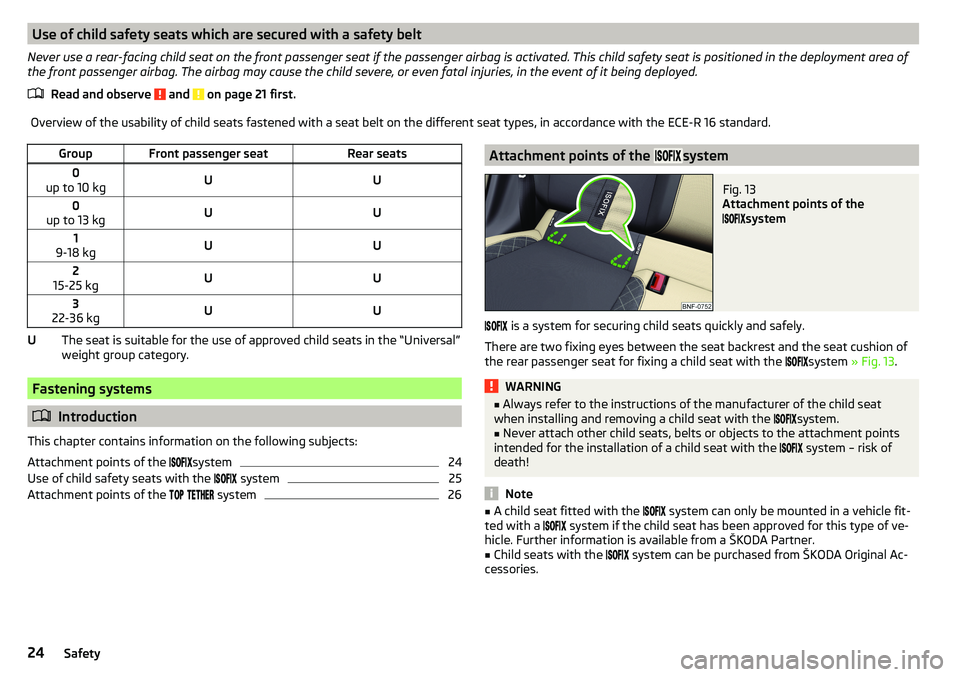
26UAttachment points of the systemFig. 13
Attachment points of the
system
is a system for securing child seats quickly and safely.
There are two fixing eyes between the seat backrest and the seat cushion of the rear passenger seat for fixing a child seat with the system
» Fig. 13 .
WARNING■
Always refer to the instructions of the manufacturer of the child seat
when installing and removing a child seat with the system.■
Never attach other child seats, belts or objects to the attachment points
intended for the installation of a child seat with the
system – risk of
death!
Note
■ A child seat fitted with the system can only be mounted in a vehicle fit-
ted with a system if the child seat has been approved for this type of ve-
hicle. Further information is available from a ŠKODA Partner.■
Child seats with the
system can be purchased from ŠKODA Original Ac-
cessories.
24Safety
Page 28 of 172
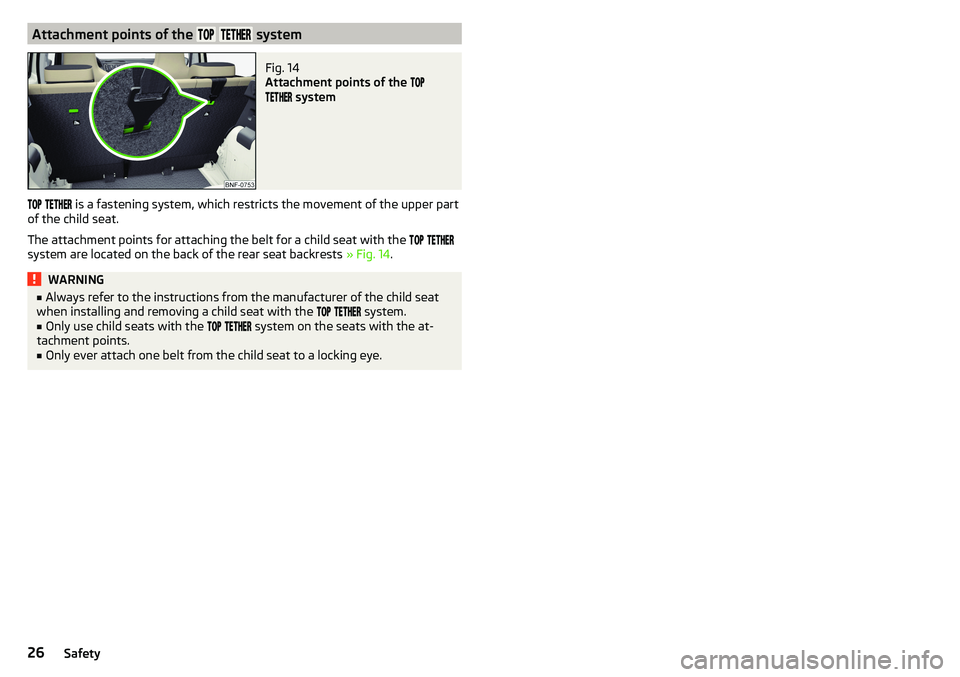
Attachment points of the systemFig. 14
Attachment points of the
system
is a fastening system, which restricts the movement of the upper part
of the child seat.
The attachment points for attaching the belt for a child seat with the
system are located on the back of the rear seat backrests » Fig. 14.
WARNING■
Always refer to the instructions from the manufacturer of the child seat
when installing and removing a child seat with the system.■
Only use child seats with the
system on the seats with the at-
tachment points.
■
Only ever attach one belt from the child seat to a locking eye.
26Safety
Page 33 of 172
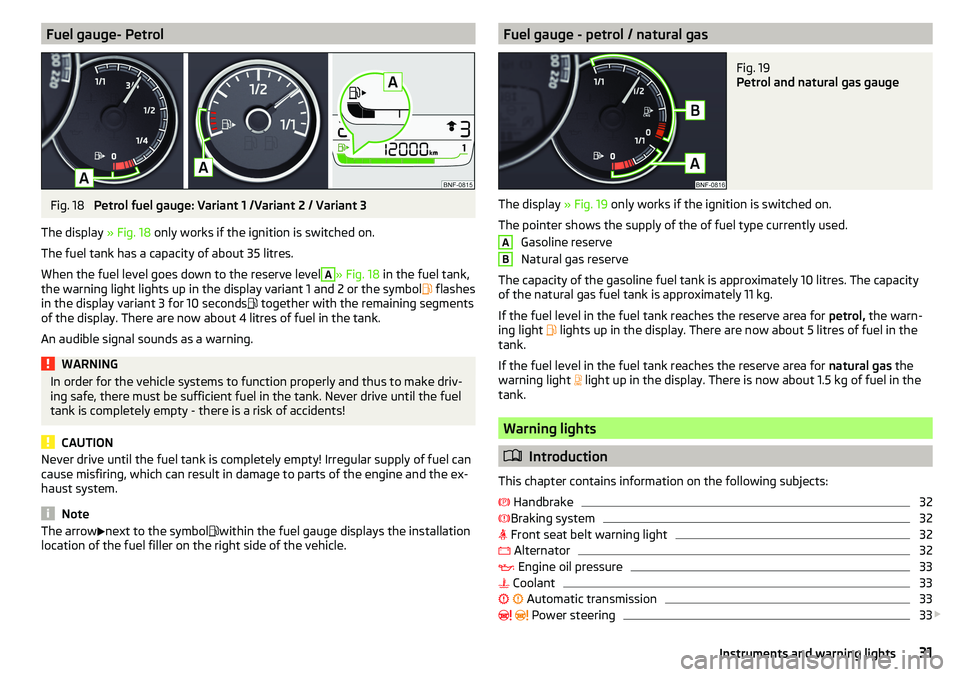
Fuel gauge- PetrolFig. 18
Petrol fuel gauge: Variant 1 /Variant 2 / Variant 3
The display » Fig. 18 only works if the ignition is switched on.
The fuel tank has a capacity of about 35 litres.
When the fuel level goes down to the reserve level
A
» Fig. 18 in the fuel tank,
the warning light lights up in the display variant 1 and 2 or the symbol flashes
in the display variant 3 for 10 seconds together with the remaining segments
of the display. There are now about 4 litres of fuel in the tank.
An audible signal sounds as a warning.
WARNINGIn order for the vehicle systems to function properly and thus to make driv-
ing safe, there must be sufficient fuel in the tank. Never drive until the fuel
tank is completely empty - there is a risk of accidents!
CAUTION
Never drive until the fuel tank is completely empty! Irregular supply of fuel can
cause misfiring, which can result in damage to parts of the engine and the ex-
haust system.
Note
The arrow next to the symbol within the fuel gauge displays the installation
location of the fuel filler on the right side of the vehicle.Fuel gauge - petrol / natural gasFig. 19
Petrol and natural gas gauge
The display » Fig. 19 only works if the ignition is switched on.
The pointer shows the supply of the of fuel type currently used. Gasoline reserve
Natural gas reserve
The capacity of the gasoline fuel tank is approximately 10 litres. The capacity
of the natural gas fuel tank is approximately 11 kg.
If the fuel level in the fuel tank reaches the reserve area for petrol, the warn-
ing light lights up in the display. There are now about 5 litres of fuel in the
tank.
If the fuel level in the fuel tank reaches the reserve area for natural gas the
warning light light up in the display. There is now about 1.5 kg of fuel in the
tank.
Warning lights
Introduction
This chapter contains information on the following subjects:
Handbrake
32
Braking system
32
Front seat belt warning light
32
Alternator
32
Engine oil pressure
33
Coolant
33
Automatic transmission
33
Power steering
33
AB31Instruments and warning lights
Page 34 of 172
Stability control (ESC) / Traction control (TCS)34 Anti-lock braking system (ABS)34
34
Low fuel - petrol
35
Low fuel - natural gas
35
Rear fog light
35
Emission control system
35
Engine electronics check
35
Airbag system
35
Handbrake - automatic transmission
36
Brake pedal (automatic transmission)
36
Turn signal system
36
Cruise control system
36
Main beam
36
/
Rear seat belt warning light
36
City Safe Drive
36
/
START-STOP
36
The warning lights in the instrument cluster indicate the status of certain
functions or the presence of faults.
Some warning lights can be accompanied by acoustic signals and messages in
the display of the instrument cluster if required.
After switching on the ignition, some warning lights light up briefly as a func-
tion test. If the tested systems are OK, the corresponding warning lights extin-
guishes for a few seconds after switching on the ignition or after starting the
engine.
WARNING■ Ignoring light-up indicator lamps in the instrument cluster and the control
symbols in the display may cause serious injury or damage to the vehicle.■
If you have to stop for technical reasons, then park the vehicle at a safe
distance from the traffic, switch off the engine and activate the hazard
warning light system » page 52. Place the warning triangle at the prescri-
bed distance.
■
The engine compartment of your car is a hazardous area. The following
warning instructions must be followed at all times when working in the en-
gine compartment » page 120, Engine compartment .
Handbrake
Read and observe
on page 32 first.
lights up – the hand brake has been applied.
An audible warning is also given if you drive the vehicle for at least 3 seconds
at a speed of more than 6 km/h.
Braking system
Read and observe
on page 32 first.
lights up - the brake fluid level in the brake system is too low or there is an
ABS fault.
▶ Stop the vehicle, switch off the engine, and check the level of the brake fluid
» page 125 .
WARNING■
If the warning light lights up at the same time as warning light
» page 34 , Anti-lock braking system (ABS) , do not continue your
journey! Seek help from a specialist garage.■
A fault to the ABS system or the braking system can increase the vehi-
cle's braking distance – risk of accident!
Front seat belt warning light
Read and observe
on page 32 first.
lights up - the driver or front passenger has not fastened their seat belt.
At a speed of over 20 km/h the warning light flashes and an audible warning
sounds at the same time.
The warning signal is switched of and the indicator light is permanently lit if
the driver and front passenger have not fastened their seat belts within the
next 90 seconds.
Alternator
Read and observe
on page 32 first.
lights up – the battery is not being charged whilst the engine is running.
32Using the system
Page 37 of 172
▶Seek help from a specialist garage.
Disconnecting the vehicle battery
If the vehicle's battery has been disconnected and reconnected, the warning
light comes on after switching on the
ignition.
The warning light should go out after driving a short distance.
If, after a short drive, the indicator light does not go out, there is a system er-
ror.
▶ Seek help from a specialist garage.
Other incidents
The following reasons can explain the warning light being illuminated.
▶ The vehicle is loaded on one side. Distribute the load evenly.
▶ The wheels of one axle are loaded more heavily (e.g. when driving uphill or
downhill).
▶ Snow chains are mounted.
▶ A wheel has been changed.
CAUTION
Under certain circumstances (e.g. sporty style of driving, wintry or unpaved
roads) the warning light in the instrument cluster can be delayed or does
not light up at all.
Low fuel - petrol
Read and observe
on page 32 first.
illuminates – the petrol level in the fuel tank is at the reserve level (approxi-
mately 4-5 litres).
An audible signal sounds as a warning. ▶ Please refuel » page 118.
Low fuel - natural gas
Read and observe
on page 32 first.
illuminates – the natural level in the fuel tank is at the reserve level (approxi-
mately 1.5 kg litres).
An audible signal sounds as a warning. ▶ Please refuel » page 119.
Rear fog light
Read and observe
on page 32 first.
lights up – the rear fog light is switched on.
Emission control system
Read and observe
on page 32 first.
lights up – there is a fault in the emission control system. The system
makes it possible to drive on in emergency mode - there may be a noticeable
reduction in engine performance.
▶ Seek help from a specialist garage.
Engine electronics check
Read and observe
on page 32 first.
lights up – there is a fault in the engine management system. The system
makes it possible to drive on in emergency mode - there may be a noticeable
reduction in engine performance.
▶ Seek help from a specialist garage.
Airbag system
Read and observe
on page 32 first.
System fault
lights up - there is a fault in the airbag system.
This also applies if the warning light does not come on when the ignition is
switched on.
The functionality of the airbag system is monitored automatically even if one
of the airbags is switched off.
One of the airbags or a belt tensioner has been disabled by the diagnostic
tool
lights up for approximately 4 seconds after the ignition is switched on and
then flashes for approximately 12 seconds.
The front passenger airbag has been disabled with the key switch
lights up for a few seconds when the ignition is switched on.
35Instruments and warning lights
Page 38 of 172
Below the lettering in the middle of the dash panel lights
up after switching on the ignition » page 20, Deactivating the front passenger
airbag .WARNINGWhen a fault in the airbag system occurs, there is a risk of the system not
being triggered in the event of an accident. Therefore, this must be
checked immediately by a specialized garage.
Handbrake - automatic transmission
Read and observe
on page 32 first.
lights up or flashes - engage the parking brake.
Further information » page 100, Automated transmission .
Brake pedal (automatic transmission)
Read and observe
on page 32 first.
lights up – apply the brake.
Further information » page 100, Automated transmission .
Turn signal system
Read and observe
on page 32 first.
flashes – the left turn signal is turned on.
flashes – the right turn signal is turned on.
If there is a fault in the turn signal system, the warning light flashes at twice
its normal rate.
When the hazard warning light system is switched on, this will cause all of the
turn signal lights as well as both warning lights to flash.
Cruise control system
Read and observe
on page 32 first.
lights up – the vehicle speed is regulated by the cruise control system.
Main beam
Read and observe
on page 32 first.
lights up – the main beam or the headlight flasher is switched on.
/ Rear seat belt warning light
Read and observe
on page 32 first.
lights up – a rear seat belt is not fastened.
lights up – a rear seat belt is fastened.
When the seat belt is fastened/unfastened, the particular light lights up briefly
and indicates the current belt status!
City Safe Drive
Read and observe
on page 32 first.
flashes quickly - the City Safe Drivesystem is braking the vehicle automati-
cally.
flashes slowly - the system is not available or there is a system malfunction.
If the system is turned off and the vehicle is moving at a speed of about 5-30
km/h, the warning light
lights up in the instrument cluster display.
If the system is activated again, the warning light
lights up in the instru-
ment cluster display for about 5 s.
Further information » page 107, City Safe Drive .
/ START-STOP
Read and observe
on page 32 first.
lights up - the START-STOPsystem is active.
lights up - the START-STOPsystem is active, but the automatic engine cut-
off is not possible.
flashes - the START-STOPsystem is not available.
Further information » page 96, START-STOPsystem .
36Using the system
Page 59 of 172
WARNING■If the seat backrest is folded, passengers may only be transported on the
outer seat behind the driver.■
The front passenger airbag should be switched off when transporting ob-
jects on the seat backrest that has been folded forwards » page 20.
■
Do not adjust the seat back while driving - danger of injury and accidents!
■
When moving the seat backrest, keep limbs out of the area between the
seat and seat backrest – risk of injury!
■
Never transport the following items on the seat backrest when folded
forwards. ■Objects that could restrict the driver's view.
■ Objects which make it impossible for the driver to control the vehicle
(e.g. if they roll under the pedals, or protrude into the driver's zone).
■ Objects which could lead to injury to passengers (e.g. if accelerating
sharply, braking or changing direction).
Rear seat backrests
Fig. 52
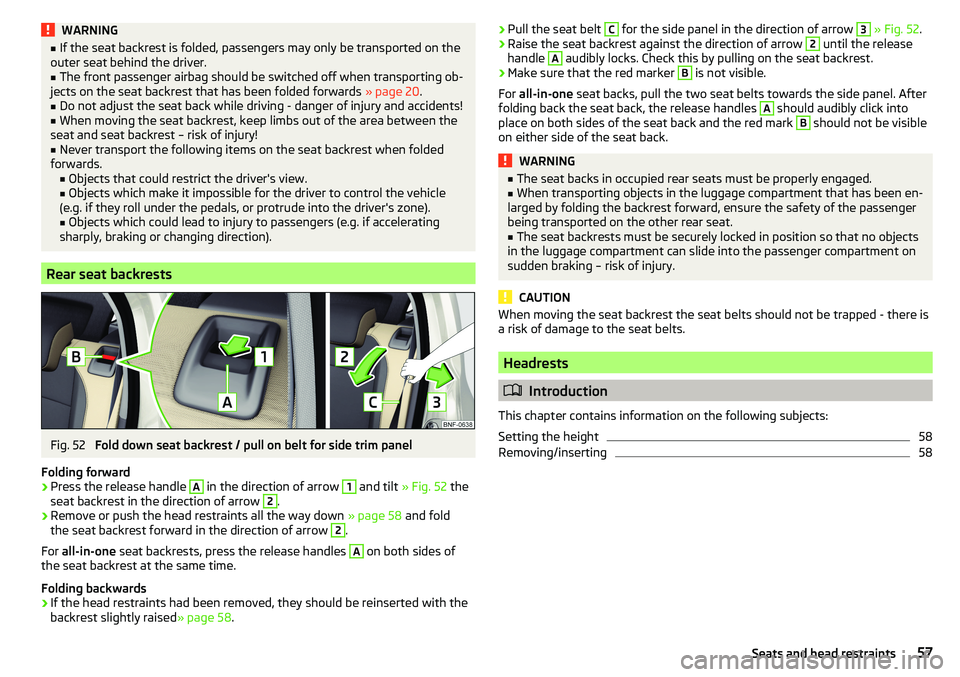
Fold down seat backrest / pull on belt for side trim panel
Folding forward
›
Press the release handle
A
in the direction of arrow
1
and tilt » Fig. 52 the
seat backrest in the direction of arrow
2
.
›
Remove or push the head restraints all the way down » page 58 and fold
the seat backrest forward in the direction of arrow
2
.
For all-in-one seat backrests, press the release handles
A
on both sides of
the seat backrest at the same time.
Folding backwards
›
If the head restraints had been removed, they should be reinserted with the
backrest slightly raised » page 58.
›Pull the seat belt C for the side panel in the direction of arrow 3
» Fig. 52 .›Raise the seat backrest against the direction of arrow 2 until the release
handle A
audibly locks. Check this by pulling on the seat backrest.
›
Make sure that the red marker
B
is not visible.
For all-in-one seat backs, pull the two seat belts towards the side panel. After
folding back the seat back, the release handles
A
should audibly click into
place on both sides of the seat back and the red mark
B
should not be visible
on either side of the seat back.
WARNING■ The seat backs in occupied rear seats must be properly engaged.■When transporting objects in the luggage compartment that has been en-
larged by folding the backrest forward, ensure the safety of the passenger
being transported on the other rear seat.■
The seat backrests must be securely locked in position so that no objects
in the luggage compartment can slide into the passenger compartment on
sudden braking – risk of injury.
CAUTION
When moving the seat backrest the seat belts should not be trapped - there is
a risk of damage to the seat belts.
Headrests
Introduction
This chapter contains information on the following subjects:
Setting the height
58
Removing/inserting
5857Seats and head restraints
Page 99 of 172
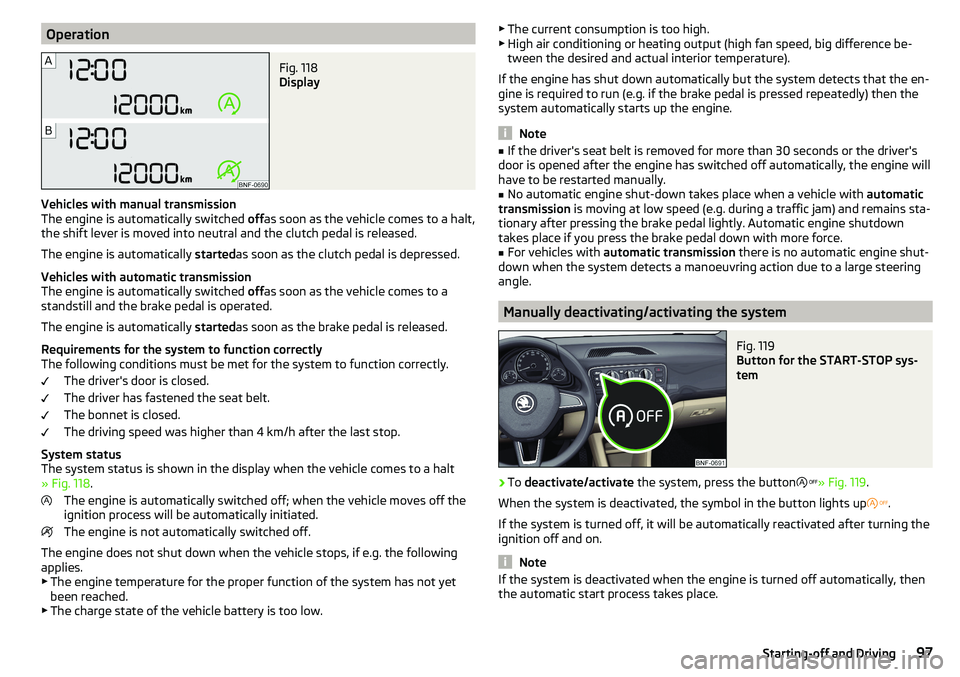
OperationFig. 118
Display
Vehicles with manual transmission
The engine is automatically switched offas soon as the vehicle comes to a halt,
the shift lever is moved into neutral and the clutch pedal is released.
The engine is automatically startedas soon as the clutch pedal is depressed.
Vehicles with automatic transmission
The engine is automatically switched offas soon as the vehicle comes to a
standstill and the brake pedal is operated.
The engine is automatically startedas soon as the brake pedal is released.
Requirements for the system to function correctly
The following conditions must be met for the system to function correctly.
The driver's door is closed.
The driver has fastened the seat belt.
The bonnet is closed.
The driving speed was higher than 4 km/h after the last stop.
System status
The system status is shown in the display when the vehicle comes to a halt
» Fig. 118 .
The engine is automatically switched off; when the vehicle moves off the
ignition process will be automatically initiated.
The engine is not automatically switched off.
The engine does not shut down when the vehicle stops, if e.g. the following
applies.
▶ The engine temperature for the proper function of the system has not yet
been reached.
▶ The charge state of the vehicle battery is too low.
▶
The current consumption is too high.
▶ High air conditioning or heating output (high fan speed, big difference be-
tween the desired and actual interior temperature).
If the engine has shut down automatically but the system detects that the en-
gine is required to run (e.g. if the brake pedal is pressed repeatedly) then the
system automatically starts up the engine.
Note
■ If the driver's seat belt is removed for more than 30 seconds or the driver's
door is opened after the engine has switched off automatically, the engine will
have to be restarted manually.■
No automatic engine shut-down takes place when a vehicle with automatic
transmission is moving at low speed (e.g. during a traffic jam) and remains sta-
tionary after pressing the brake pedal lightly. Automatic engine shutdown
takes place if you press the brake pedal down with more force.
■
For vehicles with automatic transmission there is no automatic engine shut-
down when the system detects a manoeuvring action due to a large steering
angle.
Manually deactivating/activating the system
Fig. 119
Button for the START-STOP sys-
tem
›
To deactivate/activate the system, press the button
» Fig. 119 .
When the system is deactivated, the symbol in the button lights up
.
If the system is turned off, it will be automatically reactivated after turning the
ignition off and on.
Note
If the system is deactivated when the engine is turned off automatically, then
the automatic start process takes place.97Starting-off and Driving
Page 114 of 172
WARNING (Continued)■Do not manipulate individual parts of the airbag system, as this might re-
sult in the airbag being deployed.■
If the airbag has been deployed, the airbag system must be replaced.
WARNINGThe airbag system operates using pressure sensors located in the front
doors. For this reason, no adjustments may be carried out to the doors or
door panels (e.g. installation of additional loudspeakers). Resulting damage
can impair the functioning of the airbag system - risk of accidents and fatal
injuries! The following guidelines must therefore be observed.■
Any work on the front doors and their door panels must be carried out by
a specialist garage.
■
Never drive the vehicle with the inner door panels removed or with open-
ings in the panelling.
Trailer operation
Read and observe
on page 110 first.
The vehicle is not approved for towing a trailer. The vehicle is not factory-
equipped with a towing device and it cannot be retrofitted with a towing de-
vice.
WARNINGNever attach a towing device to the vehicle.
Acceptance and recycling of used vehicles
Read and observe
on page 110 first.
All new ŠKODA vehicles are 95% recyclable.
Service intervals
Introduction
This chapter contains information on the following subjects:
Overview of service intervals
113
Fixed service intervals QI1 - QI4
113
Digital Service Plan
113
The service interval display in the display of the instrument cluster will remind
you to carry out every service stipulated by the manufacturer at the right time
in order to prevent you from forgetting any » page 42.
The completion of services can be verified through the printed verification
from the digital service schedule and the respective receipts.
The specified service intervals are tailored to normal operating conditions.
In the case of aggravated operating conditions, it will be necessary to have
some service work carried out before the date of the next regular service or
between the specified service intervals. This applies mainly to the cleaning or
the replacement of the air filter insert in regions with heavy dust pollution as
well as checking and replacing the toothed belt, but also to vehicles with die-
sel particle filters, which can put greater strain on the engine oil.
The following is taken to mean aggravated operating conditions: ▶ Frequent short trips.
▶ Longer periods of engine idling (e.g. taxis).
▶ Operation in areas with heavy dust pollution.
▶ Predominantly stop-and-go traffic as is e.g. often the case in city driving.
▶ Operation predominantly during winter.
You will be told at the specialist garage whether the operating conditions of
your vehicle may make it necessary for service work to be carried out between
the normal service intervals.
Different service charges may apply according to the particular scope of work
required, the vehicle type and specification, and your vehicle’s condition.
Note
■ The customer is responsible for covering the cost of all services including
changing or replenishing the oil, even during the warranty period, unless sta-
ted otherwise in the ŠKODA AUTO warranty terms or other agreements.■
You will be informed about the service checks and actions at each service by
the specialist garage.
112General Maintenance
Page 118 of 172
■Windows and door mirrors
■ Do not clean the insides of the windows/mirrors with sharp objects - risk of
damage to the filaments or the antenna. ■ Do not use a cloth which has been used to polish the body - this could dirty
the window and impair visibility.■
Head / tail lights
■ Do not wipe head/tail lamps dry, do not use any sharp objects - risk of dam-
age to the protective coating and cracks forming on the headlamp glass cov-
ers.
■
Door lock cylinders ■ Make sure that as little water as possible gets into the locking cylinder
when washing the vehicle - there is a risk of freezing the lock cylinder!
■
Wheels
■ Heavy soiling of the wheels can affect the balance of the wheels - the re-
sult can be a vibration, which can cause premature wear of the steering.
Caring for the interior
Read and observe
and on page 114 first.
Vehicle compo- nentsCircumstancesRemedy
Natural leather /
Artificial leather /
Alcantara ®
/
Material
Dust, surface
soilingVacuum cleanerSoiling (fresh)Water, slightly damp cotton / wool
cloth, if necessary, mild soap solution a)
,
then wipe off with a soft clothStubborn stainsCleaning fluid specifically for this taskCare (natural
leather)Treat the leather periodically with a
leather protecting fluid / use a care
cream with light blocker and impregna-
tion after each cleaningCare (Alcan-
tara ®
/ material)Remove stubborn hair using a “cleaning
glove”.
Remove pills from materials with a
brushPlastic partsSoilingWater, slightly damp cloth or sponge, if
necessary cleaners specifically for this
purposeVehicle compo- nentsCircumstancesRemedyWindowsSoilingWash with clean water and dry with a
wipe specifically for that purposeCovers on electri-
cally heated seatsSoilingCleaners specifically for this purposeSeat belts » Soilingsoft cloth and mild soap solution a)a)
Mild soap solution = 2 tablespoons of natural soap to 1 litre of lukewarm water.
WARNING■
Never clean the seat belts chemically as chemical cleaning products could
destroy the fabric.■
Air fresheners and scents can be hazardous to heath when the tempera-
ture inside the vehicle is high.
CAUTION
■ Natural leather / leather / Alcantara ®
/ material
■ Avoid standing for lengthy periods in bright sunlight, and protect the mate-
rials by covering to prevent them from fading.
■ Remove fresh stains (e.g. from pens, lipstick, shoe polish and similar) as
soon as possible.
■ Ensure that no part of the leather is soaked through during cleaning and
that no water gets into the seams - risk of damaging the leather!
■ Do not clean the roof panelling with a brush – risk of damage to the surface
of the panelling.
■ Do not use leather cleaners, floor wax, shoe cream, stain remover or similar
agents on Alcantara ®
seat upholstery.
■ Some clothing fabrics (e.g. dark denim) do not have sufficient colour fast-
ness - this could lead to clearly visible discolouration on the upholstery. This
is not a defect in the fabric.
■ Sharp objects on garments (e.g. zips, rivets, sharp- edged belts) can dam-
age the upholstery fabrics in the vehicle. Such damage will not be recognised
as a justified complaint.■
Plastic parts
■ Do not attach scents or air fresheners to the dash panel – risk of damage to
the dash panel.
■
Windows
■ Do not attach any stickers to the filaments or glass antenna - there is risk
of damage.
116General Maintenance