brake SKODA FABIA 2006 2.G / 5J User Guide
[x] Cancel search | Manufacturer: SKODA, Model Year: 2006, Model line: FABIA, Model: SKODA FABIA 2006 2.G / 5JPages: 258, PDF Size: 44.86 MB
Page 85 of 258
Seats and Stowage84
– Insert the plug of the electrical appliance into the socket of the
cigarette lighter.
The 12 volt power socket can also be us ed to supply power to electrical acces- sories with a power uptake up to 180 watts.
WARNING
•Take care when using the cigarette lighter! Not paying proper atten- tion or incorrect use the cigarette li ghter in an uncontrolled manner may result in burns.
•The cigarette lighter and the power socket also operates when the ignition is switched off or the ignition key withdrawn. This is why you should never leave children unattended in the vehicle!
Caution
Only use matching plugs, which fulfils the DIN - ISO Standard 4165, to avoid damaging the power sockets.
Note
Connecting electrical co mponents when the engine is not running will drain the battery of the vehicle - risk of battery draining!
Storage compartments
Overview
You will find the following stor age facilities in your vehicle:
WARNING
•Please do not place anything on top of the dash panel. Such objects might slide or fall down when driving (when accelerating or cornering) and may distract you from concentrating on the traffic situation - risk of accident!
•Ensure that when driving no objects from the centre console of from other storage possibilities may get into the footwell of the driver. You would then no longer be able to appl y the brakes, operate the clutch or accelerator - risk of accident!
Storage compartments on the front passenger side*⇒ page 85
Storage compartment on the driver's side⇒page 86
Stowage compartment for spectacles*⇒page 86
Stowage compartment in centre console⇒page 87
Storage compartment in the front seat*⇒page 87
Front seat armrest with stowage compartment*⇒page 88
Storage compartment in the front doors⇒page 88
Storage compartments in the luggage compart- ment⇒ page 89
Flexible storage compartment*⇒page 89
Clothes hooks*⇒page 90
NKO A05Fabia 20.book Page 84 Tuesday, September 26, 2006 8:38 AM
Page 106 of 258
Starting-off and Driving105
Using the systemSafetyDriving TipsGeneral MaintenanceBreakdown assistanceTechnical Data
Starting the engine
General
You can only start the engine only using an original ignition
key.
•Place the gearshift lever into neutral an d put on the handbrake firmly before starting the engine.
•The clutch pedal should be fully depr essed when starting the engine which means that the starter only has to crank the engine.
•Let go of the key as soon as the engine starts otherwise there may be damage to the starter.
The engine running noises ma y louder at first be louder for a short time after starting the cold engine until oil pressure can be built up in the hydraulic valve clearance compensation. This is quite normal and is not an operating problem.
If the engine does not start ...
You can use the battery of anothe r vehicle as a jump-start aid ⇒page 229.
It is only possible to tow-start vehicl es fitted with a manual gearbox. The tow- starting distance must not be more than 50 metres ⇒page 233.
WARNING
•Never run the engine in non ventilated or enclosed areas. The exhaust gases of the engine contain besides the odorless and colourless carbon monoxide a poisonous gas - hazard! Carbon monoxide can cause unconsciousness and death.
•Never leave your vehicle unattended with the engine running.
Caution
•The starter may only be operated (ignition key position ), if the engine is not running. If the starter is immediately operated after switching off the engine, the starter or the engine can be damaged.
•Avoid high engine revolutions, full thrott le and high engine loads as long as the engine has not yet reached its norm al operating temperature - risk of damaging the engine!
•Vehicles which are fitted with an exha ust gas catalytic converter should not be tow-started over a distance of more than 50 metres.
For the sake of the environment
Never warm up the engine when the vehi cle is standing. Drive off right away. When driving the engine reaches its operating temperature more rapidly and the pollutant emissions are lower.
Petrol engines
These engines are fitted with a starter system which selects the correct fuel/air mixture for every external air temperature.
•Do not operate accelerator before and when starting engine.
•Interrupt the attempt at starting after 10 seconds if the engine does not start right awayand wait for about 30 seconds before repeating the attempt.
•It is possible that the fuse on the electrical fuel pump is defect if the engine still does not start. Check the fuse and replace it if necessary ⇒page 235.
•If the engine does not start, contact the nearest specialist garage to obtain professional assistance.
It may be necessary, if the engine is very hot, to slightly depress the accelerator after the engine has started.
A3
NKO A05Fabia 20.book Page 105 Tuesday, September 26, 2006 8:38 AM
Page 107 of 258

Starting-off and Driving106
Diesel engines
Glow plug system
Diesel engines are equipped with a glow plug system, the preglow period being controlled automatically in line with the coolant temperature and outside temperature.
The preglow indicator light comes on after the ignition has been switched on.
You should not switch on any major electrical components during the heating period otherwise the vehicle battery will be drained unneces- sarily.
•You should start the engine immediately after the glow plug warning light has gone out.
•The glow plug warning light will come on for about one second if the engine is at a normal operating temperature or if the outside temperature is above +5°C. This means that you can start the engine right away.
•Interrupt the attempt at starting after 10 seconds if the engine does not start right awayand wait for about 30 seco nds before repeating the attempt.
•It is possible that the fuse on the diesel preglow system is defect if the engine still does not start. Check th e fuse and replace it if necessary ⇒ page 235.
•Contact the nearest specialist garage to obtain professional assistance.
Starting the engine after fuel tank has run dry
It may take longer than normal to start th e engine after refuelling if the fuel tank has run completely dry - up to one minute. This is because the fuel system must first of all be filled while the attempting to start the engine.
Switching off the engine
– The engine can be sw itched off by turning the ignition key from
position ⇒page 104, fig. 89 into position .
WARNING
•Never switch off the engine before the vehicle is stationary - risk of accident!
•The brake booster only operates when the engine is running. Greater physical effort for braking is required when engine is switched off. Because if you do not stop as normal, this can cause an accident and severe injuries.
Caution
you should not switch the engine off righ t away at the end of your journey after the engine has been operated for a length y period at high loads but should be allowed it to run at idling speed for about 2 minutes. This prevents any accumu- lation of heat when the engine is switched off.
Note
•The radiator fan may continue running for a further 10 minutes or so after the engine and the ignition have been switched off. The coolant fan may, however, also switch on again after some time if the coolant temperature rises because of an accumulation of heat in th e engine or if the engine is warm and the engine compartment is additionally heated by strong sunlight.
•This is why particular care is requir ed when carrying out any work in the engine compartment ⇒page 198, “Working in the engine compartment”.
A1
NKO A05Fabia 20.book Page 106 Tuesday, September 26, 2006 8:38 AM
Page 108 of 258
Starting-off and Driving107
Using the systemSafetyDriving TipsGeneral MaintenanceBreakdown assistanceTechnical Data
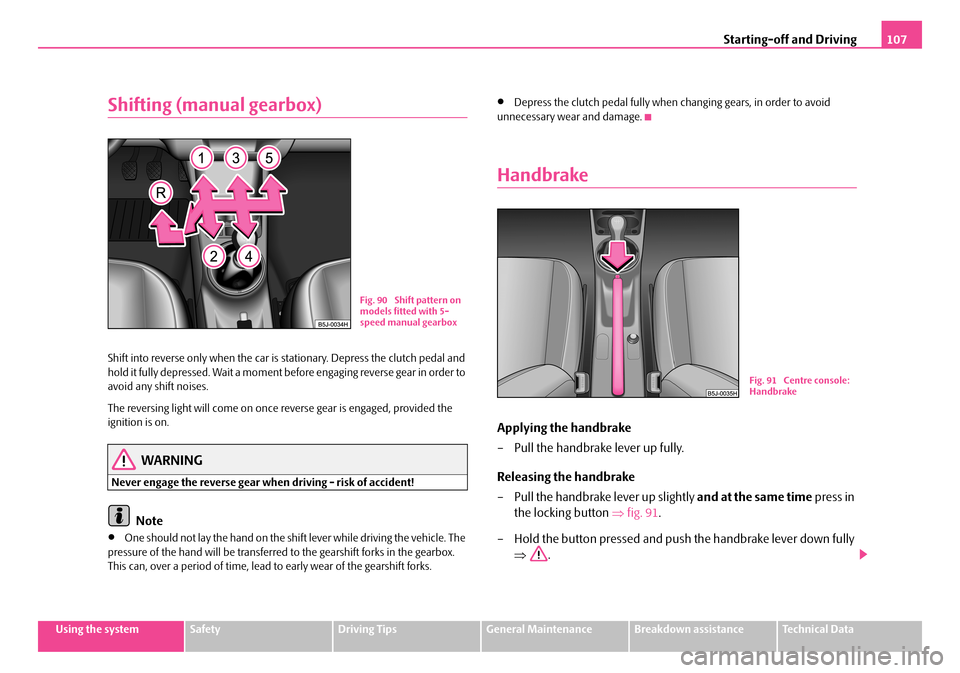
Shifting (manual gearbox)
Shift into reverse only when the car is stationary. Depress the clutch pedal and hold it fully depressed. Wait a moment before engaging reverse gear in order to avoid any shift noises.
The reversing light will come on once reverse gear is engaged, provided the ignition is on.
WARNING
Never engage the reverse gear when driving - risk of accident!
Note
•One should not lay the hand on the shift lever while driving the vehicle. The pressure of the hand will be transferre d to the gearshift forks in the gearbox. This can, over a period of time, lead to early wear of the gearshift forks.
•Depress the clutch pedal fully when changing gears, in order to avoid unnecessary wear and damage.
Handbrake
Applying the handbrake
– Pull the handbrake lever up fully.
Releasing the handbrake
– Pull the handbrake lever up slightly and at the same time press in
the locking button ⇒fig. 91.
– Hold the button pressed and push the handbrake lever down fully
⇒ .
Fig. 90 Shift pattern on models fitted with 5-speed manual gearbox
Fig. 91 Centre console: Handbrake
NKO A05Fabia 20.book Page 107 Tuesday, September 26, 2006 8:38 AM
Page 109 of 258
Starting-off and Driving108
The handbrake warning light lights up when the handbrake is applied, provided the ignition is on.
A warning signal sounds and the following text appears in the display* if you have inadvertently driven off with the handbrake applied:
HANDBRAKE ON
The handbrake warning is activated if you drive at a speed of more than 6 km/h for more than 3 seconds.
WARNING
•Please note that the handbrake must be fully released. A handbrake which is only partially released can re sult in the rear brakes overheating which will have a negative effect on the operation of the brake system - risk of accident! In addition this can result in premature wear of the rear brake pads.
•Never leave children unattended in the vehicle. The children might, for example, release the handbrake or take the vehicle out of gear. The vehicle might then move off - risk of accident!
Caution
After the car has come to a stop, always first of all apply the handbrake firmly before then additionally engaging a gear (manual gearbox) or moving the selector lever into position P (automatic gearbox).
Parking aid*
The parking aid provides a warning of obstacles behind the
vehicle.
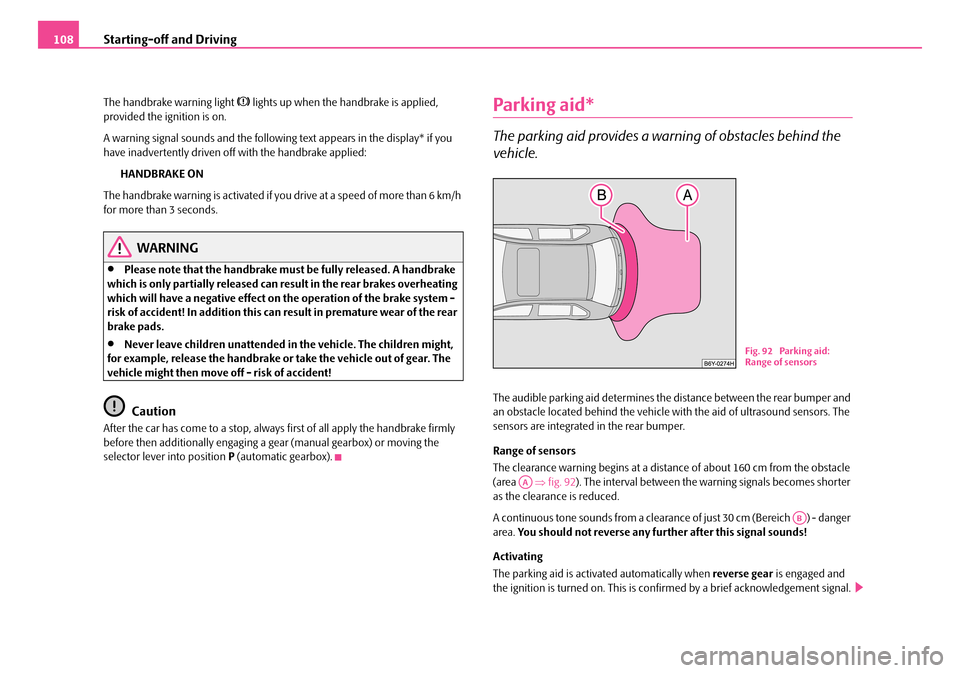
The audible parking aid determines the distance between the rear bumper and an obstacle located behind the vehicle wi th the aid of ultrasound sensors. The sensors are integrated in the rear bumper.
Range of sensors
The clearance warning begins at a distan ce of about 160 cm from the obstacle (area ⇒fig. 92). The interval between the warning signals becomes shorter as the clearance is reduced.
A continuous tone sounds fr om a clearance of just 30 cm (Bereich ) - danger area. You should not reverse any further after this signal sounds!
Activating
The parking aid is activated automatically when reverse gear is engaged and the ignition is turned on. This is conf irmed by a brief acknowledgement signal.
Fig. 92 Parking aid: Range of sensors
AA
AB
NKO A05Fabia 20.book Page 108 Tuesday, September 26, 2006 8:38 AM
Page 110 of 258
Starting-off and Driving109
Using the systemSafetyDriving TipsGeneral MaintenanceBreakdown assistanceTechnical Data
Deactivating
The parking aid is deactivated by removing the reverse gear.
WARNING
•The parking aid is not a substitute for the driver paying proper atten- tion and it is always the driver's responsibility to take care when parking the vehicle or carrying out similar manoeuvres.
•You should therefore satisfy yourself, before reversing, that there is no small obstacle, such as a rock, th in post, trailer drawbar etc., behind your vehicle. Such an obstacle might not be within the range detected by the sensors.
Note
•The parking aid does not operate if you are towing a trailer (applies to models which feature a fact ory-fitted towing device*).
•A system fault is indicated if a warning signal sounds for about 5 seconds after switching the ignition on and engaging reverse gear and there is no obstacle close to your vehicle. Have the fault rectified by a specialist workshop.
•The sensors must be kept clean and free of ice to enable the parking aid to operate properly.
•If the parking aid is activated and the selector lever of the automatic gearbox is in the position , warning signal indicates interruption (vehicle can no longer move).
Cruise control system (CCS)*
Introduction
The cruise control system (CCS) maintains a constant speed, more than 30 km/h, once it has been set, without you having to depress the accelerator pedal. This is only possible within the range which is permitted by the power output and braking power of the engine. The cruise control system makes it possible - particularly on long journeys - for you to rest your “accelerator foot”.
WARNING
•The cruise control system must not, for safety reasons, be used in dense traffic or on unfavourable road surfaces (such as icy roads, slip- pery roads or loose chippings) - risk of accident!
•In order to prevent unintentional use of the cruise control system, always switch off the system after use.
Note
•Models fitted with a manual gearbox: Always depress the clutch pedal if you switch on the cruise control system when the gearbox is in Neutral. Otherwise the engine can rev up unintentionally.
•The cruise control system is not able to maintain a constant speed when driving on steep downhill sections. The weight of the vehicle increases the speed at which it travels. One should shift down in good time to a lower gear or slow the vehicle down by applying the foot brake.
•It is not possible on vehi cles fitted with an automatic gearbox to switch on the cruise control system if the selector lever is in the position P, N or R.
AP
NKO A05Fabia 20.book Page 109 Tuesday, September 26, 2006 8:38 AM
Page 111 of 258
Starting-off and Driving110
Storing a speed
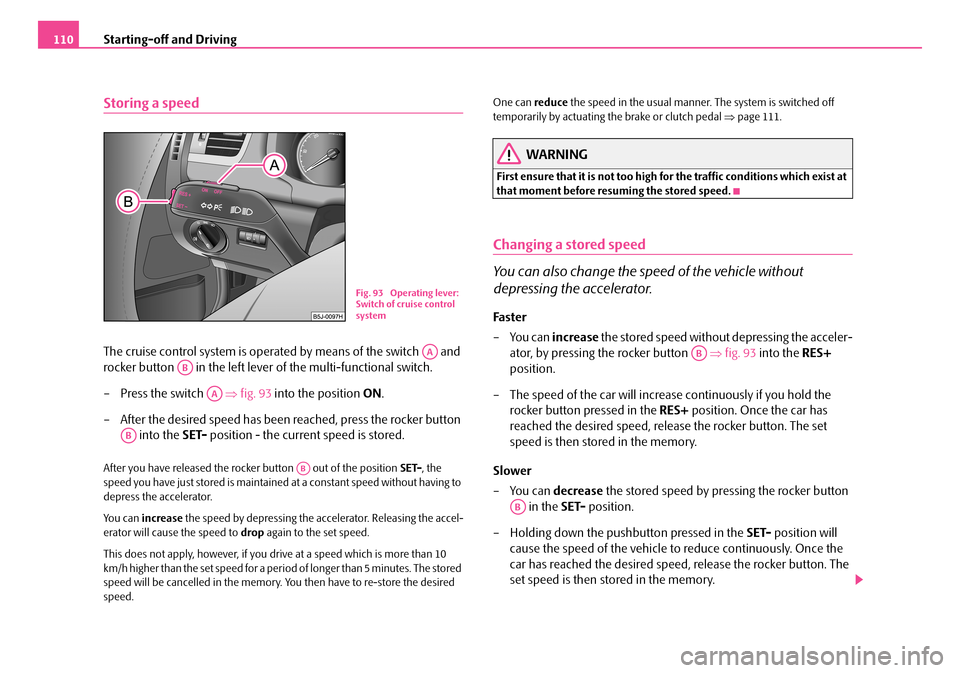
The cruise control system is operated by means of the switch and
rocker button in the left lever of the multi-functional switch.
– Press the switch ⇒fig. 93 into the position ON.
– After the desired speed has been reached, press the rocker button
into the SET- position - the current speed is stored.
After you have released the rocker button out of the position SET-, the speed you have just stored is maintained at a constant speed without having to depress the accelerator.
You can increase the speed by depressing the accelerator. Releasing the accel- erator will cause the speed to drop again to the set speed.
This does not apply, however, if you drive at a speed which is more than 10 km/h higher than the set speed for a period of longer than 5 minutes. The stored speed will be cancelled in the memory. You then have to re-store the desired speed.
One can reduce the speed in the usual manner. The system is switched off temporarily by actuating the brake or clutch pedal ⇒page 111.
WARNING
First ensure that it is not too high for the traffic conditions which exist at that moment before resuming the stored speed.
Changing a stored speed
You can also change the speed of the vehicle without
depressing the accelerator.
Fa s t e r
– You can increase the stored speed without depressing the acceler-
ator, by pressing the rocker button ⇒fig. 93 into the RES+
position.
– The speed of the car will increase continuously if you hold the
rocker button pressed in the RES+ position. Once the car has
reached the desired speed, release the rocker button. The set
speed is then stored in the memory.
Slower
–You can decrease the stored speed by pressing the rocker button
in the SET- position.
– Holding down the pushbutton pressed in the SET- position will
cause the speed of the vehicle to reduce continuously. Once the
car has reached the desired speed, release the rocker button. The
set speed is then stored in the memory.
Fig. 93 Operating lever: Switch of cruise control system
AA
AB
AA
AB
AB
AB
AB
NKO A05Fabia 20.book Page 110 Tuesday, September 26, 2006 8:38 AM
Page 112 of 258
Starting-off and Driving111
Using the systemSafetyDriving TipsGeneral MaintenanceBreakdown assistanceTechnical Data
– If you release the rocker button when the car is travelling at a speed
of less than 30 km/h, the speed is not stored, the memory is erased.
It is then necessary to again store the speed with the rocker button
in the position SET- after an increase in speed of the vehicle to
more than 30 km/hour.
Switching off the cruise control system temporarily
– You can switch off temporarily the cruise control system, if you
depress the brake or clutch pedal.
The set speed remains stored in the memory.
Press the rocker button in the position RES+ for the resumptionof the stored speed after releasing the clutch or brake pedal.
WARNING
First ensure that it is not too high for the traffic conditions which exist at that moment before resuming the stored speed.
Switching off the cruise control system completely
– Press the switch ⇒page 110, fig. 93 to the right into position
OFF .
AB
AB
AA
NKO A05Fabia 20.book Page 111 Tuesday, September 26, 2006 8:38 AM
Page 113 of 258
Automatic gearbox112
Automatic gearbox
6-speed automatic gearbox*
Introduction
Your car is equipped with an electronically controlled 6-speed automatic gearbox. Shifting up and also down through the gears is performed automati-cally.
At the same time this is a conventional automatic gearbox. The maximum speed is reached in the 5th gear. The 6th gear serves as an economic driving programme, which is intended to reduce the fuel consumption.
Information for driving with an automatic gearbox
Shifting up and down through the gears is performed auto-
matically.
You can also, however, switch the gearbox over into the Tiptronic
mode . This mode makes it possible for you to also shift gears manu-
ally ⇒page 116.
Starting-off and Driving
– Depress the brake pedal and hold it depressed.
– Press the Shiftlock button (button in handle of the selector lever),
move the selector lever into the desired position, e.g. D
⇒ page 113, and then release the Shiftlock button.
– Wait a moment until the gearbox ha s shifted (a slight engagement
nudge can be felt).
– Release the brake pedal and depress the accelerator ⇒.
Stopping for a short time
– The selector lever position N does not have to be selected when
s t o p p i n g j u s t fo r a s h o r t t i m e , s u c h a s a t a c ro s s ro a d s . I t i s s u f f i c i e n t
to hold the vehicle stationary usin g the foot brake. The engine can,
however, be allowed just to idle.
Parking
– Depress the brake pedal and hold it depressed.
– Apply the handbrake firmly.
– Press and Shiftlock button in the selector lever, move the selector
lever to P and then release the Shiftlock button.
The engine can only be started when the selector lever is in position P or N ⇒ page 105.
It is sufficient to engage selector lever position P when parking on a flat surface. When parking on a slope you should firs t apply the handbrake firmly and then move the selector lever into position P. This is to ensure that there is no exces- sive pressure acting on the lock mechanism and that it is easier to subsequently move the selector lever out of position P.
If the selector lever position N is selected by accident while driving it is first necessary to release pressure on the acce lerator pedal and wait for idling speed of the engine to be reached before enga ging a drive position in the selector lever.
NKO A05Fabia 20.book Page 112 Tuesday, September 26, 2006 8:38 AM
Page 114 of 258

Automatic gearbox113
Using the systemSafetyDriving TipsGeneral MaintenanceBreakdown assistanceTechnical Data
WARNING
•Do not depress the accelerator when changing the position of the selector lever if the car is stationary and the engine is running - risk of accident!
•Never move the selector lever into position R or P when driving - risk of an accident!
•When the engine is running and the vehicle is stationary, it is neces- sary to hold the car with the brake pedal in all the positions of the selector lever (except P and N) since the power transmission is never completely interrupted, also not when the engine is idling - the vehicle "creeps".
Selector lever positionsThe selector lever position you have engaged is shown in the information display of the instrument cluster with the corresponding gear symbol high- lighted ⇒fig. 95. In the positions D and S the gear you have already engaged will be additionally displayed on the display.
P - Parklock
The driven wheels are locked me chanically in this position.
The Parklock must only be engaged when the vehicle is stationary ⇒.
If you wish to move the sele ctor lever into or out of this position, you must press the Shiftlock button in the handle of the selector lever and at the same time depress the brake pedal.
R - Reverse
Reverse gear must only be engaged when the vehicle is stationary and the engine idling ⇒.
The brake pedal must be depressed and at the same time the Shiftlock must be pressed, if you wish to obtain the selector lever positions R, P or N.
Fig. 94 Selector lever
Fig. 95 Information display: Selector lever positions
NKO A05Fabia 20.book Page 113 Tuesday, September 26, 2006 8:38 AM