oil SKODA FABIA 2006 2.G / 5J Owner's Guide
[x] Cancel search | Manufacturer: SKODA, Model Year: 2006, Model line: FABIA, Model: SKODA FABIA 2006 2.G / 5JPages: 258, PDF Size: 44.86 MB
Page 199 of 258
Inspecting and Replenishing198
Opening the bonnet
– Unlock the bonnet ⇒page 197, fig. 141.
– Ensure that the arms of the windscreen wipers are correctly in
place against the windscreen before opening the bonnet other-
wise damage could occur to the paintwork.
– Press the locking button ⇒page 197, fig. 142, the bonnet unlocks
itself.
– Grip the bonnet and lift it up.
– Take the bonnet support out of its holder and set it in the opening
designed for it ⇒page 197, fig. 143.
Closing the bonnet
– Lift the bonnet slightly and unhook the bonnet support. Press the
bonnet support into the holder designed to hold it.
– Allow the bonnet to drop from a height of about 30 cm into the lock
- bonnet do not press down on it!
WARNING
•Never open the bonnet if you see that steam or coolant is flowing out of the engine compartment - risk of scalding! Wait long enough until the steam or coolant has stopped escaping.
•For safety reasons, the bonnet must always be properly closed when driving. One should therefore check that the lock has in fact engaged properly after closing the bonnet.
•Stop your vehicle immediately whil e driving if you notice that the lock is not properly engaged and close the bonnet properly - risk of an accident!
Caution
•Before opening the bonnet, ensure that the arms of the windscreen wipers are correctly in place against the windscreen. Otherwise, there is a risk of damage to the paintwork.
Working in the engine compartment
Particular care is required when carrying out any work in the
engine compartment!
There is a risk of injuries, scalding, accidents and fire when working in the engine compartment, e.g. inspecting and replenishing oil and other fluids. For this reason, it is essential to comply with the warning instructions stated below and with the general appl icable rules of safety. The engine compartment of your car is a hazardous area ⇒.
WARNING
•Never open the bonnet if you see that steam or coolant is flowing out of the engine compartment - risk of scalding! Wait long enough until the steam or coolant has stopped escaping.
•Switch off the engine and pull out the ignition key.
•Apply the handbrake firmly.
•If your vehicle is fitted with a manual gearbox, move the gearshift lever into Neutral, or if it is fitted with automatic gearbox, move the selector lever into position P.
•Allow the engine to cool down.
•Keep children clear of the engine compartment.
•Do not touch any hot engine parts - risk of burns!
NKO A05Fabia 20.book Page 198 Tuesday, September 26, 2006 8:38 AM
Page 200 of 258
Inspecting and Replenishing199
Using the systemSafetyDriving TipsGeneral MaintenanceBreakdown assistanceTechnical Data
•Never spill oil and other fluids over the hot engine. Such fluids (e.g. the antifreeze contained in the coolant) may ignite!
•Avoid short circuits in the electrical system - particularly on the battery.
•Never place your hand into the radiator fan as long as the engine is still warm. The fan might suddenly start running!
•Never open the cap of the coolant expansion bottle as long as the engine is still warm. The co oling system is pressurized!
•Cover over the cap of the coolant expansion reservoir with a large cloth when opening it as protection for your face, hands and arms from hot steam or hot coolant.
•Do not let objects, such as e.g cleaning cloth or tools lie in the engine compartment.
•If you wish to work under the vehicle, you must secure the vehicle from rolling away and support it with suitable supporting blocks: the car jack is not sufficient for this - risk of injury!
•In cases where it be necessary to carry out inspection work when the engine is running there is an additional risk from rotating parts (e.g. the V-ribbed belt, alternator, radiator fan) and from the high-voltage igni- tion system. Please observe in addition the following:
− Never touch the electrical cables of the ignition system.
− Absolutely avoid any jewellery, loose items of clothing or long hair from getting into the rotating part s of the engine - Hazard! Therefore remove any jewellery beforehand, tie up your hair and wear tight fitting clothing.
•Please also comply with the warnin g instructions stated below when carrying out any essential work on th e fuel system or on the electrical system:
− Always separate the car battery from the electrical system.
− Do not smoke.
− Never carry out any work close to naked flames.
− Always keep a working fire extinguisher at hand.
Caution
When replenishing fluids in the engine, always ensure that the fluids are on no account mixed up. This may result in ma jor operating problems and also vehicle damage!
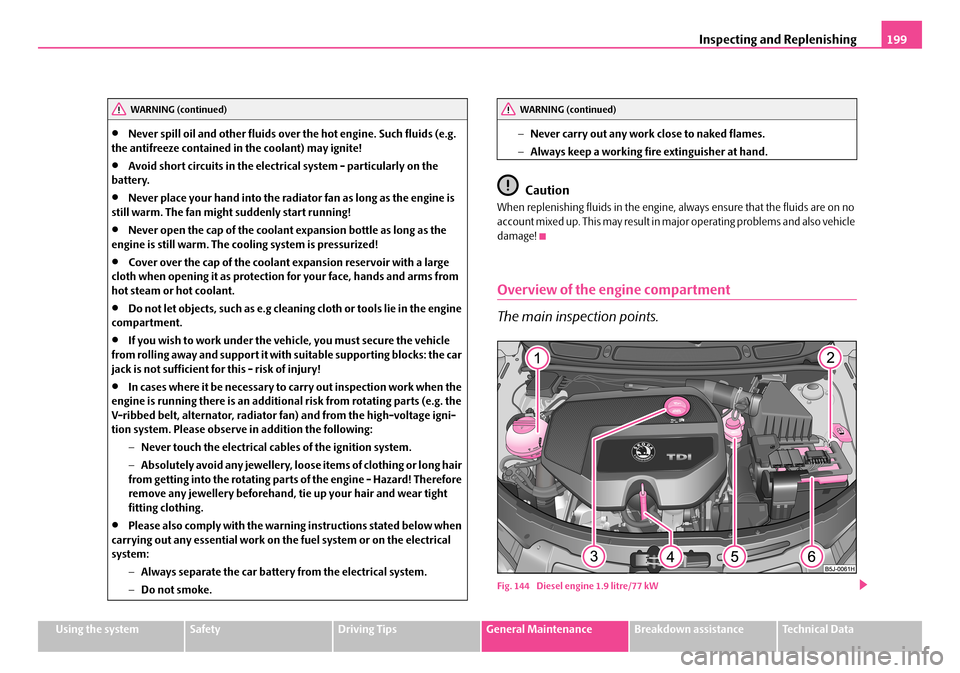
Overview of the engine compartment
The main inspection points.
Fig. 144 Diesel engine 1.9 litre/77 kW
WARNING (continued)WARNING (continued)
NKO A05Fabia 20.book Page 199 Tuesday, September 26, 2006 8:38 AM
Page 201 of 258
Inspecting and Replenishing200
Coolant expansion bottle . . . . . . . . . . . . . . . . . . . . . . . . . . . . . . . . . . .
Windshield washer fluid reservoir . . . . . . . . . . . . . . . . . . . . . . . . . . .
Engine oil filler opening . . . . . . . . . . . . . . . . . . . . . . . . . . . . . . . . . . . . .
Engine oil dipstick . . . . . . . . . . . . . . . . . . . . . . . . . . . . . . . . . . . . . . . . . .
Brake fluid reservoir . . . . . . . . . . . . . . . . . . . . . . . . . . . . . . . . . . . . . . . .
Battery (below a cover) . . . . . . . . . . . . . . . . . . . . . . . . . . . . . . . . . . . . .
Note
The location of the inspection points in the engine compartment of petrol and diesel engines is practically identical.
Engine oil
Engine oil specifications
The grade of engine oil should be selected in accordance with
precise specifications.
The engine of your vehicle has been fact ory-filled with a high-grade oil which you can use throughout the year - except in extreme climatic regions.
You can mix various oils together with ea ch other when refilling with oil. This does not, however, apply for models with flexible service intervals (QG1).
Engine oils are, of course, undergoing continuous further development. Thus the information stated in this Owner's Manual is only correct at the time of publication.
Škoda Service Partners are informed by Škoda Auto a.s. about current changes. We recommend having this oil change undertaken by a Škoda Service Partner.
Engine oil specifications for vehicles with fixed service intervals (QG0, QG2)
Engine oil specifications for models with flexible service intervals (QG1)
Caution
Only the above-mentioned oils may be used on vehicles with flexible service intervals (QG1). We recommend always re filling with oil of the same specifica- tion since this will maintain the properti es of the oil. In exceptional cases, you must top up only once engine oil complying with Specification VW 502 00 (only for petrol engines) or Specification VW 505 01 (only for diesel engines) to maximum 0.5 litres. You must not use other engine oils - risk of engine damage!
A1204A2211
A3202
A4201
A5206
A6207
Engine oil specifications
Petrol engines
VW 501 01 VW 502 00 VW 504 00
ACEA A2 a) or A3 a)
a)Only to be used in exceptional cases if the oils specified above are not available.
Diesel enginesVW 505 01b)
VW 507 00 c)
b)Only for engines without diesel particle filter ⇒page 36.c)Only for engines with diesel particle filter ⇒page 36.
Engine oil specifications
Petrol enginesVW 504 00 alternative VW 503 00
Diesel enginesVW 507 00
alternative VW 506 01 a)
a)Only for engines without diesel particle filter ⇒page 36.
NKO A05Fabia 20.book Page 200 Tuesday, September 26, 2006 8:38 AM
Page 202 of 258
Inspecting and Replenishing201
Using the systemSafetyDriving TipsGeneral MaintenanceBreakdown assistanceTechnical Data
Note
•Before a long drive we recommend that you purchase and carry with you engine oil which complies with the specif ication for your vehicle. Consequently, you will always have the correct engine oil for refilling.
•We recommend using a preservative fr om the Škoda original accessories offered by your Škoda dealer.
•For further information - see Service shedule.
Check engine oil level
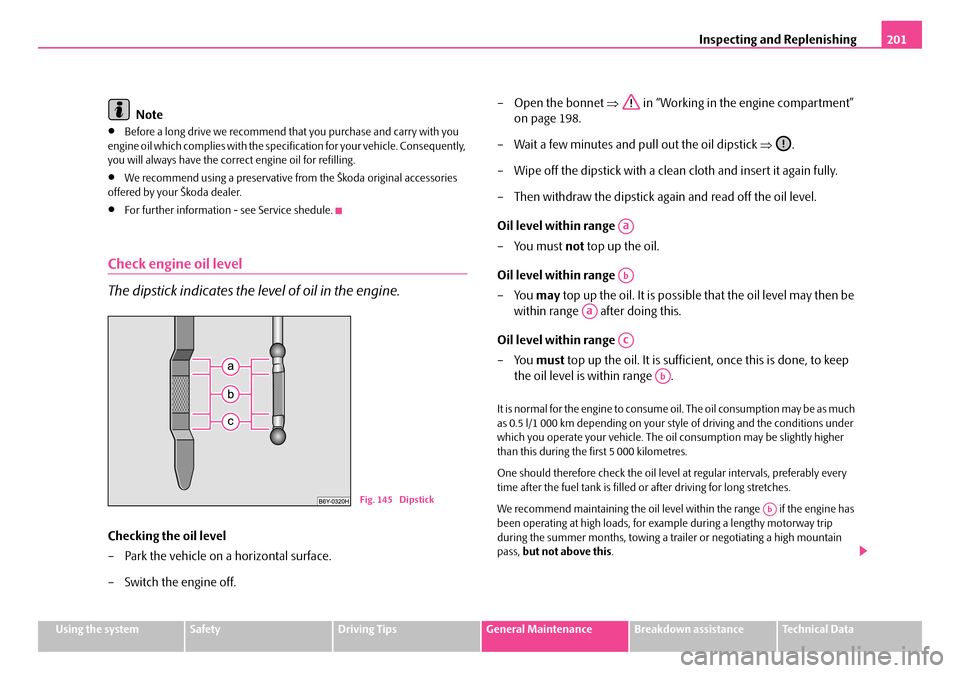
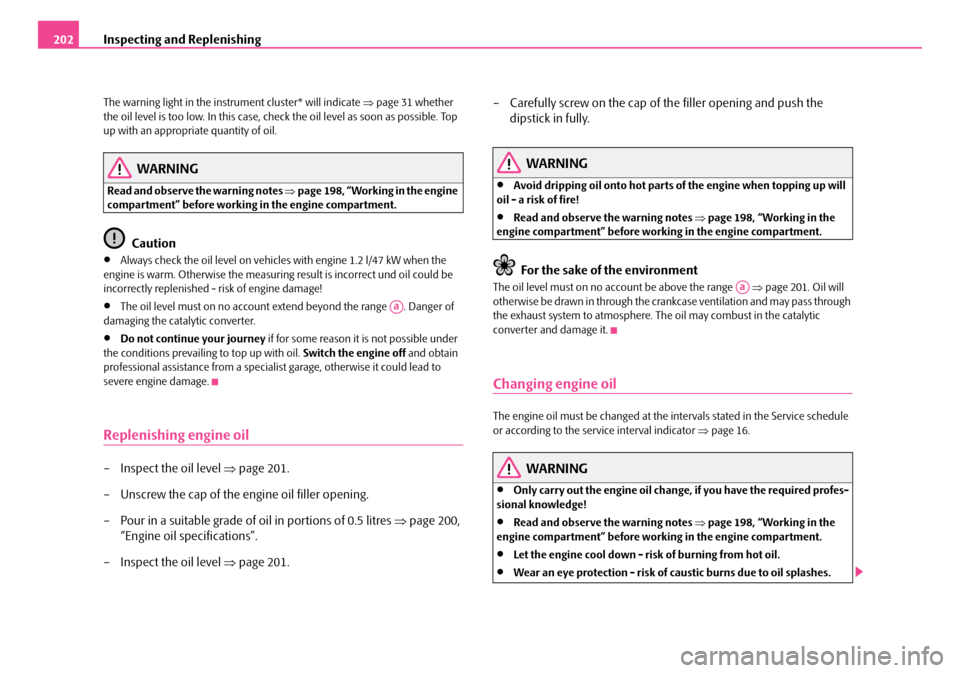
The dipstick indicates the level of oil in the engine.
Checking the oil level
– Park the vehicle on a horizontal surface.
– Switch the engine off.
– Open the bonnet ⇒ in “Working in the engine compartment”
on page 198.
– Wait a few minutes and pull out the oil dipstick ⇒.
– Wipe off the dipstick with a clean cloth and insert it again fully.
– Then withdraw the dipstick again and read off the oil level.
Oil level within range
– You must not top up the oil.
Oil level within range
– You may top up the oil. It is possible that the oil level may then be
within range after doing this.
Oil level within range
– You must top up the oil. It is sufficient, once this is done, to keep
the oil level is within range .
It is normal for the engine to consume oil. The oil consumption may be as much as 0.5 l/1 000 km depending on your style of driving and the conditions under which you operate your vehicle. The oi l consumption may be slightly higher than this during the first 5 000 kilometres.
One should therefore check the oil level at regular intervals, preferably every time after the fuel tank is filled or after driving for long stretches.
We recommend maintaining the oil level within the range if the engine has been operating at high loads, for ex ample during a lengthy motorway trip during the summer months, towing a tr ailer or negotiating a high mountain pass, but not above this.
Fig. 145 Dipstick
Aa
Ab
Aa
Ac
Ab
Ab
NKO A05Fabia 20.book Page 201 Tuesday, September 26, 2006 8:38 AM
Page 203 of 258
Inspecting and Replenishing202
The warning light in the instrument cluster* will indicate ⇒page 31 whether the oil level is too low. In this case, check the oil level as soon as possible. Top up with an appropriate quantity of oil.
WARNING
Read and observe the warning notes ⇒page 198, “Working in the engine compartment” before working in the engine compartment.
Caution
•Always check the oil level on vehicles with engine 1.2 l/47 kW when the engine is warm. Otherwise the measuring result is incorrect und oil could be incorrectly replenished - risk of engine damage!
•The oil level must on no account ex tend beyond the range . Danger of damaging the catalytic converter.
•Do not continue your journey if for some reason it is not possible under the conditions prevailing to top up with oil. Switch the engine off and obtain professional assistance from a specialist garage, otherwise it could lead to severe engine damage.
Replenishing engine oil
– Inspect the oil level ⇒page 201.
– Unscrew the cap of the engine oil filler opening.
– Pour in a suitable grade of oil in portions of 0.5 litres ⇒page 200,
“Engine oil specifications”.
– Inspect the oil level ⇒page 201.
– Carefully screw on the cap of the filler opening and push the
dipstick in fully.
WARNING
•Avoid dripping oil onto hot parts of the engine when topping up will oil - a risk of fire!
•Read and observe the warning notes ⇒page 198, “Working in the engine compartment” before work ing in the engine compartment.
For the sake of the environment
The oil level must on no account be above the range ⇒page 201. Oil will otherwise be drawn in through the cran kcase ventilation and may pass through the exhaust system to atmosphere. The oil may combust in the catalytic converter and damage it.
Changing engine oil
The engine oil must be changed at the intervals stated in the Service schedule or according to the service interval indicator ⇒page 16.
WARNING
•Only carry out the engine oil change, if you have the required profes- sional knowledge!
•Read and observe the warning notes ⇒page 198, “Working in the engine compartment” before work ing in the engine compartment.
•Let the engine cool down - risk of burning from hot oil.
•Wear an eye protection - risk of caustic burns due to oil splashes.
Aa
Aa
NKO A05Fabia 20.book Page 202 Tuesday, September 26, 2006 8:38 AM
Page 204 of 258
Inspecting and Replenishing203
Using the systemSafetyDriving TipsGeneral MaintenanceBreakdown assistanceTechnical Data
•Oil is toxic! Store old oil in a safe place out of the reach of children and unauthorized persons until you dispose of it properly.
Caution
You must not pour any additives into th e engine oil - risk of engine damage! Damage, which results from such product, are excluded from the warranty.
For the sake of the environment
•You must on no account pour oil into the ground or into the sewage system.
•In view of the problems involved in properly disposing of old oil, the mate- rial, equipment and the knowledge required for such work, we recommend that you have the oil and oil filter change ca rried out by your Škoda Service Partner.
Note
After your skin has come in contact with the oil, you must thoroughly wash your skin.
Cooling system
Coolant
The job of the coolant is to cool the engine.
The cooling system does not require an y maintenance under normal operating conditions. The coolan t consists of water with a concentration of coolant addi- tive of 40 %. This mixture not only provid es antifreeze protection down to -25°C but also protects the cooling and heat ing system from corrosion. It also
prevents the formation of scale and significantly increases the boiling point of the coolant.
You must therefore not reduce the concentration of antifreeze agent in the coolant by adding water, also not duri ng the summer months or in countries with a warm climate. The concentration of coolant additive in the coolant must be at least 40%.
You can increase the amount of antifreeze in the coolant if a higher concentra- tion of antifreeze is necessary for clim atic reasons but only up to 60% (anti- freeze protection down to approx. -40° C). The antifreeze protection tails off above that concentration.
Vehicles exported to co untries with a cold climate (e.g. Sweden, Norway, Finland) are already factory-filled with a coolant which offers antifreeze protec-tion down to about -35°C. In these countries the concentration of coolant addi- tive should be at least 50 %.
Coolant
The cooling system is filled at the works with coolant (purple in colour), which complies with the specification TL-VW 774 F.
We recommend that you use the antifreeze agent - G12 PLUS (purple in colour).
We recommend that you contact your Šk oda Service Partner if you have any questions regarding the coolant or if you wish to fill up with a different coolant.
Your Škoda Service Partner can also supp ly you with the correct coolant addi- tives.
Caution
•Other coolant additives may cause operational problems which, in particular, involves significantly reducing the anticorrosion effect.
•Any faults or problems resulting from corrosion may cause a loss of coolant and, as a consequence of th is, result in major engine damage.
WARNING (continued)
NKO A05Fabia 20.book Page 203 Tuesday, September 26, 2006 8:38 AM
Page 205 of 258
Inspecting and Replenishing204
Inspecting the coolant level
The coolant expansion bottle is located in the engine compartment on
the right.
– Switch the engine off.
– Open the bonnet ⇒ in “Working in the engine compartment”
on page 198.
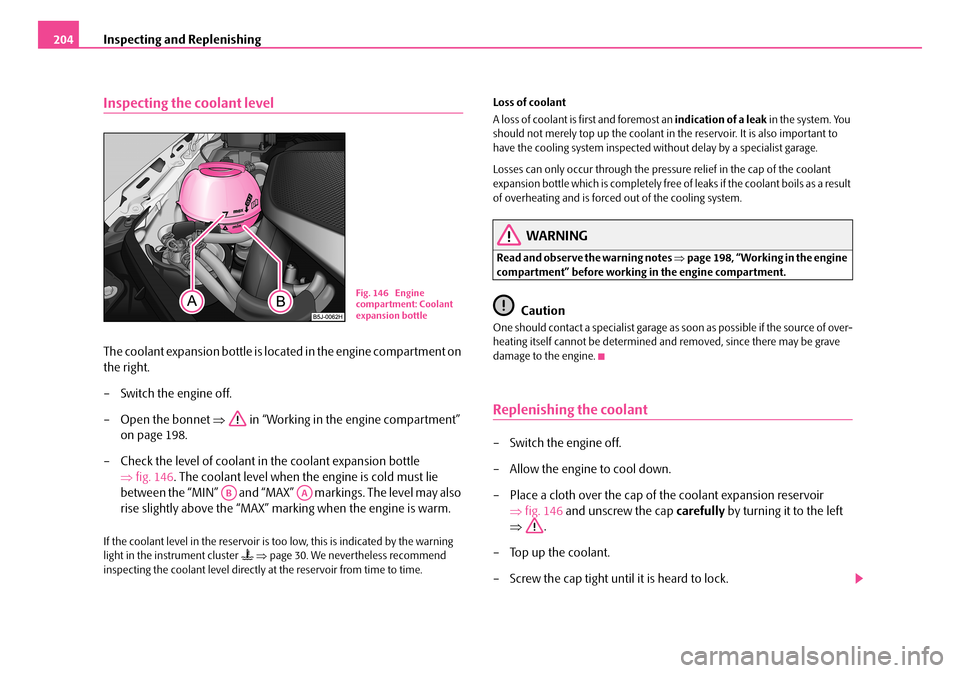
– Check the level of coolant in the coolant expansion bottle
⇒ fig. 146. The coolant level when the engine is cold must lie
between the “MIN” and “MAX” markings. The level may also
rise slightly above the “MAX” ma rking when the engine is warm.
If the coolant level in the reservoir is too low, this is indicated by the warning light in the instrument cluster ⇒page 30. We nevertheless recommend inspecting the coolant level directly at the reservoir from time to time.
Loss of coolant
A loss of coolant is first and foremost an indication of a leak in the system. You should not merely top up the coolant in the reservoir. It is also important to have the cooling system inspected without delay by a specialist garage.
Losses can only occur through the pressure relief in the cap of the coolant expansion bottle which is completely free of leaks if the coolant boils as a result of overheating and is forced out of the cooling system.
WARNING
Read and observe the warning notes ⇒page 198, “Working in the engine compartment” before working in the engine compartment.
Caution
One should contact a specialist garage as soon as possible if the source of over- heating itself cannot be determined an d removed, since there may be grave damage to the engine.
Replenishing the coolant
– Switch the engine off.
– Allow the engine to cool down.
– Place a cloth over the cap of the coolant expansion reservoir
⇒ fig. 146 and unscrew the cap carefully by turning it to the left
⇒ .
– Top up the coolant.
– Screw the cap tight until it is heard to lock.
Fig. 146 Engine compartment: Coolant expansion bottle
ABAA
NKO A05Fabia 20.book Page 204 Tuesday, September 26, 2006 8:38 AM
Page 207 of 258
Inspecting and Replenishing206
Brake fluid
Inspecting the brake fluid level
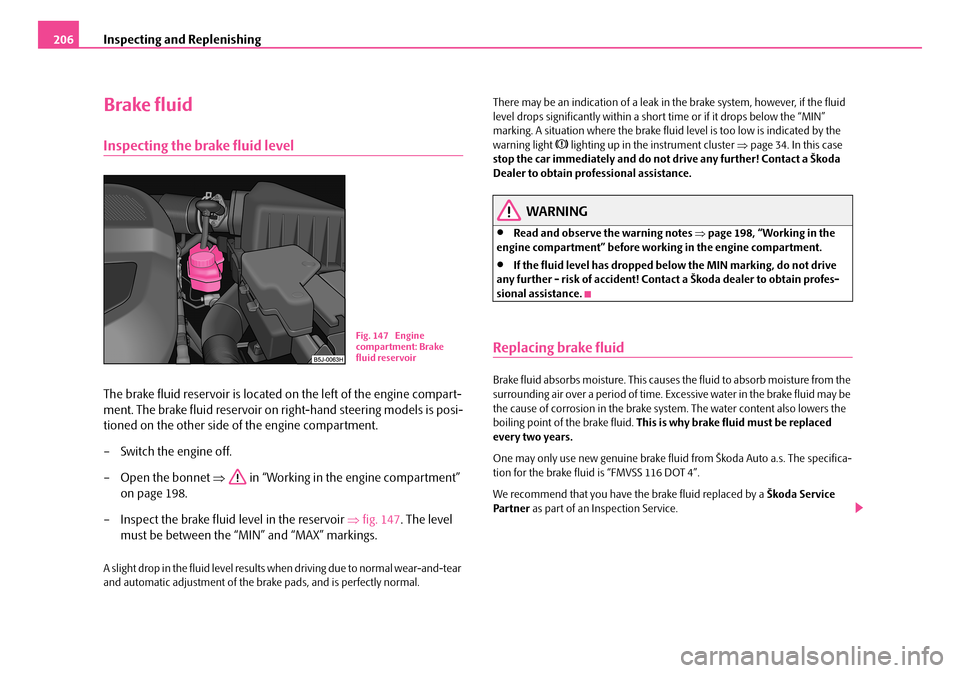
The brake fluid reservoir is located on the left of the engine compart-
ment. The brake fluid reservoir on right-hand steering models is posi-
tioned on the other side of the engine compartment.
– Switch the engine off.
– Open the bonnet ⇒ in “Working in the engine compartment”
on page 198.
– Inspect the brake fluid level in the reservoir ⇒fig. 147. The level
must be between the “MIN” and “MAX” markings.
A slight drop in the fluid level results when driving due to normal wear-and-tear and automatic adjustment of the br ake pads, and is perfectly normal.
There may be an indication of a leak in the brake system, however, if the fluid level drops significantly within a short time or if it drops below the “MIN” marking. A situation where the brake flui d level is too low is indicated by the warning light lighting up in th e instrument cluster ⇒page 34. In this case stop the car immediately and do not drive any further! Contact a Škoda Dealer to obtain professional assistance.
WARNING
•Read and observe the warning notes ⇒page 198, “Working in the engine compartment” before work ing in the engine compartment.
•If the fluid level has dropped below the MIN marking, do not drive any further - risk of accident! Contact a Škoda dealer to obtain profes- sional assistance.
Replacing brake fluid
Brake fluid absorbs moisture. This causes the fluid to absorb moisture from the surrounding air over a period of time. Excessive water in the brake fluid may be the cause of corrosion in the brake syst em. The water content also lowers the boiling point of the brake fluid. This is why brake fluid must be replaced every two years.
One may only use new genuine brake fluid from Škoda Auto a.s. The specifica- tion for the brake fluid is “FMVSS 116 DOT 4”.
We recommend that you have th e brake fluid replaced by a Škoda Service Par tner as part of an Inspection Service.
Fig. 147 Engine compartment: Brake fluid reservoir
NKO A05Fabia 20.book Page 206 Tuesday, September 26, 2006 8:38 AM
Page 214 of 258
Wheels and Tyres213
Using the systemSafetyDriving TipsGeneral MaintenanceBreakdown assistanceTechnical Data
Wheels and Tyres
Wheels
General comments
•New tyres do not offer optimal grip at first and should therefore be run in for about 500 km at a moderate speed and an appropriately cautious style of driving. You will also profit from longer tyre life.
•The tread depth of new tyres may differ because of design features and the configuration of the tread (depending on the type of tyre and the manufac- turer).
•Drive over curbs on the side of the road and other such obstacles slowly and, where possible, at a right angles in order to avoid damage to tyres and wheel trims.
•Inspect your tyres from time to time for damage (punctures, cuts, splits and bulges). Remove foreign bodi es from the tyre profile.
•Damage to tyres and wheels is frequently not visible. Unusual vibrations or pulling of the vehicle to one side could be a sign of tyre damage. Please reduce your speed immediately an d stop if you suspect that a wheel is damaged. Inspect the tyres for signs of damage (bulges, splits, etc.) If no visible damage is present, please drive at an appropriately slow speed and carefully to the nearest specialist garage in order to have your vehicle inspected.
•Also protect your tyres from contact with oil, grease and fuel.
•Immediately replace any dust caps of the valves which have got lost.
•Mark wheels before removing them so that their previous direction of running can be maintained when mounted them again.
•Always store wheels or tyres which been removed in a cool, dry and, where possible, dark place. Tyres which are not fixed to a wheel trim should be stored upright.
Unidirectional tyres*
The direction of rotation of the tyres is marked by arrows on the wall of the tyre. This indicates the direction of rotation of the tyre, and it is essential that the tyres are fitted on to run in this direction. Only then are the tyres able to provide the optimal properties in terms of grip, low noise, wear-and-tear and aquaplaning.
Further information concerning th e use of unidirectional tyres ⇒page 218.
WARNING
•New tyres during the first 500 km do not offer optimal grip and should therefore be run appropriately - risk of accident!
•Never drive with damaged tyres - risk of accident!
Note
Please observe the various differing legal requirements regarding tyres.
NKO A05Fabia 20.book Page 213 Tuesday, September 26, 2006 8:38 AM
Page 218 of 258
Wheels and Tyres217
Using the systemSafetyDriving TipsGeneral MaintenanceBreakdown assistanceTechnical Data
used in exceptional cases and only th en when adopting an appropriately cautious style of driving.
•Do not, where possible, replace individual tyres but at least replace them on both wheels of a given axle at the same time. Always fit the tyres with the deeper tread depth to the front wheels.
For the sake of the environment
Old tyres must be disposed of in conf ormity with the appropriate regulations.
Note
It is not normally possible to fit wheels from other models of cars for technical reasons. This may also apply in certain circumstances to the wheels of the same type of vehicle.
Wheel bolts
Wheels and wheel bolts are matched to each other in terms of design. Each time you fit other wheels - e.g. light allo y wheels or wheels with winter tyres - you must therefore also use the matching wheel bolts of the correct length and shape of spherical cap. This is essentia l to ensure that the wheels are tightly fitted and that the brake system operates properly.
If you retrofit wheel trims (or have this done), please also ensure that an adequate flow of air remains assured for cooling the brake system.
The Škoda Service Partners are instructed in the technical possibilities which exist regarding converting or retrofitting wheels, tyres and wheel trim.
WARNING
•In case of incorrect treatment of th e wheel bolts, the wheel can loosen when the car is moving - risk of accident!
•The wheel bolts must be clean and must turn easily. However, they must never be treated with grease or oil.
•If the wheel bolts are tightened to a too low tightening torque, the rim can lossen when the car is moving - risk of accident! A tightening torque which is too high can damage the bolts and threads and this can result in permanent deformation of the contact surfaces on the rims.
Caution
The prescribed tightening torque of the wheel bolts for steel and light alloy wheels is 120 Nm.
Winter tyres
The handling of your vehi cle will be significantly improved when driving on wintry roads if you fit winter tyres. Summer tyres do not offer the same grip on ice, snow and at temperatures below 7 °C because of their construction (width, rubber blend, tread pattern). This applie s in particular to vehicles which are equipped with low-profile tyres or high-speed tyres (code index H, V or W on wall of tyre).
Winter tyres must be mounted on all four wheels to obtain the best handling characteristics.
You must only fit those types of winter ty re which are approved for your vehicle. The permissible sizes of winter tyres are stated in your vehicle documents. Approvals may differ becaus e of national legislation.
Please remember that the tyres should be inflated to 20 kPa (0.2 bar) more than is the case for summer tyres ⇒page 214.
WARNING (continued)
NKO A05Fabia 20.book Page 217 Tuesday, September 26, 2006 8:38 AM